The First Two Weeks of Bloomburrow

Want to learn more about the metrics I use in tracking the metagame? You can find an explainer here.

July is a weird time of year for me. It’s the only month in the summer where my family can really take a vacation. In case you didn’t know, in my day-to-day life I run a campus center at a college and work closely with New Student Orientation. As a result August is the busiest time of year for me at work. Combine this with my child’s school schedule and we get a relatively narrow window for some well earned rest and relaxation.

Of course that’s hardly the case. I love vacation but coming back to a mountain of work is far from ideal. Combine that with some less than ideal travel conditions on our drive home – including a fender bender (we’re all fine!) and a sick kid (their car seat is not!) – and you get delays in publication.

So that leads me to today. We are two weeks into Bloomburrow season, which in practice is more of an extension of Modern Horizons 3 season. This is not a knock on Bloomburrow, a set that I am excited for in other formats. The issue with the latest release is not the overall power level but where that power is concentrated. Bloomburrow is a set heavily built on internal synergy and as such the commons are meant to support that need. Removed from that context a card like Intrepid Rabbit is not a payoff for Rabbit and Mouse decks, but rather a less than ideal payoff for aggressive Kor Skyfisher decks.

Compare this the Modern Horizons 3. The cards are individually powerful to be sure, but they also intentionally have synergy with cards from Magic’s long and storied history. Writhing Chrysalis works fine on its own but pair it with other Eldrazi and you get a real stat monster. Refurbished Familiar works well in an environment with reasonably costing artifacts but shines in one lousy with cheap and free trinkets. Malevolent Rumble just works if you put it in a green deck.

But still we have new additions to the card pool and so the season has turned. With that in mind let’s take a look at the first two weeks of Bloomburrow season.

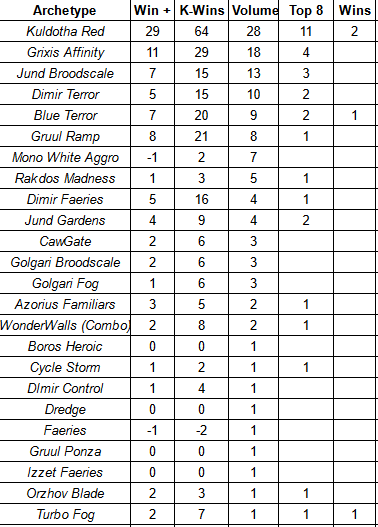
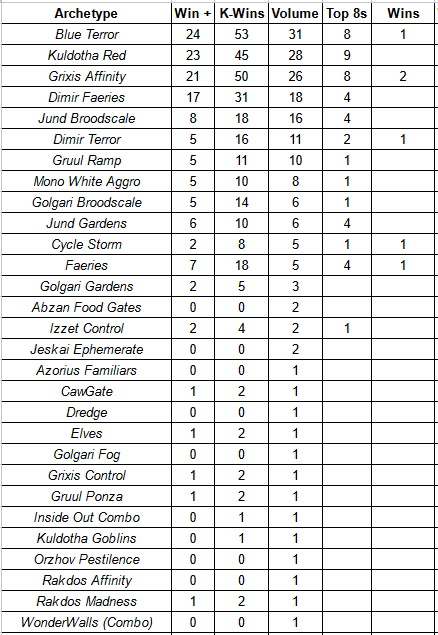
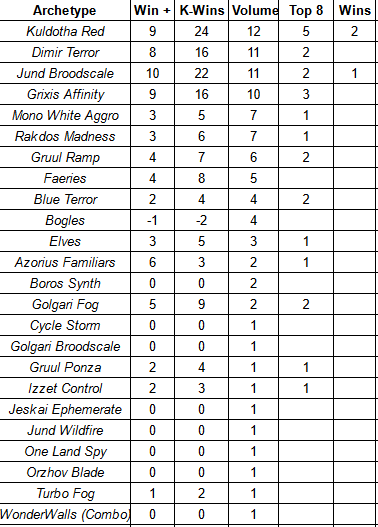
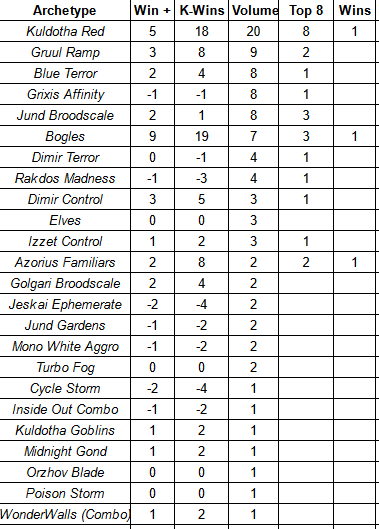
These numbers represent the first six challenge Top 32s of Bloomburrow season and one thing to note is the diversity in the most popular archetypes. Yes, Grixis Affinity is still chugging right along with 13.54% of the Top 32 metagame, but other macro archetypes are right there with the Machine, if not exceeding its volume.

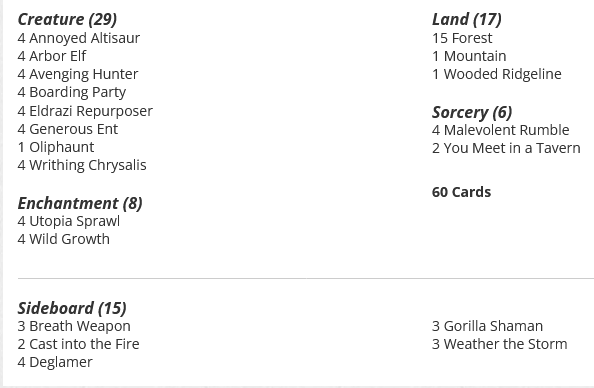
4 Annoyed Altisaur
4 Arbor Elf
4 Avenging Hunter
4 Boarding Party
4 Eldrazi Repurposer
15 Forest
4 Generous Ent
4 Malevolent Rumble
1 Mountain
1 Oliphaunt
4 Utopia Sprawl
4 Wild Growth
1 Wooded Ridgeline
4 Writhing Chrysalis
2 You Meet in a Tavern

Sideboard
3 Breath Weapon
2 Cast into the Fire
4 Deglamer
3 Gorilla Shaman
3 Weather the Storm

When I say “macro” archetype, in this instance I am not talking about the big buckets like aggro, control, midrange, and combo. Instead I’m using it in this specific instance to talk about decks based around somewhat similar cores and gameplans. A perfect example of this is Gruul Ponza and Gruul Ramp. These two decks have a lot in common, starting with their acceleration package of Arbor Elf and Utopia Sprawl. They both want to accelerate to a dominating endgame but Ponza as has a mana denial angle of attack and, until recently, was the more dominant execution of this core. Clearly that has change in recent weeks but Gruul Arbor Elf decks have made up 19.28% of the Top 32 metagame.

1 Azure Fleet Admiral
4 Brainstorm
4 Counterspell
1 Crimson Fleet Commodore
4 Galvanic Discharge
2 Lightning Bolt
4 Lórien Revealed
1 Lose Focus
3 Murmuring Mystic
2 Perilous Landscape
4 Ponder
2 Preordain
4 Skred
9 Snow-Covered Island
3 Snow-Covered Mountain
3 Spell Pierce
4 Tolarian Terror
1 Tune the Narrative
4 Volatile Fjord

Sideboard
3 Annul
2 Boomerang
2 Breath Weapon
1 Cast into the Fire
3 Gorilla Shaman
3 Pyroblast
1 Swirling Sandstorm

We can see something similar in Tolarian Terror decks. While Blue Terror, Dimir Terror, and Izzet Control all have different executions, these decks all push towards an endgame where they have the biggest threat left on the table. The biggest difference is how they are clearing a path. Combined these decks make up 23.44% of the Top 32 metagame.

4 Basking Broodscale
3 Bloodrite Invoker
4 Chromatic Star
4 Deadly Dispute
4 Duress
2 Energy Refractor
3 Eviscerator's Insight
4 Foreboding Landscape
5 Forest
4 Ichor Wellspring
4 Malevolent Rumble
4 Sadistic Glee
7 Swamp
4 Tamiyo's Safekeeping
2 Tree of Tales
2 Wizard's Rockets

Sideboard
2 Circle of Protection: Blue
4 Drown in Sorrow
2 Mesmeric Fiend
4 Snuff Out
3 Weather the Storm

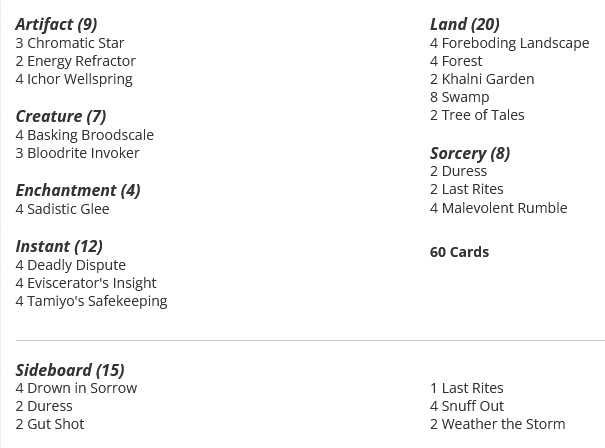
Wrapping up this group there’s Basking Broodscale combo. These decks come in two main camps – Golgari and Jund – but there’s a massive amount of variety, especially when it comes to ending the game. Still they all revolve around the same unbound loop of Basking Broodscale and Sadistic Glee providing an endless supply of Eldrazi Spawn, +1/+1 counters, and colorless mana. Combined these archetypes take up 18.76% of the Top 32 metagame.

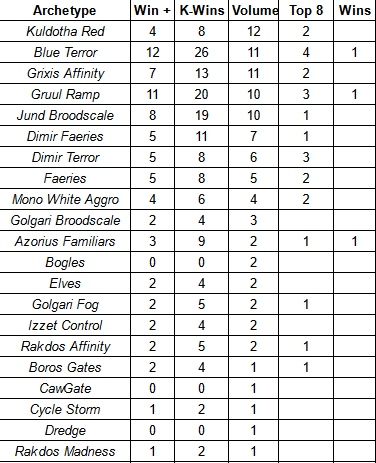
How does this translate to the Winner’s Metagame? Tolarian Terror decks lead the way with 21.3% of the Winner’s Meta share with Gruul Arbor Elf not far behind at 21%. Broodscale combo is next up with 18.37% with Grixis Affinity outside a medal finish at 12.63%. Again this pulls from a small sample size but right now Pauper centers around who can keep their big threats alive. It follows then that low-restriction removal spells has seen an uptick in play. It also makes sense that Elves has made a comeback.

2 Avenging Hunter
4 Birchlore Rangers
2 Elvish Mystic
2 Essence Warden
13 Forest
2 Fyndhorn Elves
4 Jaspera Sentinel
2 Lead the Stampede
2 Llanowar Elves
4 Nyxborn Hydra
4 Priest of Titania
4 Quirion Ranger
4 Timberwatch Elf
3 Vines of Vastwood
4 Wellwisher
4 Winding Way

Sideboard
2 Divest
4 Hallow
3 Masked Vandal
4 Mesmeric Fiend
2 Standard Bearer

Elves is a deck that, by all accounts, should struggle in Pauper. The bevy of efficient sweepers has kept the pointy eared army at bay for years at this point. But going wide has its advantages in a world full of point removal. The biggest innovation as of late is a mana sink that can win the game on its own in Nyxborn Hydra. Now Priest of Titania can do a fairly solid Timberwatch Elf impersonation, for at least one turn.

The metagame is still settling but moving forward I would want to ensure I have a way to stop Basking Broodscale while also holding Tolarian Terror and Writhing Chrysalis at bay. And this is to say nothing of being able to stop a horde of elves. A deck that can resolve a Pestilence early could go far, if it has the ability to follow that up with cards like Extract a Confession.

I want to take a moment to thank all my Patrons I am going to do my level best to keep providing you with the kind of content that brought you here in the first place. If you are interested in supporting my work, rewards for my Patreon start at just $1.

Can’t make a commitment to Patreon? I have a Ko-Fi where you can make a one time contribution.

Looking for another way to support my work? Click here for my TCGPlayer affiliate link. Any purchases through the link let the folks there know you like my content!
Broodscale Combo: Has Pauper Finally Found its Splinter Twin?

Today on ChannelFireball it’s a quick guide to Basking Broodscale Combo. Check it out here.

I want to take a moment to thank all my Patrons I am going to do my level best to keep providing you with the kind of content that brought you here in the first place. If you are interested in supporting my work, rewards for my Patreon start at just $1.

Can’t make a commitment to Patreon? I have a Ko-Fi where you can make a one time contribution.

Looking for another way to support my work? Click here for my TCGPlayer affiliate link. Any purchases through the link let the folks there know you like my content!
July 19-21 Pauper Weekend Recap

Want to learn more about the metrics I use in tracking the metagame? You can find an explainer here.

Oh yeah, I’m thinking I’m back.

But in all seriousness, this past weekend saw three Pauper Challenges take place on Magic Online. There was also a Showcase Qualifier but I am excluding that from this results summary mostly because it failed to reach a 32 player threshold. At five rounds the event would skew the data set to such a degree that I fear it would create more noise than information. All that being said the event did seem to lean a bit more on the assertive side of things which largely tracks with the wider trends we have seen in Pauper since the return of published data.

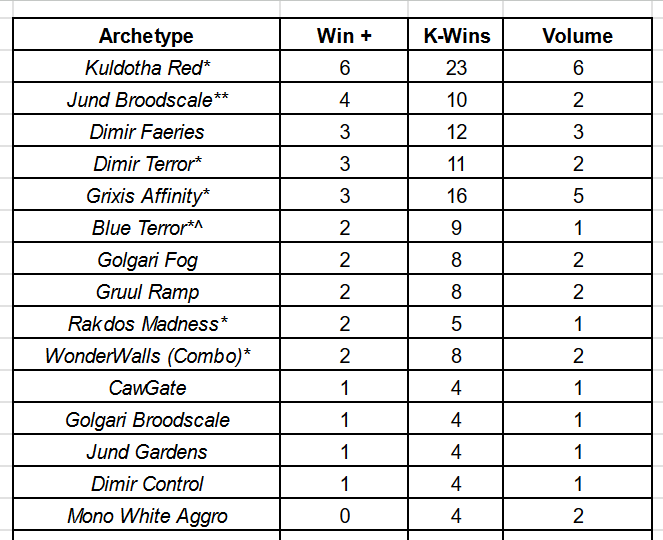
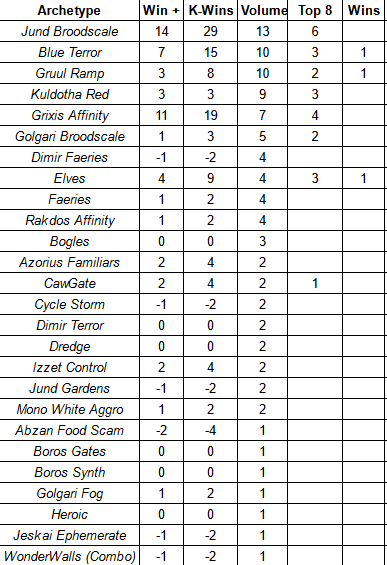
It is hard to talk about the current state of Pauper without bringing up the recent surge in Mono White Aggro. The deck has been a fringe contender for quite some time and apparently the final piece it needed was an above average removal spell in Thraben Charm. The deck wins by putting power and toughness onto the battlefield then using said stats to attack and block for the win. The deck is not “simple” but it is straightforward and the fact that it is experiencing this level of success is heartening as it relates to overall format health as it represents the first traditional aggro deck to experience such heights in quite some time. Last week Mono White had the third best Adjusted Meta Score Above Replacement at 0.86 but was the second most populous deck int he Winner’s Meta Share with 16.16%.

4 Brainstorm
4 Counterspell
4 Cryptic Serpent
4 Deem Inferior
2 Deep Analysis
4 Delver of Secrets
16 Island
4 Lórien Revealed
4 Mental Note
3 Ponder
3 Spell Pierce
4 Thought Scour
4 Tolarian Terror

Sideboard
4 Annul
4 Blue Elemental Blast
1 Dispel
4 Hydroblast
2 Sleep of the Dead

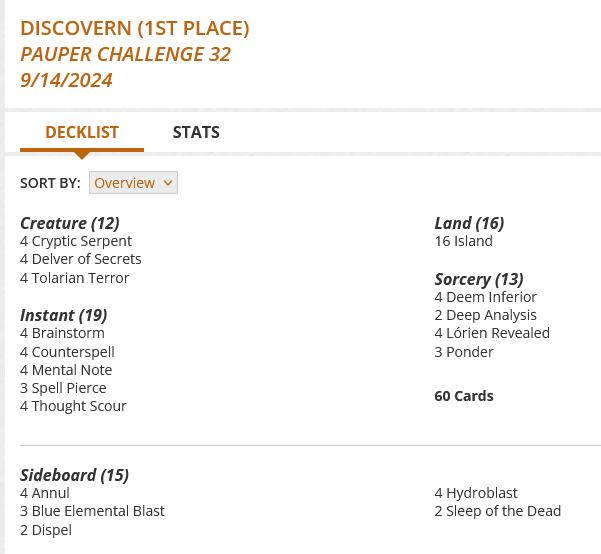
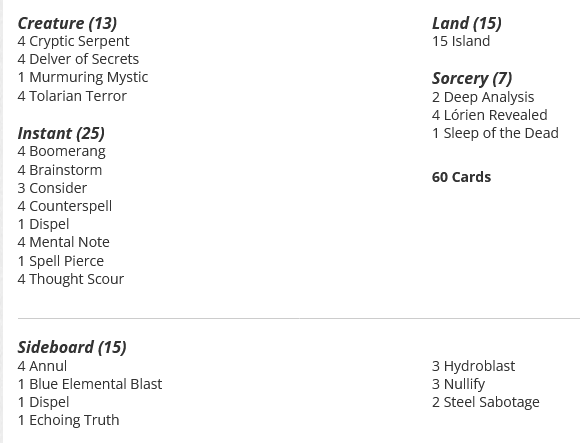
What deck topped the field in aMSAR? Blue Terror with an impressive 1.07 (and 13.58% of the Winner’s Meta Share). This strategy cemented itself as part of the Pauper metagame last year when Cryptic Serpent was downshifted in Commander Masters. Since then it has cycled in and out of the top tier but has always been a solid choice. The deck excels at presenting a real threat and backing it up with Counterspell, something that has been a tried and true path to victory for decades at this point. Like Mono White Aggro, Blue Terror also got a new spell from Modern Horizons 3 in the shape of Deem Inferior, which usually costs a single blue mana thanks to the abundance of cantrips. The ability to tuck an offending nonland permanent in pretty important as it can buy precious time against Basking Broodscale decks (amongst others).

3 Avenging Hunter
2 Bojuka Bog
4 Cast Down
3 Crypt Rats
4 Deadly Dispute
4 Defile
2 Duress
2 Fanatical Offering
1 Haunted Mire
4 Khalni Garden
4 Lembas
2 Reckoner's Bargain
2 Snuff Out
2 Spinning Darkness
11 Swamp
3 Thorn of the Black Rose
4 Tithing Blade
2 Troll of Khazad-dûm
1 Witch's Cottage

Sideboard
2 Drown in Sorrow
1 Duress
2 Fangren Marauder
2 Relic of Progenitus
4 Return to Nature
4 Weather the Storm

Grixis Affinity might have been the most popular deck in the Winner’s Meta Share (17.19%) and had the second best aMSAR (0.98) but instead of talking about Affinity again I want to discuss Golgari Gardens. This archetype had all but fallen off the radar in recent weeks, hardly making a dent in the first month of the Modern Horizons 3 cycle. After a solid showing last week it took another step up with 11.1% of the Winner’s Meta Share and an aMSAR score of 0.55. Given the abundance of decks that lean heavily on creatures – whether they are trying to attack or are components of a combo, it was only a matter of time before one of the best Snuff Out decks returned to prominence. In addition to the 10 copies of Gardens to make the Top 32 there were three Mono Black variants (that did touch other colors in the sideboard) with similar game plans that lacked the closing power provided by Avenging Hunter.

Where does that leave things looking ahead to next week? Pauper is in a pretty good spot right now, format health wise, and the reviews are glowing. Despite the continued strength of Affinity it is far from clear that the Machine is the best deck on a week to week basis. Things are constantly shifting and at times it feels as if anything can not only win, but experience some modicum of sustained success.

Coming off of last week where the shift towards black based removal strategies was somewhat expected, I anticipate movement towards more resilient threats. Cards like Sacred Cat laugh at a single Snuff Out while Sneaky Snacker is a persistent nuisance. If removal is going to be out in force then a deck that cares less about losing a singular threat seem like good choices. If it were me I would be looking at Orzhov builds that lean on Ephemerate and potentially go over the top with a card like Vampire Sovereign.

I want to take a moment to thank all my Patrons I am going to do my level best to keep providing you with the kind of content that brought you here in the first place. If you are interested in supporting my work, rewards for my Patreon start at just $1.

Can’t make a commitment to Patreon? I have a Ko-Fi where you can make a one time contribution.

Looking for another way to support my work? Click here for my TCGPlayer affiliate link. Any purchases through the link let the folks there know you like my content!
July 12-14 Pauper Weekend Recap

Want to learn more about the metrics I use in tracking the metagame? You can find an explainer here.

Hello there.

It’s been a while.

Now that the Magic Online decklists are back to being published, albeit in a reduced fashion, we can start exploring the Pauper metagame once again. While the lack of full Challenge lists is not ideal, the goal of this series has always been to look at the top of the Pauper metagame in an effort to understand what strategies are consistently performing well. The lack of complete data, while a hindrance, does not mean the end of analysis. Historically the analysis of the Top 32 I have done largely lines up with the format at large. That is not to say this is perfect information or is as robust as it was in week’s prior, but if you are looking for an understanding of competitive Pauper, I believe this remains a good place to start.

I have a set of Power Rankings going live on ChannelFireball this week but that article does not really take this last weekend into account. Still I don’t feel that it is too “Shhh, Spoilers” to tell you both Kuldotha Red and Grixis Affinity are near the top of my chart. Both decks remain popular options that can just get people dead. The closing power of Galvanic Blast cannot be understated – this card just gets people dead. Whether it is supported by the additional burn and Goblin Bushwhacker powered beats of Kuldotha Red or the slow grind of Refurbished Familiar and Blood Fountain in Affinity, Galvanic Blast decks continue to find themselves well positioned in Pauper.

That’s nothing new.

This weekend, however, showed off two interesting trends that might be worth exploring. With the full caveat that only two Challenges fired this weekend – the Friday and Saturday 32 player minimum events – I want to highlight two decks that made their presence felt.

4 Annoyed Altisaur
4 Arbor Elf
4 Avenging Hunter
4 Boarding Party
2 Cast into the Fire
1 Colossal Dreadmask
4 Eldrazi Repurposer
4 Generous Ent
1 Highland Forest
4 Malevolent Rumble
16 Snow-Covered Forest
1 Snow-Covered Mountain
4 Utopia Sprawl
3 Wild Growth
4 Writhing Chrysalis

Sideboard
3 Breath Weapon
1 Cast into the Fire
4 Deglamer
4 Gorilla Shaman
3 Weather the Storm

First, let’s talk about Gruul Ramp. This deck is not entirely new as players have been cutting the land destruction package from their Arbor Elf/Utopia Sprawl decks for quite some time. Last weekend only one such deck made the Top 8 and it decided to do its own thing instead of blowing up lands. Normally I would see this as an outlier but then similar decks, cutting the mana denial package, started to crop up in the Pauper League Results.

Gruul Ramp lacks the free wins that Thermokarst and Mwonvuli Acid-Moss provide. By cutting these cards, however, the deck no longer has dead draws in the late game or against any of the decks that are running Bridges as a significant part of their mana base – 26.56% of the Top 32 decks last weekend. The addition of Landscapes to decks also reduce the efficacy of land destruction as these cards can sit in play and help cast spells until a key moment. In exchange Ramp gets to run cards more tailored to specific metagames and increase its threat count. Whether this build overtakes Ponza in the long run remains to be seen, but I would be bullish on monsters over Stone Rains.

4 Battle Screech
3 Eagles of the North
3 Guardians' Pledge
2 Idyllic Grange
1 Journey to Nowhere
4 Kor Skyfisher
3 Lunarch Veteran
4 Militia Bugler
4 Novice Inspector
17 Plains
3 Prismatic Strands
4 Raffine's Informant
4 Thraben Charm
4 Thraben Inspector

Sideboard
4 Dust to Dust
2 Journey to Nowhere
3 Lone Missionary
1 Prismatic Strands
3 Revoke Existence
2 Standard Bearer

Mono White Aggro is not a new deck and has been putting up sporadic results for quite some time. The deck got a huge shot in the arm with Thraben Charm which helps to give the strategy more flexibility. Now it can pack creature removal and graveyard interaction all into one card, while also having a maindeck out to Makeshift Munitions. Mono White also excels at leveraging Prismatic Strands as both an offensive and defensive weapon and Raffine’s Informant gives the deck an easy way to get it into the graveyard. Battle Screech and Guardians’ Pledge can end games and between eight copies of Inspector effects and Militia Bugler, the cards flow with ease.

Mono White had the best Adjusted Meta Score above replacement this weekend with a robust 1.70. Now this comes with a fairly big caveat of only two such decks made the Top 32 all weekend (although both ended up in the Top 8 and one won the Saturday Challenge). Grixis Affinity had a solid 0.68 with Kuldotha Red bringing home the bronze with 0.44. For a weekend with relatively few data inputs this metric is not the best. So what happens when we look at winner’s metagame share?

Kuldotha Red leads the way by a significant margin with a robust 23.04% of the winner’s meta (down from 28.13% of total volume). Grixis Affinity clocks in at 16.54% (up from 15.63% of the Top 32 field) while Mono White’s winner’s share was 12.42%, almost doubling it’s 6.25% Top 32 volume.

There is, of course, something else going on in Pauper. The era of Modern Horizons 3 is the best by creature based combo decks in a way that hasn’t been seen in quite some time. The first four weeks of the cycle had the combo version of WonderWalls perform at an incredible clip – it had the second best AMSAR for the month at 0.56 – while Inside Out Combo put up solid results as well. The other story is Basking Broodscale combo. When paired with Sadistic Glee the lizard creates an unbound loop which can kill in all manner of ways from Makeshift Munitions to Nadier’s Nightblade to an attack with Haunted Cloak. None of these decks lean on the graveyard the way Goblin Combo has in the past and are somewhat resilient to the readily available board wipes.

4 Basking Broodscale
3 Bloodrite Invoker
4 Chromatic Star
2 Darkmoss Bridge
4 Deadly Dispute
4 Duress
2 Energy Refractor
3 Eviscerator's Insight
2 Foreboding Landscape
4 Forest
2 Haunted Mire
4 Ichor Wellspring
2 Implement of Ferocity
4 Malevolent Rumble
4 Sadistic Glee
2 Snakeskin Veil
6 Swamp
2 Tamiyo's Safekeeping
2 Tree of Tales

Sideboard
3 Drown in Sorrow
2 Mesmeric Fiend
4 Snuff Out
2 Tamiyo's Safekeeping
4 Weather the Storm

So next week I would recommend running a deck that can fully leverage Snuff Out. While a single removal spell is not going to be able to beat all the top decks and lingering combo builds, Snuff Out remains an incredibly powerful card that currently lacks a competitive home (only one Golgari Gardens deck made the Top 32 last weekend and it had 2.04% of the Winner’s Metagame over the first four weeks). Gardens may not be the most well positioned deck for the upcoming week but playing a heavy removal Orzhov or Dimir deck isn’t totally outside the bounds of what is reasonable.

I want to take a moment to thank all my Patrons I am going to do my level best to keep providing you with the kind of content that brought you here in the first place. If you are interested in supporting my work, rewards for my Patreon start at just $1.

Can’t make a commitment to Patreon? I have a Ko-Fi where you can make a one time contribution.

Looking for another way to support my work? Click here for my TCGPlayer affiliate link. Any purchases through the link let the folks there know you like my content!
June 14-16 Pauper Weekend Recap

Want to learn more about the metrics I use in tracking the metagame? You can find an explainer here.

Modern Horizons 3 is finally here! While some players meet these sets with a sense of trepidation, especially for what they do to established formats, I find them exciting in how much change they can catalyze. The infusion of power cards help to push the metagame and new and different directions which, at least at the start of the process, is novel. The issues arise when whatever is new is so powerful that it obsoletes everything that came before without bearing a passing resemblance to that same era.

At the same time, formats need to evolve and adapt. Sometimes decks simply loose their luster and there is very little that can be done to return them to the spotlight. Stompy is a great example of this phenomena. Once a format staple due to how its threats lined up with the metagame, the mono green deck has fallen on hard times due in part to the power creep in other cards but also due to how the deck’s avenue of attack doesn’t mesh with the latest traffic pattern in Pauper.

Back to the story at hand. So while what the latest iteration of Modern Horizons‘ impact might not be fully known, the weekend of the set’s debut has certainly provided Pauper with some interesting points of information. In some ways the first set of Challenges met expectations and in at least one way caught people just a bit off guard.

Across the three Challenges that took place this weekend, Grixis Affinity was the most popular archetype (23 total appearances out of 179 entrants; 12.85%). Bogles placing second (18 total appearances, 10.06%) was a bit of a surprise but once you look a bit deeper it starts to make sense.

3 Blood Fountain
1 Chromatic Star
4 Deadly Dispute
2 Drossforge Bridge
4 Galvanic Blast
4 Great Furnace
4 Ichor Wellspring
2 Krark-Clan Shaman
1 Makeshift Munitions
1 Metallic Rebuke
3 Mistvault Bridge
4 Myr Enforcer
2 Nihil Spellbomb
3 Reckoner's Bargain
4 Refurbished Familiar
4 Seat of the Synod
2 Silverbluff Bridge
4 Sneaky Snacker
4 Thoughtcast
4 Vault of Whispers

Sideboard
4 Blue Elemental Blast
1 Chainer's Edict
2 Gorilla Shaman
1 Krark-Clan Shaman
1 Negate
1 Nihil Spellbomb
4 Red Elemental Blast
1 Tithing Blade

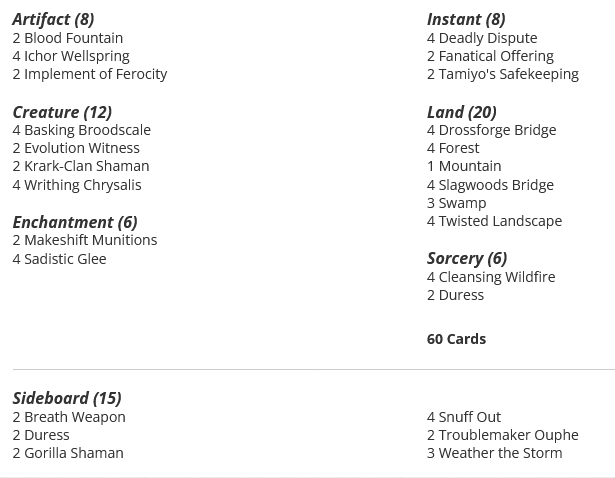
Let’s start with Grixis Affinity. Going into Modern Horizons 3 this was the deck at the forefront of the discourse. The latest iteration of a dedicated Artifact Land deck, Grixis Affinity operates as a control deck and instead of applying pressure early (with cards that have since been banned), Grixis wants to drag out the game so it can win by recurring threats with Blood Fountain or setting up a situation where Makeshift Munitions can handle those final life points by throwing Bridges at people. The prevailing narrative going into the weekend was that, thanks to Refurbished Familiar Sneaky and Snacker the deck had achieved Tier Zero status. The early returns in the League backed up this claim before the deck’s trophy count fell off.

Now it could very well be true that the sheer amount of hate being packed for Affinity – Dust to Dust, Deglamer, Gorilla Shaman, Ancient Grudge, and more – could be holding the deck back. However even when players were packing significant hate for previous decks to be decried at Tier Zero (Glitter Affinity, Red with Swiftspear), those decks still managed to pad their trophy chest and have strong performances in the Challenges. The current builds of Affinity have yet to display this sort of stickiness in the face of a prepared metagame. Whether this settles into a healthy cycle remains to be seen but it is something I’m keeping my ever-hopeful eye upon.

4 Abundant Growth
4 Ancestral Mask
4 Armadillo Cloak
2 Ash Barrens
2 Cartouche of Solidarity
4 Ethereal Armor
11 Forest
4 Gladecover Scout
1 Khalni Garden
1 Lifelink
4 Malevolent Rumble
3 Plains
4 Rancor
4 Silhana Ledgewalker
4 Slippery Bogle
4 Utopia Sprawl

Sideboard
2 Crimson Acolyte
2 Flaring Pain
3 Relic of Progenitus
2 Spirit Link
2 Standard Bearer
2 Tamiyo's Safekeeping
2 Young Wolf

Bogles is a deck I didn’t really put a ton of stock in moving into the latest release cycle. The deck tends to perform well in new metagames as people adjust their removal but I was completely caught off guard by how good Malevolent Rumble is in the builds. Rumble digs towards everything that Bogles wants – lands, creatures, or auras – all why providing a piece of fodder to feed to Tithing Blade and the like. The fact that it also leaves behind a body which can wear auras, albeit without the protection inherent in the deck’s namesake, helps to increase the overall consistency of the deck. While it is only one weekend, Bogles was hte most popular deck in the Top 32 (up to 13.52% of the latter), before dipping to 11.53% of the winner’s metagame with an Adjusted Metascore Above Replacement of 0.54. By comparison, Affinity dropped to 10.42% of the Top 32 metagame with a winner’s share of 7.12%. It also pulled in with an aMSAR of -0.09, meaning it performed slightly worse than average in the Top 32.

4 Ancient Den
1 Bojuka Bog
4 Cast Down
4 Fanatical Offering
4 Glint Hawk
4 Goldmire Bridge
4 Inspiring Overseer
4 Kor Skyfisher
4 Novice Inspector
2 Okiba-Gang Shinobi
1 Omen of the Dead
3 Orzhov Basilica
3 Plains
4 Refurbished Familiar
1 Swamp
1 Thraben Charm
4 Thraben Inspector
4 Tithing Blade
4 Vault of Whispers

Sideboard
2 Dawnbringer Cleric
4 Dust to Dust
3 Nihil Spellbomb
4 Revoke Existence
2 Suffocating Fumes

So what deck led the way? Why Orzhov Blade. It has an impressive aMSAR of 1.31 and gained share with each narrowing of our scope. Ten appearances means 5.59% of the total metagame, with six of those decks making the Top 32 (6.25%) and an impressive 9.86% of the winner’s metagame. It also closed the weekend with three Top 8 finishes, tying Bogles in that regard. These decks are adept at recycling enters-the-battlefield triggers and Refurbished Familiar is a natural fit, especially for a deck that wants to grind out small advantages turn after turn.

Even though these strategies did not perform exceptionally well, I want to point out the development in the Arbor Elf/Utopia Sprawl decks. These decks have made great use of current bane of limited Writhing Chrysalis, which slots in perfectly to play defense until it can turn sideways, all while providing more mana for expensive late game spells. Some of these builds have moved away from land destruction, instead opting to focus entirely on a proactive metagame and so these archetypes have been split into Ponza (mana denial) and Ramp (accelerated endgame) buckets. This is absolutely going to be an archetype to watch moving forward and I am interested to see where the lists settle.

4 Annoyed Altisaur
4 Arbor Elf
4 Avenging Hunter
4 Boarding Party
4 Eldrazi Repurposer
2 Highland Forest
3 Malevolent Rumble
4 Mwonvuli Acid-Moss
16 Snow-Covered Forest
4 Thermokarst
4 Utopia Sprawl
3 Wild Growth
4 Writhing Chrysalis

Sideboard
2 Breath Weapon
1 Cast into the Fire
4 Deglamer
2 Gorilla Shaman
3 Relic of Progenitus
3 Weather the Storm

As for next week I fully expect Bogles, Ramp, and Orzhov to be at the top of everyone’s mind (with Tolarian Terror decks not far behind). Extract a Confession seems like where you want to be for Edict style removal and as a result Basilisk Gate starts to look like an attractive option. Or you could just copy Gabriel Nassif’s deck from the Creator Showcase and run Boros Bully, which hasn’t gained any new cards (EDIT: I missed the two copies of Thraben Charm in my review of the list; my mistake) but appears to be well positioned against the rest of the meta, at least for this week.

Power Rankings
  • 10: Mono White Aggro
  • 9: Kuldotha Red
  • 8: Gruul Ramp/Ponza
  • 7: Grixis Affinity
  • 6: CawGate
  • 5: Goblin Combo
  • 4: Rakdos Madness
  • 3: Blue Terror
  • 2: Bogles
  • 1: Orzhov Blade

I want to take a moment to thank all my Patrons I am going to do my level best to keep providing you with the kind of content that brought you here in the first place. If you are interested in supporting my work, rewards for my Patreon start at just $1.

Can’t make a commitment to Patreon? I have a Ko-Fi where you can make a one time contribution.

Looking for another way to support my work? Click here for my TCGPlayer affiliate link. Any purchases through the link let the folks there know you like my content!
June 7-9 Pauper Weekend Recap

Want to learn more about the metrics I use in tracking the metagame? You can find an explainer here.

Outlaws of Thunder Junction season is drawing to a close. The final four weeks of the cycle took place without All That Glitters hanging over the format’s collective head. Last week we looked at three weeks worth of events but today we’re going to focus on the final weekend with it’s three Challenges and one Showcase Qualifier. A final review will be coming in the not too distant future but for now I want to explore this weekend in isolation.

Why explore four tournaments, separate from the rest of the season, especially with a high impact set coming down the pike? Pauper, traditionally, has evolved slowly. Even when strong cards are added the first implementations of the new options often come in existing shells. On top of that while Modern Horizons sets have caused shifts in the landscape they have done so in ways that were built upon Pauper’s history: Arcum’s Astrolabe fit neatly into existing Tron and Kor Skyfisher shells before taking on a life of its own; the Bridges slotted in alongside the Mirrodin Artifact Lands; Chatterstorm and Galvanic Relay looked to previous Storm shells. The cards in Modern Horizons 3 are powerful and could spawn entirely new archetypes. At the same time there’s a very good chance that in Week 1 we are going to see Refurbished Familiar brought back with Blood Fountain or blinked with Ephemerate in decks that are otherwise known.

The weekend of June 7-9 saw three Challenges as well as a massive (for Pauper) 203 player Showcase Qualifier. All told there were 383 entrants that played at least one round in these tournaments. Kuldotha Red was the most popular deck on the weekend with 63 total appearances, accounting for 16.45% of the entire field. CawGate took silver in the popularity contest with 47 total appearances, good for 12.27% of the total metagame. Grixis Affinity also ended up on the podium with 29 total appearances (7.57%), barely beating out Gruul Cascade (28 appearances/7.31%) and Rakdos Madness (27/7.05%).

Moving into next week the top three decks should be on everyone’s radar. Kuldotha Red continues to set the pace for Pauper and while the latest release does not provide any clear additions, the fact remains that red isn’t getting worse. Getting on board early with a bevy of small creatures, only to turn them sideways later after kicking Goblin Bushwhacker, all while backed up with Galvanic Blast, remains a great way to win games. It’s possible Sarpadian Simulacrum supplants Voldaren Epicure as an artifact that turns on Kuldotha Rebirth while also being the correct creature type for Goblin Grenade, giving the deck a small boost in the synergy camp.

When it comes to the Top 32 metagame, Kuldotha Red moves into second place with 12.5% of the total Top 32 meta, 13.04% of the winner’s meta, and an Adjusted Meta Score Above Replacement of 1.16. Kuldotha Red performed admirably and took a reasonable dip in presence with the cut to the Top 32. The winner, however, was CawGate. In the same number of Top 32 appearances it ended up with 14.2% of the winner’s metagame and an aMSAR of 1.52.

4 Azorius Guildgate
4 Basilisk Gate
4 Brainstorm
4 Citadel Gate
4 Counterspell
1 Dispel
1 Glacial Floodplain
2 Guardian of the Guildpact
1 Heap Gate
3 Island
3 Journey to Nowhere
3 Lórien Revealed
2 Outlaw Medic
4 Preordain
3 Prismatic Strands
4 Sacred Cat
4 Sea Gate
1 Spell Pierce
4 Squadron Hawk
4 The Modern Age

Sideboard
1 Blue Elemental Blast
4 Dust to Dust
1 Flaring Pain
4 Hydroblast
4 Pyroblast
1 Relic of Progenitus

CawGate is a midrange control deck that leverages the interaction between Brainstorm and Squadron Hawk (not to mention Lórien Revealed) to increase the overall quality of the cards in its hand. Its light permission suite is designed to ensure you can end the game with an evasive creature enhanced by Basilisk Gate. It is the quintessential blue midrange deck in Pauper, plodding along as a reasonable choice, often positioning itself thanks to a flexible mana base and sideboard. Basilisk Gate is a resilient threat that just requires a creature to get the ball rolling. CawGate does not have any clear gains from the latest set, but a card like Perilous Landscape could find a home if new builds desire a more reliable splash or want another shuffle effect while not missing out on mana development.

4 Annoyed Altisaur
4 Arbor Elf
4 Avenging Hunter
4 Boarding Party
1 Crimson Fleet Commodore
4 Generous Ent
1 Highland Forest
4 Llanowar Visionary
4 Mwonvuli Acid-Moss
2 Reclaiming Vines
16 Snow-Covered Forest
1 Snow-Covered Mountain
4 Thermokarst
4 Utopia Sprawl
3 Wild Growth

Sideboard
3 Breath Weapon
4 Deglamer
1 Fiery Cannonade
2 Gorilla Shaman
2 Relic of Progenitus
3 Weather the Storm

Although it did not have the best numbers on the weekend, Gruul Cascade (or something similar) is likely to flood the queues in the early going. 7.31% of the overall metagame is nothing to sneeze at, it dipped to 6.25% of the Top 32 metagame, dropping further to 4.1% of the Winner’s Metagame, ending up with a -0.17 aMSAR. So why am I bullish on this strategy? First, it won the Super Qualifier which always provides a small boost in popularity. Second, green ramp strategies are getting a gift in Colossal Dreadmask. A six drop that ca turn any old Arbor Elf into a real threat is attractive. Couple this with Horrific Assault, which might be a reason to return to Ulamog’s Crusher, and you get a strategy poised to run over the competition in the early going.

Going into next weekend, if I wasn’t keen on bringing something new, I’d be bringing Ethereal Armor to the party. Both Bogles and Heroic have been on the upswing recently (even if they are still mired in the scrum around the Top 32). These decks are getting a few new options thanks to new creatures with Bestow, as well as a focus on cards caring about Modified creatures and some neat combat tricks. On top of all this these decks are very good at applying pressure and you have a mix that is ripe for these strategies to have a strong showing.

I want to take a moment to thank all my Patrons I am going to do my level best to keep providing you with the kind of content that brought you here in the first place. If you are interested in supporting my work, rewards for my Patreon start at just $1.

Can’t make a commitment to Patreon? I have a Ko-Fi where you can make a one time contribution.

Looking for another way to support my work? Click here for my TCGPlayer affiliate link. Any purchases through the link let the folks there know you like my content!

Outlaws of Thunder Junction Check In

Pauper in a Post-All That Glitters World

Want to learn more about the metrics I use in tracking the metagame? You can find an explainer here.

It feels like I haven’t checked in on the format in a while. As it so happens the past few weeks have been incredibly busy for me, with a previously scheduled medical procedure (I’m fine!), childcare responsibilities (I’m exhausted!) and the reveal of Modern Horizons 3 (I need to finish my set review!). Because of this temporal reality we now have ten Challenge level events in the post-All That Glitters metagame, so what better time to do a check in? As per usual we are going to be looking at the total Challenge metagame, the Top 32 Metagame, and the Winner’s Metagame.

This chart takes into account all 656 decks that played at least one round in one of the events over the past three weeks. The cut off for making the chart is 2%, with 14 total appearances netting 2.13% of the total meta. There were 35 different archetypes that did not meet this threshold.

3 Blood Fountain
2 Cast Down
1 Chromatic Star
4 Deadly Dispute
3 Drossforge Bridge
1 Extract a Confession
2 Frogmite
2 Galvanic Blast
2 Gearseeker Serpent
2 Great Furnace
4 Ichor Wellspring
2 Kenku Artificer
2 Krark-Clan Shaman
1 Makeshift Munitions
1 Metallic Rebuke
3 Mistvault Bridge
4 Myr Enforcer
2 Nihil Spellbomb
4 Reckoner's Bargain
4 Seat of the Synod
3 Silverbluff Bridge
1 Swamp
4 Thoughtcast
3 Vault of Whispers

Sideboard
1 Breath Weapon
1 Extract a Confession
2 Gorilla Shaman
3 Hydroblast
2 Negate
4 Pyroblast
2 Unexpected Fangs

If you have been following Pauper over the past few months it should not be surprising that Grixis Affinity and Kuldotha Red are the two most popular decks in the format at the moment. Red was a powerful strategy before the recent ban and while it was possible that the lack of another aggressive strategy could mean an increase in hate for red, it hasn’t put a damper on how many people are eager to sleeve up Mountain and Great Furnace. This is not misplaced belief as Red largely holds up as you look at the meta from other angles, with 12.81% of the Top 32 Metagame and 11.77% of the Winner’s Metagame. Kuldotha Red is currently tied for 4th/5th in Adjusted Meta Score Above Replacement with a score of 0.57.

Grixis Affinity is a powerful control deck that leverages the Affinity and Metalcraft mechanics for undercosted threats, interaction, and card draw. Prior to the introduction of All That Glitters it was a top tier archetype that took a step back once people began to apply pressure early and often with copies of Gingerbrute wearing fancy pants. Without the threat of imminent doom it became reasonable for Affinity to grind out the game with Blood Fountain again, perhaps benefiting from the drop in artifact specific hate in the wake of the format update. While Grixis had a fantastic weekend May24-26 it came back to early last weekend, which could indicate that people are putting respect on the Grixis name. Like Red, Grixis largely held true to its 12.2% Challenge Metagame with 12.81% of the Top 32 Meta, ticking up to 13.36% of the Winner’s Metagame. Through these three weeks Grixis is leading the pack with an aMSAR of 1.06.

Not every strategy held true between the overall field and the cutoff to the Top 32. Golgari Gardens, for example, saw a decent increase from 5.79% of the larger sample to 8.56% of the Top 32 Metagame. These gains were not reflected in the Winner’s Metagame, dropping back to 5.25% of that sample with an aMSAR of 0.10 (ninth best through this point). Blue Terror, on the other hand, held steady from Total Metagame (4.57%) to Top 32 metgame (5%) but, thanks to a fantastic weekend May 31-June, jumped to 8.17% of the Winner’s Metgame. Also on the back of the last weekend of results (five Top 8 finishes with a win), it holds the second best aMSAR with 1.01.

4 Boomerang
4 Brainstorm
2 Consider
4 Counterspell
4 Cryptic Serpent
2 Deep Analysis
4 Delver of Secrets
2 Force Spike
4 Lórien Revealed
4 Mental Note
1 Murmuring Mystic
15 Snow-Covered Island
2 Spell Pierce
4 Thought Scour
4 Tolarian Terror

Sideboard
1 Blue Elemental Blast
1 Deep Analysis
2 Dispel
2 Hoodwink
4 Hydroblast
2 Jace's Phantasm
1 Lose Focus
1 Murmuring Mystic
1 Steel Sabotage

Blue Terror was not the only deck with five Top 9s and win last weekend. CawGate achieved the same results. A more popular deck with 9.76% of the Challenge Meta, the strategy jumps up to 11.56% of the Top 32 Metagame before coming back to the pack just a bit with 10.66% of the Winner’s Metgame. It falls just behind Kuldotha Red (and Jeskai Ephemerate) with an aMSAR of 0.56.

There’s one more deck I want to call out and that is Gruul Cascade. This deck, built around accelerating out copies of Mwonvuli Acid-Moss and Annoyed Altisaur, was hardly a blip during the All That Glitters era. The strategy went from 2.61% of the pre-ban Thunder Junction meta to 5.79% over the past three weeks. This jumps to 6.88% of the Top 32 Metagame (up from 1.17% before the ban) and another step up to 7.26% of the Winner’s Metagame (a massive leap from 0.84%). Arbor Elf might not be the best thing you can be doing in Pauper these days but it is a much more reasonable option these days.

4 Annoyed Altisaur
4 Arbor Elf
4 Avenging Hunter
4 Boarding Party
1 Crimson Fleet Commodore
16 Forest
4 Generous Ent
1 Highland Forest
3 Jewel Thief
3 Llanowar Visionary
1 Mountain
4 Mwonvuli Acid-Moss
4 Thermokarst
4 Utopia Sprawl
3 Wild Growth

Sideboard
3 Breath Weapon
1 Cast into the Fire
4 Deglamer
1 Gorilla Shaman
3 Relic of Progenitus
3 Weather the Storm

What does this mean moving forward and towards Modern Horizons 3? The metagame, overall, is far less stratified than it was previously. As a result being able to correctly predict the subtle shifts in top tiers will work to your advantage. For example, players adjusted for Affinity after the weekend of May 24-26 in deck choice and sideboard options and the deck took a massive step back. If this trend holds true then next week should see people attempt to beat back Blue Terror and CawGate, which means an emphasis on Tithing Blade and similar spells, which in turn can create a window for Dimir Faeries or Kuldotha Red to have a strong performance.

Power Rankings
  • 10: Dimir Faeries
  • 9: Izzet Control
  • 8: Golgari Gardens
  • 7: Gruul Cascade
  • 6: Jeskai Ephemerate
  • 5: CawGate
  • 4: Goblin Combo
  • 3: Blue Terror
  • 2: Kuldotha Red
  • 1: Grixis Affinity

I want to take a moment to thank all my Patrons I am going to do my level best to keep providing you with the kind of content that brought you here in the first place. If you are interested in supporting my work, rewards for my Patreon start at just $1.

Can’t make a commitment to Patreon? I have a Ko-Fi where you can make a one time contribution.

Looking for another way to support my work? Click here for my TCGPlayer affiliate link. Any purchases through the link let the folks there know you like my content!

May 17-19 Pauper Weekend Recap

Want to learn more about the metrics I use in tracking the metagame? You can find an explainer here.

We’re back!

Did anything happen?

Jokes aside, Pauper is entering an interstitial moment. All That Glitters is gone and Modern Horizons 3 is not yet here. The format exists in a metagame that is, for all intents and purposes, entirely temporary. While we can examine the data from this past weekend’s three Challenges to anticipate what Friday (and Saturday and Sunday) may bring. Attempting to prognosticate past June 14th is a waste of brain cells as the next direct to Modern release is all but guaranteed to shake things up (if history is any indication).

Here we have the overall Challenge metagame. Across the three events there were 163 entrants who played at least one round and aside from the absence of Glitter Affinity the metagame looks remarkably familiar. Kuldotha Red was the most popular archetype but hardly a dominant force by way of presence; Golgari Gardens managed to adjust quickly enough to maintain its position in the metagame.

There are a few things that stand out to me about this chart. First is the return of Gruul Cascade. This deck has been all but absent in the All That Glitters metagame which makes sense. A key play pattern of this deck is taking the opponent off of resources but when a top deck can operate on effectively no lands then this style of strategy can fall flat. The other element that really caught my eye was the relative meager showing of Grixis Affinity. The go-to Affinity deck before Commander Masters dropped off in a dramatic fashion once the aggressive builds came to bear, but it seems that for the time being people are shying away from such dedicated builds.

The Top 32 metagame has its own story to tell. Golgari Gardens had a strong performance once it reached the Top 8 but the strategy was more likely to end up outside the Top 16. Kuldotha Red fared better but not as well (albeit in limited sample size) as Dimir Faeries and Goblin Combo. And now we come to the rub about next week.

Given the relatively small sample size from last weekend, as well as the recent changes to the format, it is hard to pull too much information from the most recent trio of Challenges. The metagame in many ways looks entirely similar to the one we saw prior to the ban with the absence of Glitters pushing aggressive strategies down the ladder. Instead we are seeing a proliferation of combo and midrange decks. What can be extrapolated from this?

Next week I would want to be on a control deck. Counterspell and its ilk look incredibly well positioned at the moment, but housing it in a more reactive shell appears to be better. Outside of Kuldotha Red nothing is trying to kill you quickly. Trying to be a hair larger than midrange with an increased emphasis on interacting seems like a good place to be, especially if your opponents are trying to rely on that one key spell to ether things done.

I want to take a moment to thank all my Patrons I am going to do my level best to keep providing you with the kind of content that brought you here in the first place. If you are interested in supporting my work, rewards for my Patreon start at just $1.

Can’t make a commitment to Patreon? I have a Ko-Fi where you can make a one time contribution.

Looking for another way to support my work? Click here for my TCGPlayer affiliate link. Any purchases through the link let the folks there know you like my content!

May 3-5 Pauper Weekend Recap

Want to learn more about the metrics I use in tracking the metagame? You can find an explainer here.

Today’s post would not have been possible a few months ago. It is only recently that Daybreak games has decided to provide the decklists for every Challenge participant, which provides a more robust image of what actually is going on in Pauper. At the same time while more information is a good thing, the data still needs to be put into context. Let’s take this past weekend’s Challenge meta breakdown.

At first glance this does not look like a healthy metagame. Over 20% of the entire weekend Challenge metagame (49 decks out of 231 entrants) were Kuldotha Red. Coming off of a year dominated by Monastery Swiftspear and friends this is a disconcerting sight. Even if the Monk is banned the deck is still a force to be reckoned with as it can go under many other strategies while also putting a ton of damage on the board between Kuldotha Rebirth and Goblin Bushwhacker. Kuldotha Red also benefits from the positioning of Electrickery and Breath Weapon against All That Glitters. This is not trying to take anything away from the strength of Red but again, context matters.

4 Chain Lightning
4 Experimental Synthesizer
4 Galvanic Blast
4 Goblin Blast-Runner
4 Goblin Bushwhacker
4 Goblin Tomb Raider
4 Great Furnace
4 Implement of Combustion
4 Kuldotha Rebirth
4 Lightning Bolt
13 Mountain
3 Reckless Lackey
4 Voldaren Epicure

Sideboard
4 End the Festivities
3 Gorilla Shaman
2 Pyroblast
2 Red Elemental Blast
2 Relic of Progenitus
2 Smash to Smithereens

What happens when you look at the Top 32 metagame? Kuldotha Red takes a step backwards to 18.75% of that population. Going deeper and examining the Winner’s Metagame, Kuldotha Red tanks to 12.76%. While the deck is flooding the field it is not performing well relative to its performance. While it’s conversion rate from overall Challenge to Top 32 is reasonable, once it gets past that threshold the deck is largely pedestrian. Kuldotha Red’s weekend Adjusted Meta Score Above Replacement came in at 0.09, placing its performance as a hair above average.

Using Adjusted Meta Score Above Replacement as our barometer, the best performing deck on the weekend was CawGate with a healthy 1.20 aMSAR score. CawGate only took down 4.76% of the overall metagame and improved upon this to 5.47% of the Top 32 metagame. Looking at the Winner’s Meta we see a decent jump to a share of 8.5%. The addition of Outlaw Medic provides a decent blocker and way to pad your life total. In a world so focused on aggression the ability to not only block but also to crunch in for massive lifelink swings thanks to Basilisk Gate counts for quite a bit.

1 Azorius Guildgate
4 Basilisk Gate
3 Brainstorm
4 Citadel Gate
4 Counterspell
2 Destroy Evil
1 Dispel
2 Guardian of the Guildpact
2 Heap Gate
1 Idyllic Beachfront
3 Island
3 Journey to Nowhere
4 Lórien Revealed
2 Outlaw Medic
1 Plains
3 Preordain
4 Prismatic Strands
4 Sacred Cat
4 Sea Gate
4 Squadron Hawk
4 The Modern Age

Sideboard
3 Blue Elemental Blast
3 Breath Weapon
4 Pyroblast
3 Relic of Progenitus
2 Remove Soul

So does that mean CawGate had the best overall weekend? That is not so clear. Boros Glitters can make a case. Looking at the three metagame shares it starts with 6.93% of the total meta before improving to 9.38% of the Top 32 meta and finishing off with 10.93% of the Winner’s Meta. A weekend silver medal with an aMSAR of 0.79 places this beatdown deck firmly in the “above average” camp, which should come as no surprise if you’ve played Pauper over the past few months. Boros Glitters is the premier All That Glitters deck at the moment and can effectively win from nowhere by maneuvering a game to a point where a top-decked Aura will end things on one swing.

4 All That Glitters
3 Ancient Den
1 Barbed Batterfist
2 Boros Garrison
1 Dawnbringer Cleric
4 Experimental Synthesizer
4 Galvanic Blast
4 Glint Hawk
3 Great Furnace
4 Kor Skyfisher
3 Lembas
4 Lightning Bolt
1 Makeshift Munitions
2 Mountain
4 Novice Inspector
4 Plains
3 Rustvale Bridge
4 Thraben Inspector
3 Wedding Invitation
2 Wind-Scarred Crag

Sideboard
2 Dawnbringer Cleric
3 Destroy Evil
2 Electrickery
2 Gorilla Shaman
2 Red Elemental Blast
4 Relic of Progenitus

There are plenty of other interesting tidbits from last weekend. Dimir Faeries led the way with five total Top 8 appearances but largely performed to expectations across the three metas (total, Top 32, Winner’s). Dimir Faeries’ 0.12 aMSAR places it as above a replacement level entry but lagging behind other strategies. Out of the four archetypes that won a Challenge only CawGate can lay claim to having the best weekend but Golgari Gardens is not far behind, improving over three percentage points from total meta with Winner’s Meta and ending up with an aMSAR of 0.46.

So where does that leave things going into next weekend? At a surface level you need to be prepared for aggression from both the “go-wide” of Kuldotha Red and the “go-tall” of All That Glitters, but you cannot rely entirely on Fog effects thanks to the copious amount of burn and the resilience of Basilisk Gate to push through damage. The best solution for this puzzle might be playing a more reactive deck that has ways to answer Guardian of the Guildpact. Being able to remove offending threats is important and sitting back with removal can work until you meet a creature that just refuses to die.

I want to take a moment to thank all my Patrons I am going to do my level best to keep providing you with the kind of content that brought you here in the first place. If you are interested in supporting my work, rewards for my Patreon start at just $1.

Can’t make a commitment to Patreon? I have a Ko-Fi where you can make a one time contribution.

Looking for another way to support my work? Click here for my TCGPlayer affiliate link. Any purchases through the link let the folks there know you like my content!
April 26-28 Pauper Weekend Recap

Want to learn more about the metrics I use in tracking the metagame? You can find an explainer here.

Today’s update is going to be a little different than usual as we’re going to start at the ending. Here’s what you need to know about Pauper: Kuldotha Red had a fantastic weekend on raw numbers, taking down over21% of the Challenge Metagame while also hauling in 24.12% of the Winner’s Metgame. It had the best Adjusted Meta Score Above Replacement at 0.97, just a shade above Azorius Familiars with a score of 0.96. Azorius Familiars improved on its 4.76% overall meta share to 10.67% of the Winner’s Metagame.

What does this mean for next week? I like the position of a Orzhov Blade deck that can leverage life gain and graveyard hate. That being said this strategy has struggled mightily over the past few weeks so I wouldn’t take this deck into battle unless I was sure I had a strong build that could meet the format where it is currently.

The other day I posed a question about a single card that defines Pauper. As expected All That Glitters was the most popular answer and it is almost certainly correct. However I believe you can make a case that Galvanic Blast might be the single most important card in the format currently. Despite the popularity of various Glitters decks over the past several months, Kuldotha Red has not gone anywhere. Similarly even before it adopted the Aura, Boros Synthesizer was a reasonable choice and Grixis Affinity has stuck around in part due to Blast’s strength.

What does Galvanic Blast do to the format? First and foremost it shrinks games. When the baseline burn spell available can take out 20% of a life total as opposed to 15% the result is that there may fewer turns if you are under pressure. Being able to attack early with small creatures and end the game in a flurry of fire is a tried and true method to winning games and as we have seen with Kuldotha Red it persists even in a high power format like Pauper. All That Glitters and Galvanic Blast can reduce an opponent to zero life in double time. The overall result is an increased pressure on the format.

But that’s not all since Galvanic Blast can also hit creatures. As a result if you are playing a deck that wants to keep threats on the board in the middle and later stages of the game they either need to have five toughness or be somewhat immune to Galvanic Blast. A look at decks like Black Gardens, CawGate, and Dimir Terror all showcase a creature suite that is in some way resilient to the removal spell. Alternatively you can try to go wide so that a single Blast is not as effective or play a deck that does not need creatures as all.

I want to be very clear with this: what follows is an observation and does not reflect the opinion of the Pauper Format Panel nor its members. Rather this reflects my own thoughts and feelings as they stand today, May 1, 2024.

Pauper currently is a format where there are a ton of very powerful enablers and a series of differently managed outputs. Some of these enablers, such as Tron, have settled into a good space. The artifact synergy package is one that is constantly at the line, if not over it. Over the years, as sets return to artifact based themes for draft archetypes, artifact synergies get better. On top of that the proliferation of artifact tokens as material has made it easier to just turn these mechanics “on”. While we do see this with other attributes of the game it is not at the frequency of artifacts. On top of that the new cards are far more balanced overall, which means previous outliers get to push the boundary and reap the rewards.

Will other suites get their day in the sun? Surely. Over those same years we have gotten tons of graveyard matters archetypes and “spells matter” over and over again. Every combat trick in white or green is an invitation to revisit Heroic or Stompy. Pauper is a non-rotating format and as such has to look forward as much as it looks back when new card enter the ecosystem.

I want to take a moment to thank all my Patrons I am going to do my level best to keep providing you with the kind of content that brought you here in the first place. If you are interested in supporting my work, rewards for my Patreon start at just $1.

Can’t make a commitment to Patreon? I have a Ko-Fi where you can make a one time contribution.

Looking for another way to support my work? Click here for my TCGPlayer affiliate link. Any purchases through the link let the folks there know you like my content!