Want to learn more about the metrics I use in tracking the metagame? You can find an explainer here.
As has become tradition here, we are four weeks into a play season which means it is time to dig a bit deeper into the metagame. Today, instead of relying on the explainer linked above, I want to talk a bit more about what the statistics I track and how you can use them to inform your approach to playing in Pauper events. For this exercise we are going to be using a 2% cut off of Top 32 volume, which translates to roughly ten appearances over the course of the 16 tournaments.
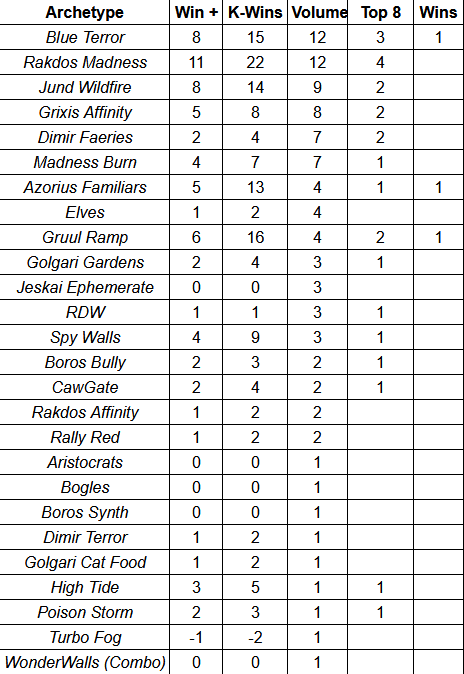
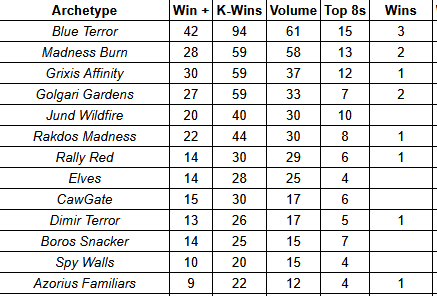
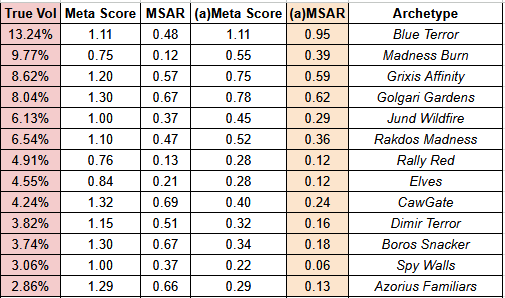
Thirteen decks had at least ten appearances in the Top 32 over the past month. Blue Terror and Madness Burn were the two most popular and also are leading the field in Top 8 appearances. Win+ measures a deck’s performance against an X-3 record in the Swiss rounds. K-Wins takes all wins less all loses, Top 8 performance included. These are mere counting stats and without proper context do little to tell us about how well these decks are performing in comparison to each other.
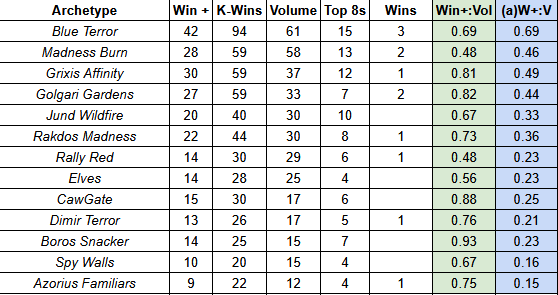
Win+ is useful for understanding how well a deck does during the tournament itself. As a Win+ score approaches 1, a deck is more likely to be finishing in the Top 16. From the green column we see that Boros Snacker comes the closest to finishing in the Top 16, followed by CawGate and Golgari Gardens. However these decks combined only have four more Top 32 finishes than Blue Terror. This is where the blue column – Adjusted Win+:Volume comes into play. This metric corrects for how popular a deck is (or is now) in comparison. These numbers are deflated compared the unadjusted metric but still provide insight.
When looking at Swiss performance it is important to take both numbers into account. A smaller sample size should not render a finish moot, but the popularity has to be considered. Based upon these numbers, I would rank Blue Terror as the best deck for Swiss rounds, followed by Grixis Affinity, Golgari Gardens, Cawgate, and then Madness Burn.
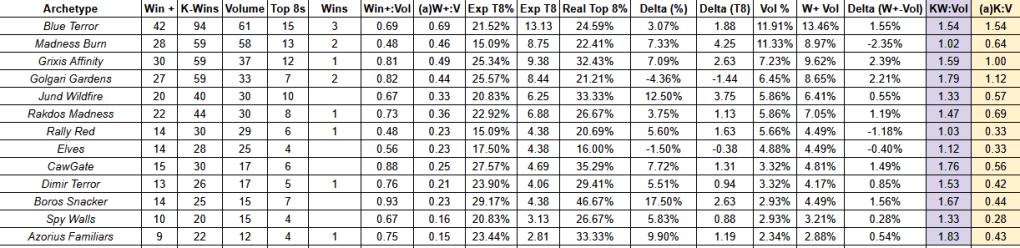
Apologies for the small image – if you want access to the full spreadsheet you can sign up for my Patreon – but we are going to be focusing on K-Wins in this segment. Again, this measure takes into account Top 8 performance and measures all wins less all losses. Here as the number approaches 2 we are averaging a finish closer to the Top 8 than the Top 16. Once again, sample size can confound the data which is why the raw ratio (purple) has some outliers. Azorius Familiars, for example, might have a better average finish than Blue Terror but does that make it a stronger deck?
The yellow column corrects for presence. Again it should come as no surprise that Blue Terror is leading the pack but under the hood we are seeing some movement. Golgari Gardens jumps past Grixis Affinity when looking at the format from this metric. After those two I would probably places Rakdos Madness ahead of CawGate.
Here we travel to the other end of the chart where we get to some of the more “all encompassing” numbers. First in red is True Volume. This is what I commonly refer to as “Winner’s Metagame Percentage” and takes an average of the actual Top 32 presence, the percentage of overall Win+ points, and the percentage of overall K-Win points. This provides an general idea of how strong a given strategy is in the Challenge Metagame. In this measure we see that Blue Terror has started to pull away from the rest of the field while Madness Burn, Grixis Affinity, and Golgari Gardens form a solid second tier.
And finally there’s Adjusted Meta Score Above Replacement. Borrowing from baseball’s concept of Wins Above Replacement (or WAR), this is designed to see how good a deck is against an average (or replacement level) Top 32 deck. The Meta Score is based upon the Win+ and K-Win to volume ratio while the adjusted score is based upon the adjusted versions of those measures. Once more, Blue Terror leads the pack while Golgari Gardens and Grixis Affinity end up in the second tier.
So this is what I take into consideration when I explore the top of the Pauper metagame. The stronger a deck does in these areas, the more likely I am to give it more weight and push it up the Power Rankings, while also giving it more credence in what people should be considering when they hit the digital tables. So with all of that being said, here is were I see Pauper after four weeks of Avatar: The Last Airbender:
Power Rankings
Dropped from rankings: Boros Snacker, Dimir Terror 10. Elves 9. Rally Red (Not Ranked) 8. Azorius Familiars (-4) 7. Jund Wildfire (+1) 6. Rakdos Madness (-1) 5. CawGate (Not Ranked) 4. Madness Burn (+2) 3. Grixis Affinity 2. Golgari Gardens 1. Blue Terror
I want to take a moment to thank all my Patrons. I am going to do my level best to keep providing you with the kind of content that brought you here in the first place. If you are interested in supporting my work, you can sign up for my Patreon starting at just $1.
Can’t make a commitment to Patreon? I have a Ko-Fi where you can make a one time contribution.
Want to learn more about the metrics I use in tracking the metagame? You can find an explainer here.
The other day I was driving my child to a birthday party. Given the circumstances of alternate side parking I was also driving their friend and said friend’s father. My phone was connected to the speaker and my kid asked me to play “Everything is Alright“. The other father, misunderstanding the request, burst into Bob Marley. T on my commute to work I started to wonder about my taste in music. One friend described it as “depressed dad” music – punk and adjacent genres from the late 80s until today – but something occurred to me as a song ostensibly written for teenagers blared in my ears. The music I listen to describes dreams and the way things could be, even if they aren’t there yet.
This describes my relationship to Pauper over the years. Following the format for nearly two decades I always saw Pauper for what it could be – what it has recently achieved. A fully realized format that is played around the world. How cool is that? And yet there’s that dissatisfied part of my brain that pokes and prods, telling me that things could be even better. Why settle? Never settle.
Okay so a lot happened in the past few weeks. It was Thanksgiving in the United States and the several days out of the office meant my body slowed down enough to be hit with a nasty cold, which knocked me out for a few days. Since our last check in there have been eight Magic Online Challenges as well as the winter iteration of Paupergeddon and Brazilian Pauper Nationals. While the stats I collect and track come from Magic Online today’s discussion will pull from the totality of events.
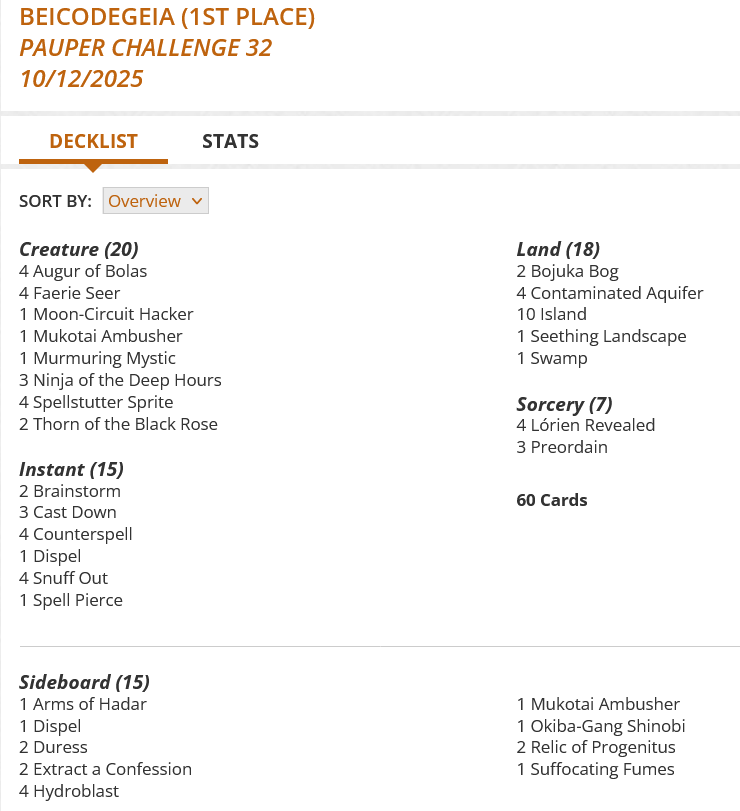
We start with the re-ascent of Blue Terror. Over the past few weeks the deck has put up strong numbers on the digital client and leads the field with a dozen Top 8 finishes. It also notched a Top 8 finish at Paupergeddon. Cheap threats and countermagic remain a powerful combination. So much so that Dimir builds have started to crop up again, While some of these decks lean on both Gurmag Angler and Tolarian Terror, a few stick with a single large threat and instead pad out the deck with value like Abandon Attachments and Sneaky Snacker, Thorn of the Black Rose, or Murmuring Mystic.
The surge in Blue Terror has not knocked Golgari Gardens from its number two spot. The deck continues to perform well on Magic Online but was completely absent from the Top 16s of both major paper tournaments. The midrange archetype spans two man builds – one that leans more into green for Avenging Hunter and another that plays closer to “destroy all monsters” control – but the conceit of converting material into cards remains the same. Midrange decks thrive on established metagames and while the Magic Online meta is largely stable, the size and scope of tabletop events can often mean bringing the wrong set of answers which in turn can lead to these decks stumbling.
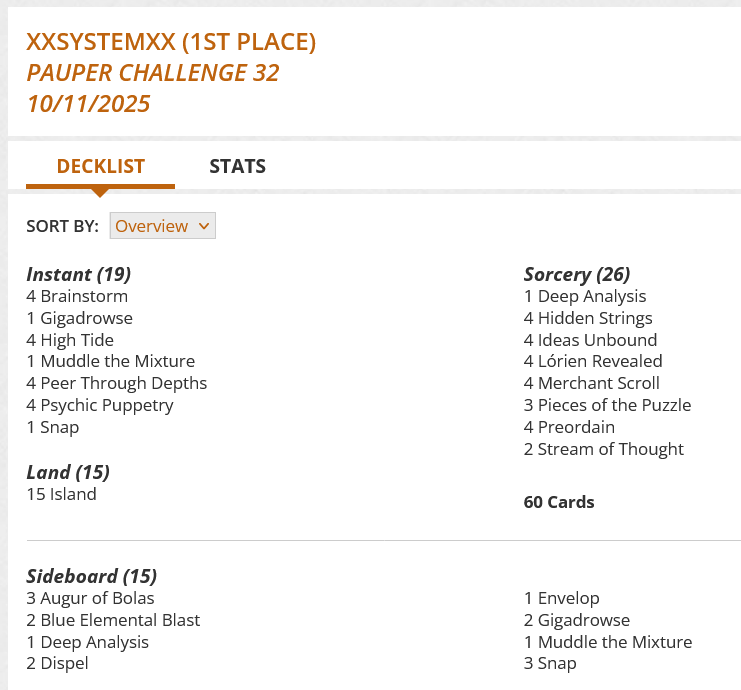
One deck which had a fantastic showing in the physical realm was Azorius Familiars. A deck that often exists on the fringe of the digital landscape due to the number of clicks needed to win the game, Familiars is a powerhouse. Using Ghostly Flicker or Ephemerate with Archaeomancer, the strategy can see a ton of cards while also creating a dominating board position thanks to Murmuring Mystic. The deck also can create an abundance of mana thanks to Snap. While more vulnerable to graveyard hate than the recently banned High Tide, a skilled Familiars player can maneuver around this angle of attack. That being said there are more copies of Bojuka Bog and Relic of Progenitus running around today than at any point in my memory and any graveyard combo deck has their work cut out for them.
The last deck I want to talk about is Spy Walls. Despite being the villain of the week often during the summer, the deck has largely fallen off. Online the deck has ten total Top 32 appearances in a dozen events and has a single Top 8 to its credit this season. Whether the success of Spy was a symptom of High Tide and the lack of the other combo deck has meant more focus can be placed on Dread Return decks or the deck just needs to adapt for a new metagame remains to be seen. I know I won’t be ignoring the graveyard anytime soon.
I want to take a moment to thank all my Patrons. I am going to do my level best to keep providing you with the kind of content that brought you here in the first place. If you are interested in supporting my work, you can sign up for my Patreon starting at just $1.
Can’t make a commitment to Patreon? I have a Ko-Fi where you can make a one time contribution.
Want to learn more about the metrics I use in tracking the metagame? You can find an explainer here.
A few weeks ago I started my first watch of Avatar: The Last Airbender with my son and I’d like to now say that yeah, I get it. The set is true to the show while also feeling like authentic Magic. After the awkward rollout and horrible reception of Spider-Man, seeing the Avatar cards hit differently – they pass the smell test.
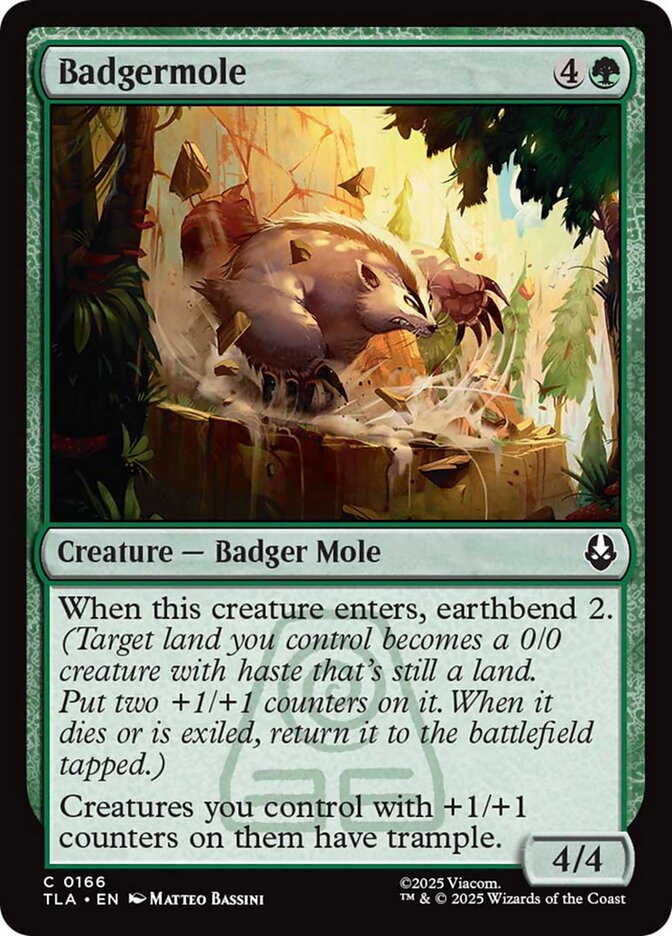
As for Pauper, well, the cards are just starting to make their mark. Badgermole has seen some play as a top end in Gruul Ramp builds while Abandon Attachments is yet another way to cheat Sneaky Snacker into play but unlike Grab the Prize, this one can see play in blue decks. But these are niche applications and are far from the top of the standings.
There were four Challenges to kick off Avatar season and it appears this will be the case moving forward. While this has provided a bounty of data, it also means the run down of the decks has grown long. While annoying for Yours Truly it does mean we have a much better idea of what the best decks are at any given time.
Outside of Thraben Charm, I am also very bullish on Crypt Rats and Pestilence. Being able to apply pressure to your opponent’s board development while also holding your finger over an “I Win” button is powerful.
Would it come as a shock, then, that both of the winning Golgari Gardens lists (from the same pilot, no less) featured Crypt Rats? Gardens had a strong week with an average finish in the Top 16 to go along with its pair of wins. The strategy also had the second best Adjusted Meta Score Above Replacement at 1.41, just 0.18 points behind the leader but a whopping 0.60 points ahead of third place. Gardens takes many forms, and while the two most successful lists skewed towards the control end of the spectrum the archetype is decidedly midrange.
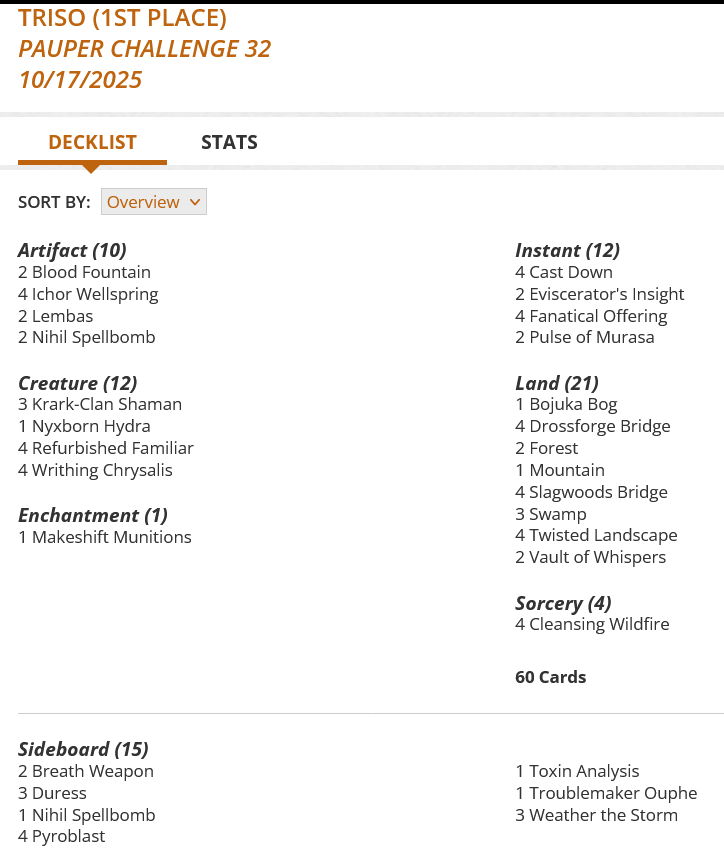
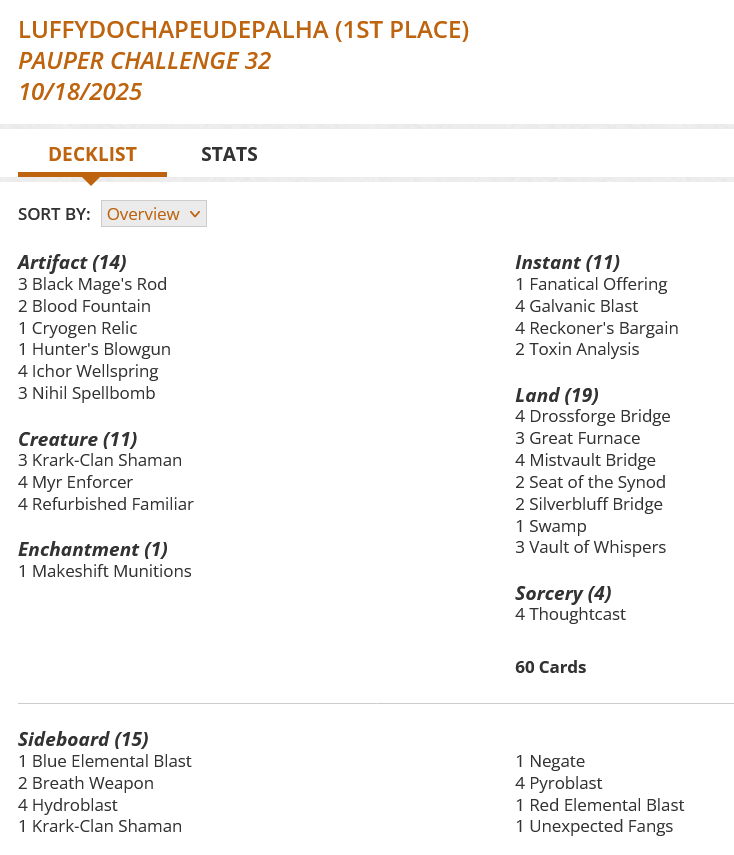
As for the best deck from the four Challenges, why that would be Grixis Affinity. Another format stalwart, this is the archetype with the AMSAR of 1.69. The Machine had an average finish closer to the Top 8 than Top 16 and racked up an impressive five Top 8s (with a win). Grixis Affinity is a midrange deck with another gear – one that can end the game in a flurry of Galvanic Blasts or feeding grist to the Makeshift Munitions mill.
My Thraben Charm prediction did not bear the same fruit. While white had some sporadic success it lacked the staying power of Golgari. I am personally not as high on Glint Blade these days – board position feels incredibly important and resetting your side of the battlefield for incremental advantage feels risky – I could see Orzhov Ephemerate or other proactive builds pick up the Thraben Charm banner.
In fact, I think white could be a key color next week thanks to Revoke Existence. Hitting key artifacts and enchantments remains important and Revoke Existence, while not as backbreaking as Dust to Dust, can get the job done. The problem is what do you pair with white to keep up? Glint Hawk and Kor Skyfisher are staples but if board position matters – as I believe – resetting it turn after turn for an extra card may be a bridge too far. What do you think white needs to make the jump? What under the radar cards could be out there just waiting to be uncovered?
Power Rankings
Dropped from rankings: Caw Gate, Mono White Aggro 10. Rakdos Madness (Not Ranked) 9. Spy Walls (-6) 8. Faeries (Not Ranked) 7. Jund Wildfire (-6) 6. Elves (+3) 5. Rally Red (Not Ranked) 4. Blue Terror 3. Madness Burn (+4) 2. Golgari Gardens (+4) 1. Grixis Affinity (+5)
I want to take a moment to thank all my Patrons. I am going to do my level best to keep providing you with the kind of content that brought you here in the first place. If you are interested in supporting my work, you can sign up for my Patreon starting at just $1.
Can’t make a commitment to Patreon? I have a Ko-Fi where you can make a one time contribution.
Want to learn more about the metrics I use in tracking the metagame? You can find an explainer here.
High Tide, once more, finds itself on the Pauper ban list. Normally in the wake of such a change we would have to wait a few weeks to see how the metagame would adjust. Lucky for us, Magic Online was running a week of Pauper events. The result is six tournaments worth of data to give us a solid impression of the metagame before moving into Avatar: The Last Airbender season.
The removal of High Tide from Pauper resulted in a slight format correction. Spell based combo is a tricky beast given the card pool as the ways to handle a win off the top are few and far between. Pauper lacks the tools other formats have to fight such decks, notably powerful discard and tax effects. Much of the interaction used to stymie spell based combo comes in the form of countermagic, which is concentrated in blue. True to form, it was Islands that performed the best during the final weeks of High Tide. While the combo deck was in the top 5 of the format, Blue Terror led the way. It took down 23 Top 8s for a stellar 25.56% conversion rate from Top 32 to the elimination rounds. The deck also won four Challenge level events and had the best Adjusted Meta Score Above Replacement with 1.02 (the next best deck in this metric was Madness Burn at 0.69).
Now don’t get me wrong – the absence of High Tide combo doesn’t suddenly mean Blue Terror is bad, but it has allowed the format to adjust to its absence. High Tide attacked Pauper at an angle that was almost entirely perpendicular to the rest of the format. It avoided creatures and did not utilize the graveyard much, if at all. Compare this to almost every other deck that is currently successful. They use the graveyard to reduce the cost of the creatures or store threats for later. The resulting metagame is one that looks rather familiar but has some key differences.
Midrange has come back in force. While it was never really dead (Jund Wildfire had 17 Top 8s in the same span as Blue Terror’s 23), the strategy struggled to establish any variety in the world with High Tide. In the six events from last week, non-black midrange decks – specifically CawGate – have reestablished themselves. Skewing more assertive, Mono White Aggro has also seen a surge. What gives?
For the time being I believe we are entering a Thraben Charm metagame. The absence of High Tide has made it so creatures matter again but also has pushed Balustrade Spy to the front as the most popular combo option. The Spy decks in Pauper almost always come with a pivot away from the graveyard, allowing them to turn creatures sideways and win with Sagu Wildling or another limited role player. Slots are precious and given the diversity of the Pauper metagame the ability to dedicate sideboard space for cards that can turn a matchup around are a priority. Thraben Charm may not be the best creature removal spell or way to target a graveyard, but the fact that it can do both is massive.
Every card you decide to run comes at the expense of other options. The opportunity cost may be negligible but it absolutely exists. Thraben Charm can help to mitigate that cost in decks that can support its creature removal mode. The Charm is not as reliable as a true kill spell or even a Journey to Nowhere, but it makes up for that lack by being able to absolutely wreck a graveyard.
Moving into Avatar season you have to come prepared for Thraben Charm strategies. it is not that they are dominant but rather they are present, and the versatility of the card presents a problem for decks that might want to attack the metagame from right angles such as Bogles or Spy Combo.
Outside of Thraben Charm, I am also very bullish on Crypt Rats and Pestilence. Being able to apply pressure to your opponent’s board development while also holding your finger over an “I Win” button is powerful. Given my excitement over Thraben Charm you might be surprised to hear I would not par the instant with the board wipes in a Guardian of the Guildpact deck. The fact is I think the stalwart spirit is a bit too slow these days to run more than a copy or two at most. While the ability to punch through still matters quite a bit the fact that Writhing Chrysalis can eat it for breakfast, lunch, dinner, and fourth meal, means the opportunity cost of a two power four drop is too dang high. That being said I think there is a build of Orzhov Pestilence out there that could find a lane.
Power Rankings
Last check in: October 24-26 Dropped from rankings: High Tide (Banned), Azorius Familiars, Gruul Ramp, Rakdos Madness 10. Mono White Aggro (Not Ranked) 9. Elves 8. Dimir Faeries 7. Madness Burn 6. Grixis Affinity (-2) 5. Golgari Gardens (Not Ranked) 4. Blue Terror (-3) 3. Spy Walls (Not Ranked) 2. CawGate (Not Ranked) 1. Jund Wildfire (+1)
I want to take a moment to thank all my Patrons. I am going to do my level best to keep providing you with the kind of content that brought you here in the first place. If you are interested in supporting my work, you can sign up for my Patreon starting at just $1.
Can’t make a commitment to Patreon? I have a Ko-Fi where you can make a one time contribution.
Every so often I wonder what could have been. If I had decided that my first year Calculus class was not that bad, would I have pursued a degree in Physics instead of English? Would I have ended up getting as involved at college and found my career? If my Magic collection hadn’t fallen off the shipping truck to Graduate School, would I have become as engaged with Pauper?
If, if, if. One of life’s major existential thoughts appearing in a blog post (not even an official article) about building Commander decks. And yet it feels right, because deckbuilding is a situation where we have control over the result.
I can’t speak for everyone, but I still get a giddy little each every spoiler season. The lizard part of the my brain that was activated by Lego lights up, neural pathways that could have been spent trying to solve more important problems seeing how all the different pieces could potentially fit together. Invariably I get excited about a card or two and start plotting a new list. Avatar: The Last Airbender gave me one such card.
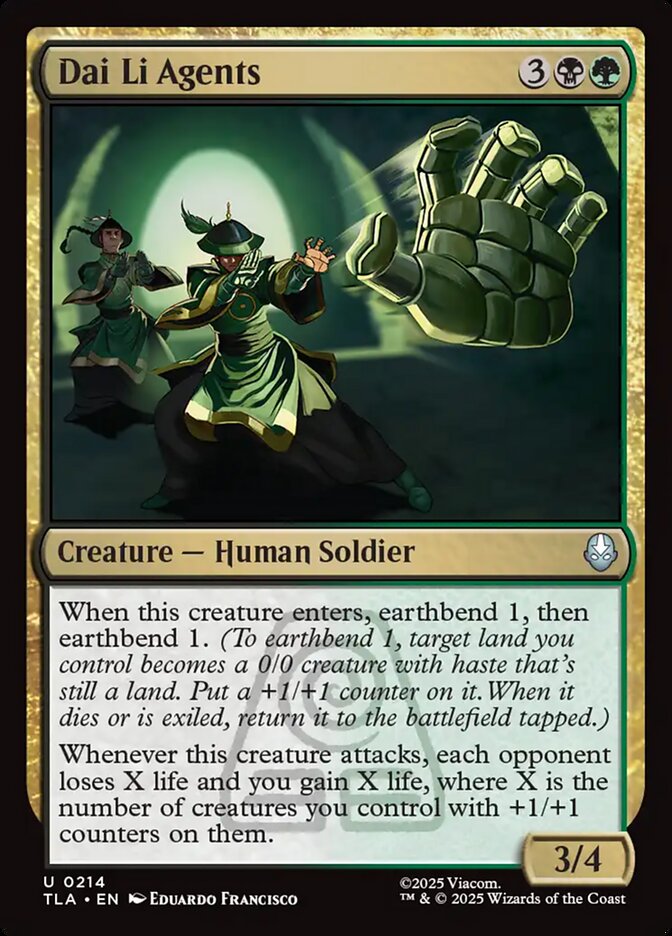
Dai Li Agents and similar cards deeply appeal to me in Commander. Like Gray Merchant of Asphodel and Skemfar Shadowsage they are creatures that have to work in the conceit of a given deck without being prescriptive. Each of these creatures help to win the game but none of them are necessarily locked into one specific build. Gray Merchant is just as home in mono black as Zombies; Shadowsage can fit into any number of creature-type-matters builds. Dai Li Agents asks for +1/+1 counters but I am sure it will show up in upcoming Earthbending strategies.
Maybe it was because I had Insidious Roots on the brain but the second I saw Dai Li Agents I felt like I was going to do something with the card. I was excited over the prospect of attacking for lethal damage despite not having to connect with the creature; part of Magic‘s uneven texture that makes me smile. The next few days were spent searching for Commanders that could helm such a deck before I found what I considered to be a perfect Partner pair.
Partner is a superposition of a terrible mechanic and something amazing. The original iterations left things far too open and broad, giving decks incredibly powerful cards in the Command Zone and access to too many options outside it, which could turn these builds less into focused entities and instead into a stew made from the best ingredients of varying cultures and cuisines. Perhaps it would be delicious, but blue cheese and kimchi are not the most compatible flavors (to my palette, at least).
And yet it is this open ended nature that gives Partner its beauty. It is possible to pore over these creatures and find the right mix of abilities to helm any mixture. My original idea for Dai Li Agents was an elf based deck using Naider, Agent of the Duskenel and Numa, Joraga Chieftan. I ended up drifting away from this pairing in part because of how expensive – mana wise – it could get. But I had hit upon something that worked – pairing the ability to put counters on creatures with generating tokens.
I was getting ready to build the Bane of Playmats; the Bookkeeping Nightmare.
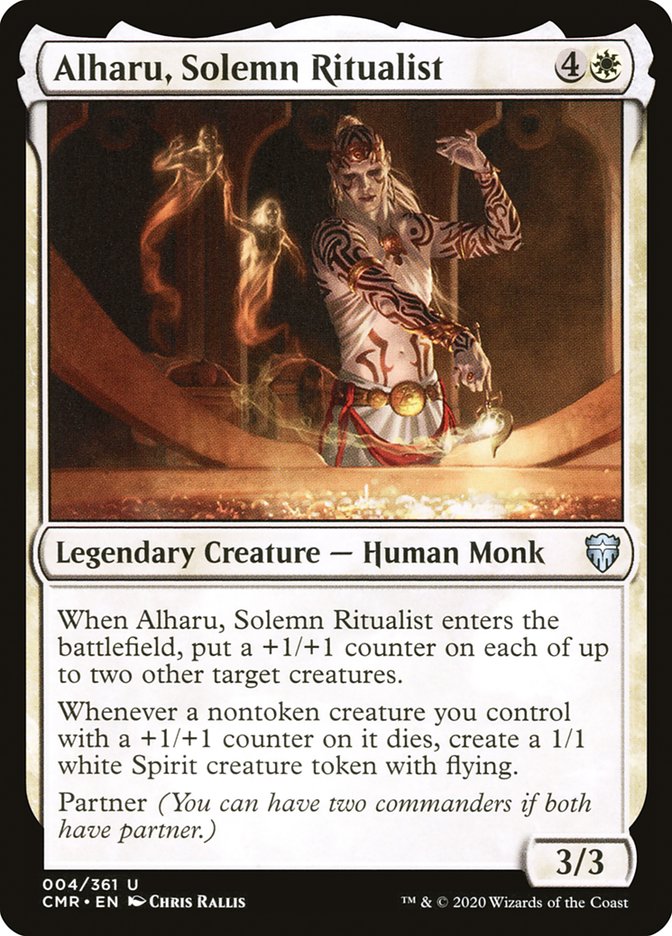
The next pair I found was not going to ease that burden. Wanting to both go wide with tokens and conserve +1/+1 counters I settled on Alharu, Solemn Ritualist and Reyhan, Last of the Abzan. With these Legends at the helm I was going to have a fairly steady supply of tokens while also never really running out of counters to make sure my Dai Li Agents did its business.
Alharu was the card that encouraged me to go down this path. Reyhan has been a known quantity to me for years going back to days when I was a Skullbriar, the Walking Grave gamer. The white Legend’s ability to not only distributed counters but ensure that my creatures- which would for sure be dying regularly – left behind material went a long way towards patching what I considered to be a glaring hole in the idea – how to make the two seemingly disparate elements work together in the Command Zone. An Abzan Ascendancy that I could access whenever I wanted seemed to be exactly what the deck needed.
Once I had settled on the Commanders I started to generate the list of cards to round out the deck. Hardened Scales and The Ozolith (both versions) led the list, with Cathar’s Crusade and Inspiring Call quickly joining them. Winding Constrictor could find another home as would some of the very best removal spells available. Yet the more cards I added to my mental notes the more bored I became, Here was a new deck to uncover and put together and yet by the time I had figured out the majority of nonland options I had no lingering desire to actually pull the cards from my collection. The deck had built itself.
At its best Commander is a series of experiences. It is the joy of crafting and iterating a list and then piloting it. The games themselves should be a series of vibrant punctuations that spur a cycle of improvement. It is not always about finding the perfect build but rather the things that bring you those happy moments. For me part of this joy is derived from doing things differently. It’s not intentionally hampering my decks but rather doing something that provides a novel occurrence. The Alharu-Reyhan deck I had conceived would be strong for sure but nothing about it would be a surprise.
There was another nagging feeling. Poring over the latest card file I came to realize how much of a challenge it would be to keep the deck up to date. The further away from novelty a deck moves the more likely it is that new cards will be released that just fit. This would evolve to be an exercise in self restraint, telling myself I do not need the latest Ouroboroid for the deck to work. While absolutely true at what point would I tire of seeing cards perfect that I would pass up due to exhaustion?
Why do we avoid building decks? I cannot speak for everyone but for me it is about discovery. When I have an idea I want to feel like I found something, even if the pieces were laid out there in front of me. I want the games to unfold in a way so that even if I know what is coming there is an element of risk. We’re can’t go off script if there was only an outline at the onset. If I build a deck and it is just an expression of cardboard rather than something of mine I end up leaving the deck unplayed until the contents end up back in a pile somewhere.
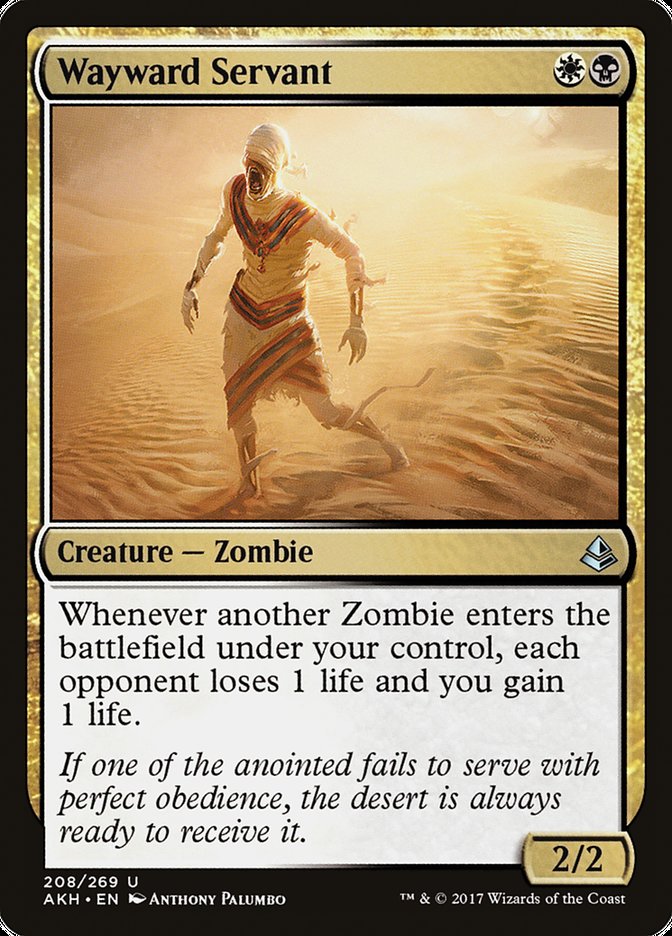
One of my favorite creature types to build around is Zombie. Being a filthy Golgari player there is little I enjoy more than recycling material from my graveyard and over the years I have put together, and dismantled, multiple Zombie decks. This is due in no small part to the decks starting to Frankenstein themselves. On some level the deck was being constructed by a mad doctor outside my control. It was not until I honed in on Wayward Servant that I found a hook that made my lips curl; that kept me interested.
Wayward Servant was a card that grabbed my interest early on but I never got around to building around it. I love Aristocrats strategies and decks that win one point of damage at a time. Servant hit all those notes but the idea of Esper Zombies never sat right, in part because it was what the cards told me to do. Where’s the fun in self expression if you’re doing what you’re told? Listen, just because I’m a dad now doesn’t mean I’ve completed buried the punk ethos that got me all the way from high school to my late 20s. But Wayward Servant was giving me a signpost.
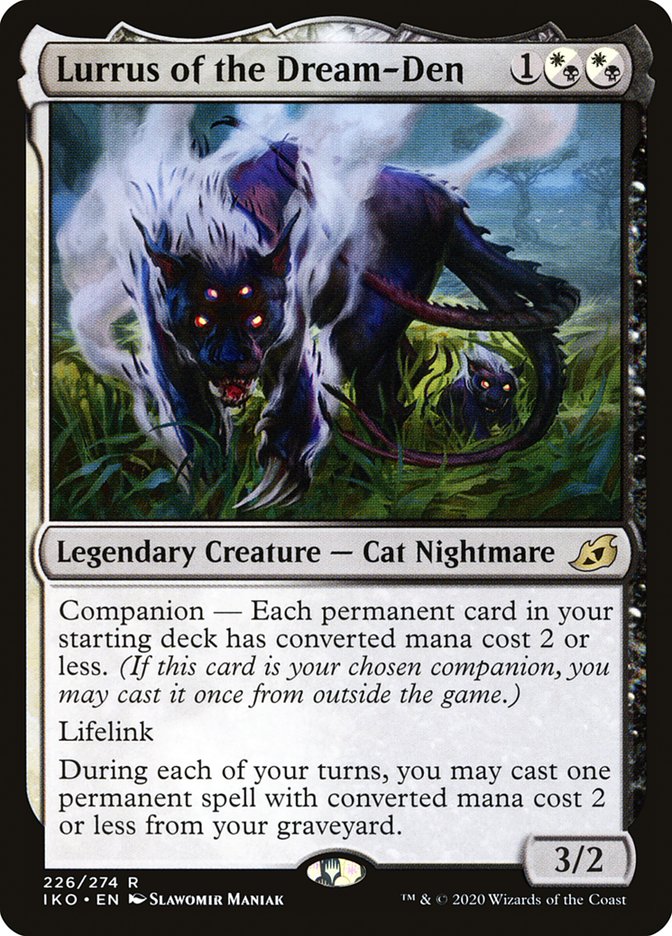
I started to think about what appealed to me about Zombies and so much of it was how the cards lent themselves to a relentless approach to the game. At one point I had a Gisa and Geralf deck it never stuck in part because it bored me. But Lurrus of the Dream Den never did. Instead of handing me directions it gave me a map and told me to find my own way. Lurrus is a legend that had captured my interest but I never found a build that stuck. It was a chocolate and peanut butter moment when I realized that Wayward Servant was a Zombies that only cost two mana. Suddenly I had something new and novel that would afford me the opportunity to have both a Lurrus deck and a Zombie deck.
My current Lurrus deck may feature a number of cards considered staples in the Zombie archetype but it also gets to do things differently. Biasing towards working with Lurrus’ ability encourages me to think about the build from multiple angles. Yes, it may be a Zombie but can the Cat bring it back? If not, is it worth inclusion? It’s not enough to just be the correct creature type – it has to fit with the various engines. Whether it’s Lurrus herself or Binding Mummy or Siege Zombie, additions have earn their keep instead of just taking a spot that they earned by virtue of being printed.
Every time I build a deck there is a moment. An instant where I think about what comes next and either a smile spreads across my face or I realize that this collection of cards is not for me. The point on the timeline where I saw that Alharu-Reyhan would be rote was parallel to when I realized that Lurrus Zombies would continue to provide me opportunities to explore. If a deck is finished before I even shuffle it up for the first time then is it even worth putting it in sleeves?
If I had stuck with Gisa and Geralf for all those years, would I have found my current joy with Siege Zombie? If I had never taken apart my Skullbriar deck from the mid-2010s would I have the same qualms about a new +1/+1 counter strategy? I don’t have a good answer. What I do know is that no matter what you do, every step of the process, from conceiving a deck to saying “Good Game” as the last life point gets crossed out should bring a smile to your face. Otherwise, why did you even bother playing the game in the first place?
I want to take a moment to thank all my Patrons. I am going to do my level best to keep providing you with the kind of content that brought you here in the first place. If you are interested in supporting my work, you can sign up for my Patreon starting at just $1.
Can’t make a commitment to Patreon? I have a Ko-Fi where you can make a one time contribution.
Want to learn more about the metrics I use in tracking the metagame? You can find an explainer here.
A lot happened last weekend in the world of Pauper but whether it matters or not remains to be seen. As with all results, a single weekend does not always mean there’s a changing of the guard. Does the complete lack of Faeries and the meager performance of High Tide this weekend mean those decks are gone for good? Does the strong showing by Azorius Familiars means that it is currently the deck to beat? I like to think you know the answers to these questions but just in case, neither of those statements hold water.
Pauper is a non-rotating format with a ton of inertia. Without an infusion of new and powerful options the metagame is unlikely to shift rapidly. Rather what we are seeing is a blip – a small course correction given recent results. When we get to the power rankings two decks have dropped off – Aristocrats and Faeries – but that does not mean they are non-factors. Perhaps their adherents moved to other decks or simply had different plans. The surge in Dimir Faeries tells us that Spellstutter Sprite hasn’t lost any luster, but maybe removal was more important last weekend.
More than any other format I’ve played outside of Limited, current Pauper is defined by how you’re answering threats. In some cases you can very easily trade time for board presence with a Snap or Deem Inferior. Other times you need to Snuff Out a Writhing Chrysalis until your opponent’s adjust to Gixian Infiltrator and suddenly your key card is left stranded. If you want to identify what’s happening in Pauper at any given time, looking at the removal is a good place to go after examining the archetypes.
What does last week tell us? In the end, not much. The format was more hostile to spell based decks at large, but that gave space for creature based strategies like Gruul Ramp to surge. I would expect a regression next week as things settle for the final few weeks of the season.
I want to take a moment to thank all my Patrons. I am going to do my level best to keep providing you with the kind of content that brought you here in the first place. If you are interested in supporting my work, you can sign up for my Patreon starting at just $1.
Can’t make a commitment to Patreon? I have a Ko-Fi where you can make a one time contribution.
I want to take a moment to thank all my Patrons. I am going to do my level best to keep providing you with the kind of content that brought you here in the first place. If you are interested in supporting my work, you can sign up for my Patreon starting at just $1.
Can’t make a commitment to Patreon? I have a Ko-Fi where you can make a one time contribution.
Want to learn more about the metrics I use in tracking the metagame? You can find an explainer here.
We’ve made it four weeks through Spider-Man/Through the Omenpaths season. Traditionally this is where I check in with the format as opposed to recounting what happened in the previous week. So let’s do that by examining what I consider to be the ten best decks in the format over the past month.
Power Rankings
10. Faeries (-2) – 7 Top 8s; AMSAR: 0.21
Faeries remains a stalwart of the format. Despite a recent surge in the popularity of Dimir Faeries, the mono blue version continues to put up solid results. The game plan of sticking evasive creatures and turning them into ninjas, all while backed up with counterspells, has stood the test of time. Faeries might not be the flashiest deck in the format but it gets the job done. 9. Dimir Faeries (-3) – 3 Top 8s; 2 Wins; AMSAR: 0.23
How can Dimir Faeries be above the other two decks considering it has worse seasonal metrics? Recency bias. While Dimir Faeries might be lacking in raw numbers it has come on strong over the past few weeks and is gaining popularity. The ability to play a traditional Faeries game with access to removal is potent, especially if you manage to fit in a threat like Murmuring Mystic or Gurmag Angler to help turn the corner. 8. Rakdos Madness (+2) – 2 Top 8s; AMSAR: 0.31
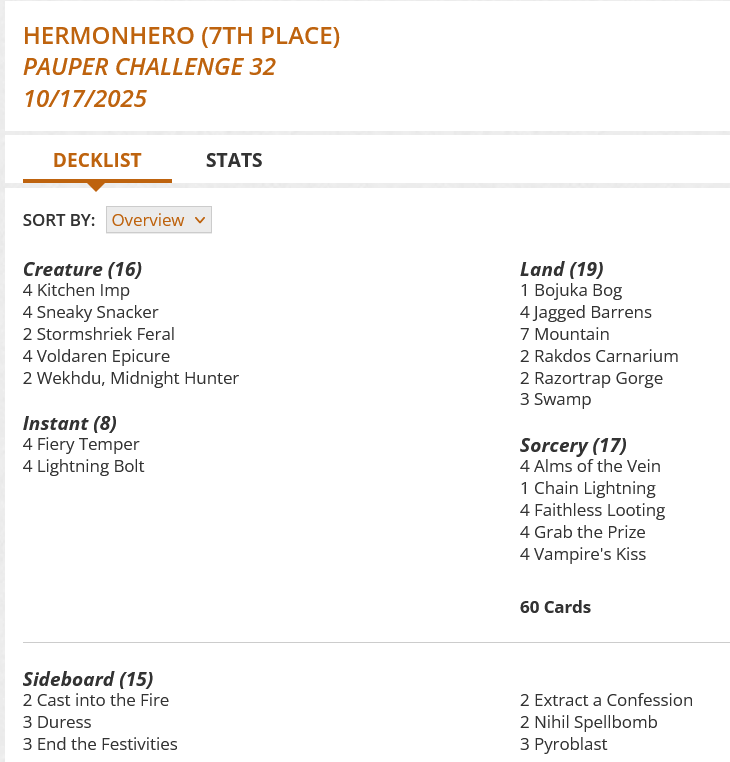
Another well established archetype that tries to turn the downside of Faithless Looting and similar cards into an advantage. Rakdos Madness can pile on the damage and has adopted Swarm, Being of Bees/Wekhdu, Midnight Hunter as another threat, giving the deck more options to flash this out or to access it post combat with Mayhem.
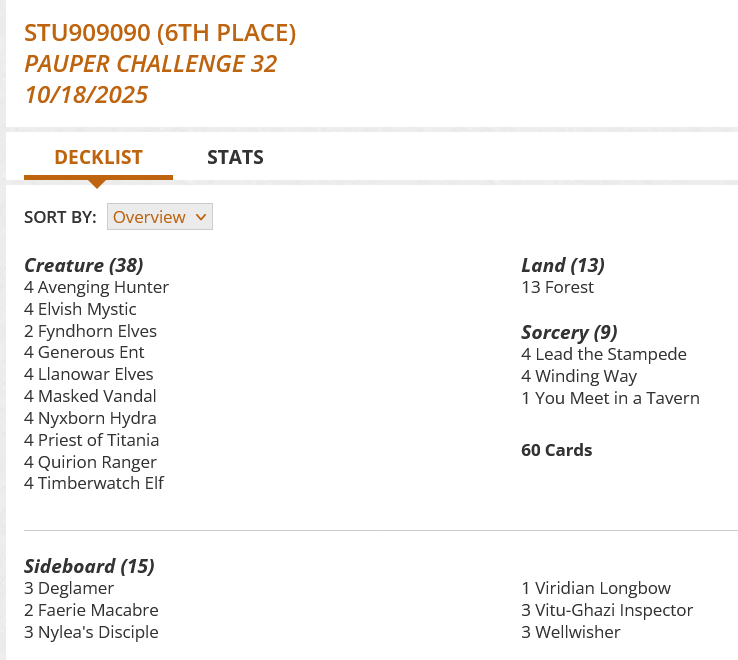
Elves has restablished itself as a real player in Pauper. The deck is capable of spitting out a ton of creatures and present a lethal combination involving Timberwatch Elf. Elves also has adopted Avenging Hunter as another top end threat which makes sense considering the deck is quite capable of gumming up the board to defend the Initiative. 6. Aristocrats (-4) – 6 Top 8s; 1 Win; AMSAR: 0.38
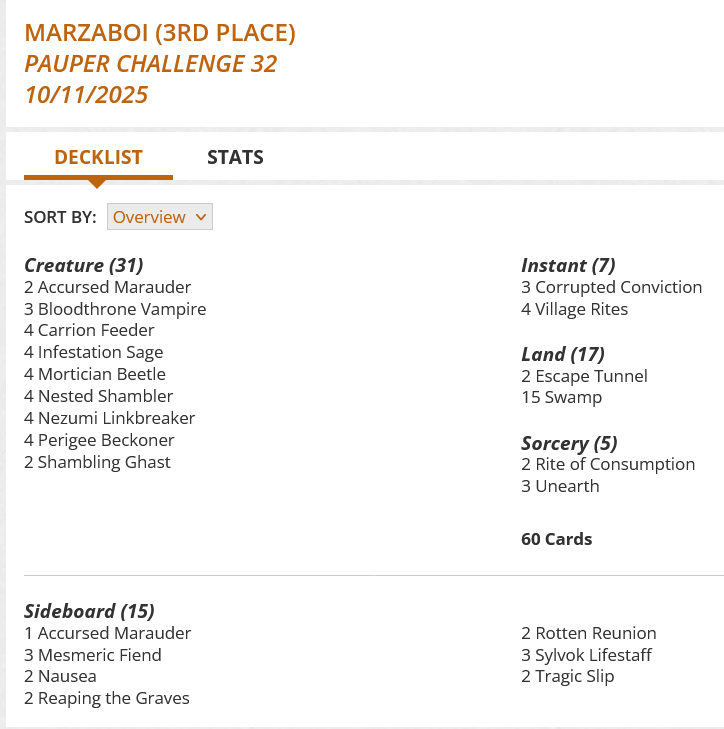
Aristocrats – or Black Sac – is a mono black aggressive deck that leverages sacrifice outlets and creatures that leave behind material to generate massive threats. The deck strategy has been on the fringes of Pauper for quite a while and has broken out this year thanks to Perigee Beckoner. With two copies of the Beckoner, Aristocrats can generate an unbound number of death triggers and an arbitrarily large Carrion Feeder. It is this additional gear that has boosted the deck from jobber to contender. 5. Madness Burn (+2) – 9 Top 8s; 1 Win; AMSAR: 0.5
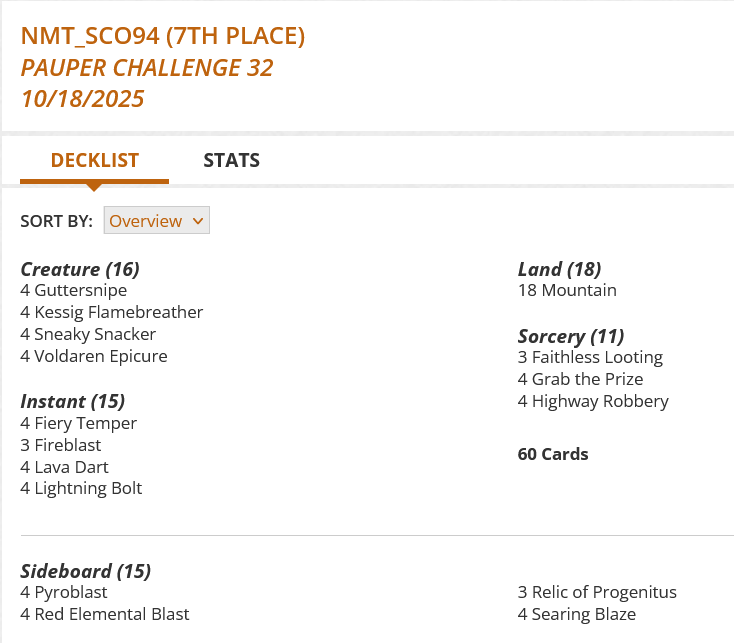
What happens when you cut the black cards from Rakdos Madness and replace them with Guttersnipe and more burn? You get the best red deck in the format. Madness Burn can pile on the damage and when it is doing the thing a single Lava Dart can represent nearly a third of a starting life total. Things get scarier when Guttersnipe is joined by Kessig Flamebreather or two, turning any one damage spell into a Fireblast level threat. 4. Jund Wildfire – 10 Top 8s; 1 Win; AMSAR: 0.5
The Midrange Deck of the format, Jund Wildfire is just a collection of good cards. Stitched together with a Cleansing Wildfire engine, the deck runs solid threats, top tier removal, and can even have maindeck Duress as a treat. It’s hard to describe this deck as anything other than Jund and while it is falling back to the pack just a bit it is still quite capable of Jundin’ them out. 3. High Tide – 8 Top 8s; 1 Win; AMSAR: 0.53
I wrote my piece on High Tide last week so I will not rehash it here. Suffice to say the deck is quite good but hardly Storm levels of broken. It remains a polarizing strategy due to the fact that some decks are simply incapable of presenting meaningful interaction. In it of itself this is not a bad thing, but the list of decks that fit this bill may be too long. 2. Grixis Affinity (+3) – 11 Top 8s; 2 Wins; AMSAR: 0.93
The only reason Affinity is not higher on this list is because it has only recently put up strong numbers. It is also hard to separate the deck’s success from the pilot that is LuffyDoChapeuDePalha, who has put up the vast majority of Top 8s and wins with Grixis Affinity. Make no mistake – the control deck is powerful – but like any control deck it takes some time for the metagame to settle before it can present the proper answer suite. 1. Blue Terror – 11 Top 8s; 1 Win; AMSAR: 0.87
Tolarian Terror better watch out – Grixis Affinity is coming for its crown. Blue Terror can present a quick threat and protect it with counterspells. Blue Terror’s threats are some of the largest available in Pauper and rarely come at full price. Whether or not this strategy can stay on top remains to be seen, but it almost certainly isn’t going anywhere any time soon.
I want to take a moment to thank all my Patrons. I am going to do my level best to keep providing you with the kind of content that brought you here in the first place. If you are interested in supporting my work, you can sign up for my Patreon starting at just $1.
Can’t make a commitment to Patreon? I have a Ko-Fi where you can make a one time contribution.
I want to take a moment to thank all my Patrons. I am going to do my level best to keep providing you with the kind of content that brought you here in the first place. If you are interested in supporting my work, you can sign up for my Patreon starting at just $1.
Can’t make a commitment to Patreon? I have a Ko-Fi where you can make a one time contribution.
Want to learn more about the metrics I use in tracking the metagame? You can find an explainer here.
It is impossible to tell the story of last weekend’s Magic Online Pauper Challenges without addressing High Tide. The deck made eight total appearances in the Top 32 and five of those ended in the Top 8 (including a win). Gavin Verhey of Wizards of the Coast and the Pauper Format Panel announced that the update on the format had been moved to November to align with the other Banner and Restricted List updates. This announcement is supposed to decide the fate of High Tide – whether it is banned once again or allowed to persist. The anticipation is palpable and if you are following the discourse then you probably know how people feel about the deck. Almost no one feels it is oppressively strong in the metagame and yet many people want the deck neutered in some way because of how it impacts tournaments.
High Tide is non-deterministic. When the deck goes for it there is a high chance of success but it is not guaranteed, which means the correct play in a tournament setting is to hope the Tide pilot fizzles; that they run into a sequence of cards that opens the window for you to take one more turn and hope they don’t go for it again. The High Tide combo turn can be a plodding ponderous thing that requires constant attention and tracking. The Professor recently featured such a turn as a part of the closing credits of his Shuffle Up & Play series and if you have a quarter hour to spare you can check the turn here. Yes, this is played for laughs and yes, there are pilots who can move through the operations more quickly. That does not take away from the reality that these kinds of moments exist and can wreck havoc on a tournament’s timeline and participants enjoyment (beyond the agony of defeat).
What about the deck’s performance? It is merely above the curve. Over Tarkir Dragonstorm season High Tide had an Adjusted Meta Score Above Replacement of 0.48 – about half a win better than an average Top 32 deck in that span. It’s mean finish was just outside the Top 16 and it had two wins in nine Top 8 appearances. But there’s another stat I measure that I don’t break out often – Expected Top 8% against Actual Top 8%. Given a deck’s average Swiss performance we can estimate how often the deck should make the Top 8. In Tarkir Dragonstorm season High Tide should have made the Top 8 in 23.85% of its Top 32 appearances, or 9.06 times. While the strategy didn’t meet the fractional mark, it played true to form.
In Magic X FINAL FANTASY the deck made the Top 8 ten times with two victories. It had an AMSAR of 0.45 (in line with Dragonstorm) but this time averaged a finish in the Top 16. It had an expected Top 8% of 31.25%, or ten appearances. Once again, High Tide merely performed to its mean. It isn’t until Edge of Eternities that we see the deck bump itself to another level. In the most recently completed season the strategy ended up with an AMASR of 0.43 and again, had an average finish just outside the Top 16. However it had 19 Top 8 finishes and two wins. Given its overall performance High Tide should have ended with a Top 8 conversion rate of 24.48% – around 15 trips to the elimination rounds. It over-performed in this metric to the tune of 7.19%, earning around four additional chances to play more Magic.
Now those numbers might seem gaudy, and they are in isolation. However if we look at two of the more popular and successful decks in the format, we see another story. Blue Terror had around a dozen Top 8s above expectation during Edge of Eternities season; Jund Wildfire had around eight more opportunities to win the trophy. Yes, High Tide has been good, but when taken in the context of the metagame that has been where the deck tops out. Even in the current season (three weeks in) it has the third best AMSAR of 0.62 (behind Blue Terror and Aristocrats) and us currently performing about two Top 8s above expectation.
On the numbers, the deck does not appear to be an issue. That being said there are things these statistics do not tell us. They do not tell us how many people opt out of the deck due to clock considerations nor how successful the deck is in tabletop play. They do not tell us how many rounds go to time or past (active player finish your turn and then there are five additional turns does not come with a hard cap on minutes). We do not know how many people have zoned out, miserable that they couldn’t grab a bite to eat because there was an iota of a chance they could pull out a win if and only if the opponent couldn’t find the key card.
I don’t have an answer for you today, but I want to know what you think: what do you think should happen to High Tide?
Power Rankings
10. Rakdos Madness (Not Ranked) 9. Rally Red (-3) 8. Faeries (+1) 7. Madness Burn (-2) 6. Dimir Faeries (NR) 5. Grixis Affinity (-1) 4. Jund Wildfire (-3) 3. High Tide (+5) 2. Aristocrats (+1) 1. Blue Terror
I want to take a moment to thank all my Patrons. I am going to do my level best to keep providing you with the kind of content that brought you here in the first place. If you are interested in supporting my work, you can sign up for my Patreon starting at just $1.
Can’t make a commitment to Patreon? I have a Ko-Fi where you can make a one time contribution.
You must be logged in to post a comment.