October 11-13 Pauper Weekend Recap

Want to learn more about the metrics I use in tracking the metagame? You can find an explainer here.

The first step to solving a problem is identifying if one exists in the first place. If you’ve been following this blog for Duskmourn season you will no doubt know that until this point I did not believe that Kuldotha Red presented a real problem in the Pauper metagame. The truth of the matter is that I still do not feel this way, but my conviction in the matter is not nearly as strong. As always when presented with new information I tend to reevaluate my positions and this past weekend provided a slate of new data to examine and explore.

There are a few things to note about the weekend of October 11-October 13. First is that in addition to the three Challenges there was a Pauper Qualifier – a feeder tournament for the Pro Tour system. The second thing to note is that the Saturday Challenge – which had 42 total players – ran concurrently with the Qualifier. Five of Kuldotha Red’s Top 8 finishes on the weekend and one of its wins all came in this smaller Challenge. I point this out because Kuldotha Red is a fairly easy deck for Double Queuing – that is play in two tournaments simultaneously. Two of the players who made Top 8 in the Challenge on Saturday with Red also played the deck in the Qualifier (with one making Top 8 there as well).

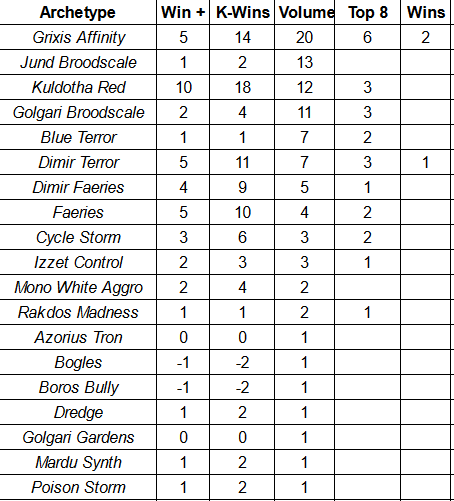
This context is important. In aggregate red demolished the field. A Win+ Average better than 1 puts the deck’s average finish firmly in the Top 16. Kuldotha Red’s eleven Top 8 finishes over the weekend are nearly two better than could be expected given its overall results. The strategy held 21.88% of the Top 32 metagame and improved on that nearly five percent to 26.84% of the Winner’s Meta. Rounding this all out, Kuldotha Red finished the weekend with an Adjusted Meta Score Above Replacement of 1.4, nearly a win and a half better than the average Top 32 deck and over a full win better than the next tier of strategies.

But there’s more. The Pauper Challenge Project, as communicated by Kirblinxy collected information that showed Kuldotha Red had a better than 60% non-mirror win rate in the three Challenges over the weekend. This, combined with the rather alarming numbers overall, should be cause for alarm. If you have gotten to this point and have read my articles before, I am sure you can expect a twist.

Saturday, October 12 Pauper Qualifier Top 32

The same Pauper Challenge Project collected data on the Qualifier where Kuldotha Red had a sub-45% non-mirror win rate. That is a marked difference from the dominant performance alluded to in the other data. The deck accounted for 23.74% of the entire field in the Qualifier as opposed to 20.13% of the entire Challenge meta on the weekend, with more Red players participating in the Challenge than in all three Challenges combined. The larger data set provides a different picture of Kuldotha Red – one that is just as popular but possibly less dangerous overall.

All of this being said I am more concerned about Red’s role in the metagame today than I was a week ago. The popularity of the strategy, combined with its sustained success is cause for additional attention. A 60% non-mirror win rate over a weekend is an eye popping stat, but if its lightning in a bottle that’s very different than sustained success. As it stands today, Kuldotha Red is leading the way in Duskmourn season with a cumulative Adjusted Meta Score Above Replacement of 1.1 where no other deck has a score above 0.3. If Red is able to sustain this clip then it might be time for a different course of action. For now I am still of the mindset that the format can adjust for the red shift.

There are two decks that cropped up I wanted to discuss. The first is this Boros Heroic build that made the Top 32 in the Friday Challenge.

2 Akroan Skyguard
4 Ancestral Anger
3 Benevolent Blessing
3 Boros Garrison
3 Defiant Strike
1 Emerge Unscathed
4 Ethereal Armor
4 Hyena Umbra
4 Lagonna-Band Trailblazer
3 Mountain
2 Mutagenic Growth
8 Plains
3 Satyr Hoplite
4 Sentinel's Eyes
1 Spirit Link
4 Sticky Fingers
3 Tenth District Legionnaire
4 Wind-Scarred Crag

Sideboard
1 Emerge Unscathed
3 Gods Willing
2 Gut Shot
2 Mutagenic Growth
3 Spirit Link
4 Temur Battle Rage

I like what this deck is trying to do. Tenth District Legionnaire is the kind of card worth stretching your mana base for and the additional card flow provided by Ancestral Anger – as well as its ability to punch through for extra damage – could be well worth the decrease in consistency. While I understand Sticky Fingers it feels a bit optimistic here as the Aura does not really do much for helping in combat. I wonder if this deck could make use of a few copies of Turn Inside Out as it would have little problem turning Manifested creatures face up. If that were the case it would probably need to up the threat count or find a way to include more graveyard synergy.

2 Ancient Den
2 Bojuka Bog
3 Cast Down
3 Deadly Dispute
4 Glint Hawk
2 Goldmire Bridge
1 Kabira Crossroads
4 Kor Skyfisher
4 Lembas
4 Novice Inspector
3 Obscura Storefront
1 Okiba-Gang Shinobi
2 Omen of the Dead
1 Orzhov Basilica
4 Plains
4 Refurbished Familiar
1 Suffocating Fumes
3 Swamp
2 Thraben Charm
4 Thraben Inspector
4 Tithing Blade
2 Vault of Whispers

Sideboard
2 Arms of Hadar
3 Duress
4 Dust to Dust
3 Snuff Out
3 Trespasser's Curse

The other deck I wanted to point out is this Orzhov Blade list that made Top 8 on Sunday. This is the kind of deck that can really find its lane once the metagame has started to settle. Orzhov Blade has the ability to go toe-to-toe with assertive strategies by chucking blockers into play. The Kor SkyfisherOmen of the Dead loop provides a decent long game plan. I would be somewhat concerned about the mana cost of Cast Down in such an aggressive metagame but I am not sure any deck can easily afford to max out on Snuff Out in the moment. If there is one card I am eyeing for this build it is Carrot Cake for its ability to put blockers on the board while also providing a small life bump in dire straits.

If I were to play in next weekend’s events I would likely be on some form of Orzhov Blade. While I would not be sure on Carrot Cake I would almost certainly be looking to include some number of Extract a Confession. Blue Terror and Dimir Terror both had solid showings last weekend and given the continued presence of Kuldotha Red in the metagame it would not surprise me of Bogles made a run at some Top 8s. In both instances having access to a more curated Edict effect could work wonders, especially if your game plan is built around incremental advantages.

I want to take a moment to thank all my Patrons. I am going to do my level best to keep providing you with the kind of content that brought you here in the first place. If you are interested in supporting my work, you can sign up for my Patreon starting at just $1.

Can’t make a commitment to Patreon? I have a Ko-Fi where you can make a one time contribution.

Looking for another way to support my work? Click here for my TCGPlayer affiliate link. Any purchases through the link let the folks there know you like my content!
October 4-6 Pauper Weekend Recap

Want to learn more about the metrics I use in tracking the metagame? You can find an explainer here.

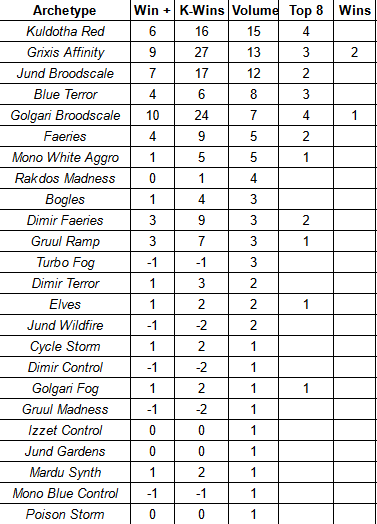
I am not going to bury to lede this week: Kuldotha Red had the best weekend. The assertive strategy had a dozen Top 32 appearances and converted that to five Top 8s and a pair of wins. It had an average finish firmly in the Top 16 and held 14.51% of the winner’s meta share (an increase of 2% over general Top 32 volume). Its Adjusted Meta Score Above Replacement of 1.02 put it about a win clear of the mean Top 32 finish for the weekend.

Why put this above the fold? Because, as discussed elsewhere, Kuldotha Red occupies an outsized portion of the discourse around Pauper. There are datasets where the deck looks fantastic on the surface but under performs (like the weekend of September 27) and then there are tournament sets like last weekend where the deck is just as good as it looks by the numbers. Red is a good deck to be sure but it is hardly a dominant force.

What, then, is the difference between something being dominant and a deck being a part of a healthy metagame? What role does Kuldotha Red serve? Formats need a Clock – that is a deck that puts a limitation on the amount of nonsense in which one can engage. This is neither good nor bad but rather a feature of competitive metagames. Without decks that can establish parameters it can become difficult to craft a strategy that can navigate a tournament. Here we find the crux of the difference between competitive formats and social ones. It is entirely possible to play social Pauper where you concoct a contraption out of commons, yet if that deck cannot operate within the very real parameters of the competitive metagame it exists on a parallel track.

A dominant deck, on the other hand, is one that takes up an outsized portion not only of the metagame as it exists in results but the metagame as it exists as a thought experiment around the format. If the first, last, and only consideration one would have when building a deck and sideboard is a specific meta deck then there may be a problem. Similarly if an interaction or suite of cards starts to create a similar monopoly of thought then perhaps additional investigation might be warranted. Currently I do not believe that Kuldotha Red rises to this level.

Now you might be asking yourself about the Bridges. These cards have earned a level of notoriety. These lands have changed the way other decks have had to approach Affinity while also serving as the backbone for one of the best card draw engines in the format. The Bridges have become part of the landscape of Pauper in a way that they support multiple strategies, often enabling decks that might otherwise struggle. At the same time it is hard to ignore the impact they have had. The question that exists today is whether or not the rest of the format has risen to the power band or remains too far behind to reasonably keep up.

Today I want to look at one list I believe supports the former statement. Golgari Fog is an emergent strategy that blends elements of Golgari Gardens with Turbo Fog to present a deck that can wring out a victory in the long game.

1 Basilisk Gate
4 Black Dragon Gate
1 Bojuka Bog
2 Campfire
3 Crypt Rats
1 Darkness
4 Deadly Dispute
3 Eviscerator's Insight
1 Fanatical Offering
2 Fog
2 Forest
1 Golgari Rot Farm
4 Heap Gate
1 Heaped Harvest
3 Ichor Wellspring
3 Khalni Garden
4 Lembas
3 Manor Gate
4 Moment's Peace
1 Nadier's Nightblade
2 Reckoner's Bargain
1 Respite
1 Retrofitted Transmogrant
1 Stream of Thought
3 Swamp
2 Tangle
2 Weather the Storm

Sideboard
4 Basking Broodscale
1 Nadier's Nightblade
4 Pyroblast
4 Sadistic Glee
1 Stream of Thought
1 Weather the Storm

Golgari Fog is a midrange control deck that leans on the Deadly Dispute package to keep cards flowing. It leans into Gates as well to provide a win condition in Basilisk Gate and a steady stream of material through Heap Gate. Campfire (and in this build Stream of Thought) provide additional insurance on the library count and this version continues the innovation of including the Broodscale Combo in the sideboard for a juke. In my opinion the relatively strong positioning of this deck indicates a healthy metagame.

Golgari Fog is constructed with two different poles in mind. It wants to survive the early game onslaught of small creatures and does so with various Fog effects. It also is prepared for decks that want to drag the game out with copies of Campfire to recycle its resources – and exhaust those of the opponent – in something that feels extremely Golgari. The deck is evocative of the control decks of yore with scant few actual win conditions – we’re talking a single Basilisk Gate here – and simply wants to grind your opponent’s will to keep playing into dust.

Looking ahead to next week I would come prepared to Kuldotha Red first but Jund Broodscale is not that far behind. Dimir Terror also had a solid showing so having a reliable way to wipe the board early feels paramount, but you need to survive against those 5/5s in the midgame. If I were looking to go off script I’d be trying to find a way to make Swirling Sandstorm work but I would also keep my eye on Battlefield Scrounger, especially if I was set on playing something Golgari.

I want to take a moment to thank all my Patrons. I am going to do my level best to keep providing you with the kind of content that brought you here in the first place. If you are interested in supporting my work, you can sign up for my Patreon starting at just $1.

Can’t make a commitment to Patreon? I have a Ko-Fi where you can make a one time contribution.

Looking for another way to support my work? Click here for my TCGPlayer affiliate link. Any purchases through the link let the folks there know you like my content!

September 27-29 Pauper Weekend Recap

Want to learn more about the metrics I use in tracking the metagame? You can find an explainer here.

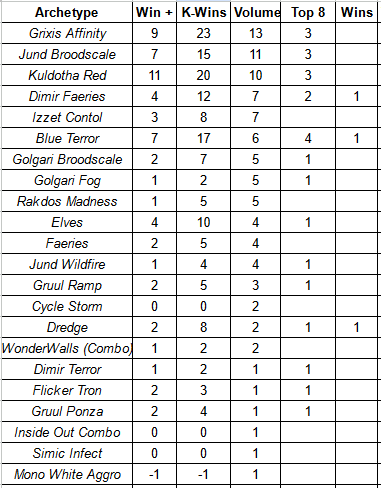
Just in time for October (also known as Spooky Season for some reason), Pauper has entered its Duskmourn era. The first weekend of Magic Online Challenges proved to be scary for a number of reasons, not the least of which were the paltry number of participants in the Friday and Saturday tournaments. Barely breaking the threshold to launch, the first two Challenges in the latest cycle have confounded the data set just a bit. All told, 22 of the 96 Top 32 competitors (let me tell you how painful it is to write a sentence with so many sequential numbers) had losing records.

What does this mean? Largely that we cannot infer too much from the first dataset presented. Including the losing records does provide some insight, especially for popular decks that falter in that we can have a better idea of what happens outside a traditional winner’s metagame. If, for example, Grixis Affinity has a ton of decks in the Top 8 but also plenty of people piloting the strategy to 2-4 records we can’t draw any conclusions but it could mean that perhaps the deck is not the behemoth those Top 8s make it out to be.

We’re not going to be talking about Grixis today, however. Instead we are going to be talking about Kuldotha Red. The latest iteration of the red deck took down twenty Top 32 slots last weekend, good enough for 20.83% of the field. Eight Top 8 finishes and a win made it so Kuldotha finished with the second best overall performance at the end of Sunday. It did this with an average finish well outside the Top 16 and with an Adjusted Meta Score Above Replacement of 0.35.

We also aren’t going to be talking about the best deck on the weekend. Bogles had three Top 8 appearances, and a win, in seven total trips to the Top 32. It had an average finish in the Top 8 and vastly improved on its raw Top 32 volume (7.29%) in winner’s meta share (26.78%) with a healthy adjusted meta score above replacement of 1.43.

So why are we talking about Kuldotha Red? Because this deck often becomes the center of attention early in a set’s cycle when it puts up some unhealthy looking rates of play. In a way we will be talking about Red, but also Bogles and Grixis. What we are we talking about, however, is interpreting small sets of information.

Bear in mind I am not a statistician. My background in analyzing data comes from the world of social sciences. In my day job I help to run the assessment initiatives for my department where we try to identify different areas of growth, learning, and participation in a college aged population. A tad different than Magic all told.

Kuldotha Red is an assertive strategy. It wants to play to the board early and press its advantage with small creatures. It can end the game with a massive attack or a furry of burn spells. Relatively recently (historically speaking), the deck has also gained access to solid card flow options, giving it the opportunity to keep pace in the middle stages of a game. The strategy has been hit by one ban – Monastery Swiftspear – and while not as potent as prior iterations, Kuldotha Red remains a top choice in Pauper.

It is also, in a way, metagame agnostic. While the specific inclusions at the fringes may change, the core of the deck is largely static. More than that, it does not have to adapt as much to the an otherwise changing field. Put another way, you do not always need to tech out Kuldotha Red in order for it to succeed as it is inherently powerful, albeit susceptible to the whims of the metagame. The ability to simply overrun your opponent before they can establish themselves is powerful and Kuldotha Red is quite good at that.

Whenever a new set enters Pauper (or any format really) had to adjust. Often times this means testing out new pieces for more intricate builds and trying to gauge what is going to happen in the wider metagame. Put another way people are trying out the latest cards. While things are still being defined, Kuldotha Red is a great choice in that it can, as mentioned, just win. For players who are grinding Leagues day after day Kuldotha Red also affords them the opportunity to learn the most in the shortest amount of time. The number of games you can play with Red likely outpaces nearly every other deck, all while giving a good rate of return on the investment of Play Points and time.

Early on, therefore, it follows that Red is going to be overrepresented. It is largely insulated from micro shifts in the metagame, wins quickly, and has an established pedigree. As time marches on the deck may get less popular (it is difficult to ascertain this with any confidence as we do not have the lists for every deck in the League) or the metagame adapts. It can still put up numbers but other decks are able to keep pace or surpass it in the results column.

How, then, can it be determined if Kuldotha Red is problematic? This decision cannot be made in the short term, regardless of how much the deck surges in the early part of a season. The early leagues for Bloomburrow had a strong showing of Kuldotha Red, with the deck hovering around 20% of the early League 5-0 lists. The same strategy had two weekends where it was the most popular Top 32 deck in the Challenges and another pair of weekends where it was second most popular (this includes a weekend where it was tied for second most popular). Over the eight weeks of Bloomburrow the deck did not hold true to that early surge and settled into a healthy spot – outside the very best decks in the metagame but still a solid contender. For those wondering, it held a seasonal adjusted meta score above replacement of 0.51 (about half a win better than the mean Top 32 deck) and had the eighth best average Swiss performance of all decks with at least 2% of the Top 32 metagame (16 appearances).

A decision cannot be made based entirely on early results nor can it wait for absolute certainty. Red has a short leash due to its pedigree but for now it simply seems to be a smart choice in a developing metagame. Sideboard accordingly.

I want to take a moment to thank all my Patrons. I am going to do my level best to keep providing you with the kind of content that brought you here in the first place. If you are interested in supporting my work, you can sign up for my Patreon starting at just $1.

Can’t make a commitment to Patreon? I have a Ko-Fi where you can make a one time contribution.

Looking for another way to support my work? Click here for my TCGPlayer affiliate link. Any purchases through the link let the folks there know you like my content!
The Top 8 Decks of Bloomburrow Season

Want to learn more about the metrics I use in tracking the metagame? You can find an explainer here.

Eight weeks, two dozen Challenges, and a whole lot of advanced stats. Check out my Bloomburrow season recap here.

I want to take a moment to thank all my Patrons. I am going to do my level best to keep providing you with the kind of content that brought you here in the first place. If you are interested in supporting my work, you can sign up for my Patreon starting at just $1.

Can’t make a commitment to Patreon? I have a Ko-Fi where you can make a one time contribution.

Looking for another way to support my work? Click here for my TCGPlayer affiliate link. Any purchases through the link let the folks there know you like my content!
September 20-22 Pauper Weekend Recap

Want to learn more about the metrics I use in tracking the metagame? You can find an explainer here.

Sometimes the data set is confounding. Last weekend is a perfect example. The September 20-22 set of Challenges were the first to take place under the new payout system introduced by Daybreak. While the Saturday and Sunday events largely held true to their former attendance numbers, the Friday tournament barely crossed the starting threshold. The result was a Top 32 where several 1-X players “cashed”.

In the grand scheme of things – that is when I write my season recap – this one tournament will not have as large an impact on the information. But here it can have an outsized effect. The records serve to drag the worse decks down and make the strategies at the top of the standings seem slightly better than they may have been in actuality. Please keep that in mind when we examine the results.

Jund Broodscale was the best deck on the weekend. A baker’s dozen total Top 32 appearances with a nearly 50% conversion rate to the Top 8. The three color combo build amassed an Adjusted Meta Score Above Replacement of 1.43, clearing the next best strategy (Grixis Affinity) by over a third of a point. Broodscale Combo decks have asserted themselves as a healthy part of the metagame, giving players a way to go over the top while not dominating the format.

I want to take a moment to call out just how important a development this is in the Pauper metagame. While Broodscale might not appeal to a certain stripe of combo gamer – those that prefer casting spells to getting the job done with creatures – it does seek to win the game through an unbound loop. While other creature based combo decks have had their moment in the sun, including WonderWalls and Goblin Combo, Broodscale is resilient enough to put up consistent results while being vulnerable enough to not overtake the metagame. This is a delicate line to walk from a format management perspective as pushing too hard in either direction can cause a lot of trouble. Personally speaking it is refreshing to see a deck of this nature put up consistent results without crowding out other strategies.

The rise in Broodscale combo has given blue decks another shot in the arm. Removal can be effective if timed correctly but drawing the wrong piece of interaction against the combo deck can prove problematic. Counterspell has no such restrictions on what it hits and decks that can reasonably cast the spell have an edge in the current format. This can been seen in the sustained success of Blue Terror but also in the slim meta share of both Azorius Familiars and CawGate. These decks were well set up to use counters as a way to defend their plan in the late game, buying important time to turn the corner. This angle does not work as well when you are facing down a potential lethal lizard on turn three or four. Here a more proactive use of counter magic is applicable, which helps to explain the surge in blue decks Terrorizing the tables. A 0.44 aMSAR places Blue Terror third (behind Grixis Affinity) over the weekend with a health three Top 8s, including a win.

Where does this leave things going into Duskmourn? It is hard to say. The set is packed with interesting cards that might take some time to figure out. Early on, however, I would absolutely be focused on having a plan for Kuldotha Red. Clockwork Percussionist is another aggressive one drop that fits neatly into the strategy while also providing some card flow. Being able to feed the Monkey to a Kuldotha Rebirth to end up card neutral is a pretty big game, especially after it pecks in for a few points of damage. This is nothing new, of course, as assertive decks always have a leg up early.

Emerge from the Cocoon is not a traditional reanimation spell as you’re not going to be getting a steep discount. If, however, you can figure out a way to cast this ahead of curve, whether it is with a mana dork or other means, and get a large threat into play the extra three life could make up for how ponderous the card plays out. The problem, as always, is Pauper is full of Baneslayers (that is, stat monsters) and lacks Titans (big creatures that generate value). Is getting Avenging Hunter back from the graveyard better than casting it? I feel like we are going to find out in the first few weeks of the next season.

I wanted to take a moment to address something I made public yesterday. Due to a shift in content strategy, October will be my final month writing for ChannelFireball. It has been an amazing honor and privilege to write for CFB and I am grateful for the opportunity. I plan on continuing to write on this page, but the loss of my gig at CFB does represent a decent hit. If you have enjoyed my content over the years and would like to support my writing moving forward, please consider becoming a member through Patreon. Thank you for your consideration – I love being able to share my writing with folks and want to do it for as long as I have something to say.

I want to take a moment to thank all my Patrons. I am going to do my level best to keep providing you with the kind of content that brought you here in the first place. If you are interested in supporting my work, you can sign up for my Patreon starting at just $1.

Can’t make a commitment to Patreon? I have a Ko-Fi where you can make a one time contribution.

Looking for another way to support my work? Click here for my TCGPlayer affiliate link. Any purchases through the link let the folks there know you like my content!
Treasured Finds: My Favorite Commander Cards from Duskmourn

I have always found Commander to be an intensely personal experience. This may seem like an odd statement given that in an average game you’re going to have three times as many opponents as you would in a game of heads up Magic. But Commander is place where I find it easier to express something through deck construction. Sure, there might be better cards out there but these are the cards I want to play.

Because of this I have often struggled to pontificate on the format. It isn’t that I have nothing to say; years of playing against different people has shown me that I occupy a niche spot when it comes to my style. Rather it is because unlike my work on Pauper there isn’t the competitive atmosphere to serve as the backdrop. A card could see play in Commander for any number of reasons, from the art to the flavor text to the fact that someone just thought it was cool. And all of these are equally valid.

That brings us to Duskmorn: House of Horror. I have zero affection for the window dressing of the set but the mechanical core speaks to me on several levels. The impending doom of back stax pieces? Fiddly graveyard shenanigans? Cards that care about enchantments? It’s like Saved By The Bell influenced fever dream. So today I am going to talk about the cards from this set that I am excited to play. To be clear this is not every card I preordered but just the ones that I know are going to make me smile when I put them on the stack.

We’re going to start with Victor, Valgavoth’s Seneschal. This card does so many things I love in Commander. It puts cards into the graveyard, it taxes your opponent’s resources, and if you work hard enough you can bring back a monster from the dead. And you have to work for the final two modes. Victor gives you a quest and asks you to build a deck that can accomplish it. The reward is something akin to The Eldest Reborn, another card I absolute love to cast due to the choices it forces.

Victor may one day find itself at the helm of my Orzhov Enchantress deck but for now the Commander is Neva, Stalked By Nightmares. Make no mistake – Victor is absolutely going into the 99 as Neva is well suited to make sure we get the full send on the Seneschal early and often. Replenish and Retether get the job done, but so does Cleansing Meditation. Ondu Spiritdancer and Starfield of Nyx also help the cause. Neva is going to get a lot of attention after Duskmourn releases as I am also interested in finding a home for Sheltered By Ghosts, Balemurk Leech, and Sporogenic Infection in the list.

This brings us to Osseous Sticktwister. Grave Pact is one of my favorite cards of all time but I rarely play it anymore due to the miserable games it can create. I have taken a liking to Braids, Arisen Nightmare and this scarecrow provides another twist on this effect. Damage is easier to stomach than letting your opponent draw cards so I am hopeful that the Sticktwister applies just enough pressure to be ominous. I have a dedicated Delirum deck in Ishkanah, Grafwidow but I could see this finding a home in Neva or my Glissa, The Traitor deck.

Sticking on the Enchantress train we have my Hakim, Loreweaver deck. Mono Blue Auras is not a common Commander archetype but this deck is near and dear to my heart. There’s something about the world’s angriest storyteller punching you the face that fills my heart with glee. Entity Tracker is tailor made for this deck as it helps to keep the cards flowing. I am also interested in trying out Fear of Sleep Paralysis as a way to lock down creatures since it works rather nicely with Hakim’s ability to bring back multiple Auras in a single turn. The trick with Hakim is that you can activate his ability as many times as you want during your upkeep provided he has no Auras on him; the ability checks on activation, not resolution.

While Ishkanah is getting an on theme mana rock in Twitching Doll, the cards I am most excited about for my Spider Queen are The Swarmweaver and Broodspinner. Broodspinner is a nice early drop that will usually pop in the middle stages of the game for five or six tokens, which works just fine with both Beastmaster Ascension and Eldrazi Monument. The Swarmweaver is a mini-anthem as well but I am more excited about adding another Artifact Creature to the mix as a way to ensure that Ishkanah can keep bringing her brood along for the ride.

Arabella, Abandoned Doll is a messed up card. While I picked up a copy for my Caparocti, Sunborn deck, this card is going to one shot tables like nobodies business. It is not hard to build up a horde of tiny creatures and keep them alive just long enough to crunch in for lethal. You can also be excessively cruel by slapping a Grafted Exoskeleton on this Arabella and making everyone sick to their stomach. I wouldn’t play this deck at the start of the evening but if you barely have time for one more game than busting out the toxic toy might be the right call.

I love how Anathamancer can pressure players. The threat of it absolutely annihilating a life total is appealing to me as a way to end games. Sawblade Skinripper is the kind of card that is going to end games. If you can keep it alive in a deck that is focused on sacrificing anything it is going to dole out tons of damage. While I do not have a clear home for this card at the moment I can just imagine the havoc this creature is going to wreak on multiple tables.

There are more cards than these in Duskmourn that I am going to play, but these are the ones that are going to make me smile. There’s nothing wrong with being excited about Withering Torment but to me it’s just another utility spell that isn’t going to make me crack a grin like gaining six life off of Osseous Sticktwister.

I want to take a moment to thank all my Patrons. I am going to do my level best to keep providing you with the kind of content that brought you here in the first place. If you are interested in supporting my work, rewards for my Patreon start at just $1.

Can’t make a commitment to Patreon? I have a Ko-Fi where you can make a one time contribution.

Looking for another way to support my work? Click here for my TCGPlayer affiliate link. Any purchases through the link let the folks there know you like my content!

September 13-15 Pauper Weekend Recap

Want to learn more about the metrics I use in tracking the metagame? You can find an explainer here.

As Bloomburrow season starts to wind down the threads that have woven their way through Pauper since Modern Horizons 3 are starting a new pattern. The ascendancy of Gruul Ramp and Basking Broodscale strategies were a jolt to the Pauper metagame and for a while seemed poised to turn the format on its ear. The past few weeks saw a rise in decks that looked far more familiar in Faeries and other blue based control and tempo strategies. Given this I anticipated a rise in Kor Skyfisher decks that have traditionally done well in the face of Spellstutter Sprite and Counterspell. And, reader, I was very wrong.

Blue Terror didn’t just continue to have a strong showing – it dominated the weekend. On raw stats the deck outperformed its rate. At 11.46% of the Top 32 metagame, Blue Terror took down 14.43% of the Winner’s Metagame and had the best Adjusted Meta Score Above Replacement of 3.24. The strategy did not only lead the way in Top 8 appearances but when taken on balance it performed significantly better than the average Top 32 deck. This pushes Blue Terror to the top of the format over the past three weeks with an aMSAR over that span of 1.12, beating Grixis Affinity’s score of 0.77.

4 Brainstorm
4 Counterspell
4 Cryptic Serpent
4 Deem Inferior
2 Deep Analysis
4 Delver of Secrets
16 Island
4 Lórien Revealed
4 Mental Note
3 Ponder
3 Spell Pierce
4 Thought Scour
4 Tolarian Terror

Sideboard
4 Annul
3 Blue Elemental Blast
2 Dispel
4 Hydroblast
2 Sleep of the Dead

Rather than dive deeper into this little wrinkle, especially with a suite of new options entering in the coming weeks with Duskmourn, I instead wanted to dive into another metric I utilize when looking at the competitive metagame: Expected Top 8. Hold on because this is a stat I don’t bring up often but can provide another bit of insight into Pauper.

Top 8 finishes are one way to understand how well a given archetype is performing. While a single Top 8 finish does not mean much in the grand scheme of things, a deck consistently making it to the Top 8 can represent something that can sustain success. Over a long enough time period, however, decks are going to miss out on Top 8 due to things like tiebreakers. This is one reason why many larger tournaments have breakdowns that get into the weeds of the Top 16.

Expected Top 8 is a metric that has been part of my analysis for quite some time, even if I do not lean on it much anymore. The underlying theory of it is that it there is an average distribution of records for the Top 8 that clusters around X-1 with an occasional X-2 and undefeated record. Using this average we could therefore estimate how often a deck should make Top 8 based on its Swiss performance. Extrapolating from this we can also see where decks are outperforming expectations, albeit in only a small aspect of the metagame.

For the next portion I am going to use the Challenge data set starting August 2 and concluding August 25. This includes 12 Challenges and therefore 96 Top 8 finishes. The relevant portion of this chart is coded in green.

Let’s start with Grixis Affinity. The second post popular archetype over the timespan the deck put up an impressive 18 Top 8 finishes (including two wins). Given it’s Swiss Performance as indicated by Win+ (and the Win+: Volume ratio) it had a mean finish within the Top 16. Given this performance it could be expected that Grixis Affinity would Top 8 roughly one out of every top 32 appearances, good for 15 total Top 8s. In other words Grixis Affinity outperformed its expectations to the tune of three finishes in the Top 8.

Compare this to Gruul Ramp – the most popular archetype over the same span (by a single Top 32 finish). Ten Top 8 finishes (with a win) put it behind Grixis in the end of event accolades. It also had a worse Win+:Volume ratio which puts its mean finish outside the Top 16. Even so given its results it was reasonable to expect the deck to have a dozen Top 8 placements. It missed this mark by two whole finishes.

Now not that this is predictive, but Grixis Affinity has continued to sustain success in the back half of Bloomburrow season while Gruul Ramp has fallen off some. And if we want to talk about trends, Blue Terror outperformed its actual Top 8 finishes by almost a full showing in the elimination rounds and is currently putting up results at a similar clip.

Leaning on this metric to make predictions for next week the decks I would expect to see tick up in success include Dimir Terror and Mono White Aggro. Of course using only one measure to try and understand the metagame only gives you part of the story. The addition of net wins less net losses (K-Score in my charts) provides yet another way to explore the format. For example, these two archetypes both had a negative aMSAR, meaning they performed worse than an average Top 32 deck. Put another way, I’m putting down my prognosticator hat for a week.

Did you like this look behind the curtain? Let me know if you want me to do more look ins on various statistical measures over the course of a season.

I want to take a moment to thank all my Patrons. I am going to do my level best to keep providing you with the kind of content that brought you here in the first place. If you are interested in supporting my work, rewards for my Patreon start at just $1.

Can’t make a commitment to Patreon? I have a Ko-Fi where you can make a one time contribution.

Looking for another way to support my work? Click here for my TCGPlayer affiliate link. Any purchases through the link let the folks there know you like my content!

Two More Weeks of Bloomburrow

Want to learn more about the metrics I use in tracking the metagame? You can find an explainer here.

It’s practically inevitable.

Spellstutter Sprite is back on top of Pauper.

The past two weeks of Weekend Challenges had various decks featuring the Lorwyn standout rise to the top of the standings. This should not be a shock to anyone as Spellstutter Sprite is one of the best Pauper cards of all time. What is remarkable is how often history repeats itself in the format. New decks will emerge to upend the metagame, often displacing a Spellstutter Sprite deck only for the faerie to rear its wings again a few weeks down the line.

Spellstutter Sprite is synonymous with assuming the control role in Pauper. It is two-for-one that has only gotten better over time as the overall mana curve of the format trends lower. It can disrupt opposing game plans before becoming a clock in its own right (albeit a very slow one) and helps to enable other card advantage engines (mostly Ninja of the Deep Hours). While the Sprite is at its best with additional Faerie support it has occasionally shown up in decks where it is the only one of its kind, leveraging its stopping power in decks such as Familiars to provide another angle of interaction.

The biggest barrier to Spellstutter Sprite’s effectiveness is the nature of the metagame. As new cards are introduced and strategies are being sussed out, proactive decks tend to have an edge. Control decks in Pauper lack the overwhelming hammers that may benefit them in other formats. The format’s catch up mechanisms are a bit behind the curve and simply accruing cards is a risky proposition when you’re potentially facing down a lethal onslaught on turn four. But as things start to settle and new threats emerge, Sprite decks can start to figure out the best ways to blunt these assaults, survive and then thrive.

4 Brinebarrow Intruder
4 Counterspell
4 Faerie Miscreant
4 Faerie Seer
18 Island
4 Moon-Circuit Hacker
4 Ninja of the Deep Hours
4 Of One Mind
4 Snap
4 Snaremaster Sprite
2 Spell Pierce
4 Spellstutter Sprite

Sideboard
3 Annul
3 Blue Elemental Blast
2 Dispel
3 Jace's Phantasm
2 Steel Sabotage
2 Weakstone's Subjugation

Last week saw the reemergence of traditional Mono Blue Faeries. One of the longest tenured strategies in Pauper, Faeries emerged from Delver of Secret decks after the first Modern Horizons gave the format Faerie Seer. No longer “burdened” with Delver, the deck was able to load up on Faeries to increase the potential gets for Spellstutter Sprite. That the deck came back is only surprising in that more recently Sprite has been paired with red or black for the ability to clear the board of threats. The big change here, however, is Sadistic Glee. A one mana card that has the capacity to end the game, Glee is susceptible to removal to be sure but the various Basking Broodscale decks have a plan for that in the form of Tamiyo’s Safekeeping or Snakeskin Veil. Broodscale combo decks have also been leaning on Duress to make sure the coast is clear and wouldn’t you know it, Sprite is immune to the black spell. Over the past two weeks Faeries pulled in a very respectable 0.47 Adjusted Meta Score Above Replacement and while it only had 2.6% of the Top 32 metagame, it improved upon this with 4.54% of the Winner’s Metagame.

But let’s dive deeper. Over the August 30-September 1 weekend Faeries did not have any Top 32 appearances. In other words all of its results came from the September 6-8 weekend where it had an aMSAR of 1.05 (the best score on the weekend) with a 9.03% share of the Winner’s Metagame over 5.21% of the Top 32 metagame. Put another way, in the span of one weekend Faeries not only put itself back on the map, but is climbing back to the upper tier of the metagame.

1 Agony Warp
1 Bojuka Bog
4 Brainstorm
2 Cast Down
4 Contaminated Aquifer
4 Counterspell
2 Deep Analysis
1 Dihada's Ploy
1 Dimir Aqueduct
10 Island
4 Lórien Revealed
1 Murmuring Mystic
2 Preordain
1 Seething Landscape
4 Sneaky Snacker
4 Snuff Out
1 Spell Pierce
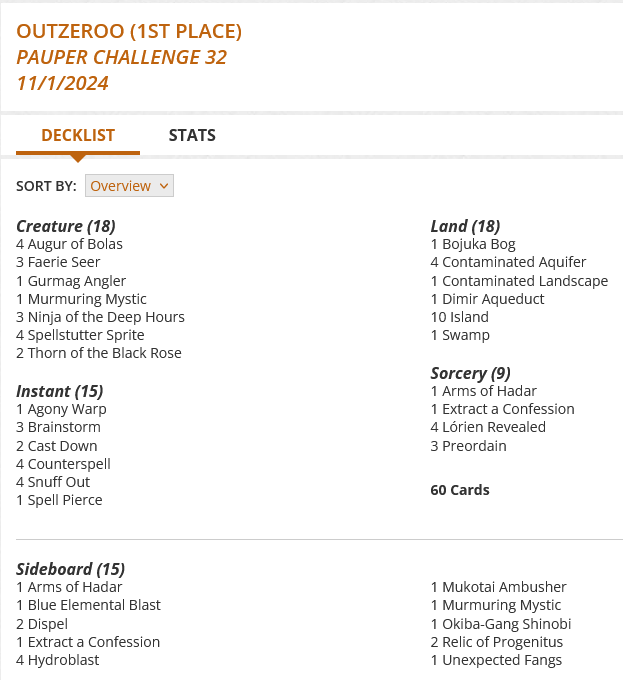
4 Spellstutter Sprite
1 Suffocating Fumes
1 Swamp
4 The Modern Age
1 Thorn of the Black Rose
2 Tolarian Terror

Sideboard
1 Annul
1 Arms of Hadar
3 Blue Elemental Blast
1 Bojuka Bog
2 Dispel
1 Extract a Confession
2 Hydroblast
1 Murmuring Mystic
1 Nihil Spellbomb
1 Thorn of the Black Rose
1 Unexpected Fangs

What about the other Spellstutter Sprite deck? A hybrid of Murmuring Mystic Dimir Control and old school Dimir Faeries has emerged. Lumped together with traditional Dimir Faeries in my tracking, this deck is not as tempo oriented as previous builds and leans harder on the control side of things. Instead of relying on Faerie Miscreant or Faerie Seer to improve upon Spellstutter Sprite, it goes with Sneaky Snacker. This build wants to keep the board clear an eventually overwhelm with either Mystic or Thorn of the Black Rose. Over the past two weeks these decks have an aMSAR score of 0.52 and have 10.65% of the Winner’s Metagame (compared to 9.38% of the Top 32 meta).

These decks are emerging as contenders in the format but currently have to contend with the top three decks of the last two weeks: Blue Terror (aMSAR of 0.99), Grixis Affinity (0.99), and Kuldotha Red (0.80). Three of the top five decks are leaning on Counterspell strategies which could create an opportunity for Glint Hawk builds to come back to try and out-grind the blue mages if they can also solve for Broodscale Combo. And on the lizard front I would also anticipate more decks leaning on Mesmeric Fiend for their disruption as opposed to Duress.

I want to take a moment to thank all my Patrons I am going to do my level best to keep providing you with the kind of content that brought you here in the first place. If you are interested in supporting my work, rewards for my Patreon start at just $1.

Can’t make a commitment to Patreon? I have a Ko-Fi where you can make a one time contribution.

Looking for another way to support my work? Click here for my TCGPlayer affiliate link. Any purchases through the link let the folks there know you like my content!
Labor Day-bor Commander

It’s been a while since I’ve indulged myself in the “dash of Commander” that this page purports to support. So today I’m putting off tracking last weekend’s Pauper Challenge recap for a bit to talk about the three games of Commander I got to play yesterday. Self-indulgent? Sure. But I finally feel like I have something to say about the format.

One of my biggest truisms when it comes to writing (and really, creating content in general) is that you have to have something to say. This has been my biggest struggle with writing about Commander, largely because I find the entire format to be so personal. With Pauper there is a metagame and tournaments, a best deck for a given event and new cards to constantly evaluate. Commander, to me at least, is less about the latest cards.

So then what is it about? That’s harder to nail down. It is absolutely a social experience (which my games yesterday were) but that isn’t always the case. More often than not for me it is about solving a puzzle. Win or lose if I get to set up a challenge for myself and meet it, I was able to participate in the game. Now this is often easier to accomplish with known associates but with good pregame conversations they can happen in open play scenarios. Now these conversations are not always easy for people to have and due to the nature of my work I have had a lot of practice in guiding these discussions so I’m able to jump start these chats.

The biggest advice I can provide here is to practice “I Statements”. Clearly state what you would like to get out of the game and have everyone do the same and adjust accordingly.

Back to Labor Day 2024. As a 40-something with a full time job and a family it can be hard to get a regular gathering together. Over the past few months I’ve managed to assemble a semi-regular play group that has met up a handful of times. A few weeks ago we started up the chain again and settled on Labor Day as a good time to get together for some games. And so we did: myself, Andrew, Ryan, and Anthony.

While these particular collection of folks as a regular play group is relatively new all of the players are veterans of the New York City Magic and Commander scene. One reason that this group works is we all operate on a similar axis and have similar expectations for what we want games to look like. And I cannot remember the last time I had three games that were as good as the set we played yesterday.

Game 1: Ryan (Dakkon Blackblade), Anthony (Pippin, Warden of Isengard/Merry, Warden of Isengard), Alex (Captain Storm, Cosmium Raider), Andrew (Duke Ulder Ravenguard)

My Captain Storm deck is one I built when I realized the absurd interaction between the Commander and Animation Module where every mana available leads to another +1/+1 counter and another Servo. Andrew was the person who keyed me on the strength of Animation Module and it’s been a pet card ever since. Captain Storm is all about trying to one shot players with Commander damage and then use Fling effects to steal games. Things started out well for me with an early copy of my Commander with Sunshot Militia. Gleaming Geardrake, Crime Novelist and Forensic Gadgeteer all going. I was able to apply pressure but was at the whim of various removal spells. Ryan had Dakkon carrying the Blackblade Reforged to fight in the Arena while Anthony had Kambal, Profiteering Mayor keeping his life total high. He also had Tarrrian’s Journel going but had no idea what the back face of the card could do. Andrew was slower to develop and helped to progress the game with Spectacular Showdown into a board wipe (Austere Command I believe). That set me back as I had Animation Module ready to go off with Ashnod’s Altar and Chandra’s Ignition in my hand. But then Dakkon came in a dealt me lethal Commander damage and Ryan mopped up everyone else in short order.

Game 2: Andrew (Horobi, Death’s Wail), Ryan (Kraum, Ludevic’s Opus/Tormod, the Desecrator), Anthony (Chulane, Teller of Tales), Alex (Imoti, Celebrant of Bounty with Keruga, the Macrosage Companion)

This game was a wild ride. Andrew had an early Mirage Mirror which threatened to machine gun the entire board thanks to Horobi. Ryan was assembling his zombie horde and trying to pressure life totals with Nekusar, the Mindrazer. Anthony’s deck was blink focused and leaned heavily on Lagrella, the Magpie for full shenanigans. Imoti’s puzzle, for me, was in the deck build in an effort to maximize the wild swings inherent with Cascade. I managed to resolve a Hurl Into History against Ryan only to draw the Equilibrium rather than put it into play in the face of Anthony’s Reclamation Sage. I ended up drawing a ton of cards thanks to my copy Nezahal, the Primal Tide. Nezahal kept me in the game as I was able to rebuild from board wipes and targeted removal. Alchemist’s Refuge and Winding Canyons gave me ample opportunity to try and sneak threats into play but eventually Anthony had enough creatures to go with his Mirror Entity and was able to deal lethal to all three of us over two turns.

Game 3: Ryan (Daretti, Scrap Savant), Anthony (Ludevic, Necro-Alchemist/Vial Smasher the Fierce), Alex (Laughing Jasper Flint), Andrew (Yusri, Fortune’s Flame)

While it did not come up in this game, Andrew’s Yusri deck is a Rule Zero affair with Wish and a pack of cards to replicate the spell from Dungeons & Dragons. This game was played under the threat of Ryan and his Dragonspark Reactor which thanks to the nature of his deck could kill the table in one shot between Stuffy Doll effects and Rings of Brighthearth. Anthony’s deck was Grixis Deterrent Control and forced the table to go after each other while Andrew was flipping coins and drawing cards. Me? I was slowly building up an army of Outlaws which granted me access to my opponent’s cards. The key play came when Anthony tried to Blasphemous Act the board away only for him not to pay the one for Andrew’s Rhystic Study, which in turn drew Andrew An Offer You Can’t Refuse and keep the board well stocked. Ryan went for the OTK with Dragonspark Reactor only to be stymied by interaction from Anthony, and then Ryan pushed Anthony to single digits. That knocked Anthony low and when he went for Prisoner’s Dilemma both Ryan and I took a dozen to the dome, knocking Ryan out of the game. Whip of Erebos was keeping me alive and I managed to Author of Shadows back Prisoner’s Dilemma which took Anthony out and then had Dire Fleet Daredevil to snipe Andrew’s Delayed Blast Fireball from his graveyard and take the game.

These games were all great. We all were able to impact the outcome. There were big plays and massive swings and all of us had a shot at winning every game. Now the problem is we all want to do it again…

I want to take a moment to thank all my Patrons I am going to do my level best to keep providing you with the kind of content that brought you here in the first place. If you are interested in supporting my work, rewards for my Patreon start at just $1.

Can’t make a commitment to Patreon? I have a Ko-Fi where you can make a one time contribution.

Looking for another way to support my work? Click here for my TCGPlayer affiliate link. Any purchases through the link let the folks there know you like my content!

The First Four Weeks of Bloomburrow

Want to learn more about the metrics I use in tracking the metagame? You can find an explainer here.

Now that the school year has started (or rather, that New Student Orientation has ended), I hope to be able to return to a more regular posting cycle. My gastroenterologist tells me that being regular is a good thing. He also tells me I’m full of…

Anyway.

As I discussed last week, Bloomburrow season feels much more like an extension of Modern Horizons 3 than its own entity. A look at my latest Power Rankings highlights that despite a new set of cards the current state of things is largely defined by what has come before. Today I want to dive a little deeper into the stats and try to suss out a bit more information that did not quite make it into my other articles.

Gruul Ramp has been the most popular deck this season with 11.98% of the Top 32 metagame and 12.5% of the calculated Winner’s Metagame. These numbers are far from gaudy as in past seasons one could reasonably expect the top decks to take down north of 15% of the Winner’s Meta. It’s Adjusted Meta Score Above Replacement is a healthy 0.98, placing its performance firmly above average. But the story of this strategy is one of mild decline.

4 Annoyed Altisaur
4 Arbor Elf
4 Avenging Hunter
4 Boarding Party
4 Eldrazi Repurposer
15 Forest
4 Generous Ent
4 Malevolent Rumble
1 Mountain
1 Oliphaunt
4 Utopia Sprawl
4 Wild Growth
1 Wooded Ridgeline
4 Writhing Chrysalis
2 You Meet in a Tavern

Sideboard
3 Breath Weapon
2 Cast into the Fire
4 Deglamer
3 Gorilla Shaman
3 Weather the Storm

It led the pack in the first two weeks of the season with aMSAR scores of 1.17 and 1.29 before underperforming in week three with a score of -0.23 before bouncing back last week with a 0.16. All told this appears to be the story of a deck that was able to attack an underprepared metagame. Once people got wise the deck came back to earth. Already we have seen some players move back towards Mwonvuli Acid-Moss (but not Thermokarst) as another way to leverage the mana bump from Writhing Chrysalis.

3 Blood Fountain
2 Candy Trail
2 Cast Down
4 Deadly Dispute
4 Drossforge Bridge
4 Galvanic Blast
2 Great Furnace
4 Ichor Wellspring
2 Kenku Artificer
3 Krark-Clan Shaman
4 Mistvault Bridge
4 Myr Enforcer
2 Nihil Spellbomb
4 Reckoner's Bargain
4 Refurbished Familiar
2 Seat of the Synod
3 Silverbluff Bridge
1 Swamp
2 Thoughtcast
1 Toxin Analysis
3 Vault of Whispers

Sideboard
2 Cast into the Fire
4 Duress
3 Gorilla Shaman
3 Hydroblast
2 Red Elemental Blast
1 Toxin Analysis

It has become impossible to talk about Pauper without discussing Grixis Affinity. After the Monastery Swiftspear ban, Grixis Affinity emerged as the de facto best deck in the format. While it alone does not define the metagame, its position as the premier control deck puts some limits on what can be done in the format. The Modern Horizons 2 Bridges tie all of Grixis’ synergies together, providing amble fodder for the format’s darling board wipe Krark-Clan Shaman. As someone who has been playing Pauper for nearly two decades (that sound you hear are my knees grinding into dust) it is both wild and awesome. The current tech is to pair it with Toxin Analysis to take out everything on the ground and gain a bunch of life.

Neat.

Grixis started off slow, going from an aMSAR of 0.14 before jumping to 0.81 and 0.91 in Weeks 2 and 3. Last weekend it took a leap to 2.09 (which was somehow only good for the second best showing), ending the last month with a 1.26, a full 0.28 better than Gruul Ramp. With 11.72% of the Top 32 metagame and 13.77% of the Winner’s Meta, Grixis Affinity is once again setting the pace for Pauper.

4 Basking Broodscale
2 Blood Fountain
4 Cleansing Wildfire
4 Deadly Dispute
4 Drossforge Bridge
2 Duress
2 Evolution Witness
2 Fanatical Offering
4 Forest
4 Ichor Wellspring
2 Implement of Ferocity
2 Krark-Clan Shaman
2 Makeshift Munitions
1 Mountain
4 Sadistic Glee
4 Slagwoods Bridge
3 Swamp
2 Tamiyo's Safekeeping
4 Twisted Landscape
4 Writhing Chrysalis

Sideboard
2 Breath Weapon
2 Duress
2 Gorilla Shaman
4 Snuff Out
2 Troublemaker Ouphe
3 Weather the Storm

All of this is before we get to the Eldrazi in the room: Broodscale combo. It’s only recently that the builds are starting to settle with two main camps emerging: a relatively creature light dedicated combo Golgari build and a more midrange Jund execution of the strategy. Regardless, the decks win the same way – generating an unbound number of tokens and colorless mana thanks to Basking Broodscale and Sadistic Glee. The spout might be different, but the machinations bear more than a passing resemblance.

4 Basking Broodscale
3 Bloodrite Invoker
3 Chromatic Star
4 Deadly Dispute
2 Duress
2 Energy Refractor
4 Eviscerator's Insight
4 Foreboding Landscape
4 Forest
4 Ichor Wellspring
2 Khalni Garden
2 Last Rites
4 Malevolent Rumble
4 Sadistic Glee
8 Swamp
4 Tamiyo's Safekeeping
2 Tree of Tales

Sideboard
4 Drown in Sorrow
2 Duress
2 Gut Shot
1 Last Rites
4 Snuff Out
2 Weather the Storm

Given that these are two distinct archetypes, their aMSAR scores are split. Needless to say they have both consistently performed at the average or above, with Golgari Boodscale netting a four week score of 0.66 while Jund is just behind at 0.6. Comparing this macro strategy to the rest of the field, at least at a glance, means utilizing a combined Winner’s Meta share. Broodscale Combo start at a combined 16.8% of the Winner’s Meta, moving to 20% in Week 2, down to 16.44% in Week 3, and finishing at 20.28% in Week 4. Looking at the entire month, Broodscale Combo accounted for 18.23% of the total Top 32 metagame and 18.18% of the Winner’s Meta.

2 End the Festivities
4 Experimental Synthesizer
1 Fireblast
4 Galvanic Blast
4 Goblin Blast-Runner
4 Goblin Bushwhacker
2 Goblin Grenade
4 Goblin Tomb Raider
4 Great Furnace
3 Implement of Combustion
4 Kuldotha Rebirth
4 Lightning Bolt
14 Mountain
2 Reckless Lackey
4 Voldaren Epicure

Sideboard
4 Cast into the Fire
2 End the Festivities
3 Gorilla Shaman
4 Pyroblast
2 Relic of Progenitus

So far we’ve discussed ramp, control, and combo. The aggressive deck I want to highlight should not be a shock to anyone in that it is Kuldotha Red. With an aMSAR this season of 0.52 thus far and 8.31% of the Winner’s Metagame (which is largely in line with the 8.33% of the Top 32 metagame), Kuldotha Red has fallen back in the metagame just a bit. Overall the format has gotten more powerful and as such the stagger strength of the deck does not appear to be as daunting. There has been some evolution in the archetype with a few pilots opting to move into a move Goblin heavy build- Goblin Grenade has become a baseline inclusion but some players have decided to further empty the warrens for cards like Goblin Sledder.

4 Boomerang
4 Brainstorm
3 Consider
4 Counterspell
4 Cryptic Serpent
2 Deep Analysis
4 Delver of Secrets
1 Dispel
15 Island
4 Lórien Revealed
4 Mental Note
1 Murmuring Mystic
1 Sleep of the Dead
1 Spell Pierce
4 Thought Scour
4 Tolarian Terror

Sideboard
4 Annul
1 Blue Elemental Blast
1 Dispel
1 Echoing Truth
3 Hydroblast
3 Nullify
2 Steel Sabotage

Finally I want to take a moment to talk about Blue Terror. The strategy is currently third in aMSAR score at 0.73 and has 10.4% of the Winner’s Meta. Counterspell remains a fantastic card and Blue Terror is one of the better shells to leverage the card. Tolarian Terror can end games in short order which makes it a well suited threat to capitalize on the tempo gained by countering a key spell. Like other strategies these builds adjust from week to week, moving from Boomerang to Deem Inferior to other bounce spells in an effort to find the best path to victory.

Overall, Pauper appears to be in a good place. While there are decks that are clearly in a class of their own, no one of them are so good as to make picking a divergent strategy a clear mistake. In practice these six* archetypes represent almost 61% of the Top 32 metagame and just over 63% of the Winner’s Metagame. Compare this to season’s past where specific archetypes would easily chew up north of 20% of both shares. Pauper is experiencing a power surge at the moment – a shock tot he system – and it might take a while for the other strategies to catch up. I for one am excited to see what Duskmourn has to offer the format, provided it doesn’t take the shape of a jump scare.

I want to take a moment to thank all my Patrons I am going to do my level best to keep providing you with the kind of content that brought you here in the first place. If you are interested in supporting my work, rewards for my Patreon start at just $1.

Can’t make a commitment to Patreon? I have a Ko-Fi where you can make a one time contribution.

Looking for another way to support my work? Click here for my TCGPlayer affiliate link. Any purchases through the link let the folks there know you like my content!