I want to take a moment to thank all my Patrons. I am going to do my level best to keep providing you with the kind of content that brought you here in the first place. If you are interested in supporting my work, you can sign up for my Patreon starting at just $1.
Can’t make a commitment to Patreon? I have a Ko-Fi where you can make a one time contribution.
If you are reading this then you either regularly follow my work or you were brought here by a teaser I wrote. Regardless, welcome to my corner of the internet. This piece will serve as a way to organize my thoughts about the September 27 announcement of the 2026 Magic: The Gathering release schedule. The sheer volume of product: seven Standard legal releases, including four from the Universes Beyond line, is a lot. Couple this with some Secret Lairs that make no sense to me (and apparently many others) and there was a lot of discourse floating around the pockets of the internet I inhabit. So what’s a writer to do but write, so here I go. I’m not going to try and extrapolate my feelings to the wider audience here – this is how I feel. If any of that resonates with you then I’m grateful to have helped given workd to your emotions.
The Soul of the Game
I found Magic in grade school. I was already a voracious reader of fantasy novels by the time I saw the cards and the idea of being part of a story drew me to the game. Part of this, I’m sure, was power fantasy. I was (and am) short and was not athletically inclined until college. The idea of being a powerful wizard summoning monsters to do battle on my behalf was enticing. As my friends started to drift away I dug deeper, scouring the internet and reading magazines (remember those?) to find places to play. That led me to Neutral Ground – my first Local Game Store – and a community I returned to through graduate school.
Time and time again Magic served as an escape. When I was struggling with my assistantship supervisor in my Master’s Program, there was Magic to give me a sense of comfort. When my first job kept me in the suburbs I was able to find another game store for Friday Night Magic and Prerelease events. Returning to Brooklyn for my second job led me to yet another store and a new community. Throughout these points in my life I was writing – whether for articles or forum posts – I was engaged with other people about the game. Time and time again what kept me engaged with Magic was not just the experience of sitting down and shuffling cardboard or clicking my screen but rather the opportunity to share those moments with other people.
In the fallout from yesterday’s announcement I have seen some decry to loss of the game’s soul. That somehow this shift away from original settings somehow lessens the totality. On some level I agree. I was (and still am) enamored with the worlds of Magic and while I did enjoy comic books as a kid I never found the same thrill in the Marvel Universe. Even though I devoured fantasy novels I never completed reading The Lord of the Rings Trilogy. I fell in love with Magic because of Magic and though I wish we spent more time with those original worlds I still enjoy every visit.
Over time I came to realize the soul of the game was not these worlds or the characters, but the people. The gorgeous and full settings pulled me in but it was the draw of connection that kept me coming back. If it were not for the community I would have lost interest long ago. They say it truly is about the gathering but the game is nothing without the people.
Indifference
There’s been a lot of discussion over the years about the emotional reaction and resonance of Magic. The idea that at some point there is going to be something distinctly For You. These are the things that you hold dear; that you love. It follows that there are going to be somethings that are not for you. Maybe these are things you despise but I would argue that the worst thing one can feel towards Magic is indifference. If I love a set and hate the next, I can look at the upcoming one for something else I love. It can keep me engaged. What happens if that hate is replaced with nothing – a middle of the scale emotion? If there are too many sets where I am completely indifferent then perhaps I look for that community elsewhere.
A Magic set used to be a rarer thing. There was more time to sit with and digest a world. They were surgical and had to hit as many player types as possible. Now Magic releases seem to never stop with the goal being “like what you like”. I am not sure if this is better or worse in aggregate. I find cards I enjoy everywhere and some sets that definitely resonate with me. I cannot speak for everyone but then again my relationship with the game has changed. I may be indifferent to entire settings but there is always at least a card or ten that pique my interest and make me smile.
The Constant
The world is uncertain. Speaking nothing about the state of global affairs and the current state of my country of residence, things that I once believed to be stable no longer appear that way. And that is scary. I am also a parent and nothing prepares you for the challenges of raising a human who is constantly changing. Personally, surgery and chronic illness have altered the course of my life. But Magic has been a constant.
Magic has become a touchstone for me. A way to find a piece of calm in the chaos of existence. Yet Magic has continued to change, albeit in different ways. The game today is not the same as the only I played on the school yard black top as a ten year old. Part of me misses that, but I think what I miss more is the stability that Magic represented. A world for three sets, then two, then one. Worlds I didn’t know being introduced to me over the course of three acts before being condensed into snapshots, and then some of them replaced with worlds that I did know and yet felt entirely alien. Magic is still a constant in my life but the motion sickness pill it provided doesn’t hit the same way.
Bandwagoning
Part of who I am is defined by Magic. I have written about the game for over a decade. I have worked with Wizards of the Coast in some capacity for several years, whether through coverage or the Pauper Format Panel. There are people I have met along they way who are not nearly as engaged but they still feel a strong affinity towards Magic. They are not people who play but rather they are Magic players. Developing an identity is not an easy thing to do and having part of who you believe to be changed by external forces can be jarring. Yet for much of the time the thing that brought the community together was Magic.
What happens when someone finds this community through other means? Whether it’s Doctor Who or Spider-Man or the next entry in Universes Beyond, are they any less of a Magic player? A driving force behind the production of cards for years has been acquisition – getting new players into the game. I have seen first hand people brought in by Universes Beyond become Magic players. Is their experience any less valid?
I am a die hard Mets fan and while, as I write this, they are not making the postseason they are still a team set up for success. I have been a fan of the Mets for almost 30 years, through many lean times. I have seen their home stadium empty and full. Fans who engage during the boom times sometimes get chastised as “jumping on the bandwagon”. and maybe they fall off. But when they stick around and engage more deeply with the fandom, then the highs and lows they experience are not that different from my own.
I can’t speak for everyone but I remember feeling like I was an outsider for playing Magic. I have to imagine others felt the same way. Now that the game is popular I don’t want to make others feel unwelcome because of how they found their way to this space. The soul of the game is the people.
We Live in a Society
I cannot write about this moment without acknowledging that currently, for worse, we live in a capitalist system. Profit drives so much of what is served to the world on a daily basis and that is something that leaves me, personally, feeling uneasy. But this is the system in which we currently operate, and that means that for some the line must always go up. This is not new to Magic and one could argue has been part of the game since it was impossible to find packs of Alpha. The difference is that today it is much more in our face and we are constantly bombarded with the siren song of spending. Can there still be art to the game? Has art always existed under capitalism? I want to say yes but I can fully understand and appreciate folks who disagree. Even me writing these words is, in a sense, done so with the intent to generate views: a non-monetary commodity.
Magic is bigger than it has ever been. Players, like me, have other things that pull at their attention. I don’t buy as much product as I used to and instead I target my purchases for maximum enjoyment. I want to visit conventions and engage there, as I am sure many others do. I play Commander at my local game store and at the homes of my friends. I am not rushing out to buy boxes. But there are people who do that and I would argue that as more people age into my bracket that the game needs people who are eager to grow their collection by leaps and bounds not to make sure that the line goes up but rather to make sure there is a line at all.
I don’t know. It hurts me to see people in my community unhappy. I hope people are able to find the joy and the soul again, in whatever way they so choose.
I want to take a moment to thank all my Patrons. I am going to do my level best to keep providing you with the kind of content that brought you here in the first place. If you are interested in supporting my work, you can sign up for my Patreon starting at just $1.
Can’t make a commitment to Patreon? I have a Ko-Fi where you can make a one time contribution.
Want to learn more about the metrics I use in tracking the metagame? You can find an explainer here.
Six weeks is a long time to go between Pauper recaps. So what happened? In a word, life. Not that this is the most riveting content in the world but I figured that you, reader, might want a tiny bit of insight as to what’s been going on.
Normally the end of August into the start of September is the busiest time of year for my work. This year we are down a person in our office but have no less work to do which puts additional pressure on those who remain. Couple that with a child starting second grade, the holidays, and follow up medical visits from my procedure back in May and you have a recipe for something hitting the back burner.
And truth be told, sometimes I just need a break. I’ve still been writing on this blog and started to dabble in making some Commander videos just to flex different muscles. But every so often I need to take a step back from Pauper to gain some perspective. This time that was about six weeks. But now that I’m going to be looking at pictures of Spider-Man…I mean traversing the Omenpaths… it’s time to dive back in.
There were eight weekends of Challenges in the Edge of Eternities season. There were eight decks which cleared the 5% threshold for volume of Top 32 presence and I’ll be taking a look at some those strategies today. That being said there are two decks who did not meet that threshold that are worth mentioning.
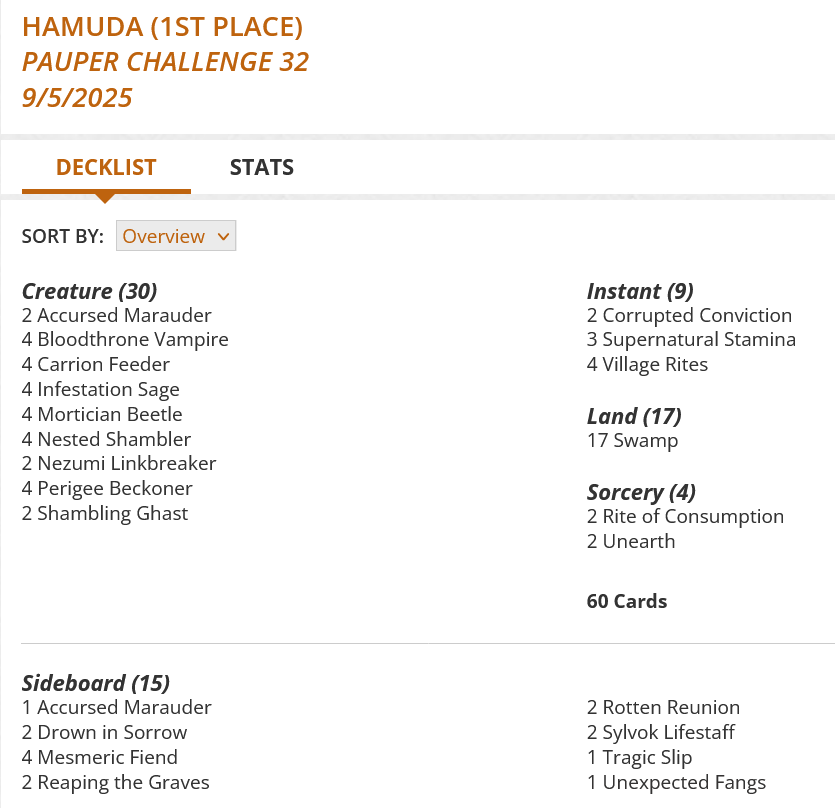
The first is Aristocrats or Black Sac. A strategy near and dear to my heart this deck got a boost in the form of Perigee Beckoner as two copies of the card can go infinite with a sacrifice outlet. This deck is just a pile of creatures that replace themselves and while is quite literally greater than the sum of its parts. Why talk about a deck that clocked in at under 2.75% of the Top 32 metagame over the season? Because it over performed by quite a bit in the back half of the season. Two wins in the last four weeks of Edge of Eternities season and an Adjusted Meta Score Above Replacement of 0.42 – second best over that span – means that this list should be one on your radar for the next season.
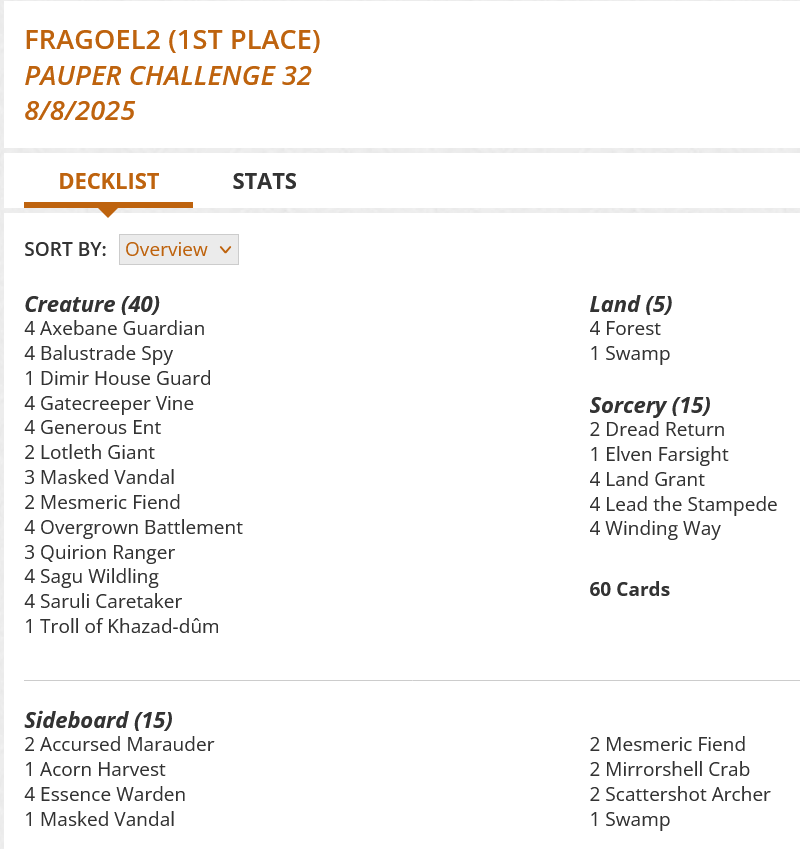
Spy Walls is the latest Pauper take on the infamous “Oops, All Spells!” strategy, except the Pauper version needs to run actual lands. While this deck has been around for quite some time (and previous versions ran a single land), the latest versions run between four and five lands and have also added other mana engines – whether they be Elves or Walls based. This deck got a lot of press at the start of the season as a powerful combo deck that was applying a ton of pressure to the metagame. The numbers are unclear, as the Walls version ended up as the seventh best archetype based on Winner’s Meta share and third best on AMSAR. However, in the final four weeks the strategy dropped to 16th in Winner’s Meta volume and AMSAR (with a score of -0.06, performing slightly behind an average Top 32 deck). Again, this is a deck to be on the lookout for but it appears as if the metagame has adjusted to its presence.
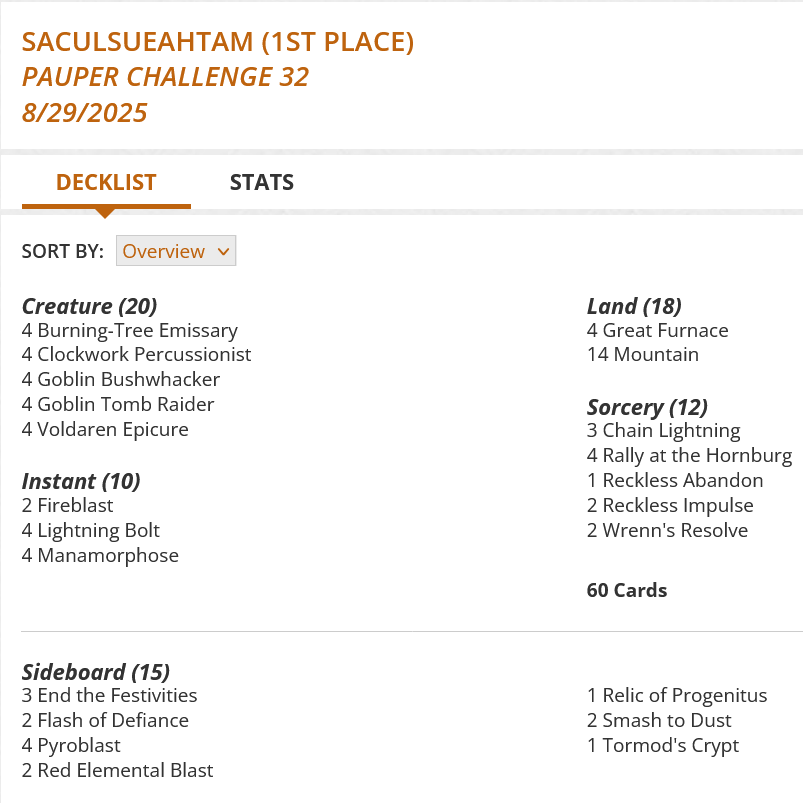
There are two different varieties of red decks that saw success during Edge of Eternities season. Rally Red – a low to the ground aggressive deck that can chain Burning-Tree Emissary into Rally at the Hornburg to swing in for damage immediately. This style of deck is nothing new to Pauper as it has similar play patterns to previous Goblin Bushwhacker decks. Rally Red acquired six Top 8s and a win out of 46 trips to the Top 32. Overall Rally ended up with 4.23% of the Winner’s Metagame (down from 5.68% of the Top 32 meta) and its AMSAR score of -0.01 tells us the strategy was decidedly average over the course of eight weeks.
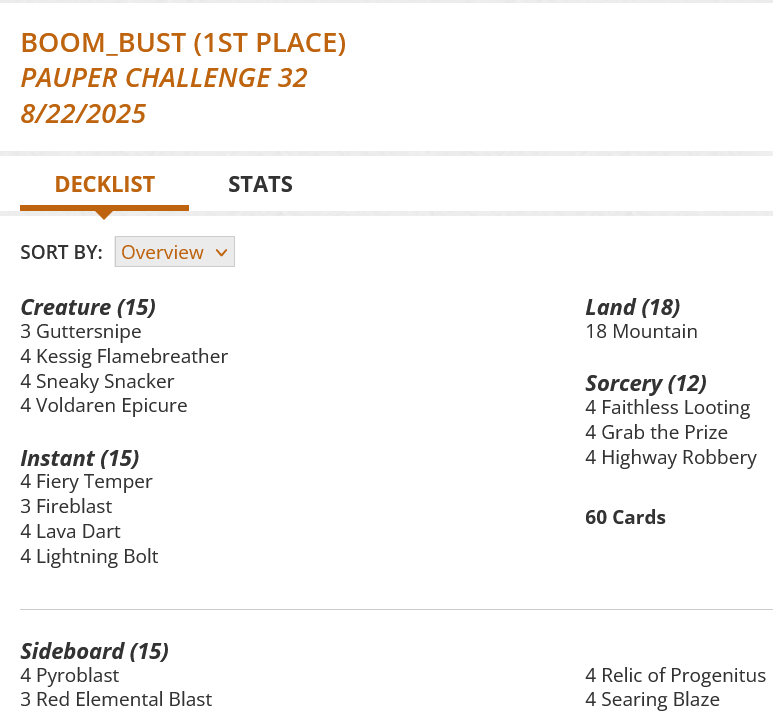
Compare this to Madness Burn. This deck wants to leverage Grab the Prize with Fiery Temper and Sneaky Snacker to ignore downsides while piling on the damage with Guttersnipe. Whereas Rally Red wants to turn creatures sideways, Madness Burn wants to point spells directly at the opponent’s dome. The deck holds a respectable 14 Top 8 finishes (including a win) in 61 Top 32 appearances. With 7.48% of the Winner’s Metagame (and 7.53% of the Top 32 meta), and an AMSAR of 0.29, Madness Burn looks to be the slightly better red option moving forward.
Let’s take a moment to talk about red’s position in the metagame. As we will see down the way, blue is a dominant force in the metagame. Having access to eightBlast effects gives the deck a fighting chance to win stack battles. Being well positioned against blue is important and the fact that both of these decks can go over the top of other strategies bodes well for them long term. If I had to pick one to be bullish on it would be the more direct burn version as it has slightly better counterplay to Weather the Storm and other lifegain.
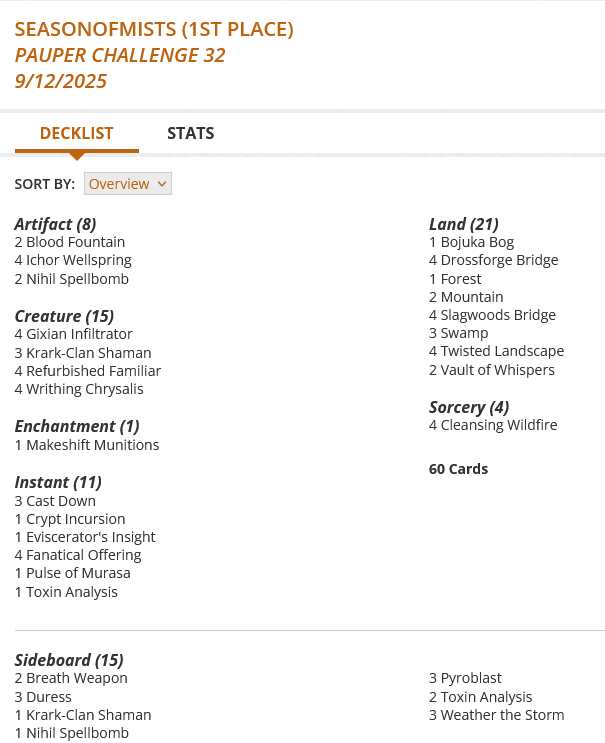
Jund Wildfire remains a stalwart of the Pauper metagame. The deck has cemented itself as the go-to midrange strategy in the format and has the results to back up how frequently it is played. Jund racked up 21 trips to the Top 8 with three wins in 92 Top 32 finishes. At 11.36% of the Top 32 metagame and 10.04% of the Winner’s metagame, if you play in an event you are likely to run into Jund at some point. An ASMAR of 0.36 puts it on the podium for the bronze on that metric and the deck continues to evolve. This season so the widespread adoption of Gixian Infiltrator as yet another threat that get large that also happens to dodge Snuff Out.
Blue Terror was the best deck on the season and it wasn’t even close. It was at the top of the AMSAR standings in five of the eight weekends and closed the season with a score of 1.09 – 0.63 better than second place. How many Top 8s? Three dozen. How many wins? Seven. 15.45% of the Winner’s Metagame are numbers that no other deck in the format can match. And it makes sense. Blue Terror can stick a massive threat early and protect it with countermagic, which has long been a winning strategy in Pauper. This is just one of the reasons those blasts out of the red decks are so valuable, but also why flooding the board with pesky tokens can buy the time needed to win the game.
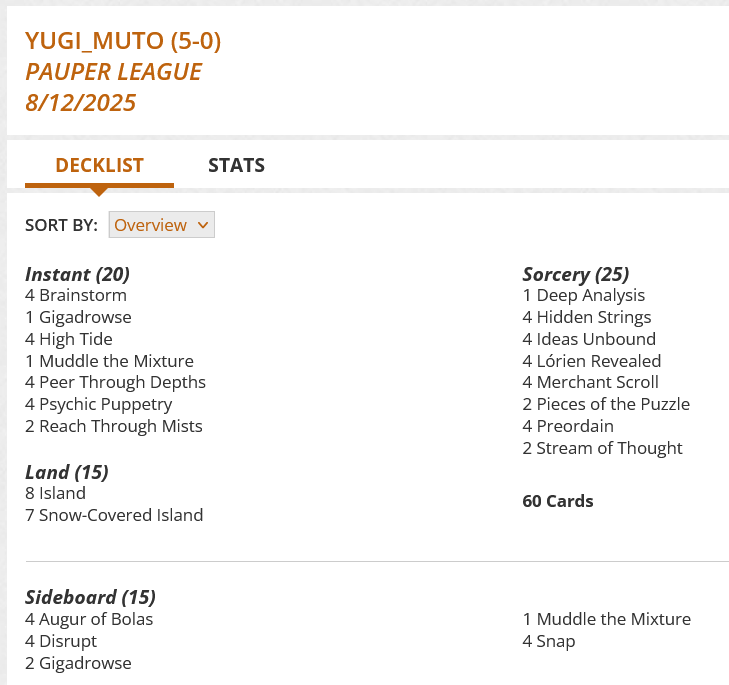
Hide Tide combo, by my estimation, is the second performing deck in the format. Based on AMSAR (0.43) and the delta between Winner’s Meta Share (8.59%) and Top 32 meta share (7.41%), it comes in behind Blue Terror and nothing else. Nineteen Top 8s and a pair of wins are no slouch either. Despite not being as popular as some of the other strategies available High Tide continues to put up rather strong numbers and continues to increase its metashare, especially as it comes to the winner’s side of things. At the same time the deck is becoming less popular. The deck has established itself as one of the best options in Pauper if your goal is to win.
What about the next release? While there are cards that have piqued my interest for niche strategies it does not seem that anything will shake up the top of the standings. Mono White midrange aggressive strategies get a new tool which can tussle in the red zone while Gruul Ramp now have access to a piece of ramp that has the potential to do some damage. Still, I do not anticipate the format to look drastically different in the coming weeks.
I want to take a moment to thank all my Patrons. I am going to do my level best to keep providing you with the kind of content that brought you here in the first place. If you are interested in supporting my work, you can sign up for my Patreon starting at just $1.
Can’t make a commitment to Patreon? I have a Ko-Fi where you can make a one time contribution.
I want to take a moment to thank all my Patrons. I am going to do my level best to keep providing you with the kind of content that brought you here in the first place. If you are interested in supporting my work, you can sign up for my Patreon starting at just $1.
Can’t make a commitment to Patreon? I have a Ko-Fi where you can make a one time contribution.
I want to take a moment to thank all my Patrons. I am going to do my level best to keep providing you with the kind of content that brought you here in the first place. If you are interested in supporting my work, you can sign up for my Patreon starting at just $1.
Can’t make a commitment to Patreon? I have a Ko-Fi where you can make a one time contribution.
I want to take a moment to thank all my Patrons. I am going to do my level best to keep providing you with the kind of content that brought you here in the first place. If you are interested in supporting my work, you can sign up for my Patreon starting at just $1.
Can’t make a commitment to Patreon? I have a Ko-Fi where you can make a one time contribution.
How do you build towards narrow cards? This is the question that has enamored me since I was introduced to Commander. There’s nothing wrong with picking a legendary that offers multiple paths – I’ve have more than one deck where such a card is at the helm – but I also derive joy from finding a general where I have to scour the entire history of Magic to find cards that fit and only if you squint just right. This is where love is found. There’s a fondness for the weird legends, the ones that when you take it out of the deckbox, members of the pod may be met with a card that they had no idea existed. These options do not have to be old but instead they may just not measure up to the current crop of commanders.
The (technically correct) way to build towards a narrow Commander is to find 99 other pieces of cardboard that you like and shuffle them up. Thank you for coming to my lecture, please leave a five star review. If you actually want a deck that does something you have to be more selective. You need to examine the card selected and think of everything it can do and build out from there. Given the entire legacy of Magic, the slowly shifting nature of the Color Pie, and the need to keep limited environments fresh, it feels possible to build nearly any archetype in any color identity. All it takes is the ability to see things in the context of that history instead of only the past few years.
This is easy for me to say. I am a full fledged adult who has been playing Magic since Revised (for the record my “break” came before Ice Age). I also went accomplished much of my schooling before the era of the omnipresent internet (and well before the era of the useless internet) and had to do research in libraries using microfilm and other antiquated concepts. There were times in college when I would find a book in the stacks and pore over the bibliography to check the source material on the off chance it would be applicable to my current endeavor. This is the approach one must take when looking at Commanders that play to themes not heavily supported in color identity.
While there is no central library for Magic there are plenty of sources. Scryfall and EDHRec both facilitate research. If you are able to search terms and find key cards in the former you can then see how people are applying that knowledge in the latter. This is my preferred way to use EDHRec as it can give me clues to cards that may have escaped my notice (being old means I can’t keep up with the cadence of new cards) while letting me leverage the pieces of cardboard that get stuck in my mind (looking at you Strands of Night). I want to show putting this method into practice using Crovax the Cursed.
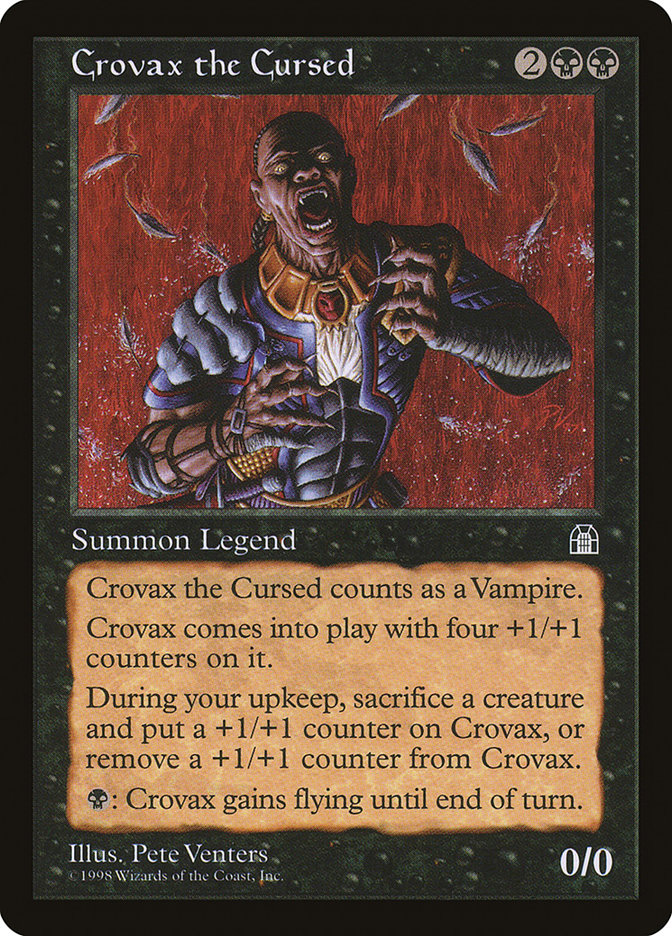
From the first time I saw Crovax I was enthralled. The Weatherlight Saga was in full force and the story was being revealed in the cards and the pages of The Duelist. This specific card depicted the moment that Crovax lost his humanity. The text says it all: he counts as a Vampire. He has to constantly feed to maintain his strength. Pete Venters’ art is striking in his signature manner. The line work is phenomenal, especially when shrunk down to card size. The lighting, the red, the feathers of the fallen angel; all of it communicates the moment. By modern standards the card is not very good but that does not matter because of the feelings it evokes.
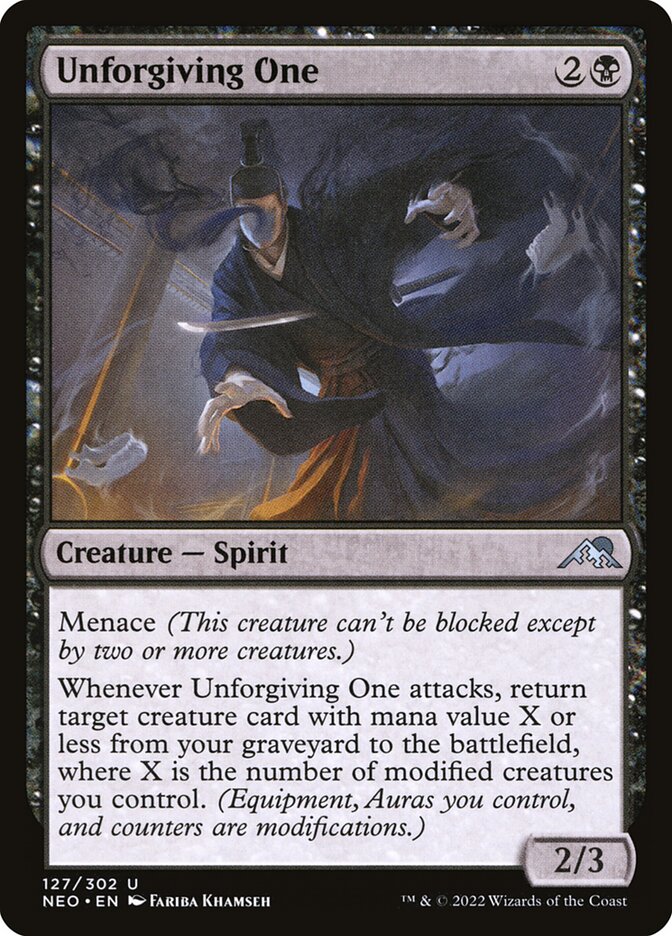
When cards get stuck in my brain I am always looking for other options that may end up working with them. Years after I first saw and built my initial Crovax deck, Unforgiving One was spoiled. I knew I wanted to play this card in Commander. It did not matter to me that the card was not especially powerful or that its thematic hook – Modified – was not exactly supported in black. The idea of conditionally bringing creatures back from the graveyard makes me smile and attacking is still honest. A copy was added to my collection even as I took apart the first iteration of Crovax.
But the idea of Mono Black Modified continued to tickled the part of my mind dedicated to deckbuilding. The release of Tarkir Dragonstorm and its focus on different counters – not just +1/+1 counters – gave me the spark of inspiration I needed to pull the Vampire Noble back out. Flipping through my collection I saw cards that added all manner of counters to my army, from Charnel Serenade to Isareth the Awakener. The hook’s hooks were in me and I started to look for auras and equipment that would fit the bill. While I have not found auras that spoke to me, it does not mean I’ll leave Chorale of the Void on the outs forever. Thankfully, for my opponents at least, I decided to leave my copies of Grafted Exoskeleton and Phyresis on the bench. Nevertheless I had the hypothesis for my research.
Narrow decks are some of my favorite ones to build and maintain. Honing in on a select suite of cards while also being able to find new and novel ways to engage with the entire history of the game keeps things entertaining. It also makes these decks easier to update as new cards are released. Looking at a card file for black cards that care about counters provides a set of parameters where it is entirely possible no cards could be added to the deck for months at a time. What a relief!
Building Crovax with an emphasis on Modified meant he needed to be a threat. Crovax needs to get large to punch players in their mouth while surviving long enough to do it again (and again, hopefully). This is part of the allure. Being able to fling him at an opponent with Rite of Consumption is a reasonable endgame (I still can’t find my copy of Essence Harvest) and Surestrike Trident doesn’t force me to sacrifice my Commander while also leaning into the Modified theme. Looking at other ways to boost Crovax’s power, Blade of the Bloodchief fits perfectly turning each piece of fodder fed to Crovax into three points of power. Tarrian’s Soulcleaver might not care about Crovax’s vampirism but can grow him all the same. Ring of Xathrid is a fantastic option that not only can protect Crovax but also keeps him alive if I am unable to feed him enough.
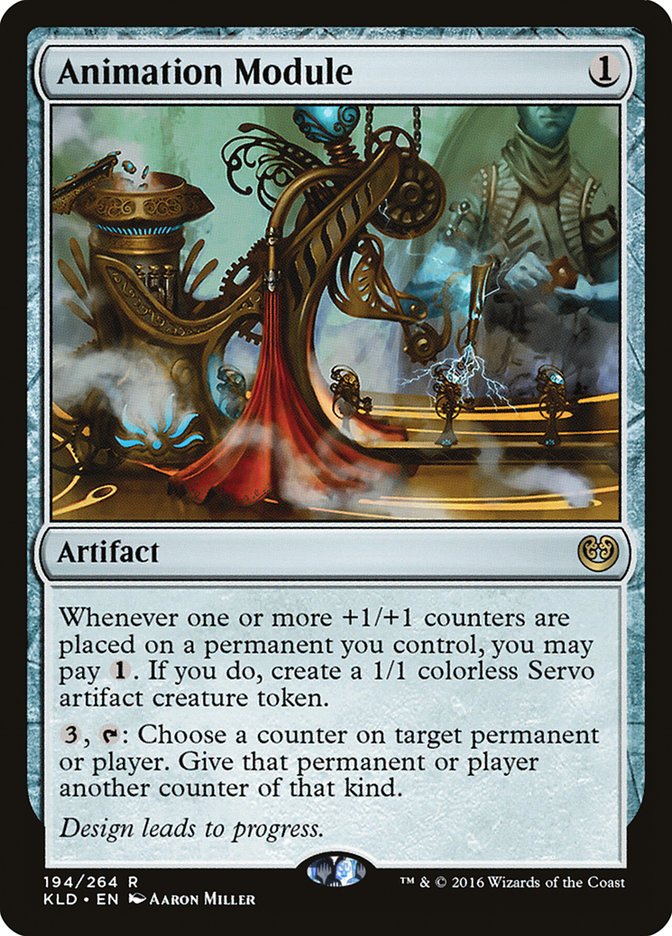
Caring about +1/+1 counters means I get to bust out one of my favorite trinkets: Animation Module. I am always trying to get this engine adjacent card to work and it shines here. When it is out on the board it turns Crovax’s upkeep cost into a scant one generic mana while also providing a pastiche of Proliferate. Animation Module cares about any +1/+1 counter being placed on a creature so actual Proliferate – Contagion Engine, Vat Emergence, and Vraska, Betrayal’s Sting – all find a home here as well. Now any of our creatures are able to grow tall.
What about going wide? As Unforgiving One cares about multiple creatures carrying enhancements, we need to look at options. Nikara, Lair Scavenger and Yathan Tombguard also want multiple creatures with counters and converts them into cards. Hagra Constrictor makes these creatures more difficult to block. Unspeakable Symbol is no Treasonous Ogre but it can convert life into damage. The three life is steep but does pay dividends in this build. Isareth and Charnel Serenade can bring these creatures back for one last rodeo as well, providing just enough of an oomph to make their finality clauses worth the cost of inclusion.
Noosegraf Mob is an odd duck. It comes in as a 5/5 but can provide a steady stream of bodies to block and feed to Crovax. There are plenty of ways to keep this zombie alive and spewing filth, from the equipment available to Mikaeus, the Unhallowed. It is also emblematic of cards in the deck that benefit directly from having +1/+1 counters placed directly on them – one only needs to look at Emperor of Bones or Fetid Gargantua to see what else can happen when you decide to feed your army of horrors.
The first time I played Crovax in its current rebuild it stumbled. Hard. Part of this was due to mana issues but a not so small part of the problem was the lack of relevant early drops. Bloodghast, Nether Traitor, and Reassembling Skeleton were slam dunks as they obliged the Noble. I had replaced more expensive card draw with Clattering Augur and Dusk Legion Zealot in an effort to speed up development. Still I needed more. The release of Edge of Eternities provided Timeline Culler as another persistent source of fuel. I leafed through my longboxes, found copies of Hangarback Walker and Marketback Walker as a smile spread across my face. Here were cards that could come down early. wanted to die, and worked with +1/+1 counters. It didn’t take much to convince myself of their worth
Now that I had all of these bonuses I needed to put them to good use. Retribution of the Ancients turns excess counters into creature removal and when combined with Mikaeus could help create a perpetually undying army. Retribution also enables the reactivation of an Adapt ability which can mean more cards from Fetid Gargantua or more hasted attackers from Emperor of Bones. Fain the Broker is a fiddly card that does a lot at a cost. However when there are counters to spare he can put it work.
The fact that Fain can remove Finality Counters does not hurt and provides some redundancy with Nesting Grounds to help keep the creatures coming back for more. Both the land and the Broker also allow creatures to continue to Adapt (are you sensing a theme yet?).
Then there’s Equipment. Loxodon Warhammer is a classic and helps to offset life loss. Ghost Lantern comes with Bind Spirit, leveraging both halves of the card. Lashwrithe not only makes a creature large but is also leaves behind a piece of fodder for Crovax. Banshee’s Blade is a neat card that leaves the counters on the artifact, meaning it can move its power around the board not unlike The Ozolith. There are other equipment that add counters to the creature itself – Armory of Iroas – but having one that is not contingent on its wielder surviving adds to the deck’s resilience.
This is my exploration of a narrow card that is anything but. I am not going to say that my Crovax deck is a world beater – if I wanted it to be stronger I would add another color. Skullbriar, the Walking Grave or Reyhan, Last of the Abzan or Grismold, the Dreadsower are all better decks for a +1/+1 counter theme that also come with green’s ability to multiply counters, and I have built each of these decks in the past. However each of them leaves something to be desired. These builds are, in many ways, prescribed. You can build any of these decks but how good are they without Hardened Scales and its ilk? There is nothing wrong with running these decks and leaning into the powerful options gifted by the additional color. But intentionally limiting yourself has more benefits than just bookkeeping – it can lower your threat profile.
Sitting down in any pod requires some level of assessment. Not only do you need to consider your position in turn order but you also must survey the other Commanders. If you are sitting in a regular group you understand more about your enemies but in open play you have to make snap judgements based upon known information. A card that screams +1/+1 counters at you is more likely to play with cards you have seen before and even if there are some minor differences the main thrust will remain the same. It is understood. If you take your Commander out and it is a narrow – or more likely worse – version of something of something established that can work in your favor. Your cards work in ways that may not be as easy to parse to the opponent’s providing an advantage. Playing cards that are present in fewer decks can also lead to being underestimated, which in turn can give you a chance to strike. At the end of the game this can lead to more enjoyment since everyone loves an underdog story.
If you are looking for something new for Commander night why not focus on something outside the box? Think to what card gripped you for the first time (of the fiftieth) and build with that in mind. You never know what relic you might uncover in your efforts.
I want to take a moment to thank all my Patrons. I am going to do my level best to keep providing you with the kind of content that brought you here in the first place. If you are interested in supporting my work, you can sign up for my Patreon starting at just $1.
Can’t make a commitment to Patreon? I have a Ko-Fi where you can make a one time contribution.
Want to learn more about the metrics I use in tracking the metagame? You can find an explainer here.
Normally when I start writing about a new season of Pauper Challenges on Magic Online I give the caveat that there’s not much to glean from one week of data. Two weeks in and we can start to see trends emerge. In my estimation here are the things you need to know about the shifting state of Pauper as you prepare for upcoming events.
Combo Summer?
Combo in Pauper is a daredevil walking a tightrope. It has to be just powerful enough to be competitive without being so dominant that it warps the format. Recently we have seen Basking Broodscale combo prove to be too powerful while other stalwarts – like the traditional combo version of WonderWalls – falling shy of the top tier. The introduction of High Tide combo into the metagame has provided Pauper with a combo deck, that while strong, has yet to dominate in the ways its predecessors has. While there are other complaints about the deck – namely around the way it impacts tournament operations and the clock – purely based on numbers High Tide remains a reasonable inclusion in the format. It’s strength as a spell based combo deck has opened the way for other decks that operate on more familiar axes to succeed.
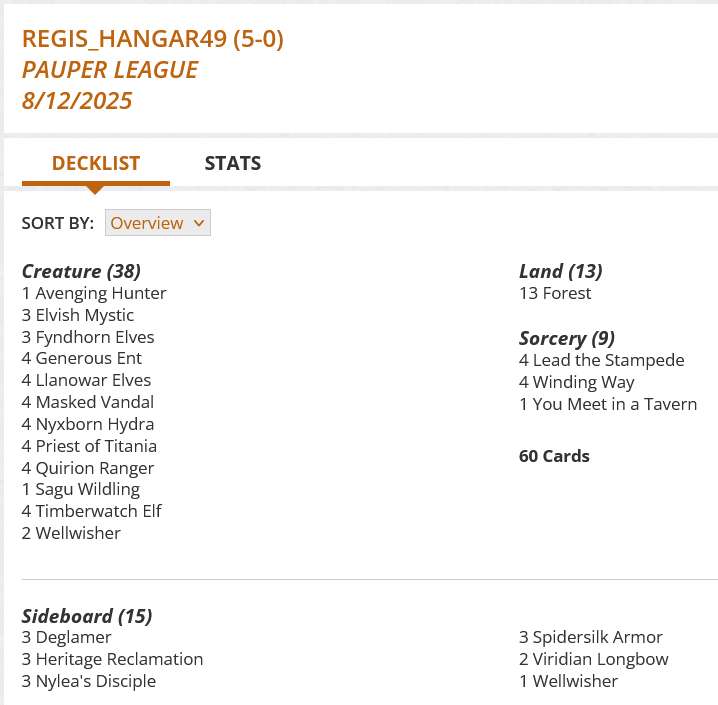
Elves, for all its little green creatures, is a combo deck. Operating on the principle of Hypermana, where every threat helps to progress you mana development to a top end, Elves snowballs quickly. The deck’s ability to deploy a large army for Timberwatch Elf or sink Priest of Titania mana into Nyxborn Hydra provides multiple angles of attack and the duo of Lead the Stampede and Winding Way means your hand is going to be well stocked. Elves excels at deploying these cards and, for the time being, has fewer board wipes to worry about thanks in part to High Tide and the other ascending combo deck.
I Spy Walls
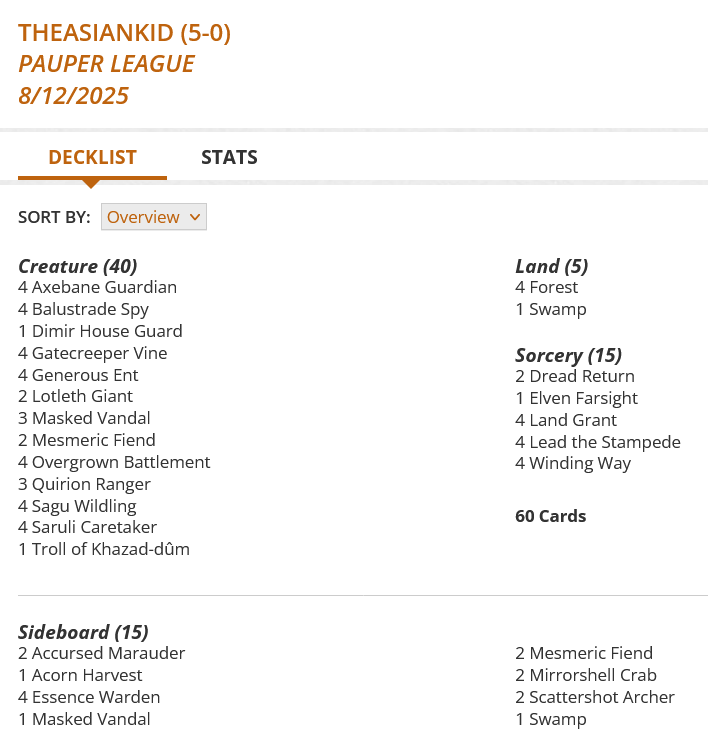
Balustrade Spy and Dread Return have been tearing up Legacy for quite some time and while these cards have both been legal in Pauper well over a year it is only recently that a consistent version of the combo has emerged. Spy Walls takes the mana generation from WonderWalls – which relies on creatures – and adds a Balustrade Spy kill line with Lotleth Giant. The Walls line means the deck has a fail case of just casting the Giant as well as Sagu Wilding and Generous Ent. The deck is a testament to the power of Pauper while also presenting something novel. Discourse around the deck has been largely around its strength but, despite its high placing in the Power Rankings later in this piece, I feel much of the talk is wasted words.
Spy Walls is a good deck but it has multiple failure points. Like many other Pauper combo decks it is highly vulnerable to graveyard hate. Part of the reason for its success is that out of the three main “combo” decks seeing play these days, it is the only one that leans heavily on the discard pile. In fact, each deck operates in a different sphere – spells, creatures in play, creatures in graveyard. This divergence means that there are very few “universal” answers to the combo threat at the moment which in turn has added to the success of these archetypes.
Wiped Clean
Krark-Clan Shaman and Toxin Analysis formed the backbone of board control in Pauper for the past several months. Both Grixis Affinity and Jund Wildfire leaned heavily on this duo to take out threats and bolster their life total. Both of these decks are falling rapidly down the Power Rankings. The lack of a strong board control deck in the format has helped given rise to Elves and the struggles of black based midrange means fewer copies of Bojuka Bog and Nihil Spellbomb floating around which gives graveyard decks a bit more breathing room. While I do not think Grixis Affinity will return to its former glory, I am more bullish on Jund.
Grixis Affinity is a collection of good cards held together with Artifact themes. Over the past two years, commons have been pushed towards existing synergies and Artifacts have become more prevalent. As such there are more cards that care about “noncreature” cards while abilities like Affinity are far more rare. The threshold to care about Artifacts has dropped to a single inclusion. In order to get the benefit of a card like Fanatical Offering you do not need to dedicate your deck to it – you simply need enough spare material. Affinity style decks will continue to see play – Refurbished Familiar is a hell of a Magic card – but the need to push hard in construction just is not there anymore.
What about Jund? This deck is, by nature, reactive. It needs to be built to match a specific metagame and the landscape has changed. Jund absolutely has the tools to adapt but given the cycle of a format it will take a few weeks for the correct threats and answers to bu sussed out before Jund can climb the mountain again. While I doubt the deck will fight for the top spot in Pauper, it is likely to be a top five deck before the season ends.
I See What UU Did There
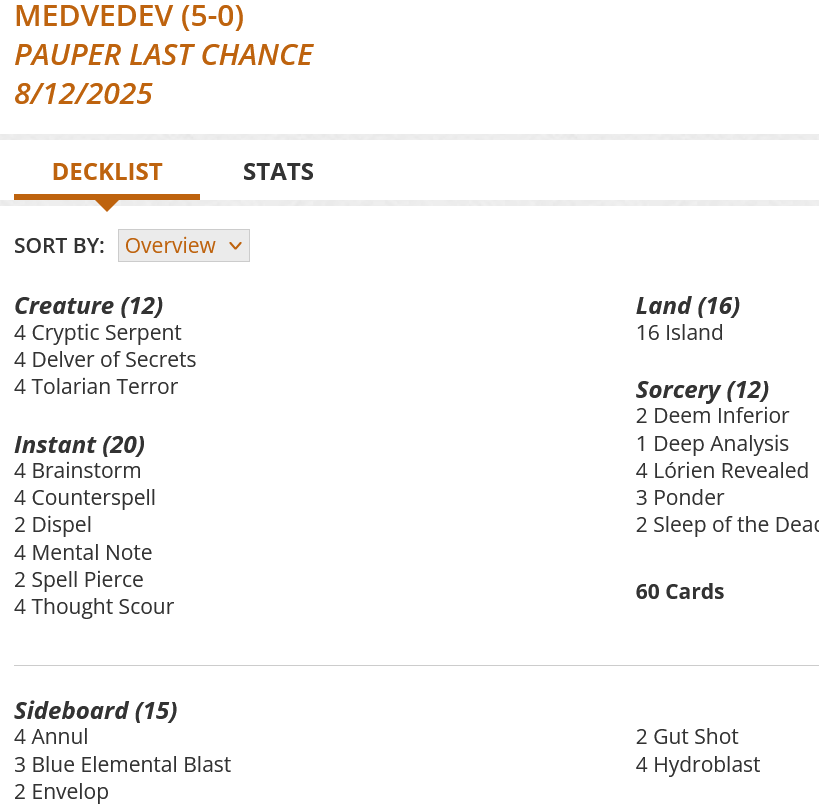
Blue Terror remains the best deck in Pauper. Faeries – a deck that struggled to find footing much of last season – has climbed four spots in the Power Rankings. This is a testament to the ability to say “no” with Counterspell and Spellstutter Sprite. In metagames where there is a wide array of problematic cards and multiple lines of attack, very little is as strong as shutting down a key spell. While Elves might be able to navigate around a single counter, High Tide needs to resolve a copy of its namesake while Spy Walls can fall flat if it took the wrong line in the face of countermagic. Terror has been at the top of Pauper for quite some time but Faeries is experiencing something of a resurgence thanks in part to a Jellyfish.
Illvoi Galeblade is not a Faerie, and it certainly isn’t Spellstutter Sprite. What it is, however, is a flash flyer that leaves up mana for interaction while also setting up a Ninja and cashing in for a card later in the game. This little push has been enough to make Faeries a real factor in the format heading into the weekend. Faeries is always lingering at the edges, ready to strike, and its time seems to be near.
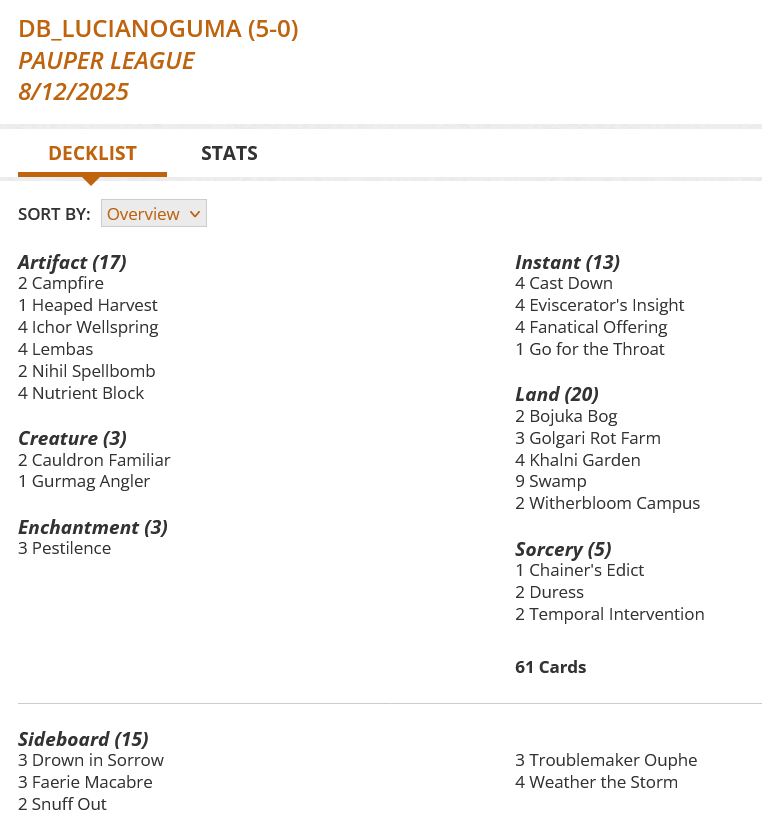
Looking ahead to this weekend I would be looking at something in the midrange camp that would have play against this wide field. Being the weirdo that I am I would be iterating on a Food Gardens lists that have added Nutrient Block to the mix while also having access to maindeck copies of Pestilence. These decks can gain gobs of life while also controlling the board. And who doesn’t love a chance to play Cauldron Familiar in a fair capacity?
I want to take a moment to thank all my Patrons. I am going to do my level best to keep providing you with the kind of content that brought you here in the first place. If you are interested in supporting my work, you can sign up for my Patreon starting at just $1.
Can’t make a commitment to Patreon? I have a Ko-Fi where you can make a one time contribution.
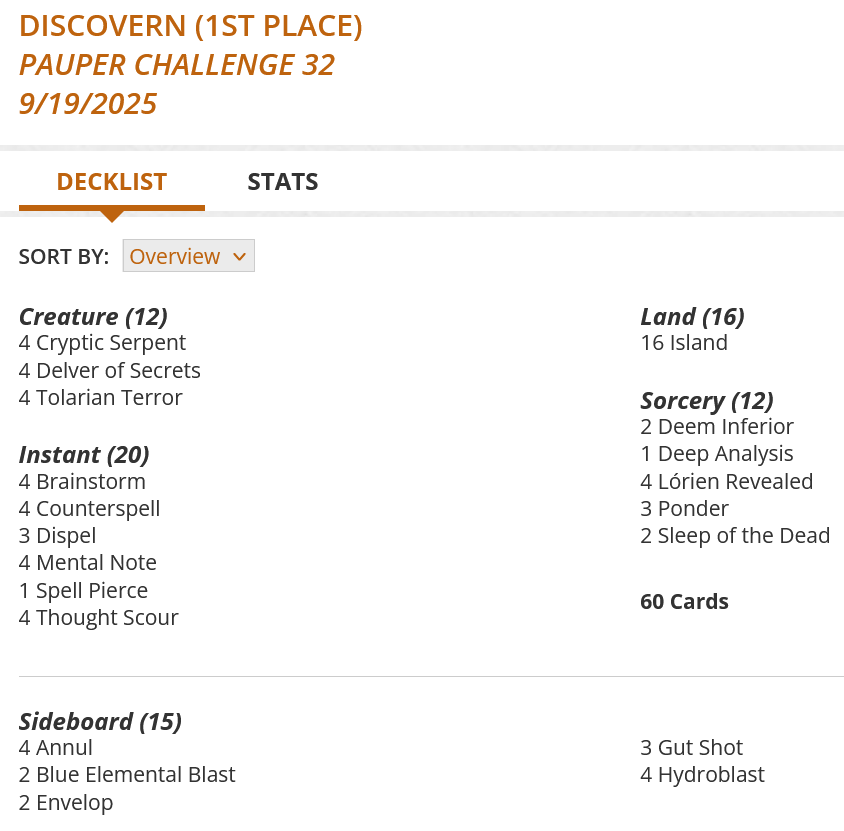
Recently, after Commander night I was standing outside my local game store with a friend and regular podmate. We had just finished our third game of the night where the two of us were the last players standing. Piloting my Sek’Kuar, Deathkeeper Aristocrats deck, I was able to whittle him down from 60 life to zero in a single turn. But that isn’t what he brought up. Instead he remarked that my deck was able to function, even without my Commander in play. He brought up the first game of the evening which I had also won, where my Pia, Consul of Revival deck secured the victory without the eponymous card on the battlefield. Clearly this conversation stuck with me as you are reading the words on this page. But why?
Let’s back track a bit. First off, I am a dinosaur in the world of Magic. I have been playing the game since Revised was fresh on the shelves and my introduction to Commander – then Elder Dragon Highlander – came before the Kaalia of the Vast was a physical Magic card. Back then even the most well oiled machine felt like they were held together with duct tape and a dream. In the intervening decade plus, Wizards has learned how to design for multiplayer even as they continuously push the envelope. Now decks that come out of the box can reasonably hold their own against tried, tested, and tuned homebrews. And that box matters because of who is plastered on the front.
Today Commander focuses far more on, well, the Commander. If Magic can be about personal expression then selecting a legend that leads a deck in some way is an extension of the pilot. The centering of the Commander also alters the way the deck functions in practice. When the Commander is an integral part of the strategy, the other 99 cards not only must support the Commander but also exist to turn that one card into a threat. In modern Commander every deck is a Voltron deck.
Voltron is a nickname for a type of deck where you enhance your Commander with the intent to attack. Whether it’s +1/+1 counters, auras, or equipment, the idea is to turn your Commander into an engine of destruction. These decks can falter when their centerpiece is dealt with, as the surrounding architecture only holds up when the general is on the battlefield. Now I am not saying every new deck that rolls off the printing press completely falls apart without one key card but when I look at Commanders printed since 2020 many are so powerful that their absence can cause the deck to stumble.
What does this have to do with the conversation I had? Back when I was learning the ins and outs of the format the cards were, by and large, worse. A deck had to have a strategy that, while not separate from the Commander, had to function in someway without it in play. This was not because the card in the Command Zone was any less a piece of self expression or important to the deck, it was just that they were cards not designed to be a Commander. When I rolled up to my meetups in the 2010s with Sek’Kuar, Deathkeeper, I had to have a deck built to support a five drop Commander that had no inherent protection and did not win the game on its own. These cards were just another cog in the machine; not Liquid Schwartz.
Part of this may have to do with how I was introduced to the format. Back when I started it was possible to shuffle a Commander into its owner’s library. The so-called “Tuck Rule” meant that a card like Chaos Warp could more or less ensure your opponent would never see their most important card again, I remember snatching up every copy of Void Stalker I saw, believing that they were going to be a terror at the tables. The existence of this rule practically necessitated building in such a way that your deck could function without its centerpiece; a lesson I carry to this day.
A deck’s reliance on a Commander is nothing new but the sheer number of strategies that begin to crumble without that 100th (or in many ways, 1st) card led me to think about resilience. When I get to play Commander I want to make sure I actually get to play; I want to engage in the game and not simply put cardboard rectangles on to my playmat as the other three competitors jockey for position. More than that I want to be engaged with as many points in the match as possible. I do not want to be undone by a single counter, removal spell, or board wipe. It is rather quixotic to believe this will never happen, but that does not mean I cannot build in such a way to reduce the amount of time I spend as a spectator.
But how do I accomplish this?
Not to beat a dead horse but make sure you’re running enough mana sources. While not the mainthrust of this piece the best way to make sure you are involved in a game is to be able to cast the spells you draw. Look at your Commander’s mana value and include enough resources to be able to cast it at least twice from the Command zone. If your deck falls apart without the Commander than you are going to want to up this number to three, or maybe even four times to ensure you have access to a key element of your strategy.
Being able to play your cards is one way to be active in a game, but what do those cards do? Several months ago I wrote about layered engines but today I want to take a little more time to explore what that means in context. It all starts with the conceit behind the deck: What are you trying to do? How are you trying to win? While the answer to this questions can often start with the Commander there are other options. Perhaps you are infatuated with a tournament deck from another era or you really enjoy specific aspects of the game. For example, I have long been a fan of Nether Shadows – creatures that can bring themselves back from the graveyard.
Bloodghast and Reassembling Skeleton make me happy to the point where I accidentally ordered 16 copies of Tenacious Dead. Regardless I had built more than one deck around these cards even before Tormod, the Desecrator was released. Given the expansive history of Magic it is possible, even if it is not easy, to build a deck around any mechanical concept.
The goal of this is to look sideways and do research. It feels almost odd in this current moment when the idea of digging into source material and looking for synonyms or corollaries are becoming as antiquated as a rotary phone. At the same point it can be rewarding to see how the pieces can come together to create something greater than the sum of its parts. Rebell (who for my money is doing some of the best work on social Commander theory today) put out a video recently about a similar concept and I encourage you all to check it out. Returning to the Nether Shadow example, once a seed is planted a deck can branch out in multiple directions. There is the previously mentioned Tormod angle, where you generate value from cards leaving the graveyard. Of course they also need to get into the bin in some way so that can lead you down the path of self-mill, Buried Alive, or sacrifice engines. If you are sacrificing the creatures then Blood Artist effects follow and yes I know we just built a Syr Konrad deck but bear with me. Each of these different synergies are not discrete and isolated entities. There are ways to bridge them together so that if you aren’t able to fully execute one plan it is possible for you at least progress on another. Syr Konrad is a perfect example in part because it does so much that it can easily bridge the gaps. Ayara, First of Lochthwain is another card that can stitch together these engines as it wants you to put black creatures into play while also providing a way to get them into the graveyard.
It is not about any one thing your Commander does but rather about everything it can do.
Let’s look at my Sek’Kuar deck. While the list above is not exactly what I played in the game in question, the conceit of the deck is the same. Sek’Kuar is an Aristocrats deck that wants to leverage the Orc’s ability to generate material. That the Graveborn tokens are reasonable threats in their own right matters as well. The overarching theme of the deck is to sacrifice for value and while the main spout is the Orc from Coldsnap there are many other cards that make use of things hitting the bin. While these can work together they do not have to in order to march towards victory. Creatures dying might give you an Experience Counter with Meren of Clan Nel-Toth or force opponent’s to make a choice with Savra, Golgari Queen. They can plink in for damage with Blood Artist (and friends) or draw cards thanks to Smothering Abomination. Mazirek, Karaul Death Priest means everything that is sacrificed can become more strength on the battlefield for your shambling horde. If the coast is clear you can also loop Living Death with Phyrexian Altar or Pitiless Plunderer and Eternal Witness. It is not that any given Sek’Kuar deck can’t do all of these things but rather there is a thread – Sacrifice – that ties these pockets together such that progressing on one axis can move you forward on others, all towards the same end.
I put a high priority on being an active participant in games of Commander. To me this means building redundancy into decks and finding ways to progress a game plan even in the absence of the Commander. There has been more than one occasion where a spoiler drops for a card that should be entirely in my wheelhouse but my reaction is “I don’t want to build that”. Why? Because the Commander itself is so powerful that its absence would completely wreck my opportunity to engage in the game.
Hashaton, Scarab’s Fist is a card I should enjoy. It deals with Zombies; it does sideways reanimation; it doesn’t even exile the cards from your graveyard. This card is practically calling to me from the grave. And yet it exhibits many of the qualities of Commanders I avoid. When Hashaton is not on the battlefield the strategy can shift towards standard reanimator. Now don’t get me wrong, I love this style of play, but there are other decks that do a better job of scratching that itch.
Hashaton demands discard outlets, which work well with this back up strategy but are required for your Commander to function. I think it’s actively a good thing Hashton does not have a built in way to pitch cards, but it then pushes the build to have enough of these cards to have one at all times. It is not that you cannot build a unique Hashaton deck that does things its own way, but rather every Hashaton deck is going to be doing the same thing, just slightly differently, and missing any one of the key pieces can turn the game into hoping you top deck the correct piece.
Another card that fits this mold for me is Meren of Clan Nel-Toth. If you’ve ever sat down against a Meren deck you know exactly what you’re in for. Sure the mixture of creatures might be different but at some point you are very likely to get locked under Spore Frog and hope against hope to draw the correct piece of interaction. Meren decks have a certain way they want to games to go and do everything in their power to try and stick to that path.
In these instances the decks don’t try to play the game but rather they are focused on enacting their game plan. While not Voltron in the strictest sense of the word they are honed in on doing the same thing and built towards that end. To be perfectly clear there is nothing wrong with decks of this stripe, but they do not appeal to me.
Let’s examine the relatively new Gilgamesh, Master of Arms. This Commander screams at you to follow a path – Equipment. There are ways to let your toe leave the path with Reconfigure or the Living Weapon lineage, but Gilgamesh is going to demand a hefty deckbuilding price and as a result things may play on rails. This is not to say you can do something different with Gilgamesh but the more you deviate from the primary objective the greater the chance of non-games.
Voltron decks make demands while other Commanders provide options.
In a hypothetical Gilgamesh deck, once the Commander is removed once or twice what can the deck do? It requires a density of Equipment to function but there are only so many pieces of Equipment that double as a creature. Adding cards like Godo, Bandit Warlord, Valduk, Keeper of the Flame, and Brass Squire might provide redundancy but do so at a real cost. Returning to Sek’Kuar, the deck absolutely wants to have its namesake on the battlefield but the deck does just fine without the Commander. It is part of the plan, not the only plan.
Here we run into a conundrum. If your approach to the format is playing games with your friends or finding the right build for a particular mechanical execution then pivoting away from a particular legendary is just part of the experience. But what happens when you want to play a deck because of a specific character and their card pushes towards Voltron? How can you ensure participation in the game when so much hinges on the main character.
I talked about supplementing the plan in the case of Gilgamesh, but that does come with a cost. In that instance it may require several games of playing to figure out the right balance of hits and misses to ensure the ability to play the game. Beyond that you can look for strategies that intersect with the main thrust of the deck in an attempt to provide other avenues of success. If I were to build around this Commander I would lean hard on cards like Commander’s Plate and Darksteel Plate which go a long way towards protecting my key component.
Expecting these cards to be targeted at some point means redundancy is in order and thankfully red has access to Goblin Welder and Daretti, Rocketeer Engineer. Daretti plays nice with Gilgamesh in that it also wants to attack, encouraging a similar line of play. From here I would look at ways to generate Artifact material like Powerstones, which would provide a steady supply of tokens to trade in for the armory. Powerstones can pull double duty as they would make it easier to reequip cards later in the game as well. While this deck might not be the best execution of a Gilgamesh strategy it does open up the possibility of participating in the game once the main strategy is cut off.
Legendary Creatures today are designed with Commander in mind. To that end they are crafted with the idea that someone will build a deck dedicated to make them work. The ceiling is high for sure, but in order to raise the floor more work has to be done to ensure that you get to engage in more of any given game. I’m not saying to take a completely different path, just to look for other routes to your destination.
I want to take a moment to thank all my Patrons. I am going to do my level best to keep providing you with the kind of content that brought you here in the first place. If you are interested in supporting my work, you can sign up for my Patreon starting at just $1.
Can’t make a commitment to Patreon? I have a Ko-Fi where you can make a one time contribution.
Want to learn more about the metrics I use in tracking the metagame? You can find an explainer here.
In the three weeks since my last post, nine Challenges and two other major tournaments took place on Magic Online. As of this writing we are staring down the barrel towards Edge of Eternities. As Magic travels to the one place still free from capitalism we can use the information gleaned from the realm of…realms of FINAL FANTASY to understand where things might be going.
Pauper remains balanced. The results from the last three weeks show that while there are certainly decks that perform better than others. these archetypes are not such outliers as to cause major problems. The two decks at the top of the format – Blue Terror and Jund Wildfire – are there in part because they are able to deal with a wide variety of decks. These two decks have found themselves at the top of the heap for the duration of Final Fantasy season.
These decks have solid results on the season. Blue Terror accumulated four wins and 29 Top 8 finishes in 90 Top 32 appearances. It closed out the season with an Adjusted Meta Score Above Replacement of 1.33. Put another way, Blue Terror decks finished events with a record more than a win better than the average Top 32 deck when adjusted for metagame presence – this is the difference between a Top 32 and Top 16 finish, or a Top 16 and a Top 8 finish. A Win+ score of 0.82 tells us that Blue Terror’s average finish was approaching the Top 16 and a K-Win of 2.27 – over two – tells us that when the deck made Top 8 it tended to do well. Speaking of those 29 Top 8s, given Blue Terror’s Swiss performance it was on pace for around 23 such finishes and through the luck of matchups and tie-breaker math it appears to have over performed in that regard. All told the deck closed out the season with a healthy 13.77% of the Winner’s Metagame.
Jund Wildfire is the other deck at the top of the heap. Three wins and 22 Top 8 finishes in 74 Top 32 appearances is more than respectable. Jund ended the season with an aMSAR score of 1.1, only slightly behind Blue Terror. The midrange deck did better than Blue in the Win+ category, notching 0.86, putting it slightly ahead of the monochrome in Swiss standings; a K-Win of 2.3 seems to back that up. Jund was on pace for 20 Top 8 finishes and cleared that marker. Rounding things out the Cleansing Wildfire strategy held 11.58% of the Winner’s Metagame.
If the best two decks in the format play fair Magic, that is far from a bad thing. The spread between them in Winner’s Metagame share is not all that large, and the gap between Jund and the next deck on the list – Rakdos Madness – is just over 3%. There are four more decks with Winner’s Metagame shares within 3% of Rakdos (Madness Burn, Elves, High Tide, Red Deck Wins) and another a fraction of a percent behind that group (Grixis Affinity). It is hard to look at the format and everything that is viable and come away things are bad.
So how can one get an edge in something so balanced? There are still ways. First and foremost is trying to pack a way to handle large creatures. Tolarian Terror and Writhing Chrysalis remain the biggest threats in the format and both feature prominently at the top of the metagame (to say nothing of people trying Gruul Ramp builds as well as Dimir Terror and Izzet Control). Three of the other top decks are Lightning Bolt strategies – makes sense why decks would want access to either Weather the Storm or up to eight copies of an Elemental Blast – rounded out by Elves (and other hypermana decks) and High Tide. High Tide operates on an unique axis and requires specialized cards to combat. Elves can fall to the right mix of removal and much of the counterplay can also be applied to Overgrown Battlement decks.
Except Spy Walls. A relatively new wrinkle the format, Balustrade Spy combo has been refined over the past few releases to be a legitimate contender. This new deck adds the Walls package to provide additional resilience in the form of being able to cast some large creatures. This additional angle is neat, but a well timed piece of graveyard removal could work wonders. Considering that some folks are eager to start looping Ghostly Flicker through Cryogen Relic, having access to reliable graveyard hate seems to be mandatory heading into the next season.
Power Rankings
10. Faeries (-2) 9. Mono White Aggro (-4) 8. Grixis Affinity (-2) 7. RDW (+3) 6. High Tide (+3) 5. Elves (+2) 4. Rakdos Madness (-1) 3. Madness Burn (+1) 2. Jund Wildfire 1. Blue Terror
I want to take a moment to thank all my Patrons. I am going to do my level best to keep providing you with the kind of content that brought you here in the first place. If you are interested in supporting my work, you can sign up for my Patreon starting at just $1.
Can’t make a commitment to Patreon? I have a Ko-Fi where you can make a one time contribution.
You must be logged in to post a comment.