Want to learn more about the metrics I use in tracking the metagame? You can find an explainer here.
Oh, hello. I didn’t see you there.
Yeah…so it’s been a while since I’ve posted. March was a lot busier than I anticipated. Between my child’s birthday, a professional conference, and my tenth wedding anniversary I was busy. That was all before I found out I was going to need surgery. And then there was the small fact of the bans which had the potential to completely reshape the format. To put it bluntly, my mind was elsewhere. Given the nature of the surgery there’s a chance I may be slow to post in May but my sincere hope is that I am well enough to type out a few words now and then.
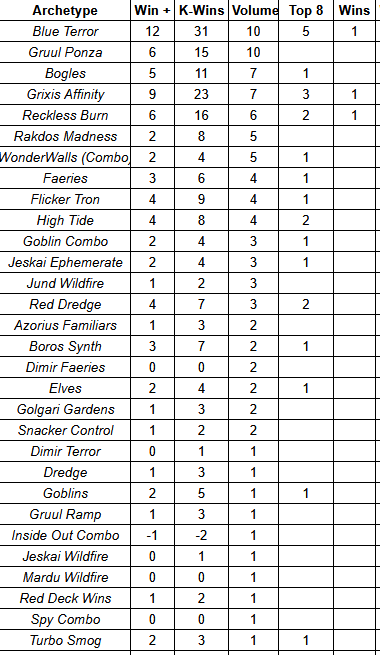
So where were we? Oh yeah…the first week of post ban Pauper…which is also the last week of Aetherdrift season. A historical footnote in that this format will only exist for a brief period of time before Tarkir Dragonstorm hits the scene. While there is no guarantee things will change with the next release I still isolated the results from the first weekend of April.
Why separate results by release cycle? Technically speaking each set of cards entering Pauper generates a new format. It is not that the rules change but rather the available interactions between the game pieces can be altered. While these shifts are often minor in nature they still exist and over time small shifts can push towards upheaval. In order to examine the format through this lens I have found that partitioning by set release (read: card legality shifts) to be helpful in understanding trends.
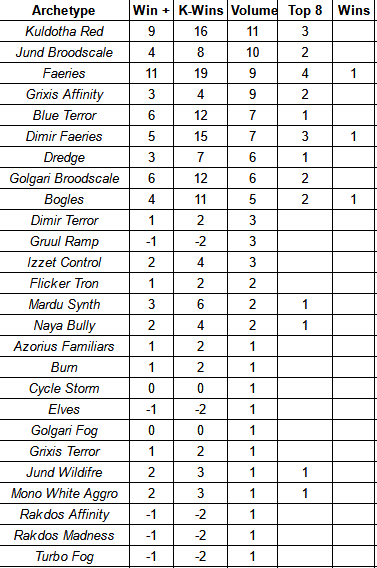
But what to do about this vestigial week? Only two cards have been added to the format while three removed, all before a new set which has some interesting tools at the ready. Completely ignoring the results serve no one as they could provide the baseline for what is to come. At the same point putting too much stock in these numbers may lead you down the wrong path for multiple reasons. Not only will next week’s format feature new cards but also this is week one after a massive shift. The banning of Basking Broodscale, Deadly Dispute, and Kuldotha Rebirth and the return of High Tide and Prophetic Prism altered the rules of engagement. The builds we are seeing may not be optimized and as the format continues to evolve we are likely to see some pretty significant changes in the way decks are constructed.
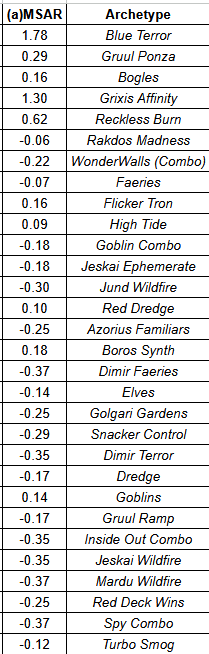
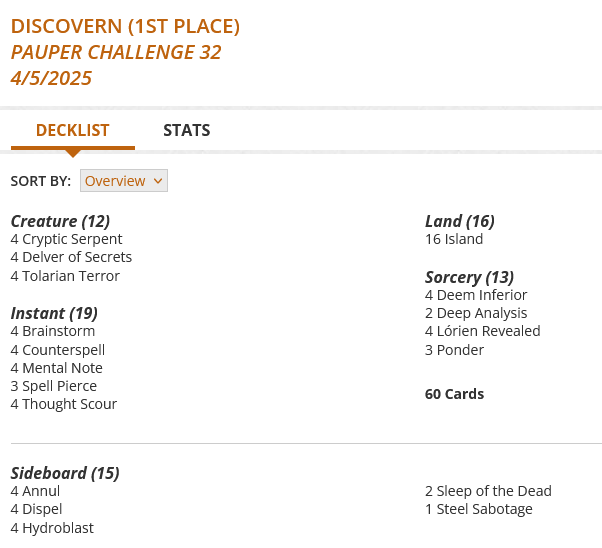
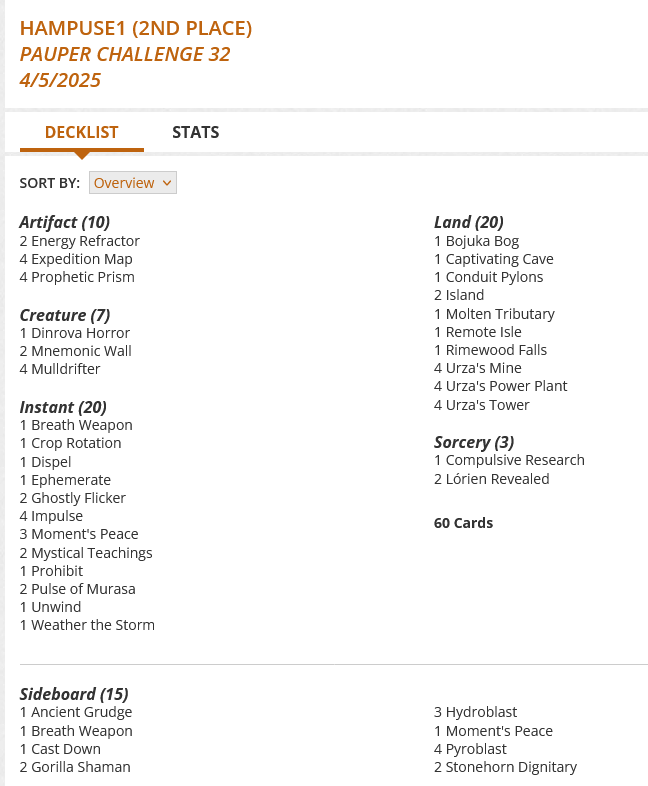
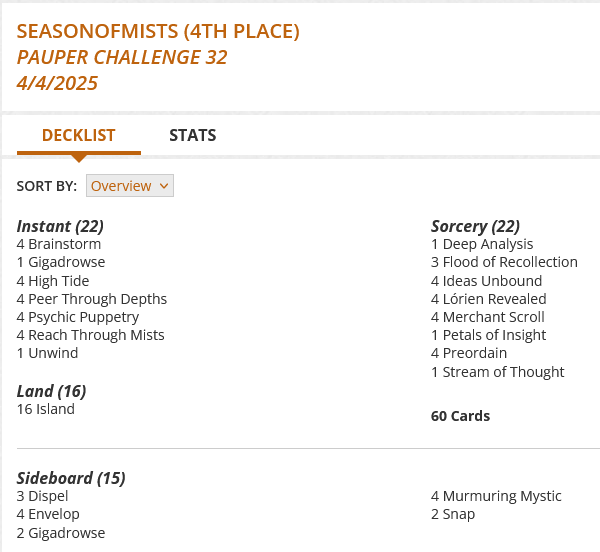
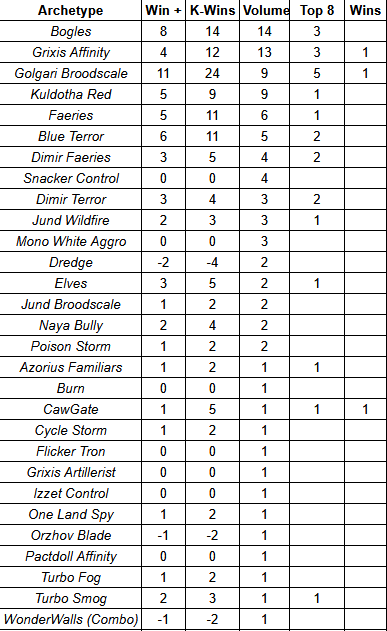
What, then, do the results say? The top two decks last weekend were Blue Terror and Grixis Affinity and this tells us two not entirely dissimilar stories. The performance of Blue Terror can be in part due to the unsettled nature of the new format. The dominant aggressive strategy has been taken down a notch which can give slightly slower decks a boost. In an open field the ability to present a threat and back it up with Counterspell would always be strong. When the deck also has the potential to stymie a new combo and win before the control deck can establish a foothold that’s a recipe for success. Blue Terror is not likely to be as strong moving forward but it put up solid results in this intercalary week.
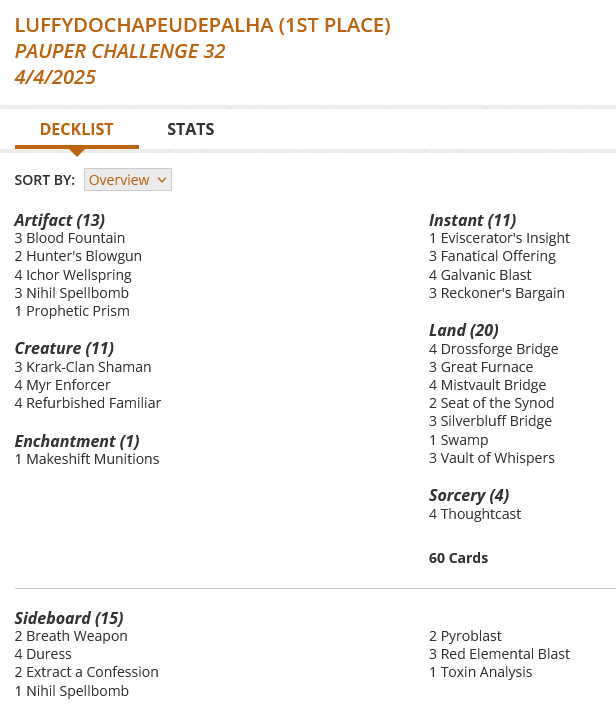
Grixis Affinity, on the other hand, is just a good deck. Yes, it lost a step with the banning of Deadly Dispute but the core engine still exists. In an open field playing a known deck full of good cards is hardly a bad idea, especially as people figure things out. I am not sure how strong Affinity will be moving into Tarkir Dragonstorm season as builds evolve and configurations are cemented but I do not believe the Machine is going to fade into obscurity.
Blue Terror and Grixis Affinity were smart choices for an open field when two of the expected emergent decks were spell based combo and long game control. Both have access to disruption and the ability to apply pressure. Terror has better stack interaction while Affinity can do more to grind out games against Tron thanks to Makeshift Munitions. One reason I am unsure about these strategies’ positions moving forward is due in part to the uncertainty around High Tide and Tron.
If your knowledge of the Pauper metagame came exclusively from discourse circles you would assume that these two decks dominated the weekend. High Tide Combo can win on turn four and can lead to games where one player is taking all the meaningful game actions early. Tron is a beloved archetype that has returned and can lead to games where one player is taking all the meaningful game actions late. Yet despite digital ink spilled in various channels neither of these decks were dominant forces on week one. Rather their specters loom large because of the fear of what they might become. Given historical precedent this feeling is not entirely unfounded. The past can be a decent lodestone for getting your bearings provided the wider environment has not changed. Still, metagames take time to coalesce and trying to prognosticate the future based on a small sample size could be a fool’s errand.
Where does that leave things going into next week? You’re guess is as good as mine but I would not be surprised to see a small surge in Bogles or various combo decks as we move into Tarkir Dragonstorm season.
I want to take a moment to thank all my Patrons. I am going to do my level best to keep providing you with the kind of content that brought you here in the first place. If you are interested in supporting my work, you can sign up for my Patreon starting at just $1.
Can’t make a commitment to Patreon? I have a Ko-Fi where you can make a one time contribution.
Looking for another way to support my work? Click here for my TCGPlayer affiliate link. Any purchases through the link let the folks there know you like my content!
Want to learn more about the metrics I use in tracking the metagame? You can find an explainer here.
Aetherdrift has been out for a little more than a month and as has become customary it is time for me to check in on the overall state of Pauper on Magic Online. Over the past four weeks there have been 12 Challenges and one Showcase tournament on the platform. Overall, 45 different archetypes have made it to the Top 32 cutoff while 23 have at least one Top 8 appearance; 16 have at least two such finishes. For the purposes of today’s piece I want to look at the archetypes with at least 3% of the Top 32 metagame – in this case that means a minimum of 9 total appearances in the the Top 32. This leaves us with 10 total archetypes to cover but does leave a few outside the discussion zone.
Out of the decks that do not make the 3% threshold, five have won one of their tournaments: Altar Tron, CawGate, Mono White Aggro, Snacker Control/The Modern Age Faeries, and Turbo Smog. Outside of CawGate these archetypes have a proven record during Aetherdrift season but find themselves outside the top of the metagame. Altar Tron is a known quantity but has only recently burst on to the scene with Pactdoll Terror as a standard inclusion. CawGate has largely fallen out of favor but it – as with Turbo Smog – now has Coalition Honor Guard as a maindeck inclusion as a way to steal copies of Sadistic Glee. Mono White Aggro is a consistently strong choice that has never garnered the popularity of other decks. Finally the Sneaky Snacker deck likely suffers from being so close to the more established (and well known) Dimir Faeries. Looking ahead to the next few weeks I imagine that these decks will continue to improve their standing while still struggling to increase their overall metagame share.
The Deadly Dispute Decks
It’s impossible to talk about the current state of Pauper without talking about Deadly Dispute. The abundant of free material in Pauper would make Dispute one of the best draw spells available but combine that with cards like Ichor Wellspring and you have the bones of a backbreaking card advantage engine. Out of the ten decks that topped the 3% Top 32 threshold, four of them are running a Deadly Dispute engine. These four (Grixis Affinity, Golgari Broodscale, Jund Broodscale, Jund Wildfire) account for over 30% of all Top 32 decks (this number jumps to 39.17% when looking at the all archetypes). Looking at the Winner’s Metagame for the 3% cutoff the top four Deadly Dispute decks hold a 34.29% share; looking at the entire Winner’s Metagame Dispute decks occupy 43.77% of the total.
These numbers are a bit startling to behold. Nearly 40% of all decks that made Top 32 in the past month were running Deadly Dispute and the card is closing in on 44% of the Winner’s Metagame. It is clear that this engines is one of the best things you can be doing in the format to support your strategy. And to be clear Dispute is supporting aggressive strategies (Mono Black Aristocrats) but more importantly both combo and midrange control.
Let’s start with combo. Deadly Dispute is the supporting scaffolding for Broodscale Combo. The deck is able to stitch together its pieces in part because of the sheer number of cards it sees and Dispute plays a key role there. Broodscale can afford to take early turns off to set things up with an Ichor Wellspring or Khalni Garden in an effort to get the cards flowing. The Treasure that gets left behind also makes it easy for Broodscale to continue to churn until it can set up its Splinter Twin situation.
Then there are the midrange options. Grixis Affinity and Jund Wildfire are also able to produce an abundance of material to feed to the black draw spell. Whereas Broodscale uses these cards to dig for key components these decks just want to amass cards in order to overwhelm the opponent. There is no need to win fast when you have all the options and simply dragging the game out until Makeshift Munitions or Nyxborn Hydra get the job done.
While not a requirement Writhing Chrysalis does a fantastic job of bridging the gap from development to winning in decks that include the Eldrazi. That it also provides material for Dispute and friends is not nothing. You don’t need to run Deadly Dispute alongside Chrysalis but decks that do tend to do better when all is said and done.
The Counterspell Decks
Three different blue decks grace the top of the standings. Faeries – both Dimir and Mono Blue – make the cut as does Blue Terror. These decks all have various ways of saying “no” to key spells and being able to cut off Deadly Dispute at the knees that are Ichor Wellspring can go a long way to pulling ahead. These decks have a combined 15 Top 8s over the past four weeks, but not a win to their name. By comparison, Deadly Dispute decks (above the 3% threshold) have 39 Top 8 finishes and 8 wins.
What does this tell us? As good as Counterspell and its ilk may be it is entirely possible to just out value blue decks. Decks that are able to amass cards and pick off threats can pick off the mono blue threats and go card for card with Dimir Faeries in the latter stages of the game. Blood Fountain can sneak in early and provide a steady stream of Refurbished Familiars – which will always get its card – late. As strong as blue can be it is a step behind this next tier.
Dig Up Her Bones
Let’s take a walk to the graveyard with Dredge. A combo deck made possible by Dread Return, Dredge wants to fill its graveyard quickly until it can reanimate a sequence of Lotleth Giants to reduce the opponent’s life total to zero. The deck also has access to the scam plan of cycling a Troll of Khazad-dûm and bringing it back with Exhume. Dredge is putty up respectable numbers (six Top 8s in 18 total Top 32 appearances) but is likely succeeding in part due to the lack of graveyard hate running around currently. Dredge can sidestep a Relic of Progenitus but when it is facing down consistent pressure it could fold. Given that very few other decks at the top of the format are currently using their graveyard as a resource it follows that Dredge could have its moment in the sun.
It Bogles the Mind
Bogles tends to have a good first week. Occasionally it has some staying power into the second week. Rarely does it remain a top deck a month into the season. The second most popular archetype with 47 Top 32 finishes (11.3%), it has a solid 11 Top 8 finishes. However Bogles appears to lack closing power. It is feasting on the other aggressive decks in the metagame and thriving in the absence of Edicts, but it does suffer in the face of Krark-Clan Shaman carrying a Hunter’s Blowgun. There are ways around this – either a Mask of Law and Grace on your Bogle or a Temporal Isolation on the Shaman, but it still puts the pressure on Bogles to play a largely reactive card in a proactive deck.
You’re Still Seeing Red? You Should Get Your Eyes Checked
Yes, Kuldotha Red is still a top deck in Pauper. It has 50 Top 32 finishes and a dozen Top 8 finishes. That being said it has yet to win a tournament in Aetherdrift season. Kuldotha Red retains its turn four uncontested kill but when the prevailing combo deck in the format has a similar clock then things get tough for little red creatures that like to turn sideways. Considering winning fast is one of the best ways to disrupt Broodscale combo the deck often comes with multiple ways to gain life including Tamiyo’s Safekeeping main and Weather the Storm out of the sideboard. Toxin Analysis can turn Krark-Clan Shaman into a way to gain an ungodly amount of life and Reckoner’s Bargain can undo two turns of Red’s hard work. Red may continue to help define Pauper but it is definitely ceding ground to a specific Eldrazi Lizard.
From my vantage point, Pauper is currently midrange hell. There are a bunch of decks that are all jockeying to win turns five, six, and seven. These decks are well set up to survive to that point and delay the victory of the other decks aiming to secure the bag in the same time frame. If you are trying to find a lane outside of this your best bet is to try and win fast or go over the top and ignore the slog. Easier said than done.
Pauper Power Rankings – March 10 Edition
10. Dredge
9. Blue Terror
8. Jund Wildfire
7. Dimir Faeries
6. Faeries
5. Bogles
4. Grixis Affinity
3. Golgari Broodscale
2. Kuldotha Red
1. Jund Broodscale
I want to take a moment to thank all my Patrons. I am going to do my level best to keep providing you with the kind of content that brought you here in the first place. If you are interested in supporting my work, you can sign up for my Patreon starting at just $1.
Can’t make a commitment to Patreon? I have a Ko-Fi where you can make a one time contribution.
Looking for another way to support my work? Click here for my TCGPlayer affiliate link. Any purchases through the link let the folks there know you like my content!
Want to learn more about the metrics I use in tracking the metagame? You can find an explainer here.
Okay folks, this was the big one. The weekend of February 21 saw three Challenges and a Magic Online qualifier. That latter tournament, which took place on Saturday, was an eight round affair. The result is that we received a treasure trove of Top 32 data on the weekend which can help provide additional texture and context to the format as it exists for the duration of Aetherdrift season. As is fitting for the current setting, the current format is all about racing.
The top line of the weekend is that both Kuldotha Red and Broodscale Combo outperformed the field. The red deck was the most popular on the weekend with seven Top 8s out of 18 appearances in the Top 32. It also led the way with an Adjusted Meta Score Above Replacement of 1.56. Jund Broodscale was not far behind with six Top 8s (including a win) in 13 Top 32 appearances, ending with an aMSAR of 1.54. Golgari Broodscale had a dozen Top 32 finishes, including four Top 8s and a win although it lagged behind with an aMSAR of 0.81. These decks were far and away the best decks on the weekend with the next best archetype being Mono White Aggro (three Top 32 finishes, two Top 8s including a win) with an aMSAR of 0.30.
Like I said, the format is about racing. Kuldotha Red is a consistent turn four win uncontested while Broodscale decks are capable of winning on turn four (or turn three if the opponent does absolutely nothing). The wrinkle in this is that once Broodscale gets set up it can potentially win at any moment thanks to that deck’s ability to dig for key components. That means unless your deck can goldfish on turn four (and survive against red for that long), you are at risk of faltering against Broodscale unless you’re loaded up on interaction.
Of course it’s never that easy. Your removal has to line up just so in order to not die to red and the best removal spells against Broodscale (Snuff Out, Cast Down) look downright silly against the aggressive creatures and burn of Kuldotha. To borrow from folklore, Kuldotha is the hare and Broodscale is the tortoise, but it’s a tortoise than can occasionally find itself a pair of rocket shoes.
Here we see the windows of opportunity emerge. Turns 4, 5, and 6 are critical in that if you can survive to turn four you should have a plan to win on turns 5 or 6, unless you are loaded up on removal and interaction. There you can find your lane to winning the long game as we can see in the other winning deck from the weekend – Jund Wildfire. This deck can stall the game long enough that its removal and heavy hitters can get the job done.
This is one reason why I feel Writhing Chrysalis is so maligned in the discourse. While this creature can just die to removal, it does a ton of work in the metagame by being a critical brick wall on turn four. Because of this it can stymie many of the decks that try to do the work of winning the game on turns five and six, which can have a sizeable impact on the outcomes of those games. As someone who has been playing an off-meta aggressive deck, I have run face first into the Chrysalis a few times and understand why its annoying. But then again I also am figuring out ways around the Eldrazi.
Looking ahead I would keep an eye on the Pactdoll Black decks. These builds can leverage Grim Bauble and Blood Fountain with Pactdoll Terror, helping to blunt assaults while regrowing threats on a consistent basis. Whether or not these decks remain mono black remains to be seen but I think there is something to be said for the four drop making a spot for itself in the metagame.
I want to take a moment to thank all my Patrons. I am going to do my level best to keep providing you with the kind of content that brought you here in the first place. If you are interested in supporting my work, you can sign up for my Patreon starting at just $1.
Can’t make a commitment to Patreon? I have a Ko-Fi where you can make a one time contribution.
Looking for another way to support my work? Click here for my TCGPlayer affiliate link. Any purchases through the link let the folks there know you like my content!
Want to learn more about the metrics I use in tracking the metagame? You can find an explainer here.
Aetherdrift has arrived. The first weekend of Magic Online Challenges are in the books. Three tournaments are in the rear view mirror and while nothing is drastically different from Foundations season, we still have a slew of new cards making their presence known.
As someone who deals in the data I would not put too much stock in these numbers. Two of the Challenges had multiple 2-4 finishers make it to the Top 32 and the early going numbers have Bogles as the most popular deck. While the slippery bois are hardly a bad choice I do not think they’ll be able to sustain these numbers as the season progresses. Rather we can approach this season much as we did the last one – focusing on the known best decks in the format. If you’re looking to get started in Pauper with the latest release here are some important pieces of knowledge.
The Bridges Connect
The Modern Horizons 2 Bridges are everywhere in the format. These cards help to power up multiple decks and strategies beyond their “natural” home in Affinity. This is due in no small part to the recent trend of printing cards that ask players to sacrifice a creature or an artifact. The result is that several decks in Pauper are built to fully leverage these lands. The most obvious of these decks is Affinity which uses the Bridges to vomit out threats while keeping the cards flowing with Deadly Dispute and Thoughtcast. Affinity never seems to run out of cards due to how many different ways it has to convert otherwise dead material into fresh cards. Many builds these days also have additional reach in the form of Makeshift Munitions which is happy to gobble up all those extra lands – both Bridges and the Mirrodin originals – to deal the final few (or final dozen) points of damage.
Many of these elements are repeated in various black midrange builds. Deadly Dispute has asserted itself as Pauper’s premier card advantage engine thanks to all the material available to grist the mill. While not every Dispute deck runs Bridges plenty do, including the ascendant Jund Wildfire. Cleansing Wildfire on a Bridge provides card neutral acceleration, making it easy for Jund to double spell or hold the fort off the back of Writhing Chrysalis. Both Affinity and Jund Wildfire have powerful end games so when you see a Bridge hit the battlefield you should be of the mindset of trying to end the game before they can set up their defenses.
Gotta Go Fast
Kuldotha Red remains the clock of the format. It is low to the ground and has nearly unmatched damage output. The recent advent of red card advantage has given Kuldotha the ability to keep pace in the mid game as well. Just as decks must be prepared for what the Bridges have in store for the long game they must be able to contend with lightning quick starts backed up by copies of Galvanic Blast and Lightning Bolt. Some of the pure defensive decks – the Moment’s Peace variants – have taken to running Campfire to give themselves a chance against the rest of the format once they manage to weather red’s starts.
Scaling the Walls
So what does that mean for the middle stages of the game? It should be anyone’s game but the reality is that portion is dominated by Broodscale Combo. Slapping a Sadistic Glee on a Basking Broodscale gives you unbound colorless mana. Once achieved it is possible to dig for a win with Eviscerator’s Insight until Nadier’s Nightblade is found and then it’s all over but the crying. The latest Pauper version of a Splinter Twin situation, Broodscale Combo cemented itself as a real threat in the last season. It can win as early as turn four but has no problem waiting to assemble a protected victory. Racing is possible but risky and while you can technically use removal to break up the combo Broodscale has countermeasures. The deck is not invulnerable but understanding how you are going to approach the matchup is going to matter quite a bit in the coming weeks.
Just Say No
And then there’s Counterspell and Spellstutter Sprite. These cards have not gone anywhere and are to be played around, Sequencing your spells in blue matchups is important and trying to get a read on what their interaction may be – whether it’s Spell Pierce, Dispel, or something else – can go long way in sneaking through threats. Of course that only matters if you’re up against a mono blue version, as multicolor builds can simply pick off creatures that manage to resolve.
Where does that leave Pauper? Honestly, in much the same place it has been for much of its recent history. The only new wrinkle is Broodscale combo and even it falters to removal – a common refrain in Pauper. For the foreseeable future these are the fights at your doorstep and the only question that remains is are you ready to battle?
I want to take a moment to thank all my Patrons. I am going to do my level best to keep providing you with the kind of content that brought you here in the first place. If you are interested in supporting my work, you can sign up for my Patreon starting at just $1.
Can’t make a commitment to Patreon? I have a Ko-Fi where you can make a one time contribution.
Looking for another way to support my work? Click here for my TCGPlayer affiliate link. Any purchases through the link let the folks there know you like my content!
Want to learn more about the metrics I use in tracking the metagame? You can find an explainer here.
Thirteen weeks.
The Foundation season on Magic Online lasted over three months. Technically the final few events took place under the auspices of Innistrad Remastered but that set only released a few cards into Pauper’s ecosystem. The result is a massive data set that can help shape the understanding of the format moving into Aetherdrift and the rest of 2025. While the metagame in Pauper moves slowly it does in fact move and we have seen some shifts over the course of Foundations.
Today we are going to look at the top performing decks from last season. I will be basing this on the measures I regularly track as linked above. For the season, the baseline Meta Score Above Replacement for the entire field was 0.56; the baseline Adjusted Meta Score Above Replacement was 0.11. This 0.11 number helps us to determine the delta for each individual archetype’s AMSAR score.
While the top two decks in Pauper were very close in performance, the best deck over Foundations season, in my estimation, was Grixis Affinity. The deck put up an impressive 37 Top 8 finishes but an absolutely staggering 11 victories. It averaged one Top 8 per Challenge and won almost 30% of all events offered over the past three plus months. This should not come as a shock to anyone who has played Pauper since Modern Horizons 3. Affinity as it exists today is not an aggressive strategy despite the presence of efficient threats. Rather it is a control deck with powerful removal and card draw that can occasionally apply a ton of early game pressure. The deck operates in part due to the Bridges which provide a stable mana base, discounts on Affinity cards, and regular fodder for Deadly Dispute. Taken together you have a deck that can operate at nearly any point in the game and has become one of the format’s bellwethers.
The other elephant in the room is Kuldotha Red. The most popular deck in Foundations season with 16.19% of the Top 32 metagame, it ended the quarter year with 14.98% of the Winner’s Meta. Despite 38 trips to the Top 8 it only walked away with one trophy. All told it had the second best aMSAR with a score of 0.67, only lagging behind Affinity’s 0.73. Red has been a stable part of the format’s top tier by presenting a lightning quick clock that is backed up with a decent amount of card flow. Experimental Synthesizer and Clockwork Percussionist provides the potential for a late game surge while the combination of Kuldotha Rebirth and Goblin Bushwhacker makes it easy to win from nowhere. Because of the deck’s strength it has become a known quality in the format and nearly every deck has to have a plan to survive the red wave in order to enact their own plan.
Broodscale Combo rounds out our pedestal, specifically the Golgari varietals. Alone the straight Black-Green builds accounted for 26 Top 8s and a pair of wins (aMSAR score of 0.45). Jund Broodscale was more popular (98 Top 32 appearances to Golgari’s 84) and had twice as many wins in the same number of Top 8 appearances. However Jund pulled in a aMSAR score of 0.34. When looking at the entire season, Jund started stronger but Golgari pulled ahead in the final weeks as the red splash decks moved more towards Jund Wildfire builds. But this is splitting hairs as the combo deck has become a force to be reckoned with in Pauper. Taking out a Basking Broodscale at instant speed has become increasingly important, leading to a surge in cards like Snuff Out and Snap, as well as the reintroduction of Flagbearer’s to Pauper’s competitive ecosystem to mess with Sadistic Glee.
Rounding out the top of the metagame for Foundations season are Counterspell decks. Blue Terror, Faeries, and Dimir Faeries/Sneaky Snacker Control put up solid numbers with Terro (27) and Faeries (26) leading the way in Top 8 finishes while Dimir was tied for third most Challenge victories (3, behind Affinity and Jund Broodscale; tied with Golgari Fog). These decks all want to leverage the strength of countermagic to just say no to some of the more egregious offenders in the format. Blue Terror tries to resolve a big threat early and force it through with tempo plays while Faeries is all about plinking in for damage. The Dimir builds tend towards the control end of the spectrum, relying more and more on the resilient threats presented by Murmuring Mystic and Sneaky Snacker. If trends hold I would predict that both Faeries and Dimir see success early in Aetherdrift season while Blue Terror tails off.
This table represents every archetype that had at least 2% of the overall Top 32 metagame. That’s 15 or 16 archetypes, depending on how you slice it. Only Kuldotha Red appears to be a real outlier with regards to popularity, even though it’s performance is lagging compared to other strategies. If I were buying stock in Aetherdrift season I would be bullish on Golgari Broodscale, Faeries, Dimir Faeries, Golgari Fog (also known as Turbo Smog), and Jund Wildfire. Wildfire has picked up steam as of late. The deck mashes Golgari Broodscale and Gruul Ramp into an efficient midrange machine that, true to the Jund of yore, gets to run all the good cards.
What are you looking forward to in Aetherdrift season? Will Magmakin Artillerist make waves or maybe Lightwheel Enhancements gives Heroic and Bogles a boost? Sound off in the comments, on reddit, or BlueSky for a chance to win one of five MTGO codes good for 120 Play Points courtesy of Daybreak games!
I want to take a moment to thank all my Patrons. I am going to do my level best to keep providing you with the kind of content that brought you here in the first place. If you are interested in supporting my work, you can sign up for my Patreon starting at just $1.
Can’t make a commitment to Patreon? I have a Ko-Fi where you can make a one time contribution.
Looking for another way to support my work? Click here for my TCGPlayer affiliate link. Any purchases through the link let the folks there know you like my content!
Want to learn more about the metrics I use in tracking the metagame? You can find an explainer here.
Aetherdrift is coming up in our rear view mirror but on Magic Online there are still a few more Foundation events. Technically these final Challenges fall under the umbrella of the Innistrad Remastered release, but given the short window between the sets and the minimal impact I have grouped the last two “seasons” together. As it stands the format is continuing to settle in its lane, sustaining the trends that have provided a relatively diverse – if stagnant – metagame for the past three months.
Once again a small Challenge left the results with several Top 32 finishers finding themselves with losing records. Over the course of the season these results wash out and help to paint a more complete picture of the format; over a single weekend they can exacerbate and highlight the spread from best to worst. The top decks on the weekend should not surprise anyone with Faeries leading the way with a 1.33 adjusted Meta Score Above Replacement and 14.15% of the Winner’s Meta (4.77% above Top 32 Volume). Dimir Faeries also had a strong showing with an aMSAR of 0.81 and 9.15% of the Winner’s Meta (1.09% above Top 32 Meta) and Kuldotha Red bounce back from a recent dip (aMSAR of 0.71; 12.96% Winner’s meta with a delta of 1.5%).
These results are continuing the story that’s been told about the format over the past few weeks. Broodscale combo isn’t going anywhere (Jund Broodscale with an aMSAR of -0.04; Golgari with an aMSAR of 0.60) and along with Kuldotha Red and Grixis Affinity (aMSAR of -0.23) help to define the format. As these decks have settled, Spellstutter Sprite decks have figured out the best suite of spells to help constrain these. As the various Faeries builds have taken hold, other blue “tempo” style decks have fallen back, opening the window for a few builds that try to win the long game (Golgari Fog, Jund Wildfire).
But again, this feels rote and routine. The game play in the current format reward deep matchup knowledge and picking up on the subtleties of how the opponent is piloting. There is plenty of skill in the play itself but there is also an emphasis on pattern recognition. Whether this is a consequence or a corollary, this leads to Pauper feeling on rails at times. The format lacks access to some effects that appear at higher rarity and can swing the momentum just by resolving. Even the Initiative, which absolutely turns the game on its ear, plays on a very prescribed path. The games are skill intensive, yes, but that also means they can be mentally exhausting and if all you’re doing is playing league after league it can grow wearisome.
This takes us to Aetherdrift. The next release does not rise to the level of a Modern Horizons 3 but it does have a few gems. Importantly the set presents cards that seem tailor made for existing fringe archetypes while also providing at least one card that has the potential to spawn something entirely new.
Lightwheel Enhancements features the new “Speed” mechanic. Cards with Start Your Engines move your speed to one and then once on each of your turns (including the turn your Speed starts), you can advance it when an opponent loses life. Once your speed reaches four you have achieved Max Speed. Here that means you can cast a cheap Aura from the graveyard. Lightwheel Enhancements seems like a slam dunk for both Bogles and Heroic. Heroic often opts for Sentinel’s Eyes which has the same in-game effect but has Escape, which means over a long enough game it will run out of fuel for recasts. All that this Aura asks of you is to have dealt damage three turns. Importantly it does not have to be in play for you to advance your Speed so playing this on turn two can move you to second gear and then things really get rolling.
I like this in Bogles a tad more because the deck has easy access to Creosote Heath – the ping Desert from Outlaws of Thunder Junction. Heroic can lean into this a bit with cards like Gut Shot but I have a feeling Enhancements is just going to be a more honest card in that build. That being said a copy or two of this in Heroic means that you have a way to build pack from nowhere, provided you have a creature that can stick around.
Spectral Interference deserves a mention if only because it hits two important card types at a tax greater than Mana Leak. I am not sure if this one can supplant the other non-Counterspell counters in Pauper, but given the current metagame it might. Right now both creatures and artifacts are rather important so it will always almost always have a target. Is that enough? Probably not but it would not surprise me if this one showed up occasionally.
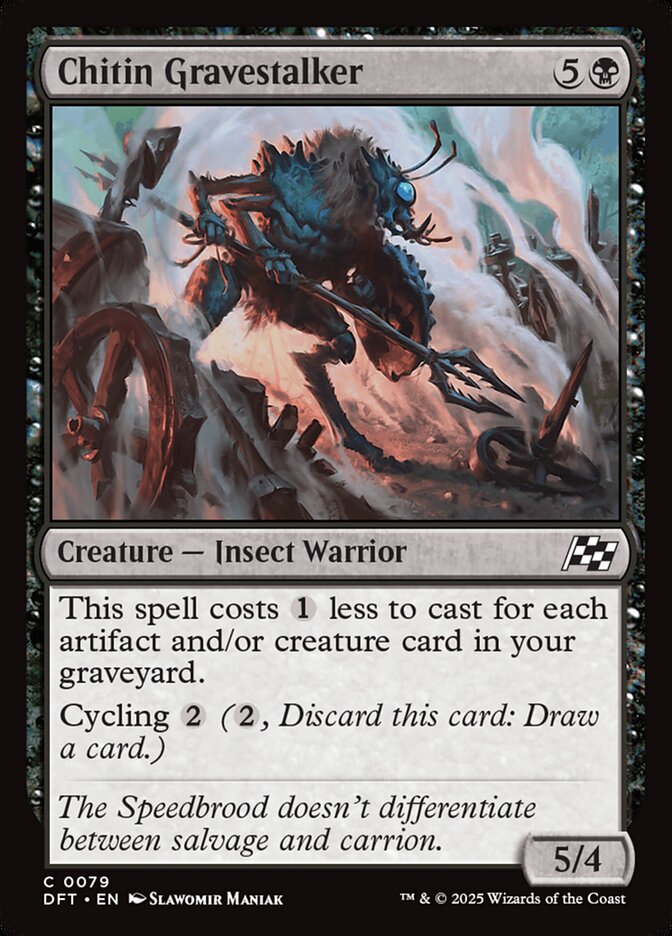
Chitin Gravestalker is big. It is a reasonable body once you start discounting it, which should not be hard in decks like Affinity, Dredge, or Cycle Storm. In the latter two this card represents a nice juke, providing a way to apply pressure outside of Plan A. The biggest thing holding this card back is the four toughness. Unlike Gurmag Angler and Tolarian Terror – two other five power creatures that can come in for a discount – Gravestalker dies to Galvanic Blast. While this is not entirely bad – it does fuel future Gravestalkers after all – it is a knock on the card. That won’t be enough to consign it to the bench but it will struggle to live up to its discount five power brethren.
I wrote a bit about this card last week when I got the chance to show it off for the first time. Since then there has been a small (very small) surge in Kor Skyfisher decks so I am hopeful this weird little guy will get a chance to shine.
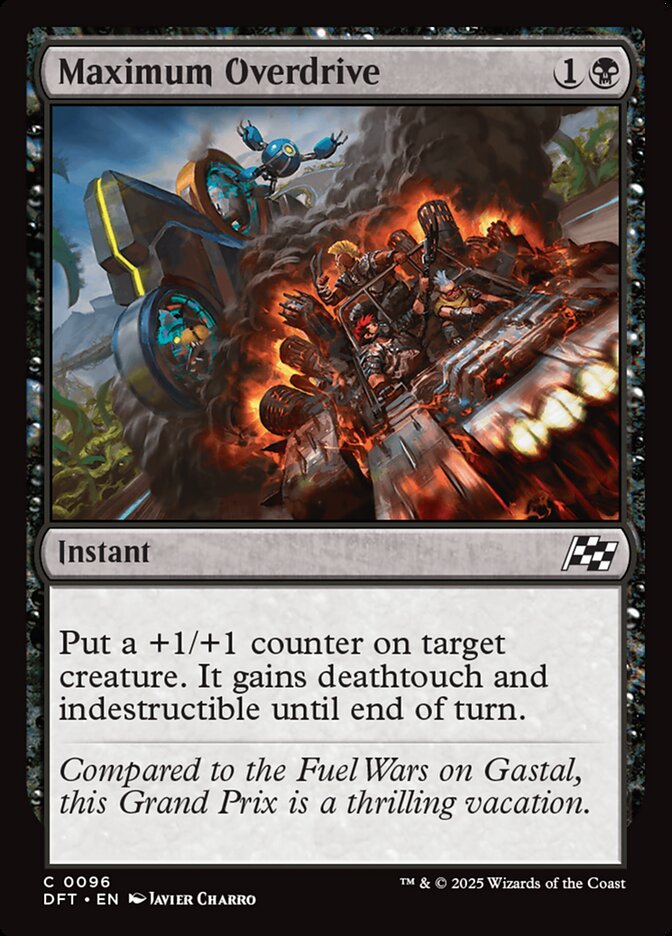
Did Broodscale Combo really need that much help? This card does it all. It protects your Eldrazi Lizard from removal while also kickstarting the combo by putting a +1/+1 counter on it, thereby gifting you an Eldrazi Spawn. It also costs black mana so you can hide your ability to “go off” by tapping out of green. Maximum Overdrive has the potential to overhaul how Broodscale decks operate in game which can just give them yet another angle of attack.
But wait, there’s more! This card also combos with Crypt Rats and Krark-Clan Shaman. This is yet another way to turn those cards into more robust board wipes. Giving up on the lifegain from Toxin Analysis does matter but in matchups where having a second go with your Wrath effect matters this card may just make the cut.
I hate the art on this card. That being said I am excited for Pactdoll Terror in Commander, but also as a potential spout in artifact combo decks. The life loss is a gain over cards like Reckless Fireweaver, meaning that stray Prismatic Strands no longer delay your victory. Being black it also dodges Snuff Out which is not nothing. Four mana is a hefty price tag but decks like Altar Tron could easily afford this if they were so inclined.
Okay now we get to the good stuff. Magmakin Artillerist is a house and could easily spawn a new archetype while shoring up some stalwarts. This card fits neatly into Cycle Storm where it doubles up on Drannith Stinger while also potentially saving on mana. By triggering off of any discard, Artillerist allows Cycle Storm to Reaping the Graves all of its creatures back and then move to the discard step. As long as this Pirate lives, going back down to seven will result in your opponent taking a ton of damage.
Then there’s Ophidian Eye. A three mana blue Aura with flash, Ophidian Eye does not trigger off of combat damage. That means given a discard outlet and enough cards in your library, these two cards can deal a lethal amount of damage. Given the relatively low cost of the cards involved and the fact that blue has cheap interaction this combo is almost certain to make waves. Going Grixis provides you with cost reduction in the form of Nightscape Familiar and redundancy in Unearth. I am excited to see what builds show up and adding another combo to the fold could serve to change Pauper’s current landscape.
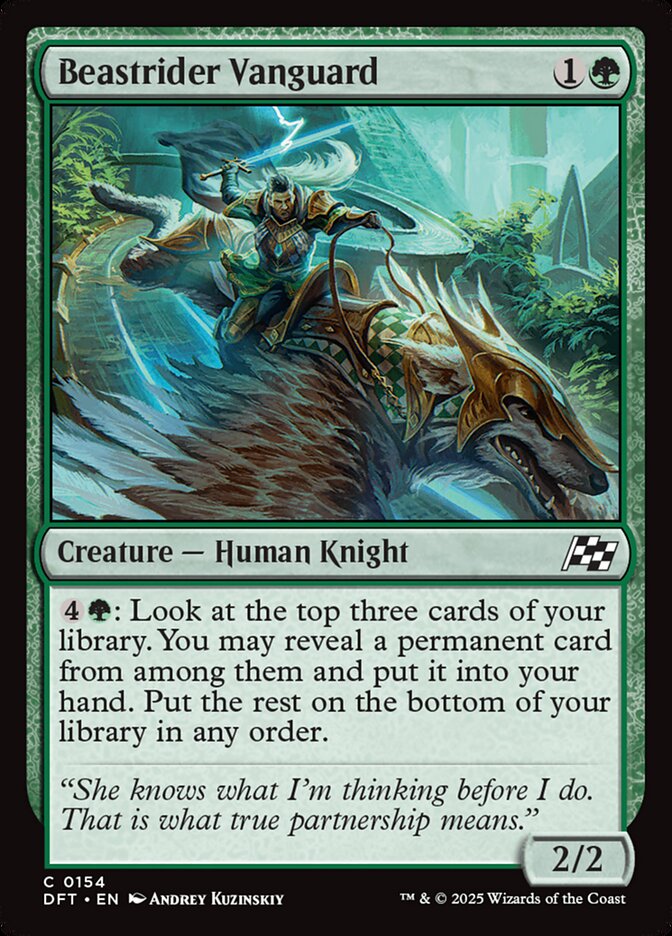
Beaststider Vanguard strikes me as an interesting mana sink. In decks like Broodscale Combo an unbound amount of mana (and Energy Refractor) means you can dig for a permanent based win condition (say Makeshift Munitions). Five mana is a lot but at the same time when you have an unbound amount of mana being able to ransack your library is far from a bad thing.
I am not a fan of the “Gotcha” Slot. You see it occasionally in decklists – a one-of that when you draw it at the exact right moment can have an outsized impact on the game. This is usually something like Mana Tithe, which makes for fantastic screenshots but given a large enough sample size end up being a waste of a slot. It is not that singleton copies are bad, but when they are so narrow and do not have synergy with your overall gameplan then they might drag your deck down at times. All of that is to say Silken Strength seems like a halfway decent “Gotcha” card in Bogles that works on both offense (with Ethereal Armor) and defense (surprise blocker).
That’s my take on Aertherdrift. What cards did I miss? What commons are you for and what decks are you looking to brew up? And tell me why it’s a mistake to be a Heroic main in the new season.
I want to take a moment to thank all my Patrons. I am going to do my level best to keep providing you with the kind of content that brought you here in the first place. If you are interested in supporting my work, you can sign up for my Patreon starting at just $1.
Can’t make a commitment to Patreon? I have a Ko-Fi where you can make a one time contribution.
Looking for another way to support my work? Click here for my TCGPlayer affiliate link. Any purchases through the link let the folks there know you like my content!
Want to learn more about the metrics I use in tracking the metagame? You can find an explainer here.
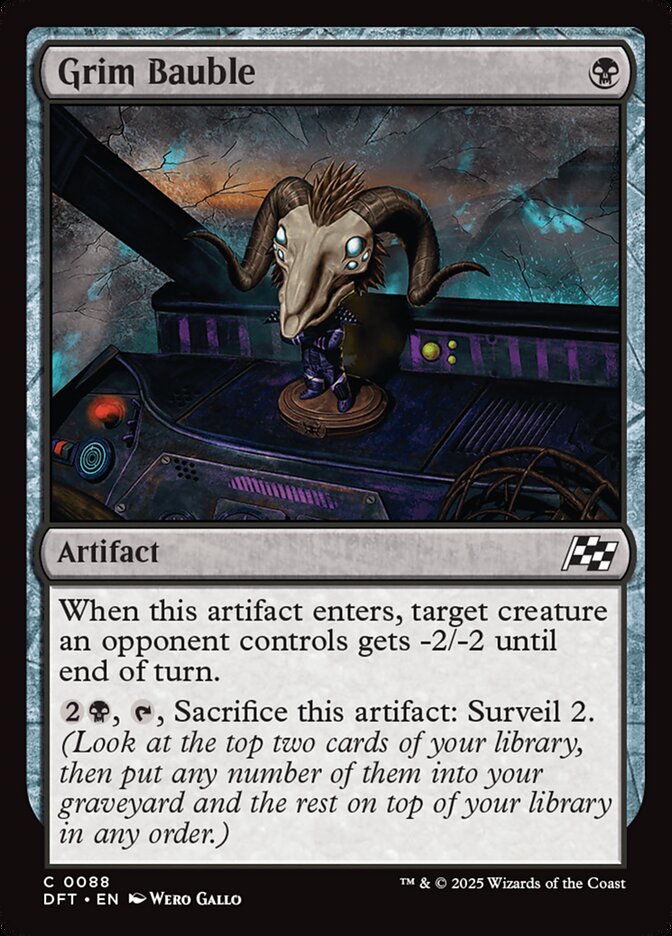
I imagine I have a few new visitors today so I won’t bury the lede. I want to thank Wizards of the Coast for sending me this preview content so I can share it with you all. Allow me to introduce Grim Bauble!
Grim Bauble continues the tradition of having cheap artifacts with meaningful enters the battlefield triggers. While Kor Skyfisher and Glint Hawk decks are not at the top of the metagame currently they do pop up from time to time. Grim Bauble provides a solid piece of material that can partner with Tithing Blade to help keep the opponent’s board under control. It also is a perfect piece of fodder for Deadly Disputer and its ilk, and given that it is almost certain to see some amount of play. At one mana it is a reasonable part of a Trinket Mage tool box if those decks ever come back into vogue. Finally it can bin itself with its final ability, helping to curate your next set of draws. As someone who has played his fair share of Omen of the Dead, that ability is not just trinket text.
I’m excited to try out this card once it hits the streets with Aetherdrift. Thanks again Wizards for the free preview.
Okay,but back to the Pauper metagame. The past few weeks have been interesting, at least on Magic Online. The platform has been experiencing a decent amount of lag as of late, which is impacting the ability of some players to fully participate in events. Pauper Challenges have suffered, with attendance dipping somewhat low. Whether this is due client issues or dissatisfaction with the format is not known. Regardless, rather than examine one week of data I took the last three weeks of Foundation season (including the first weekend with Innistrad Remastered legal) and compiled that for today’s discussion.
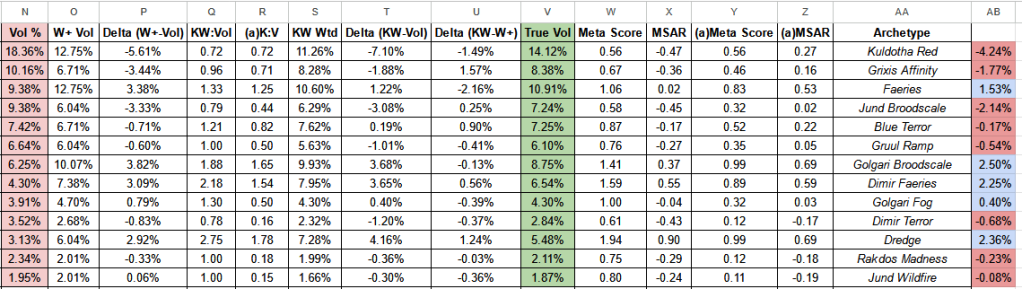
Rather than focus on the entire Top 32 metagame, I wanted to look at decks that comprised at least 2% of the total field. One deck clocked in with 1.95% at five appearances so it made the cut as well. I’ll be discussing some of the other stats as we discuss the archetypes, but for now I want to focus on two columns in the chart below: Vol % (that is, presence in the Top 32 metagame) and True Vol (a weighted measure that takes archetype performance into account). There is a third, unlabeled column, which shows a deck’s True Vol less it’s Vol%. In other words it measures if a deck under or over performed relative to its presence.
Let’s start with the True Vol/Winner’s Metagame. From this snapshot things look relatively healthy. Kuldotha Red is a bit higher than one would like a deck to be but it isn’t lapping the field. Faeries is closing in on 11% of the Winner’s Meta with four other archetypes clustered around 7% and 8%. Comparing this to the last four week check in (December 13, 2024 – January 5, 2025) and there is a stark difference, with Kuldotha Red taking down over 19% of raw volume and over 17% Winner’s Metagame. That bucket has one more weekend of data so it will be interesting to see if this trend continues. In this moment, however, it appears Pauper is trending back towards a more balanced top of the format.
There is another potential indicator of stability and health – the strong performance of Faeries. Spellstutter Sprite decks, while a constant in Pauper, have not been able to sustain their top tier status in quite some time. Rather these decks tend to start seasons off slowly and pick up steam over time as the proper answer suite is uncovered. Faeries performed admirably over the first four weeks, with 4.95% of the total metagame, bumping up to 5.44% of the Winner’s Meta, all while taking down seven Top 8s. In the second four weeks the deck ticket up – 5.11% of the total meta, 5.68% of the Winner’s Meta with another seven Top 8s, including a win. This last batch (again, only three weeks) sees a huge surge in popularity (9.38% of the Top 32 meta) and no lag in performance (10.91% of the Winner’s Meta), this time with eight Top 8 finishes.
Faeries upward trend indicates that not only is the format settling in some capacity, but that it is doing so in a way that can be attacked with interaction. This may be due in some part to the strength of Golgari Broodscale, which while holding fast at 6.25% of the Top 32 metagame has increased its share of the Winner’s Meta from 7.61% over the previous four week chunk to 8.75% of the last three weeks. As combo decks improve then decks that can disrupt them go up the power rankings. Faeries is well suited to the task, especially against Broodscale. Spellstutter Sprite gets around Duress (a common piece of interaction) and counterspells are not deterred by Snakeskin Veil.
Of course this leads us to the fact that Broodscale Combo continues to be a force in the metagame. The deck is capable of winning early and has the tools to grind to the midgame until it goes in for the kill. Interactive decks might be a solid choice here but other people are opting to just completely ignore the combo potential and try to win without caring what their opponent is doing. Dredge was only 3.13% of the Top 32 metagame but jumps to 5.48% of the winner’s share, netting four Top 8 finishes including a win in the past three weeks. Not listed above is a Poison/Proliferate “Storm” deck which went 9-0 on its way to a Challenge victory on January 26. Even if it is not dominating the landscape Broodscale is still doing a lot of work to define the meta.
So where does that leave us? Things are settling. They might even look okay on the surface. But digging deeper we are starting to see there are issues. The format does appear healthy by certain metrics but as we peel away the layers we see the balance is precarious at best. What happens in the next few weeks will do a lot to tell us where things are heading.
I want to take a moment to thank all my Patrons. I am going to do my level best to keep providing you with the kind of content that brought you here in the first place. If you are interested in supporting my work, you can sign up for my Patreon starting at just $1.
Can’t make a commitment to Patreon? I have a Ko-Fi where you can make a one time contribution.
Looking for another way to support my work? Click here for my TCGPlayer affiliate link. Any purchases through the link let the folks there know you like my content!
Every so often I decide it’s time to attempt writing about Commander again.
When I started playing, Magic was not a social event. I made acquaintances through the game but I viewed Magic as a way to prove myself at an endeavor. As I got older, however, Magic morphed into a way to just hang out. Compared to other adult activities it’s (relatively) easy to get a few friends together or head down to the Local Game Store to get sling some cardboard. I get to relax, shoot the shit, and just enjoy playing Magic.
It’s nice.
So what has been the hold up with putting my thoughts on Commander down on digital paper? I’ve been writing about Magic in some capacity for the better part of two decades. My long standing view is that Commander is a deeply personal format and everyone has their own approach. The way I see things may not hit home for a wider audience. The internet might say there is a “right” way to engage with Commander but the reality of the situation is drastically different. There is no one true way to play the format other than the one you and your podmates agree upon for that specific game. So much of the run up to that is about how you, as an individual, feel. Who is at the helm of your deck? What cards do you include – or exclude – and why? Which Basic Lands are you running and what is that story? There is no matchup data to pore over nor metagame to attack. There are simply people playing cards and looking for stories. How, then, can you write about something that means drastically different things to the various pairs of eyeballs that may read your words?
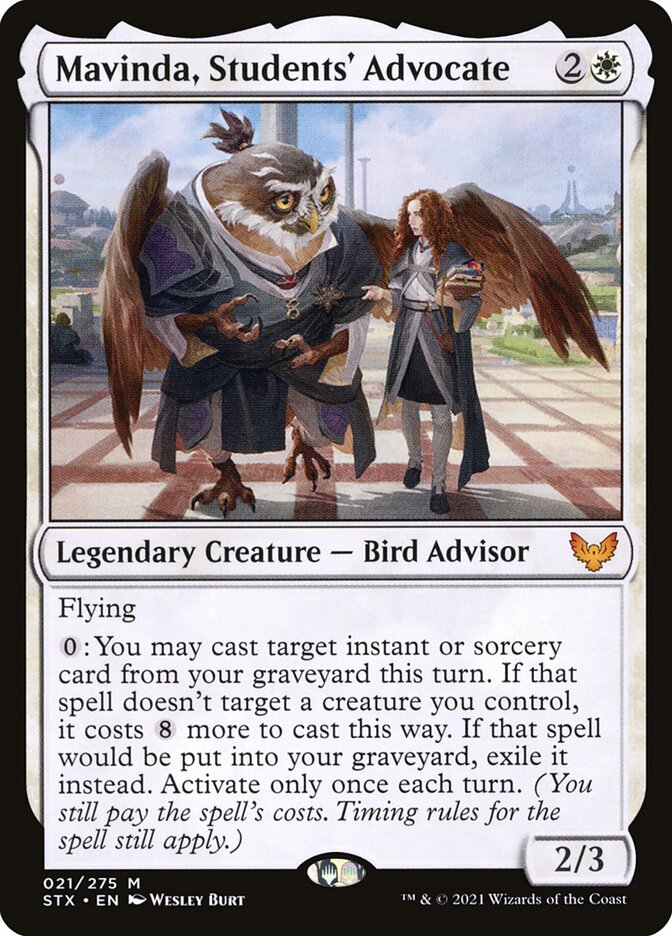
For the longest time I left it alone. I would try to write about Commander but it felt forced; the words rang hollow. A few weeks ago something changed. I was winding down from the day and excited about a deck I had just built: Mavinda, Student’s Advocate. For some reason I thought it was 2012 and decided to search the internet for anything written on the card. I found almost nothing. Sadly it made sense. These days there are so many Legendary Creatures printed that there’s no reason to write about all of them.
Given the current state of Magic content and the attention economy it tracks that only those cards that would reasonably get clicks should have dedicated articles. In that moment I realized that if no one was writing the kind of Commander content I wanted to read then I might as well do it myself. While I may not be able to write something that resonates with everyone the things that matter to me may well matter to other players. If that is the case then there is absolutely no reason to not share my thoughts.
The question then is what matters to me? It circles back to the social aspect of the format. My first experience with Commander was being invited out to Wizards of the Coast to play in the inaugural Magic Online Community Cup due to my work on the Pauper format. I had heard of EDH and decided to put a deck together on the off chance there would be an opportunity to play. I built a Darigaaz, the Igniter deck out of the cards I owned. I went to Wizards, helped win the Community Cup, and played my first game of EDH.
I was hooked. The format captured everything I loved about the my initial exposure to Magic. It combined the sense of discovery in finding weird cards with the puzzle of putting a deck together. I remember sitting at a table in Renton and relishing the feeling of just playing against people with nothing on the line besides a good time. I returned home and rifled through my collection to build another deck. At this time in my life I felt isolated. I was in my mid-20s living in the suburbs and working at a college while most of my friends were having their early adult years in New York City. It was not a far drive but my schedule did not afford me the opportunity to make many social calls. A 2011 change in job meant I could move back home to Brooklyn and EDH – now Commander – helped me to find new friends as I reconnected with my past. Time moved forward and then I was in my 30s, then my 40s. Playing the Magic became an important way to get me to engage with different people and often to get out of my own head.
These days Commander provides me a way to be social. The format also gives me an avenue where I can be creative in deck construction and play with cards that make me happy. It lets me tinker and refine, exploring new ways to make things work. Over the years I had to revise my expectations of games given my background in one-on-one play. Despite my affection for some cards it is often more enjoyable to leave them out if they can create a game that no one wants to play (looking at you, Grave Pact). Instead I found a philosophy that paired enjoyable game play with focused deck construction.
Every deck has an objective – they are all trying to Do the Thing. I realized that I derived enjoyment from decks that were trying to Play the Game. Winning the game was a secondary achievement. This conceit has become a major through-line in how I think about Commander, from the kernel of a new list to the compiling of cards itself to how I approach different pods. When I am concepting a new build I find it important to identify what the deck is trying to do and then build in such a way that allows me to engage with the game meaningfully towards that end. If I get to play the game an execute at least a portion of that gameplan, I can walk out of a match feeling as if I did something regardless of when I lost my final point of life.
Why do I feel the need to highlight this? In part I think it is because the recent deluge of options for the Command Zone have left multiple strategies with a “Best in Class” option that can do it all. The Commander is not only a way to win the game but also the main engine of progression – of moving the game plan forward. Lack of access to this card can often collapse a deck. The recent Omo, Queen of Vesuva comes to mind as one such example since that deck can cease to function without access to its Commander’s ability to make Everything Counters matter. I bring this up because building a deck that falters if a single card is absent can often lead to games where it feels like you do nothing. Constructing your deck so that it can work without the Commander and positively hum with it can make for an overall more enjoyable play experience.
Mavinda, Student’s Advocate is no one’s idea of what a Commander form the 2020s should be. She hearkens back to an era when Legendary Creatures were not designed with four player games in mind but rather a card where having multiple in play for a 60 card game might be an issue. Still I find something cool about her. If you are willing to work for it she can provide a steady stream of value “drawing” you an extra card each turn from a stocked graveyard. The buyout of eight generic mana to get around her targeting restriction means that in a pinch she can go after your opponents as well.
To best leverage her ability, Mavinda asks you to run cheap spells that target creatures you control. White heavily supports two paths that follow this route. The first is Heroic and Valiant: targeting your own creatures in an effort to make them large enough in combat to win. Here you want cards like Illuminator Virtuoso to ensure your improvement stick around as +1/+1 counters. Taking this route can mean looking for artifacts like Runechanger’s Pike to do some heavily lifting as white lacks both the force multipliers of red (Temur Battle Rage) and straight pump of green (Become Immense). Kaya’s Onslaught is fun but struggles to get the job done on its own. In the end I took a different path because boosting a creature’s stats ran counter to my vision of Mavinda.
Instead I focused on blink effects. While it is possible run both themes in the same 99 they can be at odds. Cloudshift can protect your creature but it would also erase the mountain of counters. Cards like Acrobatic Maneuver and Scrollshift also provide a save but they draw a card for good measure. The extra card helps move the game forward, digging deeper to find a way to win. The focus on flickering my own creatures encouraged me to run otherwise paltry bodies that replace themselves: Helpful Hunter, Spirited Companion, and Wall of Omens to name a few.
It also led me down a path of including some other engines that deal with cards entering (and leaving) the battlefield from old stalwarts Sun Titan, Reveillark, and Karmic Guide to the more recent Welcoming Vampire and Enduring Innocence. The resulting deck can do something at nearly every stage of the game and build towards a victory.
There is another reason I decided to focus the blink version of Mavinda and it did not become clear until after my second game with her. Sitting down to play the game is great but being able to fully participate is what leaves me feeling satisfied. I may not win but as long as I get to do something I feel like I got value out of my time. At the same point I build decks towards an overarching theme – they are not simply collections of cards but rather there is a plan. However many of these plans take time to set up and not every game provides the opportunity for their full realization. My solution is to build in layered engines that progress me towards my endgame. I did not realize it until recently but friends have longed described my decks as “Rube Goldberg machines”. The pieces all fit together so when they click I am able to do something that is far more than the sum of the parts. Mavinda is a fantastic example of this put into practice.
One of the through-lines of my build philosophy is maximizing the value of cards in play, whether that is through using them to regularly draw cards or by sending them to the meat grinder of a sacrifice outlet only to bring them back. I am naturally drawn to Aristocrats strategies – that is decks that want creatures to die for some effect – in part because they take an investment and convert it into something else. In the case of Artistocrats, a dying creature can become a point of damage with Zulaport Cutthroat or an extra card with Grim Haruspex. That’s awesome but it is something on top of what was already achieved – the creature itself. Mavinda does something similar with its spells – it already gets one use out of a Scrollshift but getting to use it a second time and draw even more cards means each actual card is worth several “cards” over the course of a game.
Taken together this means that every action is part of the overall plan. Each spell is a small step forward that provides the opportunity to engage with the other players and the battlefield while also advancing my game in a way that leads me in the direction of a win without catapulting me there. But in order to do this in Mavinda I need to build out a board. Mavinda is not a spellslinger deck that wants to amass spells and cast them in a flurry. Rather the deck needs permanents in play to generate maximum value from those same permanents being flickered to either draw cards or protect them from removal.
Once Mavinda has established a large enough board presence the deck can go about victory in any number of ways. It can plink in for damage turn after turn with whatever evasive threats it has at its disposal. It can go for value plays with cards like Sun Titan or Emeria Shepherd. Evangel of Heliod can generate an army of 1/1s that can swarm past defenses. Or it can find the cards I put in the deck to help win the game: Cathar’s Crusade or the combination of Reveillark, Karmic Guide, and Blasting Station.
We now open the door to another aspect my deck building philosophy. While some folks frown on any infinite combo I find including these engines as a way to close out the game has merit. While the play itself is meant to be enjoyed, part of any Commander game is determining the winner. Being able to jockey for position throughout the course of turns only to assemble a specific suite of cards can be exciting. What I personally do not enjoy is trying to race towards a those same game pieces as I find it anticlimactic. To this end I also make it a point of answering honestly when asked about the contents of my deck. My go-to line with Mavinda is: Yes, I do have unbound combos that can end the game, but they involved creatures and artifacts – and I will tell you when I play out the pieces when asked. Part of a good game of Commander, to me, is everyone being on the same page. Someone seeing Blasting Station, Karmic Guide, and Reveillark for the first time may not fully understand what is about to happen does not make for the best experience. Being honest and forthright with “this is when you have to kill my creature” makes it a lot easier to be invited back and to play the same deck another time.
Back to layered engines. What does this mean at the micro level? As mentioned I prefer this style of deck building because it allows me to always feel like I am “doing something” over the course of a game while also progressing my own plan. It breaks down to that the vast majority of cards in the deck need to work with other cards at various stages of the game. In Mavinda that means a heavy focus on cards that enter the battlefield but also figuring out other cards that care about said game actions.
Starting the build with Mavinda and the idea of “blink” effects at the top of mind led me down the path of cantrip creatures. White has plenty of those these days but lets go back to one of the first: Wall of Omens. On its own Wall of Omens simply replaces itself which does not seem like much. In Mavinda it makes for an excellent early target for Cloudshift. Wall of Omens also works with white’s persistent card draw like Welcoming Vampire and Enduring Innocence. I’ve opted against Mentor of the Meek in this build in part because I have found a need to leave my mana up once Mavinda is in play and overtaxing that resource can leave me low on reusing spells – it stops me from Doing the Thing. Wall of Omens also works perfectly with Reveillark, as does every other cantrip creature in the deck.
These creatures are all relatively small – three mana value or less – and that means the stalwart Sun Titan has a home here. Sun Titan is a fine blink target as well which pushes us further to the one circle Venn Diagram of “blink” and “recursion”. Karmic Guide and the aforementioned Reveillark also work here, as does Emeria Shepherd at the top of the curve. Shepherd also has the advantage of giving value to late game land drops. These creatures also help to reanimate some key creatures that also flicker such as Flickerwisp in the case of Sun Titan and Felidar Guardian, Restoration Angel, Glimmerpoint Stag, and Salvation Swan outside of Sun Titan’s wheelhouse. Salvation Swan a card where if other Birds emerge as good options for the deck I may bias towards them in the future, but I am just as likely to cut Swan in favor of a less restrictive creature.
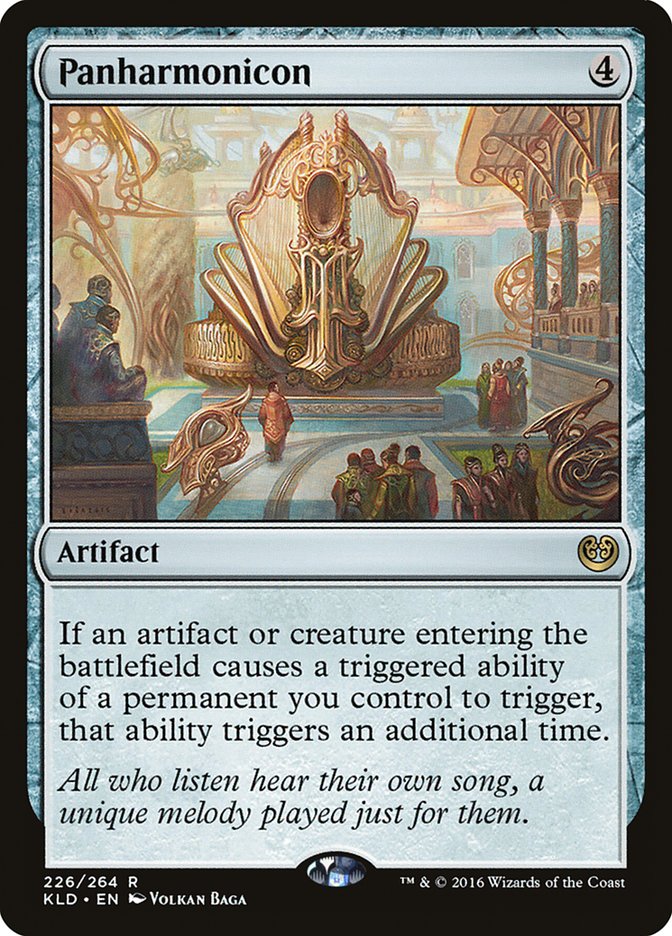
Considering how much this deck cares about creatures entering the battlefield, Panharmonicon made the cut. While the cards themselves can keep the game moving forward this artifact can help send the deck into overdrive while also helping the deck catch up if it lags too far behind. Extra card draw or blinks or recursion are always welcome and when you’re recycling Ephemerate Panharmonicon is just piling the value higher than a plate at an all you can eat buffet.
Considering how valuable a robust board state is to the strategy I needed to find ways to save my team from removal. Again I look towards to Commander to find options that meet the requirements. Divine Resilience, Eerie Interlude, and Clever Concealment all contain the magic word of target which means I get to go back for seconds without laying out eight additional mana. Bathe in Light stops damage based sweepers while also having the out to push damage past blockers in certain scenarios.
While this deck can function without its Commander in play everything works better when Bird Mom is around. As a result I tried to pick interaction that had some synergy. Wrath of God was going to make the cut regardless in part because I have a sick 8th Edition Foil. Dusk//Dawn fits because of the relatively small size of the creatures in the deck while Fell the Mighty has the all important word “target”, which means I can cast it without the tax from the graveyard with Mavinda. Sunblast Angel is a board wipe on a body that can conveniently be flickered. Outside of Wrath of God these cards all play nice with Mavinda while also allowing me to play the game and progress my gameplan mostly by delaying my opponent’s victory.
Mavinda has few defined victory condition by design. I built this deck to play the game with winning as consequence rather than a goal. Still there was intention behind selecting the ways to close things out. Karmic Guide, Reveillark, and Blasting Station get the job done quickly, but Blasting Station, Evangel of Heliod, and Emeria, the Sky Ruin does the same work, albeit at a much slower rate. Cathar’s Crusade can bolster the team while Monastery Mentor helps to go wide and push damage. The deck does not to race towards these cards but rather to finds them over the course of the game. A big part of playing this way is finding the various paths to eliminating your opponents.
How fast does Mavinda Do the Thing? That depends on your perspective. In some sense it can achieve it as early as the second turn by resolving a Spirited Companion, but if you want to get technical it will take until at least turn five to blink one of these value creatures with Mavinda in play, and then buy back the spell. Now if we’re talking about Doing the Thing – Victory Edition, well that is going to take quite a bit more time.
How is Mavinda perceived at the table? Thus far it seems to elicit positive reaction. It is an under the radar Commander that does not just steamroll the table. Instead it requires that you have put in some work to get the most out of her presence on battlefield. The combination of blink spells with Flickerwisp and friends means that you can play politics even if you are not going to pay the Iron Price for some spells. Cloudshift on Glimmerpoint Stag can remove a lethal attacker and curry favor.
I hope part of this resonated with you. I hope that, if you found this article and read it, that part of it tickled the lizard part of your brain and made you happy. Part of the joy of Commander is finding people who see things the way you do, and also who come at the game from obtuse angle.
I want to take a moment to thank all my Patrons. I am going to do my level best to keep providing you with the kind of content that brought you here in the first place. If you are interested in supporting my work, you can sign up for my Patreon starting at just $1.
Can’t make a commitment to Patreon? I have a Ko-Fi where you can make a one time contribution.
Looking for another way to support my work? Click here for my TCGPlayer affiliate link. Any purchases through the link let the folks there know you like my content!
Want to learn more about the metrics I use in tracking the metagame? You can find an explainer here.
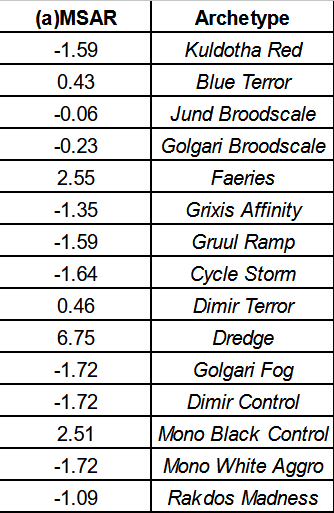
Due to some issues on Daybreak’s end, only two Challenges were able to fire this past weekend. Neither of the Challenges were particularly well attended, with Friday’s featuring two players with 1-5 records making the Top 32. These finishes tend to have a confounding effect on singular weekend data, decreasing the number of overall wins in the pool which in turn makes the decks at the top of the metagame appear potentially stronger than their actual performance. For example, Kuldotha Red may have been the most popular deck in the Top 32 last weekend, but it performed…well…I’ll just show you.
Adjusted Meta Score Above Replacement seeks to measure how well an archetype performs compared to the average Top 32 deck in a given weekend, adjusted for the number of appearances in the Top 32. It is normalized to the most popular deck in the field on a week to week basis. Kuldotha Red, with five more finishes than the next archetype, was tied for 10/11 out of 15 over last weekend. Dredge, with two total Top 32 finishes (both of which were in the Top 8, including a win) was technically the best performing archetype with numbers that are mind boggling and also an outlier.
Data is only as good as the context in which it is presented. I could easily post an image of my shocked face, double pointing at the image on Dread Return declaring “THIS DECK IS BACK FROM THE DEAD” with the subheading “Is Pauper on its way to the grave?” to get clicks, only to tell you that despite the numbers I wouldn’t recommend Dredge next week. Oh to operate in the attention economy.
So what is the full context of last weekend? Small Challenge field obfuscate actionable data. Given the field size and overall number of wins we end up information that we cannot easily use to predict how the metagame may react. In other words I cannot in good conscience make a recommendation in part because there is not real basis for said declaration.
And that in it of itself is another problem. I have used this space to talk about the relative health of Pauper. There are multiple decks you can pilot to success and despite the format being a bit top heavy things are largely in balance. The best decks in the meta jockey for position and help to keep each other in check. While things vary from week to week the flavor is starting to become stale. Is a format really healthy if people aren’t excited to play it?
To be clear I am not saying this is the case. There could be any number of reasons people are not trying their hand in these events. At the same time it has been hard to ignore the slow decline in participation. Could there be correlation to dissatisfaction with Pauper? Possibly. It could be that other formats are better than they have been in quite some time and people are playing other tournaments. Cube is more readily accessible these days and could prove an attractive diversion. Or maybe you’re like me and after a week of working at a computer the idea of sitting in front of one for your free time sounds about as much fun as walking barefoot in the snow after a hot shower.
Regardless, the low numbers have caught my attention. And if the trend continues then it could be indicative that despite all the good there is in Pauper that it might be time for a change. Just because something is stable and balanced does not mean it is good; just because something high powered is strong in the format doesn’t make it inherently bad.
I want to take a moment to thank all my Patrons. I am going to do my level best to keep providing you with the kind of content that brought you here in the first place. If you are interested in supporting my work, you can sign up for my Patreon starting at just $1.
Can’t make a commitment to Patreon? I have a Ko-Fi where you can make a one time contribution.
Looking for another way to support my work? Click here for my TCGPlayer affiliate link. Any purchases through the link let the folks there know you like my content!
Want to learn more about the metrics I use in tracking the metagame? You can find an explainer here.
Foundations season is well underway with eight weeks of Magic Online Challenges in the rear view mirror. At the same time, Pauper can feel as if it has been in the Modern Horizons 3 release cycle since that set debuted. Depending on how you look at things the metagame appears to be rather diverse but at the same time there are a relatively narrow band of things you can do. This coupled with the relatively slow metagame churn of the format has left some dissatisfied. Today I want to take stock of where things stand and try to identify where things might be headed.
First, my usual caveats. Yes, I am a member of the Pauper Format Panel. That being said the opinions I express here today are my own and are not representative of the Panel. While this information may (or may not) be similar to some of the points I make in our discussions, do not take them as gospel. Rather, these observations are just my take on things.
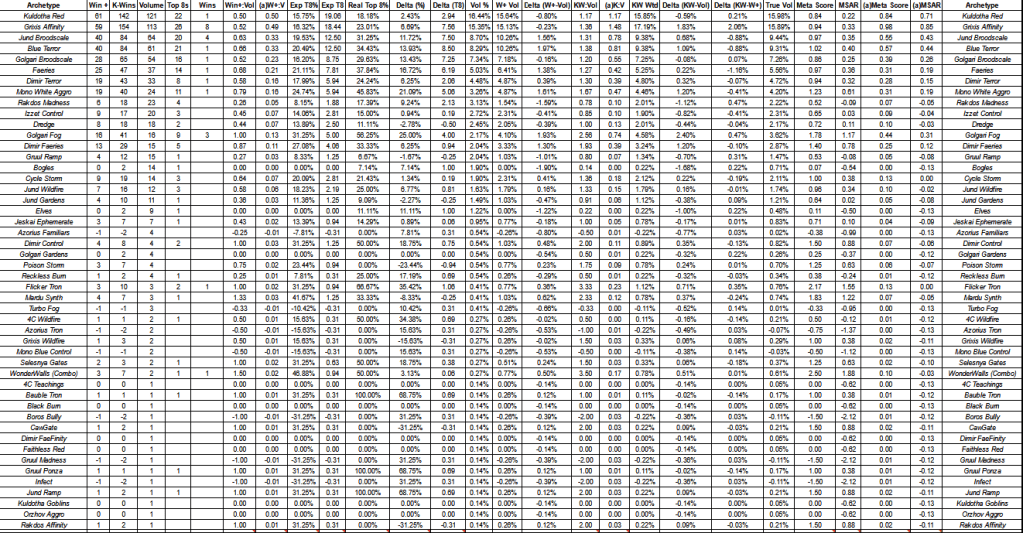
I know this chart is small, but I will do my best to highlight the relevant numbers as they relate to this discussion. Over the past two months and 23 Challenges, 49 different archetypes have made the Top 32 of the Challenges. Some of these are minor variations (a Goblins focused build of Kuldotha Red for example) or hybrids (a mashup of Affinity and Dimir Faeries). However only 14 archetypes clear 2% presence in the Top 32 (minimum 15 appearances) and only six clear 5% (37 appearances). The metagame, therefore, appears to be concentrated on a few top decks with “fringe” builds only occasionally making waves.
Today I want to focus on the “True Volume” column. This number attempts to measure how prevalent an archetype is as it relates to its strength. For example, Kuldotha Red took up 16.44% of the total Top 32 metagame but when looking at its relative performance it dipped slightly to 15.98% of the True Volume, or Winner’s Metagame. Looking at the raw numbers, only two decks stand out in this regard – the aforementioned Kuldotha Red and Grixis Affinity at 15.89% True Volume. These are the only two discrete archetypes that clear 10% for Foundations season.
Astute readers will no doubt discern that I am up to something. Despite Kuldotha Red and Grixis Affinity being the two archetypes with the best performance, the metagame includes several strategies that share core elements and gameplans. There are multiple Basking Broodscale combo decks spanning the Goglari and Jund color combinations, and no fewer than three different versions of Tolarian Terror decks (Mono Blue, Dimir, and Izzet). When we look at these larger strategically similar buckets we end up with a composite that is less a mosaic:
All told these four game plans occupy 65.56% of the Winner’s Metagame. Depending on your perspective this is either fantastic (a non-rotating format with four viable top tier strategies across seven sub-archetypes) or less than ideal (their dominance is squeezing out other potential builds). The more time passes the more I am in the latter camp in part because of how much ubiquity there is amongst multiple archetypes.
Let’s take Affinity, for example. This strategy often features the Artifact Lands, Deadly Dispute, and Galvanic Blast. If you look at the red strategies they also heavily lean on artifacts to enable Galvanic Blast. Broodscale decks run Deadly Dispute and some Jund varieties run the Bridges to accelerate with Cleansing Wildfire. Moving away from combo most midrange Golgari and Jund decks also run a Deadly Dispute package, with one build also running Bridges and Cleansing Wildfire. While there are four main buckets, there are, in some ways, three things to do – Red, Terror, or Dispute. This may be a reductive exploration but at the same time it is reflective of the top of the competitive metagame.
How many things should one be able to do in a non-rotating format? In my opinion three is too few and four is not quiet there either. If the top of the format only comprised say, half of the Winner’s Metagame it would allow for further development of Tier Two (and below) strategies that could potentially gain a foothold and find success. It is not necessarily that there are too few things to do but rather that these elements are clearly a lap or two ahead of everyone else. After the Big Four the next best macro-strategy in Pauper revolves around Spellstutter Sprite and it comes in at 8.43% of the Winner’s Metgame, and then it’s another massive drop off to Mono White Aggro at 4.2%.
Part of this is the nature of commons. Unlike Pioneer, Modern, and Legacy there fairly few singularly powerful cards around which you can build an archetype. The Initiative and Monarch both exist but have moved into a support role rather than a focus of the format. Instead of leaning on individual cards Pauper decks are built largely on layered synergies which means that the best packets will often rise to the top. The format has plenty of options but given the landscape means that the Big Four are the best things one can be doing at the moment.
Seeing as the upcoming releases are Innistrad Remastered and Aetherdrift, the chances for a Modern Horizons 3 level shake up are slim. Standard Legal sets rarely have a massive impact and neither Time Spiral Remastered nor Ravnica Remastered did much to nudge the metagame. It is possible that the only way to things to change would be for a forced rotation via cards being added or removed from the banned list. That being said it is also possible that the next two sets will buck the trend and make waves so nothing is set in stone.
There, of course, is another issue. While the format is currently rote in many ways it is balanced. Pulling or pushing on one of these core decks too strongly could upset that and cause another series of issues. Words similar to these have been written before and the solution is never obvious or prescribed. All this being said it is hard to ignore what recently happened with Modern and the massive shakeup – and excitement – that flowed from the changes to that format’s card pool.
What could be done? Lots, to be sure and I am not going to speculate on individual cards for the reason previously discussed. Still the question that lingers on my mind is how much would need to change for there to be emergent strategies? There are tons of established decks available that could assert themselves if an opening existed, but would they keep Pauper exciting or would the discourse return to this point in six months’ time?
What steps would you take with the format? Do you believe anything should be done? What cards are in your sights? Would you take a minimalist or maximalist approach to things?
I want to take a moment to thank all my Patrons. I am going to do my level best to keep providing you with the kind of content that brought you here in the first place. If you are interested in supporting my work, you can sign up for my Patreon starting at just $1.
Can’t make a commitment to Patreon? I have a Ko-Fi where you can make a one time contribution.
Looking for another way to support my work? Click here for my TCGPlayer affiliate link. Any purchases through the link let the folks there know you like my content!












 NerdtotheCore
You must be logged in to post a comment.