Center Stage: Cleansing Wildfire

Before I go any further I want to give you a heads up: here there be spoilers for Zendikar Rising. If you don’t want to learn any cards in the set ahead of time, just click out of this page and you’ll be none the wiser.

Is the coast clear?

Good.

It’s not a secret that Tron is a borderline oppressive force in Pauper. The abundance of mana provided by the trio gives Tron decks the ability to do more things in a given turn cycle. Given the relatively flat power level of Pauper, this allows Tron decks to pull ahead to a nigh insurmountable lead in the game.

One thing that always comes up in discussions about Tron is the concept of land destruction. Despite Pauper having access to some very power land destruction options, the strategy fails against Tron. This is due to a few elements.

  1. Tron does not need the Tron to operate early, which is when land destruction is at its best.
  2. Tron can protect lands with Ghostly Flicker or Pulse of Murasa, or render land destruction moot with Crop Rotation.
  3. Taking a turn off of pressuring Tron to attack their mana is not a winning trade off.

I want to talk about this last point a little more. Land destruction and mana denial has worked as a strategy when you can attack a deck’s resources and life total concurrently. A classic example of this is Red Deck Wins from Onslaught era Extended. Here’s a list from Hall of Famer Zvi:

Jackal Pup and Slith Firewalker could apply pressure like few other cards in that era and following them up with a Stone Rain or Pillage could buy enough time until a Blistering Firecat could deal the final few points. But look at all those lock pieces. Red Deck Wins could use both Wasteland and Rishadan Port to deny the opponent a chance to do, well, anything. Since Red Deck Wins had suck a low curve this was hardly a problem.

Pauper has a ton of good aggressive one and two drops. What it lacks is the supplemental ways to tax resources. This means that in order for land destruction to be viable it cannot be tempo negative.

For the regulars out there: how many times have you played against Black Ponza and not really cared about them blowing up your land since you had a threat?

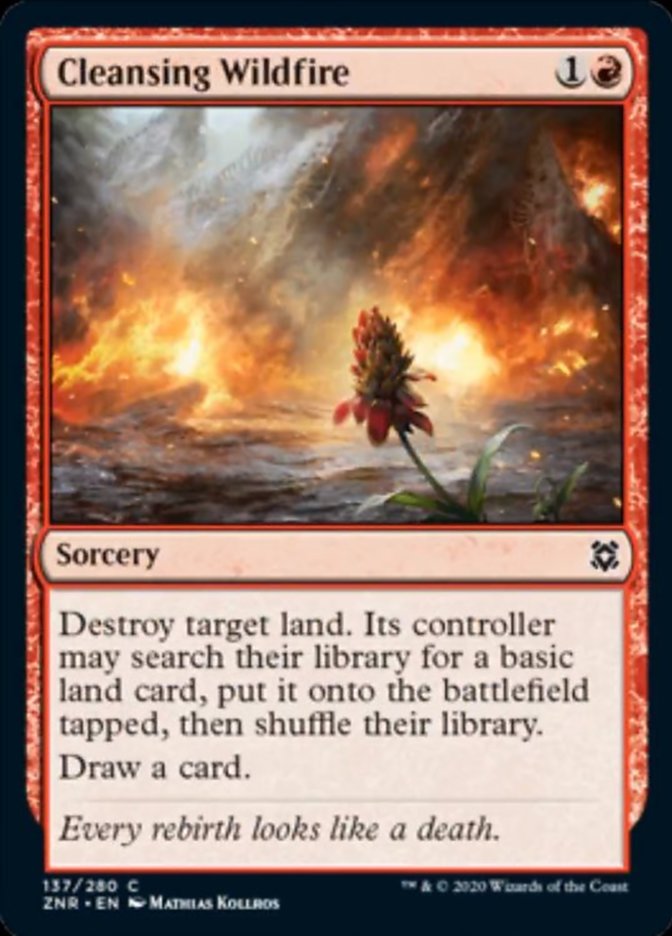
That is where today’s card comes in: Cleansing Wildfire.

One of the best cards in Pauper is Burning-Tree Emissary and now you can lead Goblin Cohort into Burning-Tree Emissary into this two mana spell. The not-Sinkhole is at its best against bounceland heavy strategies (namely Boros) as it can take away a land drop. But what about Tron – how does it fare there?

Here’s a short answer: I don’t think Tron is going anywhere. I do think Cleansing Wildfire does good work buying red decks another turn. I do not think that this is even the first nail in the deck’s coffin. Why? Because Tron can just adjust its play style and not expose a Tron land until after the ideal Wildfire turn. At that point this just becomes another annoyance rather than a roadblock.

Looking at Lists: Retriever Affinity

So maybe I got this one wrong.

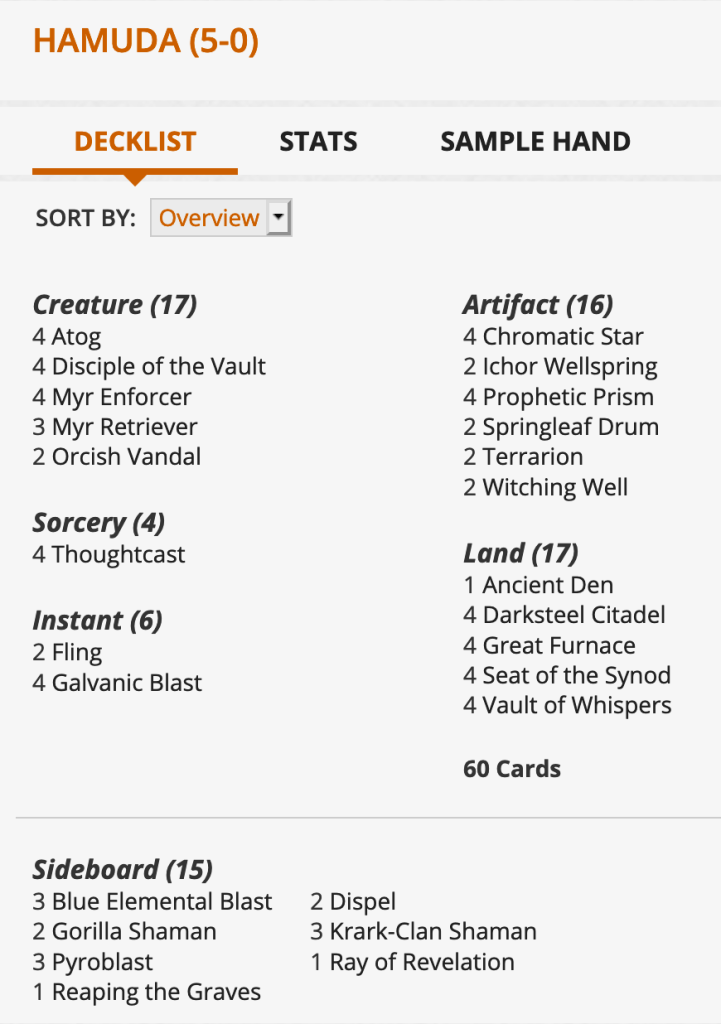
In the month since I wrote that article, Myr Retriever has done little in the way of Pauper results. It isn’t that players haven’t tried to make it work or that the combo is bad. Rather, the format is hostile to a dedicated combo deck that relies on the graveyard. Today’s league results showcased a way to use the downshift in an existing shell.

This is a dedicated comb-Affinity deck. While it is not “all-in” on Fling, it does lean harder on non-combat damage to end the game. That being said, it will see a ton of cards and while it may not have free Retrievers, it has the ability to chip in damage with Orcish Vandal.

The question remains – is this better than traditional Affinity or the Jeskai builds with Of One Mind? I don’t have a clear answer, but I think it might be the best of the bunch right now.

Being realistic, Pauper is currently hostile to attacking. While every week we see a few combat based decks getting a 5-0 the truth of the matter is that between Stonehorn Dignitary, Moment’s Peace, and Prismatic Strands, attacking is for losers. Fling doesn’t fare much better but getting around damage with Disciple of the Vault may do enough chip damage to get the opponent within Vandal or Galvanic Blast range. Retriever Affinity wants to pressure the opponent’s life total in several ways, forcing them to choose how to defend themselves. Being base Izzet gives the deck access to amazing counter play out of the sideboard.

Is Retriever Affinity the next big thing? Probably not, but it’s always cool to see new cards make a splash.

August 29-30 Pauper Weekend in Review

After a week where Challenge results didn’t populate due to back end error, we are back! Both August 29 and August 30 played host to six around affairs. We also now have 8 challenge results and, well, would you look at that? We’re standing on the precipice of yet another new release. While Zendikar Rising isn’t likely to make huge waves in Pauper, the recent run of Standard legal sets having an impact makes it possible that this will be the most impactful Zendikar set since Zendikar.

Rather than focusing on these events as distinct entities, I want to look at format trends. None of these should be very shocking.

Flicker Tron

The most popular deck in format has an excellent case for being the best option. In 35 Top 32 appearances it is averaging a Top 16 finish and has 12 Top 8s (with a win). If anything, the deck is under performing. Weird, I know. Given how powerful it is and how hard it is to disrupt, Flicker Tron should be running roughshod over the Challenges. Yet it is merely doing very well. Strange.

Boros Monarch

This deck, on the other hand, is have a resurgent season. Despite not having a win, the deck has a Win+:Volume ratio of 1.32. Roughly translated, it has more finishes of X-1 or better than it does of records on the other side of that coin. It’s doing this as the fourth most popular archetype. Even if you fold in the versions with a heavier black component, you still get a deck where the ratio is above 1. For a deck that gets housed by Tron, this likely means that Boros Monarch is the best deck against everything that isn’t Tron.

No Beatdown

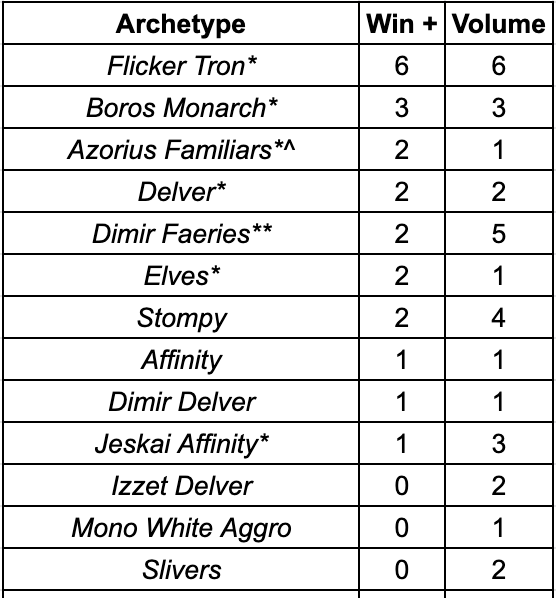
Given the top two decks, this shouldn’t be a shock. Stompy is the second most popular deck but only has 4 Top 8 appearances. For an average deck this would be amazing. But Stompy’s ratio of Win+:Volume is an abysmal 0.48 – it is more likely to finish X-3 than X-1 this season. Here’s a short, non-comprehensive list of decks that are out performing Stompy (with a minimum of five appearances):

  • Burn
  • Elves
  • Mono Black Control

These are decks that are often considered second rate at best. I’m not saying Stompy is bad, but when the best two decks are really good at stopping combat from mattering, well, what are you really doing with Burning-Tree Emissary?

I think non-beatdown Linear Decks are in an interesting spot. Both Burn and WonderWalls did well this weekend, but these are not likely to be the start of a trend for these archetypes. This is because Linear Decks have a harder time adjusting to metagame trends due to the nature of their design. Instead, I would expect the various Spellstutter Sprite decks to get a little boost next week.

Here are the top performing archetypes with at least five appearances. I included WonderWalls and Azorius Familiars here due to their results over the past weekend.

Responding to Constructed Resources

The seventh episode of Constructed Resources discussed how to beat control decks. I encourage you all to give it a listen as it provides valuable insight and, being real, it’s on a website where I write. In the episode, Luis Scott-Vargas and Andrew Baeckstrom discuss methods for disrupting and defeating control decks. Given that the current best deck in Pauper falls into this camp, I think it’s important to take a look at their methods and see how they apply to attacking Flicker Tron. 

Spoiler alert: they don’t translate especially well. 

Here are the four points summarized:

  1. Be faster than the control deck
  2. Present an unsolvable threat or an unexpected angle of attack
  3. Overload their mana on a given turn 
  4. Present a card that “must be dealt with” 

These points tend to hold true when looking at the wider Magic ecosystem. While not every deck will be able to tick every box, being able to do one or two of these is often enough to at least pressure a control deck. I often talk about trying to put a control deck on the defense – this is shorthand for forcing them to use their mana inefficiently. In fact, breaking these points down the best way to attack a control deck is to be more efficient in mana use either by lowering your curve or rendering their spells less potent.

Be faster than a control deck

Traditionally control decks take the first few turns to set up their mid and late game. Playing two-power one drops is a better use of mana early and can force the control deck to delay their set up in order to handle threats. 

Present an unsolvable threat or an unexpected angle of attack

How good is Lightning Bolt against Slippery Bogle? What about Cast Down and Guardian of the Guildpact? While the two spells listed are cheap they do nothing against the intended target, rendering the mana spent mana wasted. You can even sidestep creatures entirely and go for a Curse of the Bloody Tome or Pestilence plan.

Overload their mana on a given turn

A tale as old as time. If your threats are cheaper than their answers you will have an easier time resolving a spell. At the end of the exchange you should have a board presence staring down their depleted resources.

Present a card that “must be dealt with”

More of a corollary to the second point but this pertains more to high powered formats. The cards LSV and BK describe in the episode are Planeswalkers as they have a profound effect on how the game plays out. In Pauper, this can be something like a Thorn of the Black Rose, a Bonder’s Ornament, or my personal favorite – Dimir Guildmage.

Before going further, I think it’s important to break down the many styles of control decks that Tron encompasses. Part of the deck’s dominance is due to how much it can pack into its 75.

Big Mana

The Tron mana engine lends itself to a big mana strategy. Tron cares less about mana efficiency than about the raw power of its cards. Thanks to its abundant resources Tron has access to effects that are off limits to decks that play fair. More than that, it can cast the curve toppers of other decks earlier in the game. So where a “fair” deck has to wait until turn four to Mulldrifter and Ephemerate, Tron can do this a full turn earlier. 

Mnemonic Wall

There is a subset of control decks in Pauper that lean on the Ghostly Flicker engine to generate a persistent advantage. Before the advent of Ephemerate and Flicker Tron one could argue that the Chittering Rats lock was the go to version in this camp, despite not running Wall. Dimir Flicker played a “fair” midrange-control game that would eventually assemble its lock. It could stumble in the early game and had far more pinch points than Tron.

Teachings Control

Mystical Teachings is a powerful tutor that is limited by its mana cost. Teachings decks can run high variance-high impact cards since the deck can simply find the right tool for the job when the need arises. Teaching decks are among the most traditional control decks in Pauper in that they are vulnerable to each of the four points presented in Constructed Resources.

Tron is each of these decks layered on top of one another. In doing so, Tron has managed to cover a control deck’s traditional weaknesses to create a metagame monster. 

Be faster than a control deck

It is incredibly hard to be faster than Tron. The very best aggressive decks in Pauper are turn four kill decks with an outside shot at killing turn three. By turn four it is highly likely that Tron has established the defenses necessary to blunt assaults. Whether that is Moment’s Peace, Stonehorn Dignitary, or Weather the Storm, it is incredibly hard to “go under” Tron on a temporal scale. The banning of Expedition Map did not slow Tron down as intended. Rather, Tron shifted to Crop Rotation which gave Tron outs to be even faster at assembling its mana engine.

Present an unsolvable threat or an unexpected angle of attack

Nothing really fits here. Yes, you can try to resolve a Pestilence or a Curse of the Bloody Tome or several Fireblasts. But as stated, Tron can cast Weather the Storm and undo a ton of damage. Tron can also run Dinrova Horror and handle any permanent. Even a Slippery Bogle is vulnerable, or rather that Ancestral Mask it’s wearing is a prime target.

Overload their mana on a given turn

I mean…technically it’s possible. Technically you can overload Tron’s mana early but once the engine comes online it is nigh impossible to break it up. It is a fool’s errand to try and be more mana efficient than Tron and even if you exhaust their resources, they are only a few turns away from reloading on key cards thanks to Mnemonic Wall and Ephemerate.

Let’s take another look at the theory of overloading Tron’s mana. A “fair” blue deck wants to win stack battles in post-board games. They decide that Dispel is their best option given a limited number of sideboard slots. The Tron deck determines their best option for additional stack control is Prohibit. Both cards cost one land in their respective decks but Prohibit is far more flexible.

What happens if the blue deck decides it wants to run Prohibit as well? It’s going to lose on mana efficiency there as well. Kicked, Prohibit will cost a traditional blue deck at best four land drops (since bounce lands take up two land drops regardless). Tron can kick a Prohibit on two land drops. 

It also is difficult to force Tron to overextend their resources. Even if you are able to empty the Tron player’s hand, the nature of Mnemonic Wall and Ephemerate make it trivial to reload. Access to Wall, a Flicker, and mana means that a single Dispel or Prohibit could win an entire counter war. 

Note: One of my Patron’s, Jacob, who plays a ton of Azorius Familiars, has pointed out that it is possible to overload Tron’s discrete mana. While true, Tron can sidestep this with Ghostly Flicker on Prophetic Prism.

Present a card that “must be dealt with”

Let’s be real: there is no card in Pauper that Tron views as a “must answer”, not in the way described in the episode. Rather, Tron faces down inconveniences and annoyances.

Earlier I described beating a control deck as trying to force them to spend their resources in an inefficient manner. The reality is that there is no way to do this to Tron. The deck can reuse spent resources with ease and rarely has to worry about running out of mana. It is a metagame monster.

Looking at Lists: Bone Picker Dimir

I want to talk a little bit about Delver of Secrets. Delver exerts a unique pressure on Pauper in that when left unanswered it can absolutely take over the game. When a turn one Delver flips it changes to entire texture of battle.

Pauper in many ways is a format of Magic‘s fundamentals (taken to the extreme). The baseline stat for a creature is 2/2 and any variation on this can have massive implications. Burning-Tree Emissary isn’t a powerhouse because it is one creature but rather because it represents a much better rate for several 2/2s. Mulldrifter is also a 2/2 but comes with extra cards attached. Kor Skyfisher would not see nearly as much play if not for that extra point of toughness that gives it a leg up against, you guessed it, bears.

Delver of Secrets changes the math on combat. The damage is going to pile up 50% faster. That creates a huge incentive to try and flip the creature as quickly as possible if you are trying to be aggressive. As of late, various “Delver” decks have realized that the deckbuilding cost was too damn high. It makes sense as these decks want to trade early removal to leverage Ninja of the Deep Hours late. Taking a turn off in the hope of getting an offensive boost doesn’t track.

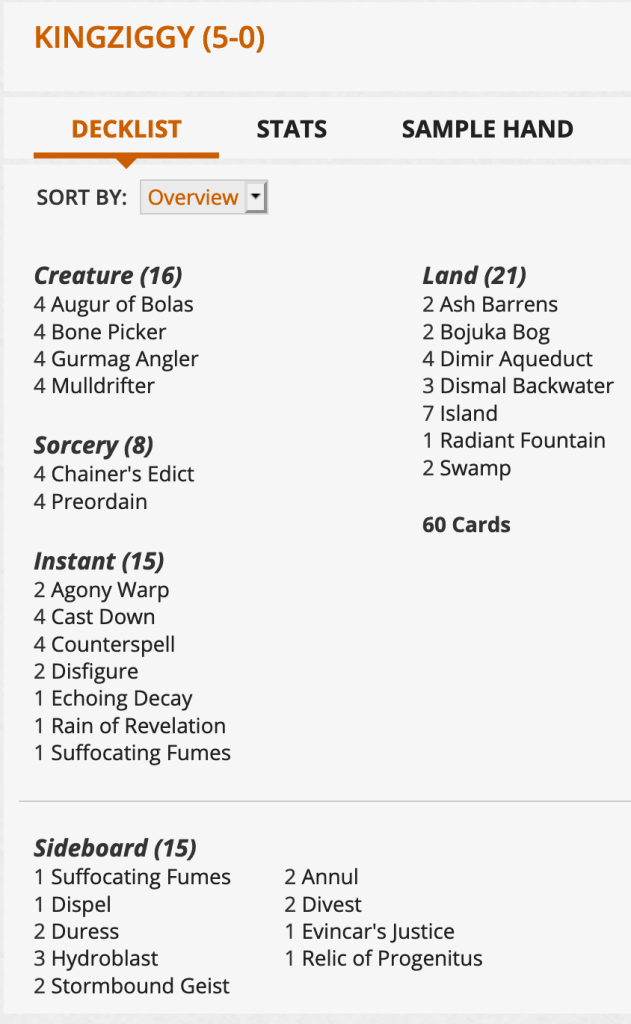
Today’s list from the league results doesn’t try to flip a Delver of Secrets early. Instead it wants to play a more traditional control game. Kingziggy’s deck wants to trade resources early to make it easier to cast Gurmag Angler in the mid game. Deck’s like this have been very popular but have also featured everyone’s favorite flying beatstick. Here it is replaced by recent downshift Bone Picker and it makes a ton of sense. Now the deck can either cast Preordain turn one or set up its mana with Ash Barrens and then double spell later to set up a Bone Picker. Or it can wait until turn four an evoke a ‘Drifter to turn on Bone Picker’s morbid ability.

I like this slightly slower take on the Dimir deck. My one quibble is the Radiant Fountain. In a deck that ideally wants access to both UU and BB, running a land that produces neither is a decent liability. While there is something nice about having a maindeck buffer for more aggressive decks, is two life really going to save you from Thermo-Alchemist?

Center Stage: Last Rites

Let’s talk about decision making.

Last Rites is a three drop discard spell that can absolutely destroy your opponent’s hand. The rub is that you need to to the same. The pay off is huge in that for each card you pitch, your opponent reveals a card in their hand and send it to the graveyard. I have found success with this deck in both Exhume decks and Lands strategies where you have tons of fodder thanks to Mulch.

The big thing about Last Rites is that discard the cards from your hand is not part of the cost. That means that if your opponent wants to counter it, they have to do it before they know how many cards you are going after. Therefore this card is at its best when it follows a Duress but even on its own it can be backbreaking. If it resolves of course.

Last Rites is one of those cards that should see more play in specific situations, but probably isn’t good enough to be a format staple.


And now for something a little different. I found out this week that starting in early September I am being furloughed for at least the rest of the calendar year. I don’t like sharing too much about my personal life here but here’s a little taste: my spouse was laid off earlier this summer and we have a toddler at home. Living in the United States means that our health insurance is tied to employment and, well, the math is pretty simple here.

Even if I didn’t have a chronic illness that requires regular doses of medication, we could not go without health insurance for any length of time. While we are both searching for work and have some savings, I can’t say things are going to be “okay” long term. And that sucks.

I know times are tough all over. If you enjoy my work and are able to, it would mean a lot if you would considering becoming a Patron. I am not going to hawk this all the time, but if I didn’t exhaust every avenue for my family, I wouldn’t be happy with myself.

While I look for new employment I will do my best to provide you all with more Pauper content.

Keep slingin’ commons,

-Alex

Looking at Lists: Turbo Fog

If you follow my writing you might find it ironic that, despite my hatred of all things Stonehorn Dignitary, I really love Turbo Fog strategies. I think it comes down to the fact that while both seek to disrupt the combat step, Turbo Fog has far more fail cases than Flicker Tron. This is probably because it actually plays fair Magic and is far more constrained on resources.

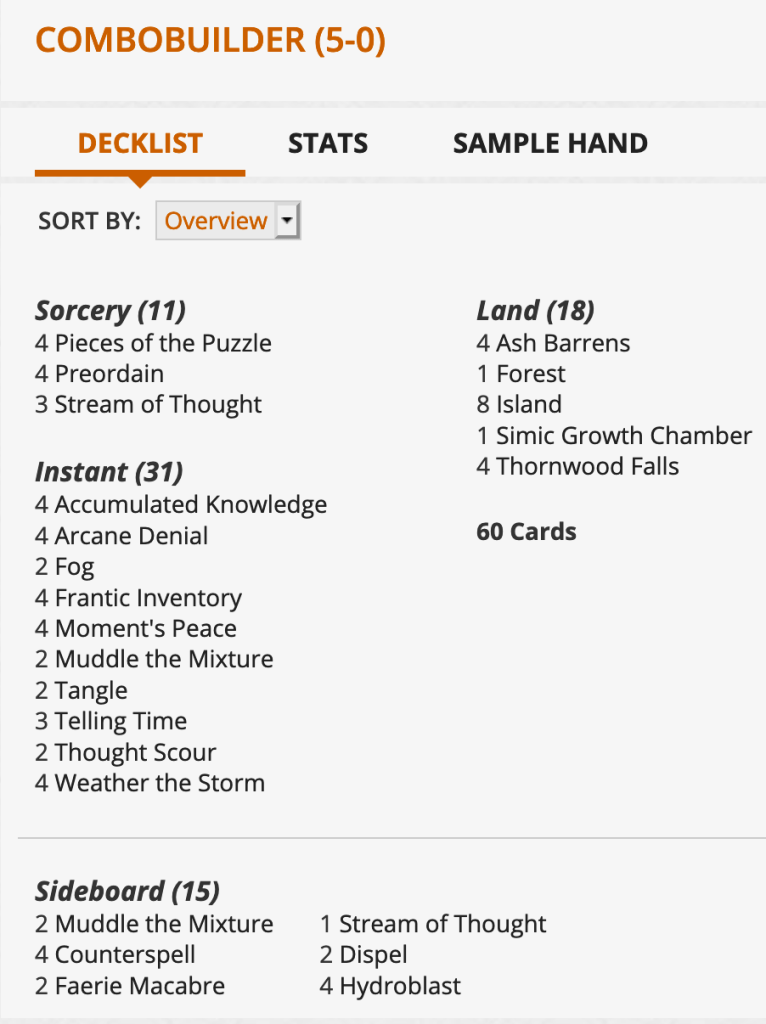
Most builds of Turbo Fog include Jace’s Erasure as a win condition to help speed along the natural process. Combobuilder even includes Muddle the Mixture – a common tutor for the enchantment – in their build. But instead of Erasure they are running three copies of Stream of Thought which seems awesome. Stream has the advantage of shuffling key cards back into your library and in the late-game it comes in with Replicate.

This build also benefits from four maindeck copies of Weather the Storm. Normally you could beat a Turbo Fog deck by dealing non-combat damage (we see you Burn). Weather the Storm not only provides additional insurance against creature combat, but it also makes it that much harder to be bludgeoned by a barrage of bolts.

If I were looking to make changes to this deck I would consider adding a few lands. This feels like a deck that wants to ensure it hits enough land drops to be able to counter something and then fog the same turn cycle. While Fog might help, it is the only single mana combat nullifier in the deck and there are only two copies total.

August 15-16 Pauper Weekend in Review

We have hit the third week of Double Masters season and the metagame is rounding into shape. To the shock of almost no one, it looks a lot like the metagame before the bans of Expedition Map and Mystic Sanctuary. The best decks remain Tron, Monarch, and Spellstutter Sprite variants. Let’s take a look.

Saturday’s Challenge was not very diverse. Stompy and Flicker Tron were the two most popular strategies; Flicker Tron performed extremely well, Stompy not so much. But the deck of the weekend was Boros Monarch. In four appearances on Saturday, it placed three decks in the Top 8 (including an undefeated Swiss run).

Before the bans, Boros Monarch had been struggling to keep pace with the other major players. As of late, it has seen a resurgence due in no small part to the Thriving lands. These cards give Boros easier access to splash colors – specifically black. We have seen more copies of Terminate, Chainer’s Edict, and Unearth show up in Boros as of late. We have also seen more copies of Bonder’s Ornament which can help to turn off Tron’s card flow. Boros also can now run Abrade as another way to pressure some of Tron’s mana rocks.

Another challenge and another undefeated run by Boros Monarch. While it made it to the Top 8, it fell in the quarterfinals. The deck of the day was Jeskai Ephemerate, with three copies in the Top 8. Jeskai Ephemerate plays a similar game plan to Tron except it eschews the benefits of Tron – namely Mystical Teachings – for running Ponder and Preordain.

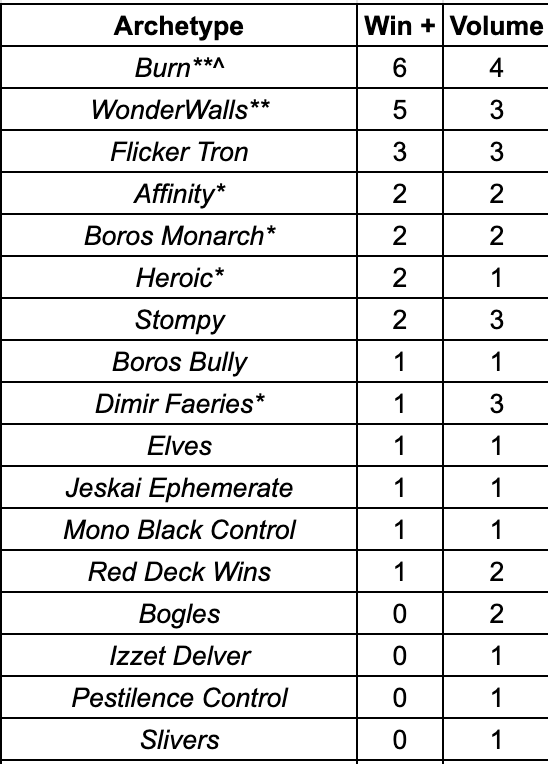
Here are the best decks with at least 2% of metagame volume (approximately 4 appearances). Left off this chart are Azorius Familiars and Izzet Delver, who each have a challenge win.

Looking at this chart we can see that both Flicker Tron and Boros/Mardu Monarch are pulling away from the field. While it is still early in the season, it appears that those two are the decks to beat. The different Spellstutter Sprite decks are putting up a good fight but are definitely better situated to do well in the Top 8 than the Swiss. Meanwhile, there’s Stompy – a deck which needs to adjust to the shifting landscape.

What deck do you think is poised to breakout next weekend?