I’m going to skip my regular summary this week. Instead I implore all of you who live in the United States, who have not done so, to vote. And while I’m not one to tell you how to live your life, I am going to encourage you to vote for the Democratic party because they, at the bare minimum, have a plan that will get us out of this pandemic (as opposed to no plan at all from the other side).
Hello and welcome to Svogthir’s Study: a place to appreciate Golgari in Commander.
When I first conceived of this series I had intended to go in chronological order. It made sense to follow the progression of a color pair as the game itself evolved. For whatever reason I forgot that we are almost always in spoiler season these days and as such there are going to be opportunities to discuss new Golgari Commanders as they are revealed. I’m seizing that opportunity today.
Belbe, Corrupted Observer does something new in Golgari: it encourages mass aggression. This plays on Belbe’s character in the Magic storyline as the emissary of Phyrexia who tested potential Evincars of Rath before the invasion (from Invasion). She is literally pitting contestants against each other. The secret with Belbe is to not treat her like a two drop but rather as a card that comes down later in the game once you can fully take advantage of her mana generation. This ability also ties into her lore as she is the compleated daughter of Eladarmi and his eponymous Vineyard made mana during the precombat main phase.
Golgari is about the cycle of life and death. Here we see a uniquely Phyrexian take on that cycle: depleting your adversaries health gives you a new resource in mana. The fact that this mana is best used to cast Artifacts (and fine, Eldrazi) is incredibly Phyrexian and rather on the nose. In this way Belbe is similar to Rakdos, Lord of Riots, except she is far easier to resolve and doesn’t paint a giant target on your head. Whereas Rakdos wants other players to lose life for your benefit, Belbe wants everyone but you to lose life for your opponent’s (and your) gain.
There are a few things you can do with Belbe. I think you can use her in an artifact centered deck. You will want to use cards like Staff of Nin and Ticking Gnomes to ensure you have a steady source of damage. Viridian Longbow can ensure that you will, at the very least get two colorless on each of your turns. Angel’s Trumpet could be a sleeper here, encouraging everyone to attack. Load up with cards like Dread to discourage folks from attacking you and then pump your extra mana into a Walking Ballista. You can also take this build in another direction and use Belbe to help cast large threats with significant colorless mana requirements – both Pestilence Demon and Woodland Bellower spring to mind. You could even run Helix Pinnacle for fun. The key here will be bridging to the point in the game where Belbe starts churning out six mana a turn and it might involve using Curses to incentivize attacking players other than you.
That’s now how I would build Belbe because I’m not a nice person and I hate fun. When I saw Belbe I realized I wanted to pit my opponent’s against each other and reap the rewards. My mind immediately went to Elephant Grass. I want all my opponents to feel the pain and that means cards like Vindictive Vampire, Zulaport Cutthroat, Poison-Tip Archer, and Bastion of Remembrance. The real spice here, though, is Slimefoot, the Stowaway. Once you have a sacrifice outlet available, Slimefoot can make sure his lady in waiting is always well tended. I’d lean hard on artifact sacrifice outlets as well – Spawning Pit, Blasting Station, and Smokestack. Your goal should not only be to deter your opponents from attacking you, but slowly strangling them to death while you reap the rewards.
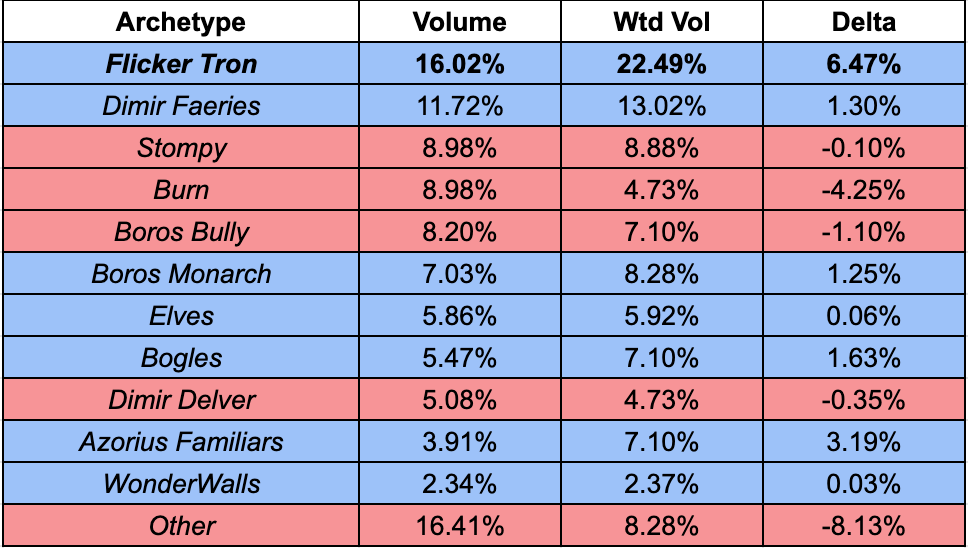
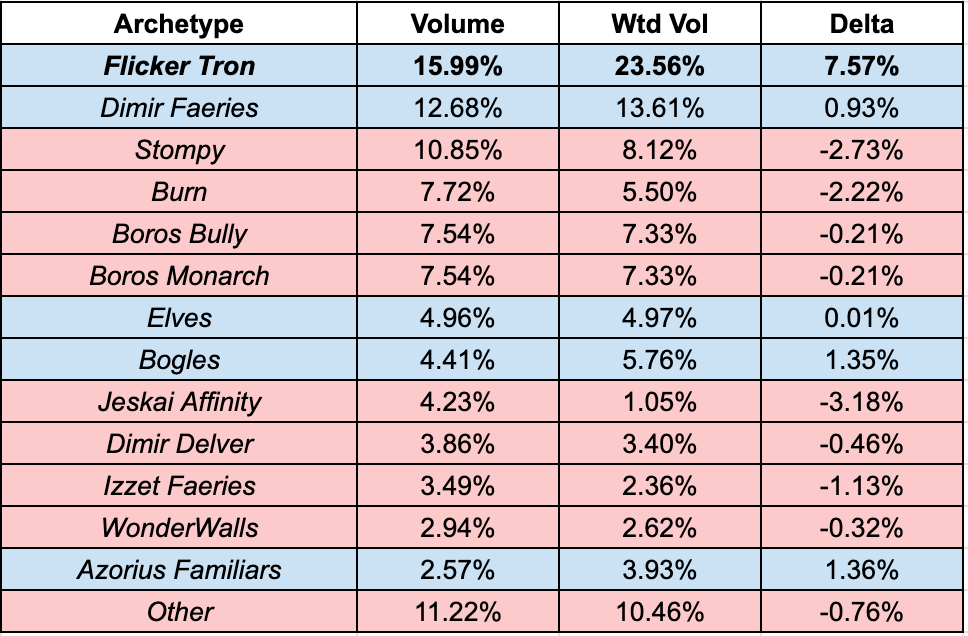
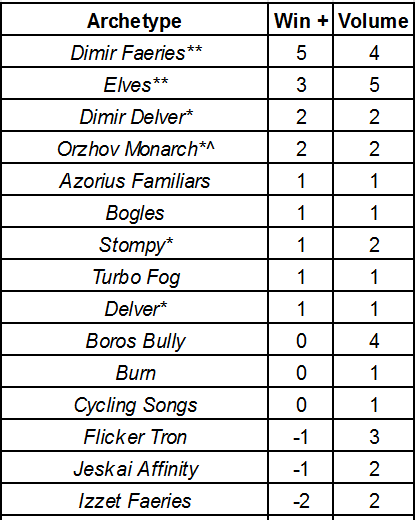
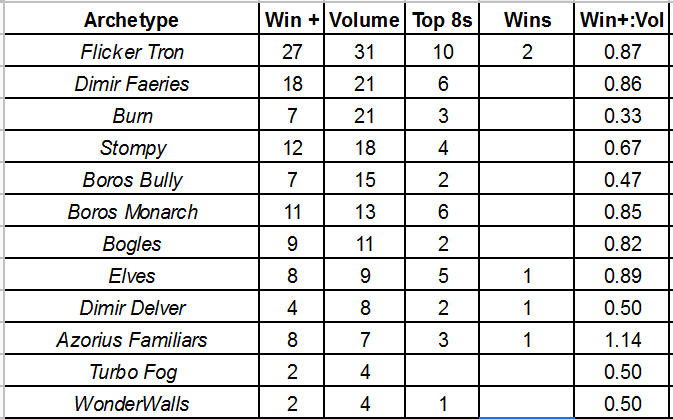
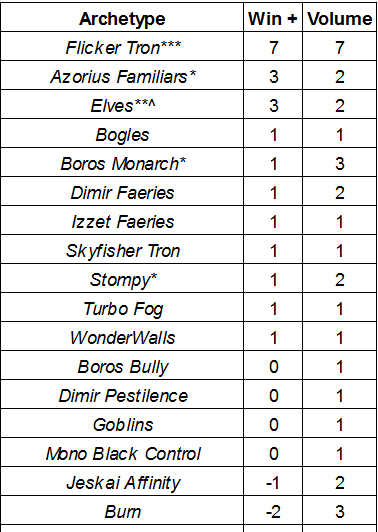
The October 24 and October 25 were nothing new. The best decks rose to the top of the metagame and Tron was a dominant force. This week a new crop of hyper linear decks came to battle, headlined by Bogles, Elves, and Turbo Fog. These decks had a solid Saturday and poor Sunday. I don’t want to get to bogged down in the data this week as it would simply be regurgitating what I’ve been saying for much of this season.
October 24
October 25
Today I want to build on what I discussed in this piece. There I focused on cards to remove from the format to change deckbuilding incentives. With a new set mere weeks away – one where the lead designer on the set had Pauper on his mind – I thought I would talk about what new styles of cards could be used to improve Pauper, separate from bans.
Incentivize Aggro
This is the number one thing that can be done to improve the overall health and diversity of the Pauper metagame. While plenty of decks win via attacking – Bogles and Izzet Blitz come to mind- there is only one traditional “aggro” deck in Stompy and one non-traditional aggro deck in Boros Bully. This is not the fault of the aggressive cards but rather the incredible payoffs that exist for building slower decks. While Stompy can put out a ton of damage the fail rate is far higher than stalling out the game to draw a ton of cards with Monarch or Bonder’s Ornament, or play tool box with Ephemerate.
How do you encourage people to turn creatures sideways? Pauper already has two mana 3/3s. I think the best way to do this would be to print weak hate bears that tax spells and not creatures. This is a tough rope to walk as you do not want to lock people out of games entirely but you want to make the bears good enough to see play.
The goal then is to not create a deck that runs these and uses them to beat down. Rather it is to use these creatures to put a tax on control decks which can then hopefully open up a lane for more aggressive strategies to blossom.
Double Down on Existing Engines
Take away Monarch and Ephemerate for a moment. Pauper has plenty of engines that just aren’t nearly good enough at the current moment. Tortured Existence and Tilling Treefolk come to mind but there are plenty of other cards that could form the backbone of a deck if given the opportunity and additional options. Trinket Mage, for example, is a powerful card that simply doesn’t do enough on its own. Pauper is littered with cards like this that just pale in comparison to what can be done with the current best options.
If we aren’t going to remove the best options, we can provide new tools for existing ones. Give decks better Retrace spells so Tilling Treefolk can be more than just a bad Mulldrifter. Give Tortured Existence a card like Syr Konrad, the Grim to it can close out games.
These are the two things that keep coming to mind as ways to increase diversity at the top of the metagame. That being said I am wary of kicking the can down the road, hoping the next non-Standard release will be the one that fixes Pauper. That being said, I think both of these are attainable goals that could go a long way to shifting the incentives in Pauper.
Hello and welcome to Svogthir’s Study: a place to appreciate Golgari in Commander.
I struggled to sit down and write this one. Bodes well for the second article in a series, right?
The truth of the matter is this: Iname as One is not a good Commander. I’m not saying you can’t run it or that you shouldn’t, but the card has a ton of baggage. Let’s look at it piece by piece.
First, that mana cost. A whopping twelve mana. Twelve! If you manage to hit a ramp spell on two mana, four mana, and two on six, you’re still not likely to get this thing out until the eighth. And you have to cast it from your hand to boot, which means using cards like Command Beacon, Netherborn Altar, and Road of Return. Even if you manage to cast this from your hand you can’t pull any Phyrexian Reclamation shenanigans since you have to exile Iname as One to get its effect. But let’s say you go through all of this work and you get two Spirits of your choosing. In black and green, you can’t get any combination of cards that has a large enough impact to warrant spending 12 mana.
I’m not going to tell you to not build Iname as One if you want to do just that. Commander should be about what you want to do. What I am saying is that someone who enjoys building around restrictions, Iname as One is a bridge too far.
All that being said, Iname as One is important to understand as one expression of Golgari as a color pair: it perfectly represents the cycle of life and death.
Black and green were set up from the start as a color pair that cared about the way life and death interaction. You can look at Dark Heart of the Wood to understand this – sacrifice a Forest to gain some life. Mirage block continued this trend – Cadaverous Bloom traded cards in your hand for mana; Grim Feast turns your opponent’s dead creatures into life points; Squandered Resources let’s you sacrifice lands for one final burst of mana. Even Vhati il-Dal can be seen as balancing life and death if you squint hard enough.
The trend continued in Apocalypse, and not just because there was a card literally named Life // Death. Aside from Llanowar Dead and Pernicious Deed, all the black-green cards that came at the end of Invasion block represented the life cycle. The entire concept of the Golgari, which would come in the set after Iname as One was released, is built on the truth that life ends and new life begins.
Is Iname as One a good Commander? I’m not going to answer that. But it is important in that it clearly spells out what Golgari cares about: the coin of life and death and making the best use of both sides.
These days most of my Pauper brews are based around Carrion Feeder or trying to turn Tilling Treefolk into a legitimate engine. Every so often, though, I try something outside my comfort zone and am pleasantly surprised. This is one such occurrence.
It all started with this post from Jarvis Yu. Prowess decks have long been a part of Pauper but then tend to pair blue with red or white. Blue has some of the best spell payoffs in Magic and traditionally, these decks want Delver of Secrets. Death’s Shadow variants in other formats lean on black and Prowess decks are almost always red. Could this logic be applied to Pauper? I built a quick Temur Battle Rage list and jumped into the league.
A 3-2 run told me I was on to something. My second attempt corrected some glaring omissions and streamlined the deck quite a bit.
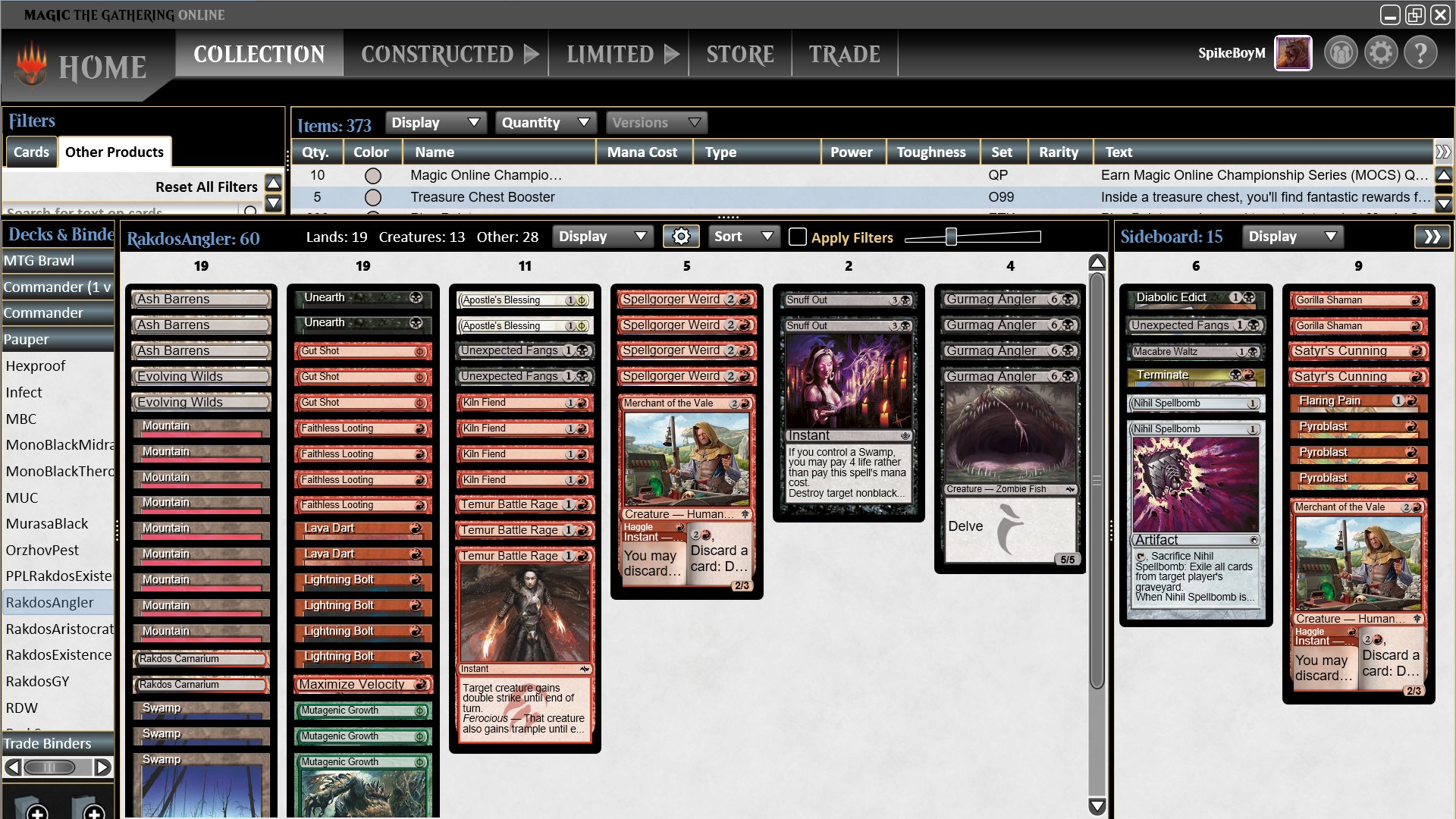
This one went 4-1 in the league and if not for missing a stop on my turn, could have gone 5-0. Here’s the most current list (with heavy input from MTGO user NotGood). The most recent build went 3-2.
Rakdos Blitz is a combo aggro deck. You win by leveraging your cheap (or free) spells and growing Kiln Fiend or Spellgorger Weird into a threat that you can then Temur Battle Rage. Gurmag Angler is fantastic here because it makes use of all those cheap spells and also is naturally Ferocious for Battle Rage. Where as other Pauper Battle Rage decks try to win in one massive swing, Rakdos Blitz can set up a win over two or three turns with ease thanks to Spellgorger Weird.
Because Spellgorger Weird gets +1/+1 counters and not a temporary buff, it turns every spell cast into more damage. It also happens to be the perfect size to be targeted by Unearth. Unearth is a huge advantage in running black over blue because it gives you more threats in the maindeck that also turn on your kill mechanism.
The best card in the deck is Faithless Looting. Looting allows you to rib through your library and find key cards while also dumping spells with Flashback or Jump-Start, or even a creature for Unearth, into the graveyard. Since you don’t need a ton of lands to win, Rakdos Carnarium can return a land to have it pitched to Looting. Looting also can stay in the bin, waiting to be flashed back on a key turn to grow your army.
Rakdos Blitz works as a deck because in the current metagame, most Pauper decks are bad at blocking. It makes sense – the format has polarized between hyper aggressive creature decks and glacially slow Tron decks. Because there are so few decks that want to play defense in a traditional sense, Rakdos Blitz has an opening to attack for the win. When blockers are played, the bevy of free spells (led by Snuff Out) can make it rather difficult to put creatures in front of your attackers.
The deck has a ton of play and I am excited to keep working on it. There are a ton of options available, including Crash Through and Rimrock Knight, that have piqued my interest. Until then, may the Red Zone be empty.
I am not going to dive too deep on the October 17 and October 18 Pauper Challenges. Taking into account what I wrote about last week, not a lot has changed. Goblins and Bogles both put up some solid results but the top of the metagame remains Flicker Tron and Dimir Faeries.
I’ve been doing a lot of thinking about Eternal formats this week thanks to the Eternal Weekend events on Magic Online. The allure of Eternal formats like Legacy and Vintage is that you can find a deck and stick with it for years at a time and while these decks may not always be the best in a given tournament, they can still compete.
Part of this is due to narrow, high impact cards that only a few decks would ever want having the ability to completely change a matchup. I’m thinking of Molten Vortex in Lands but with the vast card pool the possibilities are astronomically high.
Pauper has some of this, to be sure. Thoughtcast has some significant restrictions as does Savage Swipe. The incentives in Pauper push towards Tron and the decks is both adept at adopting the best cards available. While other decks have to be focused on their, for lack of a better term, theme, Tron has the mana flexibility to run the best possible cards. This wouldn’t be a problem if the archetype was not dominant (almost 25% of the Winner’s Weighted metagame, with no sign of slowing down).
What would Pauper look like if Tron was brought in line with other top decks? What if Tron remained around 15% of the metagame by volume but only over achieved by 3%? Would other fringe decks have that band of opportunity to shine? I don’t know, but that’s the thought rattling around my brain.
The problem with in my estimation Pauper isn’t necessarily Tron’s dominance or the strength of Monarch or Spellstutter Sprite. Rather, it’s the fact that Pauper is an Eternal format that lacks the diversity of high end competitive choices.
There is some allure to a format with a known enemy. To a format where one deck sits at the top, waiting to be attacked and dethroned. The issue is there is no real way to subvert Tron in any meaningful way.
Hello and welcome to Svogthir’s Study: a place to appreciate Golgari in Commander.
I’m a dinosaur when it comes to Magic. Many elements of the game that feel intrinsic and vital today were, at one point, novel. I don’t think there’s a better example of this than multicolored (gold) cards, especially those that feature enemy colors.
Today it’s a given that unless there’s a very good reason all color pairs are going to be supported via signpost uncommons and, at least in Standard, dual lands. Back in the mid-90s this was not the case. Multicolored cards were introduced in 1994 with Legends but they were either allied color or three colors that bridged two allied pairs with a central color (Shards like Jund). The first enemy color card came in The Dark and was one of three gold cards in the set: Dark Heart of the Wood. Ice Age and Alliances both followed this mold of allies and shards and it wasn’t until Mirage that we saw enemy colored gold cards.
When Magic started the idea was to hammer home the concept of ally and enemy colors. We saw extremely powerful hate cards for enemies and rather anemic bonuses for allies. Apocalypse – the third set in the 2000-2001 Invasion Block – saw enemy colors get similar support to allied pairs. The disparity existed to reinforce the notion that some colors were on the up and up while others just hated each other. Apocalypse with its enemy Pain Lands and high profile gold cards helped to pave the way for current ideas regarding color balance.
So what does this have to do with the subject of today’s card? Vhati il-Dal is a gold Legendary Creature from Tempest. Tempest is one of my favorite blocks of all time, probably because it was the first one where I could follow the story on the cards and in Wizards’ print magazine, and it felt different. It was out first trip off of Dominaria and, to 13 year old me, was a world built from the ground up. To that point every Magic set was rooted in very Earth things but Tempest, Tempest was Magic doing its own thing.
Bad. Ass.
While Mirage Block was the first to heavily feature enemy color cards, Tempest as a set had five gold cards and they were all enemy colored. They also had enemy pain lands that entered the battlefield tapped but let’s not talk about Pine Barrens when Llanowar Wastes exists. Vhati was one of these cards and is featured in the Tempest story (mostly as a plot device) and really, by all accounts, is pretty out of place by modern standards.
Presented as an opportunist the rules text makes sense but the color is all off and if made today, Vhati would make more sense as a Dimir or Grixis creature. The green feels out of place as nothing about the card represents growth of the life cycle. Green, even in Golgari, isn’t about taking away power or toughness unless it is adding to another creature’s stat line. Why make him Golgari then? The old color pie was weird and there needed to be a black-green card.
So how does Vhati work in Commander? There are a few ways I would build around him. First is in a deck full of ways to use his toughness setting ability to kill creatures. Ideally this would be several creatures per turn cycle so cards like Instill Energy, Magewright Stone, Thornbite Staff, and Thousand-Year Elixir are a must. You would want to include multiple ways to deal one damage or take away one point of toughness. Plague Spitter is a personal favorite but Kaervek, the Spiteful is a new card that plays rather nicely with Vhati. Screams from Within is a deep cut that doesn’t get a ton of love. To be honest, the entire Vhati il-Dal EDHRec page is one hidden track after another. I’d love to see Grave Betrayal in a Vhati deck since it’s a flavor win but also works with what you’re trying to do when your Commander is out.
The other way to play Vhati, and a way I think makes more sense given the cards power level, is in a Group Hug or Regent-Maker style deck. Vhati’s ability to reduce damage or make opposing creatures easier to kill is a great way to make friends and build alliances. Load up with Quirion Ranger and Scryb Ranger, and a few Vitalize effects, and you can change the texture of combat at your leisure. And yes I suppose Seedborn Muse works here as well. Once the dust is settled and the battlefield is clear just use Rise of the Dark Realms and Thrilling Encore to reap what Vhati has sown.
Vhati is a weird Golgari Commander. He’s from a bygone era and while I’m not likely to ever build a deck around him, I can see the appeal. Part of what I love about Commander is the opportunity to do weird stuff and Vhati provides that opportunity. Vhati also isn’t a typical Golgari Commander. For players like me, with more copies of Overgrown Tomb than every other Shock Land combined, Vhati gives us the chance to play a decidedly combat oriented deck.
No, using Craterhoof to end games doesn’t make a deck combat oriented.
Treasured Find(A Golgari card that could shine with this Commander) Death Frenzy
My name is Alex Ullman and I’m a Golgari player in Commander.
Over the course of my time playing Commander I have almost never not had access to at least one Golgari deck and usually have two at any given time, and that’s me demonstrating restraint. I love what black and green bring to Commander and how many options the combination provides.
Green grants access to ramp and card draw. It also has fantastic removal options for non-creatures. Black also helps the card flow while handling creatures with ease. These two colors also do the thins I love to do. I get to sacrifice creatures for value, mill myself, use my graveyard as a resource, and make creatures massive with +1/+1 counters Golgari gives me everything I want to do in Magic so why bother with other colors?
What I want to do with this series is share my love for all things Bayou with the rest of the Magic world. I am going to take a look at every Golgari Commander and talk about them. I am going to let you know if I’ve built the deck, if I would build the deck, or if I wouldn’t even bother. I’ll explore some obvious things to do with the Commander and hopefully, some not-so-obvious options.
I hope you join me on this journey as we plumb the depths of the undercity for some buried treasure. It’s going to be a wild ride.
I am not going to waste words discussing the October 10 and October 11 Challenges. Flicker Tron took down 10 of the 16 Top 8 slots. I want to take a look at the first four weeks of this season: 8 Challenges and one PTQ. What does the winner’s metagame look like and why did some jabroni tweet this?
Just saying that if #mtgpauper was Standard, something would have been done about Tron already.
Before diving any deeper I am going to recommend you take a few moments to review this post. In it I go over my methodology for looking at the winner’s metagame. Needless to say, Tron is killing it on every metric.
Let’s start by looking at the most played decks in the Top 32. In order to qualify for a discrete section and not be sequestered in “Other”, a deck needed to comprise at least 2% of the Top 32 metagame (roughly equal to 6 appearances). This means decks like traditional Affinity, Azorius Familiars, and Mono Black Control did not make the cut.
On raw volume the metagame looks fairly diverse. There are a dozen archetypes that make up at least 2% of the metagame. If you group the two Boros Palace Sentinel decks together, you have four archetypes at over 10% of the Top 32 metagame. If you’re wondering why these are not listen in descending order, just you wait. There is one thing that gives me pause. 17.8% of the Top 32 metagame is made up of hyper linear decks (Bogles, Burn, Elves, WonderWalls). These are all decks that try to attack on a non-traditional axis and, in all likelihood, are aimed at Tron. This is important when we take a look at the next breakdown.
This chart takes a look at the accumulated Win+ of each archetype and takes it as a percentage of the sum of all Win+ scores.
It’s neat that Dimir Faeries and Boros Bully improve on their performance when it comes to Weighted Volume. And the hyper linear decks perform almost exactly the same in this chart. But that’s burying the lede because Tron chewing the scenery. Almost a quarter of all Wins above X-3. That’s a fantastic rate. While this is absolutely bolstered by last weekend’s dominant performance, Tron’s Weighted Volume is an 8.44% increase over it’s actual volume. By comparison, the cumulative increase of the other four decks with a positive delta (Dimir Faeries, Boros Bully, Bogles, Elves) is 2.39%. Tron is over three times as successful as those four decks, combined.
In 9 events, Flicker Tron won three (and was in line for a fourth according to anecdotes, if not for clock issues). Flicker Tron has 23 Top 8s (nearly a third of all the Top 8 slots) and the next best decks (Dimir Faeries, Boros Bully, Boros Monarch) have 6 each. Add in Stompy (5 Top 8s) and those four decks have as many Top 8s as Flicker Tron in the same 9 week span.
Clearly something needs to be done. If Pauper was Standard, action would be a foregone conclusion. Last week I gave my suggestions for changes:
Ban Tron: At this point there is no reason these cards should continue to be legal as they’ve proven time and time again to be too good. Go ahead an unban Expedition Map while you’re at it.
Ban Monarch: A Monarch is a cool mechanic but in reality a free card every turn is too good in a two player format.
Ban Burning-Tree Emissary: If you remove late game incentives, you have to also remove draws that overrun control decks with ease and removing BTE takes some pressure off slower decks.
Ban Ephemerate: Ephemerate is basically the Monarch when paired with Mnemonic Wall or Archaeomancer except it’s also a tutor; removing Monarch but leaving this engine will create the same problems.
I do want to take a moment to discuss why I think adding more powerful card via downshifts is a bad idea. Over the past year we have seen what happens when you add more and more powerful cards to a format that is already unbalanced. Standard has been, for lack of a better term, a turbo-charged go-kart on a salt flat. Things are out of control and that has coincided with a conscious effort to raise the power level across the board. Doing this in Pauper is not likely to boost fringe archetypes but rather provide the best decks more tools since they are already set up to adopt new cards. You would have to pump prime Pauper with an entire small set of new options to better balance the scales.
I understand the desire to play with powerful cards and do cool things, but at some point something will need to be done to level the Pauper playing field. The card pool is growing and if the powers that be are not more aggressive with their use of the ban hammer, the format could very easily collapse under its own weight before much longer.
You must be logged in to post a comment.