
Check out the deck I’ve been playing in leagues lately, live now on ChannelFireball!
April 17-18 Pauper Weekend in Review
Strixhaven is here! The latest set has hit Magic Online and we already have seen some of its impact in the April 17 and April 18 Challenges. While it is still far too early to draw conclusions about what this season might look like, we can infer some things about next weekend.
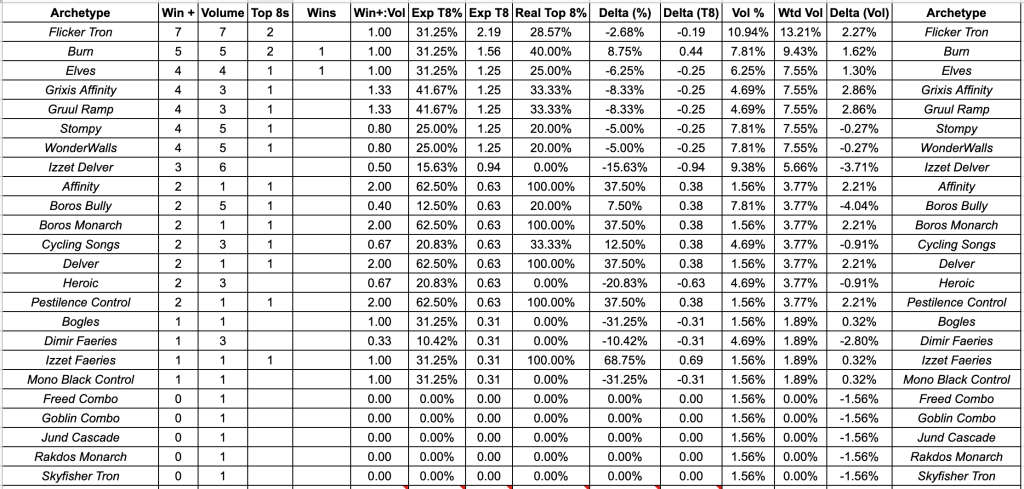
First I think we can all agree that yes, Flicker Tron is the deck to beat early on but that would be the case regardless of any new release. What is interesting is that we are seeing various aggressive decks on the rise. As we saw at the tail end of Kaldheim season, decks like Boros Bully and Stompy were returning to the fold. Now both of these decks have access to some new toys in Thrilling Discovery and Bayou Groff and it would not surprise me to see them continue these trends.
So what would I do next weekend? Currently I would stay away from a dedicated land destruction deck. Between Elves, Stompy, and WonderWalls Quirion Ranger is likely to be everywhere, saving lands like nobody’s business.
I would also anticipate people trying out First Day of Class combo. Using a sacrifice outlet and a creature with Persist, you can generate an unbound loop once First Day of Class resolves. While the Goblin version is the cleanest, I can also see a version leaning on Essence Warden and Marauding-Blight Priest working, as that version can access Mesmeric Fiend in the main.
Here are some lists making use of the new cards from last weekend:


If you enjoy this style of analysis please consider becoming a Patron. Patrons gain access to a special Discord channel as well as other perks.
April Pauper Power Rankings
My latest Pauper Power Rankings are now live!
April 10-11 Pauper Weekend in Review
Well, Kaldheim season has finally ended. With the Strixhaven Prerelease starting on Magic Online this Wednesday we can expect the new cards to be available for next weekend’s Challenges. As a result, the April 10 and 11 Challenges put a cap on one of the most interesting and dynamic Pauper seasons to date.
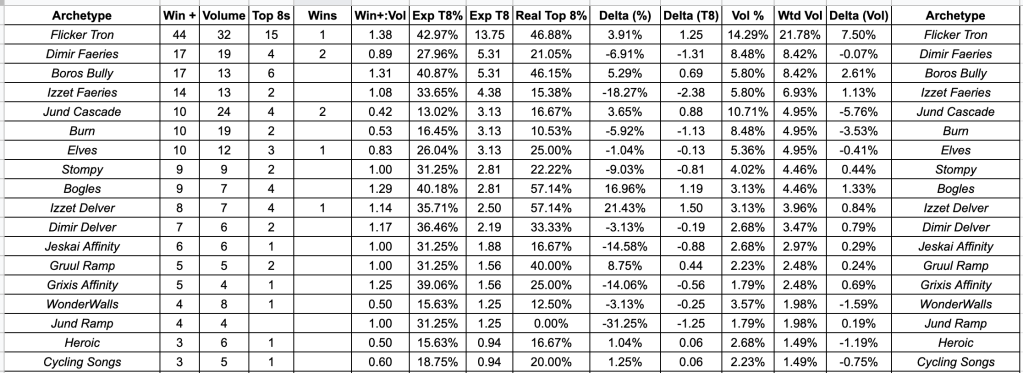
At the end of the day Flicker Tron came back in a big way while Boros Bully and Stompy also had some return to form. The new players – Gruul/Jund Ramp and Jund Cascade – struggled as the metagame shifted towards aggression and more cheap interaction. Elves and WonderWalls had solid showings in the last few weeks of the season and Cycling Songs also made its presence felt.
So at the end of the day, what is the story of Kaldheim season?

Going into Strixhaven season the deck to beat is Flicker Tron, Make no mistake – it remains the best deck in the format by a decent margin. It isn’t the utterly dominant force it has been in years past but it is still absurdly good. Izzet Faeries and Dimir Faeries are also fantastic – I would have Dimir Faeries as the better deck but the numbers seem to contradict that. Boros Bully is also back on the menu. SanPop ran a version with maindeck land destruction to a Top 8 this past weekend and I wonder if that becomes the standard moving on.
What about Jund Cascade? The deck is certainly powerful but it suffers from the same fate almost all midrange decks meet: when its answers miss the meta, it will suffer. The biggest problem with Jund Cascade is that its spell suite is constructed in such a way that it only has so many spots to work with, meaning it has to lean on less specialized answers. It doesn’t surprise me that as the meta has gone wider a deck leaning on Chainer’s Edict has suffered. Will it be back? Of course – Cascade is powerful.
So where would I be week one? That’s simple. I’d be running First Day of Class combo with Skrik Prospector and Skirk Drill Sergeant. Because that just seems fun.
Deck Guide: Brute Squad
My latest deck guide is up right now on ChannelFireball!
Learn, Lessons, and Pauper
Strixhaven is bringing a new take on Wishes to Magic and for the first time allows Pauper decks to access this powerful ability. Wishes – originally from Judgment – let you tutor for a specific subset of cards from “outside the game”. In tournament games this means going to your sideboard. For the remainder of this post whenever I refer to Wish I will be talking about it in the context of tournament Magic.
Learn is a keyword that lets you either retrieve a Lesson from your sideboard and put it into your hand. If you do not Wish for a Lesson, then you get to discard a card from your hand and draw a card (rummage). Learn and Lesson are both interesting in that they force you to not only question the value of a card, but also the value of a card slot.
Let’s start with Learn. Outside of First Day of Class (which has combo applications with Persist), these cards are all overcosted by about a mana for their base effect. The ability to rummage is something but unless you are benefiting from the rummage (perhaps with Stinkweed Imp) these cards are not worth the cost. Put bluntly – none of the effects on the cards with Learn are powerful enough to warrant including without access to Lessons.
This leads to the questions as to whether or not any Lessons are good enough. There are nine common Lessons – four colorless sorceries and one for each color pair – and none of them are powerful enough to include in any maindeck. Are they strong enough for a sideboard slot? Maybe, depending on how you value a slot in your sideboard.
Roughly speaking, a card in your sideboard is somewhere between 3 and 4 times as important as a card in your maindeck when it matters. When a sideboard card does not matter its value is roughly zero. The Lessons are all worth about a card, especially if you can get one for “free” by casting a spell with Learn. Yet the opportunity cost of including one of these in your sideboard is astronomical in that you are trading a potential game-breaking card for a card that is merely okay.
In aggregate I do not think this mechanic is worth it in Pauper. Of course there are exceptions, some of which might even matter. The leading example I can think of is in Heroic, where Guiding Voice is far from embarrassing. Considering how linear of a deck Heroic is, you rarely want to sideboard too many cards in or out. That means the deck can find home for a few Lessons in their extra fifteen. Expanded Anatomy feels like a win in Heroic as well, growing a creature and giving it the ability to stay untapped for a potential crack back. I could also see builds of Heroic with Seeker of the Way making use of Introduction to Prophecy in the midgame.
So where does this leave Learn? Most of the time you are not going to want these effects in your Pauper deck. The exception is when you are running a highly linear deck that does not want to sideboard out too many cards and could make use of a Wish-like sideboard as a way to marginally improve different matchups while not giving up on too many high impact sideboard cards.
If you enjoy this style of analysis please consider becoming a Patron. Patrons gain access to a special Discord channel as well as other perks.
April 3-4 Pauper Weekend in Review
Sometimes these updates write themselves. It helps when there’s a 9 round Super Qualifier to bolster the results. Add to that a six round Saturday Challenge and a seven round Sunday Challenge and you end up with a pretty good look at the top of the Pauper metagame.
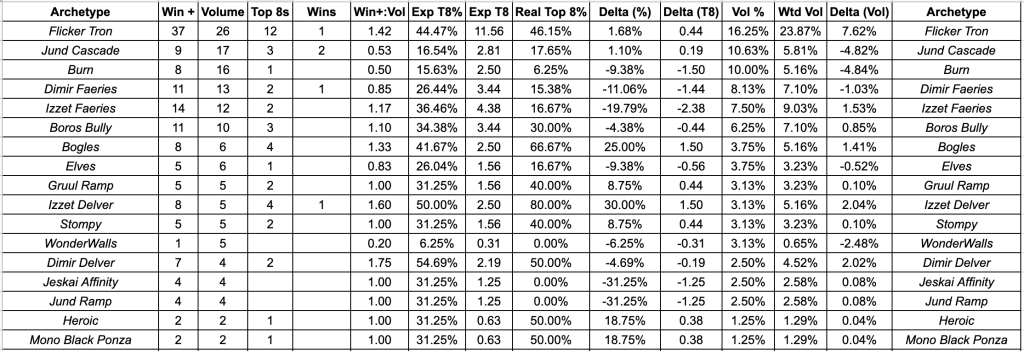
I normally divide each season into four week segments. It helps to break up the data and give reasonable check points. Thanks to the release schedule, Kaldheim will have close to three of these chunks. This is informative in that it gives us some insight into the way the metagame reacts to different decks at the top.
Let’s take the example of the current best deck: Flicker Tron. In the first four weeks Flicker Tron was a Top 5 archetype but did not hold down the top spot. Instead Boros Bully had some of the best numbers with Izzet Faeries and Gruul/Jund Ramp not far behind. The second four weeks saw the various Faerie decks do better and a decline in Boros Bully. We also saw a decline in Ramp in favor of Jund Cascade. The best deck during those four weeks? Tron.
What does this tell us about these four weeks? Initially it let’s us see that Tron needs a specific set of circumstances to be kept in check. While many decks can falter if there is one major check in the metagame, Tron is resilient enough to require two such checks. Here it appears that in order to falter there needs to be a good disruptive deck (Faeries) as well as one that can pressure the mana base (Gruul Ramp). If one of those falls by the wayside Tron can reemerge.
Now Tron may have some gaudy numbers in that latest chart but they are inflated by two incredibly strong Swiss runs in the Super Qualifier top 32: 9-0 and 8-1 (to go with 3 7-2 finishes and a 6-3).
Where does this leave us going into next week? Tron is clearly the best deck but with an ascendant Faeries there should be an opening for Mwonvuli Acid-Moss decks to find their lane. That being said I would look for them to adjust their removal suite and potentially run some number of Forked Bolt and Branching Bolt main. And it probably wouldn’t hurt them to consider Penumbra Spider in the main.
But if you’re looking to juke the metagame and want to turn creatures sideways, I would investigate Red Deck Wins. Stompy had a solid weekend all things considered. But if people are going to be blocking, having access to Goblin Heelcutter could be a way to sidestep several isses.
Treasured Finds: Thelon of Havenwood
Welcome back to Svogthir’s Study Treasured Finds: a place to appreciate Golgari and Witherbloom in Commander.
Well it certainly has been a while. The last time I wrote one of these I was still 36 and hadn’t yet received my first COVID vaccine. Now I’m another year older and have gotten both jabs. So what took me so long?
I struggle mightily with writing about Commander. I wrote about my Hakim, Loreweaver deck here and included this tidbit:
For me, Commander is intensely personal and documenting my takes on the format feels self-indulgent and embarrassing. If building a Commander deck is making a mixtape for yourself, writing about it is giving that tape to your crush.
This wasn’t made any easier by the fact that the next Commander, chronologically, is one of my all time favorites:

Back when I was attending Pro Tour Qualifiers I went to one at the Ukranian Church. I do not remember the actual name of the venue but it was a mainstay of the NYC late-Aught’s PTQ scene as it was massive and located a far walk from any mass transit.
In Manhattan that translates cheap.
At one Scars of Mirrodin sealed PTQ I stalked the dollar bin between rounds. This event stands out for two reasons. First, is that Pro Tour Champion Osyp Lebedowicz was eliminated from contention by someone who was later DQ’d for cheating (which is a story unto itself involving yelling from the balcony) and second, I picked up three different Commanders: Lyzolda, the Blood Witch, Teysa, Orzhov Scion (in Cyrillic no less!), and Thelon, of Havenwood. I don’t know why I picked up Thelon at the time. I had no intention of building the deck in that moment. Instead I just thought the card was neat.
It is also likely I bought this card before the Commander Color Identity rules changes in December of 2010. Before then, if you wanted to play Thelon you would have to play it as a Mono-Green deck.
Regardless, I eventually built Thelon as you are supposed to: a Thallid tribal deck. As is my way I was using some excessively random jank like Sporogenesis to have a good time with friends. The few times I did play the deck it performed as intended and even won a few games. But then Slimefoot, the Stowaway was printed and there was a better guy for the fun. And so I built Slimefoot and had a blast before taking the deck apart.
But Thelon is still special. He requires work to get going as there are not a ton of Fungi in Magic. Thelon has received a boost from recent design technology. In Ikoria, different counters got their time to shine and can persist with The Ozolith. Rishkar, Peema Renegade turns every creature with a counter on it into a mana dork.
A quick look at Thelon’s EDHREC page shows that the deck tends to play in well worn paths. Saprolings, +1/+1 counters, and Proliferate. You know what?
That rules.
Thelon is not the best Commander for any of those strategies these days. That means if you are playing a Thelon deck you want to be, optimization be damned. The card that I would want to include that has gone unmentioned to this point is Night Dealings. Between Slimefoot and Thorn Thallid, and attacking of course, it is not hard to imagine turning this Enchantment into a repeatable tutor. And considering you’re proliferating anyway, why the heck not?
Do you enjoy my Commander content? If so, consider becoming a Patron.
March 27-28 Pauper Weekend in Review
After an unintended vacation due to some gremlins in Renton (or wherever Magic Online‘s servers are housed), we are back with the breakdown of the March 27 and March 28 Pauper Challenges. These challenges represent the start of the third 4 week chunk of Kaldheim season. I prefer longer seasons as they provide more opportunities to examine trends in the metagame. Let’s get right to it. Here is what the first two Challenges of the third chunk look like:

So there are a few things of note. First, Flicker Tron is back in a big way. While it never went away it did have a few down weeks, to the point where I had it fall out of the top spot in my Power Rankings on more than one occasion. Second, we are seeing a surge in Izzet Delver (and Delver in general). Now these are not all decks packing four copies of the creature, but they are builds that are adapting to be more aggressive and have the option to play a beatdown game against the field. Third, Boros Bully has continued to struggle after a stellar first four weeks. Finally, we are seeing dedicated Gruul Ramp/Ponza take a hit and a rise in Jund Cascade.
Let’s try to break this down a bit more. The addition of Commander Legends and Kaldheim have changed the incentives in Pauper. Prior to these two releases the best deck at both accumulating and deploying resources was Tron. Outside of Tron decks Pauper in many ways became a battle of card economy where the player who managed to draw more cards would eventually triumph. Some decks – like Elves and WonderWalls – attempted to subvert this by winning before the sheer quantity of cards would matter. Cascade has changed that as decks can now both accumulate and deploy resources. While this has not impacted Tron in a major way (other than providing a check to the deck), it has forced out decks that have traditionally relied on amassing cards as a path to victory – Boros Monarch, for example, has all but vanished.
Now that decks are able to both draw cards and play them, committing to the board matters more. Again we see decks like Elves and WonderWalls continue to perform but this also helps to explain the return of Delver of Secrets. Delver is one of the best turn one plays if your goal is to apply continuous pressure. Delver also allows the deck to get a head start on the damage race while also leaving up mana to Spellstutter Sprite on the second turn and it does rather nicely against a deck trying to blow up a land.
If I had to pick the three best decks going into next weekend (and the Super Qualifier), they would be Flicker Tron, Izzet Delver/Faeries, and Elves. Burn, Dimir Faeries, Jund Cascade, and WonderWalls should all be on your radar as well. Kor Skyfisher looks to be an incredibly important piece next weekend due to how well it can matchup with the top of the field, but I would avoid pairing it with red this time around.
If you enjoy this style of analysis please consider becoming a Patron. Patrons gain access to a special Discord channel as well as other perks.
Cascade Tron Deck Guide
My latest deck guide is now live on ChannelFireball. Check it out here.


You must be logged in to post a comment.