Untitled Commander Series 2: 99 + 1 Does Not Equal 1 + 99

Recently, after Commander night I was standing outside my local game store with a friend and regular podmate. We had just finished our third game of the night where the two of us were the last players standing. Piloting my Sek’Kuar, Deathkeeper Aristocrats deck, I was able to whittle him down from 60 life to zero in a single turn. But that isn’t what he brought up. Instead he remarked that my deck was able to function, even without my Commander in play. He brought up the first game of the evening which I had also won, where my Pia, Consul of Revival deck secured the victory without the eponymous card on the battlefield. Clearly this conversation stuck with me as you are reading the words on this page. But why?

 Sek'Kuar, Deathkeeper {2}{B}{R}{G}

Legendary Creature — Orc Shaman

Whenever another nontoken creature you control dies, create a 3/1 black and red Graveborn creature token with haste.

Karplusan legend told of an orc so cruel that he burned his own followers in rage—yet so revered that they rose from their pyres to serve him.
4/3

Illustrated by Jeff Miracola

Let’s back track a bit. First off, I am a dinosaur in the world of Magic. I have been playing the game since Revised was fresh on the shelves and my introduction to Commander – then Elder Dragon Highlander – came before the Kaalia of the Vast was a physical Magic card. Back then even the most well oiled machine felt like they were held together with duct tape and a dream. In the intervening decade plus, Wizards has learned how to design for multiplayer even as they continuously push the envelope. Now decks that come out of the box can reasonably hold their own against tried, tested, and tuned homebrews. And that box matters because of who is plastered on the front.

Today Commander focuses far more on, well, the Commander. If Magic can be about personal expression then selecting a legend that leads a deck in some way is an extension of the pilot. The centering of the Commander also alters the way the deck functions in practice. When the Commander is an integral part of the strategy, the other 99 cards not only must support the Commander but also exist to turn that one card into a threat. In modern Commander every deck is a Voltron deck.

Voltron is a nickname for a type of deck where you enhance your Commander with the intent to attack. Whether it’s +1/+1 counters, auras, or equipment, the idea is to turn your Commander into an engine of destruction. These decks can falter when their centerpiece is dealt with, as the surrounding architecture only holds up when the general is on the battlefield. Now I am not saying every new deck that rolls off the printing press completely falls apart without one key card but when I look at Commanders printed since 2020 many are so powerful that their absence can cause the deck to stumble.

What does this have to do with the conversation I had? Back when I was learning the ins and outs of the format the cards were, by and large, worse. A deck had to have a strategy that, while not separate from the Commander, had to function in someway without it in play. This was not because the card in the Command Zone was any less a piece of self expression or important to the deck, it was just that they were cards not designed to be a Commander. When I rolled up to my meetups in the 2010s with Sek’Kuar, Deathkeeper, I had to have a deck built to support a five drop Commander that had no inherent protection and did not win the game on its own. These cards were just another cog in the machine; not Liquid Schwartz.

Part of this may have to do with how I was introduced to the format. Back when I started it was possible to shuffle a Commander into its owner’s library. The so-called “Tuck Rule” meant that a card like Chaos Warp could more or less ensure your opponent would never see their most important card again, I remember snatching up every copy of Void Stalker I saw, believing that they were going to be a terror at the tables. The existence of this rule practically necessitated building in such a way that your deck could function without its centerpiece; a lesson I carry to this day.


Void Stalker {1}{U}

Creature — Elemental

{2}{U}, {T}: Put this creature and target creature on top of their owners’ libraries, then those players shuffle their libraries.

Now you see it, now you’re gone.
2/1

Illustrated by Marco Nelor

A deck’s reliance on a Commander is nothing new but the sheer number of strategies that begin to crumble without that 100th (or in many ways, 1st) card led me to think about resilience. When I get to play Commander I want to make sure I actually get to play; I want to engage in the game and not simply put cardboard rectangles on to my playmat as the other three competitors jockey for position. More than that I want to be engaged with as many points in the match as possible. I do not want to be undone by a single counter, removal spell, or board wipe. It is rather quixotic to believe this will never happen, but that does not mean I cannot build in such a way to reduce the amount of time I spend as a spectator.

But how do I accomplish this?

Not to beat a dead horse but make sure you’re running enough mana sources. While not the mainthrust of this piece the best way to make sure you are involved in a game is to be able to cast the spells you draw. Look at your Commander’s mana value and include enough resources to be able to cast it at least twice from the Command zone. If your deck falls apart without the Commander than you are going to want to up this number to three, or maybe even four times to ensure you have access to a key element of your strategy.

 Nether Shadow {B}{B}

Creature — Spirit

Haste

At the beginning of your upkeep, if this card is in your graveyard with three or more creature cards above it, you may put this card onto the battlefield.
1/1

Illustrated by DiTerlizzi

Being able to play your cards is one way to be active in a game, but what do those cards do? Several months ago I wrote about layered engines but today I want to take a little more time to explore what that means in context. It all starts with the conceit behind the deck: What are you trying to do? How are you trying to win? While the answer to this questions can often start with the Commander there are other options. Perhaps you are infatuated with a tournament deck from another era or you really enjoy specific aspects of the game. For example, I have long been a fan of Nether Shadows – creatures that can bring themselves back from the graveyard.

Bloodghast and Reassembling Skeleton make me happy to the point where I accidentally ordered 16 copies of Tenacious Dead. Regardless I had built more than one deck around these cards even before Tormod, the Desecrator was released. Given the expansive history of Magic it is possible, even if it is not easy, to build a deck around any mechanical concept.

The goal of this is to look sideways and do research. It feels almost odd in this current moment when the idea of digging into source material and looking for synonyms or corollaries are becoming as antiquated as a rotary phone. At the same point it can be rewarding to see how the pieces can come together to create something greater than the sum of its parts. Rebell (who for my money is doing some of the best work on social Commander theory today) put out a video recently about a similar concept and I encourage you all to check it out. Returning to the Nether Shadow example, once a seed is planted a deck can branch out in multiple directions. There is the previously mentioned Tormod angle, where you generate value from cards leaving the graveyard. Of course they also need to get into the bin in some way so that can lead you down the path of self-mill, Buried Alive, or sacrifice engines. If you are sacrificing the creatures then Blood Artist effects follow and yes I know we just built a Syr Konrad deck but bear with me. Each of these different synergies are not discrete and isolated entities. There are ways to bridge them together so that if you aren’t able to fully execute one plan it is possible for you at least progress on another. Syr Konrad is a perfect example in part because it does so much that it can easily bridge the gaps. Ayara, First of Lochthwain is another card that can stitch together these engines as it wants you to put black creatures into play while also providing a way to get them into the graveyard.

It is not about any one thing your Commander does but rather about everything it can do.

Let’s look at my Sek’Kuar deck. While the list above is not exactly what I played in the game in question, the conceit of the deck is the same. Sek’Kuar is an Aristocrats deck that wants to leverage the Orc’s ability to generate material. That the Graveborn tokens are reasonable threats in their own right matters as well. The overarching theme of the deck is to sacrifice for value and while the main spout is the Orc from Coldsnap there are many other cards that make use of things hitting the bin. While these can work together they do not have to in order to march towards victory. Creatures dying might give you an Experience Counter with Meren of Clan Nel-Toth or force opponent’s to make a choice with Savra, Golgari Queen. They can plink in for damage with Blood Artist (and friends) or draw cards thanks to Smothering Abomination. Mazirek, Karaul Death Priest means everything that is sacrificed can become more strength on the battlefield for your shambling horde. If the coast is clear you can also loop Living Death with Phyrexian Altar or Pitiless Plunderer and Eternal Witness. It is not that any given Sek’Kuar deck can’t do all of these things but rather there is a thread – Sacrifice – that ties these pockets together such that progressing on one axis can move you forward on others, all towards the same end.

I put a high priority on being an active participant in games of Commander. To me this means building redundancy into decks and finding ways to progress a game plan even in the absence of the Commander. There has been more than one occasion where a spoiler drops for a card that should be entirely in my wheelhouse but my reaction is “I don’t want to build that”. Why? Because the Commander itself is so powerful that its absence would completely wreck my opportunity to engage in the game.

Hashaton, Scarab’s Fist is a card I should enjoy. It deals with Zombies; it does sideways reanimation; it doesn’t even exile the cards from your graveyard. This card is practically calling to me from the grave. And yet it exhibits many of the qualities of Commanders I avoid. When Hashaton is not on the battlefield the strategy can shift towards standard reanimator. Now don’t get me wrong, I love this style of play, but there are other decks that do a better job of scratching that itch.

 Hashaton, Scarab's Fist {W}{B}

Legendary Creature — Zombie Wizard

Whenever you discard a creature card, you may pay {2}{U}. If you do, create a tapped token that’s a copy of that card, except it’s a 4/4 black Zombie.

“I served the Scarab in an age long past, in another form, under another name. No matter their visage, I serve.”
1/3

Illustrated by Wisnu Tan

Hashaton demands discard outlets, which work well with this back up strategy but are required for your Commander to function. I think it’s actively a good thing Hashton does not have a built in way to pitch cards, but it then pushes the build to have enough of these cards to have one at all times. It is not that you cannot build a unique Hashaton deck that does things its own way, but rather every Hashaton deck is going to be doing the same thing, just slightly differently, and missing any one of the key pieces can turn the game into hoping you top deck the correct piece.

Another card that fits this mold for me is Meren of Clan Nel-Toth. If you’ve ever sat down against a Meren deck you know exactly what you’re in for. Sure the mixture of creatures might be different but at some point you are very likely to get locked under Spore Frog and hope against hope to draw the correct piece of interaction. Meren decks have a certain way they want to games to go and do everything in their power to try and stick to that path.

In these instances the decks don’t try to play the game but rather they are focused on enacting their game plan. While not Voltron in the strictest sense of the word they are honed in on doing the same thing and built towards that end. To be perfectly clear there is nothing wrong with decks of this stripe, but they do not appeal to me.

 Gilgamesh, Master-at-Arms {4}{R}{R}

Legendary Creature — Human Samurai

Whenever Gilgamesh enters or attacks, look at the top six cards of your library. You may put any number of Equipment cards from among them onto the battlefield. Put the rest on the bottom of your library in a random order. When you put one or more Equipment onto the battlefield this way, you may attach one of them to a Samurai you control.
6/6

Illustrated by Lorenzo Mastroianni

Let’s examine the relatively new Gilgamesh, Master of Arms. This Commander screams at you to follow a path – Equipment. There are ways to let your toe leave the path with Reconfigure or the Living Weapon lineage, but Gilgamesh is going to demand a hefty deckbuilding price and as a result things may play on rails. This is not to say you can do something different with Gilgamesh but the more you deviate from the primary objective the greater the chance of non-games.

Voltron decks make demands while other Commanders provide options.

In a hypothetical Gilgamesh deck, once the Commander is removed once or twice what can the deck do? It requires a density of Equipment to function but there are only so many pieces of Equipment that double as a creature. Adding cards like Godo, Bandit Warlord, Valduk, Keeper of the Flame, and Brass Squire might provide redundancy but do so at a real cost. Returning to Sek’Kuar, the deck absolutely wants to have its namesake on the battlefield but the deck does just fine without the Commander. It is part of the plan, not the only plan.

Here we run into a conundrum. If your approach to the format is playing games with your friends or finding the right build for a particular mechanical execution then pivoting away from a particular legendary is just part of the experience. But what happens when you want to play a deck because of a specific character and their card pushes towards Voltron? How can you ensure participation in the game when so much hinges on the main character.

I talked about supplementing the plan in the case of Gilgamesh, but that does come with a cost. In that instance it may require several games of playing to figure out the right balance of hits and misses to ensure the ability to play the game. Beyond that you can look for strategies that intersect with the main thrust of the deck in an attempt to provide other avenues of success. If I were to build around this Commander I would lean hard on cards like Commander’s Plate and Darksteel Plate which go a long way towards protecting my key component.

Expecting these cards to be targeted at some point means redundancy is in order and thankfully red has access to Goblin Welder and Daretti, Rocketeer Engineer. Daretti plays nice with Gilgamesh in that it also wants to attack, encouraging a similar line of play. From here I would look at ways to generate Artifact material like Powerstones, which would provide a steady supply of tokens to trade in for the armory. Powerstones can pull double duty as they would make it easier to reequip cards later in the game as well. While this deck might not be the best execution of a Gilgamesh strategy it does open up the possibility of participating in the game once the main strategy is cut off.


Daretti, Rocketeer Engineer {4}{R}

Legendary Creature — Goblin Artificer

Daretti’s power is equal to the greatest mana value among artifacts you control.

Whenever Daretti enters or attacks, choose target artifact card in your graveyard. You may sacrifice an artifact. If you do, return the chosen card to the battlefield.
*/5

Watermark: Desparked

Illustrated by Borja Pindado

Legendary Creatures today are designed with Commander in mind. To that end they are crafted with the idea that someone will build a deck dedicated to make them work. The ceiling is high for sure, but in order to raise the floor more work has to be done to ensure that you get to engage in more of any given game. I’m not saying to take a completely different path, just to look for other routes to your destination.

I want to take a moment to thank all my Patrons. I am going to do my level best to keep providing you with the kind of content that brought you here in the first place. If you are interested in supporting my work, you can sign up for my Patreon starting at just $1.

Can’t make a commitment to Patreon? I have a Ko-Fi where you can make a one time contribution.

The Final Fantasy Season Wrap

Want to learn more about the metrics I use in tracking the metagame? You can find an explainer here.

In the three weeks since my last post, nine Challenges and two other major tournaments took place on Magic Online. As of this writing we are staring down the barrel towards Edge of Eternities. As Magic travels to the one place still free from capitalism we can use the information gleaned from the realm of…realms of FINAL FANTASY to understand where things might be going.

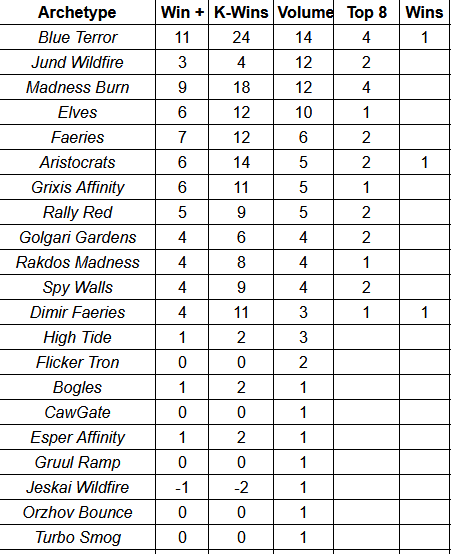
Pauper remains balanced. The results from the last three weeks show that while there are certainly decks that perform better than others. these archetypes are not such outliers as to cause major problems. The two decks at the top of the format – Blue Terror and Jund Wildfire – are there in part because they are able to deal with a wide variety of decks. These two decks have found themselves at the top of the heap for the duration of Final Fantasy season.

These decks have solid results on the season. Blue Terror accumulated four wins and 29 Top 8 finishes in 90 Top 32 appearances. It closed out the season with an Adjusted Meta Score Above Replacement of 1.33. Put another way, Blue Terror decks finished events with a record more than a win better than the average Top 32 deck when adjusted for metagame presence – this is the difference between a Top 32 and Top 16 finish, or a Top 16 and a Top 8 finish. A Win+ score of 0.82 tells us that Blue Terror’s average finish was approaching the Top 16 and a K-Win of 2.27 – over two – tells us that when the deck made Top 8 it tended to do well. Speaking of those 29 Top 8s, given Blue Terror’s Swiss performance it was on pace for around 23 such finishes and through the luck of matchups and tie-breaker math it appears to have over performed in that regard. All told the deck closed out the season with a healthy 13.77% of the Winner’s Metagame.

Jund Wildfire is the other deck at the top of the heap. Three wins and 22 Top 8 finishes in 74 Top 32 appearances is more than respectable. Jund ended the season with an aMSAR score of 1.1, only slightly behind Blue Terror. The midrange deck did better than Blue in the Win+ category, notching 0.86, putting it slightly ahead of the monochrome in Swiss standings; a K-Win of 2.3 seems to back that up. Jund was on pace for 20 Top 8 finishes and cleared that marker. Rounding things out the Cleansing Wildfire strategy held 11.58% of the Winner’s Metagame.

If the best two decks in the format play fair Magic, that is far from a bad thing. The spread between them in Winner’s Metagame share is not all that large, and the gap between Jund and the next deck on the list – Rakdos Madness – is just over 3%. There are four more decks with Winner’s Metagame shares within 3% of Rakdos (Madness Burn, Elves, High Tide, Red Deck Wins) and another a fraction of a percent behind that group (Grixis Affinity). It is hard to look at the format and everything that is viable and come away things are bad.

So how can one get an edge in something so balanced? There are still ways. First and foremost is trying to pack a way to handle large creatures. Tolarian Terror and Writhing Chrysalis remain the biggest threats in the format and both feature prominently at the top of the metagame (to say nothing of people trying Gruul Ramp builds as well as Dimir Terror and Izzet Control). Three of the other top decks are Lightning Bolt strategies – makes sense why decks would want access to either Weather the Storm or up to eight copies of an Elemental Blast – rounded out by Elves (and other hypermana decks) and High Tide. High Tide operates on an unique axis and requires specialized cards to combat. Elves can fall to the right mix of removal and much of the counterplay can also be applied to Overgrown Battlement decks.

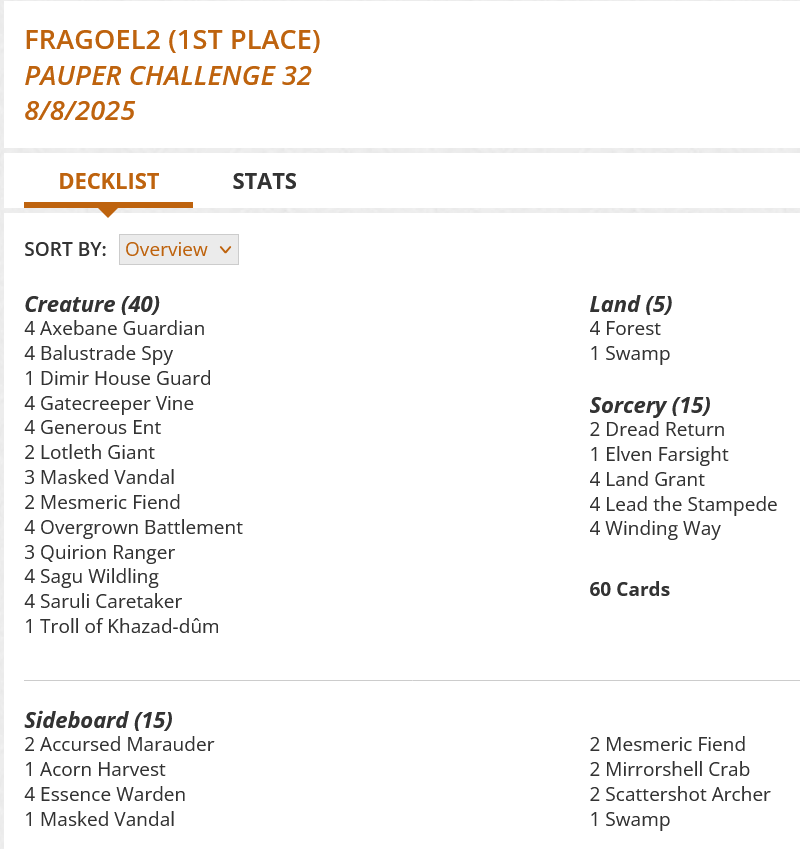
1 Acorn Harvest
4 Axebane Guardian
4 Balustrade Spy
2 Dread Return
1 Elven Farsight
4 Forest
4 Gatecreeper Vine
4 Generous Ent
4 Land Grant
4 Lead the Stampede
2 Lotleth Giant
3 Masked Vandal
2 Mesmeric Fiend
4 Overgrown Battlement
2 Quirion Ranger
4 Sagu Wildling
4 Saruli Caretaker
1 Swamp
2 Troll of Khazad-dûm
4 Winding Way

Sideboard
2 Faerie Macabre
1 Flaring Pain
1 Masked Vandal
2 Mesmeric Fiend
3 Nylea's Disciple
2 Scattershot Archer
2 Vitu-Ghazi Inspector
2 Weather the Storm

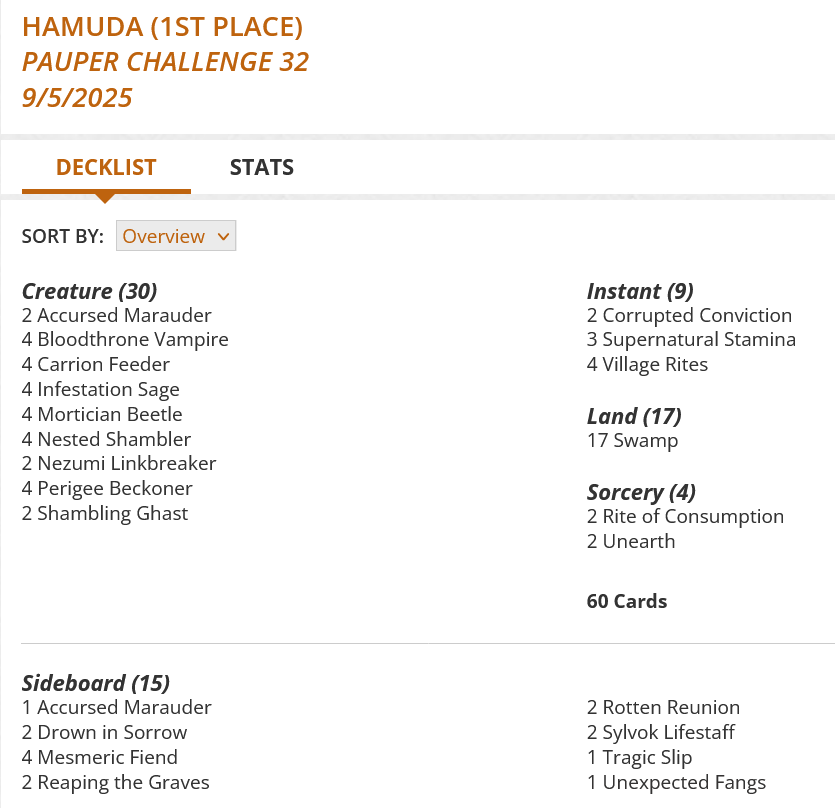
Except Spy Walls. A relatively new wrinkle the format, Balustrade Spy combo has been refined over the past few releases to be a legitimate contender. This new deck adds the Walls package to provide additional resilience in the form of being able to cast some large creatures. This additional angle is neat, but a well timed piece of graveyard removal could work wonders. Considering that some folks are eager to start looping Ghostly Flicker through Cryogen Relic, having access to reliable graveyard hate seems to be mandatory heading into the next season.

Power Rankings

10. Faeries (-2)
9. Mono White Aggro (-4)
8. Grixis Affinity (-2)
7. RDW (+3)
6. High Tide (+3)
5. Elves (+2)
4. Rakdos Madness (-1)
3. Madness Burn (+1)
2. Jund Wildfire
1. Blue Terror

I want to take a moment to thank all my Patrons. I am going to do my level best to keep providing you with the kind of content that brought you here in the first place. If you are interested in supporting my work, you can sign up for my Patreon starting at just $1.

Can’t make a commitment to Patreon? I have a Ko-Fi where you can make a one time contribution.
The First Four Weeks of Final Fantasy

Want to learn more about the metrics I use in tracking the metagame? You can find an explainer here.

Change is a constant. While it sometimes moves slow – as it did for much of Pauper’s history – it still takes marches on. Entropy is a natural state and to defy it is to swim upstream against the way of things. In Pauper the combination of a series of bans and a powerful release in FINAL FANTASY has resulted in a format that while familiar, has some striking differences. With four weeks of Magic Online Challenge data available, as well as the results of the latest edition of Paupergeddon, we can take stock of the format as it exists in the middle of 2025.

It is important to first understand the difference between the digital and tabletop metagames. Magic Online has two main avenues of competition: Leagues and Challenges. Leagues reward quick play-throughs and as such can lead players to choosing decks that have a high ceiling but a low floor. For some participants it is less about selecting the best option but rather the one that will give you the highest yield on your time. It’s not about taking the best shot but rather the most shots. Challenges (and other larger tournaments) instead reward picking consistently good decks. At the same time these events are not so long that the aggressive bias disappears but rather it is reduced. Magic Online also makes it rather easy to switch decks, which leads to players often cycling through archetypes in an effort to maximize enjoyment and success.

Compare this to tabletop, where players may be more locked in to their decks. Physical play can be a more social experience and smaller tournaments can be defined by what decks people have on hand. The larger tournaments – like Paupergeddon – do not take place in a vacuum and players have to draw their information from somewhere. That Paupergeddon cuts to Day 2, like the Grand Prix of yore, means that decks that are consistent (high floor, decent ceiling) have a real shot at making waves.

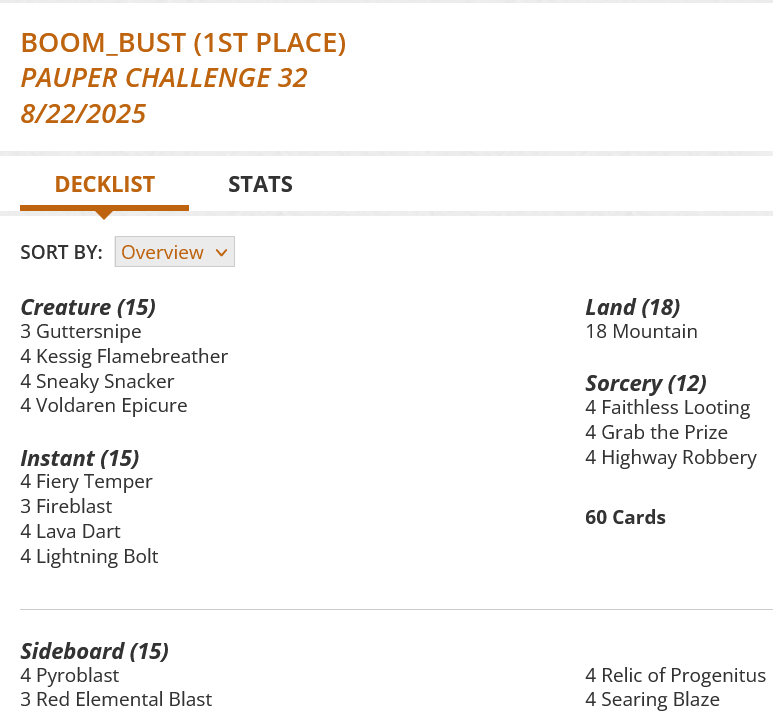
The discourse in Pauper has largely been centered on High Tide but that is not where I am going to start. Rather I am going to talk about the Tier 1.5 competitive decks on Magic Online: Madness Burn and Rakdos Madness. Sneaky Snacker might be the most important red card in Pauper at the moment, powering up these strategies and providing a consistent source of damage. Combined these decks make up just under 17% of the Top 32 metagame and around 17.6% of the Winner’s Metagame. These builds want to turn the “downside” of Grab the Prize and Faithless Looting into an advantage but in doing so they increase their reliance on the graveyard and other synergies. The mono red builds lean on Guttersnipe which exposes them more to a well timed removal spell unlike Red Deck Wins – the descendant of Kuldotha Red. The more traditional red builds are 4.4% of the Top 32 metagame and 4% of the Winner’s Meta.

These decks are one of the defining attributes of digital play due to how fast they can churn through leagues. Even if they are not as powerful in a longer event they are still something to consider and are far from weak. Combined these decks have 21 Top 8 finishes and a pair of wins. The red decks are taking metashare away from each other and an increased reliance on permanents and creatures means decks packing removal are no longer carrying dead weight in the main deck.

4 Brainstorm
1 Deep Analysis
2 Disrupt
4 Hidden Strings
4 High Tide
4 Ideas Unbound
15 Island
4 Lórien Revealed
4 Merchant Scroll
4 Peer Through Depths
2 Pieces of the Puzzle
4 Preordain
4 Psychic Puppetry
2 Reach Through Mists
2 Stream of Thought

Sideboard
3 Augur of Bolas
3 Dispel
2 Disrupt
2 Gigadrowse
1 Hydroblast
4 Snap

With that out of the way we can talk about High Tide. The deck is polarizing. While the win rate is nothing special the combo turn can often eat up the clock, leaving the person on the other side of the table doing nothing with the hope that the combo player does not find the win. On Magic Online this is less of an issue since each player has an allotment of time. Tabletop, however, has a shared clock where a protracted combo can leave precious little time to complete a match. All that being said High Tide has four Top 8 finishes in FINAL FANTASY season, with 4.95% of the Top 32 metagame and 5.7% of the Winner’s Metagame, good enough to be at the bottom of Tier 2.

The best decks in Pauper at the moment are Blue Terror and Jund Wildfire. Both of these decks have amassed fourteen Top 8 finishes; Blue Terror has four wins and Jund Wildfire has one. They are the most popular decks (11.46% of the Top 32 metagame for Blue Terror; 10.68% for Jund) and top the Winner’s Metagame as well (13.17% for Blue, 12.69% for Jund). Both of these strategies can present large threats and have the ability to disrupt the opponent either on the stack or in play. They also are able to pack reasonable hate for assertive red decks (Hydroblast, Weather the Storm) and High Tide (counterspells, Pyroblast). Blue Terror and Jund Wildfire also excel at utilizing their mana, either through chaining cantrips to resolve a threat or by accelerating with Cleansing Wildfire and sticking a massive Nyxborn Hydra.

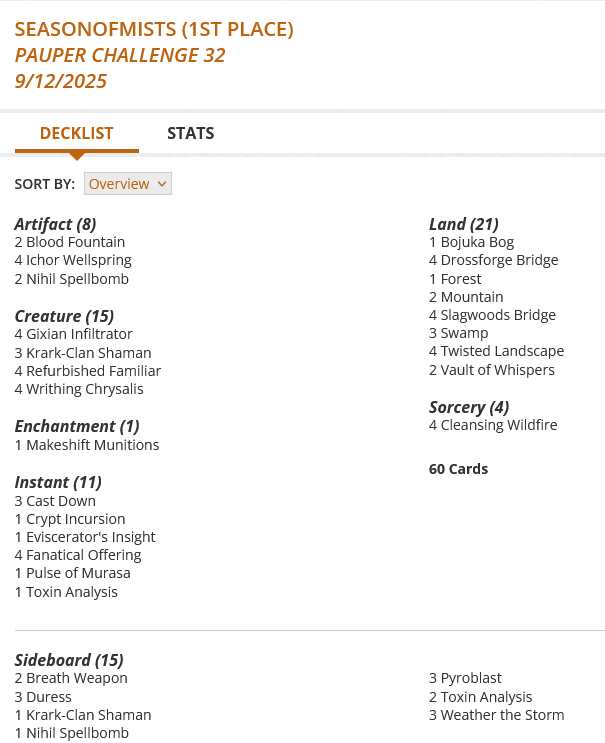
Jund Wildfire has largely supplanted Affinity’s role as the metalcraft enabled midrange deck. The Cleansing Wildfire engine allows Jund to accelerate out threats and Writhing Chrysalis not only outsizes Myr Enforcer, but also fuels the second copy in a way that can make both creatures a more imposing threat. It is clear that Affinity can find success (six Top 8s, 6.82% of the Winner’s Metagame) but it is not the format defining threat it has been in recent history.

There are two other points I want to address from the Magic Online metagame. The first is the continued presence of Black Mage’s Rod. This little artifact is giving tons of decks reach that lacked similar access previously. While black based midrange is hardly a force in the digital realm we are seeing plenty of decks lean on the extra damage from the Black Mages as a way to apply pressure. Grixis Affinity has adopted the equipment as an additional source of damage and Gardens decks – that is black midrange splashing green – have also started to run the artifact.

4 Battle Screech
1 Eagles of the North
2 Guardians' Pledge
2 Idyllic Grange
4 Kor Skyfisher
4 Lunarch Veteran
3 Novice Inspector
17 Plains
4 Prismatic Strands
4 Raffine's Informant
1 Ramosian Rally
4 Squadron Hawk
2 Summon: Choco/Mog
4 Thraben Charm
4 Thraben Inspector

Sideboard
2 Destroy Evil
4 Dust to Dust
2 Holy Light
2 Journey to Nowhere
3 Martyr of Sands
1 Palace Sentinels
1 Standard Bearer

The second point is the steady pace of Mono White Aggro. The strategy has put up six Top 8 finishes with a pair of wins with 5.21% of the Top 32 metgame and 6.17% of the Winner’s Metagame. Mono White has adopted Summon: Choco/Mog as a way to add damage to the board turn after turn and like Loyal Cathar of old it provides virtual card advantage with Kor Skyfisher. It is remarkable that a deck that is largely just power and toughness continues to perform in such a high power format but at the same time it is absolutely awesome that power and toughness still gets the job done.

But what about Paupergeddon? CawGate took down the massive event and out the top decks only Blue Terror made Top 8 at two copies. While the Azorius deck has not entirely vanished from the online metagame it has only three Top 32 finishes in the past four weeks. While some commenters have noted the favorable pairings the winner got along the way, no one ends up winning a massive event on luck alone.

So what does this all mean? Pauper is largely balanced. There is no competitive deck that is miles ahead of the others and the top of the metagame is within grasp of lower tiers. Overall things are in a good spot and players can be rewarded for paying close attention to the trends in the metagame, adjusting accordingly. As I head off for family vacation I am excited to see where things end up as we enter the final weeks of FINAL FANTASY and approach the Edge of Eternities.

Power Rankings

10. Red Deck Wins
9. High Tide
8. Faeries
7. Elves
6. Grixis Affinity
5. Mono White Aggro
4. Madness Burn
3. Rakdos Madness
2. Jund Wildfire
1. Blue Terror

I want to take a moment to thank all my Patrons. I am going to do my level best to keep providing you with the kind of content that brought you here in the first place. If you are interested in supporting my work, you can sign up for my Patreon starting at just $1.

Can’t make a commitment to Patreon? I have a Ko-Fi where you can make a one time contribution.

June 13-15 Pauper Weekend Recap

Want to learn more about the metrics I use in tracking the metagame? You can find an explainer here.

If I were more well versed in the games this is likely a spot where I would make a reference to the Final Fantasy series. Being the uncultured swine that I am you’ll have to settle for some retread of “it’s a new season in Pauper and the first weekend results do not tell us much”.

Except this time I actually have something new to add below the fold: a card from Final Fantasy has already made an impact. All that being said the metagame does not look drastically different from how Tarkir Dragonstorm season ended. This experience is familiar as Pauper rarely jump cuts to something new. Instead it takes time for the format to shift unless the new cards are so powerful they catalyze change.

It should be noted that after several weeks of larger challenges, these events were six round affairs. Saturday’s challenge had a relatively meager 42 players which is a a decent amount less than the 60 something we had seen for much of last season. That fact does not have any impact on the numbers presented above as these are merely cumulative; the size of a tournament will not impact the Top 8s acquired over the course of the season. What the number of players can influence, however, is how much cream rises to the top.

The longer a tournament, the less likely it is variance has an outsized influence. It is possible for a player to “run hot”. They can win every die roll, have amazing opening hands, have opponent’s that stumble. If you’ve played in a tournament setting you’ve likely been in one of these seats (if not both). This is one reason why I tend to look at information week after week – it can help to identify trends and separate the so called noise from the actual signal. Weeks such as this can be confounding when taken in isolation but given a long enough time span they are simple another suite of datum.

Coming out of week one of Final Fantasy I would put Blue Terror as the top deck in Pauper, continuing the trend from Dragonstorm season. Rakdos Madness has a strong weekend as well but falls into the next tier alongside Elves, High Tide, Jund Wildfire, and Madness Burn. At the top of the metagame we have a disruptive tempo deck built around singular large threats and then beneath that we have a midrange value pile, a go wide creature combo deck, spell based combo, and then a pair of decks that leverage Sneaky Snacker for damage and value. How does this relate to the breakout card of the set?

 Black Mage's Rod {1}{B}

Artifact — Equipment

Job select (When this Equipment enters, create a 1/1 colorless Hero creature token, then attach this to it.)

Equipped creature gets +1/+0, has “Whenever you cast a noncreature spell, this creature deals 1 damage to each opponent,” and is a Wizard in addition to its other types.

Equip {3}

Illustrated by Nino Is

Black Mage’s Rod has already had a huge impact on the format. It has helped to bring back Golgari Gardens and is earning slots in all manner of decks. While I believe Gardens (and other Black Control variants) are a natural home, I want to talk a bit about why this card is a perfect fit for Pauper.

First, it generates material. Whether you like it or not cards that bring a friend to the party have become a staple in a format with Fanatical Offering and Eviscerator’s Insight. While you may not want to sacrifice the Hero from the Rod that is an option that does exist. That this artifact brings a creature to the part matters for cards like Kor Skyfisher and Stickytongue Sentinel, providing a slow and steady stream of chump blockers. Time and time again cards like this have proven themselves to be potent. Being an artifact also means the Rod plays nicely with Refurbished Familiar and Pactdoll Terror.

What about the Wizard ability? Unlike Guttersnipe or Kessig Flamebreather, additional copies of the Rod will trigger previous iterations. This is, as they say, a big game. When your persistent source of damage has added synergy with the next persistent source it stacks the damage up high. Black Mage’s Rod part of the first wave of cards in black that feature the ability to passively deal damage just from casting spells. Now when you look at what black is good at in Pauper – which is casting card draw and removal spells – you start to see how the Rod can exert pressure on the format.

Going back to the top decks of the moment, black is decently well positioned to have some amount of game against them all. Black can cast Diabolic Edict effects to take down Tolarian Terror and other large threats; it has Drown in Sorrow and the combination of Crypt Rats and Toxin Analysis to wipe the board; Black can exile the graveyard with Bojuka Bog; it has discard for combo; Black can even splash green for Weather the Storm to survive an onslaught. Black has been a spellslinger color without a spout for quite some time and now the Rod (as well as Cornered By Black Mages) give the deck a way to convert those investments into a way to win the game.

Is there a chance I am too bullish on black? Absolutely – black based control is one of my favorite archetypes in the history of Pauper. That being said when I hop back into the queues my plan is to try various builds of Black Mage Gardens until I can find one that fits.

I want to take a moment to thank all my Patrons. I am going to do my level best to keep providing you with the kind of content that brought you here in the first place. If you are interested in supporting my work, you can sign up for my Patreon starting at just $1.

Can’t make a commitment to Patreon? I have a Ko-Fi where you can make a one time contribution.
The Calm After the Dragonstorm

Want to learn more about the metrics I use in tracking the metagame? You can find an explainer here.

If you’re reading this, Final Fantasy has been released into the wild. We are already seeing new cards make their appearance in 5-0 decklists and I am interested to see if any of these cards can break through in this weekend’s challenges. I am bullish on the set despite my lack of familiarity with the source material. Still it is important to have an understanding of Pauper moving into this new season and that is where this summary comes into play. I am going to be providing my takes on some of the top decks, along with some numbers that informed said takes. And for giggles and engagement, let’s make it this article resemble the Power Rankings.

8. Flicker Tron

When the Pauper Format Panel decided to reintroduce Prophetic Prism there were some concerns that the old control Tron decks would surge in popularity and create problems for decks trying to go long. The counter argument to this was that Pauper is significantly faster today than Tron’s heyday. For the time being, the latter is holding true. Flicker Tron made up 3.13% of the Top 32 metagame and 4.18% of the Winner’s Metagame, but it did rack up 12 Top 8 finishes and two wins. The deck wants to assemble its mana engine and then leverage that abundance to cast high impact spells, eventually getting the best of the bunch thanks to Mnemonic Wall and Ephemerate or Ghostly Flicker. The 0.47 Adjusted Meta Score Above Replacement places the strategy at about half a win better than an average Top 32 deck, which given the length of the season is a solid performance.

7. High Tide

High Tide was the other deck about which there were concerns when the eponymous card was added back to Pauper. Thus far, based entirely on numbers, the deck has proved to be decidedly fine. It has a 0.48 aMSAR (just in line with Flicker Tron). The deck was 4.24% of the Top 32 metagame and 4.99% of the Winner’s Metagame. The low delta here indicates that the deck performed moderately better than expectation but was hardly a breakout star. Nine Top 8 finishes and two wins round out a respectable season.

However that is not the entire story. High Tide decks can monopolize game actions and take up a ton of time in a match without having a deterministic kill. Based solely on numbers alone the deck seems to be well within the bounds of what is acceptable, and given the surge in popularity in Pauper Challenges over Dragonstorm season, the deck has not kept people away. At the same time where are folks who have made their feelings on the “time suck” known. For now I have it as the seventh best deck going into Final Fantasy season.

6. Rakdos Madness

The back half of the season saw Rakdos Madness as one of the more popular decks. With Fifteen Top 8 finishes, 3 wins, and an aMSAR of 0.53 Rakdos Madness was one of the ways people decided to establish a clock in the post Kuldotha Rebirth metagame. All that being said the deck underperformed it’s 8.04% of the Top 32 metagame with 7.27% of the Winner’s Metagame. Taken together we have a popular deck that while very good, might be a hair overplayed.

5. Elves

The numbers for Elves were buoyed by a very strong second half of the season. Seventeen Top 8s and 2 wins, Elves was 5.92% of the Top 32 metagame and 6.57% of the Winner’s Meta and finished with an aMSAR of 0.56. Elves found its lane and thrived, often putting games out of reach early and applying pressure with notable elf Crashing Drawbridge. The lack of Elves in the latest set should not so much to hinder the deck’s success but it would not shock me to see a surge in black strategies which may cause issues for this particular stripe of green mage.

4. Jund Wildfire

Good old Jund. An aMSAR of 0.58, 4.91% of the Top 32 metagame and 5.5% of the Winner’s Metagame; a dozen Top 8 finishes and not a single win. These are some real Jund numbers in that the showcase a deck that is better than fine but hardly anything to write home about. Yet as long as drawing cards and killing creatures is good, Jund Wildfire will find a place in the Pauper metagame (until it’s supplanted by a better black midrange deck).

3. Grixis Affinity

There really isn’t much to say about this deck that I haven’t said before, so here are the numbers: Fourteen Top 8s with two wins; 7.03% of the Top 32 metagame and 7.1% of the Winner’s Metagame; an aMSAR of 0.59. Grixis Affinity remains a top choice but it is entirely possible that the advent of Suplex will put a damper on the machine.

2. Red Deck Wins

The heir to Kuldotha Red, this is a separate deck than the Guttersnipe/Sneaky Snacker Madness Red. A whopping 23 Top 8 finishes with a single win, RDW was 10.38% of the Top 32 metagame. Its 9.57% share of the Winner’s Meta indicates that it performed slightly below expectations, even with a solid aMSAR of 0.65. Like Rakdos Madness, these decks can falter in the face of dedicated lifegain and that is something Pauper has in abundance. While RDW can still grind out damage late, it lacks the second gear provided by the now banned Kuldotha Rebirth.

1. Blue Terror

The best deck on the season. It was nearly a win better than the average Top 32 deck with an aMSAR of 0.96. It played largely true to expectation with 10.83% of the Winner’s metagame against 10.94% of the Top 32 metagame. 22 Top 8s; 4 wins. The deck put up real numbers. Later in the season we saw a return of Dimir Terror in an effort to one up the 5/5s and 6/5s with Crawl from the Cellar, but even then the mono blue version was hard to stop. All told Blue Terror might just be the deck to beat going into Final Fantasy season and so I have it at the top of my Power Rankings.

That’s where Dragonstorm season leaves us off. Do you have questions about any deck not listed here? What cards from Final Fantasy are going to make an impact in Pauper? Sound off and let me know what think. We’ll be back next week with our first look at the new metagame.

    I want to take a moment to thank all my Patrons. I am going to do my level best to keep providing you with the kind of content that brought you here in the first place. If you are interested in supporting my work, you can sign up for my Patreon starting at just $1.

    Can’t make a commitment to Patreon? I have a Ko-Fi where you can make a one time contribution.
    May 30 – June 1 Pauper Weekend Recap

    Want to learn more about the metrics I use in tracking the metagame? You can find an explainer here.

    The calendar has turned from May to June which means we are that many days closer to Final Fantasy.

    Wow that feels weird to write.

    Anyway, there were three Pauper Challenges last weekend and if we are looking exclusively at the numbers the trends established over the last seven weeks of the season have held largely true. While I would not describe the progression of Pauper through Tarkir Dragonstorm as perfectly linear, there is a steady line of best fit.

    For example, 15 different archetypes made it to the Top 8 over the weekend with no single archetype taking down more than three slots (an average of one per Challenge). The two decks that hit the triple crown were Blue Terror and RDW – two of the more popular decks this season (but of note, not on the weekend). The recent tournaments also are showcasing Grixis Affinity’s slow descent from the top tier to merely a solid competitor (for the time being) and the steady rise of High Tide. One thing that I neglected to mention in my last post was the reappearance of Dimir Terror with its copies of Crawl from the Cellar, likely as a way to one up the Blue Terror players.

    This chart provides us with a better image of what actually did well over the weekend. Adjusted Meta Score Above Replacement (aMSAR) is a metric that looks at both Swiss round performance and overall wins, while adjusting for number of appearances. In this model an “average” Top 32 deck will have a score of 0.00 for a given weekend – a positive number means an archetype outperforms the average while a negative score indicates a strategy did not meet expectations.

    Blue Terror (aMSAR: 1.44) and High Tide (1.12) were the best archetypes on the weekend, setting themselves apart from the field. Given their Top 8 performances and Wins it makes sense that these two would get a boost in aMSAR as a Challenge Win is worth three wins in the formula for overall wins. Digging deeper, however, we see that Blue Terror was in a class by itself as the difference between it and High Tide was just a hair larger than the difference between High Tide and the next best deck – Elves (0.82).

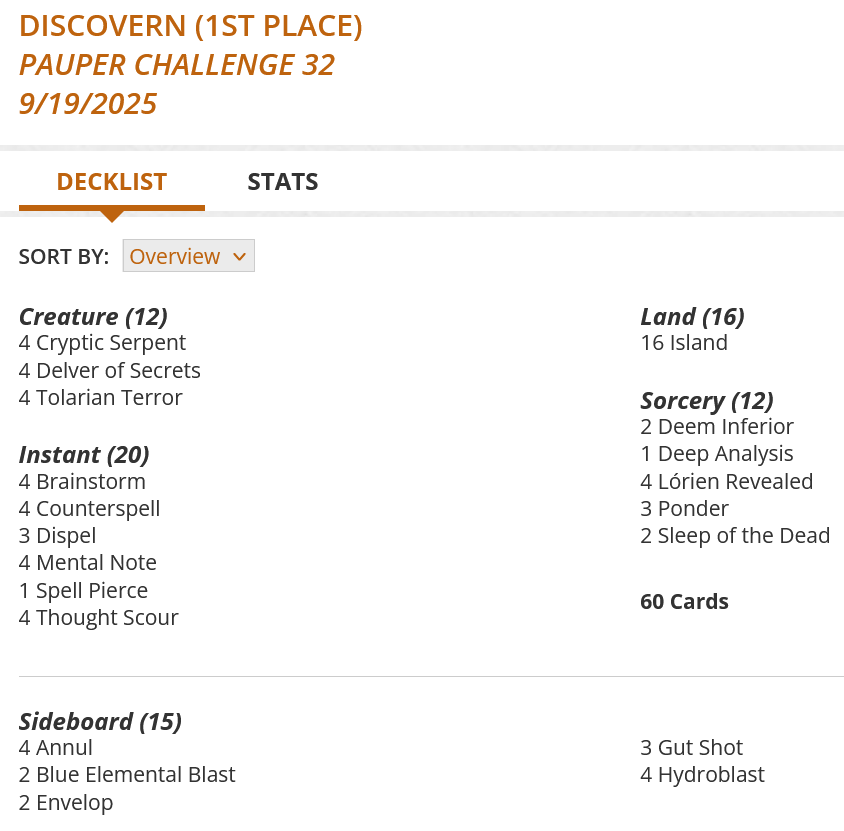
    Blue Terror has been a steady presence in Pauper since the release of Tolarian Terror but it really took off with the downshift of Cryptic Serpent. The intervening years have provided additional tools, the most valuable of which may just be Deem Inferior – a card that can set the opponent back on development and can undo at least a turn’s worth of investment (if not more). Blue Terror also is able to run a suite if cheap countermagic which affords pilots the opportunity to stymie opposing strategies. Cards like Spell Pierce may lack impact late but if you’re presenting five and six power creatures on turns three then there is not exactly a lot of time left in the game.

    Blue Terror has also been one of the top decks all season long. The way I track the metagame affords me the opportunity to examine different archetypes both week over week and in aggregate. I divvy the seasons into four week chunks, which helps to identify trends, but I also will look at the sum total of results. Eight weeks in this is what the Challenge Metagame looks like for decks with above 2% of the metagame share (minimum 15 appearances):

    The columns I would like you to focus on are True Volume and aMSAR. The former essentially weights a deck’s performance and adjusts it’s presence depending on how well an archetype performs. Blue Terror might only account for 10.55% of the overall metagame but it slightly improves upon that number here at 10.84%. The True Volume/Winner’s Metagame gives a solid impression of what you can expect to see at the top tables. And the story is fairly consistent: Blue Terror is leading the way followed by old stalwarts Grixis Affinity and RDW with Elves hot on their heels.

    The next tier of the metagame is a scrum with High Tide, Jund Wildfire, Faeries, Bogles, and Flicker Tron all vying for Tier 2 supremacy. What stands out to me is how important Blue is in the current format. Three of the top seven decks are mono blue and Flicker Tron does lean heavily on blue spells to enact the endgame. Blue being good is nothing new and as such I would expect to see more Pyroblast decks moving forward. However one cannot simply carry a Red Elemental Blast into battle lest they be defeated by Elves or Jund Wildfire. The next crop of red decks need to have access to board control elements that can both go wide with Breath Weapon and tall to try and take out Writhing Chrysalis. This may mean dipping into another color for better removal as temporary answers like Stingscourger and Dead // Gone won’t cut the mustard. Even Journey to Nowhere might be lacking in a world with Nyxborn Hydra, but Feed the Swarm does look halfway decent in that specific situation.

    If I had my brewers hat on I would be looking at a Mardu Cleansing Wildfire list – one less focused on Experimental Synthesizer/Glint Hawk shenanigans. I would want to build a deck with cheap answers that could match my opponent’s offense with a speedy defense. These decks have not exactly excelled this season but that’s part of the fun in trying to make it work – finding the right mix of cards to attack the metagame. What deck do you think you’d bring to Pauper these days?

    I want to take a moment to thank all my Patrons. I am going to do my level best to keep providing you with the kind of content that brought you here in the first place. If you are interested in supporting my work, you can sign up for my Patreon starting at just $1.

    Can’t make a commitment to Patreon? I have a Ko-Fi where you can make a one time contribution.
    Catching Up on Dragonstorm

    Want to learn more about the metrics I use in tracking the metagame? You can find an explainer here.

    Hello again.

    It’s been a hot minute.

    For those of you who don’t know, earlier this month I had some surgery. I thought that, in the run up to the procedure, I would be able to use writing as a distraction – a way to occupy my mind and keep focus away from my impending trip under the knife. I was wrong. I had no energy to look past anything but the operation. Once it was done and I was out of the hospital it took me time to get back into the swing of things. Turns out that have your insides rearranged is an exhausting experience and as much as I enjoy poring over Pauper decklists, the combination of my body and brain were focused on healing.

    But, just like my incisions, the urge to write has started to itch again. And so after a few days of playing catchup and getting back into the rhythm of my life (being a dad, going back to work, being aware of but not dwelling on the horrors). Looking at the past several weeks of major Magic Online Pauper tournaments has definitely provided insight into the format. Now since I usually write once a week, but have been gone for the better part of the month, I have decided to talk about the most recent events (the past three weeks) and how those trends vary from the first month of Tarkir Dragonstorm Season.

    First and foremost, Pauper looks balanced at least in the Challenge metagame. Over the past three weeks – which includes nine Challenges and a Qualifier – the top three decks in the format are all within spitting distance of each other in Winner’s Metagame Share: Red Deck Wins (the heir apparent to Kuldotha Red) at 12.86%, Blue Terror at 11.05%, and Elves (yes Elves) at 9.75%. These are also the three leaders in Adjusted Meta Score Above Replacement (0.84, 0.77, 0.74 respectively).

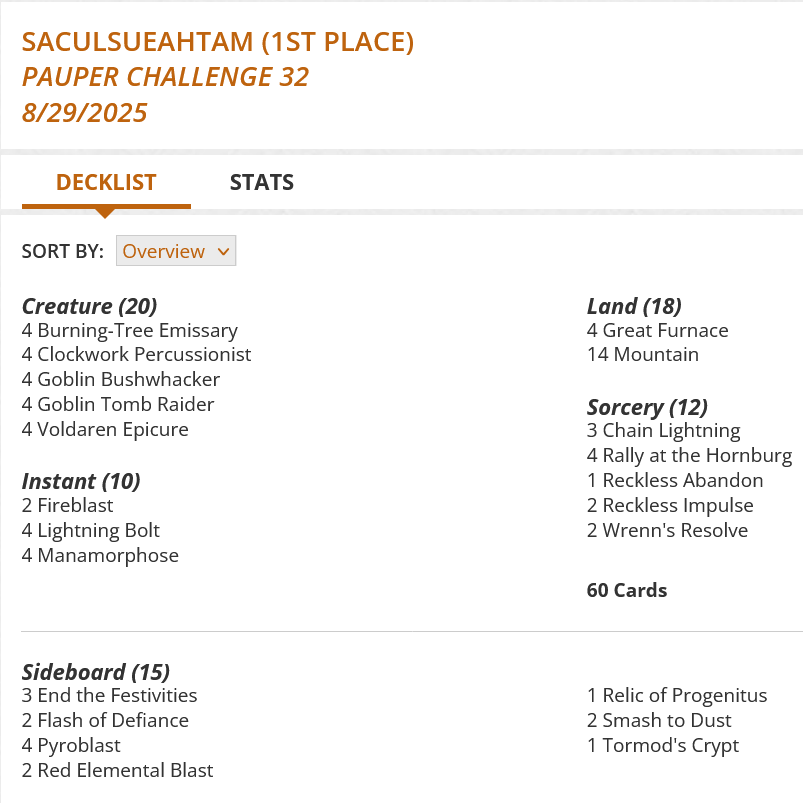
    2 Chain Lightning
4 Clockwork Percussionist
2 End the Festivities
4 Experimental Synthesizer
1 Fireblast
4 Galvanic Blast
4 Goblin Tomb Raider
4 Great Furnace
4 Kessig Flamebreather
3 Lava Dart
4 Lightning Bolt
14 Mountain
2 Thermo-Alchemist
4 Voldaren Epicure
4 Wrenn's Resolve

Sideboard
4 Cast into the Fire
2 Gorilla Shaman
3 Pyroblast
4 Raze
2 Relic of Progenitus

    Compare this to the first four weeks of Dragonstorm season. The top three decks by Winner’s Meta Share were Blue Terror (10.53%), Grixis Affinity (9.51%), and RDW (9.33%). When looking at the aMSAR of these decks, Grixis led the way with 1.21 with Blue Terror behind at 0.92. RDW (0.53) was behind both Flicker Tron (0.58) and Faeries (0.57).

    4 Brainstorm
4 Counterspell
4 Cryptic Serpent
4 Deem Inferior
1 Deep Analysis
4 Delver of Secrets
1 Dispel
16 Island
4 Lórien Revealed
4 Mental Note
3 Ponder
1 Sleep of the Dead
2 Spell Pierce
4 Thought Scour
4 Tolarian Terror

Sideboard
4 Annul
2 Blue Elemental Blast
4 Gut Shot
4 Hydroblast
1 Sleep of the Dead

    These numbers tell us a few things. First, the metagame is evolving and dynamic. There has been movement amongst the top decks and while many of them are no stranger to the top tier, no deck has a stranglehold on first place. The clustering of the top decks, with none of them topping 15% of the Winner’s Metagame also point to a format where no deck is dominant to a point of concern. RDW has been the most popular deck on raw volume but even those numbers come in under that 15% threshold. The competitive landscape is far from flat but not nearly as stratified as some previous iterations of Pauper.

    I would be lying to say I was not concerned about the repercussions after the actions taken by the Pauper Format Panel in March. While I am a member of the Panel and had a say in these decisions I still was wary of what the return of High Tide and Prophetic Prism would mean for overall format health. Much to my delight, both Flicker Tron and High Tide have integrated into the metagame and at this point do not present a problem based on numbers alone. I understand the experience of playing against these decks can leave something to be desired (one can look at my writings on the format during the height of Tron’s power for an example) but based on their results in the weekend tournaments things seem to be just fine.

    1 Bojuka Bog
1 Breath Weapon
1 Cave of Temptation
1 Conduit Pylons
2 Crop Rotation
4 Energy Refractor
1 Ephemerate
3 Expedition Map
1 Focus the Mind
2 Ghostly Flicker
1 Heritage Reclamation
4 Impulse
2 Island
2 Lórien Revealed
3 Mnemonic Wall
1 Molten Tributary
2 Moment's Peace
3 Mulldrifter
1 Murmuring Mystic
2 Mystical Teachings
1 Prohibit
4 Prophetic Prism
1 Pulse of Murasa
1 Remote Isle
1 Tangled Islet
1 Unwind
4 Urza's Mine
4 Urza's Power Plant
4 Urza's Tower
1 Weather the Storm

Sideboard
1 Ancient Grudge
1 Blue Elemental Blast
1 Dinrova Horror
2 Envelop
2 Hydroblast
1 Lightning Bolt
1 Pulse of Murasa
2 Pyroblast
1 Red Elemental Blast
1 Remove Soul
1 Scattershot
1 Stonehorn Dignitary

    Flicker Tron made up 4.26% of all Top 32 decks during the first four weeks of Dragonstorm Season, improving to 5.3% of the Winner’s Metagame with an aMSAR of 0.58. For the last three weeks the former elephant-in-the-room made up only 1.88% of the Top 32 metagame and 2.87% of the Winner’s Meta, seeing its aMSAR score drop to 0.16. Taken together we see a deck that is certainly capable of strong finishes but is lacking in some ways. Whether the format has gotten too fast for Tron or too few players are iterating on it to find an optimal build or the metagame is dynamic enough that one needs to constantly tinker to present the correct 75 the outcome is that Flicker Tron has simply become another solid option instead of the clear best choice.

    High Tide, as a deck, has caused more hand wringing. Combo, when it has been good in Pauper, has typically found itself over the line. Storm and Broodscale decks are two examples of combo builds that pushed other strategies out of the competitive sphere. High Tide, being a spell based combo, shares some issues with both. It can be difficult to interact with on the combo turn and given the make up of the deck it can “win from hand”. Unlike many other Pauper combo decks, High Tide does not rely on the graveyard or creatures, further insulating it from counter-play. However the deck has merely been fine. In the first four weeks, High Tide was 3.98% of the total Top 32 metagame and dropped to 3.35% of the Winner’s Meta with an aMSAR score of 0.00 (this is roughly equivalent to averaging a Top 16 finish). The past four weeks have been kinder to the Islands, with 3.75% of the Top 32 metagame, 5.57% of the Winner’s Meta and an aMSAR of 0.57. It should be noted that this boost may be related to the 8-0, 3-0 run by MackSmith with the deck in the May 16 Pauper Qualifier. Taken together High Tide is in a similar spot to Tron – a strong option but currently not a dominant force.

    4 Brainstorm
1 Flood of Recollection
4 High Tide
4 Ideas Unbound
16 Island
4 Lórien Revealed
4 Merchant Scroll
2 Muddle the Mixture
4 Peer Through Depths
1 Petals of Insight
2 Pieces of the Puzzle
1 Ponder
4 Preordain
4 Psychic Puppetry
4 Reach Through Mists
1 Stream of Thought

Sideboard
1 Blue Elemental Blast
3 Envelop
3 Gigadrowse
3 Hydroblast
2 Relic of Progenitus
3 Snap

    In my opinion, High Tide has actually been good for Pauper overall. As a spell based combo deck that avoids leaning on the graveyard, High Tide has opened up paths for other combo decks to succeed. While not nearly at the same level, Spy Combo, Dredge, and WonderWalls have seen some recent success and that doesn’t include the resurfacing of old friends Goblin Combo and Inside Out Combo. High Tide has attracted the attention of players which in turn has impacted the amount of hate for these other decks. While not a direct cause, the strength of High Tide may be related to the open lanes for other combo decks to reach the winner’s circle.

    So where does that leave Pauper going into this weekend? Overall it is in a good spot. Ideally you want a deck that has access to some number of sweepers to handle both Elves and RDW and at the same time you need access to disruptive elements. Grixis Affinity is also a factor even if it is currently trending down. If I had to pick one card to highlight it would be Pilfer. A solid backup to Duress, Pilfer is a relatively recent addition from Foundations that can nip problematic cards in the bud. The issue, of course, is figuring out the best shell and while Mono Black Control has put up a few results I think finding a second (or third) color could prove beneficial to the strategy.

    Power Rankings

    10. Bogles
    9. WonderWalls
    8. Flicker Tron
    7. Rakos Madness
    6. Jund Wildfire
    5. High Tide
    4. Grixis Affinity
    3. Elves
    2. RDW
    1. Blue Terror

    I want to take a moment to thank all my Patrons. I am going to do my level best to keep providing you with the kind of content that brought you here in the first place. If you are interested in supporting my work, you can sign up for my Patreon starting at just $1.

    Can’t make a commitment to Patreon? I have a Ko-Fi where you can make a one time contribution.
    April 11-13 Pauper Weekend Recap

    Want to learn more about the metrics I use in tracking the metagame? You can find an explainer here.

    A new season is upon us with the release of Tarkir Dragonstorm. Due to the recent additions to (and subtractions from) the Banned List the format was primed to undergo a pretty significant shift. Despite this today’s Pauper bears more than a passing resemblance to the format from a month ago aside from the absence of Broodscale Combo and the presence of both High Tide and Control Tron. There’s more, of course, but so much of it is confounded by the available data.

    The first weekend of Dragonstorm season saw a disruption on Magic Online which canceled the Sunday Challenge. These things happen. That the issue took place on the first weekend is both a blessing and a curse when it comes to data collection. Relying on too small a sample size to draw conclusions can prove to be a mistake but losing early season data is not a hindrance in understanding a season long story. Why? Put simply in the first weeks of a format people are still figuring things out.

    The most popular deck on the weekend was just an update of Kuldotha Red while two of the decks tied for the second most appearances were known quantities from last season and are proactive. The final deck in a three-way tie for the silver was Flicker Tron – a deck with a known pedigree that had one of its biggest enablers reintroduced to the format. Given what I know about Pauper the decks we saw last weekend are likely to persist but their raw volume is likely to shift.

    Pauper moves slowly – it always has. However one thing that always tends to happen is that in the earliest stages of a new format – whether due to the removal or addition of high impact cards – is that decks with a clear gameplan rise to the top in the early goings. Red decks, Bogles, decks that present a clear and concise threat perform well as decks have to adjust their answer suite to the new normal.

    Let’s take a case study with Kuldotha Rebirth. This card, in concert with other factors, made one-for-one removal risky despite that style of card’s relative strength against Broodscale combo (to say nothing of the rest of the format). Now that Kuldotha Rebirth has been banned many red decks are pivoting back towards builds where singular creatures (such as Kessig Flamebreather) are more important. It should follow that cards like Doom Blade and Skred would go up in value.

    Except for the ascendancy of both Tron and High Tide. These decks are largely inoculated against creature removal because they were constructed in such a way to lack that vulnerability. This tension will likely remain for the foreseeable future which puts into context the deck that led the way in Adjusted Meta Score Above Replacement.

    Faeries had arguably the best weekend. A 60% conversion rate from Top 32 to Top 8 and a win all lead to a weekend leading AMSAR of 1.51. Faeries might not provide the quickest clock but it can put the opponent on the back foot. What it lacks in offense it makes up for in broad answers. Counters might not be the best in every application but they do have play against nearly everything. It follows then that Faeries could both stymie certain aggro strategies while having game against decks that eschew creatures. Again, none of this is new but it can be important to spell it out so we understand the field of battle.

    What does all of this mean for next week? I would expect a lot of the same decks to show up but given the recent league results I would hedge more against Tron and red decks. These builds have been fairly present and operate at two extremes of the format. Faeries absolutely remains a strong choice but it is unclear if something could slide in and come at the metagame from another angle.

    Can’t make a commitment to Patreon? I have a Ko-Fi where you can make a one time contribution.
    Looking for another way to support my work? Click here for my TCGPlayer affiliate link. Any purchases through the link let the folks there know you like my content!

    April 4-6 Pauper Weekend Recap

    Want to learn more about the metrics I use in tracking the metagame? You can find an explainer here.

    Oh, hello. I didn’t see you there.

    Yeah…so it’s been a while since I’ve posted. March was a lot busier than I anticipated. Between my child’s birthday, a professional conference, and my tenth wedding anniversary I was busy. That was all before I found out I was going to need surgery. And then there was the small fact of the bans which had the potential to completely reshape the format. To put it bluntly, my mind was elsewhere. Given the nature of the surgery there’s a chance I may be slow to post in May but my sincere hope is that I am well enough to type out a few words now and then.

    So where were we? Oh yeah…the first week of post ban Pauper…which is also the last week of Aetherdrift season. A historical footnote in that this format will only exist for a brief period of time before Tarkir Dragonstorm hits the scene. While there is no guarantee things will change with the next release I still isolated the results from the first weekend of April.

    Why separate results by release cycle? Technically speaking each set of cards entering Pauper generates a new format. It is not that the rules change but rather the available interactions between the game pieces can be altered. While these shifts are often minor in nature they still exist and over time small shifts can push towards upheaval. In order to examine the format through this lens I have found that partitioning by set release (read: card legality shifts) to be helpful in understanding trends.

    But what to do about this vestigial week? Only two cards have been added to the format while three removed, all before a new set which has some interesting tools at the ready. Completely ignoring the results serve no one as they could provide the baseline for what is to come. At the same point putting too much stock in these numbers may lead you down the wrong path for multiple reasons. Not only will next week’s format feature new cards but also this is week one after a massive shift. The banning of Basking Broodscale, Deadly Dispute, and Kuldotha Rebirth and the return of High Tide and Prophetic Prism altered the rules of engagement. The builds we are seeing may not be optimized and as the format continues to evolve we are likely to see some pretty significant changes in the way decks are constructed.

    What, then, do the results say? The top two decks last weekend were Blue Terror and Grixis Affinity and this tells us two not entirely dissimilar stories. The performance of Blue Terror can be in part due to the unsettled nature of the new format. The dominant aggressive strategy has been taken down a notch which can give slightly slower decks a boost. In an open field the ability to present a threat and back it up with Counterspell would always be strong. When the deck also has the potential to stymie a new combo and win before the control deck can establish a foothold that’s a recipe for success. Blue Terror is not likely to be as strong moving forward but it put up solid results in this intercalary week.

    4 Brainstorm
4 Counterspell
4 Cryptic Serpent
4 Deem Inferior
2 Deep Analysis
4 Delver of Secrets
16 Island
4 Lórien Revealed
4 Mental Note
3 Ponder
3 Spell Pierce
4 Thought Scour
4 Tolarian Terror

Sideboard
4 Annul
4 Dispel
4 Hydroblast
2 Sleep of the Dead
1 Steel Sabotage

    Grixis Affinity, on the other hand, is just a good deck. Yes, it lost a step with the banning of Deadly Dispute but the core engine still exists. In an open field playing a known deck full of good cards is hardly a bad idea, especially as people figure things out. I am not sure how strong Affinity will be moving into Tarkir Dragonstorm season as builds evolve and configurations are cemented but I do not believe the Machine is going to fade into obscurity.

    3 Blood Fountain
4 Drossforge Bridge
1 Eviscerator's Insight
3 Fanatical Offering
4 Galvanic Blast
3 Great Furnace
2 Hunter's Blowgun
4 Ichor Wellspring
3 Krark-Clan Shaman
1 Makeshift Munitions
4 Mistvault Bridge
4 Myr Enforcer
3 Nihil Spellbomb
1 Prophetic Prism
3 Reckoner's Bargain
4 Refurbished Familiar
2 Seat of the Synod
3 Silverbluff Bridge
1 Swamp
4 Thoughtcast
3 Vault of Whispers

Sideboard
2 Breath Weapon
4 Duress
2 Extract a Confession
1 Nihil Spellbomb
2 Pyroblast
3 Red Elemental Blast
1 Toxin Analysis

    Blue Terror and Grixis Affinity were smart choices for an open field when two of the expected emergent decks were spell based combo and long game control. Both have access to disruption and the ability to apply pressure. Terror has better stack interaction while Affinity can do more to grind out games against Tron thanks to Makeshift Munitions. One reason I am unsure about these strategies’ positions moving forward is due in part to the uncertainty around High Tide and Tron.

    1 Bojuka Bog
1 Breath Weapon
1 Captivating Cave
1 Compulsive Research
1 Conduit Pylons
1 Crop Rotation
1 Dinrova Horror
1 Dispel
2 Energy Refractor
1 Ephemerate
4 Expedition Map
2 Ghostly Flicker
4 Impulse
2 Island
2 Lórien Revealed
2 Mnemonic Wall
1 Molten Tributary
3 Moment's Peace
4 Mulldrifter
2 Mystical Teachings
1 Prohibit
4 Prophetic Prism
2 Pulse of Murasa
1 Remote Isle
1 Rimewood Falls
1 Unwind
4 Urza's Mine
4 Urza's Power Plant
4 Urza's Tower
1 Weather the Storm

Sideboard
1 Ancient Grudge
1 Breath Weapon
1 Cast Down
2 Gorilla Shaman
3 Hydroblast
1 Moment's Peace
4 Pyroblast
2 Stonehorn Dignitary

    If your knowledge of the Pauper metagame came exclusively from discourse circles you would assume that these two decks dominated the weekend. High Tide Combo can win on turn four and can lead to games where one player is taking all the meaningful game actions early. Tron is a beloved archetype that has returned and can lead to games where one player is taking all the meaningful game actions late. Yet despite digital ink spilled in various channels neither of these decks were dominant forces on week one. Rather their specters loom large because of the fear of what they might become. Given historical precedent this feeling is not entirely unfounded. The past can be a decent lodestone for getting your bearings provided the wider environment has not changed. Still, metagames take time to coalesce and trying to prognosticate the future based on a small sample size could be a fool’s errand.

    4 Brainstorm
1 Deep Analysis
3 Flood of Recollection
1 Gigadrowse
4 High Tide
4 Ideas Unbound
16 Island
4 Lórien Revealed
4 Merchant Scroll
4 Peer Through Depths
1 Petals of Insight
4 Preordain
4 Psychic Puppetry
4 Reach Through Mists
1 Stream of Thought
1 Unwind

Sideboard
3 Dispel
4 Envelop
2 Gigadrowse
4 Murmuring Mystic
2 Snap

    Where does that leave things going into next week? You’re guess is as good as mine but I would not be surprised to see a small surge in Bogles or various combo decks as we move into Tarkir Dragonstorm season.

    I want to take a moment to thank all my Patrons. I am going to do my level best to keep providing you with the kind of content that brought you here in the first place. If you are interested in supporting my work, you can sign up for my Patreon starting at just $1.

    Can’t make a commitment to Patreon? I have a Ko-Fi where you can make a one time contribution.
    Looking for another way to support my work? Click here for my TCGPlayer affiliate link. Any purchases through the link let the folks there know you like my content!

    The First Four Weeks of Aetherdrift

    Want to learn more about the metrics I use in tracking the metagame? You can find an explainer here.

    Aetherdrift has been out for a little more than a month and as has become customary it is time for me to check in on the overall state of Pauper on Magic Online. Over the past four weeks there have been 12 Challenges and one Showcase tournament on the platform. Overall, 45 different archetypes have made it to the Top 32 cutoff while 23 have at least one Top 8 appearance; 16 have at least two such finishes. For the purposes of today’s piece I want to look at the archetypes with at least 3% of the Top 32 metagame – in this case that means a minimum of 9 total appearances in the the Top 32. This leaves us with 10 total archetypes to cover but does leave a few outside the discussion zone.

    Out of the decks that do not make the 3% threshold, five have won one of their tournaments: Altar Tron, CawGate, Mono White Aggro, Snacker Control/The Modern Age Faeries, and Turbo Smog. Outside of CawGate these archetypes have a proven record during Aetherdrift season but find themselves outside the top of the metagame. Altar Tron is a known quantity but has only recently burst on to the scene with Pactdoll Terror as a standard inclusion. CawGate has largely fallen out of favor but it – as with Turbo Smog – now has Coalition Honor Guard as a maindeck inclusion as a way to steal copies of Sadistic Glee. Mono White Aggro is a consistently strong choice that has never garnered the popularity of other decks. Finally the Sneaky Snacker deck likely suffers from being so close to the more established (and well known) Dimir Faeries. Looking ahead to the next few weeks I imagine that these decks will continue to improve their standing while still struggling to increase their overall metagame share.

    The Deadly Dispute Decks

    It’s impossible to talk about the current state of Pauper without talking about Deadly Dispute. The abundant of free material in Pauper would make Dispute one of the best draw spells available but combine that with cards like Ichor Wellspring and you have the bones of a backbreaking card advantage engine. Out of the ten decks that topped the 3% Top 32 threshold, four of them are running a Deadly Dispute engine. These four (Grixis Affinity, Golgari Broodscale, Jund Broodscale, Jund Wildfire) account for over 30% of all Top 32 decks (this number jumps to 39.17% when looking at the all archetypes). Looking at the Winner’s Metagame for the 3% cutoff the top four Deadly Dispute decks hold a 34.29% share; looking at the entire Winner’s Metagame Dispute decks occupy 43.77% of the total.

    These numbers are a bit startling to behold. Nearly 40% of all decks that made Top 32 in the past month were running Deadly Dispute and the card is closing in on 44% of the Winner’s Metagame. It is clear that this engines is one of the best things you can be doing in the format to support your strategy. And to be clear Dispute is supporting aggressive strategies (Mono Black Aristocrats) but more importantly both combo and midrange control.

    Let’s start with combo. Deadly Dispute is the supporting scaffolding for Broodscale Combo. The deck is able to stitch together its pieces in part because of the sheer number of cards it sees and Dispute plays a key role there. Broodscale can afford to take early turns off to set things up with an Ichor Wellspring or Khalni Garden in an effort to get the cards flowing. The Treasure that gets left behind also makes it easy for Broodscale to continue to churn until it can set up its Splinter Twin situation.

    Then there are the midrange options. Grixis Affinity and Jund Wildfire are also able to produce an abundance of material to feed to the black draw spell. Whereas Broodscale uses these cards to dig for key components these decks just want to amass cards in order to overwhelm the opponent. There is no need to win fast when you have all the options and simply dragging the game out until Makeshift Munitions or Nyxborn Hydra get the job done.

    While not a requirement Writhing Chrysalis does a fantastic job of bridging the gap from development to winning in decks that include the Eldrazi. That it also provides material for Dispute and friends is not nothing. You don’t need to run Deadly Dispute alongside Chrysalis but decks that do tend to do better when all is said and done.

    The Counterspell Decks

    Three different blue decks grace the top of the standings. Faeries – both Dimir and Mono Blue – make the cut as does Blue Terror. These decks all have various ways of saying “no” to key spells and being able to cut off Deadly Dispute at the knees that are Ichor Wellspring can go a long way to pulling ahead. These decks have a combined 15 Top 8s over the past four weeks, but not a win to their name. By comparison, Deadly Dispute decks (above the 3% threshold) have 39 Top 8 finishes and 8 wins.

    What does this tell us? As good as Counterspell and its ilk may be it is entirely possible to just out value blue decks. Decks that are able to amass cards and pick off threats can pick off the mono blue threats and go card for card with Dimir Faeries in the latter stages of the game. Blood Fountain can sneak in early and provide a steady stream of Refurbished Familiars – which will always get its card – late. As strong as blue can be it is a step behind this next tier.

    Dig Up Her Bones

    Let’s take a walk to the graveyard with Dredge. A combo deck made possible by Dread Return, Dredge wants to fill its graveyard quickly until it can reanimate a sequence of Lotleth Giants to reduce the opponent’s life total to zero. The deck also has access to the scam plan of cycling a Troll of Khazad-dûm and bringing it back with Exhume. Dredge is putty up respectable numbers (six Top 8s in 18 total Top 32 appearances) but is likely succeeding in part due to the lack of graveyard hate running around currently. Dredge can sidestep a Relic of Progenitus but when it is facing down consistent pressure it could fold. Given that very few other decks at the top of the format are currently using their graveyard as a resource it follows that Dredge could have its moment in the sun.

    It Bogles the Mind

    Bogles tends to have a good first week. Occasionally it has some staying power into the second week. Rarely does it remain a top deck a month into the season. The second most popular archetype with 47 Top 32 finishes (11.3%), it has a solid 11 Top 8 finishes. However Bogles appears to lack closing power. It is feasting on the other aggressive decks in the metagame and thriving in the absence of Edicts, but it does suffer in the face of Krark-Clan Shaman carrying a Hunter’s Blowgun. There are ways around this – either a Mask of Law and Grace on your Bogle or a Temporal Isolation on the Shaman, but it still puts the pressure on Bogles to play a largely reactive card in a proactive deck.

    You’re Still Seeing Red? You Should Get Your Eyes Checked

    Yes, Kuldotha Red is still a top deck in Pauper. It has 50 Top 32 finishes and a dozen Top 8 finishes. That being said it has yet to win a tournament in Aetherdrift season. Kuldotha Red retains its turn four uncontested kill but when the prevailing combo deck in the format has a similar clock then things get tough for little red creatures that like to turn sideways. Considering winning fast is one of the best ways to disrupt Broodscale combo the deck often comes with multiple ways to gain life including Tamiyo’s Safekeeping main and Weather the Storm out of the sideboard. Toxin Analysis can turn Krark-Clan Shaman into a way to gain an ungodly amount of life and Reckoner’s Bargain can undo two turns of Red’s hard work. Red may continue to help define Pauper but it is definitely ceding ground to a specific Eldrazi Lizard.

    From my vantage point, Pauper is currently midrange hell. There are a bunch of decks that are all jockeying to win turns five, six, and seven. These decks are well set up to survive to that point and delay the victory of the other decks aiming to secure the bag in the same time frame. If you are trying to find a lane outside of this your best bet is to try and win fast or go over the top and ignore the slog. Easier said than done.

    Pauper Power Rankings – March 10 Edition

    10. Dredge

    9. Blue Terror

    8. Jund Wildfire

    7. Dimir Faeries

    6. Faeries

    5. Bogles

    4. Grixis Affinity

    3. Golgari Broodscale

    2. Kuldotha Red

    1. Jund Broodscale

    I want to take a moment to thank all my Patrons. I am going to do my level best to keep providing you with the kind of content that brought you here in the first place. If you are interested in supporting my work, you can sign up for my Patreon starting at just $1.

    Can’t make a commitment to Patreon? I have a Ko-Fi where you can make a one time contribution.
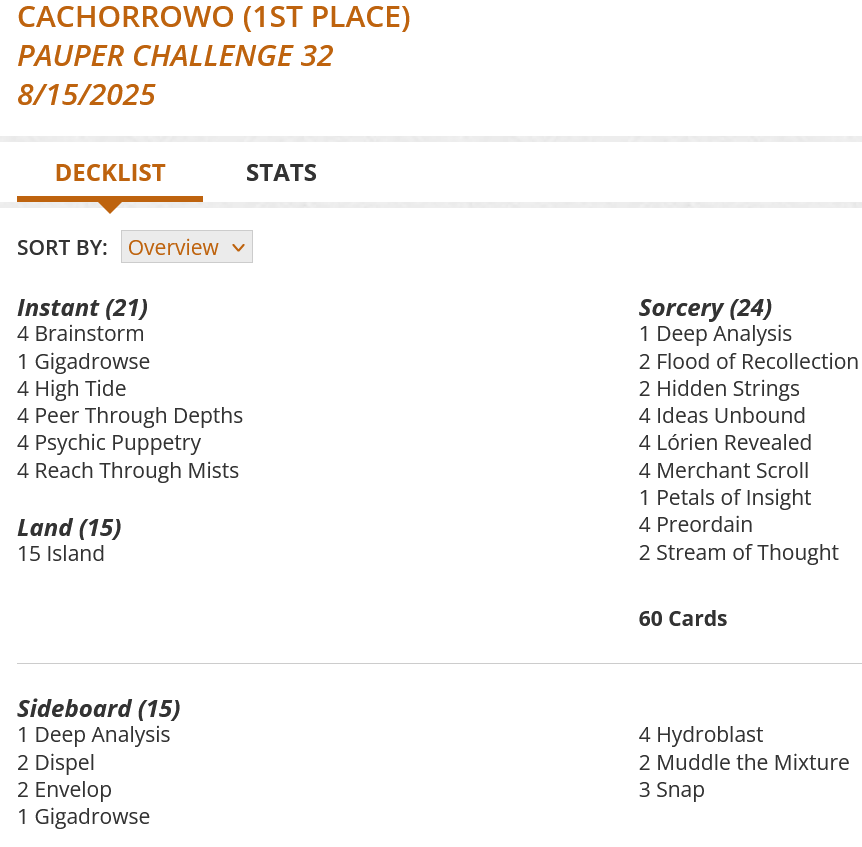
    Looking for another way to support my work? Click here for my TCGPlayer affiliate link. Any purchases through the link let the folks there know you like my content!