My latest article is now live on ChannelFireball – check it out here!
August 27-28 Pauper Weekend Recap
Last week I went into some detail on some of the stories of Double Masters 2022 Season. The final weekend challenges of the season were won by established decks Gate Blade and Red Blitz but Grixis Affinity, and more importantly the Affinity shell, put up good numbers.


There are a lot of interesting threads woven through the past nine weeks, but if I had to pick the most important it would be that red is likely the best color in the format right now.
Let’s go back to the first few events after Monastery Swiftspear was downshifted. Red Blitz put a new pressure on the format due to its ability to consistently present a game ending threat on the third or fourth turn of the game. What made Blitz so dangerous was that it did not rely on Lightning Bolt and similar effects to get the job done and instead is built on cheap spells that either replace themselves or have some other benefit.
Take Lava Dart for example. Trading a Lightning Bolt for a Quirion Ranger against Elves is often correct but never felt great as a red player. Lava Dart wants to be spent early so it can be “free” later for the combo turn. Crash Through and Ancestral Anger both give evasion while drawing cards and like all other spells in the deck add to the damage output. Red Blitz is a deck that is more than the sum of its parts but requires one of its spouts to function. Compare this to traditional Burn which is a deck where each spell will almost always fulfill its purpose regardless of the other cards in play or in your hand.
But then there’s Grixis Affinity. Part of this decks strength resides in its resilience with Blood Fountain but this deck also has a very “red” angle of attack thanks to Makeshift Munitions. Converting otherwise useless resources into damage, even a single damage, is enough to end the game eventually. While Affinity can kill quickly thanks to Myr Enforcer and Gurmag Angler teaming up with Galvanic Blast, it has become a red deck far more comfortable in the latter turns of a game.
So for one of the first times in Pauper’s history red has the ability to kill you fast or slow. The kind of cards that are good against fast red are not as strong against slow red and vice versa. Even cards that are somewhat powerful against fast red, like Weather the Storm, are somewhat useless in the face of Temur Battle Rage.
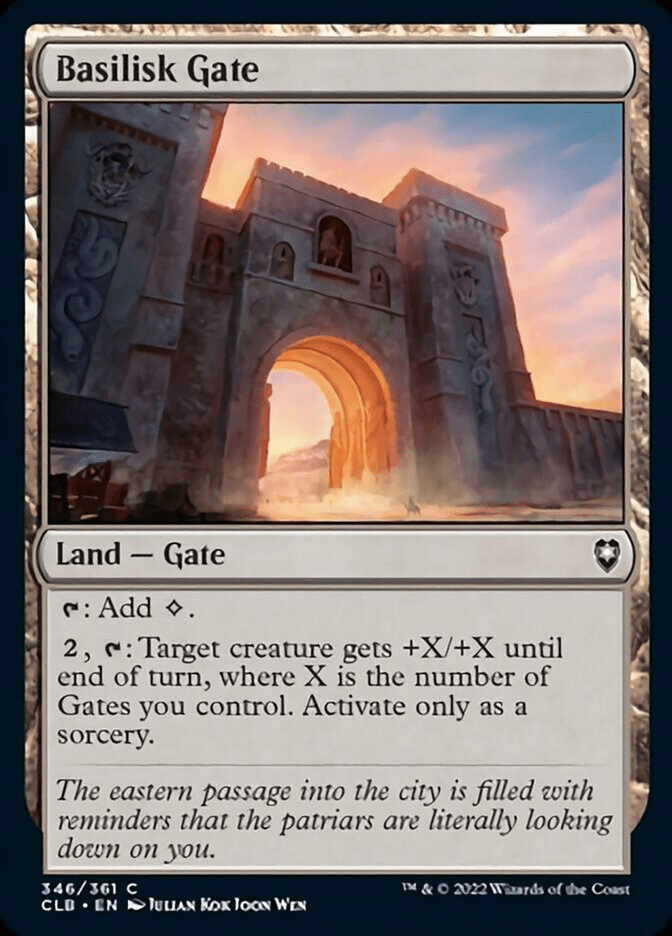
Fast forward four weeks to the first dribs and drabs of Battle for Baldur’s Gate on Magic Online. The set almost immediately makes an impact thanks to the pairing of Sacred Cat and Basilisk Gate in Gate Blade. This damage engine catches on in Boros Bully, adding Lunarch Veteran as another source of life gain. Now there are decks capable of pressuring life totals early and often while also bolstering their own in the face of red decks. Lunarch Bully caught on quickly, perhaps because it was proactive or perhaps because the shell already existed. This past weekend Gate Blade won on Saturday and was the most popular Top 32 deck on Sunday. And it did this in part by being a traditional White-Blue Control deck in a field of red.
So where does that leave the format in the wake of Dominaria United? While the set looks interesting nothing jumps out as format shaking. Instead we already saw a bit of a course correction on Saturday with an increase in Gruul Cascade decks running Thermokarst and Mwonvul Acid-Moss, possibly as a way to hit Gates and possibly due to how good Annoyed Altisaur is against Counterspell. If I were trying to level the metagame for this weekend, I would look at a way to fit white into the Cascade-Ramp engine as a way to preserve my life total.
I want to take a moment to thank all my Patrons – both old and new. I am going to do my level best to keep providing you with the kind of content that brought you here in the first place. If you are interested in supporting my work, rewards for my Patreon start at just $1 and every little bit helps.
August 20-21 Pauper Weekend Recap
Today’s entry is going to lean heavily on this post, so please read that first. After eight weeks of Double Masters 2022 season, I want to take a look at three of the top decks but to do that we need to establish some parameters.
First, let’s talk about the fact that I only examine the Top 32 decklists. When I started this project that was the only data readily available where I could verify the composition of each deck. These breakdowns are not meant to be a comprehensive look at every matchup but rather an exploration of what is doing well on a week to week basis. Using the Top 32 as a cutoff while far from ideal gives me a concrete data set that is accessible through Wizards’ own website.
The measure upon which a lot of these conclusions are drawn is Win+. This measure looks at decks and assigns them one point for each win at X-2 or above. So in a six round Challenge a 4-2 record has a Win+ of 1, a 5-1 record a Win+ of two; for a seven found Challenge a 5-2 record has a Win+ of 1 and so on. This is because an X-3 record, more often than not, is the breakeven point. Sometimes an X-4 record sneaks into the Top 32 (more often than not these days), but when looking at the relative strength of a deck in a given field, I’m looking at wins above the break even point.
Win+ gives another pool of volume data – that is the entire collection of Win+ points available in a Top 32 pool. This provides a chance to examine how much of the winner’s share an archetype is occupying. Win+ can also be compared to a deck’s presence in the metagame to give an ratio that, the closer it is to 1, the closer a deck is to consistently placing in the Top 16 as a Win+ score of 1 often (but not always) equates to a Top 16 finish.
With all of that out of the way let’s take a look at Double Masters 2022 season broken down into chunks: July 2-July 24 and July 30-August 21:


Today I want to talk about Grixis Affinity, Red Blitz, and Izzet Faeries.
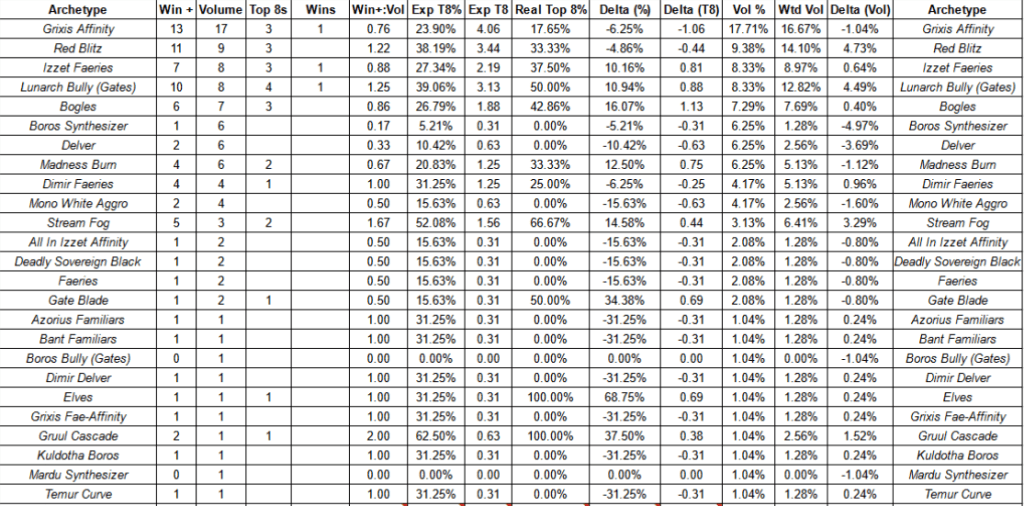
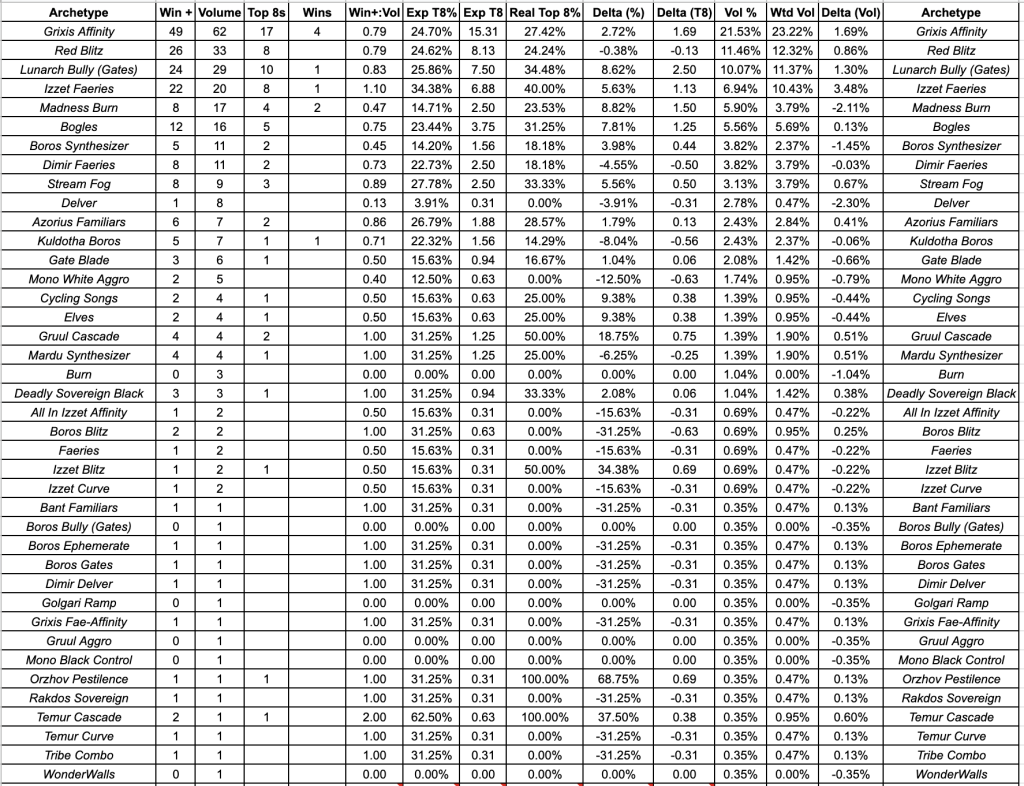
Red Blitz – the Monastery Swiftspear powered Temur Battle Rage deck burst on to the scene and has an immediate impact. In the first four weeks it had 9 Top 8s in 42 total appearances, including a win. Despite reshaping the metagame in many ways it was merely a good deck and not a great one – it did not outperform it’s volume by that much (actual volume: 16.41%; winner’s share: 16.84%) and had a Win+:Volume ratio of .76. Despite taking a back seat in the next four weeks it arguable did better on these metrics – eight Top 8s in 33 appearances with an actual/winner’s split of 11.46%/12.32%. The Win+:Volume ratio this time as .79. Over the eight weeks of the season so far Red Blitz has 75 total Top 32 appearances, 17 Top 8s, a W+:V ratio of .77 and an actual/winner’s split of 13.79%/14.57%.
Red Blitz has been a consistently good, but not great deck, over the course of the season.
This sets the stage to talk about Grixis Affinity. The deck was overshadowed by Blitz in the first four weeks with only 20 Top 32 finishes, including 5 Top 8s and a win. The W+/V ratio during this time was .75 and the actual/winner’s split was 7.81%/7.89%. In other words, for the first four weeks of the season Affinity was merely another good deck if you look just at the results.
The second four weeks tell a different story. Affinity has 17 Top 8s with 4 wins in a whopping 62 Top 32 appearances. The W+/V ratio improved to .79 (the same as Blitz over the same time span) with an actual/winner’s split of 21.53%/23.22%. Over the entire season Affinity clocks in with 82 Top 32 appearances, 22 Top 8s with 5 wins, a W+/V ratio of .78 and an actual/winner’s split of 15.07%/16.08%.
Grixis Affinity has had a stellar month and that has more than made up for a slow start.
When looking at the Winner’s Metagame it is vital to understand that these two decks are shaping it. Despite falling off as of late Red Blitz is an absolute house of a deck and Grixis Affinity has transitioned to being the preeminent control deck in the format. These two have made up a little more than a quarter of the Top 32 metagame this season, over 30% of the weighted metagame, and almost 29% of all Top 8s, with Affinity winning 5 of 17 challenge level events.
So why do I also want to talk about Izzet Faeries?
In the first four weeks of the season, Izzet Faeries had a respectable 21 Top 32 appearances with 7 Top 8s and a win. It’s W+/V ratio was .9. In the second four weeks of the season the deck had another 20 Top 32 appearances, 8 Top 8s and a win but it had a W+/V ratio of 1.1 – meaning it averaged better than Top 16 appearance. Overall Izzet Faeries has 41 Top 32 appearances with 15 Top 8s, 2 wins, and a W+/V ratio of 1. It has been the most consistent deck all season.
Now this analysis does not correct for raw volume – Affinity has twice the Top 32 appearances as Izzet. It also does not take into account what happens outside the Top 32. Taken together this information helps to paint a picture of the different poles of the current Pauper metagame.
Red Blitz is very much the clock of the format – it establishes the timeline by which other decks must establish a defense or succumb to pressure.
Affinity is the control deck, built with effective card draw, resilience, and interaction, it will win the game if it goes long.
Izzet Faeries is the one of the viable midrange options right now and trends towards control but does a fine job of clearing the board to end the game.
It’s not included in the wider breakdown the but the latest build of Boros Bully using Lunarch Veteran and Basilisk Gate is the best “midrange” aggressive deck by a decent margin as it can both go tall with Gate or wide with Battle Screech and Rally the Peasants.
So where does that leave Pauper? Red is everywhere but Galina’s Knight is not a large enough threat to end the game. Affinity presents a real riddle for the long game as failure to exile its threats means they are just going to come back. Regardless we are only a few short weeks away from Dominaria United which could inject some new tools into the format.
For now, I am going to leave you with the full chart metagame breakdown for Double Masters 2022 season so far.

I want to take a moment to thank all my Patrons – both old and new. I am going to do my level best to keep providing you with the kind of content that brought you here in the first place. If you are interested in supporting my work, rewards for my Patreon start at just $1 and every little bit helps.
August 13-14 Pauper Weekend Recap
Dominaria United previews are about to get underway but for now Pauper is still living in the world of Double Masters 2022. The August 13 and August 14 Challenges, as well as the Showcase Qualifier, were dominated by Affinity. For much of the past year this has been a common refrain and critique of Pauper: despite all the bans, Affinity is still a powerhouse.

This got me thinking about the four macroarchetypes and how they have stacked up against each other over the past seven weeks of the season. So let’s take a look:
Red Decks: Burn, Madness Burn, Red Blitz
July 2-July 24: 26.56% of the T32 Metagame; 28.31% of the Winner’s Metagame
July 30-August 14: 18.75% of the T32 Metagame; 16.94% of the Winner’s Metagame
None of this should be too surprising. In the wake of Monastery Swiftspear’s downshift many players flocked to red spells. In the intervening weeks as the meta has adjusted and shifted, red has taken a pretty significant hit. Red, despite being a powerful strategy, has a natural foil in life gain. While it is not an end all and be all, sufficient life gain present in the metagame can make it far more difficult for these decks to succeed. The abundance of Sacred Cat and Basilisk Gate decks, backed up with Lunarch Veteran, can help to mitigate the damage output.
Boros Decks: Blitz, Bully, Gates, Kuldotha, Synthesizer
July 2-July 24: 8.98% of the T32 Metagame; 7.89% of the Winner’s Metagame
July 30- August 14: 17.42% of the T32 Metagame; 19.19% of the Winner’s Metagame
While correlation is certainly not causation, we can infer that the increase in Boros decks (and the wide release of Baldur’s Gate cards) helped to bolster Boros while suppressing Red Decks. Boros is also a traditional enemy of Faerie decks and as we will see in a little bit these were extremely popular in the first half of the season. The issue with Boros is how diverse the archetype can be with strategies often bending boundaries and bleeding into one another. And yet these decks have enough differences to be distinct.
Faeries: Delver, Dimir Faeries, Faeries, Izzet Faeries
July 2-July 24: 26.95% of the T32 Metagame; 28.31% of the Winner’s Metagame
July 30- August 14: 16.97% of the T32 Metagame; 15.81% of the Winner’s Metagame
Faeries started out incredibly strong and has come back to the pack. None of this is surprising as Faerie decks often wax and wane in strength over the course of a season.
Affinity
July 2-July 24: 7.81% of the T32 Metagame; 7.89% of the Winner’s Metagame
July 30- August 14: 20.99% of the T32 Metagame; 23.72% of the Winner’s Metagame
That’s a pretty wide disparity. Looking at New Capenna season (April 30-June 26), Affinity had an 18.87% Top 32 metagame share while it had an even 20% of the Winner’s Metagame. So what happened during the first month of this season? Again, correlation is not causation but it appears that a lot of players shifted to Monastery Swiftspear at least initially before returning to the machine. It is also possible that with multiple high profile events taking place more recently (Qualifiers and the like) that people are more eager to try a deck that many consider to be “the best”.
The New Normal?
I am going to admit that sometimes I see format health discourse less as something constructive and more as a desire to return to some old glorious state. For people who have been playing Pauper for some time a lot of staple decks have fallen by the wayside and new metagame monsters – like Affinity – have emerged. As the cardpool grows so to does the overall power level and similarly, decks built on synergies that are common will get more tools – Boros is going to get more value creatures, blue is going to get more cheap spells, Affinity is going to get more Artifacts.
So then what should be the threshold for action? That is far less clear, even to me. You could look at metagame volume and how much a deck wins or you could try to examine play patterns and see whether or not they meet some arbitrary metric of “fun” or “desirable”. Historically cards have ended up on the Pauper ban list if their rate was too good (that is, the actual cost was too low for the output) and stifling the wider metagame.
Looking at the numbers posted above one could make the argument that Affinity has crossed this threshold and when the entire mechanic is based on “rate” then maybe it’s time to look at what makes that rate so attainable if and only if it deserves a ban.
But unlike bans of yore, Affinity isn’t stifling other decks to the point that other major players are being lapped by the archetype. Unless it actually is and then there’s a bigger question knocking down the door:
What is Pauper’s new normal?
Decks like Stompy and Mono Black Control are barely viable these days, overtaken by other strategies that do what they do, but better. Affinity, Boros, Faeries, and Red are all at the top right now and outside of Red decks the others do not have clear and obvious counterplay options. But should the format be reshaped by a bevy of bans or should it adjust to a new, higher power level?
This isn’t a question to be taken lightly as any action could have unintended consequences. I am not of the belief that the format is suffering under a weight of ban debt but rather that over the past two years several cards that may have been offensive in the format’s not too distant past have found their niche. Yet that is only my opinion and I know plenty of folks out there have different ones.
So again, is this the New Normal? And if so is it still fun?
If Affinity is a problem then what else might be lurking underneath? And if Affinity takes a knock. what else has to go to keep the format healthy, vibrant, and evolving?
I want to take a moment to thank all my Patrons – both old and new. I am going to do my level best to keep providing you with the kind of content that brought you here in the first place. If you are interested in supporting my work, rewards for my Patreon start at just $1 and every little bit helps.
Updating Ishkanah
Today on ChannelFireball, I talk about the process of updating my Ishkanah, Grafwidow deck. Check it out here.
July 30-31 Pauper Weekend Recap
Pauper has turned a proverbial page and we are now in the second four week stretch of Double Masters 2022 Season. The first month ended with Faeries, Boros, and Monastery Swiftspear at the top of the metagame with Affinity remaining a major contender. Last weekend saw a Challenge on Saturday and Sunday in addition to the Showcase Qualifier on Saturday. Where does that leave us at the end of the day?

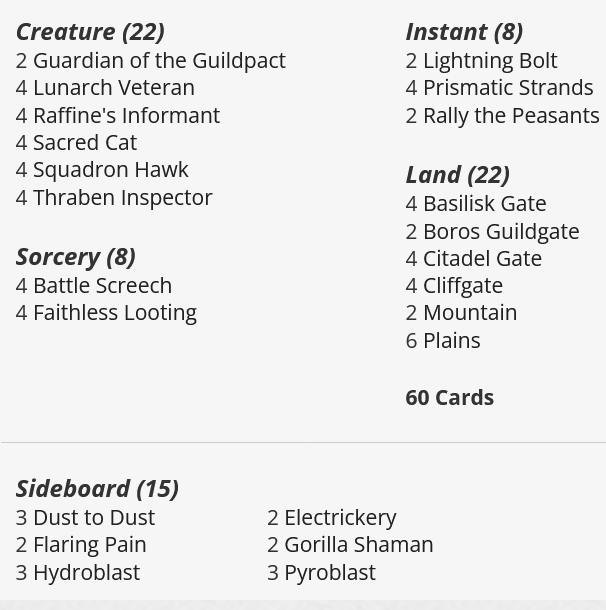
While this image may be a bit hard to read, things should be somewhat clear. The same macro strategies continue to perform well with Affinity, Faeries, and Boros all taking down events. The big story, to me at least, is the ascendancy of the Lunarch Veteran version of Boros Bully that runs the Basilisk Gate damage engine.

While this is not the list that won Saturday’s Challenge, instead making Top 8 on Sunday in the hands of Folero, this deck does a feature Raffine’s Informant. Informant is a great back up to Faithless Looting. More than that, it is arguably better in concert with Prismatic Strands since it not only advances your board state but provides a fresh body to use when you Connive away the Flashback Fog.

Boros Bully was already a deck based on a damage engine – that of going wide and ending the gate with Rally the Peasants. Basilisk Gate gives the deck another engine that works in a different direction. Where Bully traditionally won by going wide, Basilisk Gate allows it to go tall and present a single threat that can end the game. Guardian of the Guildpact is a fine target but Sacred Cat might be better right now. With Monastery Swiftspear and Affinity pressuring life totals, a 1/1 lifelink that can absorb a blow and come out swinging for Armadillo Cloak levels of life gain is huge. The fact that it requires two answers from Faeries does not hurt either.
So where would I look next week? I expect cards like Suffocating Fumes to see some play especially since black seems to be back on the menu thanks to Vampire Sovereign decks. But if you’re an enterprising Pauper, you might want to dig a bit deeper into the bulk box because a new storm might be a brewing.

I want to take a moment to thank all my Patrons – both old and new. I am going to do my level best to keep providing you with the kind of content that brought you here in the first place. If you are interested in supporting my work, rewards for my Patreon start at just $1 and every little bit helps.
July 23-24 Pauper Weekend Recap
After July 23 and July 24, Pauper has a full month with the Double Masters 2022 downshifts available and several weeks of some Battle for Baldur’s Gate cards distributed on Magic Online. The resulting format is somehow entirely expected and full of surprises.

Let’s start by talking about the elephant in the room – Monastery Swiftspear. This one card has had a massive impact on the format. Not only is its natural home the most popular deck, but it has also cropped up in both the Rakdos Madness Burn deck paired with Seeker of the Way in Boros Blitz. Swiftspear is a fantastic aggressive threat – the kind the format has sought for years to make beatdown decks viable – and it has done just that.
All that being said, Red Blitz is merely good. It might be the most popular discrete deck but it is less popular than Spellstutter Sprite decks overall and has fewer Top 8 finishes as well. Despite its strength the strategy has natural foils. Now, no one life gain spell is going to stop Temur Battle Rage, but enough of them round after round will make for a much rougher go of things. Similarly having access to the correct removal (do I have to bring up Dead Weight every week?) can buy you the time needed to establish your game plan.
Before we get to the real winner of July I want to talk about Basilisk Gate. This card has proven to be an absolute house. GateBlade was an early winner and Gate based game plans have continued to perform. However they have not matched Zoohn’s original GateBlade success. This may be part of the midrange problem – where midrange decks can perform well in league, where the meta is more open, but struggle in Challenges if they do not come with the right suite of answers. For example, going into next week I would want to be prepared for Affinity (it did win Sunday after all) and Spellstutter Sprite.
What? You thought it went away? Spellstutter Sprite decks – Delver, Faeries, Izzet Faeries, Dimir Faeries – have 23 Top 8 finishes (almost 36%), almost 27% of the Top 32 volume and over 32% of the Winner’s Metagame. Spellstutter Sprite gets better the lower the overall mana curve of the format AND these decks do well in more open metagames. The result is that blue decks are doing exceptionally well, which means Kor Skyfisher and Battle Screech could be a smart meta call moving into next weekend.
So here’s where I am at: the format is still about Monastery Swiftspear and failing to have a plan for it is a plan to fail. However, you need to be prepared to beat Spellstutter Sprite while not ignoring the fact that Affinity is still a viable deck. If I were trying to game the meta, I would want to be a Kor Skyfisher deck with access to efficient removal that does a good job of handling Swiftspear but also has a plan to beat a Guardian of the Guildpact with a Basilisk Gate. If I wanted to do something completely left of center, I would look at a go-wide green deck that can pressure a life total or one that attacks resources. Whether this is something in the vein of Stompy or one that can resolve a quick Ulamog’s Crusher remains to be seen.
But really, I’d probably play Kor Skyfisher.
I want to take a moment to thank all my Patrons – both old and new. Last week I saw the biggest jump in my growth in several years and I am going to do my level best to keep providing you with the kind of content that brought you here in the first place. If you are interested in supporting this work, rewards for my Patreon start at just $1 and every little bit helps.
July 16-17 Pauper Weekend Recap
The July 16 and July 17 Pauper Challenges continue to story of Double Masters 2022 and Battle for Baldurs Gate. Monastery Swiftspear is currently defining the format even if the decks it houses are not tearing up the metagame.

Monastery Swiftspear powered red decks are far and away the most popular discrete archetype. However, when looking at larger buckets we see Spellstutter Sprite decks as the most popular with just under 24% of the Top 32 metagame. When looking at the winner’s metagame – that is the share of wins at X-2 or better – Faeries comes in at just under 31%. Compare that to just over 16.5% for Red Blitz and the picture starts to become far more clear – Spellstutter Sprite is back even if it never left.
This makes sense. Roughly speaking you are going to be on the play 50% of the time and all of the spells in the Blitz deck are cheap. Spellstutter Sprite can stop them from storming off and put a blocker in the way of Monastery Swiftspear, buying you the time to draw into more counters and ways to mitigate the damage output. Or maybe you’re running red and you now have the time to find Lightning Bolt, Skred, or Fire // Ice.
All of this combined pushes the critical turn of the format down. While the Fundamental Turn – that is the turn when games are largely decided on the board – still hovers around 4, it may be that the most important turn in the format right now is turn two. If you are taking too much time off to develop your game plan, whether it be with tap lands or cards that do not directly impact the board, you can very easily find yourself three steps behind when it comes to Spellstutter and Swiftspear. At the same time the format is awash in sweepers that can do a solid job of helping you catch up, from Fiery Cannonade to the newer additions Breath Weapon and Arms of Hadar. All that being said you need to survive to that point.
So where does that leave the state of things? To me you really want to be looking at high impact one-drops. Cards like Lunarch Veteran have proven their worth already and maybe it’s time to bust out Soul Warden and Soul’s Attendant as well. I’ve already extolled the virtues of Dead Weight and believe it should be seeing way more play. Finally, it might be time to look at Elvish Mystic as a way to jump the curve and get you to the sweepers that much faster. If you’re trying for Arms of Hadar, Mind Stone or Signets might be the best call.
If you could take a moment to support my content through Patreon I would greatly appreciate it. Rewards start at $1 and allow me to take the time to dive deep into the issues surrounding Pauper.
Treasured Finds: Sarulf, Realm Eater

Welcome back to Treasured Finds: a place to appreciate Golgari and Witherbloom in Commander.
The other day a friend of me asked how I felt about the proliferation of potential Commanders. Overall, I’m fine with it as it not only gives more people access to different avenues of self expression but it also can enhances the sense of discovery I felt during the earliest days of Magic when I had to reach across the blacktop to try and learn every card to see what it did. It’s the joy of the prerelease that runs against an identity of a Magic player who desires perfect knowledge.
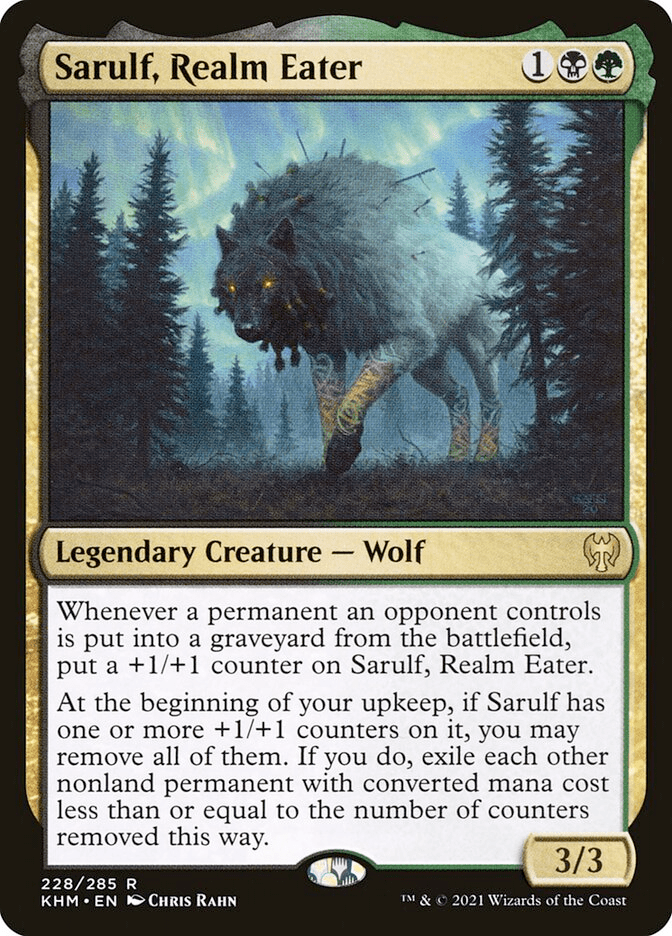
It’s not all upside. We get Commanders like Sarulf, Realm Eater which while undeniably cool, encourage a style of play that may be hard to swallow at more social tables. Sarulf wants things to die so you can blow up the world over and over again. Incredibly flavorful, but as someone who managed to achieve Sapling of Colfenor and Worldslayer once and everyone decided to concede so we could move to the next game, it isn’t exactly my jam (even if I do have a showcase version in my collection). There are lots of fun things that can be done with Sarulf, including turning the wolf into a Mutate stack (thanks EDHRec!) but the reality is that as a Commander it is hard for me to see a table where I leave happy by annihilating everyone in this specific way. It puts a target on your head and the second someone has a removal spell things are poised to turn south.
Instead I want to use today to talk about Sarulf and the black-green concept of unchecked growth. Golgari is concerned with the life-death cycle and this can be seen in its mechanics, but looking at the wider black-green slice of the color pie there is a through line of dangerous growth.

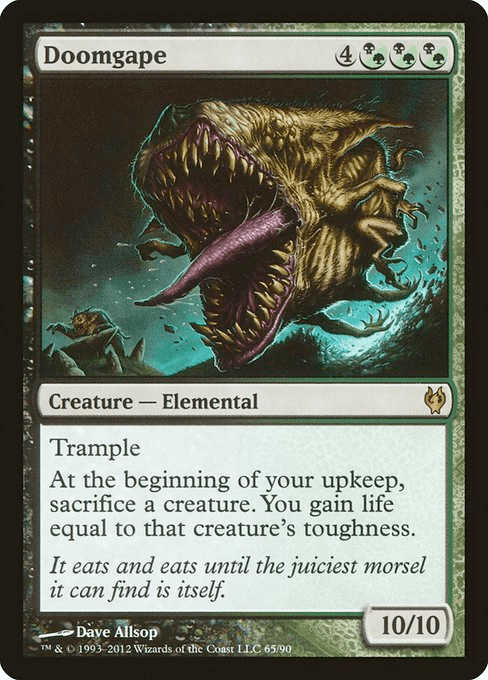
Grim Feast is not the first black-green gold card but it set the color pair on this path. Yes, your life total is going to grow as long as you can keep killing creatures. The spiritual precursor to Vulturous Zombie and Lord of Extinction, Grim Feast showcases this conceit of the color pair in that not only does it feed on death but that death is a hungry beast and wants to keep consuming. Doomgape is a clear descendant of this chain as it provides you with a nominally under-costed monster but one that has an unending need to consume. Where Sarulf feeds off of your opponent’s woe and potentially harms you, Doomgape eats your stuff and maybe deals some damage?

What happens when you pair black’s “greatness at any cost” mantra with green’s desire for natural growth? That is what Sarulf excels at demonstrating. Playing black and green does not have to be about the meticulous march of card advantage. There can a high risk-high reward element to playing the color pair that can put a hurt on your adversaries provided you’re willing to pay that price.
Do you enjoy my Commander content? If so, consider becoming a Patron.
Militia Bugler’s Many Uses
Today on ChannelFireball, I talk about Militia Bugler and how I think it might have the widest impact out of any card from Double Masters 2022. Check out the article here.

You must be logged in to post a comment.