July 16-17 Pauper Weekend Recap

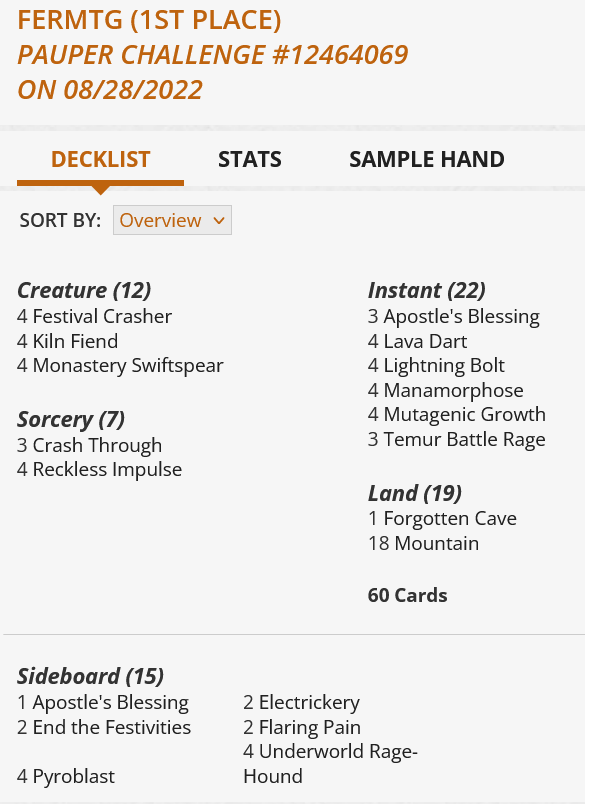
The July 16 and July 17 Pauper Challenges continue to story of Double Masters 2022 and Battle for Baldurs Gate. Monastery Swiftspear is currently defining the format even if the decks it houses are not tearing up the metagame.

July 3-17 Pauper Challenges; minimum 4 appearances OR Top 8 finish

Monastery Swiftspear powered red decks are far and away the most popular discrete archetype. However, when looking at larger buckets we see Spellstutter Sprite decks as the most popular with just under 24% of the Top 32 metagame. When looking at the winner’s metagame – that is the share of wins at X-2 or better – Faeries comes in at just under 31%. Compare that to just over 16.5% for Red Blitz and the picture starts to become far more clear – Spellstutter Sprite is back even if it never left.

This makes sense. Roughly speaking you are going to be on the play 50% of the time and all of the spells in the Blitz deck are cheap. Spellstutter Sprite can stop them from storming off and put a blocker in the way of Monastery Swiftspear, buying you the time to draw into more counters and ways to mitigate the damage output. Or maybe you’re running red and you now have the time to find Lightning Bolt, Skred, or Fire // Ice.

All of this combined pushes the critical turn of the format down. While the Fundamental Turn – that is the turn when games are largely decided on the board – still hovers around 4, it may be that the most important turn in the format right now is turn two. If you are taking too much time off to develop your game plan, whether it be with tap lands or cards that do not directly impact the board, you can very easily find yourself three steps behind when it comes to Spellstutter and Swiftspear. At the same time the format is awash in sweepers that can do a solid job of helping you catch up, from Fiery Cannonade to the newer additions Breath Weapon and Arms of Hadar. All that being said you need to survive to that point.

So where does that leave the state of things? To me you really want to be looking at high impact one-drops. Cards like Lunarch Veteran have proven their worth already and maybe it’s time to bust out Soul Warden and Soul’s Attendant as well. I’ve already extolled the virtues of Dead Weight and believe it should be seeing way more play. Finally, it might be time to look at Elvish Mystic as a way to jump the curve and get you to the sweepers that much faster. If you’re trying for Arms of Hadar, Mind Stone or Signets might be the best call.

If you could take a moment to support my content through Patreon I would greatly appreciate it. Rewards start at $1 and allow me to take the time to dive deep into the issues surrounding Pauper.

Treasured Finds: Sarulf, Realm Eater

Welcome back to Treasured Finds: a place to appreciate Golgari and Witherbloom in Commander.

The other day a friend of me asked how I felt about the proliferation of potential Commanders. Overall, I’m fine with it as it not only gives more people access to different avenues of self expression but it also can enhances the sense of discovery I felt during the earliest days of Magic when I had to reach across the blacktop to try and learn every card to see what it did. It’s the joy of the prerelease that runs against an identity of a Magic player who desires perfect knowledge.

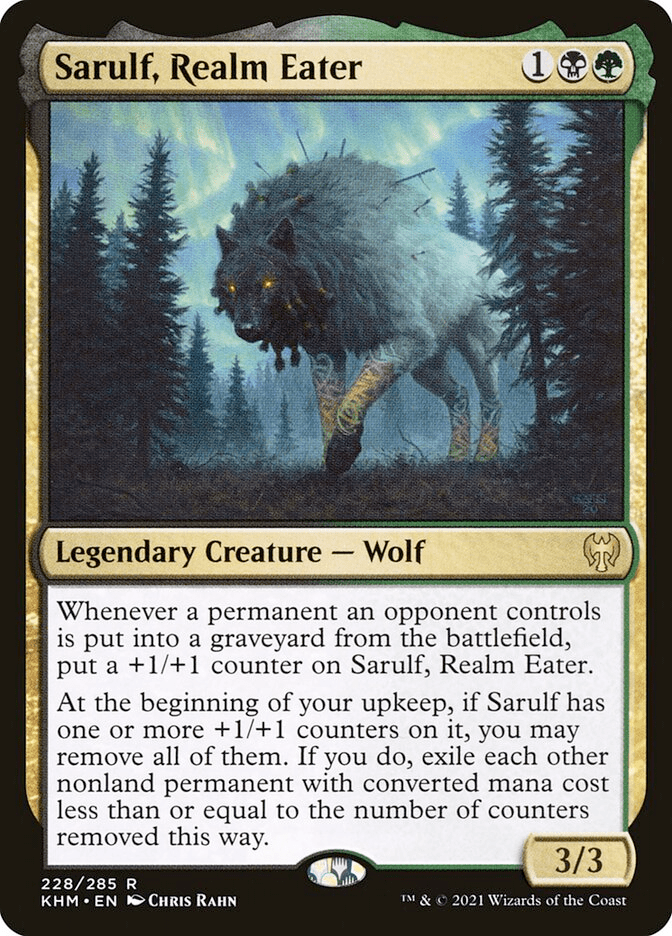
It’s not all upside. We get Commanders like Sarulf, Realm Eater which while undeniably cool, encourage a style of play that may be hard to swallow at more social tables. Sarulf wants things to die so you can blow up the world over and over again. Incredibly flavorful, but as someone who managed to achieve Sapling of Colfenor and Worldslayer once and everyone decided to concede so we could move to the next game, it isn’t exactly my jam (even if I do have a showcase version in my collection). There are lots of fun things that can be done with Sarulf, including turning the wolf into a Mutate stack (thanks EDHRec!) but the reality is that as a Commander it is hard for me to see a table where I leave happy by annihilating everyone in this specific way. It puts a target on your head and the second someone has a removal spell things are poised to turn south.

Instead I want to use today to talk about Sarulf and the black-green concept of unchecked growth. Golgari is concerned with the life-death cycle and this can be seen in its mechanics, but looking at the wider black-green slice of the color pie there is a through line of dangerous growth.

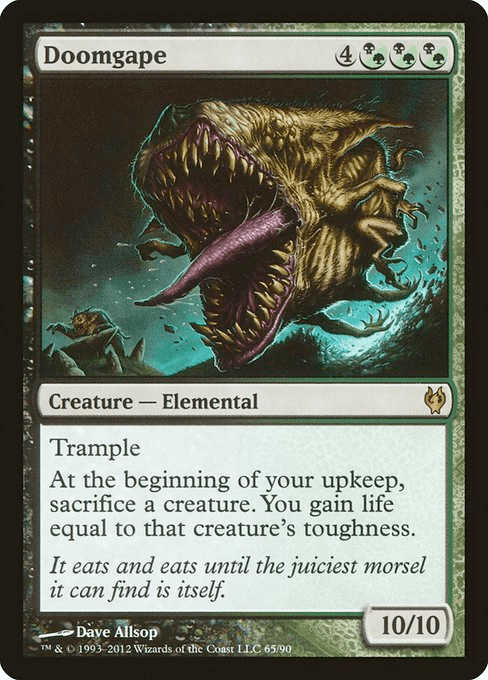
Grim Feast is not the first black-green gold card but it set the color pair on this path. Yes, your life total is going to grow as long as you can keep killing creatures. The spiritual precursor to Vulturous Zombie and Lord of Extinction, Grim Feast showcases this conceit of the color pair in that not only does it feed on death but that death is a hungry beast and wants to keep consuming. Doomgape is a clear descendant of this chain as it provides you with a nominally under-costed monster but one that has an unending need to consume. Where Sarulf feeds off of your opponent’s woe and potentially harms you, Doomgape eats your stuff and maybe deals some damage?

What happens when you pair black’s “greatness at any cost” mantra with green’s desire for natural growth? That is what Sarulf excels at demonstrating. Playing black and green does not have to be about the meticulous march of card advantage. There can a high risk-high reward element to playing the color pair that can put a hurt on your adversaries provided you’re willing to pay that price.

Do you enjoy my Commander content? If so, consider becoming a Patron.

July 9-10 Pauper Weekend Recap

A little push goes a long way, so I want to start by thanking Brian Coval and Phil Gallagher for stumping for me over the weekend. When two people you respect a great deal – as Magic players and as people – give you a shout out, it helps to rekindle a fire.

For the newcomers, welcome! I’ll do a more involved pitch later but before you go read further it would help to familiarize yourself with this post, which details how I go about exploring the Magic Online Top 32 Challenge metagames.

Okay, so first off, Pauper is in a weird spot right now. Ignoring the actual games played the online is different than the one in the physical world. The Initiative cards (and some others from Battle for Baldur’s Gate) are not currently programmed into Magic Online and as such the cards are not factoring into these breakdowns. That’s an issue unto itself as Initiative looks to be really good. Monarch already generates a card of value each turn but Initiative can do more than that thanks to the synergy with Ephemerate and Ghostly Flicker. If you blink a Palace Sentinels when you have the Monarch nothing changes; do the same to an Aarakockra Sneak and you venture deeper into the dungeon.

And that’s not all – right now the Baldur’s Gate cards on Magic Online are somewhat difficult to acquire and are in short supply. This means decks lack last week’s winning GateBlade are, well, gated to a portion of the community.

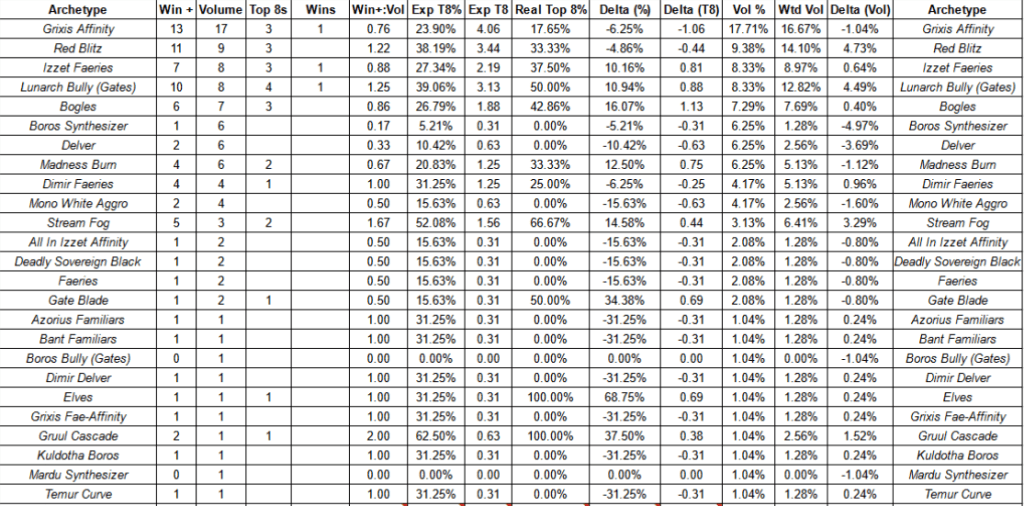
All this being said, this post in concerned with the metagame as it exists on Magic Online. After the July 9 and July 10 Challenges, here is where things stand. The following chart includes every deck that has at least 3 Top 32 appearances over the four challenges since Double Masters 2022 hit MTGO or has at least one Top 8 appearance.

Going into the release of Double Masters 2022, Affinity was the clear best deck in the format. It had some of the best threats, great card draw, and resilience. The deck is still quite good but Monastery Swiftspear has remade the format in her image. Not only are Swiftspear fronted red decks the most popular at the moment, but the Khans of Tarkir downshift has made waves in other decks.

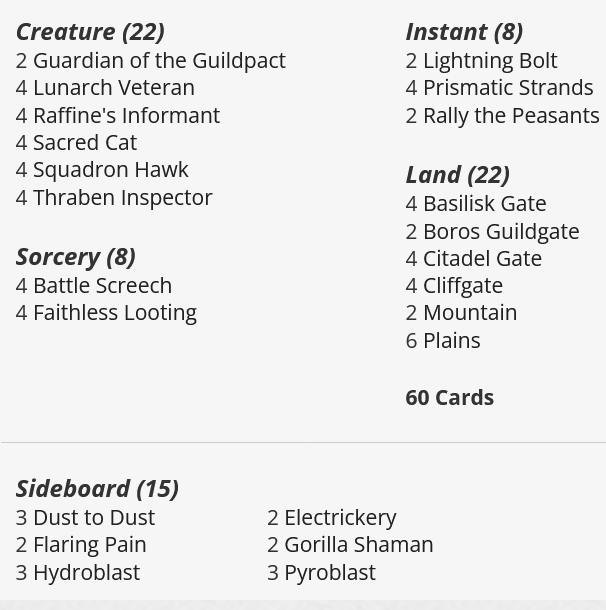
First off, Lunarch Bully is now the most popular version of Boros. This makes sense as it has some great blockers in Lunarch Veteran and Sacred Cat, while also having a decent amount of build in lifegain. Izzet Faeries is the best performing deck early on this season which may have something to do with the fact that it can run Lightning Bolt, Skred, Fire//Ice, and Izzet Charm.

Now none of this means that Affinity cannot rebound and have a fantastic season. The core has not changed and nothing has come along to disrupt its game plan – only to subvert it with speed. And it could just be that this early in a new set’s cycle people are trying new things out and putting down their Bridges for the time being. Early returns indicate that Affinity is still a factor, as is Spellstutter Sprite, with Swiftspear decks taking out a larger chunk of the meta.

So how do you fight this? I think longtime Orzhov-mage HeWhoIsinTheWater has a reasonable approach:

Orzhov Pestilence puts in work against Spellstutter Sprite decks and is not dead to Affinity. It can also use its eponymous enchantment to curtail other aggressive strategies, go over the tog of Moment’s Peace, and limit the damage that Goblin Combo can inflict. It also packs enough lifegain to survive against Monastery Swiftspear but it’s the sideboard copies of Dead Weight that are most attractive there. Swiftspear is dangerous for sure, but the ability to answer it on turn one is huge and can save you quite a few life points. If I were to play this deck I would absolutely be willing to add these to the main.

But what about next week? I would try to run the best Dead Weight deck I could that did not give up too much to Affinity while also potentially going over the top of other midrange decks. If I could get my hands on Arms of Hadar I would try my hand at a base-Golgari ramp deck in the vein of the popular Cascade strategies.

And now for that sales pitch:

If you could take a moment to support my content through Patreon I would greatly appreciate it. Rewards start at $1 and allow me to take the time to dive deep into the issues surrounding Pauper.

June 18-19 Pauper Weekend in Review

Normally I examine Pauper through the lens of different releases. In my mind it makes sense that, even if a new set does not completely change the format it does provide a new pool of cards. Given the slow and piecemeal roll out of Battle for Baldur’s Gate on Magic Online, and the rapidly approaching Double Masters 2022 with its powerful downshifts, I have decided to group these post Baldur’s Gate events with Streets of New Capenna season.

With that out of the way, we have our second four week chunk of data from this season, hanging out with trolls under various Bridges. Pauper has seen some interesting developments at its fringes recently, with beatdown Goblins adopting Experimental Synthesizer, Cascade going back to Mulldrifter, Boros Tribe combo emerging, and Turbo Fog establishing itself as a metagame player. All in all, 17 different archetypes topped 2% of the Top 32 metagame (at least six total appearances).

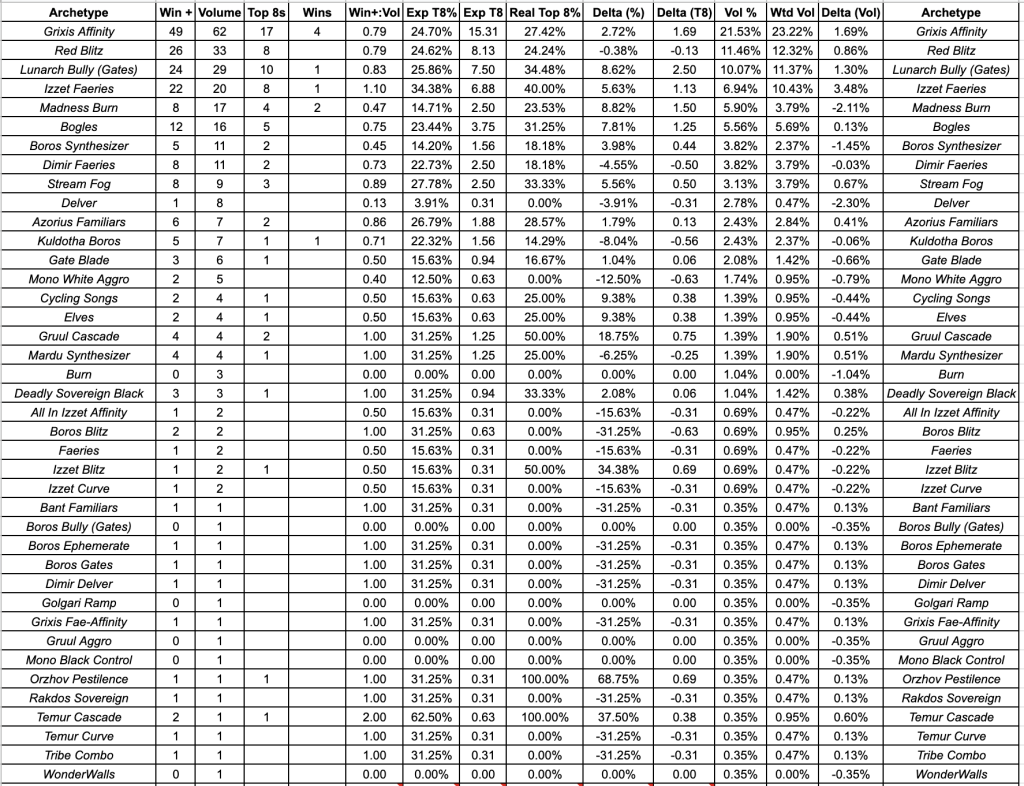
All archetypes with at least 6 T32 appearances May 28-June 19

In case it is not clear, I am going to highlight a segment of this spreadsheet – the righthand most columns.

Despite there being 17 different archetypes with at least 2% of the Top 32 metagame, only one deck topped 10% and it was that same deck that topped 20% – Grixis Affinity. While these decks are not entirely the same – some skew more towards control with cards like Counterspell, for example – the fact that this is the only deck to reach such a level is both impressive and foreboding. If you group all the Spellstutter Sprite decks they come to 13.55% of the Top 32; all the Boros decks here make up 12.15% of the Top 32 metagame.

Put another way, Affinity is just that good.

If you’re reading this article you don’t need me to tell you that Affinity is great. At this point it is clear that some action will need to be taken. I am not going to speculate on what action could be taken today because I’ve done it recently and frankly there’s not much else to be said.

Instead I want to talk about the edges someone can going in this metagame. These days the best way to approach the metagame is to figure out which linear deck is best positioned for that week. Kuldotha Goblins, Red Blitz, Bogles, Heroic – all of these decks excel at enacting their game plan and each have a decent fail rate if met with the correct counterplay. And that is where Pauper is right now – to gain an edge you have to be willing to take a risk.

The best decks – Affinity, Faeries, Boros – are all decks with a high floor and a high ceiling, Affinity being the best there. Many of the linear decks listed previously have a higher ceiling but the floor is subterranean. Still, if you are looking for an advantage that is one area to explore.

And for next week what would I be trying to do? I’d want to do something red for access to Flaring Pain. After a strong showing from Bogles over the past few events, I fully expect Fogs to be out in force.

If you enjoy my more dedicated Pauper content, consider supporting my work via Patreon. Rewards start at just $1 and every little bit is appreciated!

A Rant About Different Tweets

Yesterday the Pauper Format Panel released its view on the current state of the format and everything was quiet for about a day. And then Kalikaiz – someone I respect quite a bit when it comes to Pauper – released this thread on Twitter:

And just like that, the conversation began anew.

Once again, I am going to put this in the big font:

These are my opinions and not those of the Pauper Format Panel. I am not the Scarlet Witch and do not have the kind of power.

Okay let’s go.

Is Affinity a problem? Even if the numbers do not bear it out long term the perception is that the core of the deck has become an issue for Pauper. The Bridges have provided the deck with all the reward and none of the risk. The points about Dust to Dust are valid in that it might be the best sideboard card for the matchup but it still is a two-for-one where you’re spending three mana to deal with two cards which cost almost nothing, if not entirely free. The addition of Deadly Dispute (and other sacrifice outlets) means that you aren’t even going to get the full value off of Dust to Dust all of the time. This has led to a format that is reliant on a sideboard card that isn’t doing the job it is assigned.

But that’s not the whole story. Affinity has eaten up a lot of real estate thanks to its powerful core – material, Galvanic Blast, and Deadly Dispute is a solid combination and forms the backbone of many different strategies at the moment. That Dust to Dust is ineffective here is part of the problem but it is more that the Dust to Dust plan – that is blowing up lands in an attempt to buy time – works better when it involves actual Land Destruction. The Thermokarst decks have picked up steam as a way to go over the top. They run a consistent mana engine that gets them to Cascade threats early and can dominate a “fair” game. The result is a combination of problematic cards and play patterns that many people find less than fun. I do not like using “fun” as a metric since it is so subjective, but when a format becomes “blow up your lands and win” or “blow up your lands and lose”, there might be something underfoot.

So hypothetically speaking what happens if the Bridges go away? The hope is that other decks can assert themselves in an old new way. Boros and Faeries return and Affinity sticks around in a more vulnerable state. The hope then would be that aggressive decks could make a comeback and help handle the Cascade/Land Destruction decks that are currently keeping bounceland strategies from competing.

Right?

If the Bridges go Affintiy probably reverts to a viable Tier 1.5/2 option. The deck still has to face the wrath of Mox Monkey but with Deadly Dispute and Makeshift Munitions that probably is not as scary a proposition. Maybe Etherium Spinner catches on for real this time or the deck just cycles through various less robust cores from week to week.

Boros is likely to get stronger in such a world. Without having to dedicate the same number of sideboard slots to Dust to Dust it can round out its extra stack with some of white’s more powerful sideboard options. What probably won’t happen is a return to the decks that relied on four drops – why would Boros do this with access to Experimental Synthesizer? – as it can be far more efficient and lean.

Faeries will continue to do what it always does and be one of the best decks in the format. Maybe it gets better with fewer copies of Makeshift Munitions but maybe it also takes a hit as more people can focus on Spellstutter Sprite as opposed to Myr Enforcer. Perhaps something needs to be banned from this core in the future but honestly at this point who knows?

But what about aggro? We’ve seen the emergence of a Goblin deck that leans on artifacts and Kuldotha Rebirth but other than that the innovation has mostly been in “go tall” decks like Bogles and Infect. This is not a Pauper problem as much as one that plagues non-rotating formats. The removal gets better, the card draw gets more efficient, but it’s really hard to have a better aggro creature than a 2/2 for one mana.

I don’t think the decline of Affinity – and with it Krark-Clan Shaman and Makeshift Munitions- is going to lead to a resurgence in aggro decks akin to Stompy. I do not think the incentives are there to play traditional beatdown in Pauper. Will creature-combo return? Possibly, but that doesn’t mean the Thermokarsts are going away.

Pauper is on the same timeline as other non-rotating formats. Over time the interaction will get cheaper and more efficient. The best card draw will rise to the top and creature decks are forced to look for another angle. Legacy has Death & Taxes and Modern has at different times had Hammer Time, Hardened Scales, and Humans (as well as others).

So really, what’s the problem?

The problem is not only about cards at the moment but rather that the cards present are encouraging some less than ideal play patterns. The hope appears to be that by knocking the Bridges down (and potentially taking some other cards with them) the format can achieve some previous state of grace. The hope is that doing this removes the incentives to engage in those play patterns and instead opens things up.

But my question is this: does it? Does removing the Bridges and sure, let’s throw the Monarch in (as it is also a popular subject in these discussions) really change things up? If such action is taken, what do you think will happen?

Mono-Black Control is a deck that has, by and large, been surpassed by the format. When almost every color has two and three drops that generate value the incentive chain Chittering Rats into Gray Merchant of Asphodel is low. No one bats an eye at this (and in fact MBC is a bit of a meme in some competitive spheres). The same can be said of Stompy but for different reasons. Unless you want to take a phalanx of chainsaws to the format, I’m not sure traditional aggro can every achieve the level of success it did when Stompy was at its apex.

But this is just one person’s opinion and I want to hear from you: what action do you think should be taken and, importantly, what are the consequences of that action? What will the format look like if your plan is enacted? Sound off in the comments, in the #MTGPauper Discord, or in the replies to the tweet where I post this.

Catching Up with Pauper – May & June 2022 Edition

Every so often I need to step away from Pauper. It is not an indictment of the format but rather sometimes, the world just gets to be too much. Without getting into too many details, the past few weeks were really rough on my as a parent of a school-aged child in the United States. Normally at the end of these posts I make a request to sign up for my Patreon but today I’m asking that if you were going to sign up to instead donate that money here.

There’s been a lot going on in Pauper the past few weeks, especially given the announcement that Battle for Baldur’s Gate would not be released on Magic Online in a way the coincides with its paper release. While there are some clues as to which cards are going to be available (thanks to the collection filter on the platform), the Pauper playing masses are trying to piece together what the near future is going to resemble. Affinity remains the fulcrum of the metagame thanks to its powerful threats and ability to easily reload. Krark-Clan Shaman and Makeshift Munitions also give the deck a way to defend against swarm strategies. Looking at the sum of its parts it makes sense that the rest of the format revolves around Affinity.

Yet the metagame around Affinity continues to churn. For a few weeks we saw Familiars, both Azorius and Esper, get a ton of press. More recently Turbo Fog and base-green Cascade/Ponza decks have been picking up popularity. While drastically different on the surface, these decks all share a very important elements that might be contributing to their success.

First, these decks are strong in a place where Affinity is weak: Dust to Dust. Availing itself as a key card these days, not being hit by Dust to Dust is a great way to gain an edge in the current metagame. In a similar vein these decks are resilient to Blue and Red Elemental Blasts. While each of these decks does have cards that get hit by these cheap spells, they all have some way to combat them – Familiars and Turbo Fog have recursion engines that can rebuy key pieces while the green ramp decks have Cascade threats to get around countermagic.

Out of all of these I think that Turbo Fog is the best positioned moving into this weekend. Despite their strength, both Familiars and Cascade have a common weakness to a resolved Magma Spray while Turbo Fog can just ignore a lot of commonly included interaction. There has also been a decline in Burn decks recently while Kuldotha Goblins has seen more play. To that end it makes sense for Turbo Fog to make gains this weekend. So if I were trying to game the system, I would look for a way to run Pestilence without getting run over by Affinity since it provides a convenient way to end the game through Moment’s Peace.

A Rant About Tweets

Let’s start by saying I was not expecting to write this today. Normally the posts I release at the start of the week go over the Challenges from the previous weekend and talk about shifts in the metagame. But I saw this tweet from Pauper regular Raptor56 and it got me thinking about the format and the perception of Pauper both from within and without.

The part that stood out to me was this: “I really wish the bridges did not have the artifact subtype. The format has revolved around then, and it’s gotten quite stale.” Now this is a pretty common refrain from people who play Pauper a ton and is something that I’ve observed, but I wanted to see if this sentiment was held by a wider population and not just those who are heavily engaged with the format. And so I posted this, and more than a day later my notifications continue to explode:

Before I continue, I want to be as crystal clear as I possibly can:

The following opinions are mine alone and do not necessarily reflect the feelings of the Pauper Format Panel.

And if that was not clear enough, here’s another tag line:

Just because I write something here doesn’t mean that it is going to happen. Chill the Eff Out.

With that out of the way, let’s get down to business.

First, there were a ton of responses the hearkened back to the glory days of the past, when Pauper used to be good and you could win a game without your opponent taking meaningful game actions – when you could Daze their first play and Spellstutter Sprite their next one or use Invigorate on Glistener Elf to kill them on turn two. In this era Pauper had an identity as a powerful format but it was incredibly punishing and the choices boiled down to bringing the right deck. A format where most of the decision making has to take place outside of the actual game leaves little to actual gameplay and that’s a bad time (this is a knock on the current iteration of Pauper for what it’s worth).

Another suite of responses focused on Pauper’s inclusion of all commons. Strixhaven Championship winner Sam Pardee opined that the Monarch and commons from other supplemental sets undercut the ethos of the format by taking some liberties with the nature of what a common can do. The fact that common is a completely arbitrary delineation wholly contingent on the limited environment and not intrinsically tied to individual power level does create some issues.

Pardee’s sentiment is echoed by Bryan Gottlieb and Gerry Thompson in this episode of the Arena Decklists podcast where Gottlieb advocates for Pauper to move to the Modern cardpool, eschewing the outliers from before Eighth Edition as well as the nonsense caused by sets such as Conspiracy, Commander Legends, and going back as far as the Magic Online Masters Editions which fudged the rarity of cards for limited concerns. While I disagree about cutting out everything that didn’t first pass through Modern, this gets to the kernel of the issue brought up by Raptor in their post that inspired this exercise.

Supplemental sets, whether they be focused on Modern or Commander or whatever, have different needs than sets that have to go through Standard first. Because of this they tend to feature Commons that are outside what many would consider an appropriate power band. To me this alone if not a reason to exclude these cards as the format still contains Lightning Bolt and Preordain. Rather it is when these cards are geared towards formats with more than two players that things start to get dangerous. The other time when these supplemental cards cause issues is when they prop up existing archetypes in a way to wallpaper over their weaknesses. We can look at two case studies here in the Monarch and Bridges.

The Monarch, as it was released, was not designed for two player games of Magic. Here is where people point to articles from Mark Rosewater that describe how the Monarch was borrowed from Ixalan design when it was called The Edge and gave a bonus. We don’t know a lot about The Edge; we do not know if the benefit was a card every turn or if it would even make it out of what was then called development. Because of this it creates an imbalance when brought into games where there are not a requisite number of players to help balance out its benefits – in a four player game, each turn cycle means two “free” cards for the Monarch and three “free” cards for their opponents. This is one reason why I am cautious around Initiative and the Undercity.

The Bridges, on the other hand, were designed for a specific limited format and have done a number on Pauper. Affinity is a broken mechanic and taking away one of the archetypes main weaknesses – its fragile manabase – has shown Pauper exactly how busted the machine can be. The result is that in an effort to return Pauper to some semblance of balance, many believe the Bridges have to go. The issue with this stance is that it doesn’t actually address the issue of Affinity as a mechanic and leaves the door open to more things going wrong in the future (but I’ll get to this more later).

In order to ensure Pauper’s continued success, I believe there needs to be both short term decisions and long term action. I think the Pauper Format Panel is well set up to handle the “thousand yard view” that the format needs. I am an advocate for more aggressive use of the banned list to deal with problem cards but I also am happy this is not the stance everyone holds as it forces us to explore problems from multiple angles. That being said I think in order to move past the current morass, some cards need to be examined.

First up, the Monarch and upcoming cards with Initiative need a good, long look. Cards designed for multiplayer games that scale, like Encore, Myriad, or Melee, are fine in Pauper since they check the number of opponents before granting a benefit. Monarch and Initiative do not care about the other players in the same way and as a result have the potentially to completely throw off the balance of the game.

Second, and this is contingent on the third point (I’m going out of order for a reason, I think) is to examine ways to weaken the Faerie/Ninja core. The core game plan of cantrip into Spellstutter Sprite into Ninja of the Deep Hours is extremely powerful and if the other steps laid out here are taken, could exert a ton of pressure on the format at large in a way that makes blue the undisputed ruler once again.

As for Affinity, here is where I’m veering off course. I do not like the Bridges, but I think they do one thing exceptionally well: the encourage decks to play more expensive cards. The interaction between these lands and Cleansing Wildfire encourages decks to play more expensive cards and build towards a long game. This should not be discounted as otherwise the format would follow the trend of other large card pool formats, as Gottlieb and Thompson pointed out, towards 0, 1, and 2 mana spells. Being able to buck this trend is important for diversity in my opinion.

Rather, I think the time might be nigh to come for Pauper’s low-threshold one mana-draw twos. If you remove Thoughtcast from the equation, Affinity loses a key way to keep chaining draws for cheap. I also think that time has shown Deadly Dispute might just be too good for Pauper as it also effectively costs one mana and has a low threshold towards including in a deck. Unlike Reckoner’s Bargain it leaves behind a Treasure and unlike Village Rites it can be fueled by material that might be extraneous. Of One Mind is probably safe since it requires far more specific deckbuilding restrictions than simply “include artifacts”.

Supplemental sets are not going anywhere and they provide an opportunity to give Pauper some cards that might otherwise be out of the format’s reach. However when they do get released, action needs to be taken to identify problems they might cause and decisions need to be made about what to do.

But of course if you’ve been following me for any stretch of time, you already knew that’s where I stand.

If you could take a moment to support my content through Patreon I would greatly appreciate it. Rewards start at $1 and allow me to take the time to dive deep into the issues surrounding Pauper.

May 14-15 Pauper Weekend in Review

We had our normal Saturday and Sunday Challenges, as well as a Showcase Challenge that ran on Saturday. While there were plenty of decks that performed well the story of the weekend was one that has been told time and time again over the past several months: Affinity, Boros, and Faeries are all jockeying for position with decks like Azorius Familairs and Goblin Combo making their presence felt. But three weeks into New Capenna season, here is what the big three archetypes are doing in the Winner’s Metagame:

I am not here to say whether or not this is a good thing or a bad thing – this is just the way Pauper is right now, with the best decks consistently making up over 50% of the winner’s metagame. Both Boros and Faeries encompass several sub-archetypes while Affinity is overwhelmingly made up of the Grixis variants. Still, having a metagame so dominated by these decks is something to watch, especially as we get ready for the next release in Battle for Baldur’s Gate.

Multiplayer focused sets tend to do a number on Pauper. Conspiracy: Take the Crown introduced the Monarch which reshaped the format and Commander Legends brought with it Fall From Favor, which broke the format for several months. There is already concern about Initiative, which mashes up the Monarch with Forgotten Realms‘ Venture Mechanic.

While we do not have all the cards with this mechanic, our first look is one that generates about a cards worth of value on each step of the Undercity Dungeon. Pairing the Sneak with Ephemerate will put you fairly far ahead for only five total mana and if there are any Initiative cards that are cheaper than four, Pauper could be in for another tempestuous series of events.

However that is not set in stone. Fall From Favor took one of the best strategies and made it significantly better while also providing counterplay for Faeries against Monarch decks in preboard games. Fall From Favor also came out when the format was at a lower power level. Since Fall From Favor was banned the overall strength of the decks in Pauper has gone up. Also, without knowing all the cards it is hard to contextualize how they will fit into the format at large. So for now I’m taking the “wait and see” approach and hope rather than adding more fuel to the existing engines, Initiative provides incentives to build new decks.

But there’s a very good chance I’m wrong and that by the time we reach July something will have to change.

If you enjoy my more dedicated Pauper content, consider supporting my work via Patreon. Rewards start at just $1 and every little bit is appreciated!