March 16-17 Pauper Weekend Recap

Want to learn more about the metrics I use in tracking the metagame? You can find an explainer here.

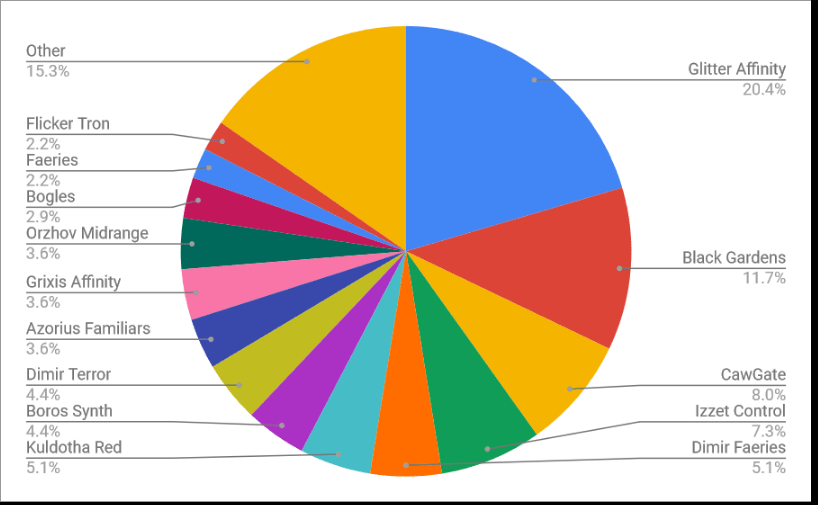
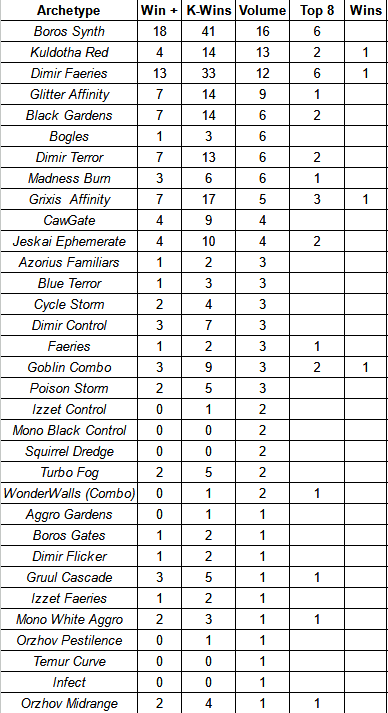
At the end of last week’s update I wrote that Glitter Affinity should be at the forefront of your mind if you are preparing for a Magic Online Pauper event these days. Last weekend’s results seem to indicate that the Pauper playing population agrees. While Glitter Affinity remained the most popular deck in the Challenges (27 total appearances), it dipped from 20.4% overall volume last week to a far more reasonable 15.8% this last weekend. On the surface it appears that Affinity continues to experience success, albeit at a reduced rate. And with three Top 8s to its credit over the three challenges that would appear to be the case. But regular readers are sure to note that the way I wrote this paragraph indicates that Affinity maybe, just maybe, has lost a step.

And a step is exactly what it appears to have lost. Glitter Affinity saw a drop from 15.8% of the overall field to 14.58% of the Top 32 metagame and then another drop to 13.87% of the winner’s metagame. The decline is not drastic and while it is potentially in line with the overall presence it does seem to indicate that folks came prepared to take Affinity down a peg. And looking at some of the results it all comes down to Turn Aside.

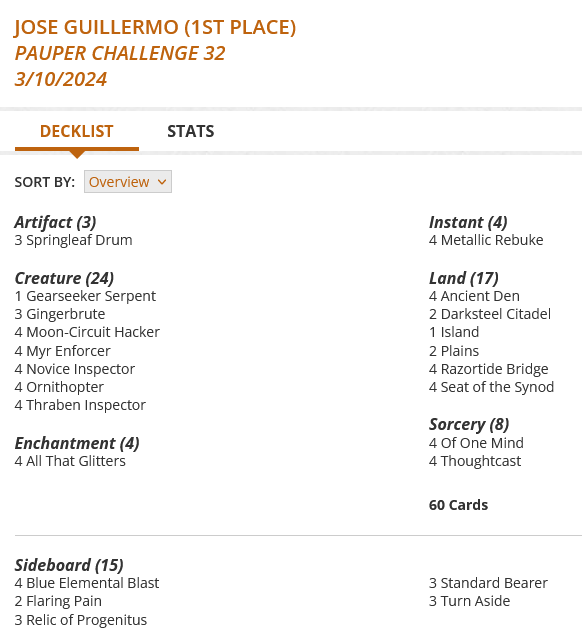
After sideboarding Glitter Affinity has access to the full four copies of Metallic Rebuke and usually two or three copies of Turn Aside. Having up to seven (effectively) one mana counterspells can make removing threats difficult. However the meta has adjusted in its answers. The number of copies of Defile in Black Gardens has gone up, allowing the deck to maneuver to a point where a removal spell will get the job done. Boros Synth made a dent in the Top 32 and between Journey to Nowhere and Makeshift Munitions, they are able to sidestep the protection offered by Turn Aside.

This is part of a dynamic metagame and frankly, it’s awesome to see in Pauper. When the format is stuck in a less than healthy cycle so often these decisions do not matter against the top of the field. Instead we are seeing the real time application of metagaming against the best decks and are also seeing the rewards of such behavior. By the end of the weekend we were also seeing some Glitter pilots adjust back, moving off of Turn Aside and towards Apostle’s Blessing as a way protect their investment at all costs.

But enough about Glitters for now, what decks performed well over the weekend?

Over the three challenges 28 different archetypes cleared the Top 32 threshold and 14 different strategies earned a Top 8 berth. Part of this diversity may have to do with the relatively small fields for each event (47, 64, 52) but it is still something of note. Something else that sticks out like a sore thumb is how well Black Gardens performed. It was the most popular deck in the Top 32 and tied for the most Top 8s. Gardens ended up with 18.5% of the winner’s metagame – up from 14.6% of the overall meta – and led the way with an Adjusted Meta Score Above Replacement of 1.19. This number tops Glitter Affinity’s 1.06 aMSAR score from last week.

Skipping over the next deck in aMSAR (Glitter Affinity with 0.55) we come to Dimir Faeries with 0.49. Another deck that leans hard on interaction, Faeries splits its answers between countermagic and removal. It was remarkably consistent, with 10.5% of the overall metagame volume, 10.42% of the Top 32 metgame and 10.9% of the winner’s metagame. In this Dimir Faeries represented the baseline choice for the weekend, serving as a standard against which the other decks can be examine.

The last thing I want to note for this week is the small bounce in Kuldotha Red. The deck had a fairly miserable performance last weekend with an aMSAR of -0.29 – meaning it was worse than an average choice in the Top 32 – with 0.52% of the winner’s meta share. Most recently it did not return to its heyday but took up a very respectable 4.79% of the winner’s meta, improving its aMSAR to -0.07, only ever so slightly worse than an average Top 32 deck. I do not expect Kuldotha to jump back to the top of the meta next week but it could see another step up as people attempt to adjust to beat the current top three of Black Gardens, Dimir Faeries, and Glitter Affinity.

Next week is going to be about dodging removal. With two black decks at the forefront of the format right now going wide could be one path to victory as a way to get around Tithing Blade and pinpoint removal. At the same time these decks are capable of packing board wipes so relying on an army of tokens does carry risk. Instead, look toward either a well tuned build of Jeskai Ephemerate or a Guardian of the Guildpact deck to you over the finish line. Jeskai has the ability to pack all the answers and close out the game while Guardian dodges removal like nobody’s buisness.

I want to take a moment to thank all my Patrons I am going to do my level best to keep providing you with the kind of content that brought you here in the first place. If you are interested in supporting my work, rewards for my Patreon start at just $1.

Can’t make a commitment to Patreon? I now have a Ko-Fi where you can make a one time contribution.

Looking for another way to support my work? Click here for my TCGPlayer affiliate link. Any purchases through the link let the folks there know you like my content!
March 9-10 Pauper Weekend Recap

Want to learn more about the metrics I use in tracking the metagame? You can find an explainer here.

Sometimes being let down is unavoidable. After last weekend’s incredibly robust slate of Pauper events it feels jarring to see only two Challenges fire on a weekend. It was not so long ago that two events were standard but now it feels out of place. There’s another lingering sense of unease; one that warrants some more discussion. Glitter Affinity has emerged as the top deck in Pauper which has led to quite a bit of discussion.

Let’s get the big question out of the way first: is Glitter Affinity a “problem”? My response is an unsatisfying “it’s hard to say”. Until last weekend the strategy had mired in the middle of the pack during Murders at Karlov Manor season but then broke out with some absolutely ostentatious numbers. I am known to say that I only start to worry if trends emerge and while the weekend of March 2-3 was a singular data point, we now have two.

But there’s additional context to this conundrum. Kuldotha Red not only been incredibly popular for several months but it has also been fairly dominant. Even last weekend the red deck was the most popular archetype in the Qualifier tournament. This week, Kuldotha Red had seven total appearances in the Challenges and one finish across two Top 32s. I’m not going to waste anyone’s time with a rhetorical “what’s changed?” because the answer is “nothing”. Instead it is plausible that the meta has adjusted to current iteration of red in a way that has rendered it less effective. Normally such a shift would be associated with a rise in another archetype that could eat unto the meta share.

Is this what is happening with Glitter Affinity? Possibly. It is also possible that in the wake of Glitter’s overwhelming dominance last weekend that more people picked it up in an information cascade. Couple this with the relatively slow rate of adjustment in Pauper and we can start to see an opening for a dominant performance by Glitter Affinity.

So what is Glitter Affinity, exactly? It is a low to the ground aggressive deck that uses cheap creatures and the Affinity mechanic to flood the board. It has a light tempo gameplan with Metallic Rebuke to keep the opponent off balance and has the capability to reload with both Of One Mind and Thoughcast. While it can put a lot of material on the battlefield it does most of its damage with All That Glitters. In this way plays like a curve based aggro deck albeit one with a Bogles style gear. It is this extra gear that can prove troublesome. The cards that are traditionally good against go wide decks suffer when faced with a sufficiently large threat and focusing on the biggest creature means you might get run over by Myr Enforcers. Glitter has the ability to apply a ton of pressure early thanks to its curve and Springleaf Drum, meaning that the rest of the format needs to build with these opening draws in mind.

4 All That Glitters
4 Ancient Den
2 Darksteel Citadel
1 Gearseeker Serpent
3 Gingerbrute
1 Island
4 Metallic Rebuke
4 Moon-Circuit Hacker
4 Myr Enforcer
4 Novice Inspector
4 Of One Mind
4 Ornithopter
2 Plains
4 Razortide Bridge
4 Seat of the Synod
3 Springleaf Drum
4 Thoughtcast
4 Thraben Inspector

Sideboard
4 Blue Elemental Blast
2 Flaring Pain
3 Relic of Progenitus
3 Standard Bearer
3 Turn Aside

So how can you approach the meta with Glitter Affinity in mind? It’s easy to say “removal spells” but what does that look like? Cast Down and Snuff Out are great but both come at a cost, either in life points or in trading negatively in terms of tempo and mana efficiency. Galvanic Blast might be able to hit everything but both look a bit anemic when facing down a turn two Myr Enforcer. A card like Electrostatic Bolt can hit almost every relevant creature in the deck and has the advantage of costing a single mana, without any other conditions. Vendetta might not be as powerful as Snuff Out but it does have the upside of not costing you 20% of your starting life total against a deck where most creatures have two toughness. This option does suffer against a resolved copy of All That Glitters but the goal should be to try and keep the board clear when resources are low and Glitters cannot keep up interaction in the form of Metallic Rebuke.

There are other cards that fly under the radar when it comes to fighting against glitter Affinity: green cards. Green is at a loose end in Pauper at the moment as it functions as a color to help grant the Initiative or as part of a hypermana strategy. That being said the deck has two one mana answers to All That Glitters that, while not game ending sideboard cards, can throw a wrench in the works. Natural State is nothing new and at one mana it can pick off many of the artifact threats in the deck as well as All That Glitters. Pick Your Poison has utility in all three of its modes but it does require a bit more set up to be at full efficacy.

I want to be perfectly clear: running these cards will not make your deck have a good matchup against Glitter Affinity. Instead they are options I feel are under-explored.

You’ll notice I am advocating here for cheap options as opposed to cards that are often seen as “hammers” against Affinity like Dust to Dust. That is because Glitter Affinity tries to win the game by capitalizing on tempo. Tempo in Magic is a notoriously nebulous concept but in this instance it can be seen as the ease of deploying threats in a mana efficient manner. Waiting until turn three to potentially hit two artifacts while not developing your board in the face of multiple threats might win you a game on card advantage but if you’re facing lethal damage it does not matter. By leaning more on cheap points of interaction you have the potential to not falling too far behind on mana spent while also pushing the game towards a point where Glitter’s early tempo advantage matters less. We’ve all been in games where someone jumps out ahead and applies a ton of pressure, only to peter out in the midgame when the control in the matchup turns the corner. That is what you should be trying to do in these instances – survive long enough that the early beats do not matter.

Does this mean that sometimes you’re going to “just lose” to a very good Glitters draw? Yes. But that does not mean the game plan is incorrect, just that it isn’t a guarantee. Tournament Magic is a two player affair and your opponent is not going to roll over to a good sideboard card hitting the stack.

Looking forward you should be thinking about the format with All That Glitters at the front of your mind. How can you stop it from connecting and how can you survive once it hits the battlefield? Like any emergent threat it is important not to bring the wrong answers because as Pauper has taught us over the past two years there is no such thing as the wrong threat.

I want to take a moment to thank all my Patrons I am going to do my level best to keep providing you with the kind of content that brought you here in the first place. If you are interested in supporting my work, rewards for my Patreon start at just $1.

Can’t make a commitment to Patreon? I now have a Ko-Fi where you can make a one time contribution.

Looking for another way to support my work? Click here for my TCGPlayer affiliate link. Any purchases through the link let the folks there know you like my content!

March 2-3 Pauper Weekend Recap

Want to learn more about the metrics I use in tracking the metagame? You can find an explainer here.

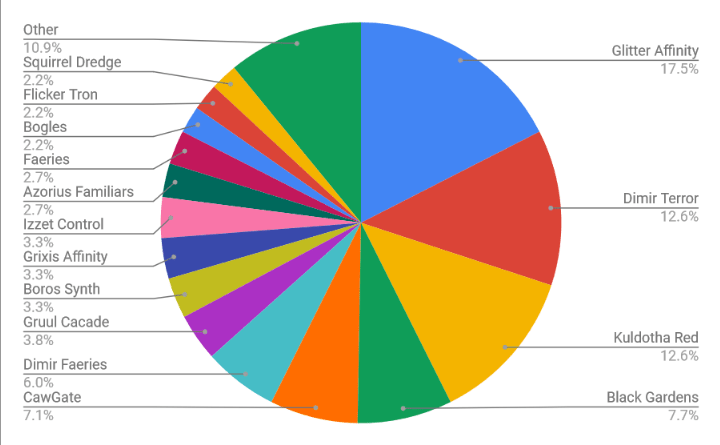
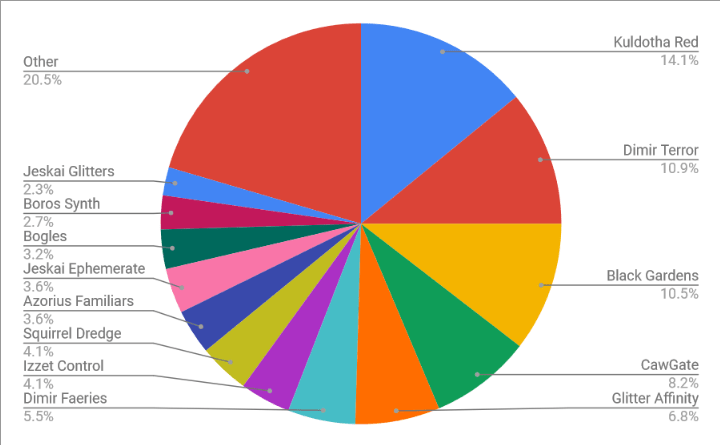
There are a lot of stories from last weekend in the world of Magic Online Pauper. In addition to the three regularly scheduled Challenges there was also a Qualifier tournament. The Qualifier had 219 participants, making it larger than the other three Challenges combined. Historically these larger events provide a different perspective on the format as they attract players who are interested in taking the next step on the competitive ladder and as such might have an understanding of the format that deviates from the folks who play it more often. Looking at the events side-by-side – that is all the Challenges and the Qualifiers – one thing becomes apparent: the weekend belonged to Glitter Affinity.

This chart represents the total metagame for all three regularly scheduled Challenges that took place last weekend. For the first time this season Kuldotha Red was not the most popular deck in the Challenges with straight up Blue-White Glitter Affinity taking that crown. It is possible that after weeks of Kuldotha Red sitting at the top of the heap players felt that having an assertive strategy with access to a counterspell could give them an edge. If you believe Pauper to be a format where racing matters, throwing a stick labeled Metallic Rebuke into your opponent’s wheel can make them stumble while you cruise to victory.

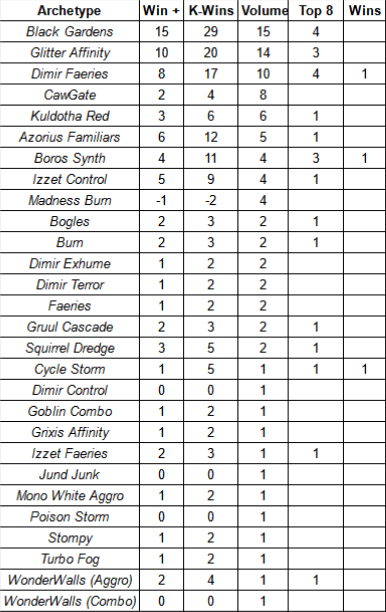
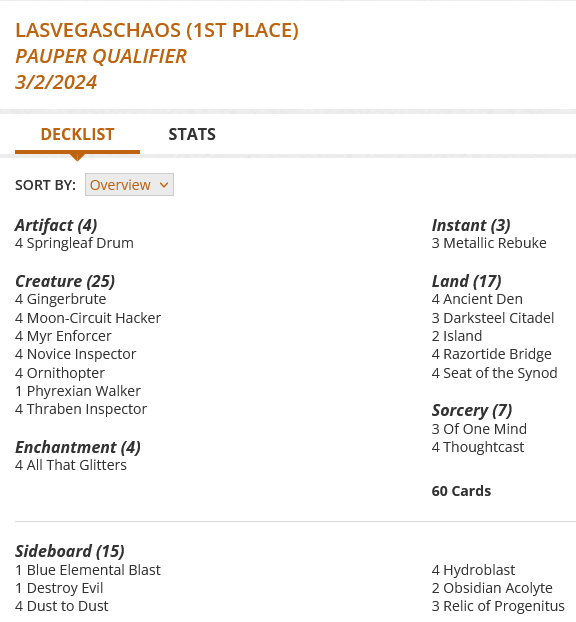
The data from the Top 32 tells a slightly different story. Not only was Glitter Affinity the most popular deck in the Challenges, but it was utterly dominant on the weekend. Leading off it was the most popular deck in the Top 32 with over 27% of that field with ten Top 8s and two wins. It’s adjusted Win+ ratio was an even 1 and it;s adjusted K-Win ratio was 2.5, meaning the deck averaged a finish in the Top 16, trending towards Top 8. The most striking stat is that it’s winner’s metagame volume was an astound 34.67%, more than doubling its overall meta presence. It is not out of the ordinary for a deck’s Top 32 finishers to out perform its overall volume but this increase indicates a dominant performance. This is backed up by a 1.55 adjusted Meta Score Above Replacement, the best of any deck in the Challenges this weekend.

It was a slightly different story in the Qualifier. Glitter Affinity was the fifth most popular deck in the field in a meta breakdown that looks more in line with the past several weeks of play. Again the deck starts to break away once we examine the Top 32 where it was the most popular archetype with five finishes and a winner’s metagame volume of 20.63%, outpacing it’s raw Top 32 rate but about 5%. This is not as stark of a jump as the regular Challenges but it is still notable. When Glitter Affinity really separated itself from the pack is in the adjusted Meta Score Above Replacement – a whopping 2.76. The next best performer was Flicker Tron with 0.98. The robots were certainly on a rampage this weekend.

4 All That Glitters
4 Ancient Den
3 Darksteel Citadel
4 Gingerbrute
2 Island
3 Metallic Rebuke
4 Moon-Circuit Hacker
4 Myr Enforcer
4 Novice Inspector
3 Of One Mind
4 Ornithopter
1 Phyrexian Walker
4 Razortide Bridge
4 Seat of the Synod
4 Springleaf Drum
4 Thoughtcast
4 Thraben Inspector

Sideboard
1 Blue Elemental Blast
1 Destroy Evil
4 Dust to Dust
4 Hydroblast
2 Obsidian Acolyte
3 Relic of Progenitus

What is Glitter Affinity doing to make it so successful? First, last weekend’s builds largely ignored Galvanic Blast which reduced the number of lands that enter tapped while also making it more likely that they can cast their spells. These decks also have increased redundancy thanks to the pair of Novice Inspector and Thraben Inspector, which both provide a body for All That Glitters and increases the auras impact. As mentioned early the deck can apply pressure early while leaving up countermagic to make sure that the opponent’s plays are for naught. Glitter Affinity also requires a slightly different approach than Kuldotha Red. Whereas the red deck can often falter in the face of sweepers (provided the control deck has a high enough life total), resolving an All That Glitters before a wipe can be resolved renders this angle of attack moot.

4 Brainstorm
2 Cast Down
4 Contaminated Aquifer
4 Counterspell
3 Deep Analysis
2 Fallaji Archaeologist
4 Gurmag Angler
1 Ice Tunnel
4 Lórien Revealed
4 Mental Note
11 Snow-Covered Island
4 Snuff Out
2 Spell Pierce
4 Thought Scour
4 Tolarian Terror
3 Unexpected Fangs

Sideboard
3 Annul
2 Chainer's Edict
1 Dispel
4 Hydroblast
1 Murmuring Mystic
2 Rotten Reunion
2 Shrivel

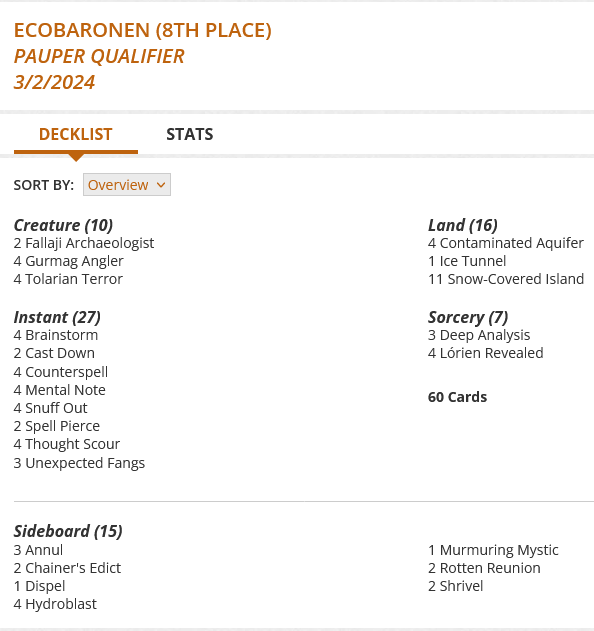
Another thing to consider is the prevalence of Dimir Terror over the weekend. While not a true control deck the strategy can assume the role thanks to its bevy of removal and countermagic. Dimir Terror was the second most popular archetype on the weekend but struggled to convert that presence to Top 32s in the Qualifier. Glitter Affinity can get on the board underneath Terror while also having cheap enough spells to render Spell Pierce dead. Sideboard copies of Obsidian Acolyte can be a back breaker for Cast Down and Snuff Out. Unexpected Fangs can put you out of range of burn spells but does very little if your opponent can leave back a 10/12 Ornithopter on defense. It is possible that the prevalence of this deck helped to create a lane where Glitter Affinity could succeed.

What about Kuldotha Red? It was just as popular as Dimir Terror in the Challenges but had a mediocre showing in those tournaments. It was the most popular strategy in the Swiss rounds of the Qualifier and ended up the third best archetype in that tournament. The more rounds that get played it makes sense that the red deck might struggle, as high impact sideboard cards are more likely to show up. Despite this, and its reputation as a top deck in the format making it a target, the numbers it put up are more than respectable.

Another deck that suffered from the number of rounds this weekend is Black Gardens. The premier black based midrange build in the format faltered. Midrange is great when your game plan lines up correctly with the spells on the other side of the table. The longer the tournament goes the more likely it is that you’re going to see the wrong half of your deck. The abundance of aggression also reduces the number of potential turns in a game which can put the squeeze on Gardens over enough games played.

1 Bojuka Bog
1 Breath Weapon
3 Crop Rotation
4 Energy Refractor
1 Ephemerate
1 Exclude
1 Ghostly Flicker
4 Impulse
3 Lórien Revealed
3 Mnemonic Wall
1 Molten Tributary
4 Moment's Peace
4 Mulldrifter
2 Mystical Teachings
1 Network Terminal
1 Prohibit
1 Pulse of Murasa
1 Rolling Thunder
1 Runaway Boulder
2 Snow-Covered Island
1 Tangled Islet
1 Thornwood Falls
4 Thriving Isle
1 Unwind
4 Urza's Mine
4 Urza's Power Plant
4 Urza's Tower
1 Weather the Storm

Sideboard
1 Ancient Grudge
1 Breath Weapon
1 Gorilla Shaman
4 Hydroblast
1 Negate
4 Pyroblast
2 Rhystic Circle
1 Weather the Storm

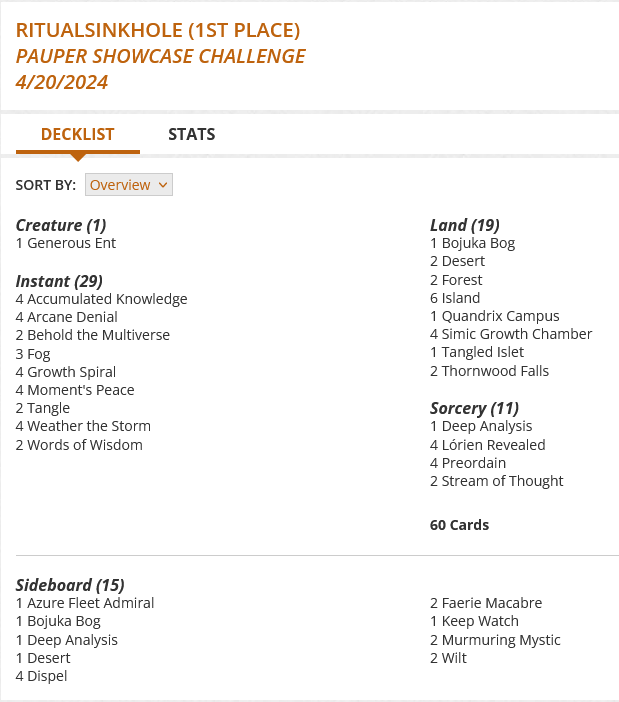
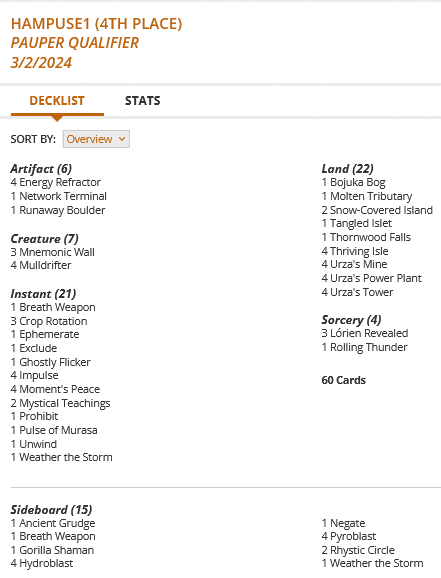
In a real blast from the past, Flicker Tron had a fantastic qualifier. Two Tron pilots made the Top 8 and one more finished in the Top 32. That was every Tron deck in the field. A 100% conversion rate to Top 32 is impressive especially given the variety in the field. Tron is a deck that wants to reach its end-game quickly because few decks can match Tron’s late-game power. To get these these decks both ran a full four copies of Moment’s Peace main in addition to two copies of Mystical Teachings to find them. This says nothing of the four Impulse to dig for Peace and Weather the Storm as another angle of defense. Finally Rhystic Circle shows up in the sideboard as yet another way to negate attacks on the life total. Tron came to win the game of survival. At the end of the day, though, the deck can still get run over by red if the aggro deck has a quick draw.

The last weekend in Pauper showcased the diversity in the format but also how dynamic it can be. While Kuldotha Red was still near the top of the heap Glitter Affinity, a deck which was firmly in the middle of the pack a week ago, rose to the top. Dimir Terror made its presence felt while Black Gardens took a step back. And this is to say nothing of Flicker Tron rising up from the ashes. CawGate and Dimir Faeries also showed up and performed well while Bogles, Boros Synth, Izzet Control, and Squirrel Dredge loudly proclaimed they were there too. At the end of the day next week you have to be prepared for aggressive strategies but I would also try to find a way to pinch off Ephemerate loops. Flicker Tron is not going to go quietly and coming prepared to win a slog seems like a worthwhile endeavor.

I want to take a moment to thank all my Patrons – both old and new. I am going to do my level best to keep providing you with the kind of content that brought you here in the first place. If you are interested in supporting my work, rewards for my Patreon start at just $1 and every little bit helps.

Can’t make a commitment to Patreon? I now have a Ko-Fi where you can make a one time contribution.

Looking for another way to support my work? Click here for my TCGPlayer affiliate link. Any purchases through the link let the folks there know you like my content!
February 24-25 Pauper Weekend Recap

Want to learn more about the metrics I use in tracking the metagame? You can find an explainer here.

Some may find the image that comes next a bit uncomfortable. Don’t say I didn’t warn you.

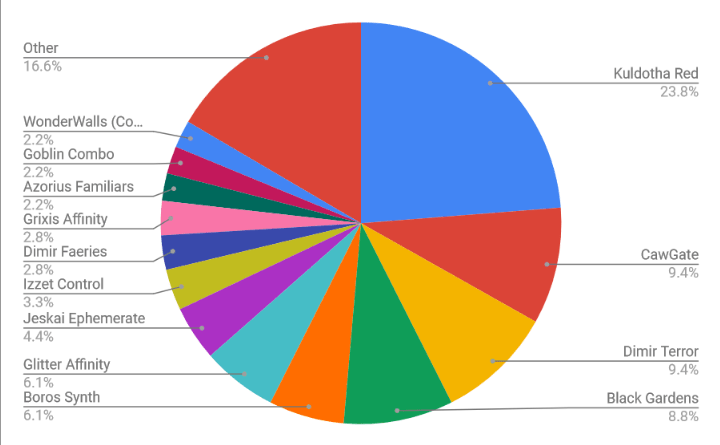
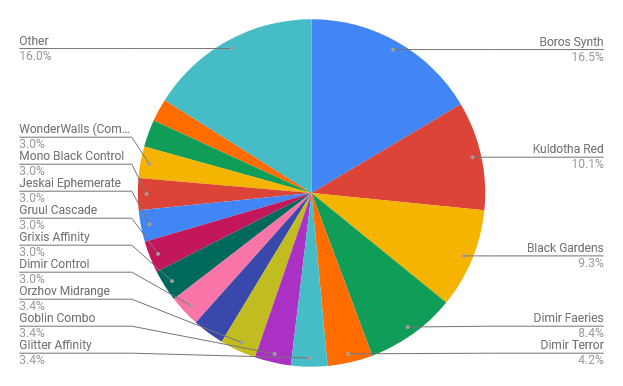
This chart represents the overall Challenge metagame for the weekend of February 24-25. Out of 181 decks that entered one of the three challenges, 43 were Kuldotha Red. On the surface this does not look great but as we dive deeper into the numbers things are not looking quite as dire. As long as Magic Online has been around, low to the ground assertive decks have been somewhat over-represented in tournaments due in part to their low access barrier but also how quickly than can finish games. Considering that the new Sunday structure does encourage double-queuing (that is entering two tournaments at once), the return on investment for Kuldotha Red (both in entry fee, time spent playing, and cognitive load) has the potential to be far greater than other, potentially better, deck choices.

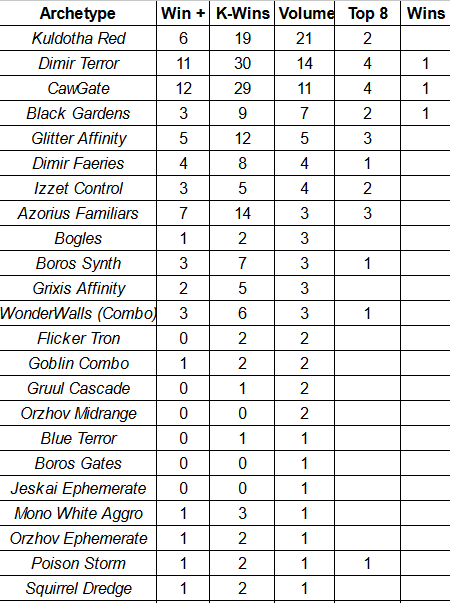
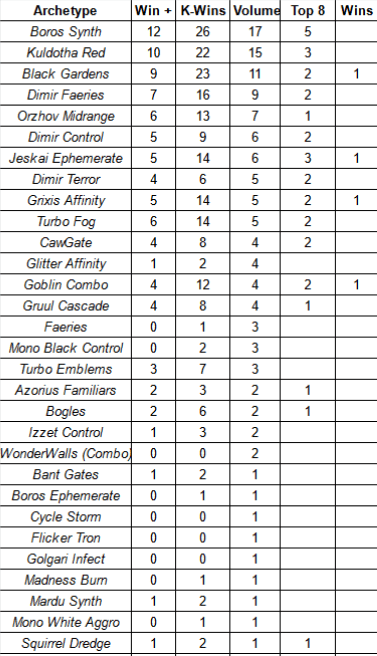
What do I mean by this? Well, Kuldotha Red held largely true to its overall presence in the Challenges by clocking in at 21.88% of the Top 32 metagame. Given this the two Top 8 finishes are also largely in line with what could be expected. Yet when it comes to winner’s metagame share Kuldotha Red tanked hard, down to 14.30% which is only good enough for third best on the weekend. When looking at Adjusted Meta Score Above Replacement Kuldotha Red came away with a paltry 0.13 – fifth best on the weekend. Over the weekend Kuldotha Red had an average adjusted Win+ ratio of 0.29, which tells the story of a deck that can make Top 16 but trends to be just on the outside. It also pulled in a 0.9 adjusted K-Win ratio, which paints a similar picture.

Decks are adjusting to the new speed of Kuldotha Red and are built to handle it, either through maindeck or sideboard options. At the same time the inherent strength of the archetype means that sometimes it will just get there. In other words it continues to be one of the defining pillars of the Pauper metagame but is a far cry from the dominant force it was prior to the Monastery Swiftspear ban.

As for which deck had the best weekend overall it’s a tossup between CawGate and Dimir Terror. CawGate had the better aMSAR with 1.83 compared to Dimir Terror’s 1.49, but Terror came out ahead in winner’s metagame, taking down 16.71% while CawGate finished with 15.98% of the winner’s share. Trying to figure out which of these strategies was the best on the weekend is really going to come down to splitting hairs but if I had pick one it would be CawGate, which improved more on its Top 32 metagame share when contrasted to the winner’s meta.

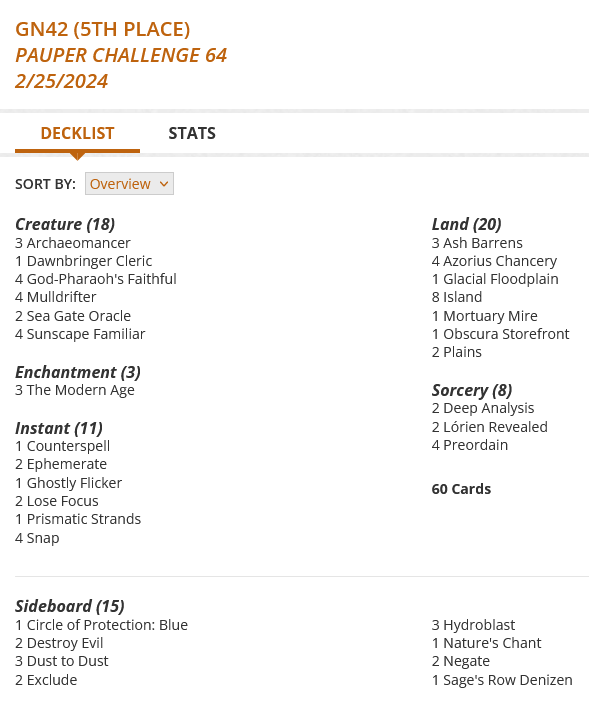
3 Archaeomancer
3 Ash Barrens
4 Azorius Chancery
1 Counterspell
1 Dawnbringer Cleric
2 Deep Analysis
2 Ephemerate
1 Ghostly Flicker
1 Glacial Floodplain
4 God-Pharaoh's Faithful
8 Island
2 Lórien Revealed
2 Lose Focus
1 Mortuary Mire
4 Mulldrifter
1 Obscura Storefront
2 Plains
4 Preordain
1 Prismatic Strands
2 Sea Gate Oracle
4 Snap
4 Sunscape Familiar
3 The Modern Age

Sideboard
1 Circle of Protection: Blue
2 Destroy Evil
3 Dust to Dust
2 Exclude
3 Hydroblast
1 Nature's Chant
2 Negate
1 Sage's Row Denizen

Azorius Familiars also had a fantastic weekend (the above list went 7-0 in the Sunday Challenge before falling in the Top 8). The strategy was only 2.21% of the overall Challenge metagame but jumped to 3.13% of the Top 32 meta. It more than doubled this with a 7.53% share of the winner’s metagame and an aMSAR score of 1.42. There were four Azorius Familiars pilots all weekend and three of them made Top 8. The deck has also been on a tear in tabletop play and has consistently been one of the secret best decks in Pauper. It runs some of the most powerful cards in the format, has a hard to disrupt engine, and a lock down endgame. So what keeps it down?

First is the Magic Online interface. The deck is based on looping Ephemerate to turn the graveyard into a toolbox via Archaeomancer but this takes time and clicks. In paper play you can just announce and reveal the cards but digitally it requires clicks and yields and can put a strain on the clock, as well as your machine. The deck also has a reputation as difficult to pilot but much of this has to deal with the practice needed to click through correctly and not time yourself out. Having played against this deck (and its ancestors) quite a bit over the years I can say from experience that it is not only powerful, but can catch unprepared opponents without a real shot in the game. It is powerful, resilient, and attacks from enough angles that if it goes untargeted it can run roughshod.

Let’s focus on this for a moment. Kuldotha Red was 23.76% of the Challenge metagame while Azorius Familiars was 2.21%. Kuldotha Red was 21.88% of the Top 32 metagame; Familiars was 3.13%. In no world does it make sense to over-prepare for Familiars when other decks are as popular as they are. The kind of hate needed to keep Familiars down – graveyard exile, exile based removal, and mana denial – are not necessarily good against rest of the format (outside graveyard hate). Familiars thrives in part because it can sidestep the metagame in a way the core players cannot. Yet if you wanted to build a deck that beat Familiars you absolutely could, without giving up too much against non-aggressive builds.

And therein lies the rub. When beatdown is as popular as Kuldotha Red is now Familiars can step in and sweep up accolades. The same is true for any deck that has clear weaknesses – when other players have to simply survive this engine based builds can thrive. If Familiars were to ever get as popular as other options it is reasonable that specific interaction would rise up, either in maindecks or sideboards, to constrain the threat. For now it remains a good choice in a field of people simply trying to get out of burn range.

There are a few other things that stood out last weekend, namely the lack of Jeskai Glitters. While Glitter Affinity had a solid showing the splash-red version of the deck was nowhere to be found in the winner’s metagame. I don’t expect this to hold true moving forward but it is interesting to note. The sharp decline in Jesaki Ephemerate decks, after last weekend’s strong performance, also caught my eye but that might be related to people trying to replicate success without adjusting their builds.

Moving into next weekend I would focus on picking the right removal for the job. Dimir Terror and CawGate are not going anywhere so packing the right answers to these, while not giving up ground to little red creatures, is going to be a key to success. Given the way things are working out it would not shock me at all to see Mono-White Aggro sidestep removal entirely and crash in for victory on the back of some copies of Guardians’ Pledge.

I want to take a moment to thank all my Patrons – both old and new. I am going to do my level best to keep providing you with the kind of content that brought you here in the first place. If you are interested in supporting my work, rewards for my Patreon start at just $1 and every little bit helps.

Can’t make a commitment to Patreon? I now have a Ko-Fi where you can make a one time contribution.

Looking for another way to support my work? Click here for my TCGPlayer affiliate link. Any purchases through the link let the folks there know you like my content!

February 17-18 Pauper Weekend Recap

I use a few different metrics when looking at the Top 32 metagame. The first is just Raw Volume. The second is Win+, which takes the sum of all wins at X-2 or better in the Swiss and assigns a score; Win+ is helpful in measuring a deck’s Swiss round performance. K-Wins takes all of a deck’s wins and subtracts its losses, Top 8 inclusive; this helps to give a measure of overall performance. The final pair is call Meta Score and Meta Score Above Replacement, which takes the average of Win+ and K-Win to try and position an archetype against its field. This number helps to provide the most robust image of a deck’s performance.

Okay right off the bat the title here is misleading as today’s post is going to be covering the first two weeks of Murders at Karlov Manor season. The weekend of February 10-11 saw an issue with Magic Online that completely borked the Sunday Challenges and as a result we didn’t get the, well, results. One event is not a lot to go on so I put off last week’s recap in favor of doing a more in depth one today. So today’s post is going to be look at the four of the first six Challenges of the recent season, taking into account 230 entrants. Let’s take a look at the overall metagame.

On first glance this looks like the kind of metagame that could make a somewhat prominent Pauper writer eat their words. Kuldotha Red was the most played deck over the first four recorded tournaments this season, coming it at over 18% of the overall metagame. And if that was the entire story I would be getting the ketchup ready. But the numbers don’t hold true – there’s a small drop in Kuldotha Red’s prevalence to 17.19% of the Top 32 metagame. The dip is even more stark in the winner’s metagame – a weighted measure that takes performance into account. There the number clocks in at a more reasonable 14.3%.

Taken together what we have is a deck that is popular and good, but also one that as the field narrows starts to see its performance drop relative to its popularity. There are a few other confounding factors to consider. First, we are in the early part of a release cycle where the highest impact new card skews aggressive, which means control decks are still in the process of adjusting. Second, Kuldotha Red is the clear best execution of a Red Deck in Pauper at the moment. For other strategies, whether it is the Initiative or seeks to leverage All That Glitters or Skred or Tolarian Terror all have multiple options. While there may be a clear best build of these strategies from week to week, Kuldotha Red will consistently at the top of its class. The result is red simply gets to accrue statistics over the course of a season. Again none of this is to say the deck is bad, just that it might not be as good as the raw numbers indicate.

This then begs the question of what decks are doing well? Black Gardens is outperforming its presence. At 8.7% of the overall metagame it actually takes a dip to 8.59% of the Top 32 metagame but jumps up appreciably to 10.47% of the weighted metagame. Over the four recorded events Black Gardens earned an adjusted Meta Score Above replacement of 0.7, beating out Kuldotha Red’s 0.53. But what was really surprising is that Black Gardens was the third best deck over the first weeks of the season.

1 Bojuka Bog
3 Chromatic Star
1 Dark-Dweller Oracle
4 Deadly Dispute
4 Drossforge Bridge
1 Duress
1 Faithless Looting
3 Fanatical Offering
4 First Day of Class
4 Goblin Matron
3 Great Furnace
4 Ichor Wellspring
1 Krark-Clan Shaman
1 Makeshift Munitions
2 Mesmeric Fiend
4 Mountain
4 Putrid Goblin
2 Rakdos Carnarium
4 Skirk Prospector
2 Swamp
4 Unearth
3 Vault of Whispers

Sideboard
2 Breath Weapon
2 Cast Down
2 Gorilla Shaman
2 Introduction to Prophecy
1 Mesmeric Fiend
4 Red Elemental Blast
2 Smash to Dust

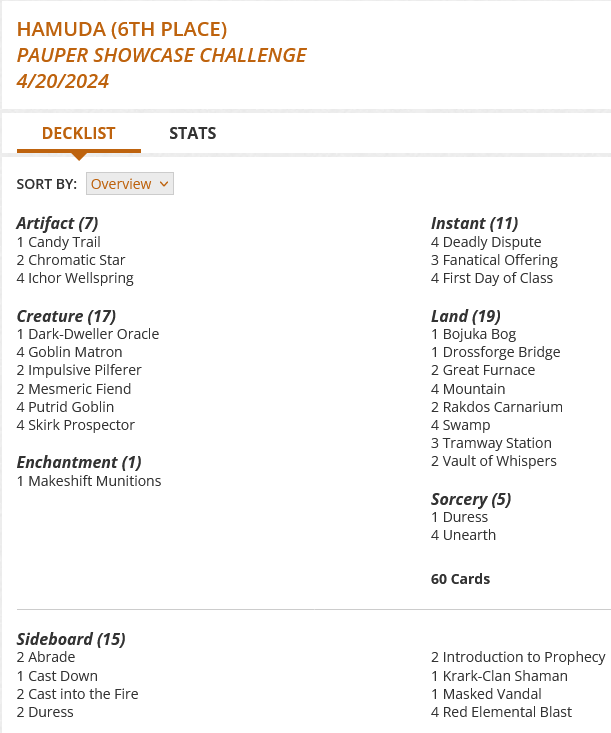
Let’s start with the second best performing deck on the weekend – Goblin Combo. Goblin Combo is a persist combo deck that uses Skirk Prospector, Putrid Goblin, and First Day of Class to generate an unbound amount of mana. Once this is achieved the deck can then convert that mana into pings with Makeshift Munitions to win the game. All of this is stitched together with Goblin Matron and Dark-Dweller Oracle, with Oracle allowing you effectively draw your entire deck. Recently the deck has also adopted Mesmeric Fiend as a piece of maindeck disruption.

Goblin Combo has been around for quite some time but has never really taken off. This may be do to the number of clicks required to accomplish the combo on Magic Online, which can be onerous as you are not able to “demonstrate a loop” in the client. The deck also relies heavily on the graveyard and as such is vulnerable to all the regular hate that crops up. That being said the deck has the ability to deal as much damage as it needs to in order to win the game and unlike other combo decks in the format can win on the opponent’s turn (given the correct set of circumstances).

Over the tracked challenges, Goblin Combo earned an aMSAR score of 0.86. It accounted for 3.5% of the overall metagame and 5.88% of the Top 32 metagame, dipping down to 5.57% of the winner’s metagame. With the abundance of aggressive decks, control builds are skewing towards removal but Goblin Combo comes packed with enough resilience and redundancy to survive until it can turn the corner.

2 Archaeomancer
1 Ash Barrens
4 Augur of Bolas
4 Brainstorm
1 Breath Weapon
1 Cast into the Fire
4 Cleansing Wildfire
4 Counterspell
1 Dawnbringer Cleric
1 Destroy Evil
2 Ephemerate
1 Glacial Floodplain
3 Lightning Bolt
4 Lórien Revealed
4 Mulldrifter
1 Murmuring Mystic
1 Preordain
4 Rustvale Bridge
4 Silverbluff Bridge
2 Skred
6 Snow-Covered Island
2 Snow-Covered Mountain
1 Snow-Covered Plains
1 Union of the Third Path
1 Volatile Fjord

Sideboard
4 Blue Elemental Blast
1 Breath Weapon
1 Destroy Evil
1 Dispel
1 Murmuring Mystic
4 Red Elemental Blast
2 Revoke Existence
1 Tormod's Crypt

Jeskai Ephemerate has been the best performing deck thus far this season with aMSAR score of 0.94. The strategy is 5.2% of the overall Challenge meta, 6.25% of the Top 32 metagame, and then takes a leap up to 9.92% of the winner’s metagame. Jeskai Ephemerate is making a play for the premier control deck in the format currently due in no small part to its tool box nature.

Based around the ArchaeomancerEphemerate engine, the goal of this deck is to see as many cards as possible and find the correct ones for a given situation. Mana hungry, Jeskai Ephemerate uses Cleansing Wildfire to accelerate while also seeing more cards. The addition of Murmuring Mystic to the format has provided a consistent win condition that can close out games quickly when needed while also absorbing damage from decks looking to turn sideways.

Part of the strength of Jeskai Ephemerate is in its flexibility. It can adjust its maindeck composition for an expected metagame, meaning the opponent can never be certain what is in store for them. Like Goblin Combo these builds are somewhat vulnerable to graveyard hate but at the same time they can just play a normal control game and sidestep Relic of Progenitus. The result is a deck that has the capability for just about anything, including falling on its face if it brings the wrong answers to the table.

The story of Murders at Karlov Manor season thus far looks to be one of folks preparing for aggression. Despite the popularity of beatdown strategies, the best performing decks to this point have been those designed to not only handle aggro but also have a plan to get around defenses. Whether it be through Trap, Munitions, or a never ending stream of Bird tokens, Pauper is not just about beating creatures on the board but figuring out a way around some well laid defenses.

Looking ahead I would be in the market for making Pestilence or Crypt Rats work. Provided such a deck could survive the early onslaught of red, these cards do a good job of keeping the board clear. Pestilence can also put in work, keeping Goblin Combo from going off and mitigating the damage from Murmuring Mystic. The issue with these decks, as always, is surviving to that point and then turning the corner. It is possible that a Basilisk GateGuardian of the Guildpact build could put in the work but then you are relying on multiple four drops to get things done, which does seem like a fairly large ask these days. Still, figuring out how to spread the sickness seems like a path worth pursuing for the upcoming Challenges.

I want to take a moment to thank all my Patrons – both old and new. I am going to do my level best to keep providing you with the kind of content that brought you here in the first place. If you are interested in supporting my work, rewards for my Patreon start at just $1 and every little bit helps.

Can’t make a commitment to Patreon? I now have a Ko-Fi where you can make a one time contribution.

Looking for another way to support my work? Click here for my TCGPlayer affiliate link. Any purchases through the link let the folks there know you like my content!

February 3-4 Pauper Weekend Recap

I use a few different metrics when looking at the Top 32 metagame. The first is just Raw Volume. The second is Win+, which takes the sum of all wins at X-2 or better in the Swiss and assigns a score; Win+ is helpful in measuring a deck’s Swiss round performance. K-Wins takes all of a deck’s wins and subtracts its losses, Top 8 inclusive; this helps to give a measure of overall performance. The final pair is call Meta Score and Meta Score Above Replacement, which takes the average of Win+ and K-Win to try and position an archetype against its field. This number helps to provide the most robust image of a deck’s performance.

Lost Caverns of Ixalan season is over. My breakdown of the post-ban metagame will be coming later this week but for now we’ll have to take a look at the three (yes, three) Challenges that took place last weekend. You see, Daybreak has decided to offer a “second chance” event every weekend in case some tournaments fail to fire. However these tournaments will be offered no matter what. For Pauper this is a second even on Sunday which this past weekend fired with over 40 participants. And, well, let’s look at the metagame chart.

Now to be clear Kuldotha Red’s share of the overall metagame is the largest all season – the deck had traditionally hovered closer to 10% of the overall Challenge meta which is more in line with a top tier archetype. Looking at this charge we can also see a skew towards more assertive strategies, including Kuldotha Red, Jeskai Glitters, and Squirrel Dredge. So maybe it’s time to talk about something unrelated to a deck’s power level: temporal considerations.

If my brain were firing on all cylinders as I wrote this I would likely be making a joke about the nebulous concept of tempo in Magic but not today. Rather I want to talk about how sometimes people will pick a deck because of how quickly it can finish games. Red decks have traditionally been over-represented on Magic Online in part because they can finish games quickly, win or lose (they also tend to have a low acquisition barrier) and can open up time for other activities – whether that be personal privilege, grabbing a beverage, or queuing up another event. Do I think the spike in Kuldotha Red and Squirrel Dredge over the past weekend is due in part to people trying to speed run these events?

In part.

At the same time they would not be selecting these decks if the strategies did not, in some way, work. No one is going to register a pile of cards that simply fails function. The question then becomes how should this be handled at a format level?

That’s right, it’s time for everyone’s favorite linguistic exercise! What comes next is simply a discussion of higher level points and should not be taken as anything related to my work on the Pauper Format Panel or the thoughts of other members. The words that follow are simply observations.

In my opinion accessibility of a deck and the speed at which it finishes games should not factor into decisions around format health unless it finishes games so quickly as to block out other strategies. Now we saw this with previous iterations of both Affinity and Kuldotha Red before those decks had cards removed from their builds. Currently the aggressive builds of Red and Affinity can apply pressure but in my estimation they do not do so at a problematic clip at this time. People are allowed to value their time differently and make decisions as to what they want to play based on any number of factors. If folks decide that going aggro and taking hours of their life back is worth it, even if the strategy is technically worse than other options that is their choice to make. Interventions should take place when decks are both over the line in power, speed, and other factors.

So what about next week? Given how Lost Caverns of Ixalan season ended I would be prepared to bear the brunt of assaults. Red and Affinity remain top contenders and assertive gameplans tend to do better early in format cycles. I know it’s a meme at this point but if you want to gain an early edge it might be time to hedge on early blockers, since now the format has access to eight copies of one of the best to ever do it.

I want to take a moment to thank all my Patrons – both old and new. I am going to do my level best to keep providing you with the kind of content that brought you here in the first place. If you are interested in supporting my work, rewards for my Patreon start at just $1 and every little bit helps.

Can’t make a commitment to Patreon? I now have a Ko-Fi where you can make a one time contribution.

Looking for another way to support my work? Click here for my TCGPlayer affiliate link. Any purchases through the link let the folks there know you like my content!

Four More Weeks of Lost Caverns of Ixalan

I use a few different metrics when looking at the Top 32 metagame. The first is just Raw Volume. The second is Win+, which takes the sum of all wins at X-2 or better in the Swiss and assigns a score; Win+ is helpful in measuring a deck’s Swiss round performance. K-Wins takes all of a deck’s wins and subtracts its losses, Top 8 inclusive; this helps to give a measure of overall performance. The final pair is call Meta Score and Meta Score Above Replacement, which takes the average of Win+ and K-Win to try and position an archetype against its field. This number helps to provide the most robust image of a deck’s performance.

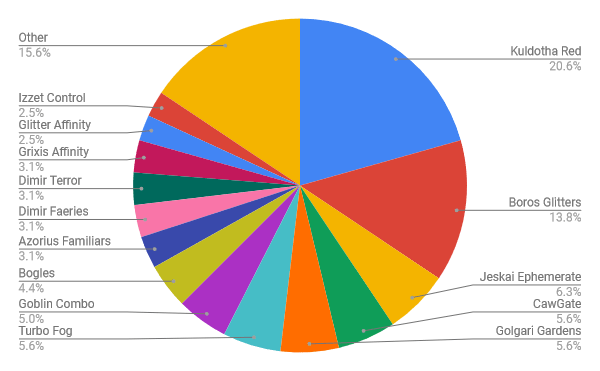
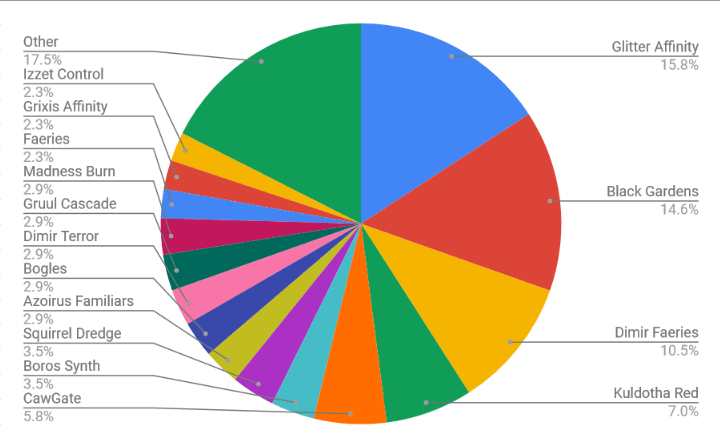
We are rapidly approaching the end of Lost Caverns of Ixalan season. Before we travel back to Ravnica for Murders at Karlov Manor there will be over two months of data to examine from the current state of the format. Given that the next set does not look to have the potential to upset the apple cart this information could prove helpful in understanding how to prepare for the weeks ahead. But that must wait for the next series of Challenges to conclude. For today we are going to be looking at the Pauper Challenge metagame for the weekends between January 6-7 and January 27-28. In that span there were 500 players who entered one of the Magic Online Challenges. The chart below tells us how their deck choices broke down (with a 2% the threshold for making cut):

Now to be clear this also includes players who signed up for the tournament but did not play a match, which is a thing you can do apparently. So let’s get one thing out of the way: Galvanic Blast is the defining removal spell in Pauper. This should not be a shock to anyone who has been following Pauper for the past year or so, but it is still interesting to see it presented in such a stark manner. The top two decks, which make up almost a fifth of the Challenge field, both lean on the Scars of Mirrodin burn spell which does a fine job of clearing a path or ending the game. If you add in Grixis Affinity and Boros Synthesizer over a quarter of the Challenge metagame are Galvanic Blast decks.

We see this reflected in the other successful strategies. Black Gardens leans into the Initiative as a way to grow Avenging Hunter out of range while Dimir Faeries presents either too many threats or a 5/5 with Ward 2 as their closer. CawGate has the opportunity to lean on Guardian of the Guildpact to reduce the impact of Blast.

What does this all mean? The prevalence of Galvanic Blast puts significant limits on what kind of creatures can see play. Barring a behind that earns the Sir Mix-a-Lot stamp of approval, creatures need to come with enough value to warrant then dying almost instantly. Alternatively if you can present enough redundant pieces (think Elves or WonderWalls) then it is possible to sidestep the point removal.

But how does this match up to the winner’s metagame?

This chart represents the breakdown of each deck in the Top 32 is it relates to Winner’s Meta Share. Each deck is assigned a score based upon their collective overall performance and collective Swiss performance and this chart displays their share of this value. Kuldotha Red remains the most popular deck in the winner’s meta share but Black Gardens and CawGate overtake Jeskai Glitters. These decks can still “just lose” to the best red draws (as do most decks) but it also appears that there’s enough hate for artifacts that can help keep Affinity down. Make no mistake that Affinity is still a major player in the format but the weight of interaction may be having an impact.

Still, the winner’s meta looks to be largely in line with the format at large. There is something reassuring about this in the sense that what you see in the Challenges at large is representative of what is doing well, proportionally. While some league results have skewed towards red (possibly a byproduct of being in the last weeks of a set release cycle, possibly a result of the deck potentially being a little better than the other options), the Challenge meta overall looks reasonable for a non-rotating format.

How does this shake out when it comes to adjusting for presence? Taking into account Top 32 meta percent as well as Swiss and overall performance, the best deck over the past four weeks was Black Gardens with an Adjusted Meta Score Above Replacement of 1.67. This score shows how decks perform against other archetypes, with the average score over the past month coming in at 0.42, so Black Gardens performed that much better than an average deck. Grixis Affinity is next in line with a score of 1.02 with Kuldotha Red coming in third at 0.94. Beyond that CawGate (0.73) and Dimir Terror (0.70) round out the Top 5 archetypes based on aMSAR. It should be noted that four of these five decks are either midrange or control builds.

Taken together the format is defined in many ways by aggressive strategies with reach. The ability to close out games with Galvanic Blast is an animating force in the format. At the same time many top decks have adjusted to be able to handle this line of play to the point where many top performing decks opt for a reactive approach to games and are not just trying to get you dead quickly. Moving into the final week of Lost Caverns of Ixalan and the early days of Murders at Karlov Manor there appears to be a lane where players can get an edge – finding an aggressive deck that goes slightly slower than Red and Glitters while having enough pressure to get in under the controlling decks could prove fruitful.

I want to take a moment to thank all my Patrons – both old and new. I am going to do my level best to keep providing you with the kind of content that brought you here in the first place. If you are interested in supporting my work, rewards for my Patreon start at just $1 and every little bit helps.

Can’t make a commitment to Patreon? I now have a Ko-Fi where you can make a one time contribution.

Looking for another way to support my work? Click here for my TCGPlayer affiliate link. Any purchases through the link let the folks there know you like my content!

January 20-21 Pauper Weekend Recap

I use a few different metrics when looking at the Top 32 metagame. The first is just Raw Volume. The second is Win+, which takes the sum of all wins at X-2 or better in the Swiss and assigns a score; Win+ is helpful in measuring a deck’s Swiss round performance. K-Wins takes all of a deck’s wins and subtracts its losses, Top 8 inclusive; this helps to give a measure of overall performance. The final pair is call Meta Score and Meta Score Above Replacement, which takes the average of Win+ and K-Win to try and position an archetype against its field. This number helps to provide the most robust image of a deck’s performance.

As excited as I am for Murders at Karlov Manor, those cards have not been released yet. Put another way, we are still working our way through Lost Caverns of Ixalan season. What’s changed since last week? The January 20 and January 21 Challenges saw Dimir Faeries supplant Kuldotha Red as the most popular choice for the Challenges and also featured a notable decline in the raw volume of Black Gardens and Jeskai Glitters. This weekend also saw a rebound in the number of people playing in the tournaments so there were no negative records in our Top 32 results. Consequentially what we see coming out of last weekend could be seen as helping to clarify the format instead of muddying the waters.

Dimir decks proved themselves last weekend. Clocking in at just under 12% of the total meta last weekend, they were responsible for nearly a quarter of all lists run in the Challenges just a few days ago. While the three builds – Control, Faeries, and Tempo – share some cards and have endgames that bear more than a passing resemblance but are nonetheless distinct. All of these decks leverage countermagic and removal to great efficacy, trading one for one against decks that are trying to present threats while having outs to simply have more cards than other slower decks.

So then why then am I talking about Orzhov Midrange?

3 Ancient Den
2 Bojuka Bog
1 Candy Trail
1 Cast Down
1 Dawnbringer Cleric
4 Deadly Dispute
4 Glint Hawk
4 Hopeless Nightmare
3 Ichor Wellspring
4 Kor Skyfisher
2 Lembas
3 Obscura Storefront
2 Omen of the Dead
3 Orzhov Basilica
3 Plains
1 Prismatic Strands
1 Snowfield Sinkhole
2 Snuff Out
1 Suffocating Fumes
3 Swamp
2 Thorn of the Black Rose
4 Thraben Inspector
4 Tithing Blade
1 Troll of Khazad-dûm
1 Vault of Whispers

Sideboard
1 Arashin Cleric
1 Arms of Hadar
1 Cast Down
1 Dawnbringer Cleric
4 Duress
4 Dust to Dust
3 Relic of Progenitus

Czacza went undefeated on Sunday until losing in the finals for a total record of 9-1. Orzhov decks have had an up and down season thus far as they are largely contingent on having the right mix of supplemental threats and answers in order to find their metagame lane. This build is loaded with ways to draw cards in its artifacts but it also has a way to grind down an opponent’s resources in Hopeless Nightmare. White decks are quite adept at rebuying permanents and Nightmare not only pressures cards in hand but also can chip in for damage. Unlike Raven’s Crime Hopeless Nightmare does not cost you a card so any subsequent discards put you ahead instead of at parity. While the above deck does have some inevitability with Omen of the Dead I would like to see another way to turn the corner, especially given the closing speed of other decks in the format.

Orzhov Midrange was not a popular choice on the weekend and so the 1.86 adjusted Meta Score Above Replacement needs to be taken with a healthy dose of salt. Out of the decks with more Top 32 representation Dimir Control led the way with a aMSAR score of 1.4. Jeskai Glitters had the second best score out of the popular decks with a 0.57 aMSAR.

All of this is to say that Pauper continues to exist much as how it has in the wake of the recent ban. Things are largely balanced. Next week is my cyclical eight challenge check in and in the past six events no one archetype has topped 10% of Top 32 volume or winner’s meta volume – instead there are plenty of decks right around the 7% and 8% mark for winner’s meta volume. In that same six event span no deck has topped 10% of total volume. Now this is a relatively small sample size of events, and it will be interesting to see how the post-ban season shakes out, but for now Pauper is looking to be balanced. But that’s only half the equation so I want to know – are you finding the format fun?

I want to take a moment to thank all my Patrons – both old and new. I am going to do my level best to keep providing you with the kind of content that brought you here in the first place. If you are interested in supporting my work, rewards for my Patreon start at just $1 and every little bit helps.

Can’t make a commitment to Patreon? I now have a Ko-Fi where you can make a one time contribution.

Looking for another way to support my work? Click here for my TCGPlayer affiliate link. Any purchases through the link let the folks there know you like my content!

January 13-14 Pauper Weekend Recap

I use a few different metrics when looking at the Top 32 metagame. The first is just Raw Volume. The second is Win+, which takes the sum of all wins at X-2 or better in the Swiss and assigns a score; Win+ is helpful in measuring a deck’s Swiss round performance. K-Wins takes all of a deck’s wins and subtracts its losses, Top 8 inclusive; this helps to give a measure of overall performance. The final pair is call Meta Score and Meta Score Above Replacement, which takes the average of Win+ and K-Win to try and position an archetype against its field. This number helps to provide the most robust image of a deck’s performance.

The January 13 and January 14 Challenges provide us with some confounding data. Leading up to the weekend Magic Online was experiencing a significant outage and it is possible that it impacted participation in the Saturday Challenge (40 entrants, 39 participants). The result was a six round event where several 2-4 records made the Top 32. While it is not uncommon to see one or two such records make this threshold, seven such players achieved this feat on Saturday. As a result the data set is pulling from multiple records with a negative score in both Win+ and K-Win. Even if this does muddy the waters a bit it still provides the opportunity for insight. First let’s look at the archetypes as broken down by total entrants.

The top of the metagame, at least as far as people perceive it, remains similar. Kuldotha Red and Jeskai Glitters both apply significant pressure to opposing life totals with low to the ground threats, backing them up with Galvanic Blast. It is not just about the board presence with these decks but also their ability to chew up huge chunks of health of a minuscule mana investment. Black Gardens takes on the role CawGate assumed last week as playing foil to the assertive strategies. We are seeing a format that currently revolves around Galvanic Blast and its ability to not only close out games but also pick off a significant majority of threats that can be presented. If you travel down the popularity chart you will see plenty of decks that have a plethora of tasty targets for the Scars of Mirrodin standout.

And today I want to focus on one of them: Elves.

4 Birchlore Rangers
3 Distant Melody
3 Elvish Mystic
3 Elvish Vanguard
13 Forest
2 Fyndhorn Elves
4 Jaspera Sentinel
4 Lead the Stampede
1 Llanowar Elves
2 Lys Alana Huntmaster
1 Masked Vandal
2 Nettle Sentinel
4 Priest of Titania
4 Quirion Ranger
1 Spell Pierce
4 Timberwatch Elf
1 Wellwisher
4 Winding Way

Sideboard
3 Gleeful Sabotage
1 Gorilla Shaman
2 Hydroblast
2 Masked Vandal
1 Negate
2 Sandstorm
1 Scattershot Archer
1 Valakut Invoker
1 Viridian Longbow
1 Wellwisher

I am not going to sit here and tell you that I thought Elves would be a good choice going into last weekend, because the deck was barely on my radar. The abundance of good board wipes that have entered the format as of late have put a road block in front of the pointy eared horde. When it comes to creature based hypermana decks, Axebane Guardian is more resilient than Priest of Titania. Yet Elves put up two Top 8 finishes on Saturday, including a win. The big difference I see in these builds over the last time Elves was putting up solid numbers is the density of reload spells. Previous wisdom said that Elves could run two thirds of Distant Melody, Lead the Stampede, and Winding Way. The latest successful iterations throw that out the window and instead run 11 of 12 possible copies. This means some redundancy in actual bodies is lost but makes up for it in the potential to completely reload after a spate of removal or board wipes. With six total appearances over the weekend and three total Top 32 finishes, I wouldn’t say Elves is back on the map but it is certainly a deck worth watching moving forward.

When we look at the Top 32 data, the three decks that led the way from raw volume also did the same once they got past the cutoff. But when we look at the winner’s meta volume things look stark: Black Gardens tops the field at 14.99% with Kuldotha Red not far behind at 13.58%. Jeskai Glitters, hamstrung by several sub-500 finishes, only took down 1.86% of the winner’s metagame volume. I would not read too much into this low number as it is a byproduct of the small field on Saturday but it might indicate that sideboards are adjusting to the deck’s position in the meta. Elves, our featured deck of the day, came in with a healthy 11.43% of the winner’s meta. Looking at these decks through adjusted Meta Score Above replacement we get the following:

  • Elves: 1.68
  • Black Gardens: 1.58
  • Dimir Terror: 0.96
  • Kuldotha Red: 0.8
  • Grixis Affinity: 0.43

Jeskai Glitters had a aMSAR score of -0.62, meaning it performed worse than an average Top 32 deck.

For next week I would be keen on trying to make Sulfurous Blast work. This sweeper has the advantage of being able to hit three toughness creatures while also pressuring life totals. The recent spate of Red Tron decks might be able to find a home for this card and given the way the field looks this more assertive big mana deck could prove to be a strong meta call.

I want to take a moment to thank all my Patrons – both old and new. I am going to do my level best to keep providing you with the kind of content that brought you here in the first place. If you are interested in supporting my work, rewards for my Patreon start at just $1 and every little bit helps.

Can’t make a commitment to Patreon? I now have a Ko-Fi where you can make a one time contribution.

Looking for another way to support my work? Click here for my TCGPlayer affiliate link. Any purchases through the link let the folks there know you like my content!
January 6-7 Pauper Weekend Recap

I use a few different metrics when looking at the Top 32 metagame. The first is just Raw Volume. The second is Win+, which takes the sum of all wins at X-2 or better in the Swiss and assigns a score; Win+ is helpful in measuring a deck’s Swiss round performance. K-Wins takes all of a deck’s wins and subtracts its losses, Top 8 inclusive; this helps to give a measure of overall performance. The final pair is call Meta Score and Meta Score Above Replacement, which takes the average of Win+ and K-Win to try and position an archetype against its field. This number helps to provide the most robust image of a deck’s performance.

Let’s talk about Jeskai Glitters. After the first four weeks of the post-ban metagame the aggressive Affinity strategy, which takes the All That Glitters shell and trades stack interaction for Galvanic Blast, the subarchertype clocked in with 5.6% of the total challenge metagame and 6.81% of the winner’s metagame. Last weekend both the Saturday and Sunday Challenge fired and Jeskai Glitters was 12.3% of the overall metagame and 8.29% of the winner’s meta.

4 All That Glitters
4 Ancient Den
4 Ardent Recruit
4 Experimental Synthesizer
4 Frogmite
4 Galvanic Blast
4 Gingerbrute
4 Glint Hawk
4 Great Furnace
4 Myr Enforcer
2 Razortide Bridge
2 Reckless Impulse
2 Rustvale Bridge
1 Seat of the Synod
3 Silverbluff Bridge
4 Springleaf Drum
4 Thoughtcast
2 Wrenn's Resolve

Sideboard
4 Dispel
2 End the Festivities
4 Pyroblast
3 Seal of Fire
2 Tectonic Hazard

I’m not going to bury the lead – Jeskai Glitters did not have the best weekend. Looking at adjusted meta score above replacement it finished outside the Top 5 with an aMSAR of 0.50. Yet these decks are looking to set the pace of the metagame for the immediate future as they provide a quick clock that can win from nowhere. Unlike the threats Kuldotha Red, Jeskai Glitters has options that are resilient to the most commonly played sweepers in the format. The ability to “just win” cannot be understated and was enough to convince 16 players to pick the cards up for the weekend. Still the deck fell short. So what happened?

Despite the raw strength Jeskai Glitters, like many aggressive decks, have some serious shortcomings in Pauper. Looking at the raw volume chart above CawGate, Black Gardens, Dimir Faeries, Grixis Affinity, and Izzet Control can all be classified as control strategies in the metagame while Kuldotha Red and the Glitters variants occupy the assertive roles. The Terror variants are more mutable but tend to play towards a tempo game. All of this is to say that as strong as decks that play to the board can be there is power in keeping those threats off the board, either through removal, counters, or bounce. When 47.1% of the discrete metagame can take on the control role at a given time then the potential for answers to line up well with threats can make it difficult to get over the line for 20 damage.

The Top 32 metagame tells a similar story. While the beatdown decks are far from absent the top of the winner’s meta is stacked to the brim with interactive strategies. I have often said the best way to get ahead in Pauper is to have the correct removal for a given aggressive strategy but that means that picking the correct threats to dodge answers matters just as much. In Pauper that means selecting threats that have break points at 3 toughness (to dodge sweepers) and 4 toughness (to dodge Lightning Bolt). Jeskai Glitters has Myr Enforcer which checks all these boxes and can lean on other three toughness threats to round things out.

As for aMSAR, the week shook out with CawGate as the very best with an astonishing score of 3.4. Next up was Black Gardens with 1.11 followed closely by Izzet Contol with 1.1. Grixis Affinity is next up with 0.88 with Blue Terror rounding out the top 5 with 0.72. In other words, Jeskai Glitters might not have been the best deck on the weekend but people absolutely came prepared to defend their life total. Whether this was a result of Kuldotha Red remaining a top contender or chatter around the Jeskai deck running up to the Challenges, folks had their shields up and it paid off.

Looking ahead I would be hesitant to go too deep on Jeskai Affinity as I expect more copies of Cast into the Fire as a way to fight against the various low to the ground threats and high impact artifacts. No matter what I would want to find a way to get around CawGate while also not losing a step to the other beat down strategies.

I want to take a moment to thank all my Patrons – both old and new. I am going to do my level best to keep providing you with the kind of content that brought you here in the first place. If you are interested in supporting my work, rewards for my Patreon start at just $1 and every little bit helps.

Can’t make a commitment to Patreon? I now have a Ko-Fi where you can make a one time contribution.

Looking for another way to support my work? Click here for my TCGPlayer affiliate link. Any purchases through the link let the folks there know you like my content!