This post is a little late going up so my apologies for that. Last Wednesday I played a Hallar, the Firefletcher on Kendra’s Commander night.
If you’re interested, here’s the current list for the deck. I had wanted to play a deck based around The Ozolith but wanted to avoid my same old Golgari ways. I had also been enamored with the interaction of Keen Sense and Snake Umbra with creatures that could deal non-combat damage to opponents. Big Mike had also suggested looking at an uncommon Commander and wanted me to run Eutropia, the Twice Favored. Instead I focused on Hallar and built a red-green Spellslinger deck. And I was pleasantly surprised. The deck, despite having a relatively narrow card pool, was a blast to pilot. The ability to apply pressure with spells while not attacking is something I don’t really do often in Commander. There’s also the fact that slapping a Snake Umbra on to Hallar and turning the Archer into a repeatable Ancestral Recall is a ton of fun.
I am not sure what I would do moving forward with this deck. I would absolutely retool the manabase to be better – hello Fungal Reaches – but as noted by many in the game above the card pool is finite. That being said I am absolutely bringing this to another MTGO night at some point in the future.
On the heels of last weekend some speculated that Mono Black Control would be on the rise. Some others – myself included – felt that this would not be the case. Despite containing some powerful cards it just seems like Mono Black Control is never a perfectly positioned deck.
A win and five Top 8s later, it appears that I may have been mistaken.
I think it’s important to talk a little bit about regional differences in the Pauper metagame. One critique I have seen of my metagame analysis is that it is heavily biased in favor of events Americans can more easily attend and it is biased towardsevents held on Magic Online. I don’t dispute this in the slightest.
I tend to look at the Top 32 lists provided by Wizards of the Coast because it provides a cohesive data set. Not only do we see the Top 32 decks, we also see their match records. That last piece provides information on what decks can succeed in a Swiss style tournament when examined over a long enough time frame.
None of this is to say the results from major tournaments in Brazil or Italy do not matter because they most certainly do. The problem with examining them beyond lists provided is that it can be challenging to find match record information. Often times paper lists rely on individual naming conventions and I can attest that sometimes people get creative. Yes, Stompy might have a red card and a black card, but that doesn’t make it Jund Aggro.
Getting back to the main point, for years the Brazilian player base has been touting Mono Black Control as a powerful option. The Italian player base has repeatedly criticized the Sunday Challenge results for being too focused on one segment of the Pauper playing population. The addition of a Saturday Challenge has opened upthe Magic Online events to more time zones which can influence what decks show up.
There is another element at play here. Recently MTGGoldfish changed their metagame tracker to default to a seven day window. This has placed a greater emphasis on Player Run Events where Mono Black Control is popular. Combined with a good showing last weekend and we have an Information Cascade. Because Mono Black Control put up a result people will pick it up and for a short period of time its results might be inflated regardless of the actual strength of the deck.
None of this means Mono Black Control is bad. Rather it is a deck that can capitalize when other decks stumble. Most Pauper decks these days are built to operate on maximum consistency and suffer from persistent disruption. Mono Black Control can disrupt opposing draws with discard and Chittering Rats and can take advantage of missteps by chaining together copies of Gray Merchant of Asphodel. Because of this MBC will never truly die, but there are going to be days when it is better than others.
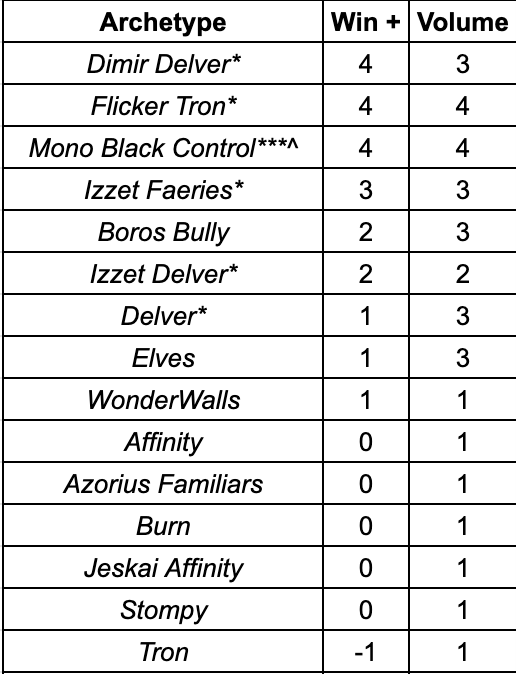
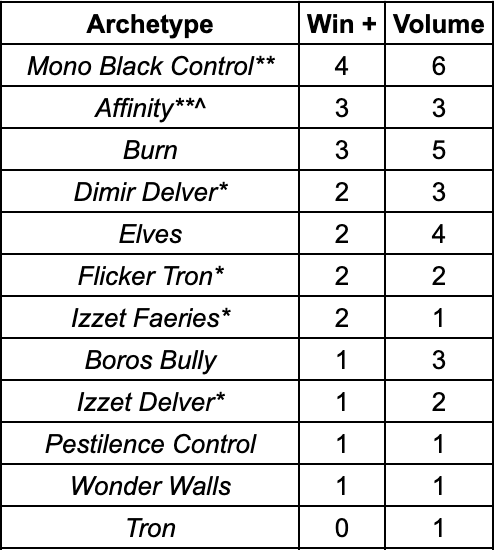
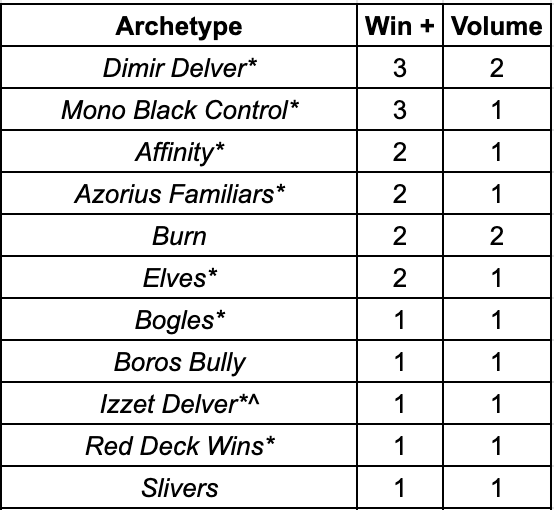
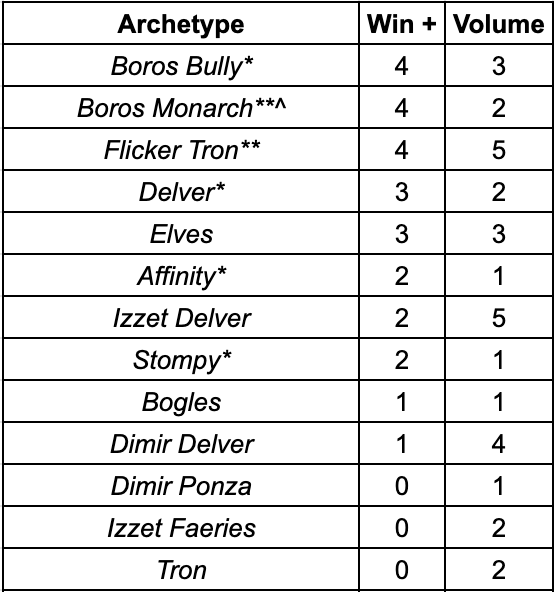
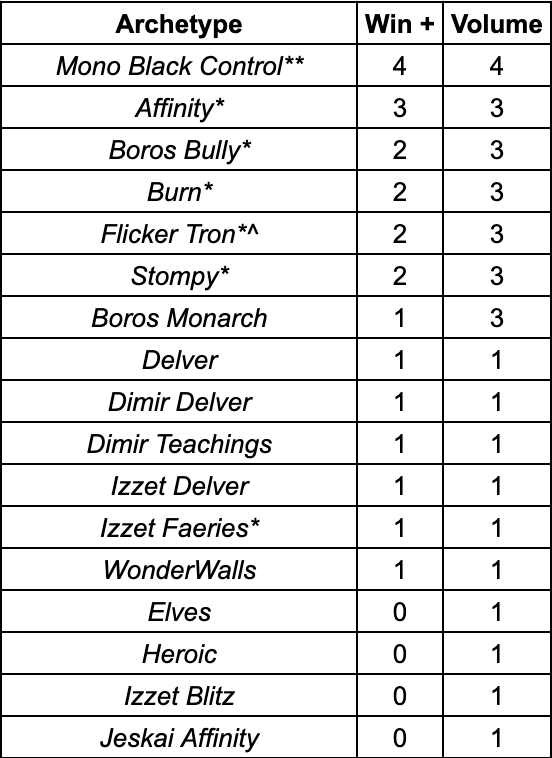
In the above charts, an asterisk indicates a Top 8 finish and the carat indicates a Challenge win. Win+ measures wins above an X-3 record and volume is the number of appearances in the Top 32.
Here is a breakdown of the first four weeks of Ikoria season,. This chart only takes into account decks that have comprised at least 2% of the winner’s metagame (5 appearances). Decks with a Top 8 appearance that do not make the cut: Izzet Blitz (2), Atog Shift, Bogles, Cycling Songs, Dimir Ponza
If you want to look at what the best decks are, you start at Flicker Tron – I don’t think there can be any question about it at this point. After that I have Affinity. Despite not being as popular as Boros Bully, Affinity has the second most wins this season and has the ability to attack a game from multiple angles. While I have Boros Bully as 3rd in my power rankings, I think that deck is overrated despite its popularity.
What decks do you think are currently underrated? Which ones are poised to make a run in the next four weeks? Let me know in the comments or on Twitter. And if you enjoy this content, please consider becoming a Patron.
I encountered this situation today in the Pauper League and in examining the game, this decision had a huge impact on how the game played out.
It is game three and you’re on the play. You are on BG Aristocrats and your opponent is on Flicker Tron. You won game one where your opponent went to four cards and you easily ran them over. In game two Tron did its thing and assembled a lock.
It’s now game three. Here is your deck:
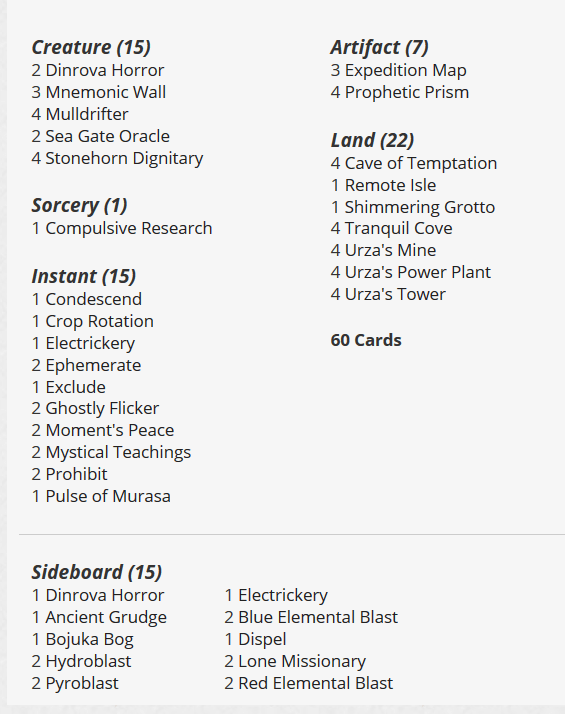
You have sided out the two Plagued Rusalka and two Nest Invader for three Mesmeric Fiend and a Falkenrath Noble. You assume your opponent is on this deck or a very similar list:
Your starting hand isn’t amazing but it includes Carrion Feeder and Loam Dryad – key cards to explosive starts. Your opponent has taken a mulligan to six.
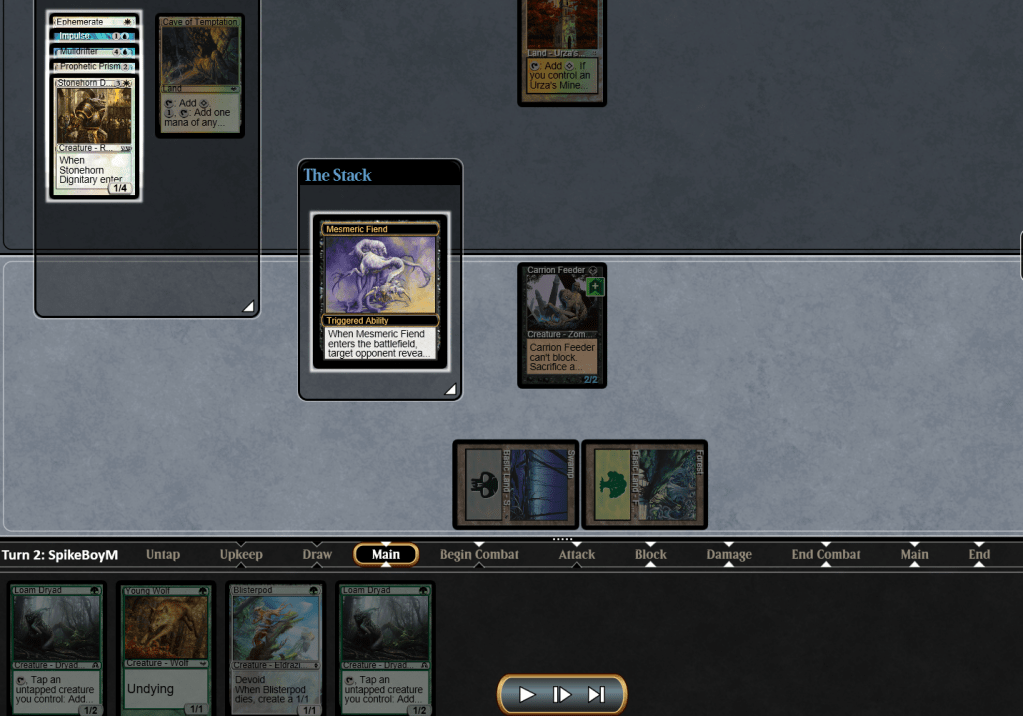
You lead on Carrion Feeder and they lead on Urza’s Tower. On your turn you draw Mesmeric Fiend – one of the best cards in this situation. You cast it and stack the triggers with Carrion Feeder so that you can nab the card forever. This is what you see:
The cards you can take are Ephemerate, Impulse, Prophetic Prism, Stonehorn Dignitary, and Mulldrifter. The other card in their hand is Cave of Temptation.
What card do you take and why? You’ll find my answer below.
There are merits to every card you can take. Let’s start with Ephemerate. This card is key to their endgame engine and with either Mulldrifter or Stonehorn it can bury you, either under cards or blanked combat steps. Exiling it is a good call since Mnemonic Wall can easily get it back. However, the deck runs anywhere from two to three other copies of this effect and given the other cards in their hand, taking Ephemerate doesn’t seem wise.
What about Prophetic Prism? This is the only card they can currently cast next turn and it sets up their Impulse on turn three which digs them deeper and potentially helps to set up Tron. Prism also replaces itself and while they already have fixing in the form of Cave, taking Prism does buy you time which is what you need right now. Of course, so much of this is undone by them drawing a land, but Prism, to me, remains a viable option.
Next up is Impulse. As good as this card is I don’t think you can justify taking it here. Impulse digs them four deep and can find other hammers like Moment’s Peace or another Urza Land, but it costs them time. Time is something you want them to be taking so leaving them that option doesn’t seem too terrible.
Next up is Stonehorn Dignitary. This card is a nightmare. While you have reach in the form of Falkenrath Noble and Lampad of Death’s Vigil, you need to attack to get them low enough where your reach can close the game through a Pulse of Murasa. They are, at best, two turns away from Stonehorn Dignitary which, given the cards in your hand and composition of your deck, you cannot win by. Taking Stonehorn means they need to find another other fast – something Impulse and Mulldrifter can do. Still, if you’re looking for time taking Stonehorn buys you the most.
Mulldrifter might be the most flexible card in this hand, coming down on turn three, four, or five. However if they are able to cast Mulldrifter for five there’s a good chance you’ve already lost the game. If they cast it for three, you are likely able to pull ahead. Given the variance here, I don’t think you can reasonably take the flying fish.
That leaves the cards to take as Prophetic Prism and Stonehorn Dignitary. I believe I made the wrong decision and I took Prism, thinking that the draw I was denying them would be good enough. Their next two draws were lands – Tranquil Cove and Urza’s Mine – meaning I lost my combat steps in short order. Taking Dignitary forces them to spend resources to find another (or a Moment’s Peace) while you’re able to build out your army and deploy threats, getting them low enough to where Lampad or Noble can finish the job.
Sometimes you don’t want to think. Usually for Kendra’s stream I try to come up with a new brew. This week, however, I wanted to play one of my paper decks. So I went to one with a backstory.
For quite some time now, I’ve worked with Mike (Omniczech/Big Mike) on building decks for some time. Mike helps me to cut some of the chaff and refine the ideas as I move towards a full list. When I saw Polukranos, Unchained I started sounding off about a million terrible ideas. Mike recommended I build Grismold, the Dreadsower. As he put it, it would let me run a ton of bad cards and “readers” – cards that most people would need to read regardless of how long they had played the game.
I was sold.
Grismold provided an interesting challenge. But I was up for it. I looked for persistent effects that would handle the tokens created by my commander on regular basis. I knew about Plague Spitter, Illness in the Ranks, and Virulent Plague. Mike introduced me to Festering Evil and I was excited to add it, as well as every Pestilence variant I could get my grubby hands on. Last Laugh was a fun find and one that, if I set it up correctly, should leave me with a massive troll and an empty board.
Grismold also gave me the opportunity to run some of my favorite cards and combinations. The +1/+1 counter theme let me run Animation Module, which feeds Grismold twice over. It also let me turn Retribution of the Ancients into a machine gun. Grismold provided a home for some combos that would otherwise have no home in my collection like Nath–Hypnotist and Mephidross Vampire–Triskelion. I also got to include Vigor, which is just good, and Saber Ants, which is just weird.
Wednesday’s game was wild and even though I was choked on lands for most of it, I managed to get a few good hits in and eventually helped to dictate the way the game ended. Even if it wasn’t entirely on my terms.
I’m going to start by saying this: don’t put too much stock in the Showcase Qualifier results. Shortly after the event finished, Top 8 competitor Simon Nielsen tweeted that none of the Flicker Tron decks in the 25 person field made Top 8. In fact, only one such deck finished with a winning record.
May 3 Showcase Qualifier
Pauper Challenges already have a relatively small player pool but a 25 person tournament that cuts to Top 8 after five rounds isn’t representative of the metagame at large even if the top decks look familiar. The lone Mono Black Control deck in the winner’s bracket went undefeated in the Swiss but is that enough to proclaim the deck “is back”? Not for me. Even though two more builds made the Top 8 of Sunday’s Challenge, I would be cautious before throwing my chips down with Gray Merchant of Asphodel. But I’ll talk more about that later.
As has been the case, Saturday’s Challenge was a six round affair. Boros Monarch took down the tournament and two slots in the Top 8 despite barely making a blip thus far in Ikoria season.
May 2 Challenge
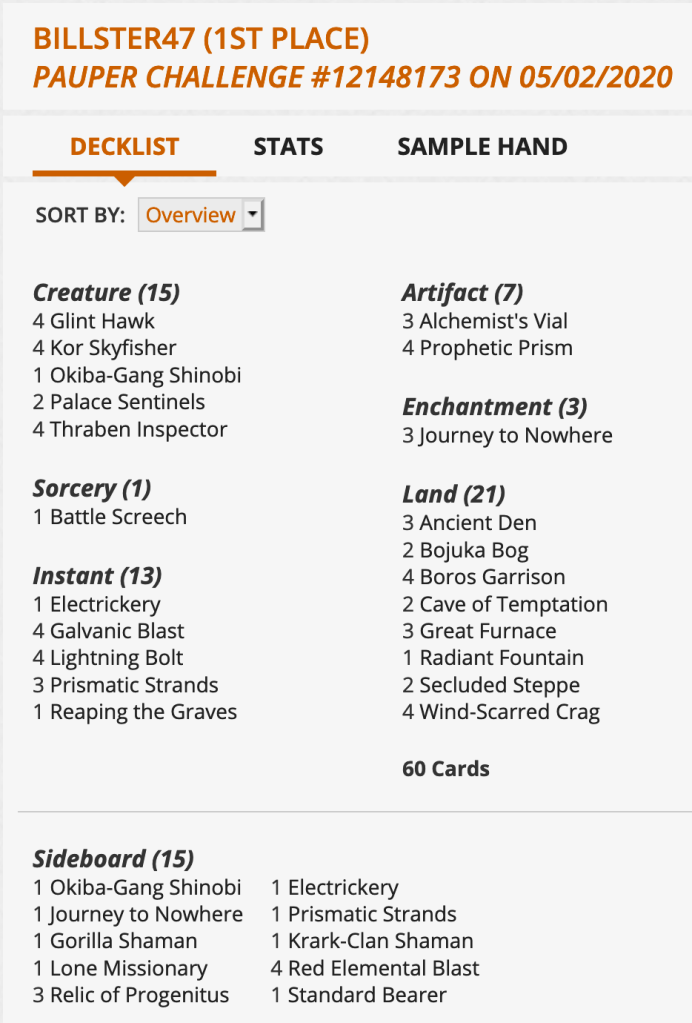
Out of the top decks, Flikcer Tron only did alright by its own gaudy standards. Boros put on a clinic and for at least a day the midrange crown shifted from a Mystic Sanctuary to a Wind-Scarred Crag. Despite Boros’ victory, I found the winner’s list to be ambitious, adding two copies of Cave of Temptation to a deck splashing two black cards is just begging to lose to your mana. Then again, I’ve long rallied against cards like Radiant Fountain in Boros so what do I know?
Sunday’s Challenge saw two more Mono Black Control decks in the Top 8 but, once again, Flicker Tron won the Challenge. Despite placing only three copies in the Top 32, one went all the way for the fourth time in Ikoria season. Despite having what appeared to be a bad weekend, the deck still managed three Top 8 slots and maintains a weighted metagame volume over of 22.2%, compared to its real volume of 17.7%
May 3 Challenge
So what does this weekend tell us? There are a few decks to beat – namely Flicker Tron, Boros builds, and Delver decks. Stompy and Affinity are the most consistent aggressive options and do a fine job of applying pressure. But beyond these, everything is up in the air. The fringe elements of the metagame exist but they struggle to establish a foothold. i think I would be less alarmed by this if every deck would eventually regress to their expected performance. Most do, except for Flicker Tron.
Mono Black Control was a big winner on the weekend and expect there to be plenty of people trying to win on the back of Gary this week. Still, the deck isn’t back, especially since it hasn’t gotten anything new. Instead, I expect various Boros Monarch builds to emerge as the defacto midrange option this week. If you’re dead set on playing black, though, I would run some sort of persistent engine like Grim Harvest or Kor Skyfisher and Omen of the Dead.
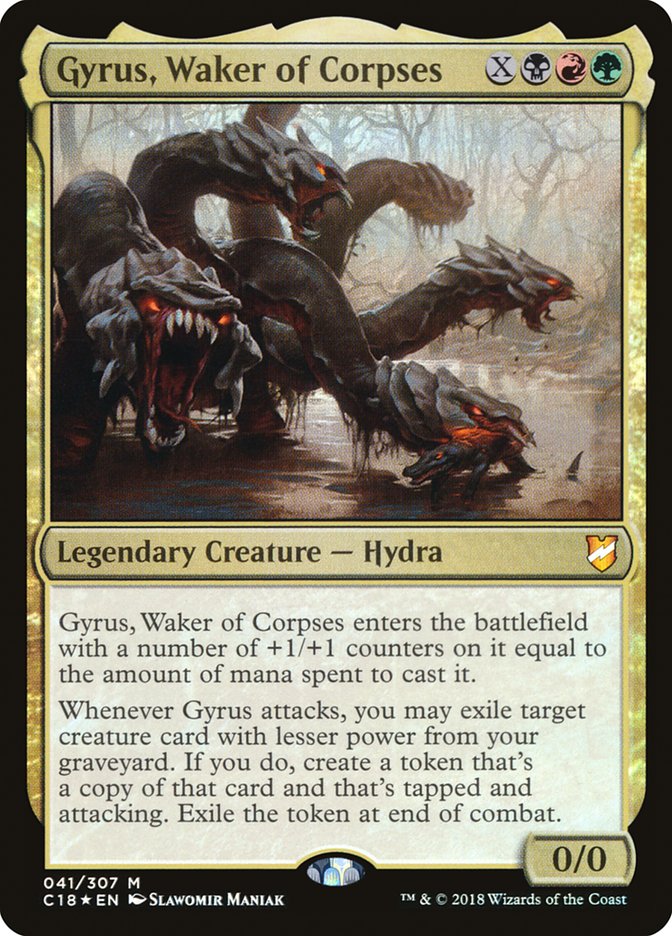
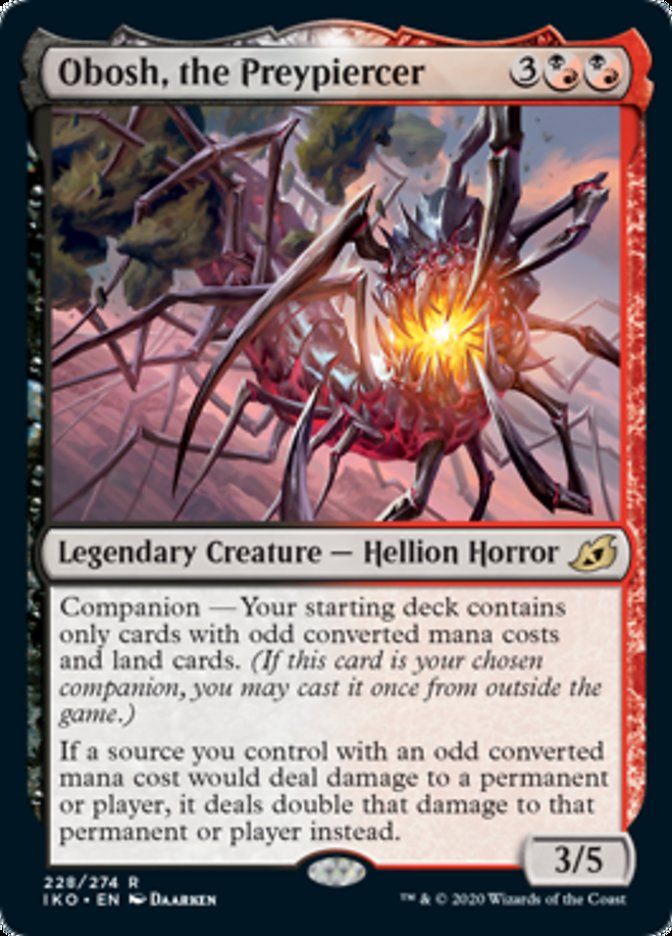
Last night was Ikoria: Lair of Behemoths night on Kendra’s stream. I’ll be honest here – none of the legendary creatures in Ikoria really appeal to my Commander senses. I considered playing a Brokkos, Apex of Forever or a Nethroi, Apex of Death deck, but I just couldn’t settle on a build I enjoyed. I then shifted my thought process to running a Companion. I almost ran a Pharika, God of Afflicition deck with Umori, the Collector as a Companion to attempt the all-enchantment challenge. Instead I decided to go for broke and build a Gyrus, Waker of Corpses deck with Obosh, the Preypiercer as a Companion.
The games were a delight and I won’t spoil them for you in case you want to watch them unfold yourself. Instead of talking about the deck I played, I want to talk about the process of building it and the give some overall thoughts on Companion itself.
Building this deck was capital ‘F’ Fun. I have a few ways I like to play Commander and even though Gyrus is firmly in my wheelhouse, I found myself choked off of a few cards I love to run. Instead I had to scour the options for cards that would meet Obosh’s condition. I relished in finding ways around the restriction and even though I missed some obvious inclusions – I somehow neglected Doubling Season – and came away pleased with the results. For someone who finds themselves falling into the “samey” trap, building towards a Companion was a fun way to flex tired muscles. The payoff was middling. I cast Obosh once and while it doubled the damage it didn’t take place at a high impact moment in the game. I didn’t feel like I was at a significant advantage in Commander since the extra card was mitigated by a pretty hefty drawback, all things considered.
That being said, I’ve soured on Companions overall. I think they are great for non-competitive formats. For tournament play, however, I worry that they change something fundamental about how Magic works. Back when Arena was an in-store play program and not a digital platform, there were cards called Vanguard. These were oversized cards that gave you a global ability while also modifying your starting hand size and life total. Guess which ones were the best?
Magic is a game of resources and giving players additional resources at the start of a duel gives an inherent advantage. Not only do Companions incentivize players to build towards having one, they basically require all players to do so to maintain card economy parity. Compare Companions to Leylines.
Leylines come with a significant cost: they have to be in your starting hand. That means running enough copies to reasonably find one in your opening seven. While a Leyline is essentially cast “for free”, additional copies could be dead if found off the top. Companions have no such cost. They sit there as a single option, not eating a deck slot, waiting to be deployed.
I am not sad that Companions were printed. I think expanding what the game of Magic can do is vital to its continued growth and success. But I do think, at least with regards to the competitive sphere, that this mechanic was pushed too far. And I hope that the next two years of Standard (and non-rotating formats in perpetuity) aren’t dominated by cards from outside the game.





 NerdtotheCore
You must be logged in to post a comment.