More Tron Talk

While we wait for the weekend Challenge results to post I wanted to take some time to talk about the loxodon in the room. Early reports from Double Masters season indicates that Tron has gotten stronger. Despite the fact there was a ban that specifically targeted the deck, Tron continues to be a dominant force. Today I want to discuss why these three lands cause so many problems and why, in the long run, they will need to be banned.

Pauper, like any Magic format, has cards of varying power levels. That being said the very best Pauper cards and not that much better than the worst ones. I am speaking here about cards that see play or have the potential to see play; I am not talking about Chimney Imp. This is baked into Pauper since the format restricted by rarity. Because of this, one of the best ways to get ahead is to do multiple things in a single turn cycle. Blue cantrip decks can set up their draws while leaving up mana for a counter. Stompy decks can commit multiple threats thanks to their low cost and the presence of Burning-Tree Emissary. Kor Skyfisher decks try to do this with cheap burn and recasting Prophetic Prism over and over.

Tron laughs at all of these. Thanks to the mana abundance made available by its mana engine, Tron can do far more in a single turn than any other deck. The entire point of the Expedition Map ban was to provide other decks time to beat Tron before the three lands were assembled. Regardless of whether or not the ban achieved this goal, it is vital to understand that one of the root causes was to try and level the field between decks that do things in the early game against decks that do things in the late game.

Switching Crop Rotation in for Map has largely been seen as an improvement. Crop Rotation has a real cost associated with it in that a counter is rather punishing. However the banning of Mystic Sanctuary has pushed decks that can leverage Counterspell lower in the metagame. The result is that one of Tron’s natural predators is neutered, giving the deck more room to breathe and do its thing.

I want to switch gears for a moment and talk about Arcum’s Astrolabe. Part of the problem with Arcum’s Astrolabe is that it enabled decks to ignore discrete mana costs. Astrolabe decks in Pauper (and other formats) became “good card soup” where they simply ran the most powerful options.

Tron decks are Arcum’s Astrolabe decks with access to more mana.

Between the new Thriving Lands, Prophetic Prism, Cave of Temptation, and others, Tron will always have access to the color it needs. The result is that when Tron wants to use a tool it has to sacrifice very little to do just that. Double Masters gave Pauper access to two amazing removal spells in Abrade and Cast Down. These are powerful cards and both help out Tron by giving them more early interaction. Now Tron has less to fear from early aggressive decks and Abrade has the upside of randomly wrecking Affinity.

To summarize my points so far, Tron is able to do more than other decks in the format and has access to all the best spells due to the nature of its mana base.

A common refrain about Tron bans is to hit the flicker effects: Ephemerate, Ghostly Flicker, and Displace. These would absolutely hinder the current iteration of Tron by making it harder for them to lock folks out of the combat step. Hitting these cards would leave Tron as a viable inclusion for control decks.

I think this change would be a half measure. As more cards are printed and new spells appear to take the place of older, more expensive versions, the problem with Tron’s ability to simply overwhelm every other deck thanks to an abundance of mana will persist.

I may be wrong about this. Perhaps Tron is safe or perhaps the flickers are the correct hit. I think that at some point down the road, something is going to break Tron again. I think it’s time to stop this train.

Looking at Lists: Gruul Madness and Mutant Zombies

We’re barely a month into this and I’m already breaking my rules.

I can’t help it; there were two incredibly sweet decklists that went 5-0 in the Pauper League this week. Let’s get right to them.

I have a soft spot for Zombies as a deck While I’m not a huge fan of the aggressive builds with Carnophage, I see the merit when you’re also including Village Rites. But that’s not what excites me with this list. Instead it’s the inclusion of Cavern Whisperer. First off, it comes in and eats a card in your opponent’s hand. Second, if you put it on a Carrion Feeder you have a 4/4 with all those +1/+1 counters and menace. Sign me up yesterday. This deck scratches an itch for me and I cannot wait to give it a shot.

Gruul Madness is a deck with a long history in Pauper. It has some results in the Italian Paupergeddon series but hasn’t done much on MTGO. Part of this is that Affinity does Madness better than Madness does Madness. If you’re trying to cheat in 4/4s, Myr Enforcer and Carapace Forger are cheaper than Reckless Wurm. There are a few elements I really like about this list. First, it biases towards red. Previous versions of this list went for green to try and turn on Werebear and Arrogant Wurm. Going red gives you a chance to apply pressure with Kird Ape which, as a 2/3, is very good against the creatures in the format. I also love the inclusion of Savage Swipe in this deck as it gives yet another way to clear out the board to crunch in for damage. Swipe also gets to play tricks with Wild Mongrel (pumping after the fight) or Gathan Raiders (unmorphing after the fight). All in all, a fun list that I can’t wait to try out.

Which of these is your favorites? Which list are you excited to test in the league?

July 25-26 Pauper Weekend in Review

Another weekend, another two Challenges. The metagame continues to take shape in the wake of the Expedition Map and Mystic Sanctuary bans. A significant portion of the community believes that these bans did noting to hinder Tron and in some ways, made the deck better. We are only four Challenges deep, so let’s take a look.

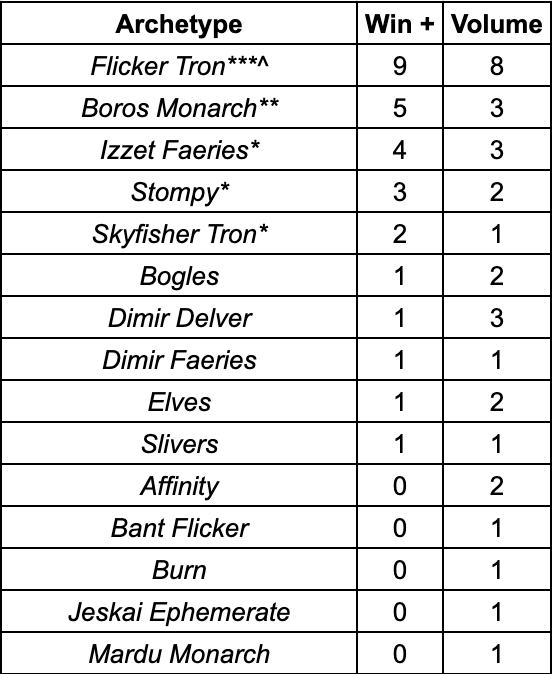
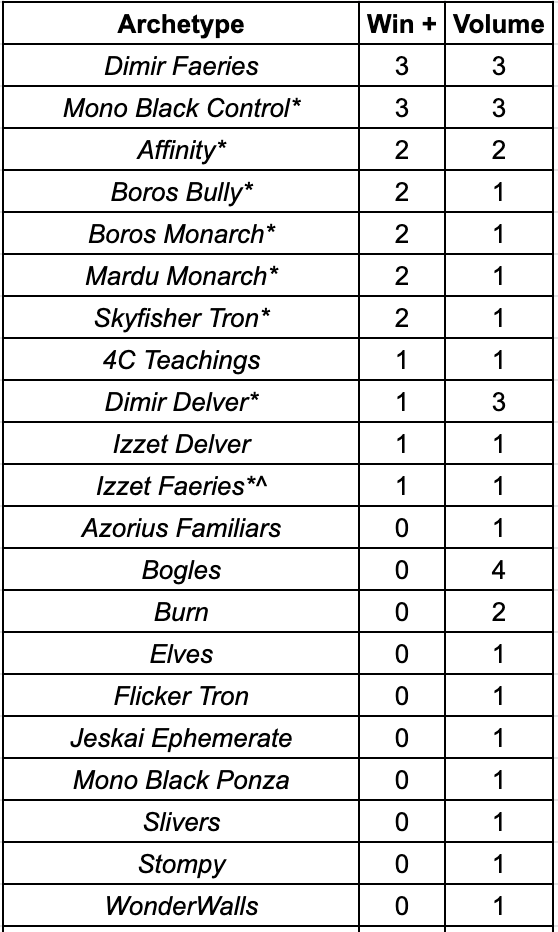
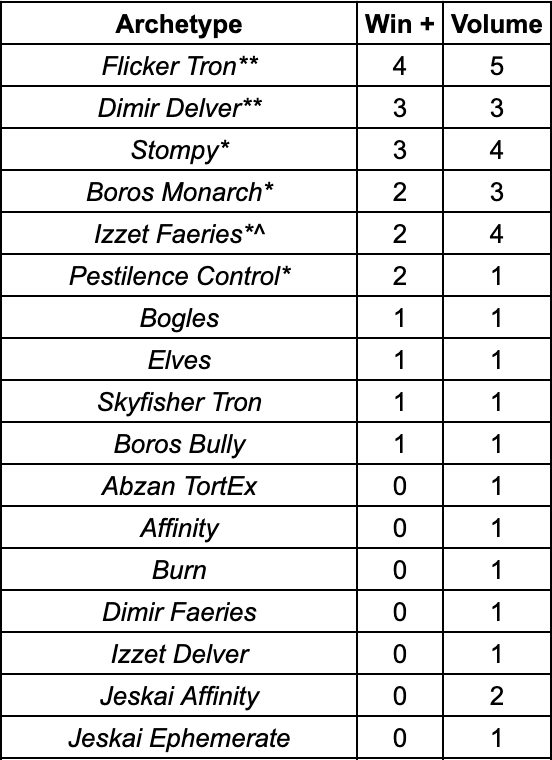
I’m going to revisit some of the terminology I use when examining data. First is Win+ – this is a score assigned for wins above an X-3 record. An X-2 record in a Pauper Challenge is worth a Win+ of 1, X-1 is 2, and X-0 is 3. This provides a way to measure successful archetypes (those that finish int he Top 32) against each other. The closer a Win+ is to an archetype’s volume, the more likely it is to have finished in the Top 16 than outside of it.

Look at Saturday it’s hard to argue Tron had a great day. The Win+:Volume ratio is exactly 1 and Tron placed 4 decks in the Top 8 (granted across two different iterations of the deck). Stompy, by comparison, also achieved a ratio of 1 in 5 appearances (two in the Top 8). Which deck did better? That’s subjective, but you can make a case for either, mostly based upon the fact that if you look exclusively at Flicker Tron it has a ratio under one. Still, Tron being Tron, it’s fair to give it the nod.

To be clear, this event caused a heated discussion in the Pauper Discord I manage. The presence of four Tron decks in the Top 8 reignited the call for bans, claiming that banning Expedition Map had not done enough to weaken Tron. The conceit of the argument is that the Tron mana engine itself is broken in Pauper and the ability to do multiple things every turn will keep it head and shoulders above the rest of the format.

On Sunday there were no copies of Tron in the Top 8.

So does that mean everything is fine?

Of course not, but one event doesn’t mean everything is broken either.

Tron is going to have a spotlight on it for as long as it remains legal in Pauper. It is incredibly powerful and acts as a hard limit for many other strategies in the format. But we simply do not have enough information to make an informed decision at this juncture.

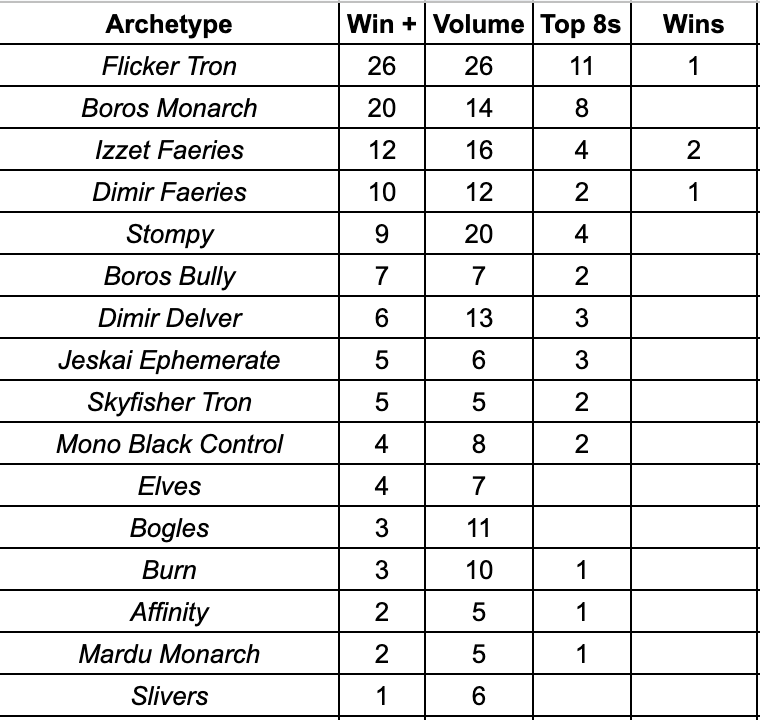
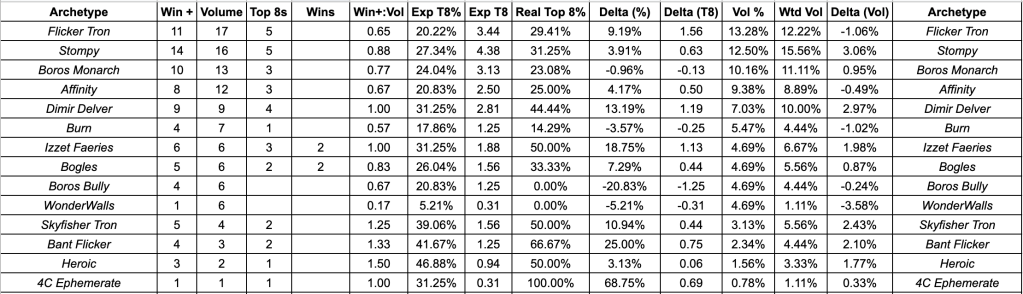
Here is a look at the top performing archetypes out of the four post-ban challenges. This looks at every deck with at least 2% metagame volume (~3 appearances) or a Top 8. While Flicker Tron and Stompy are leading in the Win+ race and Top 8 race, they aren’t lapping the field. If you fold both Tron variants into one it looks like the best deck, but not by a lot. Let’s look at similar data from Ikoria season.

Again, the cut off is a Top 8 or 2% total volume (13 appearances). The difference in numbers here is staggering, especially at the top of the metagame. Interesting note: Stompy has maintained the same Win+:Volume ratio.

So what does this all mean? Basically that I do not have enough data to an informed decision. While Tron may have access to turn three Tron more often thanks to Crop Rotation it also has that Tron more susceptible to counter magic. Tron has also adjusted faster than other decks because it had to do so. It may be true that Tron is still a problem and time will bear that out if it’s true, but the possibility still exists that the format is in a much better place.

Center Stage: Pollenbright Druid

How much is a card worth? It all depends on how you’re trying to win the game. Pollenbright Druid begs the question: can this 1/1 be worth more than a card?

A 1/1 Elf is sometimes a card, but this suite of abilities doesn’t lend Pollenbright Druid to Elves. A 2/2 is sometimes a card, but Pollenbright Druid doesn’t rise to the occasion for Stompy. Can a 1/1 that Proliferates be worth a card?

Maybe.

There are a ton of cards that incidentally use +1/+1 counters in Pauper. Going back to Stompy, Skarrgan Pit-Skulk and Hunger of the Howlpack both use these counters. There aren’t enough other creatures in traditional Stompy to make use of Pollenbright Druid, but perhaps there are enough options in Pauper to make this 1/1 worth more than a card. Here’s a short list that comes to mind:

And this isn’t even getting into River Heralds Boon if we touch a Merfolk subtheme. But the real card of note here is Pridemalkin. Before, putting counters on creatures was fine but now those creatures can get trample. There might be enough here for an approximation of a Hardened Scales deck, especially if you’re looking to load up a Vault Skirge.

So why do this instead of Stompy? Stompy leans hard on Rancor to punch through extra damage but a deck with Pollenbright Druid and Pridemalkin can go over the top with multiple threats. And if you’re willing to dip into white, Travel Preparations is a heck of a Magic card.

So how many cards is Pollenbright Druid worth? In the right context, it’s worth well more than one would think.

Looking at Lists: Izzet Wizardry

Two players I respect a great deal – Brian Coval and Luis Scott-Vargas – have referred to Goblin Wizardry as the Pauper Monastery Mentor. It makes some sense as Wizardry puts two potentially massive threats on to the board at instant speed. Wizardry also has synergies with broken blue cards and Pauper is jam-packed with those. On Saturday two players too Izzet Wizardry into the Challenge and they had decent results (27th and 32nd place).

There’s a lot to like about this deck. It runs four copies of Accumulated Knowledge and Frantic Inventory to draw gobs of cards. Outside of Augur of Bolas and Preordain you can operate at instant speed. It has a long game plan with Devious Cover-Up and gets to use Brainstorm with the Pauper fetch mana base.

What I don’t like is how soft you are in the early game. Fire//Ice is a good card but I’d rather Forked Bolt as it costs half as much. I also do not like Exclude maindeck right now as it almost always trades down in mana. I would also want a second copy of Devious Cover-Up as a backup win condition, looping the two to repopulate the deck with power spells. Finally, I would look at running some number of Izzet Boilerworks. Being able to generate two mana from a single land is powerful in control matchups. That being said, I am excited to try my hand with Goblin Wizardry.

July 18-19 Pauper Weekend in Review

There are no Winners in Pauper

The weekend of July 18th and 19th showcased the first Pauper Challenges since Expedition Map and Mystic Sanctuary were banned. It’s far too soon to make sweeping declarations of the state of Pauper, but initial impressions seem to indicate the format is trending in a healthy direction.

July 18th and 19th Challenges

Stompy was a well positioned deck in Week One – it’s easier to adjust to new metagames by being aggressive – but both Tron decks and “Delver” decks failed to take a significant dip. Some felt that the addition of Preordain to Tron would provide a boost to the deck, but that did not pan out in the first weekend.

You wouldn’t have known any of this if you were browsing Twitter on Sunday evening. Instead you’d likely have seen another instance of someone in the Pauper community being accused of manipulating Magic Online to leverage a win. And again discussion of the Pauper community and its reputation.

And again I started to think about why Pauper has this reputation. What is it about the online community that it can be so off-putting to a decent chunk of the Magic playing world?

In Magic Online Pauper there is nothing but winning and losing.

In Magic Online Pauper there is the anonymity of the internet.

These two together help to create a toxic environment where the relatively small gains of victory are so outsized that they propagate a community where winning is valued over almost everything else. Placing well in Challenges or getting a list published in the league results are the highest possible achievement for the vast majority of players in this community as they are the way to notoriety. No one knows who you really are, so what does it matter if you spam trade requests or float mana needlessly to make your opponent spend time to click “OK”?

If you’re reading this you probably play a decent amount of Pauper: how many names of Pauper players do you know? How many handles?

I understand the desire to remain anonymous in these times and respect people’s choices to do so. The nature of the anonymous internet, however, creates incentives where the “you” online is not the same entity as the “you” in the physical world.

Magic Online Pauper has created a place where the victory matters and there are no consequences. If we want Pauper to be a place where people feel welcome, there have to be consequences for this behavior. The community has to hold people accountable.

When winning is the only thing that matters there are no winners. Let’s remember that there’s a person on the other side of the match. Let’s think about what is going through their head if this is their first experience with Pauper.

Let’s make it so they want to come back.


Center Stage: Tin-Street Hooligan

I want to start exploring cards that have potential (or are just neat) but have yet to find a good home in Pauper. Today I want to talk about Tin-Street Hooligan.

When I first started playing Pauper (back when it was a player run format 15 years ago), Tin-Street Hooligan was an incredibly important card upon release. Affinity was a powerhouse. It lacked significant checks like Ancient Grudge and Gorilla Shaman, both of which had yet to be released. Instead, decks relied on slower options like Nantuko Vigilante, Overload, or Echoing Ruin to try and contain the machine. When Tin-Street Hooligan came along, everything changed. Gruul decks now had access to an on curve two-drop that could set their opponent’s board development back.

As Pauper saw its card pool grow, the format got faster. Running a two-color aggressive strategy stopped being a popular option as these decks took too long to develop their board. Taking turns off to set up mana meant a good two-color two drop like Hooligan was no longer a viable option.

So why am I bringing this card up today? Pauper has fantastic artifact removal already and the mana, while better than before, still has trouble supporting two-color aggro. The answer is Burning-Tree Emissary. In base red decks, Burning-Tree Emissary can produce the green mana needed to resolve a “kicked” Tin-Street Hooligan. Red Deck Wins, the second best Emissary deck, already wants red two drops and this one has decent upside against artifact lands at the very least. But Tin-Street can also hit Frogmite and Myr Enforcer, as well as Prophetic Prism and Bonder’s Ornament.

I am not saying that Tin-Street Hooligan is a game breaking card – far from it – but the barrier for it to see play is about as low as it has ever been. It might be time to break some stuff.

Looking at Lists: New Tron

I want to try some new things with this here blog. My plan is to look at a decklist that catches my interest once a week. The deck can be from either Challenge or the League results. Today’s deck is from the 5-0 deck dump.

I wanted to talk about Oscar_Franco’s deck for a few reasons. First up, this is not anything new. If you adjust the mana base and cut Crop Rotation/Preordain for Expedition Map you get the same old Flicker Tron deck that had been at the top of Pauper for months. Trading Map for Preordain makes the deck less likely to know it will have Tron in its opening hand but gives Tron ample opportunity to dig towards the correct pieces. This is aided by Prophetic Prism (still really good!) and Bonder’s Ornament (a card that left Matt Nass dumbstruck).

Is this version of Tron slower than previous iterations? Yes, by about a turn. While it is capable of getting a powerful draw on par with the Expedition Map versions, the new models take more time, on average. I have had the chance to play against similar builds with an aggressive Goblin deck and came within one misplay of winning the match (I missed my chance to Fireblast a Stonehorn Dignitary with Ephemerate on the stack). That being said, Tron is still very powerful and will remain a check on the format’s long game.

That brings me to my second point. When the bans were announced, many Pauper players felt that taking Expedition Map away from Tron was not enough. Rather it would just force the deck to run cards that are better in the mid-to-late game (like Preordain), trading early game consistency for more late game power. On top of that, the ban did nothing to break up some of the more repetitive elements of playing against Tron – namely rebuying Stonehorn Dignitary.

I talk more about my views of the ban here but the general consensus is that banning Map is a half measure. Rather than taking out the problematic elements of the deck (whether that is the Tron mana engine itself or Stonehorn Dignitary or the various Blink elements), the ban was designed to give the rest of the format in-game time to win. The question remains whether or not this goes far enough. While my early results indicate that this is the case, I want to see if this is borne out over the coming weeks.