Holding Myself Accountable in GO Battle League: Open Ultra Day 1

So this is something new for me – writing about Pokemon GO Battle League. I’m not going to go into too many details of the mechanics of battle in this piece (for my more Magic focused readers, I’m happy to answer questions and I’ll write something in this space soon), but instead I’m going to go forward with the understanding that if you’re reading this you have a general understanding of GO Battle League mechanics (or you really like me).

I haven’t played Open Ultra league since they started offering Premier Cup. I felt like I could not compete given that I lack many Legendary and Mythical options. However when looking at the Remix Cup meta on PVPoke I had a feeling of dread – as a level 39 battler I was cut off from XL Mons and as such would be at a significant disadvantage. So I looked at my options and Open Ultra and decided to make my push in that field despite lacking some top tier options.

I ran two sets yesterday (July 26) with Lapras (Ice Shard – Ice Beam/Surf) lead, Sirfetch’d (Counter – Leaf Blade/Brave Bird) closer and Gengar (Shadow Claw – Shadow Punch/Sludgebomb) on the switch. I scored a 4-1 my first set and was riding high until my second set where I tanked and went 1-4. I ended the day with an ELO of 2155 (way off my season high of 2406) and took a look at what I faced to try and game plan for the next day.

I saw a ton of Steel-Fairy duos which wrecked the team I had set. I also noticed a fair amount of Giratina and Cresselia. Given what options I had at my disposal I settled on a Typhlosion lead (Shadow Claw – Blast Burn/Solar Beam) with Obstagoon (Counter – Night Slash/Hyper Beam) and Gyarados (Dragon Breath – Aqua Tail/Crunch) in the back.

Today I woke up and used a few minutes before the rest of my family stirred to do some battles with that team. I went 2-3 (ended on 2132) when I realized my backline might have been decent against Giratina but was pretty awkward against other Dragons and Fairy types. I went back into the tank and settled on Alolan Muk (Snarl – Dark Pulse/Gunk Shot) on the switch with the same Lapras as the closer.

My logic was this: Typhlosion with Shadow Claw could handle a lot of leads while storing energy and A-Muk is just a solid safe swap, with both giving me some game against Giratina and Fairy types. Lapras would give me some solid Fire coverage back up Dragon coverage. Surf was not the worst against opposing Steels and Swamperts either.

Here is how my sets broke down:

  1. 4-1 (2181)
    1. Abomasnow-Charizard-Machamp – Loss. I could have won this one except I forgot I had Acid Spray on Muk. If I had a decent Poison move I win.
    2. Blaziken-Alolan Muk-Cresselia – Win. I stayed in for the lead and matched them. I timed a switch to preserve my Muk against theirs and managed to Dark Pulse down their Cresselia.
    3. Gallade-Giratina-Clefable – Win.
    4. Venusaur-Alolan Muk-Empoleon – Win.
    5. Swampert-Alolan Muk-Giratina – Win. I swapped immediately and managed to win without really using Typhlosion.
  2. 4-1 (2223)
    1. Sirfetch’d-Articuno-Kingdra – Loss. I didn’t realize how much damage Leaf Blade would do to Typhlosion and it cost me.
    2. Obstagoon-Venusaur-Cresselia – Win.
    3. Scizor-Giratina-Obstagoon – Win.
    4. Cresselia-Giratina-X – Win. When they swapped into Giratina and I counter swapped, they conceded.
    5. Cresselia-Togekiss-Abomasnow – Win.
  3. 1-4 (2179)
    1. Machamp-Togekiss-Venusaur – Loss. I overtapped a Shadow Claw at the end. If I did not misclick I think I might have been able to win.
    2. Obstagoon-Talonflame-Cresselia – Loss.
    3. Poliwrath-Swampert-Alolan Muk – Loss.
    4. Lapras-Clefable-Giratina – Win.
    5. Escavalier-Swampert-Empoleon – Loss.
  4. 3-2 (2193)
    1. Obstagoon-Umbreon-Talonflame – Win. This was a tough one that I managed to steal by storing energy on Typhlosion and getting off three Blast Burns on Umbreon.
    2. Charizard-Giratina-Togekiss – Win.
    3. Empoleon-Alolan Muk-Gengar – Loss. When Gengar came out I conceded as I was too far behind.
    4. Alolan Muk-Swampert-Venusaur – Loss. The Venusaur came at the worst spot for me as I did not have enough time to get off two Ice Beams from Lapras.
    5. Dragonite-Charizard-Scizor – Win. I swapped immediately into Alolan Muk and overcharged. This let me get off enough Dark Pulses to bring down their Dragonite and line up Lapras with Charizard and Typhlosion with Scizor.

Overall: +38 ELO.

I was happy with the team but seriously considered switching it up after the fourth set. I was not set up to lock down Counter users/Fighters in the lead, as my swap would line up poorly with theirs. After the last set I feel decent about starting tomorrow’s with this line up but have potential Charizard, Blaziken, and Gyarados led teams ready in case things do not line up in my favor. That being said I think one of my losses in set 3 (Escavalier lead) is winnable if I time my moves better and don’t fall for shield baits.

July 24-26 Pauper Weekend in Review

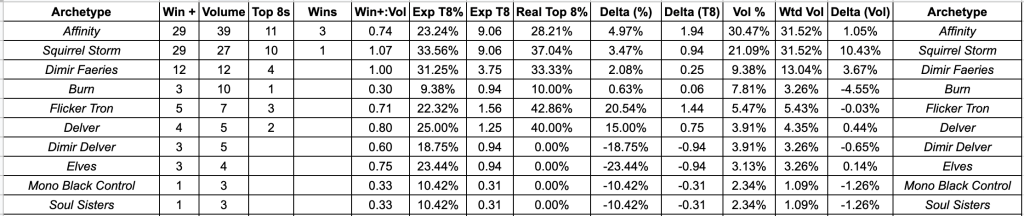
Another Monday and no changes to the banned list. I’m tired folks. After three weeks of Dungeons & Dragons: Adventures in the Forgotten Realms season here’s every deck with at least 2% of the Top 32 volume:

Affinity and Storm each hold 35% of all Top 8 slots this season and 5/6 wins between them. They are just under 50% of the metagame by volume and hold nearly 58% of the winner’s metagame share. Dimir Delver/Faeries and Delver are putting up respectable numbers but the long and short of it is that the metagame is adapting to the new normal and Pauper is shifting towards a three deck format (Affinity, Storm, Counterspell).

Maybe it was always this way. Maybe the format was always this unplayable garbage. I’d like to believe otherwise but honestly, I’m just tired.

July 17-18 Pauper Weekend in Review

I do not want to spend many words on the July 17 and July 18 Pauper Challenges. It isn’t that the results aren’t worth discussing but rather that all that can be said about the current metagame has been said multiple times: Affinity and Storm are miles better than almost everything else in the Challenges and until we see some bans, the metagame is going to remain stagnant.

After four Challenges, this is every deck to make at least 3 appearances in the Top 32 – a 2% volume threshold. It is clear that the metagame is heavily skewed towards the top. This wouldn’t be as large an issue if not for the fact that the metagame today looks remarkably similar to all of Modern Horizons 2 season – the same two decks at the top while Dimir strives to be relevant.

One thing I have done a poor job of discussing is what my ideal Pauper looks like. I tend to get lost in the numbers talking about what is dominant in the field and looking for edges or ruminating on format health. Today, instead of trudging through a well worn path, I want to talk about my vision for Pauper as a metagame and maybe more – as a format.

Pauper is a non-rotating format. Unlike other non-rotating formats it is rarity gated – that is only cards printed at common are legal. Because of the way set design works (and the nature of Magic itself) powerful effects – the same kind that tend to impact formats like Vintage, Legacy, and Modern – are printed at higher rarities. As a result it is harder to “shake up” Pauper with these releases as the cards entering the format are, inherently, of a lower power level.

This has changed somewhat in recent years. As Pauper has become more popular we have seen a slow uptick in the number of commons in non-Masters style sets that see play in the format. These cards rarely make huge waves but as we saw with First Day of Class that is not always the case. Part of the issue with new cards entering the format is that at common we already have many of the best iterations of effects – a better version of Lightning Bolt or Counterspell isn’t walking through the door. More than many other factors this prevents new cards from making waves in Pauper.

The lack of churn can lead to stagnating formats. If the majority of releases do not have a major impact then the competitive games are going to feature the same decks, cards, and strategies over and over. This in it of itself is not bad if there is a balance between the decks. When there are several viable decks – such as during Strixhaven season – then the fact that there may have been a best deck or two mattered less since each deck had reasonable counterplay in the meta and there were several strategies that could succeed given the correct metagame.

That metagame was a direct result of Commander Legends and the addition of Cascade threats to Pauper. Annoyed Altisaur and Boarding Part provided counterplay to both Flicker Tron and Monarch endgames. That in turn made it so that these strategies were regressed a bit, allowing other strategies to emerge given proper metagaming. Compare that to the current state of affairs where it does not matter what deck emerges since it is going to get run over by Storm or Affinity.

My ideal Pauper metagame is one that is dynamic. There can be a best deck or a clear top tier but given the trends in the metagame a player can make the right call and be rewarded. The worst metagames, in my opinion, are ones where this choice is removed.

I understand some people like the current metagame. They like trying to get an edge with specific cards in the established decks. I like that too but I feel that when you’re dealing with a small set of potential options some of that fun is removed from the equation.

To be clear, if Storm and Affinity both had clear counterplay that could limit the efficacy of these strategies week over week, I would be fine with them existing.

But Alex, someone out there is surely saying, this is why Pauper needs more powerful downshifts.

The danger of relying on downshifts to solve the problems is that they are almost always answers as opposed to threats. For these cards to be printed at common there has to be an incredibly specific limited environment that calls for them at that rarity and, like it or not, Pauper has to come after Limited in design considerations. A card like Dryad Militant or Skullcrack would need pretty messed up Limited formats to be viable commons (and yet these are two of the more often mentioned options for downshifts).

I want Pauper to thrive and grow. I want there to be a huge swath of viable decks that, given a reasonable set of circumstances, could do well. I would love to see decks like Tortured Existence and Mono Black Control spike a victory or a Top 8 even if they come less frequently than Delver and Tron.

I know that, as I publish this, we may be less than 24 hours from a ban. I also know that at some point in the not too distant future, perhaps in as soon as two years, we may have a similar problem arise from the next Masters level product. My hope is by then we have a clearer idea of what Wizards wants Pauper to be and then we, as a community, can at least judge the new cards by that metric.

Transitioning from Modern Horizons 2 to Adventures in the Forgotten Realms

After a brief hiatus due to personal matters, my recaps are back.

In a fashion.

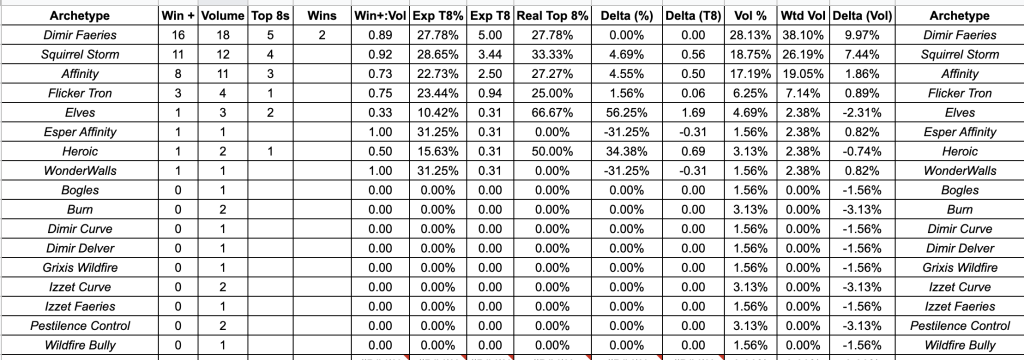
I don’t want to take too much time wrapping up the Modern Horizons 2 season as it was dominated by Affinity, Storm, and Dimir. Those three archetypes took down over 67% of the Top 32 finishes and over 75% of all Top 8 slots. These decks were dominant to the point where the next most played deck – Burn – accounted for 5% of the Top 32 metagame. The gap between the 3rd most played archetype (Dimir) and Burn was over 12%. By comparison the most popular archetype during Strixhaven season was Dimir Faeries and it only accounted for 14% of the Top 32 metagame.

I’m also not going to spend too much time talking about the July 10 and July 11 Challenges except to say that Affinity and Storm continued to rule the roost. The card to make the biggest splash from the latest set is Celestial Unicorn, which showed up in three decks across the weekend.

Instead I’m going to talk about last Tuesday when Gavin Verhey from Wizards of the Coast stopped by the #MTGPauper Discord for a chat. Gavin stops by a few times a year to check in on the format, take the pulse of people there, and answer some questions. One question and answer in particular has set off a segment of the community, and I want to address it separately.

You closed the last fireside-chat with the question: What should Pauper be? The community still feels divided to me. I’m curious what your opinion/perspective is currently. Ideally that could be used as the starting point for some conversations within the community across social media to get you a legitimate answer.

And here’s Gavin’s response (emphasis added):

I do think that ultimately a lot of this is on the players to figure out. Pauper has always been a format by the players, for the players. I remember playing in fan-run Pauper events on MTGO 12+ years ago with my homebrew Teachings decks! But I will say this: the Pauper community isn’t large, and dividing yourselves isn’t going to get you the critical mass you need. Working together is going to be important. I know there are many different opinions out there on format health, and what should be banned, and so on, but making this an inclusive community where everybody feels welcome, even if you (respectfully) disagree on aspects of the format or what decks are best is crucial to earning that larger seat at the table. We’re about to enter back into a brave new world of in-store play and a whole new generation of players who came to Magic during the pandemic. Be the landing place for them as they try playing paper. Work with your stores to run events. This is, in some sense, your chance for a whole new generation of Magic players to find a home here. Create the Pauper community you want to see in the world, and success will follow

I am going to hold off on my personal reaction to this and instead try to paraphrase some of the discontent around the answer. Pauper, at the moment, is not in a great place. Some in the chat felt that this response (and others – the conversation is preserved) was trying to sidestep the issue at hand by saying that it was on the Pauper community to drum up interest in a format that currently kind sucks. Some took this as a Catch-22: if you want people to pay attention to the format (and as a result get more eyes on it), you need to get more people to play it while it is “not fun”.

That, understandably, is not great. The people in the chat are highly engaged and if they heard “we can’t fix the format until more people are interested” that is not a great message to receive. But taking a step back I think this reading of the response is disingenuous.

The way to get more attention on any format is to get more eyes on it and more people playing it. People wouldn’t play Pauper and be invested in its long term health if it weren’t, on some level, fun. Pauper (when healthier) presents a unique puzzle.

And yet, the only time the format enters the wider conversation of Magic is when something is broken in the format OR the certain elements of the community are hostile to people who do not play the format regularly.

To me this is what Gavin was trying to hammer home. If the community wants more people to care about the format and to help prevent problems like the current metagame from dragging on then we need to do the work to make the format an attractive and welcoming community. We cannot just get up in arms when things are terrible. People need to be out there making content and talking about the format when things are going well.

I know I fall into this trap too – I didn’t get my reputation as ban-happy for no reason. But if there’s one thing I know it’s that people will remember all my negative comments far more than my positive reviews. I think that Strixhaven season was one of the healthiest in recent memory and said as much…but that doesn’t drive the same engagement as when I say “Gush is broken”. And so it’s on us – the Pauper community – to make enough noise that when things are good that we are impossible to ignore when things get bad.

June 26-27 Pauper Weekend in Review

This post is coming almost a week late. I could say it was because my toddler’s day care was closed and I was chasing him around several playgrounds (which is true) or because I was preparing for a visit from my in-laws (also true). But that’s only part of the truth.

Put simply, Pauper is not fun for me right now. I am not enjoying the games and I’m not enjoying the metagame as an observer. The June 26 and June 27 Challenges did not do much to change my opinion. Through the first four weeks of Strixhaven season there were 16 decks that made up at least 2% of the Top 32 metagame. Through the same time period in Modern Horizons 2 there are 9.

Pauper is a three deck metagame. Affinity is the most popular with nearly 29% of the Top 32 metagame and almost 30% of all Top 8s. Squirrel Storm and the two main Dimir Variants are around 19% of the Top 32 metagame and the archetypes each have 15 Top 8s (around 23% of all Top 8s). So we’re looking at these decks taking up 67% of the Top 32 metagame and almost 77% of all Top 8s.

We’re a month in. It’s safe to say that this experiment is not working.

On Tuesday, July 6th at 3pm Eastern, Gavin Verhey will be stopping by the MTGPauper Discord to answer some questions. People have already started posting some queries and you can bet that Storm and Affinity are on everyone’s mind.

On Pro Magic

I am not a professional Magic player. Those dreams died a long time ago when I realized that I just did not want to put in the time and effort into The Grind. Yet I barely remember a moment in the past 25 years where I was not thinking about professional Magic in some way, especially as I pursued a new dream of doing event coverage. Today I just feel sad – for players who did dedicate themselves to the dream and for the community of folks around the professional scene who also have their future held in limbo.
I don’t want to waste words on speculating and theorizing on why the powers that be have decided to whittle away at the elite level of play so publicly while not providing a plan. Rather, I want to talk about why I think this is a mistake and what I would like to see once we reach the next era of Professional Magic.


Discovery

Magic is a huge part of my life. It is my primary hobby and a source of income. I love the game and the friends I have made along the way. And one reason I keep coming back to shuffle cardboard is that sense of discovery. When I was a kid this meant cracking open a booster pack or a starter deck to see what new cards I could add to my collection. Today it’s about scouring spoilers for new deck ideas and tech for Commander.
For several years my discovery was driven by the Pro Tour.
At some point I had reached the limits of what I could figure out on my own. That’s when I found the pro scene. Suddenly I had new avenues of acquiring new knowledge. There were entire metagames to devour and intricate plays. Taking away the elite level of play cuts off a vital pipeline of keeping a certain stripe of player – one who is always eager to be up on the latest tech and decks – engaged in the game.
This is to say nothing of strategic discovery. Magic is an incredibly complex game and I know that I’ve gotten better by following the professional scene. These are players who are approaching the game at a level that I cannot easily achieve and being able to watch them and potentially consume the content they generate gives me that insight. But what happens when there is nothing left to strive for? What if just being the best amongst your group of friends is good enough? While plumb the depths of strategy for every little edge if none of it matters in the wider ecosystem of the game?

I don’t want to see Magic lessened in any way. I fear that without professional level play – some tangible level to aspire to – the incentives to innovate and develop new strategies will stagnate.

To be clear this is not a knock on people who enjoy the game as it exists in front of them. I am not trying to take away from people who are going to iterate and innovate on their preferred format and decks. They should enjoy it at whatever level of engagement they find appropriate. That being said, what is the point of striving to be the best if there is nothing to strive towards. But for those of us who do want to strive, a professional level has to exist to scratch that itch.

Trust

For years the Magic community has been told to wait for the next big thing in professional play. Even now we are being told that something is in the works for the 2022-23 season. The community’s trust can only go so far. And given the recent track record, why should there be any trust given to the people in charge if we do not know who they are?
There is no way to win back trust immediately but there are a few ways to start the process. The first is to restore the slashed prize pool of the 2020-21 World Championship. The second is to give the community some insight into who is making the decisions regarding organized and professional play and have them share their vision of the system.
I’m not asking for a detailed plan for every strata of competition; I’m not asking for the names of events or locations, or even prize pools. But knowing that someone is making the decisions, and having an idea of what the system could look like (not just what it won’t look like) could go a long way towards rebuilding trust.
I also believe that a good way to win back some amount of trust is to bring professional level players into the fold for a discussion. This does not need to be everyone who has ever achieved a pro point, but rather players who have sustained success at different levels of competitive play. Give them the parameters of what the system can and can’t be and then get their insight into what can make it succeed given the current limitations.

My Vision

If it is not clear, I believe professional Magic is a net positive for the game. I want to see the system return in the future even if I don’t have a shot of qualifying. I want to spend my days watching the very best sling cardboard and show me everything I don’t know about the game.
I want there to be Pro Tour level events with some sort of qualification path. I think the Player’s Tour System was a good base but could be improved upon. If anything, Magic is a global game and having large geo-region events is good, but pales in comparison to having the world’s best battle on the regular.
I believed that Grand Prix tournaments had outlived their utility before the pandemic and I don’t think they should return to that model. Grand Prix were originally super-Pro Tour Qualifiers – a way to battle against the best people in your immediate vicinity. They evolved into de facto Magic conventions with the main tournament – the Grand Prix itself – playing a vital role in the rise up professional ranks.
I’d love to see conventions continue. I’d love to see a tournament in the vein of the original Grand Prix – the best players in your region. I’d also love to see a parallel tournament that features rising competitive players as a stepping stone to whatever the Pro Tour is moving forward. We had a taste of this with Mythic Championship Magic Fests. I don’t know what the best version of these events will be, but I think having a stepping stone towards professional play is important, but it can’t be the same tournament where pro players have their future on the line.
There need to be broadcasts of these events. Magic is a dense game and trying to mesh the sometimes plodding pace of play with the excitement evident in other made-for-viewing games is a recipe for disaster. While it was not perfect the old Pro Tour broadcasts, with several games running concurrently, helped to keep the show moving. I do think something needs to be done to help the casual viewer understand what they are watching – perhaps using old matches from the archives and overlaying captions and graphics on them to help explain as interstitials – but it should not fall to the booth to explain the basics.

Arena

Magic: the Gathering – Arena is a wonderful program. It is an amazing tool for helping people learn and stay engaged with Magic. I think it is a bad vehicle for elite level play. Arena, for all its advantages, never lets the game breathe – it is busy. That is great for catching eyes but it does not give folks enough time to process the game thanks to the ever looming threat of the rope.
That being said, Arena should be used for invitational style events. These tournaments should be focused on maximizing for viewer experience and should leverage the unique elements of Arena – such as the ability to provide some truly bizarre game formats – as a way to be entertaining and informative.
Can Arena be used for some high level play in a new professional structure? Absolutely! But I do not think it needs to be the only way people can consume and participate in the highest echelons of play and reducing Magic only to Arena is a disservice to the game, the platform, and the community.

I don’t know if these are solutions. I don’t know if my ideas will fix anything. I don’t even think these are the best ideas out there. But they are mine as a huge fan of Magic and the professional scene. And hopefully I get to be a fan again, watching in the future.


June 19-20 Pauper Weekend in Review

The first six weeks of the Modern Horizons 2 season shows just what happens when mistakes are repeated or somehow, made worse. Taking into account the June 19 and June 20 Challenges here is where the Top 32 metagame stands – minimum of 4 Top 32 appearances:

Storm is a problematic mechanic in formats with better answers. Even with plenty of “answers” available to an army of squirrels, even with hate being nearly everywhere, the new Storm deck is putting up great numbers. The only deck that is clearly doing better is Affinity which recently got indestructible artifact lands and a new free 4/4 to go with Myr Enforcer. Affinity already has more appearances in six weeks than every archetype except Dimir Faeries had in the entirety of Strixhaven Season.

Storm in Pauper is a mistake. Any time a Storm card has represented a clean kill it has proven to be too powerful (and before someone chimes in to say that Temporal Fissure wasn’t a clean kill I would advise them to stop looking at the 0.01% of the time someone built back from a one sided Upheaval). Artifact Lands were a mistake that only managed to survive so long in Pauper because they represented a real risk in a format featuring Gorilla Shaman.

Now I get it – Pauper is always going to matter less than Modern and Limited. Both Chatterstorm and the new lands play a vital role in Modern Horizons 2 Limited and needed to be printed. But at this point it is increasingly clear that they have boosted two decks far beyond the rest of the metagame and action needs to be taken. Chatterstorm should be banned and something needs to be banned out of Affinity to balance the deck for the metagame.

As far as downshifts or new cards go, I doubt anything could be released that would solve these issues. Modern Horizons 2 provided the perfect opportunity to print a soft hate card for Storm at common. And it isn’t there. So that leaves banning as the last option. Unless you like a three deck metagame.

Me? Not so much.

If you enjoy this style of analysis please consider becoming a Patron. Patrons gain access to a special Discord channel as well as other perks.

June 12-13 Pauper Weekend in Reivew

So we are two weeks into the Modern Horizons 2 season and things are…well, they certainly are something. To be blunt I don’t think the format is in a very good place right now (but my guess is you don’t need me to tell you that) but I want to take some time to dive a little deeper.

So let’s get some bookkeeping out of the way with regards to the June 12 and June 13 Challenges. Affinity was a dominant force, taking down seven Top 8 slots and both wins. Despite all the fear of Chatterstorm going into the season it is not the best deck in practice, although it might be the deck doing the best job of defining the format.

Currently the best three decks in the format comprise over 61% of the Top 32 metagame. Affinity is 28.91% of the Top 32 meta, with various Dimir decks clocking in at 19.52% and Storm variants at 13.29%. While it is only two weeks into the season these numbers still should be a cause of concern, especially since these are known actors in the metagame. By comparison the three most popular decks at the end of Strixhaven season had 17.24% of the Top 32 metagame (Dimir variants), 10.04% (Burn), and 8.71% (Flicker Tron). That’s just about 36%. Now this is not an apples-to-apples comparison as two weeks is not eight weeks, but the disparity in these numbers is stark.

How did we get here? Storm is clearly the best level zero deck – the deck might not have the numbers that others do but if you are not running an answer to Storm, whether it be hate cards or winning before they do, you are going to lose. This is where the other two decks come into the fold. Affinity is not only able to run efficient hate for Storm in Echoing Truth or Krark-Clan Shaman, but it can also run an over-the-top kill in Atog-Fling to go along with its new plan of free 4/4 beatdown. It is a robust deck that can get ahead and stay there. Enter Dimir with its good counter magic and free removal as a way to check Affinity as well as the possibility of targeted Atog-Fling hate in Hydroblast. Add to this the opportunity to run good anti-Storm cards – Echoing Decay, Echoing Truth, and to a lesser extent Duress.

So that helps to explain why these are the big three, but why are they so resilient? Against Storm ones needs specific hate drawn at the correct moment to have a shot. Dimir is easier as it is simply a good deck with a well established metagame pressence. But Affinity…Affinity was a sleeping giant.

Affinity has long been a deck, like Dredge in other formats, held back by potent sideboard hate. One reason Affinity never experienced a sustained run of success is that it was trivially easy to disrupt its mana thanks to Gorilla Shaman (and to a lesser extent Ancient Grudge). Running Affinity was a massive risk because there was a non-zero chance you were not going to be able to play the game. The indestructible lands changed everything. This is not to say that the only way to curtail Affinity is to target its lands but the lands were the risk in the risk-reward dichotomy. Now there’s no real risk, only reward. No deck can match Affinity for consistency and speed and thanks to Atog and Fling, removal can only do so much.

So what’s the solution? I don’t have one at the moment. I think that once Chatterstorm gets banned (which it probably will at some point), something from Affinity has to go with it to prevent it from increasing its dominant run. I know some folks have floated a potential Atog ban and that might be good enough.

But time will tell. For now, if you do not have a plan against Affinity and either Dimir or Storm, you might as well not bother playing.

And that’s never a good sign.

If you enjoy this style of analysis please consider becoming a Patron. Patrons gain access to a special Discord channel as well as other perks.

June 5-6 Pauper Weekend in Review

It is impossible to talk about the June 5 and June 6 Pauper Challenges without discussing the format’s current sciurophobia.

Yes, I’m going to make you look it up.

It is extremely early in the Modern Horizons 2 season but there have been a number of developments that will have a profound impact. The first is the presence of a viable Storm kill card in Chatterstorm. Pauper is dense with rituals and card filtering so it is always one good spout away from exerting a ton of stress on the format. So here we are.

“But Alex,” you’re probably saying, “Storm wasn’t dominant. What gives?” Storm decks flexed their muscles and helped to narrow the metagame in the first week. Dimir Faeries was one the most played deck last season and kept the numbers up. The fact that it can run discard, Echoing Decay, and Echoing Truth just help it against Storm while not suffering against the wider metagame. Boros Bully has adopted Rustvale Bridge and other indestructible lands to go with Cleansing Wildfire (powerful against Squirrel Storm but weak against the Izzet variant) to pivot towards a land denial strategy with Fiery Cannonade in the sideboard.

Speaking of Artifact Lands, Affinity has emerged as the big winner thanks to Sojourner’s Companion, new lands, and Krark-Clan Shaman. The ability to wipe the board at will is huge when your likely to die from a horde of 2/2 squirrels in one turn. The fact that Affinity can back this up with eight different 4/4s and Atog/Fling makes it an absolute monster right now. The fact that Gorilla Shaman has lost some of its punch these days means it is going to take some time before the machine breaks down again.

So is this a problem? Chatterstorm has racked up numerous turn one wins and has people calling for a ban. Those of you who follow me know I’m no stranger to calling out problematic cards with some speed.

Here’s where I stand today: we need a little more time to see adjustments. If we start to see a rise in other decks and strategies than can compete in this new metagame, it might not need a bad. However if Chatterstorm creates a narrow metagame (similar to what we saw this past weekend) action will need to be taken to keep it and other meta monsters in check.

If you enjoy this style of analysis please consider becoming a Patron. Patrons gain access to a special Discord channel as well as other perks.