March 12-13 Pauper Weekend Recap

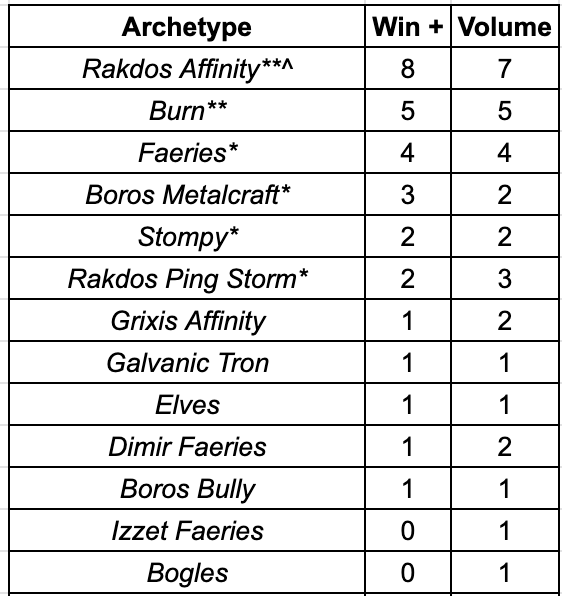
Pauper just had its first set of Challenges after the most recent bans and things turned out close to expectations with Dimir Faeries having an excellent weekend (including a win on Saturday) while Grixis Affinity (winning on Sunday), Bogles, and Boros all putting up solid results.

It is far too early to read too much into these results and the next few weeks should be informative with regards to the true metagame composition. Given what we have seen today I would expect Pestilence and Chainer’s Edict based board control to see a small surge in popularity and for Boros to figure out if it should be casting Battle Screech or Kuldotha Rebirth.

Pauper chatter in the past weeks has been dominated by discussions of power creep. The recent slate of releases, to listen to the discourse, are above the curve of what should be acceptable. Many of the cards released recently – the Bridges, Deadly Dispute, and Experimental Synthesizer – are cited as cause for alarm and representative of the recent upward trend in card strength. These cards are strong – do not get me wrong – but much of their power is not only contextual but they are also in line with cards released earlier in the format’s history.

For years Pauper was largely static. While new strategies would emerge they were often just updates or twists on existing archetypes or were decks that finally sprung forth under the weight of too much synergy. It is hard for any common printed today to compete with the likes of Lightning Bolt, Counterspell, Priest of Titania, the Tron lands, and so on and so on. And while new decks have come into being, they do so only after the final piece falls into place – I’m thinking decks like WonderWalls and Goblin Combo here.

Pauper, for years, has been defined by the format’s past rather than its present.

This issue is being exacerbated today thanks to Affinity. If you look at a list of “all time broken mechanics” Affinity for Artifacts is pretty high on that list. Back when Pauper was first given a format filter on Magic Online the archetype was the source of the only banned card in Cranial Plating. Over the years the machine menace was held in check by the fragility of its mana base and the presence of cards like Gorilla Shaman and Ancient Grudge. All of this changed with the indestructible Bridges as now the main way to attack Affinity’s mana changed to Dust to Dust and Revoke Existence.

It’s easy to write but I want to be clear – the Bridges upended over a decade of play patterns. In the relative blink of an eye a deck went from fragile fringe monster to one that is defining the metagame.

Insert into the mix Deadly Dispute – a more or less strict upgrade on Perilous Research (a card which had already seen some play in Affinity) and Experimental Synthesizer, a card that ticks so many Pauper boxes in that it provides both material and card flow. And so Affinity has come out of the shadows and has established itself as one of defining elements of Pauper.

The result is a lot of clamor, and rightfully so. In the span of two years the relatively stable Pauper metagame has been upended by powerful additions. However, prior to Modern Horizons 2 a lot of the power was added to decks that were already powerful. Arcum’s Astrolabe added strength of Monarch and Tron strategies while Mystic Sanctuary was yet another broken blue card. Fall from Favor added muscle to Faeries and Monarch. Even Ephemerate – a single card engine that remains legal – is just an improvement to Ghostly Flicker. And while these cards have all earned some vitriol, it’s drastically different than the hate Affinity is getting these days, and that may be because it has changed the way the format plays out.

Savage Swipe was a card that got a lot of flack when it was printed. Back before Stompy fell off the face of the planet, Savage Swipe was bemoaned as a card that gave the mono green deck a tool that was not already at its disposal and earned a lot of cries of “this is bull s[p]it!”.

Pauper, as a format, is more comfortable when there are incremental (or not-so-incremental) improvements made to established top decks when the general play patterns are still in place. When new cards change the way the game is played on the table (or screen), there is a bit more rabble rousing.

What should Pauper be? Should it be a format of slow, plodding change where certain decks have a historical advantage, or should it be a place where new cards are exciting and can change things? To me there should be a middle ground, where new cards more regularly make waves but maybe not ones of the tidal variety.

If you like my more hardcore Pauper content, consider supporting my work via Patreon. Rewards start at just $1 and every little bit helps!

One Engine Just Won’t Do

The March 5-6 Pauper Weekend Recap

There were Challenges on Saturday and Sunday this weekend, but the results are now a relic thanks to Monday’s bans that will take Galvanic Relay Storm out of the format and require Affinity to reconfigure itself. The chart below represents every deck that had at least 5 Top 32 finishes or a Top 8 finish in the four weeks of Neon Dynasty season before the bans took effect:

Despite Affinity and Storm getting a ton of the press (and rightfully so), both Bogles and Bully had very strong showings over the past few weeks. But that’s more a footnote in the story rather than the driving narrative. The truth is that Affinity and Storm set the pace for the past four weeks. The hope is that the changes the Pauper Format Panel enacted will help to diversify the top of the metagame.

Full disclosure: I am a member of the Pauper Format Panel and had a hand in the decision process.

Watching the discussion in the wake of the format update, a few cards came up more than a few times: Deadly Dispute and the Modern Horizons 2 Bridges. These cards were cited as recent additions to Pauper that are exacerbating underlying issues. The Bridges help to fuel Affinity’s starts while also having play in Cleansing Wildfire shells as card draw and acceleration; Deadly Dispute takes a tried and true method of extracting value in Pauper and kicks it into another level thanks to the residual Treasure.

I believe both of these instances are additive to the format but I want to take some time to discuss Deadly Dispute and its place. Dispute is highlighting something that has been true about Pauper for the past several months (if not years) but has not been called out and that is that if decks want to do battle on the axis of card advantage they now require two engines to do so.

What do I mean by an “engine” here? Roughly speaking, an engine is anything in Magic that converts resources into other resources, often at an advantage. Tron is a mana engine in that it takes three pieces to increase the reasonable output of three lands; Affinity is also a mana engine of sorts. Monarch and Ninja of the Deep Hours are both card advantage engines but a card like Moon-Circuit Hacker is more of a card selection engine.

Let’s take a look at Flicker Tron during the height of its powers. Tron had multiple layered engines, all fueled by the mana provided by Tron. Perhaps the most obvious one was the Ghostly Flicker Engine, which was later replaced with an Ephemerate Engine (itself two separate engines), combined with a Mystical Teachings engine. The result was a deck that once it got online could generate value at a rate that far outpaced most of its contemporaries. And really, it heralded the next era of Pauper deck development, but it would take a few years for the format to catch up.

Deadly Dispute stitches together a few engines that have existed in a way that pushes them to new heights. The Kor Skyfisher engine – that is the one behind nearly every build of Boros for the past decade – leverages cantrip artifacts to eke out extra value and also got a new toy in Experimental Synthesizer. Deadly Dispute pairs this with the already strong Affinity/Metalcraft mana engine by leaving behind a Treasure token, generating the more cards than Glint Hawk and an artifact but also leaving behind spare mana as opposed to a threat. It is not that Deadly Dispute is something entirely unprecedented but rather it is an optimized version of something that has existed in other colors.

Faerie strategies were often the target of ire due to their interwoven engines. Ninja of the Deep Hours could provide a steady flow of cards when coupled with removal but the addition of the Monarch provided these decks with another “free” way to draw cards. Compare this to the Boros Monarch decks which used an older version of the Kor Skyfisher engine to bridge to Monarch.

Then there’s Ephemerate which is a raw card advantage machine with Mulldrifter and a tutor engine (in a fashion) with Mnemonic Wall effects. People often say that Ephemerate is an engine unto itself and that is somewhat true, but it is just more compact than other similar packages and is far more mana efficient. It either self sufficient or layers neatly onto another engine (like Cleansing Wildfire and the Bridges).

So what good is this knowledge? First, it can help inform those who like to brew. If you are looking to try a new midrange or control strategy you need to be prepared to either have your own overlapping engines or have a way to negate at least one of your opponent’s. Similarly if you are trying to go under you need to establish a game plan for fighting against card advantage on multiple axes. This might mean going the route of Boros Bully and adding a way to filter away useless cards (Faithless Looting) or take the Bogles route and add a light touch of selection (Commune with Spirits). Even Slivers has an engine these days in Winding Way/Lead the Stampede.

This may help to explain why Stompy struggles so mightily these days – it is a deck without a secondary engine and no easy way to add one; even Burn gets some selection in Needle Drop and Voldaren Epicure.

A personal aside: this may be why Tortured Existence is always on the outside looking in – in order to run its primary engine it needs a density of cards which leaves precious little room for a supplemental engine to find footing.

What do you think? Is Pauper now a format where two engines aren’t only better than one but are necessary in the current format if you aren’t trying to clock the opponent? What engines are under explored and which ones could make waves in the weeks until Streets of New Capenna?

If you like these kinds of deep dives into the underlying structure of Pauper, please consider supporting me on Patreon. Patreon provides me with the opportunity to dig into more esoteric and Pauper specific discussion. Rewards start at just $1.

The Shifting Nature of Pauper’s Card Advantage

Pauper is undergoing a radical change in the way card advantage flows and for the first time it is not clear what color is number one.

In order to understand what is going on it is important to first know that for the vast majority of Pauper’s history the best way to gain card advantage was to play blue. Deep Analysis, Compulsive Research, Mulldrifter, Ninja of the Deep Hours and even cards like Foresee and Probe were the ways to pull ahead. Other decks had to rely on creature based card advantage like Chittering Rats or Skirk Marauder to try and eke out value. And while blue continued to add powerful options to Magic Online like Gush and Accumulated Knowledge, other decks could “go under” blue and win before the cards they accumulated could be converted into game winning pieces.

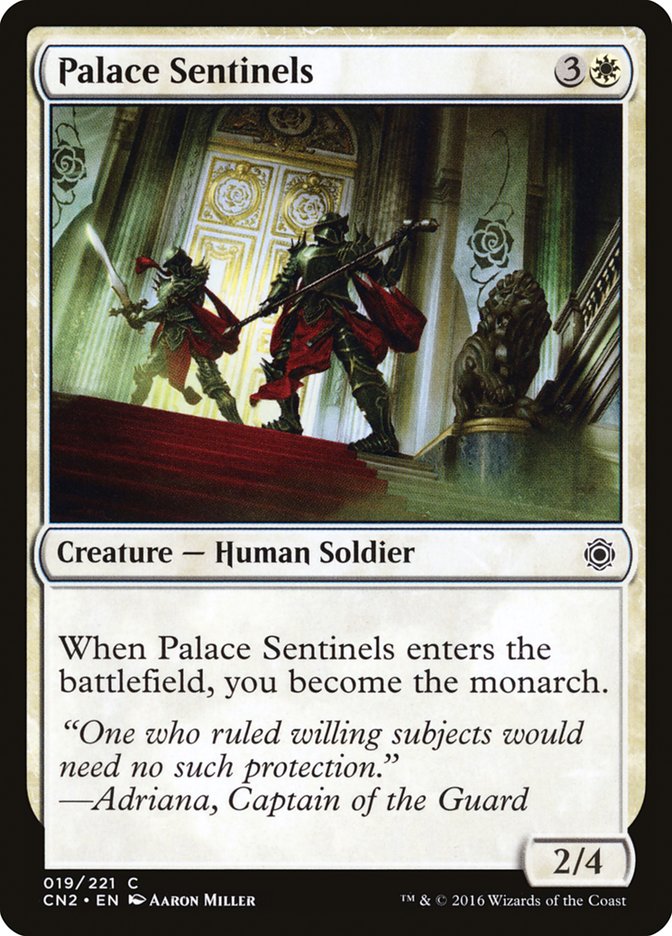
While some non-blue decks tried their hand at the card advantage game – namely Kuldotha Boros/Boros Kitty with Kor Skyfisher and Glint Hawk working with Ichor Wellspring and Prophetic Prism – it wasn’t until Modern Masters 2017 hit Magic Online that we saw our first major shift in the card advantage paradigm with the introduction of the Monarch mechanic and Palace Sentinels. Now white-based midrange decks had a reliable way to accrue resources but with one major advantage: they did not have to expend mana to get the cards.

Let’s compare these two strategies. Blue decks had relied on both instant speed methods of card accumulation, like Mystical Teachings chains or Think Twice, or the “tap out” method of cards like Compulsive Research or Mulldrifter paired with Undying Evil or Momentary Blink. In order to facilitate this, blue decks either played a Flash or Skies game or were paired with cheap interaction to buy time until their card draw engine could come online and dominate the game with hard to remove threats like Spire Golem or Shimmering Glasskite. Now the best tap out way to accumulate cards was by pairing the Monarch with cheap removal since it would generate cards turn after turn.

This was a seismic shift. Blue decks were no longer the only game in town and while “tap out” decks persisted, the most successful decks in this era (that went unbanned, we don’t talk about Treasure Cruise or Gush) were Delver or Faeries decks – the ones that evolved from Skies. Mulldrifter decks also persisted but they cheated on mana in some way, whether that was with Tron or in the Familiars shell. In order to effectively leverage the tap out nature, blue decks needed access to excess mana.

The Monarch changed all of that. Blue tap out decks had to expend early interaction in the hope of drawing two or three cards which meant that strategies designed to “go under” their wall could apply pressure. Monarch decks could spend the early turns trading off removal spells and blockers knowing that their engine, once online, would recoup most of their losses. Monarch decks excel at converting cards in hand into game actions starting on turn four or five. The nature of these play patterns made it difficult to beat Monarch decks with creatures until Savage Swipe came along but that’s another story.

The Monarch remains a hugely influential part of the Pauper environment and recently was adopted by the various Faerie decks. The newer breed of Faeries had access to it all: great card selection early, cheap interaction, and snowballing card advantage with Ninja of the Deep Hours and their Monarch of choice.

All of this changed in 2021.

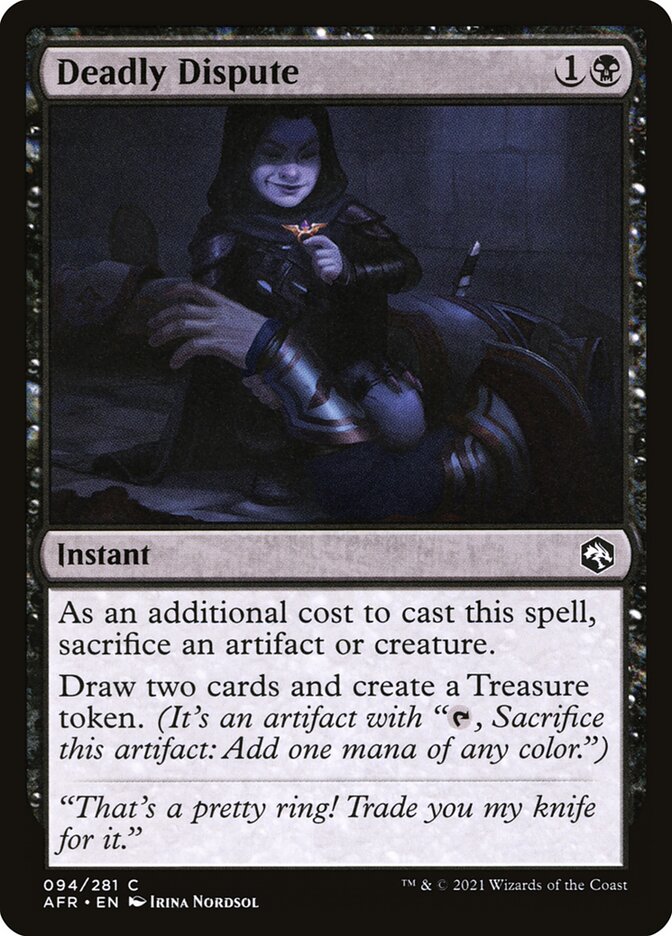
Deadly Dispute and Galvanic Relay (alongside Reckless Impulse and Experimental Synthesizer) changed the nature of card advantage in Pauper. Deadly Dispute hearkens back to the days of Kuldotha Rebirth sacrificing Ichor Wellspring. Now Dispute does the same job while also leaving behind a Treasure token acting as a black pastiche of Ancestral Recall. The red impulsive draw spells can store cards in exile, protecting them from already ineffective discard spells.

The shift might seem minor at first but the reality of the situation is that it has shaken the way card advantage works in Pauper. First with Deadly Dispute and similar (if less powerful) effects black now has the ability to play at a “flash” game, cashing in resources at the opponent’s end step or in response to removal for a burst of cards. This gives other decks access to the ability to untap with a fresh grip and deploy threats in a way it could not before. Storing cards in exile, specifically with Galvanic Relay, means a deck can accumulate an absurd number of cards and then deploy them on the next turn. This gives Storm decks an advantage in that they can keep their win hidden from interaction for a turn cycle and preventing counterplay. Compare this to blue card draw which is bound at the time of casting, or Monarch which generates value turn over turn. Relay is akin to having the Monarch for ten turns but the cards only accessible for a single turn.

None of this is inherently good or inherently bad; rather they represent a shift in the way Pauper has to approach fights over card advantage. It is Carlos Romao’s Fact or Fiction innovation but in reverse – rather than fighting over the cards drawn it is correct, even more than before, to fight over the draw itself. Duress was already a card that had a narrow window of opportunity before becoming nigh useless and now it has less time to matter.

Still, there are ways to disrupt the new normal. The first, as mentioned previously, is early interaction. Duress might not be perfect but a well timed copy can still be devastating. Spell Pierce is also stronger now as it can either counter a spell outright or tax mana in a way that prevents the utilizing impulsive resources. All of this only matters if paired with a quick clock to pressure the opponent and so cards like Gurmag Angler and other options that can dodge Galvanic Blast and Snap are paramount. But it should be noted that given how much card draw is out there right now you do need to have a plan for what happens when your opponent stabilizes.

February 26-27 Pauper Weekend Recap

The February 26 and February 27 Pauper Challenges helped to clarify the current state of the format. While there is valid concern about the current Galvanic Relay Storm deck running around the format, the results are telling another cautionary tale.

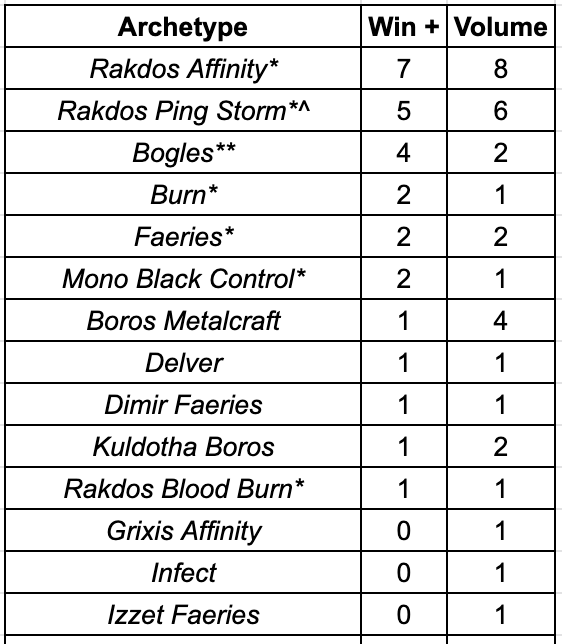
Rakdos decks – both Affinity and Storm – are helping to shape the format three weeks into Neon Dynasty season. But that’s only part of the story. Pulling back further we can see that one deck is currently driving the Pauper metagame like two go-karts going pedal to the metal.

All decks with at least 4 Top 32 finishes OR a Top 8 finish

Rakdos Affinity is the most popular deck and one of the most successful. It is taking down Top 8s at an impressive rate and shows no real signs of slowing down. The deck, like several others, is making use of the powerful Experimental Synthesizer as a way to see more cards and power out fast starts. Affinity may lack the quick combo kill of Atog-Fling but it can still end games by turning lands into damage with Makeshift Munitions and Disciple of the Vault.

Affinity is at least a deck that can potentially be mitigated. Rakdos Storm has the advantage of copious fast mana and Galvanic Relay, which is much closer to Mind’s Desire than I gave it credit for last summer. The ability to store spells and lands, including rituals, gives Storm the resiliency and consistency needed to overcome hate.

Taking a step back, the nature of card advantage engines in Pauper has shifted numerous times over the past five years. Before the advent of Monarch it was hard to beat blue decks for the ability to draw cards, either through Ninja of the Deep Hours, Mulldrifter, Gush (at the time), Thoughtcast, or many other lesser engines. Boros was able to keep up thanks to stitching together draws with Prophetic Prism and Ichor Wellspring, but it was an uphill fight. Black was clearly a step behind even with Sign in Blood.

The Monarch spread card advantage to other colors but once Dimir and Izzet Faeries adopted the mechanic, card advantage once again became the domain of blue decks. However the addition of Reckless Impulse, Galvanic Relay, Deadly Dispute and now Experimental Synthesizer have given other colors a solid foothold in the way cards are accrued.

None of this is to absolve Affinity and Storm of the problems they may or may not be causing. Instead Pauper is now entering an era where the old rules of card advantage battles are being rewritten. Where once cards in hand were the most important thing it seems that being able to “store” your cards on board (or in exile) is now the way to go. And fighting these methods requires different tactics, if they even exist.

Attacking cards like Experimental Synthesizer are easier in that if you time it properly you can leave the card stranded in exile. But even then you are trading down a card as the egg already “drew” one card. Deadly Dispute is much harder to stop since it can chew up various bits of material. And Galvanic Relay sidesteps all of this since the cards are unassailable.

Previously at this point I would talk about action Wizards could take. However given my role on the Pauper Format Panel I am not going to make suggestions lest they be taken as a way the wind will blow. What I will say is that this new era of card advantage presents an interesting puzzle and one that, if handled judiciously, could lead to a more robust and diverse format moving forward.

February 19-20 Pauper Weekend Recap

The post-Neon Dynasty metagame is starting to take shape and would you believe a one mana artifact is once again setting the Pauper world ablaze? Saturday’s Challenge saw Rakdos Affinity split the finals with Stompy while Sunday’s Challenge was taken down by Rakdos Storm. But when we look at the top of the metagame we see a format that is more and more defined by Experimental Synthesizer.

The best decks in the format right now are Rakdos Affinity, Rakdos Storm, and Boros decks. While not every Boros deck runs Experimental Synthesizer, many do and try to extract extra value from the egg through Glint Hawk and Kor Skyfisher. The Rakdos decks do something similar with Deadly Dispute and other sacrifice outlets. Experimental Synthesizer provides so much material for these decks while also keeping the cards flowing. It is also cheap enough that it can sneak under counter magic and removing it does not stop it from generating another card.

Over the weekend there were 29 copies of Experimental Synthesizer in both Top 8s; there were 28 copies of Deadly Dispute.

All of these factors, in conjunction with a ton of aggressive shells, has pushed Pauper to be a much faster format than it was a few weeks ago. This in it of itself is not a bad thing (for example, complaints about the Monarch have dwindled recently), but it is still concerning. While Synthesizer does not break the mana system like Arcum’s Astrolabe, a resolved Synthesizer represents at least three cards in the average case.

Part of this speed is due in no small part to the format being new again. Midrange and Control decks take time to adjust in the wake of new threats. Old answers are not nearly as good against the new triumvirate. The metagame was also skewed week one to beating Moon-Circuit hacker and we are only now seeing a course correction.

All decks with at least 3 appearances OR a Top 8 finish

So where does the format go from here? Trying to fight these decks on the Synthesizer axis is a losing battle as outside of Spell Pierce and Duress there are not a ton of proactive elements that are reasonable to run. That being said out of these two, Duress has more utility as a way to also delay Storm. Abrade also has utility as it not only hits every creature in Boros and many problem cards in Affinity, but it also can kill a Kessig Flamebreather.

Here is part of the puzzle: to fight these three decks requires an shift in the way people think about Pauper as a format. You cannot just hope to answer these decks once they are on the board because they play to the board better than just about anything else. Instead it is about disrupting their game plan at every step of the way in order to buy enough time to win. Here is where a deck like Death & Taxes could put in work but the closest thing Pauper has is Orzhov Rats which is fringe at best.

February 12-13 Pauper Weekend Recap

This past weekend saw the first Pauper Challenges where Neon Dynasty was legal. The set is jam packed with power and over the Saturday and Sunday Challenges seven new cards made the Top 32 cut.

In a surprise to almost no one, Moon-Circuit Hacker was the most popular Neon Dynasty card last weekend. Various Faerie decks – Delver, Dimir Faeries, Faeries, and Izzet Faeries – all ran the new ninja. Despite being obviously powerful, Faeries as a macro strategy struggled possibly in part because everyone knew it would show up.

When a card as clearly good as Hacker gets printed, it makes sense to either have a deck that beats Hacker or the best Hacker deck that beats Hacker and its predators. Last weekend it was the former that excelled.

Faerie decks were the most popular option on the weekend with 20 Top 32 finishes across the two challenges. However they only had 8 total wins above an X-3 record and two total Top 8 finishes. So what did well?

It should come as no surprise that both Affinity and Boros variants excelled in the world of Hacker. Boros is traditionally strong against Faerie strategies and Affinity, in its Rakdos variety, is perhaps the single most assertive deck in the format. Affinity saw 13 Top 32 finishes with 9 wins above an X-3 record (across two different builds) and had an impressive five Top 8s.

But Boros came out swinging. In 10 total appearances across four strategies – Boros Bully, Boros Metalcraft, Boros Monarch, and Kuldotha Boros – Boros had 13 wins above and X-3 record, six Top 8 finishes, and won both challenges. Part of this speaks to the versatility of the color pair but out of these 9 decks, 8 were aggressive. While it does not have Moon-Circuit Hacker it still has Kor Skyfisher which continues to do a great job of blocking Ninjas. Combine the veteran powerhouse with rookie sensation Experimental Synthesizer and you have a recipe for a ton of card flow in a shell that can also leverage Galvanic Blast. If I had to iterate on a deck for next weekend’s Challenges it would be Boros Metalcraft:

That being said I believe there is merit to exploring more controlling decks at the moment. While this first weekend featured a ton of assertive decks – that is decks trying to dictate the field of battle as early as turn one – so many of the best decks relied on one toughness creatures. A deck that can both resolve Eyeblight Massacre and handle Myr Enforcer (and friends) could make waves this weekend. That is a pretty big ask so it might be more reasonable to adapt one of the black based midrange decks to be stronger against Affinity.

That, of course, is a task in its own right.

Wrapping Up Crimson Vow Season

Let’s cut right to the chase. The following chart tracks the top decks from the post-ban Challenges except for one from late January that did not post. Decks in blue met the 2% threshold of at least 4 Top 32 appearances in that span. Decks in red have a Top 8 finish but failed to meet that same appearance threshold.

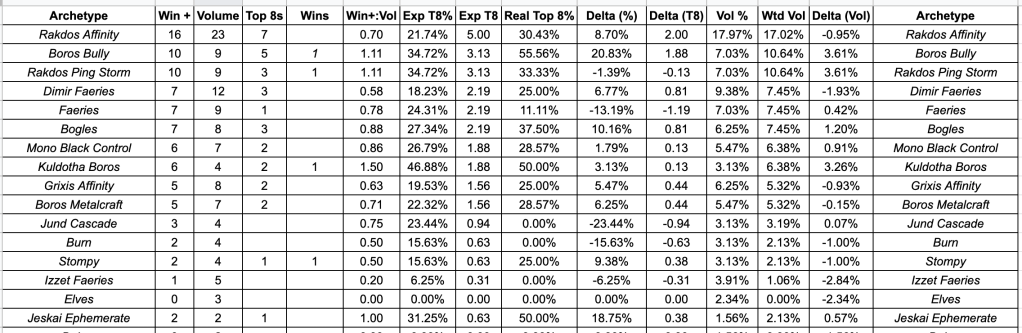
Affinity had a great stretch leading some to wonder aloud if the bans had any impact. Looking at Affinity’s combined volume here, it is below 20%. In the Crimson Vow Challenges before the ban Affinity combined to take down nearly 30% of the metagame. When it came to Weighted meta, Affinity topped 32% whereas here it is still under 20%. In other words, the bans did work in weakening Affinity without killing it outright.

With that out of the way, we can extrapolate from the top decks moving into Neon Dynasty season might be: Affinity clearly will remain a force in the format, as will Faeries and Boros Bully. Beyond that, things get murky.

Bogles could get a boost with the latest set thanks to an Enchantment-matters theme. Goblin Combo could add Experimental Synthesizer to the mix as a way to churn through their deck. Mono Black Control has the potential to put up results provided it can keep up with the metagame. And let’s not forget Faerie decks get another Ninja to add to the squad…

The future is far more fluid, however. Neon Dynasty is jam packed with powerful cards that could reshape the format just as easily as enhance existing options. I cannot remember a Standard legal set that had this much Pauper potential. While I am concerned that the rich are going to get richer once the new set hits digital shelves, I am just as optimistic that we are going to see a ton of new decks spring into existence.

January 22-23 Pauper Weekend Recap

The bans are in the books and we have a new format. The January 22 and January 23 Challenges were the first major events to take place since the ban of Atog, Bonder’s Ornament, and Prophetic Prism. Affinity won Saturday’s tournament while Cycling Songs took down Sunday. Here is a breakdown of the Top 32:

It is still too early to draw conclusions and realistically the format is likely to change again in a few weeks once Neon Dynasty hits the digital shelves. That being said there are a few nuggets of data worth exploring.

Affinity is alive and well

The goal of the Atog ban was to bring Affinity back to the rest of the pack. While it is only two tournaments, that seems to be the case at least in the early returns. Affinity is still a powerful deck but definitely lost a step. It will be interesting to see which build reigns supreme – already we’ve seen Glaze Fiend and Resculpt make appearances – but don’t skimp on your artifact hate just yet.

Where is Tron?

One of the critiques of the Bonder’s Ornament and Prophetic Prism ban was that it would hurt other decks more than Tron. However, Tron did not put up any result this weekend while Pestilence Control – one of the decks that was considered collateral damage – put up two strong finishes including a finals appearance. I don’t anticipate this being a regular occurrence. Instead once people figure out how to build Tron for the current metagame I fully expect it to make a return. I also anticipate Pestilence to take a decline as people adjust to fight Boros Bully.

Bullying the Metagame

Boros Bully appears to be the early deck to beat. It had a solid weekend and players are still figuring out the optimal composition of the deck. It is possible that as Affinity sees a decline Thraben Inspector can make a return. However if creatures are running rampant having an extra blocker in Lunarch Veteran might be just what the legion ordered.

The Crown in the Room

On Saturday 12 of the Top 32 decks were running the Monarch. On Sunday 16 of the Top 32 decks featured the mechanic. Overall that’s nearly 44% of the Top 32 metagame. Out of the Top 16 decks, 9 were running at least one Monarch enabling creature. While this is not a cause for alarm – the decks were relatively varied in strategy – it is something that should be noted if the trend continues for the next several weeks.

This is compounded by the fact that one of the strategies that can best leverage the Monarch are those built around Spellstutter Sprite. Dimir and Izzet Faeries combined for a dozen Top 32 finishes and went unscathed in the last round of bans. The question that remains is not whether or not these decks will succeed, but rather their win share. The reemergence of Stompy, at least for a moment, gives me hope that the metagame can apply enough pressure to Faeries to keep them in check.

But time will tell on that one.