What I’d Play Next Week: Mono-Black Control with Khalni Garden
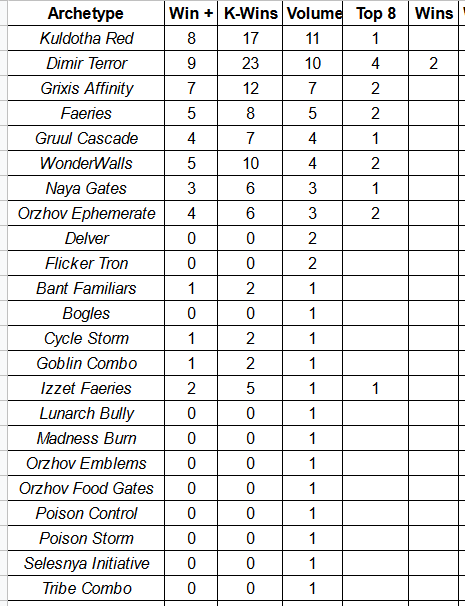
Win +: Measures all wins better than X-3 in Swiss (X-2 is 1, X-1 is 2, etc). Measures a deck’s relative strength against the field in that event
K-Wins: Measures all wins less all losses, Top 8 inclusive. Measures a deck’s strength in a winner’s metagame
Wondering where my long-form breakdown went? You can find it here on my Patreon!
Looking for another way to support my work? Click here for my TCGPlayer affiliate link. Any purchases through the link let the folks there know you like my content!
Live now on ChannelFireball, let’s make a SplinterTwin situation in Pauper. Check it out here.
I want to take a moment to thank all my Patrons – both old and new. I am going to do my level best to keep providing you with the kind of content that brought you here in the first place. If you are interested in supporting my work, rewards for my Patreon start at just $1 and every little bit helps.
Looking for another way to support my work? Click here for my TCGPlayer affiliate link. Any purchases through the link let the folks there know you like my content!
Win +: Measures all wins better than X-3 in Swiss (X-2 is 1, X-1 is 2, etc). Measures a deck’s relative strength against the field in that event
K-Wins: Measures all wins less all losses, Top 8 inclusive. Measures a deck’s strength in a winner’s metagame
Wondering where my long-form breakdown went? You can find it here on my Patreon!
Looking for another way to support my work? Click here for my TCGPlayer affiliate link. Any purchases through the link let the folks there know you like my content!
Win +: Measures all wins better than X-3 in Swiss (X-2 is 1, X-1 is 2, etc). Measures a deck’s relative strength against the field in that event
K-Wins: Measures all wins less all losses, Top 8 inclusive. Measures a deck’s strength in a winner’s metagame
Wondering where my long-form breakdown went? You can find it here on my Patreon!
Looking for another way to support my work? Click here for my TCGPlayer affiliate link. Any purchases through the link let the folks there know you like my content!
After twelve weeks, 24 Challenges, and one Super Qualifier, The Brothers’ War season has drawn to a close. This era started with the dominance of Affinity and Monastery Swiftspear and ends with both diminished but not extinguished. Today I want to look at some of the big storylines throughout the course of the season and prognosticate on what might be coming next.
A quick aside: While I am a member of the Pauper Format Panel, I see my role on this page as one where I talk about the format from the perspective of a player. The suggestions I make here are made with the intent to provide different ways to approach the format that may yield you success. Good? Good.
A second aside on terminology: I use a few different metrics when looking at the Top 32 metagame. The first is just Raw Volume. The second is Win+, which takes the sum of all wins at X-2 or better in the Swiss and assigns a score; Win+ is helpful in measuring a deck’s Swiss round performance. K-Wins takes all of a deck’s wins and subtracts its losses, Top 8 inclusive; this helps to give a measure of overall performance. The final is one I call True Volume, which takes the average of all three volumes (Actual, Win+, K-Win). This number helps to provide the most robust image of a deck’s performance in the metagame.
Affinity
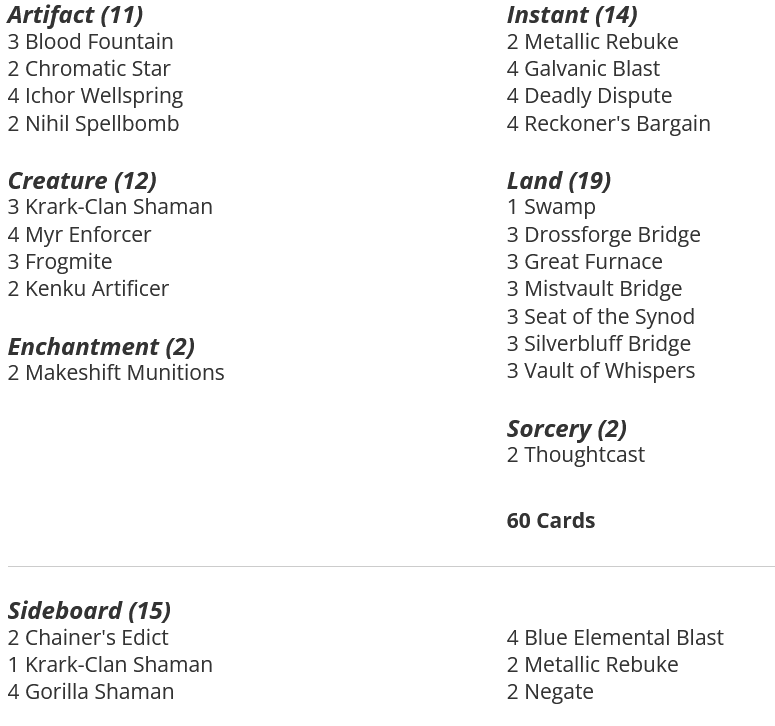
Affinity was the most popular archetype over the course of the season with 18.62% of the Top 32 metagame and a True Volume of 19.36% once the dust settled. It had 35 Top 8s and 6 Wins in 146 Top 8s. The deck is a veritable monster and is overall the best deck in the format. Part of this is how flexible the deck is in construction as it can shift from aggro to midrange to control by switching a few cards. It also has one of the best long games thanks to Blood Fountain and Makeshift Munitions while seemingly never running out of cards due in part to Thoughtcast and Deadly Dispute. The deck is, in a word, Good.
But that’s not the whole story. After the first four weeks Affinity was holding on to 21.89% of the True Volume; that number dropped to 18.44% over the second four weeks; the final four weeks saw Affinity with 15.05% of the True Volume. Now Affinity did have spikes during the decline (a 30.63% True Volume on the weekend of January 21-22) but this downward trend has been overall, steady. That is not to say that Affinity can be ignored – far from it -but rather that the metagame may have started to fully adjust to the new normal.
Part of the frustration with Affinity is how many ways it can kill. While the aggressive strategy of old has largely been set aside that does not stop Affinity from drawing three Myr Enforcers and deploying them on turn three. And it can still play for the long game, grinding things to dust under Blood Fountain and Makeshift Munitions. The deck does not only change from player to player but different draws can yield different results. Moving into Phyrexia: All Will Be One season I would focus on trying to constrain Affinity on threats. While this means you could very well lose to the high variance aggro draws, targeting their recursion and long game is a path to victory IF you are able to capitalize on the bought time. This is one reason I am not a huge fan of Dust to Dust in a vacuum – it does nothing to advance your own board and only attempts to slow them down. If Pauper is an assertive format than we should look for counter-play that is inherently proactive or flexible. I know starting with the new season I am going to be looking more at cards like Destroy Evil and Eaten Alive since they can do more than just send a creature to the graveyard.
Kuldotha Red
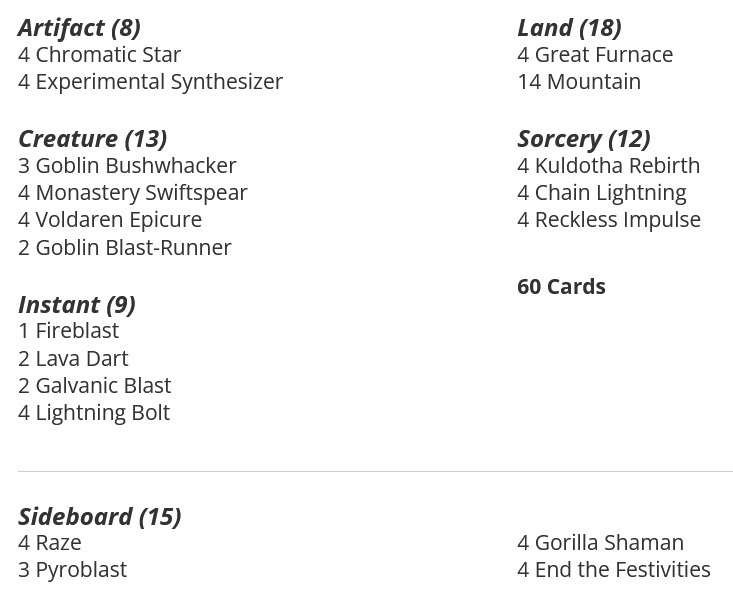
Kuldotha Red was the second most popular deck over the course of the season with 14.29% of the Top 32 metagame and 13.13% True Volume. It had a more volatile go of things. The deck started with 12.12% True Volume over the first four weeks only to surge to 18.34% in the second four week chunk before plummeting to 7.74% over the final month. Despite how quickly it can get to the board, Kuldotha Red suffers when blockers can absorb blows and there’s a persistent source of life gain. Some decks have started to adjust to this with Goblin Blast-Runner but even with that innovation the deck has settled into the “pretty good” range.
That doesn’t change how demoralizing it is to lose to those Monastery Swiftspear draws. Swiftspear changes the texture of every game in which it makes an early appearance and has forced the metagame to adjust. It is possible to play a more controlling game these days but an early answer to a red one drop has never been more important. None of this means you cannot take the first turn off to set up your mana or develop your own board, but it does mean you need a plan on how to contain the red deck moving forward.
What does this look like? I’ve extolled the value of getting on board with cards like Thraben Inspector and Dawnbringer Cleric, but answers like Flame Slash or Dead Weight can work as well if you are able to continue to develop a board that can absorb damage. It is not about playing defense forever but rather establishing a foothold before turning the corner.
Dimir Terror
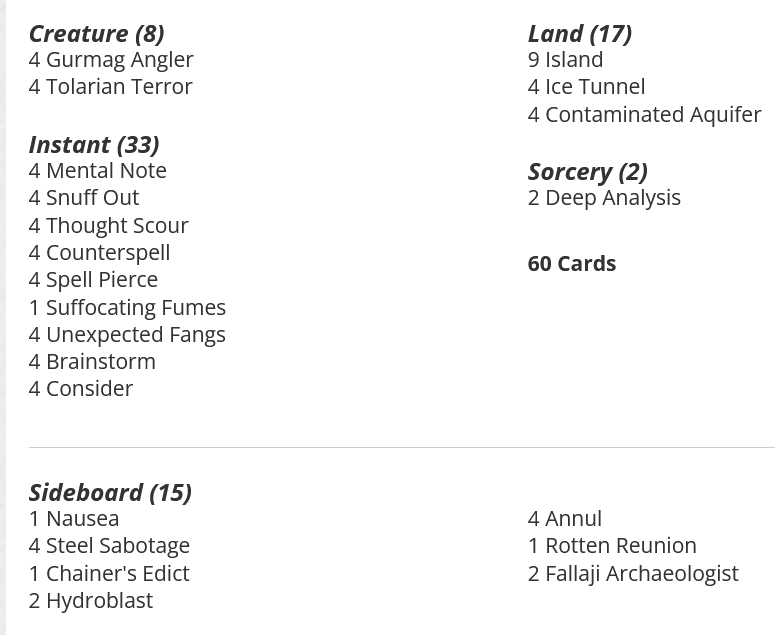
It’s hard to believe a deck that can easily slam multiple 5/5 creatures in the first few turns of the game can fly under the radar but here we are. Over the entire season Dimir Terror made up 11.99% of the Top 32 metagame and finished things out with 12.05% True Volume. The True Volume was close to 14% for the first four weeks and the second four, but dropped to 7.74% in the final third of the season. Dimir Terror can easily play a “flash” game, holding up interaction and card filtering until it has can resolve a threat (or two) with Counterspell back up. 5/5s are larger than most of what Affinity can throw at it and when Unexpected Fangs makes an appearance it can keep pace with Kuldotha Red’s aggression.
The low threat density of the deck has been a consistent weak point of the deck. Despite their size, Gurmag Angler and Tolarian Terror do fall to Chainer’s Edict and the like. Any deck that can effectively block and trade can also prove troublesome. To counter this some pilots have taken to Crawl from the Cellar to recur threats. More recently Etherium Spinner has made an appearance as a way to provide another angle of attack. All told Dimir Terror is another strong deck but one that feels much easier to play against in Pauper, likely due to the fact that strategies of this stripe have historically been a contender.
Flicker Tron
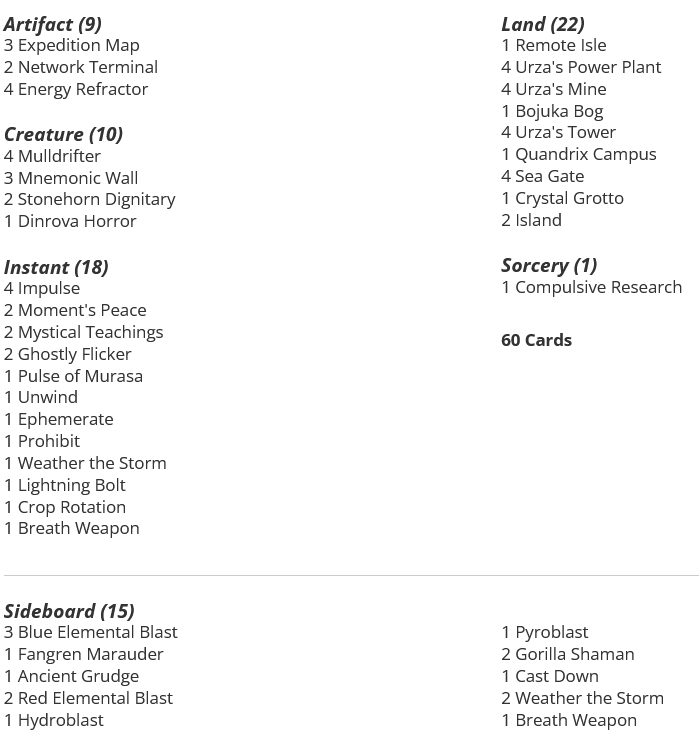
Energy Refractor has given Flicker Tron (sometimes called Control Tron, Fog Tron, or Teachings Tron) a new lease on life. The Prophetic Prism ban forced Tron to look for other ways to access discrete colors of mana and while the strategy never vanished it definitely took a hit. Eneregy Refractor might not be as mana efficient as Prism on the first activation but the fact that it can be used multiple times a turn (albeit at a loss) has been enough to bring the deck back in a meaningful way.
Flicker Tron’s True Volume has consistently outperformed its Raw Volume, meaning that when the deck does show up in the Top 32 it tends to be closer to the Top 8 than 16-32. It also has a fantastic Top 32 to Top 8 conversation rate, with 16 Top 8 finishes in 47 Top 32 appearances, with four of those Top 8 finishes ending in wins. The flexibility Tron’s mana affords the deck means that it can run Mystical Teachings and a wide array of potential answers. As the season wore on Affinity assumed a more midrange role while Tron was able to retake its position at the control end of the spectrum.
Tron still takes time to set up which means getting on the board early. Unlike the Red matchup, however, this is about applying pressure before Tron’s defenses can be set. Most builds are ready for this with multiple copies of Moment’s Peace and Weather the Storm in the maindeck, so the more consistent the pressure the better – that is until Tron is able to find the Mnemonic Wall/Ghostly Flicker package and then just grind you to dust.
Orzhov Ephemerate
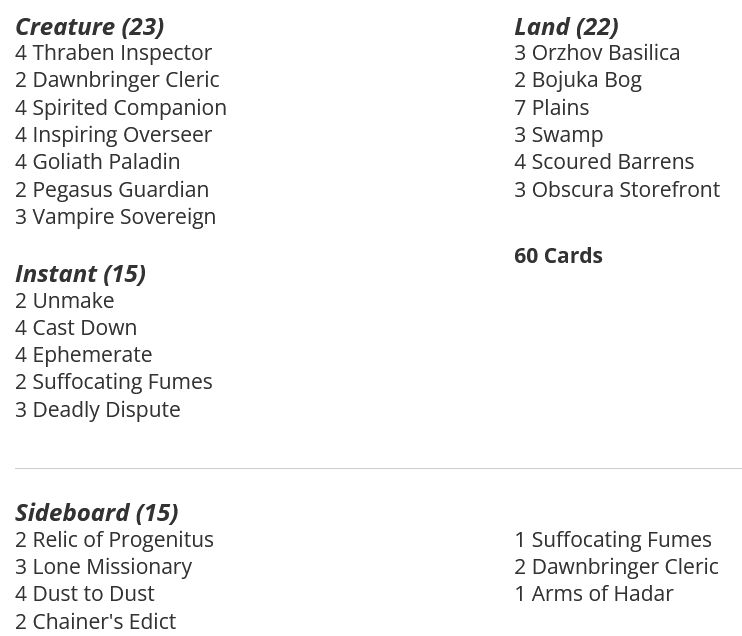
Orzhov Ephemerate made some appearances early in the season but really picked up steam during Week 7 (January 7-8) where it finished with two Top 8s. Since that point the deck has been on a bit of a heater, picking up nine Top 8s the final four weeks of the season. Even then it has underperformed its volume (11.76% of the raw metagame; 10.07% True Volume). Still, the deck does a lot of what the metagame asks for in being able to play to the board and set up defenses before establishing a suite of threats that can win the game. It also is one of the better decks at playing a fair Initiative game these days, which goes a long way in middle stages of a protracted attrition battle.
Orzhov Ephemerate is the latest in a long line of white midrange decks. Like many before it it tries to extract extra value from Thraben Inspector (and Spirited Companion) except it leans more on Ephemerate than Kor Skyfisher to do the rebuys. The deck is loaded with enters-the-battlefield effects that have an immediate impact and can throw away bodies that are past their prime with Deadly Dispute for new cards. Eventually it wants to take things over with either Goliath Paladin or Vampire Sovereign.
The deck suffers from the midrange problem of drawing the wrong half of the deck in the wrong matchup. It is not an exceptionally fast deck either and its velocity is somewhat expensive, meaning that it can easily fall too far behind the opponent. It also relies on relatively small creatures to get the job done and without access to Goliath Paladin its army can look rather meek in the fact of the other threats available. As people return to Breath Weapon, Fiery Cannonade, and Arms of Hadar, Orzhov Ephemerate could take a hit or adjust to running its own copies of Kor Skyfisher and Custodi Squire.
Basilisk Gate
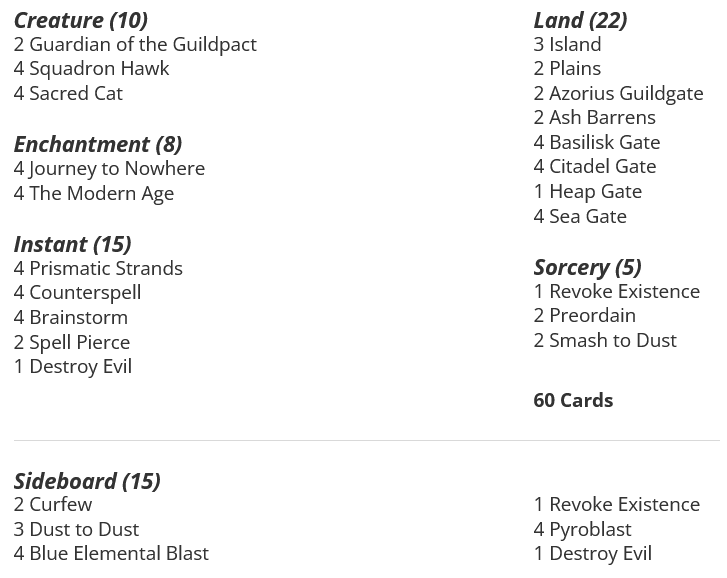
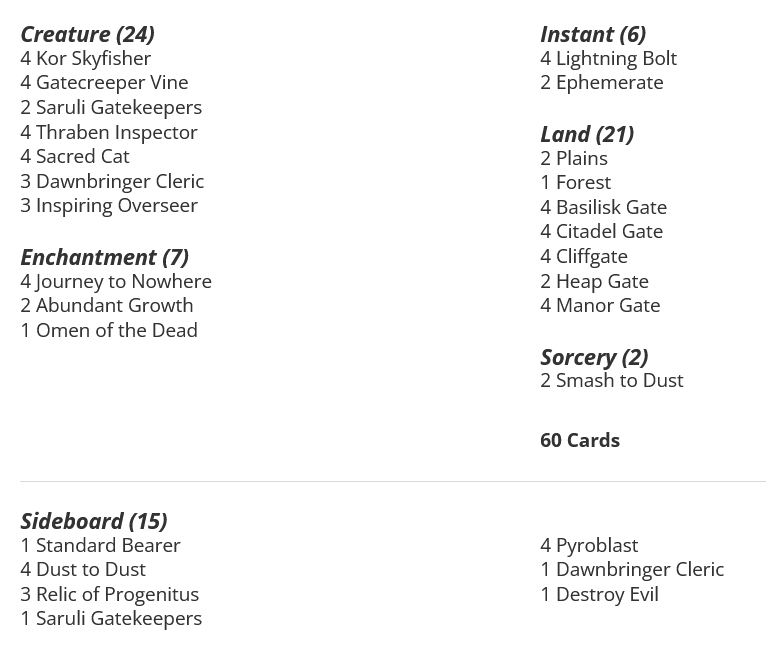
The last deck I want to highlight today is actually two decks: CawGate and Naya Gates. These decks straddle the control side of midrange, with CawGate assuming a more controlling role and Naya Gates playing a more true midrange game. Both decks tend to win with Basilisk Gate enhancing a threat and crunching through for massive chunks of damage.
CawGate is a blue and white deck that leans on some of Pauper’s history for its strength. Looting a Prismatic Strands into the graveyard is a common line used to be proactive on defense while using Guardian of the Guildpact as a plodding win condition is nothing new. CawGate is the first top deck to successfully pair Squadron Hawk with Brainstorm in Pauper, and putting Sacred Cat through the Basilisk Gate is positively terrifying. Naya Gates is more similar to Orzhov Ephemerate as it tries to extract more value from its creatures which include Gatecreeper Vine and Saruli Gatekeepers. If CawGate wants to stop you from resolving a meaningful threat, Naya Gates doesn’t care and wants to drag out the game so it can put victory out of the opponent’s reach.
Both of these decks are resilient in that their main win condition is a land. At the same time both have to run an abundance of tap lands which means they take time to get set. They are also reliant on creatures and instant speed removal can upset even the most well timed Basilisk Gate. Finally, Basilisk Gate is a mana intensive win condition and forcing them to interact at inopportune times can collapse their house of cards. Alternatively you can apply pressure early and prevent them from ever having the opportunity to spend mana on Basilisk Gate.
There are plenty of other viable decks in Pauper. Bogles, Cycle Storm, WonderWalls, and various Faeries builds all have merit. All that being said this Pauper is a very different format than the one from a few years ago. Whereas before you could easily take off a few turns to develop your game plan doing so now encumbers far more risk. Affinity and Kuldotha Red are not just assertive decks, they are good. Ignore the fact that they can get on the board quickly and start applying pressure at your own peril. This is new as previously some of the best assertive draws involved chaining together copies of Burning-Tree Emissary. Almost every deck in Pauper today has additional resiliency and Affinity and Red are not exceptions, so having a plan for the mid and late game is also important. Here’s how I would approach the next season of Pauper:
Have a plan for turns 1-3. This could mean playing to the board or holding up mana to answer threats. Hoping they don’t have it is not a plan.
The pinch point for toughness is 3. While Galvanic Blast is everywhere you’re more likely to face an early onslaught of Lightning Bolt and Chain Lightning, so getting down a creature with four toughness can do a lot to gum things up.
Removal is good, but removal that exiles is better. Between Blood Fountain, Sacred Cat, and Omen of the Dead, Pauper is a veritable zombie film.
Use your sideboard. Despite the apparent dominance of the two major archetypes, there is a lot going on in Pauper. Having a good sideboard that mixes flexible and hard answers can help you present the best possible deck for games two and three.
What is your plan for Pauper in Phyrexia: All Will Be One season? How are you planning on approaching the metagame and what new decks – or old strategies – do you expect to crop up?
I want to take a moment to thank all my Patrons – both old and new. I am going to do my level best to keep providing you with the kind of content that brought you here in the first place. If you are interested in supporting my work, rewards for my Patreon start at just $1 and every little bit helps.
Looking for another way to support my work? Click here for my TCGPlayer affiliate link. Any purchases through the link let the folks there know you like my content!
Today I explore what it means to move from a control-centered metagame to an assertive-centered format. Check it out here on ChannelFireball!
I want to take a moment to thank all my Patrons – both old and new. I am going to do my level best to keep providing you with the kind of content that brought you here in the first place. If you are interested in supporting my work, rewards for my Patreon start at just $1 and every little bit helps.
Looking for another way to support my work? Click here for my TCGPlayer affiliate link. Any purchases through the link let the folks there know you like my content!
Interested in picking any of these cards up? Click here for my TCGPlayer affiliate link. Any purchases through the link let the folks there know you like my content!
Win +: Measures all wins better than X-3 in Swiss (X-2 is 1, X-1 is 2, etc). Measures a deck’s relative strength against the field in that event
K-Wins: Measures all wins less all losses, Top 8 inclusive. Measures a deck’s strength in a winner’s metagame
Wondering where my long-form breakdown went? You can find it here on my Patreon!
Looking for another way to support my work? Click here for my TCGPlayer affiliate link. Any purchases through the link let the folks there know you like my content!
About six months ago I pitched something to my editor. I had been trying to find a way to write about Commander that played to my strengths and after bouncing a few ideas back and forth I came up with the concept that became this article. I would take successful or interesting tournament decks from Magic’s long history and expand them to 100 cards.
For whatever reason, it did not land. Getting Commander content to breakthrough is hard and I was going for something that was more narrow than that: I was looking for readers who were not only somewhat familiar with the history of competitive Magic, but also interested in Commander and had time to sit and read me wax nostalgic. So I guess you also had to be a fan of my writing.
Really trying to thread a needle here, eh?
Regardless, I still believed in the idea but set it aside. In the intervening months the website I wrote for shifted its priorities and asked me to write more Pauper focused content. Combined with the fact that my day job picked up steam and left me little time to play Commander this led me to set aside this project.
Today I am going to try to start it up again. Because if my own personal blog isn’t a good home for incredibly niche articles, then what am I even doing here?
To kick things off again, I am going to write about a deck that should be recognizable to anyone who, like me, wore out the 1998 US Nationals VHS tape. I want to talk about the Stupid Green Deck.
To fully understand this deck you also need to understand its moment in time. First, mana burn existed so a card like Eladarmi’s Vineyard could clock an opponent who had no use for green mana. Second, the old structure for US Nationals included tournaments colloquially known as Meat Grinders, where players could try to win a spot in the main event at these last-chance tournaments. Third, the internet was not nearly as prevalent as it is today meaning people who came with secret tech actually came with secret tech. This confluence of events meant that a strategy designed to beat specific parts of the metagame, if correctly predicted, could make its way to the big time. Now just because a deck performed well in the Meat Grinders did not mean automatic success in Nationals, but Stupid Green Deck did well and Bryce Currence placed in the Top 4, with a spot on the US National Team, with the archetype.
Stupid Green Deck is a midrange resource denial deck. Like so many strategies from the earliest days of the game it sought to deny the opponent any opportunity to play meaningful Magic. Winter’s Grasp and Creeping Mold would blow up opposing lands and given how few players were running green cards, Eladarmi’s Vineyard could eventually kill them. Stampeding Wildebeests and Wall of Blossoms provided a steady stream of card draw while Uktabi Orangutan could pick off opposing Cursed Scrolls – a very important card in its Standard. Spike Feeder could gain enough life to survive against the red decks of the day, which featured the same Cursed Scrolls alongside Jackal Pup, Fireblast, and Hammer of Bogardan, while Spike Weaver could fog attacks from White Weenie, which featured cards like Soltari Priest suited up with Empyrial Armor.
So how do you translate this from standard a quarter century ago to modern Commander? The first step is breaking down the deck into more appropriate buckets. If we’re talking Commander, the Stupid Green Deck is part Group Slug, part Stax, and part +1/+1 counter theme.
STAX
Stax is a strategy where you use various permanents to deny your opponents access to their resources. Stax strategies require serious redundancy since a single piece can be disrupted. Stax decks tend to make use of permanents since their effects persist. Mana denial is one such angle of attack and can be seen in cards like Winter Orb and the on-color Root Maze. Both of these can translate to the Commander version of the deck since green wants to lean on mana elves anyway. Static Orb, however, is probably a terrible fit unless you’re going to be running Seedborn Muse and Wilderness Reclamation as a way to break the parity (and let’s face it your totally should). Green lacks mass land destruction on par with Armageddon so leaning into the Creeping Mold aspect of the deck is largely a dead end. However Hall of Gemstone could be a way to disrupt your opponents by cutting them off of key mana on your turn. Collector Ouphe and Runic Armasaur can also do some work in this regard, while Hermit of the Natterknolls, Heartwood Storyteller, and Arasta of the Endless Web can punish the rest of the table for attempting to play the game.
GROUP SLUG
Unless you decide to go full Jund with Yurlok of the Scorch Thrash, using Eladarmi’s Vineyard to slowly bleed opposing life totals is likely to fall flat. Also, this is Commander and there’s definitely going to be something they can sink that mana into. No, I think the way to go is to lean into Heartwood Storyteller and give your opponent’s all the cards they can muster. Then using creatures like Viseling, Psychosis Crawler, Multani, Maro-Sorcerer, and Sage of Ancient Lore go ham on life totals. Multani also slots in nicely as a potential commander if you can figure out that entire lack of trample business. If you want to lean harder into punishing your opponent’s draws you can touch black for Fate Unraveler, Shelodred, the Apocalypse, and go off book with Dina, Soul Steeper at the helm.
A not so secret part of this deck’s success was using Stampeding Wildebeests to rebuy Wall of Blossoms and Wall of Roots. In Commander you also get access to Stampeding Serow, Roaring Primadox, and Temur Sabertooth. The cards can flow easily with Elvish Visionary, Llanowar Visionary, and Multani’s Acolyte. There’s also the value train of Eternal Witness and Timeless Witness and a near endless supply of Reclamation Sage effects – although Manglehorn might be the best fit since it also plays into the Stax theme. But really, there are so many creatures with enters the battlefield abilities that you can season this part to your taste.
So there you have it – a few ways to adapt the Stupid Green Deck from 1998 Standard to 2023 Commander. If I were going to build this I’d probably pick this creature as my Commander as it just feels right given everything else going on in the deck. How about you?
I want to take a moment to thank all my Patrons – both old and new. I am going to do my level best to keep providing you with the kind of content that brought you here in the first place. If you are interested in supporting my work, rewards for my Patreon start at just $1 and every little bit helps.
Looking for another way to support my work? Click here for my TCGPlayer affiliate link. Any purchases through the link let the folks there know you like my content!





You must be logged in to post a comment.