Commanding Stupid Green Deck

About six months ago I pitched something to my editor. I had been trying to find a way to write about Commander that played to my strengths and after bouncing a few ideas back and forth I came up with the concept that became this article. I would take successful or interesting tournament decks from Magic’s long history and expand them to 100 cards.

For whatever reason, it did not land. Getting Commander content to breakthrough is hard and I was going for something that was more narrow than that: I was looking for readers who were not only somewhat familiar with the history of competitive Magic, but also interested in Commander and had time to sit and read me wax nostalgic. So I guess you also had to be a fan of my writing.

Really trying to thread a needle here, eh?

Regardless, I still believed in the idea but set it aside. In the intervening months the website I wrote for shifted its priorities and asked me to write more Pauper focused content. Combined with the fact that my day job picked up steam and left me little time to play Commander this led me to set aside this project.

Today I am going to try to start it up again. Because if my own personal blog isn’t a good home for incredibly niche articles, then what am I even doing here?

To kick things off again, I am going to write about a deck that should be recognizable to anyone who, like me, wore out the 1998 US Nationals VHS tape. I want to talk about the Stupid Green Deck.

4 Llanowar Elves
4 Spike Feeder
4 Spike Weaver
4 Stampeding Wildebeests
2 Uktabi Orangutan
3 Wall Of Blossoms
4 Wall Of Roots
4 Winter’s Grasp
4 Creeping Mold
3 Desert Twister
4 Eladamri’s Vineyard
1 Survival Of The Fittest

15 Forest
4 Wasteland

Sideboard
4 Emerald Charm
2 Null Brooch
3 Scragnoth
4 Cursed Scroll

To fully understand this deck you also need to understand its moment in time. First, mana burn existed so a card like Eladarmi’s Vineyard could clock an opponent who had no use for green mana. Second, the old structure for US Nationals included tournaments colloquially known as Meat Grinders, where players could try to win a spot in the main event at these last-chance tournaments. Third, the internet was not nearly as prevalent as it is today meaning people who came with secret tech actually came with secret tech. This confluence of events meant that a strategy designed to beat specific parts of the metagame, if correctly predicted, could make its way to the big time. Now just because a deck performed well in the Meat Grinders did not mean automatic success in Nationals, but Stupid Green Deck did well and Bryce Currence placed in the Top 4, with a spot on the US National Team, with the archetype.

Stupid Green Deck is a midrange resource denial deck. Like so many strategies from the earliest days of the game it sought to deny the opponent any opportunity to play meaningful Magic. Winter’s Grasp and Creeping Mold would blow up opposing lands and given how few players were running green cards, Eladarmi’s Vineyard could eventually kill them. Stampeding Wildebeests and Wall of Blossoms provided a steady stream of card draw while Uktabi Orangutan could pick off opposing Cursed Scrolls – a very important card in its Standard. Spike Feeder could gain enough life to survive against the red decks of the day, which featured the same Cursed Scrolls alongside Jackal Pup, Fireblast, and Hammer of Bogardan, while Spike Weaver could fog attacks from White Weenie, which featured cards like Soltari Priest suited up with Empyrial Armor.

So how do you translate this from standard a quarter century ago to modern Commander? The first step is breaking down the deck into more appropriate buckets. If we’re talking Commander, the Stupid Green Deck is part Group Slug, part Stax, and part +1/+1 counter theme.

STAX

Stax is a strategy where you use various permanents to deny your opponents access to their resources. Stax strategies require serious redundancy since a single piece can be disrupted. Stax decks tend to make use of permanents since their effects persist. Mana denial is one such angle of attack and can be seen in cards like Winter Orb and the on-color Root Maze. Both of these can translate to the Commander version of the deck since green wants to lean on mana elves anyway. Static Orb, however, is probably a terrible fit unless you’re going to be running Seedborn Muse and Wilderness Reclamation as a way to break the parity (and let’s face it your totally should). Green lacks mass land destruction on par with Armageddon so leaning into the Creeping Mold aspect of the deck is largely a dead end. However Hall of Gemstone could be a way to disrupt your opponents by cutting them off of key mana on your turn. Collector Ouphe and Runic Armasaur can also do some work in this regard, while Hermit of the Natterknolls, Heartwood Storyteller, and Arasta of the Endless Web can punish the rest of the table for attempting to play the game.

GROUP SLUG

Unless you decide to go full Jund with Yurlok of the Scorch Thrash, using Eladarmi’s Vineyard to slowly bleed opposing life totals is likely to fall flat. Also, this is Commander and there’s definitely going to be something they can sink that mana into. No, I think the way to go is to lean into Heartwood Storyteller and give your opponent’s all the cards they can muster. Then using creatures like Viseling, Psychosis Crawler, Multani, Maro-Sorcerer, and Sage of Ancient Lore go ham on life totals. Multani also slots in nicely as a potential commander if you can figure out that entire lack of trample business. If you want to lean harder into punishing your opponent’s draws you can touch black for Fate Unraveler, Shelodred, the Apocalypse, and go off book with Dina, Soul Steeper at the helm.

+1/+1 COUNTERS

If you play Commander, you don’t need me to go into too much detail here. Doubling Season, Hardened Scales, Renata, Called to the Hunt all help to increase the efficacy of the Spikes. Aquastrand Spider and Sporeback Troll can help to push this theme as well. You can even dip into the grimdark future for Clamavus as a way to give these creatures some extra oomph. Rishkar, Peema Renegade is a potential inclusion either in the 99 or the Command Zone but there’s also Yorvo, Lord of Garenbrig, which can doe some silly stuff with Animation Module.

REBUYS

A not so secret part of this deck’s success was using Stampeding Wildebeests to rebuy Wall of Blossoms and Wall of Roots. In Commander you also get access to Stampeding Serow, Roaring Primadox, and Temur Sabertooth. The cards can flow easily with Elvish Visionary, Llanowar Visionary, and Multani’s Acolyte. There’s also the value train of Eternal Witness and Timeless Witness and a near endless supply of Reclamation Sage effects – although Manglehorn might be the best fit since it also plays into the Stax theme. But really, there are so many creatures with enters the battlefield abilities that you can season this part to your taste.

So there you have it – a few ways to adapt the Stupid Green Deck from 1998 Standard to 2023 Commander. If I were going to build this I’d probably pick this creature as my Commander as it just feels right given everything else going on in the deck. How about you?

 Kurbis, Harvest Celebrant {X}{G}{G}

Legendary Creature — Treefolk

Kurbis, Harvest Celebrant enters the battlefield with a number of +1/+1 counters on it equal to the amount of mana spent to cast it.

Remove a +1/+1 counter from Kurbis: Prevent all damage that would be dealt this turn to another target creature with a +1/+1 counter on it.
0/0

I want to take a moment to thank all my Patrons – both old and new. I am going to do my level best to keep providing you with the kind of content that brought you here in the first place. If you are interested in supporting my work, rewards for my Patreon start at just $1 and every little bit helps.

Looking for another way to support my work? Click here for my TCGPlayer affiliate link. Any purchases through the link let the folks there know you like my content!

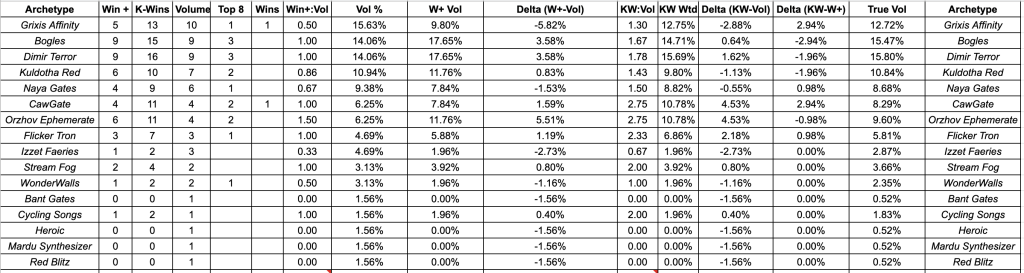
January 14-15 Pauper Winner’s Metagame Recap

January 14 and January 15 Challenge Top 32 metagame

Biggest Winner: Bogles

Biggest Surprise: Orzhov Ephemerate

What I’d Play Next Week: Mardu Synthesizer

Win +: Measures all wins better than X-3 in Swiss (X-2 is 1, X-1 is 2, etc). Measures a deck’s relative strength against the field in that event

K-Wins: Measures all wins less all losses, Top 8 inclusive. Measures a deck’s strength in a winner’s metagame

Wondering where my long-form breakdown went? You can find it here on my Patreon!

Looking for another way to support my work? Click here for my TCGPlayer affiliate link. Any purchases through the link let the folks there know you like my content!

Rumbling Crescendo – Bryant Cook

When I was thinking about this series I knew I wanted to get Bryant in early. He and I share a love of the New York Mets but also have similar taste in some music. I was excited to see his responses and I hope you are as well.

Tell us a little bit about yourself.

Hey there, I’m Bryant Cook. I’m the owner of theepicstorm.com, co-host of The Eternal Glory Podcast, and YouTuber — known for playing lots of combo decks.

Do you listen to music when you play Magic/create Magic content? Is it different from what you listen to for “fun”?

I don’t listen to music when creating, due to YouTube copyright laws it’s very difficult to make work. I’m mostly just with my thoughts, when I’m just playing in my downtime I do! It tends to be the stuff I enjoy in my daily life.

Can you share an album/track/piece of music that you want to share? Why did you pick this album/track/piece? (If it’s an album, what’s your favorite track?)

This music video hit me like a ton of bricks when I first saw it — connecting with two characters so deeply in 3:30. There’s a YouTube comment that has stuck in my brain for years that accurately describes them, “The Menzingers have a way of making me feel nostalgic for relationships I was never apart of” 

The Menzingers have slowly grown into my favorite band over the last decade, this is why I’ve selected them. Also, that music video is a work of art.

If people like this album/track/piece, what else should they listen to?

A little bit different, but I would also recommend Aaron West and the Roaring Twenties. Dan Campbell, the singer of The Wonder Years, made a side project where he wouldn’t have to sing about his own self but instead a fictional person — Aaron West. The music is a chronological story (so listen in order!) about loss, divorce, recovery and so much more. I would highly recommend. If you’re ever lucky enough to watch Aaron West and the Roaring Twenties in person, Dan Campell is in full character as well — it’s a sight to see.

Where can people find you?

linktr.ee/bryantcook 

Thanks Bryant!

I want to take a moment to thank all my Patrons – both old and new. I am going to do my level best to keep providing you with the kind of content that brought you here in the first place. If you are interested in supporting my work, rewards for my Patreon start at just $1 and every little bit helps.

Looking for another way to support my work? Click here for my TCGPlayer affiliate link. Any purchases through the link let the folks there know you like my content!
Rumbling Crescendo – An Introduction

The people who play Magic aren’t just Magic players. One thing the kept me engaged with the game for so long are the stories that were told about competitors at major events. Magic is a game but it can be so much more.

When I first started writing a blog, it took me forever to come up with a name. I wanted something that would include my hobbies which included games like Magic, World of Warcraft, and Star Wars RPGs as well as my love of ska and pop-punk. Going to high school in Brooklyn in the lat 90s/early 00s exposed me to the rise of Bomb the Music Industry! and the Long Island post-hardcore emo rise; I spent several hours watching BigWig opening for other bands at venues like Irving Plaza, Roseland Ballroom, and a basement venue called The Temple. One of the indelible moments of my life is when, moving to Buffalo for graduate school, UPS lost a single box: it contained most of my Magic collection and most of my CDs.

Fast forward to the age of digital music. For the past several years I’ve been a fan of If You’re Listening – a podcast where the hosts banter about albums that were important to one of them during high school (and beyond), and those of guests. A recent episode on Screeching Weasel really spoke to me and sparked the idea that became this series.

In Rumbling Crescendo I’m going to ask people in the world of Magic about music. How they interact with it and anything else they want to discuss. I’m excited to see how this goes and I hope you come along for the ride.

I want to take a moment to thank all my Patrons – both old and new. I am going to do my level best to keep providing you with the kind of content that brought you here in the first place. If you are interested in supporting my work, rewards for my Patreon start at just $1 and every little bit helps.

Looking for another way to support my work? Click here for my TCGPlayer affiliate link. Any purchases through the link let the folks there know you like my content!
January 7-8 Pauper Winner’s Metagame Recap

January 7 and January 8 Challenge Top 32 Metagame

Biggest Winner: Bogles

Biggest Surprise: Bogles

What I’d Play Next Week: Flicker Tron

Win +: Measures all wins better than X-3 in Swiss (X-2 is 1, X-1 is 2, etc). Measures a deck’s relative strength against the field in that event

K-Wins: Measures all wins less all losses, Top 8 inclusive. Measures a deck’s strength in a winner’s metagame

Wondering where my long-form breakdown went? You can find it here on my Patreon!

Looking for another way to support my work? Click here for my TCGPlayer affiliate link. Any purchases through the link let the folks there know you like my content!

Powerful vs Popular

I’ve had the opportunity to jump into a few league runs over the past few days and while my results are not where I’d like them to be (read: I’ve been losing more than winning), I have been learning a lot about the current lay of the land. Late Saturday night I posted the above statement, fully understanding that it would be inflammatory and dare I say it – click bait.

But I stand by it. Which leads to this post brought to you by the Sunday scaries.

If you hang out in the #MTGPauper Discord I manage for any amount of time you will no doubt come across conversation about the current prevalence of both Affinity and Kuldotha Red. The discussion focuses on play patterns, relative strength, and how often these decks seem to come up in both the League and Challenges. While neither of these decks have win rates that exist far outside the realm of “reasonable” they still are the target of ire.

Affinity is a monster of a deck which packs several draw twos, free threats, potent recursion and some serious reach. Kuldotha Red is another beast which leverages low to the ground threats with Monastery Swiftspear and an impressive burn package. The fact that both this decks are good has made them incredibly popular which means the variance one would expect to encounter playing against them is reduced due to sheer volume. In one run I face an Affinity deck three times in a row and even though they stumbled twice, I did not win a match in part because the variance was evenly distributed.

There’s something else at play here. The proliferation of power red “draw” like Experimental Synthesizer and Reckless Impulse has increased the consistency of hitting land drops outside of blue decks. Previously one of blue’s strengths was that it could use Preordain to run a low land count and still make critical drops during the early stages of the game. Experimental Synthesizer gives non-blue decks a chance to hit land drops more regularly giving increased strength to low land count red decks and strategies reliant on specific lands like Basilisk Gate.

I cannot understate this enough: red decks have an increased consistency of hitting key cards.

Something that has come up a lot in discussion is that you can no longer stumble and missing land drops is death. As someone who has played a ton against Delver and other Spellstutter Sprite strategies this is nothing new, but it feels dissonant when it happens against a deck packing a ton of Mountains.

So what can be done? At a player level it is all about being more consistent so that you do not stumble. This might mean running your own sculpting or a more robust mana base so that you can hit your own land drops and not fall behind in that regard.

At a format level, this is a tougher nut to crack. How does one balance for popularity as opposed to power? If a deck is popular and over the line then it is clear but what about when a strategy is above average (we’re talking in the 52-55% win rate, not 60% here)? Does it matter if the deck is popular or fringe in volume? Taking action based on raw volume is a risky path as you’d be playing whack-a-mole.

This is not meant to be a defense of Affinity or Red, and me posting this does not take away from the very real feelings of people who are taking a break from Pauper because they are not enjoying the format. What it is meant to be is insight into my observations and the thoughts currently rattling around in my braincase.

I want to take a moment to thank all my Patrons – both old and new. I am going to do my level best to keep providing you with the kind of content that brought you here in the first place. If you are interested in supporting my work, rewards for my Patreon start at just $1 and every little bit helps.

Looking for another way to support my work? Click here for my TCGPlayer affiliate link. Any purchases through the link let the folks there know you like my content!

Catching Up: December 24, 2022 – January 1, 2023

Top 32 Challenge Meta, December 17, 2022-January 1, 2023

Biggest Winner: Kuldotha Red

Biggest Surprise: Mardu Synthesizer

What I’d Play Next Week: Naya Gates

Win +: Measures all wins better than X-3 in Swiss (X-2 is 1, X-1 is 2, etc). Measures a deck’s relative strength against the field in that event

K-Wins: Measures all wins less all losses, Top 8 inclusive. Measures a deck’s strength in a winner’s metagame

Wondering where my long-form breakdown went? You can find it here on my Patreon!

Looking for another way to support my work? Click here for my TCGPlayer affiliate link. Any purchases through the link let the folks there know you like my content!

Transliteration: Playing Catch Up

Things have been hectic. When I wrote about Pauper mana bases over two months ago I anticipated the series becoming a regular feature on this here blog. Turns out life had other ideas and time was at a premium. But now as work slows down and I can find my footing once more now seems a good as time as any to tackle a subject that’s been rattling around in the ole’ brain case for a while.

Until recently Pauper was a format about accruing value over time. Cards like Preordain and its ilk would improve card quality while Ninja of the Deep Hours would allow you to pull ahead. Mulldrifter was the gold standard of burying your opponent in card advantage for years – so much so that before Ephemerate players would try to extract more value with Undying Evil – but the past few years has changed the nature of card advantage in Pauper.

First came the Monarch and really, Palace Sentinels which provided a steady stream of fresh draws. After that we got new forms of card draw in the shape of Deadly Dispute and then a game breaking in the Initiative. Now it was easier than ever to go up on resources and in many cases, it was also less of a challenge to deploy them. The decks that were able to pull ahead in this race could do so at an improved rate which further exposed an aspect of how games of Pauper play out: it can be very hard to catch up once you are behind.

How does one catch up in a game of Magic? If you are facing down an onslaught of creatures then Wrath is what you need; stuck in a control mirror and Sphinx’s Revelation can pull you ahead; midrange slogs can come down to who has a the better Planeswalker engine online.

An aside: The introduction of Planeswalkers, and therefore designing for an environment where they exist has had a profound impact on Pauper and the need for cards to have an immediate effect. This is a subject for its own post but it definitely merited mention here.

Pauper does not have access to these effects at the same clip and so for quite a lot of the format’s history the aggressive decks tried to race before the avalanche of cards put a stop to their advance.

Tortured Existence

Let’s start with engines – cards that convert one resource into another. Without access to true Planeswalkers Pauper had to rely on fragile ways of grinding out the long game. Tortured Existence is a fan favorite and Grim Harvest had its time in the spotlight as a way to recur threats. These were slow ways for creature based decks to keep up with card flow but compare this to something like the original Elspeth which could just continue to spit out tokens – one can pull you to parity (or even ahead) without nearly as much work. There are plenty slow engines in Pauper that can help win the game, but they are few and far between (Cenn’s Enlistment and Tilling Treefolk come to mind) but often times these are just worse than drawing more cards. The Monarch and Initiative also fill this role but come with the risk of giving that same advantage to your opponent.

Instead, the easiest way to try and pull ahead on the board is to, well, draw more cards and deploy them. As the card pool grows then more efficient cards will continue to be printed which in turn makes pure card draw that much better. Unlike other formats with powerful engines there are few incentives to actually play a value engine (damage engines are another story altogether).

Deep Analysis

What about card advantage battles? Deep Analysis remains one of the best ways to try and pull ahead. If the front half is countered there’s always the Flashback. But compare this to something like Magma Opus – Deep Analysis can help you claw back into a game but lacks the oomph to pull you ahead all on its own. This is part and parcel for Pauper as the effects are smaller by design. The result is that once you are behind on cards it can be extremely difficult to pull yourself back into a game. Consequentially it means that it is often correct to be as proactive as possible so that you do not find yourself in a space where you have to play catch up on cards.

This pushes the format towards cheap two for ones and lower curves. The ability to accrue more cards and then deploy them is a recipe for success. It follows from this that the Monarch was such a success for so long – free card draw and cheap spells was a winning combination until the Initiative came along and didn’t even ask you to cast a spell to garner an effect.

Krark-Clan Shaman

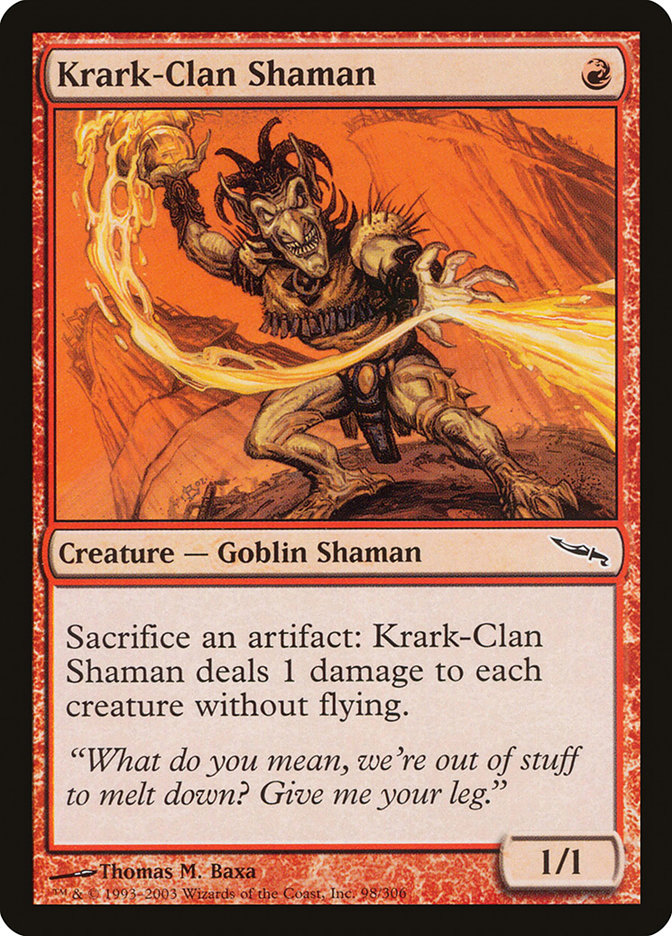
Until recently, board wipes in Pauper were not hugely impactful. Crypt Rats and Pestilence could keep a board clear at a heavy price and Electrickery was stellar and handling smaller creatures. Then came Fiery Cannonade, which put threw a real wrench into the works for traditional aggressive strategies. Still, some of these decks tried to go bigger and it worked (after a fashion). The lack of true board wipes meant cards like Moment’s Peace and Stonehorn Dignitary held value for their ability to hold back hordes. In these cases the control deck would need time to establish the win but if they were too far behind it could all be for nought.

I saved this one for last because currently it is not exactly the case anymore, at least when it comes to one style of board wipe. Krark-Clan Shaman has emerged as a real player in this area thanks to its ability to clear the ground (literally) and leave behind an army of Myr Enforcers and the like. The issue at hand is that unlike a board wipe in a traditional midrange or control deck, Affinity has the tools to easily reload and deploy threats almost immediately after wiping the board.

Another aside: It should start to be clear that Affinity is a deck that can do it all. It packs a ton of efficient card draw and cheap spells so that it can easily pull ahead. It has access to a few engines thanks to Deadly Dispute and Blood Fountain and as we already discussed a fantastic way to wipe the board. Affinity is a capital “B” Beast.

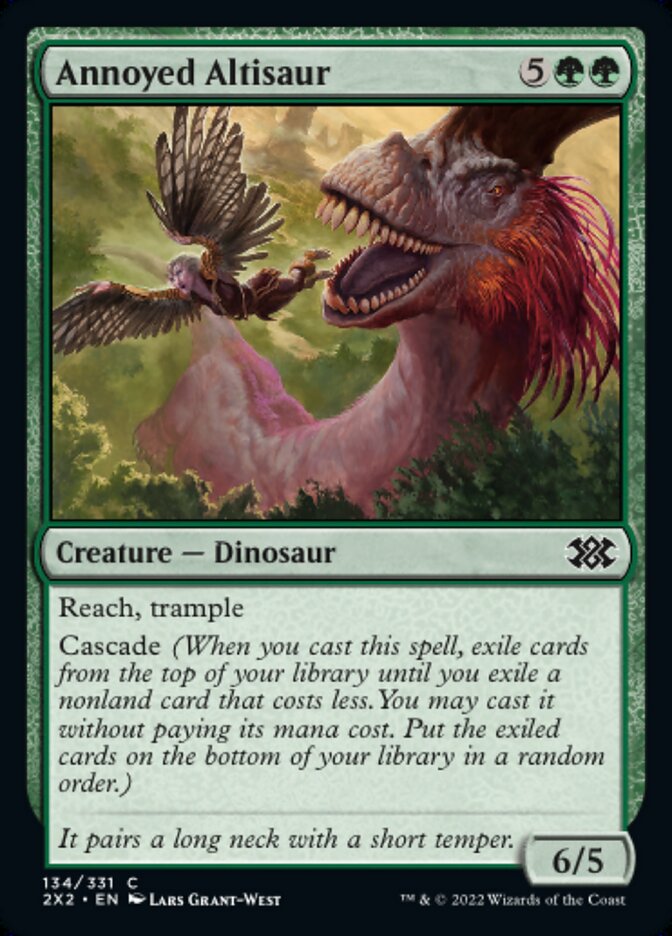
So what does this all mean? Outside of Affinity most decks rely on card draw to come back from behind. Basilisk Gate is a low (mana) cost damage engine that brings along a deck building restriction. However the reward for being able to turn it on is massive enough to plan around. Annoyed Altisaur has the capability of catapulting decks from behind to ahead provided it comes down early enough in concert with Arbor Elf and Utopia Sprawl. Other decks try to buy time with the aforementioned Stonehorn Dignitary, Moment’s Peace, or Prismatic Strands.

So what does this all mean? Where in other formats there are multiple options to pull ahead or come from behind given your deck’s overall game plan, Pauper has relatively few.

  • Pauper largely lacks board wipes, so time becomes an important resource
  • Engines are mostly inefficient aside with a few exceptions
  • Cheap card draw, threats, and answers are abundant so simply “drawing more” is a valid plan

While this last point can be extrapolated to other formats as well (one only needs to look at the busted card that is Expressive Iteration), the lack of other high impact incentives – whether that be Planeswalkers or prison-like pieces – also helps to push Pauper into a place where the best bet to getting ahead is to start there.

I want to take a moment to thank all my Patrons – both old and new. I am going to do my level best to keep providing you with the kind of content that brought you here in the first place. If you are interested in supporting my work, rewards for my Patreon start at just $1 and every little bit helps.

Looking for another way to support my work? Click here for my TCGPlayer affiliate link. Any purchases through the link let the folks there know you like my content!
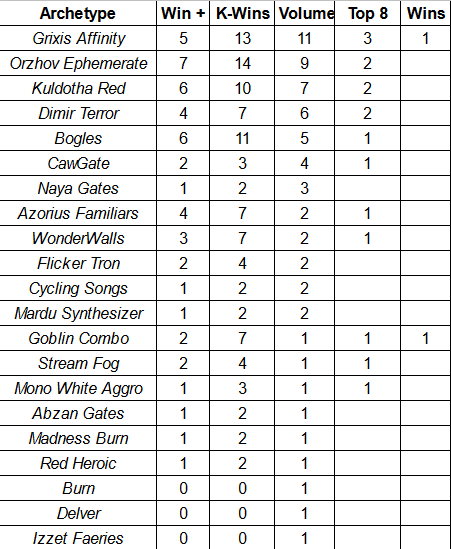
December 17-18 Pauper Weekend Recap

Top 32 Metagame for the December 17 and December 18 Challenges

Biggest Winner: Grixis Affinity

Biggest Surprise: Izzet Faeries

What I’d Play Next Week: Naya Gates

Win +: Measures all wins better than X-3 in Swiss (X-2 is 1, X-1 is 2, etc). Measures a deck’s relative strength against the field in that event

K-Wins: Measures all wins less all losses, Top 8 inclusive. Measures a deck’s strength in a winner’s metagame

Wondering where my long-form breakdown went? You can find it here (today’s is available to the general public), on my Patreon!

Looking for another way to support my work? Click here for my TCGPlayer affiliate link. Any purchases through the link let the folks there know you like my content!