December 2-3 Pauper Weekend Recap

I use a few different metrics when looking at the Top 32 metagame. The first is just Raw Volume. The second is Win+, which takes the sum of all wins at X-2 or better in the Swiss and assigns a score; Win+ is helpful in measuring a deck’s Swiss round performance. K-Wins takes all of a deck’s wins and subtracts its losses, Top 8 inclusive; this helps to give a measure of overall performance. The final pair is call Meta Score and Meta Score Above Replacement, which takes the average of Win+ and K-Win to try and position an archetype against its field. This number helps to provide the most robust image of a deck’s performance.

Pauper is not a time capsule.

I want you to keep that in mind for today’s post. In case you have not yet heard, Monastery Swiftspear has been banned in Pauper. You can read the reasoning behind this update (and some of the other changes that were considered) in this post authored by Gavin Verhey on behalf of the Pauper Format Panel. If you want some insight into my thoughts on the format moving forward you can read that here.

During the tenure of its legality Monastery Swiftspear had a massive impact on Pauper. At a gameplay level it helped to polarize the metagame, encouraging decks to either win quickly or drag the game out through any means necessary to ensure survival. As more options were added to the available card pool, Swiftspear decks went from defining the metagame to warping the format around their inclusion. Looking at this phenomena at a format level, it was one of the first times in recent memory that an aggressive deck was one of the top strategies available in Pauper.

Pauper is not a time capsule. At various points the best deck in the format has been a control deck, a midrange deck, or a combo deck. An aggressive deck being a top tier strategy might be different but in it of itself is not anathema. When any deck warps the format around it that is when things warrant attention.

In the wake of the announcement there were more than a few voices who expressed discontent. The criticism was that this ban did not go after the correct card. Instead many people discussed Kuldotha Rebirth and the duo of Reckless Impulse and Wrenn’s Resolve. The central concept of these arguments seemed to boil down to “red should not have card draw”. While Rebirth enabled red to go wide (something it has always been able to do), the recent strength of red pushed this Scars of Mirrodin card to another level. Thanks to the low cost of powerful red spells these cards were essentially too good for Pauper and should be banned to bring red back to the pack.

Is Wrenn’s Resolve that much better than Of One Mind?

Pauper is not a time capsule. Red has had access to this style of card advantage for nearly a decade even if it is a relatively recent addition to Pauper. As these cards will continue to see print red will continue to have new choices to make in deck construction and the format will have to adapt to these new play patterns. That being said if one of these spells ever approaches the egregiousness of Treasure Cruise then something might have to give.

One of the biggest complaints of Pauper before the advent of the Pauper Format Panel was that it could stay stagnant for too long; that the metagame did not change quickly enough if at all. Recent years have given other strategies time in the spotlight even as old standbys continue to see heavy play and often perform rather well. As I have said before, Pauper has shifted from a midrange format to, at least for now, one where being assertive matters as well. Pining for the game play of your favorite era is a fine exercise but Pauper’s future cannot be shackled to its past.

Where does that leave things today? Aggressive decks, whether they are red or powered by Affinity remain viable. Time will tell if the absence of Swiftspear opens up the pool of effective removal that can help blunt assaults in the earliest turns of a game. Slower decks are more viable but by how much remains to be seen. And as Gavin said yesterday, if things are not working the Pauper Format Panel is willing to take further action.

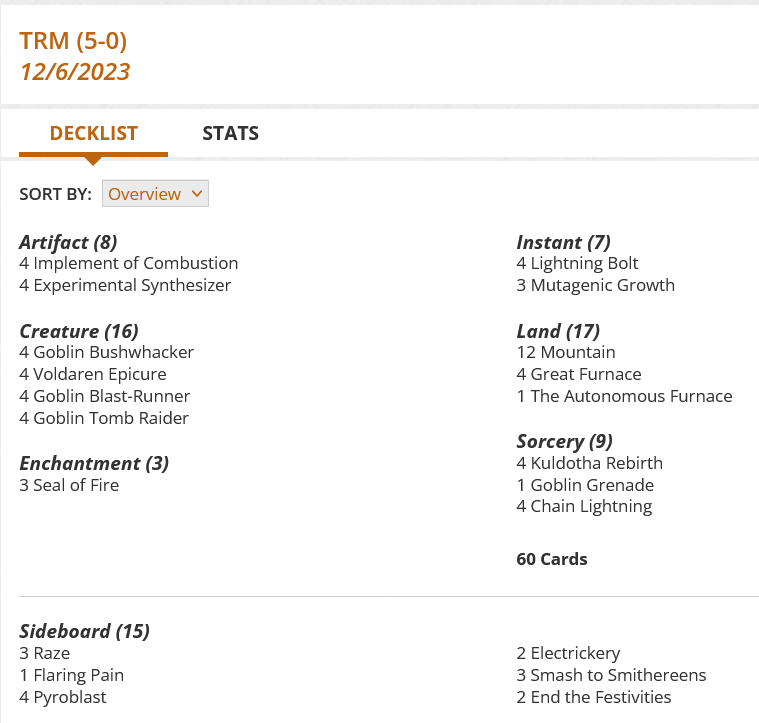
For now we are entering a different format. Kuldotha Red was far and away the best deck in Pauper during Lost Caverns of Ixalan season with an adjusted Meta Score Above Replacement of 0.95 (the next best deck was CawGate at 0.59). Red is not going anywhere but I don’t expect it to be this far ahead of the field. Instead it is likely to come back to the pack. I think CawGate and Black Gardens (aMSAR of 0.49) are going to be a step behind, at least early on, as they adjust to a world without Swiftspear. White midrange, whether Boros or Orzhov, likely have an edge in the early going by being chock full of generically good cards. In other words, you better have a plan for Ephemerate strategies in week one.

I want to take a moment to thank all my Patrons – both old and new. I am going to do my level best to keep providing you with the kind of content that brought you here in the first place. If you are interested in supporting my work, rewards for my Patreon start at just $1 and every little bit helps.

Can’t make a commitment to Patreon? I now have a Ko-Fi where you can make a one time contribution.

Looking for another way to support my work? Click here for my TCGPlayer affiliate link. Any purchases through the link let the folks there know you like my content!
Know Your Enemy: Red Decks

Today on ChannelFireball I talk about identifying decks that lead on Mountain. You can check it out here.

I want to take a moment to thank all my Patrons – both old and new. I am going to do my level best to keep providing you with the kind of content that brought you here in the first place. If you are interested in supporting my work, rewards for my Patreon start at just $1 and every little bit helps.

Can’t make a commitment to Patreon? I now have a Ko-Fi where you can make a one time contribution.

Looking for another way to support my work? Click here for my TCGPlayer affiliate link. Any purchases through the link let the folks there know you like my content!

Pauper League Highlights – November 29

The latest Pauper League result only showcased 24 deck lists and of those several subscribed to similar archetypes. So I guess it’s a good thing that this upcoming Monday the Pauper Format Panel will be making an update to the ban list. That doesn’t mean there aren’t decks worth exploring, so let’s get right to it.

3 Snap
4 Ninja of the Deep Hours
2 Force Spike
4 Spellstutter Sprite
1 Echoing Truth
3 Mutagenic Growth
4 Faerie Miscreant
4 Counterspell
2 Spell Pierce
17 Island
4 Faerie Seer
3 Of One Mind
3 Brinebarrow Intruder
4 Moon-Circuit Hacker
2 Snaremaster Sprite

Sideboard
2 Curfew
4 Hydroblast
3 Relic of Progenitus
4 Annul
2 Steel Sabotage

A few months ago (or maybe it was last year) a Magic player with Pro Tour Top 8 experienced posted about investing in a Pauper deck that they could invest in owning. They wanted one that was always a reasonable choice, if not the best. I suggested Faeries in part because it has stood the test of time but also because it always gets to pick up whatever new cheap blue cards get printed. Here we see Faeries still chugging along. Snaremaster Sprite might not be the flashiest card but it does fill a role and can help push damage. This build is looking to press that advantage, leaning into cheap narrow countermagic and Mutagenic Growth to both protect its creatures and seal the deal.

4 Tireless Tribe
2 Deep Analysis
3 Prismatic Strands
4 Ponder
4 Inside Out
2 Whiteout
4 Preordain
2 Dispel
3 Thraben Inspector
4 Circular Logic
1 Evolving Wilds
4 Ash Barrens
2 Glacial Floodplain
2 Snow-Covered Plains
10 Snow-Covered Island
4 Wedding Invitation
1 Loran's Escape
4 Fallaji Archaeologist

Sideboard
2 Gigadrowse
1 Piracy Charm
3 Peek
4 Hydroblast
2 Dispel
3 Benevolent Blessing

Inside Out Combo is a deck that has fallen from the top tier of the format to the fringe but, like Faeries, continues to acquire new options year after year. The idea is to get down and protect a Tireless Tribe and collect enough cards in your hand to get it up to a lethal amount of toughness. Then with Inside Out you can crash in for victory, aided by Wedding Invitation getting you through the door without a scratch. Circular Logic is fantastic here as a cheap (as long as you have Tireless Tribe) way to defend the combo and the kill. This deck was one of the best in the format before Gush was banned but now has to make due with blue’s other card draw and Whiteout. This green uncommon from Ice Age (downshifted in the Magic Online only Masters Edition 3) can easily be pitched to Tireless Tribe and then, provided you have enough Snow-Covered Lands, be brought back for the lethal swing.

I want to take a moment to thank all my Patrons – both old and new. I am going to do my level best to keep providing you with the kind of content that brought you here in the first place. If you are interested in supporting my work, rewards for my Patreon start at just $1 and every little bit helps.

Can’t make a commitment to Patreon? I now have a Ko-Fi where you can make a one time contribution.

Looking for another way to support my work? Click here for my TCGPlayer affiliate link. Any purchases through the link let the folks there know you like my content!

November 25-26 Pauper Weekend Recap

I use a few different metrics when looking at the Top 32 metagame. The first is just Raw Volume. The second is Win+, which takes the sum of all wins at X-2 or better in the Swiss and assigns a score; Win+ is helpful in measuring a deck’s Swiss round performance. K-Wins takes all of a deck’s wins and subtracts its losses, Top 8 inclusive; this helps to give a measure of overall performance. The final pair is call Meta Score and Meta Score Above Replacement, which takes the average of Win+ and K-Win to try and position an archetype against its field. This number helps to provide the most robust image of a deck’s performance.

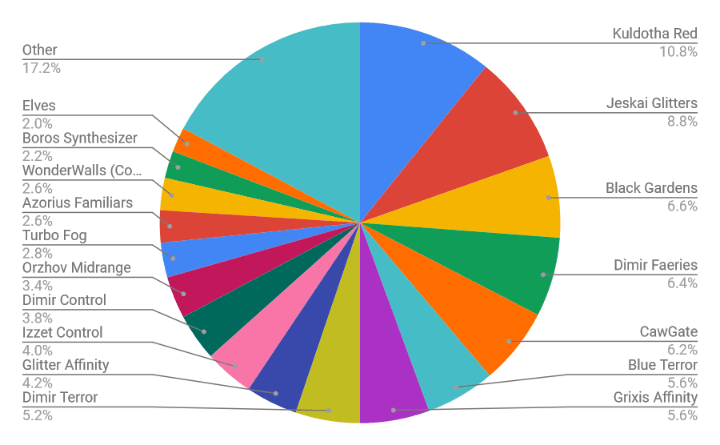
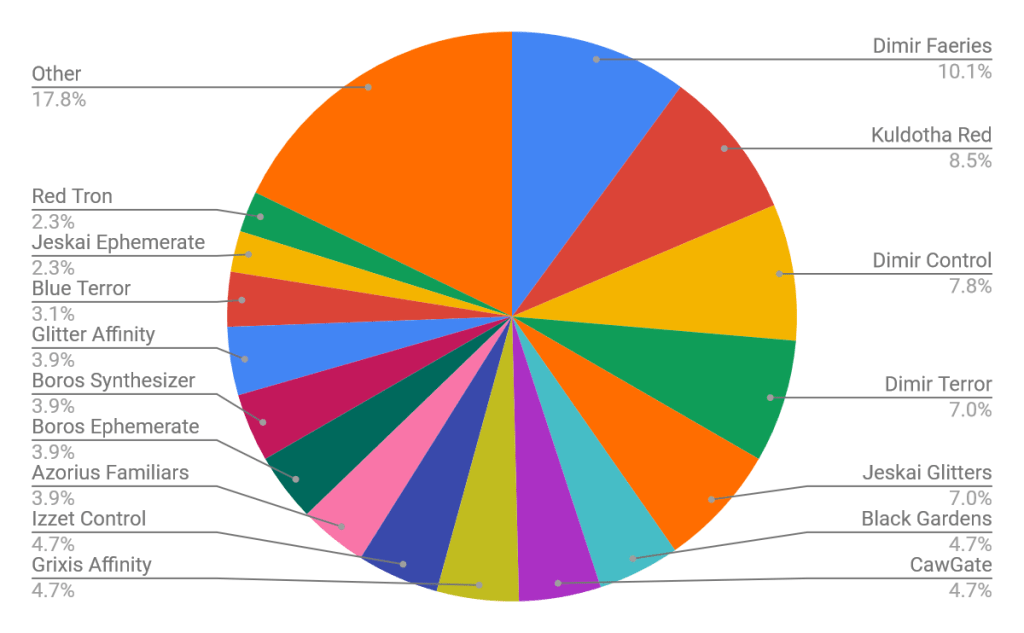
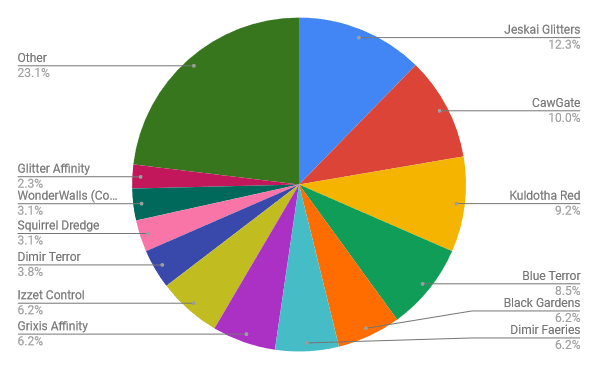
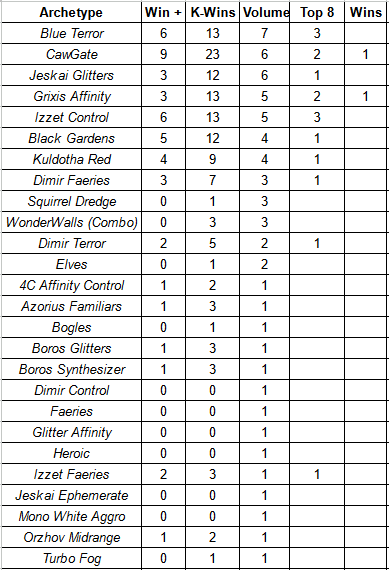
We’re going to be doing something a little different than usual today, if the chart above was any indication. The November 25 and November 26 continue the trends from the previous weekend – lots of Kuldotha Red in the Top 32. 22 decks overall – more than a third of the Top 32 field – with a fully quarter of both Tops awash in Mountains. The chart is not from this past weekend but rather takes the first four challenges from Lost Caverns of Ixalan season.

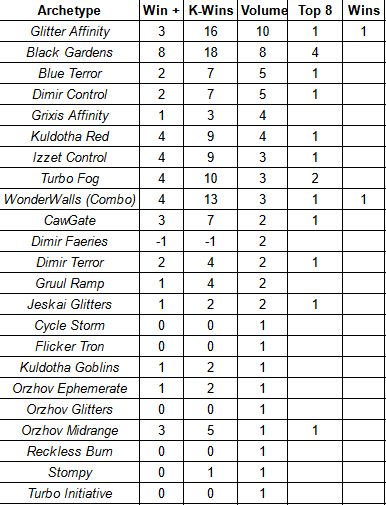
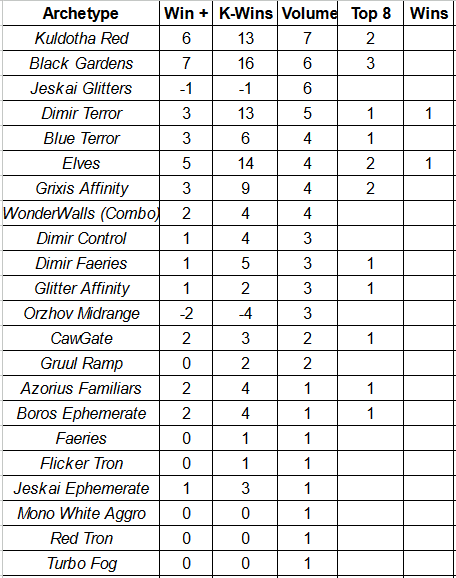
Looking at this, things appear to be grim. Fully 25% of the Top 8s went to Kuldotha Red – a deck that had more Top 32 finishes than the next two most popular decks combined. Kuldotha Red is also leading the way in raw numbers of Swiss wins (Win+) and total wins (K-Wins). This comes on the heels of a season where red decks took a pretty significant dive before apparently coming back with a vengeance. But what happens when we pull back the curtains a little bit and look at some more advanced metrics?

For this next portion of the post we are going to be discussing decks with at least three total Top 32 finishes, which hovers around the 2% volume threshold.

Win+ measures a decks Swiss performance and given Kuldotha Red’s sheer presence it should dominate in this area, which it does. Adjusting for volume the deck’s Win+ average is 0.68, which is the best mark of qualified decks. By way of comparison a Win+ average of 1 roughly equates to a Top 16 finish and so it can be inferred that Red’s average finish is trending towards a Top 16. The next best mark, adjusted for volume, is CawGate at 0.38.

K-Wins takes an archetypes total wins and subtracts total losses, including the Top 8. Adjusting for volume Kuldotha Red clocks in at a respectable 1.27 – a solid Top 16 finish that isn’t quite 9th on breakers. It is the third best mark in this regard behind CawGate (1.78) and Black Gardens (1.52). While the data set is small this indicates that once these archetypes reach the final rounds of a tournament, the more flexible decks have done better to this point in this season.

The most obvious explanation of this phenomena is that both Black Gardens and CawGate have access to the sideboard tools to keep Kuldotha Red in check while not giving up too much against the rest of the field, while understanding that Kuldotha Red lines up poorly against these two strategies. Of course this leads to the issue that has been prevalent for much of the past year – that it takes an overabundance of sideboard cards to keep Red in line with the rest of the metagame.

There is one more way to look at the decks in question and that is with their adjusted Metagame Score Above Replacement. This takes an archetype’s performance and, after adjusting for volume, compares it to the remainder of the field. Kuldotha red pulls in with a 0.74 score in this regard which is second best behind CawGate (0.89) and just ahead of Black Gardens (0.69).

What does this all mean? Right now not a whole lot. Red has added another gear to it’s game with Goblin Tomb Raider and the rest of the metagame is playing catch up. Red is still setting the pace but you have to prepare for both the quick death Mountains bring and the slow methodical demise of CawGate and Black Gardens.

I want to take a moment to thank all my Patrons – both old and new. I am going to do my level best to keep providing you with the kind of content that brought you here in the first place. If you are interested in supporting my work, rewards for my Patreon start at just $1 and every little bit helps.

Can’t make a commitment to Patreon? I now have a Ko-Fi where you can make a one time contribution.

Looking for another way to support my work? Click here for my TCGPlayer affiliate link. Any purchases through the link let the folks there know you like my content!
Pauper League Highlights – November 22

Today I want to take a slightly different approach to the latest league results. I’ve been playing a bit lately and given what I’ve seen in the league I think that Orzhov is very well positioned at the moment. The most recent deck list reveal featured three different Orzhov lists, so let’s examine what they do and where they differ.

3 Pestilence
3 Ancient Den
2 Guardian of the Guildpact
3 Journey to Nowhere
2 Kabira Crossroads
4 Glint Hawk
3 Plains
4 Orzhov Basilica
4 Thraben Inspector
3 Kor Skyfisher
2 Thorn of the Black Rose
4 Cast Down
2 Omen of the Dead
3 Scoured Barrens
2 Drown in Sorrow
3 Spare Supplies
6 Swamp
1 Silverquill Campus
2 Inspiring Overseer
4 Tithing Blade

Sideboard
2 Honorable Scout
3 Okiba-Gang Shinobi
3 Dust to Dust
2 Lone Missionary
4 Duress
1 Drown in Sorrow
2 Ancient Den
1 Unmake
4 Kor Skyfisher
2 Snuff Out
2 Bojuka Bog
4 Glint Hawk
3 Orzhov Basilica
4 Cast Down
3 Vampire Sovereign
3 Scoured Barrens
1 Omen of the Dead
1 Suffocating Fumes
1 Thorn of the Black Rose
3 Ephemerate
4 Plains
4 Swamp
4 Spirited Companion
2 Inspiring Overseer
3 Obscura Storefront
3 Goliath Paladin
4 Lembas
2 Tithing Blade

Sideboard
1 Reaping the Graves
3 Dust to Dust
2 Relic of Progenitus
1 Thorn of the Black Rose
2 Duress
3 Dawnbringer Cleric
1 Guardian Naga
2 Arms of Hadar
2 Orzhov Basilica
4 Guardian of the Guildpact
1 Bojuka Bog
4 Glint Hawk
3 Plains
2 Swamp
4 Thraben Inspector
4 Kor Skyfisher
1 Orzhov Guildgate
2 Ancestral Blade
1 Omen of the Dead
2 Suffocating Fumes
4 Cast Down
2 Dawnbringer Cleric
1 Deadly Dispute
4 Basilisk Gate
4 Black Dragon Gate
4 Citadel Gate
1 Heap Gate
2 Vampire Sovereign
4 Lembas
4 Tithing Blade

Sideboard
1 Standard Bearer
3 Dust to Dust
1 Relic of Progenitus
4 Red Elemental Blast
3 Saruli Gatekeepers
3 Drown in Sorrow

Each of these decks are build around a similar core, with all of them running the Glint Hawk/Kor Skyfisher engine with Tithing Blade and other artifacts that generate value. All the builds are also running Thraben Inspector and Guardian of the Guildpact. These suites should look familiar to anyone who has played white midrange in Pauper at any point in the past several years. Together these creatures help to provide the backbone of any white deck that wants to play to the board and slowly win the game through combat. It should be noted that all of these decks also run Omen of the Dead which can provide a steady stream of potential threats with Kor Skyfisher once the game reaches the middle and late stages.

The decks all run Cast Down, which is informative. These decks are less worried about decks that go wide (thanks in part to their blockers) but definitely want to take out the “one big threat” that could end the game. All three builds run some number of board wipes main with the first list doubling up with Pestilence and Drown in Sorrow. These builds have also opted to eschew Chainer’s Edict instead relying on the recursive nature of Tithing Blade to fill the same role.

Finally, all these decks are running at least 21 lands and left Troll of Khazad-dûm on the sidelines. They are mana hungry and cannot afford to be taking turns off to spend resources finding lands. Instead these decks want to hit their land drops on time while advancing their board state. Filling slots with cards that mostly exist to find lands detracts from the main game plan and considering how few of the lands each of these run are actual Swamps it follows that Troll might not be the best inclusion.

What separates these decks from each other are they supplemental engines. One uses Pestilence to lock down the board while another leans on Ephemerate to steamroll value. The final list leans on the Basilisk Gate damage engine for additional flexibility out of the sideboard and a way to close the game out quickly. Two lean on the Monarch or the Initiative while the Gate build avoids it entirely. None of these decks, however, are running Prismatic Strands, which means that they have no real defense of their emblems aside from keeping the board clear.

What does this all mean? These decks are built to survive the early game, coming fully online turn four and beyond. They want to tread water, biding time until they can assert control. Once they have gotten to parity these Orzhov builds want to break the game open with their various engines and slam the door. Each of them is prepared to fight Kuldotha Red on some axis while not giving up entirely against the rest of the metagame. While red might be setting the tone these builds can go toe-to-toe with everything else the leagues have to offer. Cast Down tells us that these decks are aware not every threat costs a single mana and sometimes it is the five drop that’s going to kill you.

When there are several lists in a format that are all trying to do the same thing it can be important to look at how they are similar to understand their core concept. Each of these lists are slightly different in their execution but all of them are trying to do the same thing, albeit with varied components.

I want to take a moment to thank all my Patrons – both old and new. I am going to do my level best to keep providing you with the kind of content that brought you here in the first place. If you are interested in supporting my work, rewards for my Patreon start at just $1 and every little bit helps.

Can’t make a commitment to Patreon? I now have a Ko-Fi where you can make a one time contribution.

Looking for another way to support my work? Click here for my TCGPlayer affiliate link. Any purchases through the link let the folks there know you like my content!
Treasured Finds: Ruthless Deathfang

Welcome back to Treasured Finds, a place to appreciate sacrifice in Commander

 Ruthless Deathfang {4}{U}{B}

Creature — Dragon

Flying

Whenever you sacrifice a creature, target opponent sacrifices a creature.

“Bring forth the dead, their skull-grins and rattle-bones. We will feast upon their wailing ghosts.”
—Silumgar, translated from Draconic
4/4

I have a confession to make: I’m a griefer. Given my druthers my preferred style of play is to drag out the game and put the screws to my opponent(s). I grew up in an era where breaking “negative” symmetry was a viable path to victory. This can be seen in one of my favorite cards of all time: Grave Pact. In a two player game this is merely annoying but extrapolate it to a game with four people and this card becomes an absolute house.

It also is not the kind of card everyone wants to play against.

Part of any good pregame discussion is understanding the kind of game people want to be playing. Grave Pact can absolutely wreck certain strategies and if the goal of Commander is to play the game then you want everyone to be able to play. But what does this mean when your preferred play style can, in many ways, make the game miserable for everyone else at the table?

What does it mean to be a griefer? For me it is part of playing symmetrical effects but it is also about turning a downside into an upside. Look at Bottomless Pit – this card says that everyone has to discard at random, but if you build your deck to take advantage of this “downside” with cards like The Raven Man and Bone Miser allows you to break the symmetry. That’s part of the allure of this style of play – it is the deckbuilding challenge in turning something bad on its ear.

There is something to be said for running answers. This is not the usual refrain of “run more removal” but rather at any table there can be a reasonable expectation that someone will have a board wipe or graveyard hate or some other piece of interaction in their deck to handle whatever the threat might be. At the same time cards with such asymmetrical impact as Grave Pact can often generate an overwhelming amount of value before being handled which can leave it all over except for the actual winning.

All this taken together that is all well and good for me as the grifer. But Commander is not solitaire so that leaves two options.

The first is to put out the call for other folks who are okay with this style of play. High power, no holds barred but a step below competitive Commander is my idealized style of play a majority of the time. And I hope one day I can find a group where this type of game doesn’t require a pregame discussion. But these days a lot of the games I play are in my friendly local game store with a wide array of opponents.

So that means moderating myself. In it of itself this is not a bad thing. Showing restraint and consideration for the group experience is not only being a good opponent and partner, but it’s also a good way to be a human. And now we get back to the card at he top of this post.

Ruthless Deathfang is no Grave Pact. It is not a global effect and as such can be used to help play in the political realm. It also does not trigger off of any creature death but rather exclusively on sacrifice. The result is a card that provides a reasonable approximation of my desired play style while not being overly oppressive. It also adds another wrinkle to the restriction which can easily be overcome with sacrifice outlets or other cards that force you to send things to the graveyard in a way that would set the ‘Fang off. As for me, I’m excited to give Ruthless Deathfang a try in my Araumi of the Dead Tide deck.

You can see my current, pre-Deathfang list here. Encore forces a sacrifice which gives me plenty of opportunity to point the Ruthlessness at different players. If the Dragon ever hits the bin I get to bring back three* copies which can potentially yield nine Edicts. And I think that’s just nifty.

Commander is a collective experience and even though I like making my opponent’s miserable I want them to enjoy the game. As long as I’m playing in an open setting it means I have to do a good amount of self-moderating, even if it means running an objectively less powerful card for the sake of the game. Until next time, may you only have good grief.

I want to take a moment to thank all my Patrons – both old and new. I am going to do my level best to keep providing you with the kind of content that brought you here in the first place. If you are interested in supporting my work, rewards for my Patreon start at just $1 and every little bit helps.

Can’t make a commitment to Patreon? I now have a Ko-Fi where you can make a one time contribution.

Looking for another way to support my work? Click here for my TCGPlayer affiliate link. Any purchases through the link let the folks there know you like my content!
November 18-19 Pauper Weekend Recap

I use a few different metrics when looking at the Top 32 metagame. The first is just Raw Volume. The second is Win+, which takes the sum of all wins at X-2 or better in the Swiss and assigns a score; Win+ is helpful in measuring a deck’s Swiss round performance. K-Wins takes all of a deck’s wins and subtracts its losses, Top 8 inclusive; this helps to give a measure of overall performance. The final pair is call Meta Score and Meta Score Above Replacement, which takes the average of Win+ and K-Win to try and position an archetype against its field. This number helps to provide the most robust image of a deck’s performance.

November 18 and November 19 Pauper Challenge Top 32 Metagame

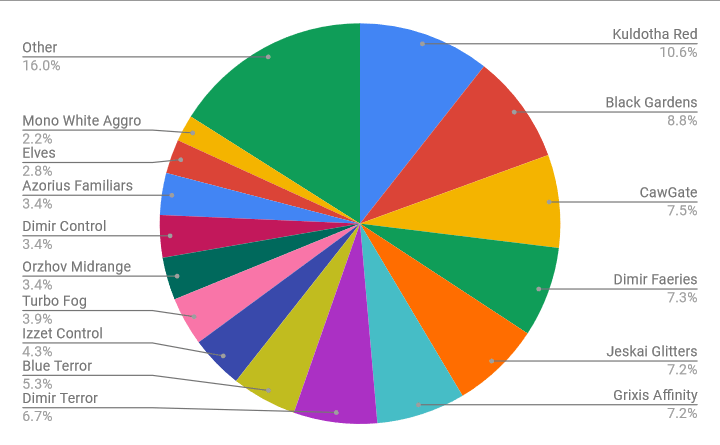
Lost Caverns of Ixalan has arrived and this past weekend Pauper got its first look at the new cards in a Challenge setting. Over in Italy, Paupergeddon Rome 2023 had 520 competitors on the first day. According to reports, various builds of red were the most popular archetype on Day One and Day Two but Black Gardens was the most popular deck in the Top 8 with three copies while Jeskai Glitters won the day. Once I get my hands on the official results I may have more to say on one of the most important tabletop Pauper tournaments of the year.

But what about Magic Online? There the metagame looks largely the same with Kuldotha Red starting the season as the most popular archetype in the Top 32. This makes sense as Kuldotha Red remains the clock of the format and it buoyed by Goblin Tomb-Raider. Traditionally aggressive strategies perform well in the earlier parts of a format cycle while players are still figuring out what new wrinkles there are to the meta. And while the second trip to Ixalan may not have the same impact as our relatively recent return to Kamigawa, things are certainly shifting.

1 Plains
1 Swamp
4 Ancient Den
4 Vault of Whispers
4 Springleaf Drum
4 Kor Skyfisher
4 Glint Hawk
4 Ichor Wellspring
4 Ornithopter
2 Darksteel Citadel
4 Myr Enforcer
4 Thraben Inspector
4 All That Glitters
4 Goldmire Bridge
4 Deadly Dispute
4 Blood Fountain
4 Tithing Blade

Sideboard
4 Dust to Dust
1 Shrivel
3 Nihil Spellbomb
1 Duress
2 Suffocating Fumes
4 Lunarch Veteran

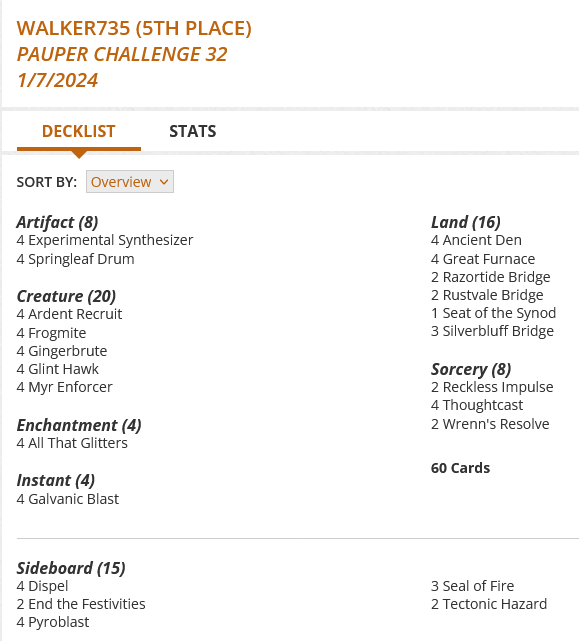
Orzhov Glitter made it to the Top 8 on Saturday and had two additional appearances in the Top 32 on Sunday. The shell blends a Kor Skyfisher engine with All That Glitters Affinity, all charged up with Tithing Blade. Tithing Blade may come to define the next few weeks as it is both an effecient removal spell that can be rebought with Skyfisher and friends while also converting itself into a slow win condition. The fact that it also fuels Affinity and can be fed to Deadly Dispute gives this edict an edge over its in-slot competitors. From experience I can tell you that crafting two of these into a Consuming Sepulcher can buy you plenty of time and slowly soften up the opponent.

Supporting Tithing Blade in non-aggressive shells is similar to supporting Chainer’s Edict – making sure there are enough other removal spells to clean up what’s left behind. Where this is spot removal or sweepers, the Blade cannot get it done all on its lonesome. At the same time the Sepulcher cannot be a lone win condition given how prevalent artifact hate is in sideboard, which means it might be best paired with either the Initiative or Guardian of the Guildpact.

Beating Tithing Blade means going wide. Getting around single creature removal means running tokens or flooding the board in other ways, but that can play into a potential board wipe. Murmuring Mystic again appears as a linchpin in the format as a way to fight against Blade on all axes. At the same time a deck can ignore Blade and dominate the end game – Tron or Familiars anyone? – can render this card inert.

The immediate future may just see an increased polarization of the format. With Red and Glitter decks continuing to have a hold on the early turns of the game and other strategies trying to stall things out until their own action plans come online. Forcing the format towards its outliers could put stress on decks that seek to occupy the middle ground such as CawGate and Dimir Faeries. Of course both of these strategies can adapt to various environments so I would not count them out. That being said in the interim I would be doing my best to leverage Tithing Blade and looking to maximize the value I could extract from the newest option.

I want to take a moment to thank all my Patrons – both old and new. I am going to do my level best to keep providing you with the kind of content that brought you here in the first place. If you are interested in supporting my work, rewards for my Patreon start at just $1 and every little bit helps.

Can’t make a commitment to Patreon? I now have a Ko-Fi where you can make a one time contribution.

Looking for another way to support my work? Click here for my TCGPlayer affiliate link. Any purchases through the link let the folks there know you like my content!
Pauper League Highlights – November 15

Lost Caverns of Ixalan has arrived on Magic Online and with it we get our first set of Pauper League results that could potentially include new cards. And while there are a lot of interesting decks nestled in those 37 trophy runs (including two Breathless Knights decks and a WonderWalls variant Faultgrinder main), I wanted to focus on builds that featured something from the latest release.

4 Great Furnace
4 Goblin Bushwhacker
4 Kuldotha Rebirth
4 Monastery Swiftspear
4 Lotus Petal
4 Lightning Bolt
4 Reckless Impulse
4 Voldaren Epicure
4 Experimental Synthesizer
4 Wrenn's Resolve
4 Name Sticker Goblin
12 Mountain
4 Goblin Tomb Raider

Sideboard
2 Flaring Pain
2 Red Elemental Blast
2 Gorilla Shaman
3 Pyroblast
2 End the Festivities
4 Cast into the Fire

Listen, we all knew this would happen. Kuldotha Red is not going anywhere and Goblin Tomb Raider provides another aggressive one drop for these builds. Here it appears to replace Goblin Blast-Runner which makes some amount of sense. Blast-Runner might have the upside of crashing in for three damage but it also can be stranded as a one power attacker turn after turn if you run out of sacrifice fodder. Tomb Raider is more likely to provide a consistent two points of damage given the 12 potential artifacts in the deck. That being said I think there are better shells for the newest addition that add more artifacts to the mix, but this is a great place to start.

3 Pestilence
3 Ancient Den
2 Guardian of the Guildpact
3 Journey to Nowhere
2 Kabira Crossroads
4 Glint Hawk
3 Plains
4 Orzhov Basilica
4 Thraben Inspector
3 Kor Skyfisher
2 Thorn of the Black Rose
4 Cast Down
2 Omen of the Dead
3 Scoured Barrens
2 Drown in Sorrow
3 Spare Supplies
6 Swamp
1 Silverquill Campus
2 Inspiring Overseer
4 Tithing Blade

Sideboard
2 Honorable Scout
3 Okiba-Gang Shinobi
3 Dust to Dust
2 Lone Missionary
4 Duress
1 Drown in Sorrow

Listen, we all knew this would happen. Someone was going to pair Kor Skyfisher with Tithing Blade. This build is an obvious place to start but, as with above, I think there is room for improvement. Glint Hawk feels risky here without additional artifact lands and once that shift is made adding more Ichor Wellspring type cards and potentially Deadly Dispute also follows suit. That build definitely takes a slower approach but this one tries to split the difference between a value oriented build and a deck seeking to grind the opponent out. While straddling the line might make sense for midrange strategies I think leaning into either side would only strengthen this concept.

2 Snap
2 Prohibit
2 Plains
4 Sunscape Familiar
3 Deep Analysis
1 Prismatic Strands
8 Island
1 Remove Soul
1 Ghostly Flicker
3 Archaeomancer
1 Mortuary Mire
4 God-Pharaoh's Faithful
4 Mulldrifter
2 Ephemerate
4 The Modern Age
2 Obscura Storefront
1 Destroy Evil
4 Preordain
4 Ash Barrens
4 Azorius Chancery
3 River Herald Scout

Sideboard
1 Circle of Protection: Blue
2 Snap
1 Last Breath
4 Hydroblast
1 Remove Soul
1 Blue Elemental Blast
2 Nature's Chant
2 Negate
1 Destroy Evil

Okay this one was unexpected. River Herald Scout was not on my “might see play in Familiars” Bingo card. Given the pilot this looks more like an experiment in whether or not the new card can replace Sea Gate Oracle rather than a strict upgrade. Scout has the advantage of binning key cards while leaving behind a solid, if unimpressive, set of stats. All in all this is a case where I do not expect the newest addition to last but then again I am far from a Familiars expert.

I want to take a moment to thank all my Patrons – both old and new. I am going to do my level best to keep providing you with the kind of content that brought you here in the first place. If you are interested in supporting my work, rewards for my Patreon start at just $1 and every little bit helps.

Can’t make a commitment to Patreon? I now have a Ko-Fi where you can make a one time contribution.

Looking for another way to support my work? Click here for my TCGPlayer affiliate link. Any purchases through the link let the folks there know you like my content!
Treasured Finds: The Four Types of Aristocrat Commanders

Last week I wrote this with the intent of turning it into a script for a video. In the intervening days I attended a professional development conference for my career and the keynote address gave me a lot to think about. Namely, writing brings me joy and I’m not sure that moving to another medium is for me. But I really like what I had to say so I’m sharing it here. If you like this, let me know; if you think this would make a good bite sized video let me know even louder. But for now, I hope you read and enjoy.

Hello everyone,

My name is Alex Ullman and this is Treasured Finds – a place where we can appreciate Commander decks that really like it when things hit the graveyard. Now you might know me better from my articles on the Pauper format and my work on the Pauper Format Panel and while I do love Pauper, I also have been an avid Commander player for more than a decade. The other day StarCityGames tweeted out a question – What is the Best Aristocrat Commander?

And I had so many opinions on the matter that I decided to make this here video.

 Zulaport Cutthroat {1}{B}

Creature — Human Rogue Ally

Whenever Zulaport Cutthroat or another creature you control dies, each opponent loses 1 life and you gain 1 life.

“Eldrazi? Ha! Try walking through Zulaport at night with your pockets full. Now that’s dangerous.”
1/1

Generally speaking an Aristocrat strategy in Commander is based around sacrificing creatures in a way that damages your opponents through cards like Zulaport Cutthroat. The name might sound odd but it comes from a Standard deck that broke out at Pro Tour Gatecrash in 2013. The deck would sacrifice creatures to Cartel Aristocrat and Falkenrath Aristocrat to leverage attacks and over time the name came to incorporate decks that would kill with Blood Artist. The name stuck even if many of the free sacrifice outlets that see play no longer bear the name.

 Goblin Bombardment {1}{R}

Enchantment

Sacrifice a creature: Goblin Bombardment deals 1 damage to any target.

One mogg to aim the catapult, one mogg to steer the rock.

Aristocrat strategies in Commander need three key components to function. First they need a sacrifice outlet so they can play god and dictate when and how things are going to die. Second, they need material to feed to the sacrifice outlet, for they are a vengeful god. Finally, they need a spout or a way to convert all these dying creatures into victory. Some cards, like Goblin Bombardment or Altar of Dementia, combine two pieces of the puzzle into one for the world’s goriest you got chocolate in my peanut butter moment.      

Back to the question at hand – what is the best option for heading up an Aristocrat deck? The reality is it, like with so many things in Magic and growing old, depends. Just like there is no one way to play Commander there is no one real way to build an Aristocrat deck. The commander you choose is going to be heavily dependent on the kind of experience you want to have and the kind of game you want to bring to the table. To me there are four main kinds of Aristocrat Commanders and each bring their own unique spin on the archetype while also influencing deck construction. They are Spouts, Fodder, Sacrifice Engines, and Spout Engines.

 Judith, the Scourge Diva {1}{B}{R}

Legendary Creature — Human Shaman

Other creatures you control get +1/+0.

Whenever a nontoken creature you control dies, Judith, the Scourge Diva deals 1 damage to any target.

At the end of the show, she stands alone on a stage brilliant with blood.
2/2

Let’s start with the most obvious – the Spouts. These are your so-called Blood Artists in the Command Zone. They are part of your primary win condition and allow you to start going to town on the table once have assembled enough fuel and a sacrifice outlet. While you may want to cast these cards early to start applying pressure they often double as a win condition, so holding them back until it is time to go for it can make sense. Putting a card like Judith, the Scourge Diva in the Command Zone before a game sends a very clear message – my creatures are going to die and you’re going to suffer for it – so it could be beneficial to assume a non-threatening posture until you can enter the victory formation.

What does that look like? It could mean letting the other players whittle each other down until you can easily take them out or go after the other strongest player at the table, leaving yourself depleted and presenting a less scary board state, opting to let the other two players deal with each other until you have once again amassed enough resources to, once again, go for it.

Fodder Commanders provide the sacrificial offerings. These Commanders do not necessarily scream “Aristocrats” but instead often masquerade as token strategies, albeit one that signal that things are going to be hitting the bin. These Commanders also need a sacrifice outlet to get going and while they can win through attacking with the army they spit out, they can make use of a Zulaport Cutthroat to end things in a flurry of corpses.

 Elenda, the Dusk Rose {2}{W}{B}

Legendary Creature — Vampire Knight

Lifelink

Whenever another creature dies, put a +1/+1 counter on Elenda, the Dusk Rose.

When Elenda dies, create X 1/1 white Vampire creature tokens with lifelink, where X is Elenda’s power.

Her centuries-long search is ended.
1/1

Elenda, the Dusk Rose is a great example of a Fodder Commander. Not only does she actively want things to die, when she meets her potentially timely end there’s an entire horde of tokens left in her wake. The result is a lot of meat to send to the Altar of Dementia and end the game in short order.

 Varolz, the Scar-Striped {1}{B}{G}

Legendary Creature — Troll Warrior

Each creature card in your graveyard has scavenge. The scavenge cost is equal to its mana cost. (Exile a creature card from your graveyard and pay its mana cost: Put a number of +1/+1 counters equal to that card’s power on target creature. Scavenge only as a sorcery.)

Sacrifice another creature: Regenerate Varolz, the Scar-Striped.
2/2

The first of our two Engine classifications, we have Sacrifice Commanders. These are Commanders that have the ability to sacrifice other creatures – shocking twist, I know. They often come out after the rest of the pieces are assembled and start things moving towards their inevitable end. Sacrifice outlets are one of the most important pieces of an Aristocrats strategy as they give their pilot control over when things die instead of having to leave it up to silly things like combat or opposing removal. The best of these have unbound sacrifice, meaning they come with no cost or timing restriction. Varolz, the Scar Striped can be rather unassuming but once it hits the board alongside a Blood Artist you know things are about to go down.

 Mazirek, Kraul Death Priest {3}{B}{G}

Legendary Creature — Insect Shaman

Flying

Whenever a player sacrifices another permanent, put a +1/+1 counter on each creature you control.

The clicks and buzz of the undercity proclaim him the incarnation of decay.
2/2

The last variety of Aristocrat Commander are the Spout Engines. These are Commanders that  benefit from other creatures being sacrificed in some way. Elenda, the Dusk Rose is one such Commander (foreshadowing) but so is Mazirek, Kraul Death Priest. Mazirek doesn’t take an active role in any part of the Aristocrats engine but benefits from it all the same (and in this case, spreads that benefit far and wide). Juri, Master of the Revue is another Commander in this vein as it likes watching other things die and at the end of their time can potentially take someone out as well.

But what about Elenda? There are a ton of Commanders available that, like Altar of Dementia and Goblin Bombardment, fit multiple roles. Elenda is not only a Fodder Commander but she also is a Spout Engine. Slimefoot, the Stowaway brings friends to the dead man’s party while also serving as a Spout. One of my old favorites, Teysa, Orzhov Scion combines a limited sacrifice outlet with the potential to generate tokens. Each of these have different benefits and reward different play patterns. It’s one reason why my collection tends to have several  Aristocrat decks at any one time – even if the mechanics are similar they provide a variety of experiences and make use of different cards to accomplish their goals.

So what is the best Aristocrat Commander? You tell me. Sound off below about which one you think is best. Don’t forget to like comment subscribe. If you like this sort of content and want to see more of it you can sign up for my Patreon and you can tell me why I’m wrong about all of this.

Thank you for watching Treasured Finds, I’ll see you next time we go Gravedigging.