
There exists a library of articles on Magic and a great many of them are written on the theoretical underpinnings of the game itself. These are the concepts that help to explain ways to approach matches as a whole, but also individual strategic moments. This is well trod territory with plenty of digital ink spilled discussing the various applications. And yet here I am deciding to wade into the part of the pool which has the one spot that always scratches at your toe: tempo.
Tempo is a notoriously difficult concept to nail down because it deals with the intersection of board presence and mana investment. Card Advantage has a heuristic: if one spell generates two “cards” worth of value, you are gaining card advantage. The Philosophy of Fire has a similarly simple explanation: each card is worth damage, and three damage is the baseline. These are elevator pitches; quick and pithy statements that get the point across. Tempo, in one-on-one Magic, is murky because the nature of it changes throughout the course of the game with an early tempo advantage having a greater impact than a similar play coming in the later turns. We can look to the humble Unsummon for an example. If you Unsummon a creature that cost two or more mana, you have effectively gained some amount of tempo, but that ephemeral thing is only made manifest if you can then commit something of value to the battlefield. There are entire decks built around this plan in sixty card constructed but it is a challenge to extrapolate this approach to tempo to Commander.
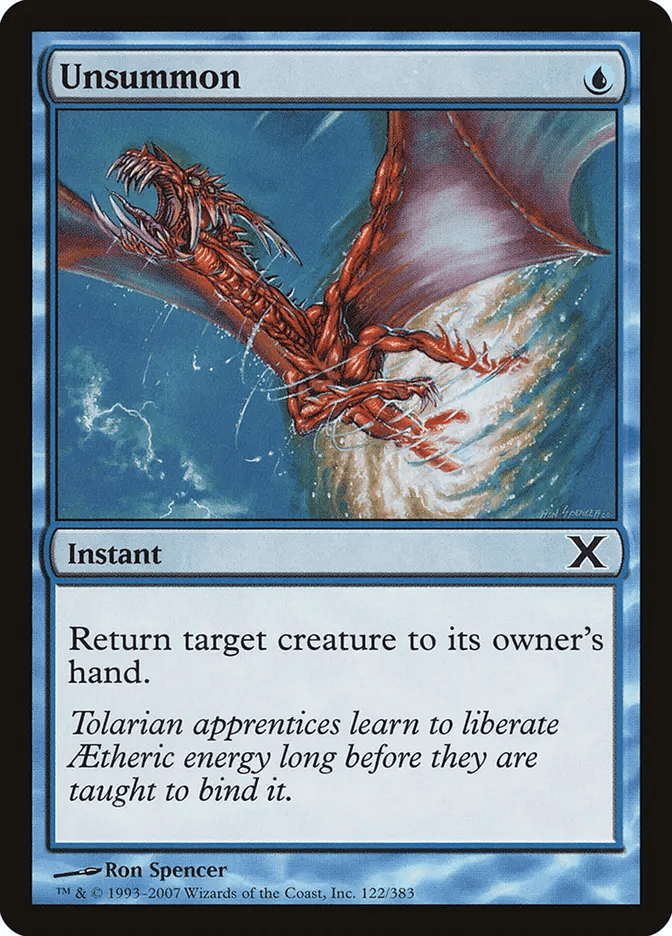
In heads up Magic, tempo is the intersection of mana invested relative to turn and board development. To gain tempo in this model you need to commit more to the battlefield, disrupt your opponent’s plans, and then press that advantage. There exists a neutral state upon which two actors can push and pull. In a game of Commander this problem is exacerbated as there are three players acting on the same tension. Leveraging tempo in this environment, therefore, requires a shift in mindset.
In Commander there is both more mana and more time than in a two player game. Each player gets a turn of development so a spell like Unsummon might set one player back while leaving the others unmarred. For each mana you spend on undoing someone’s board two other players are going to have their full turn of development and unlike using a Doom Blade the threat is just going to come back. There is a reduced rate of return on your investment due to the amount of resources available to the other players. And given the way cards produce material in the current game, trying to trade a single spell for any amount of board state feels like a losing battle.
None of this is to say that you cannot maximize tempo by looking at other elements of board presence. We have all seen games where Blasphemous Act hits the stack for a single mana and then that player rebuilds. Cyclonic Rift costs seven mana, but it can be well worth the price if it prevents you from losing or allows you to win. Yet both of these cards come with baggage of their own. Act, or any board wipe for that matter, can paint a target on your back as the threat. A Rift that prevents an opponent from winning still leaves the caster ahead, and one that does not outright win the game can leave people wondering how much longer they’ll have to slog through a rebuild to even stand a chance.
Board wipes are tempo plays in that they trade up on mana but they come with some hefty restrictions. In most cases the caster is also set back development. The player who has access to more mana has an advantage and the person who wiped the table often has access to all their resources last due to their investment in said board wipe and the fact they tend to come at sorcery speed. While there are ways around this it does not change the fact that a board wipe – at a critical turn mind you – comes with multiple tangible costs.
There are other ways to gain a tempo advantage in Commander. Think about Affinity or Slivers. These strategies build upon each other with each card generating more than a single spell’s worth of value. Many Commander decks these days are built on this avalanche of synergy, each piece building upon the ones that came before. I tend to build differently, where the pieces all fit together in different ways which causes the texture of the games to be different. For now it is safe to think about proactive tempo in Commander as the weight of synergy moving forward. It follows, therefore, that defensive tempo – true board wipes – run afoul of this because while they may undo all the work of your opponents they also shake your foundation.
I want to revisit the decks consisting of interlocking pieces. Commander decks with Layered Engines may not have the overwhelming strength of Avalanche builds but they allow you to participate in the game and, with fewer pieces built upon one another, have an easier time recovering from tempo hits. At the same time these decks can fail to execute their gameplans if they simply get buried by the other decks Doing the Thing better which increases Layered Engines reliance on interaction. Layered Engines are often composed of less impressive game pieces which leaves mana available for defense – a key removal spell, for example. But they also rely heavily on board state which means wiping away that development, while maybe not game ending, can still cause quite a bit of damage. Removing a Layered Engines board will result in a reinvestment of both time and mana to rebuild, often with the new strucutre only bearing a passing resemblance to what came before. The spells that you use to defend such positions, therefore, must be carefully selected.
Fogs – cards that negate damage- are some of the best tempo plays in Commander. For a relatively low mana investment (we aren’t talking Inkshield here folks), a single spell can render a massive combat absolutely useless. Fogs are at their best in the late stages of the game where they can swing the tide of battle, often for a pittance. While the original costs a single mana there are plenty that will get the job done at two and, if you’re feeling gaudy, three. Because they do not ask much of you to invest it is possible to continue to develop your presence without looking suspicious. A player who is going to win by combat may have to expend their resources to push through damage, which means your meager investment could be worth far more in time than its mana value would indicate.
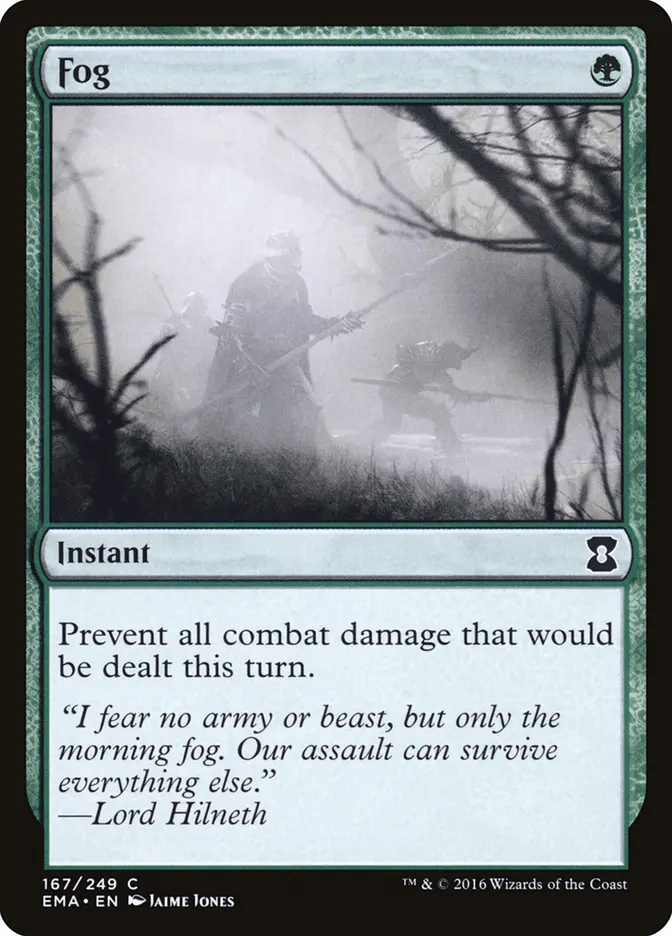
Imagine a turn where an opponent sees an opening and goes all in. They pump their team, they sacrifice some cardboard to improve their offense and go to end the game. And then you cast Moment’s Peace. The tide has turned. Your board is safe; their defenses are down. You have bought good will from other people who have not taken lethal damage. All of the cost of a mana rock.
These kinds of cards are powerful but they are niche, which is why I understand when folks choose not to run them. Commander right now is a format of success. You play your card, it does the thing. That’s how it should work. Yet a Fog can rot in your hand doing nothing. It has a fail case where it is a dead piece of card board – a scalpel that could have been a hammer.
I would posit that in order to engage with the format in a way that keeps it fresh and exciting then you need to embrace failure. There are going to be games where your deck sputters, where you stumble on mana or draw pieces out of sequence. The beauty of a well timed Druid’s Deliverance winning you the game only exists because of all the times you took a Craterhoof Behemoth on the chin.
I want to take a moment to thank all my Patrons. I am going to do my level best to keep providing you with the kind of content that brought you here in the first place. If you are interested in supporting my work, you can sign up for my Patreon starting at just $1.
Can’t make a commitment to Patreon? I have a Ko-Fi where you can make a one time contribution.

