I am not going to dive too deep on the October 17 and October 18 Pauper Challenges. Taking into account what I wrote about last week, not a lot has changed. Goblins and Bogles both put up some solid results but the top of the metagame remains Flicker Tron and Dimir Faeries.
I’ve been doing a lot of thinking about Eternal formats this week thanks to the Eternal Weekend events on Magic Online. The allure of Eternal formats like Legacy and Vintage is that you can find a deck and stick with it for years at a time and while these decks may not always be the best in a given tournament, they can still compete.
Part of this is due to narrow, high impact cards that only a few decks would ever want having the ability to completely change a matchup. I’m thinking of Molten Vortex in Lands but with the vast card pool the possibilities are astronomically high.
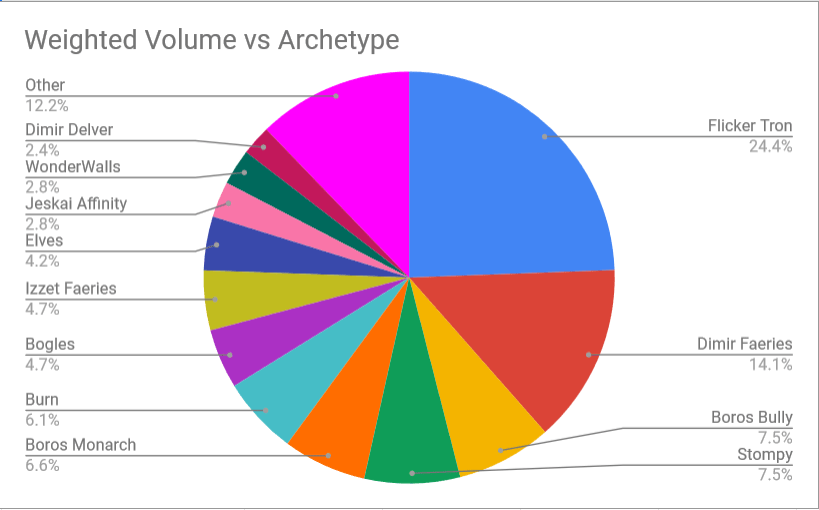
Pauper has some of this, to be sure. Thoughtcast has some significant restrictions as does Savage Swipe. The incentives in Pauper push towards Tron and the decks is both adept at adopting the best cards available. While other decks have to be focused on their, for lack of a better term, theme, Tron has the mana flexibility to run the best possible cards. This wouldn’t be a problem if the archetype was not dominant (almost 25% of the Winner’s Weighted metagame, with no sign of slowing down).
What would Pauper look like if Tron was brought in line with other top decks? What if Tron remained around 15% of the metagame by volume but only over achieved by 3%? Would other fringe decks have that band of opportunity to shine? I don’t know, but that’s the thought rattling around my brain.
The problem with in my estimation Pauper isn’t necessarily Tron’s dominance or the strength of Monarch or Spellstutter Sprite. Rather, it’s the fact that Pauper is an Eternal format that lacks the diversity of high end competitive choices.
There is some allure to a format with a known enemy. To a format where one deck sits at the top, waiting to be attacked and dethroned. The issue is there is no real way to subvert Tron in any meaningful way.
Hello and welcome to Svogthir’s Study: a place to appreciate Golgari in Commander.
I’m a dinosaur when it comes to Magic. Many elements of the game that feel intrinsic and vital today were, at one point, novel. I don’t think there’s a better example of this than multicolored (gold) cards, especially those that feature enemy colors.
Today it’s a given that unless there’s a very good reason all color pairs are going to be supported via signpost uncommons and, at least in Standard, dual lands. Back in the mid-90s this was not the case. Multicolored cards were introduced in 1994 with Legends but they were either allied color or three colors that bridged two allied pairs with a central color (Shards like Jund). The first enemy color card came in The Dark and was one of three gold cards in the set: Dark Heart of the Wood. Ice Age and Alliances both followed this mold of allies and shards and it wasn’t until Mirage that we saw enemy colored gold cards.
When Magic started the idea was to hammer home the concept of ally and enemy colors. We saw extremely powerful hate cards for enemies and rather anemic bonuses for allies. Apocalypse – the third set in the 2000-2001 Invasion Block – saw enemy colors get similar support to allied pairs. The disparity existed to reinforce the notion that some colors were on the up and up while others just hated each other. Apocalypse with its enemy Pain Lands and high profile gold cards helped to pave the way for current ideas regarding color balance.
So what does this have to do with the subject of today’s card? Vhati il-Dal is a gold Legendary Creature from Tempest. Tempest is one of my favorite blocks of all time, probably because it was the first one where I could follow the story on the cards and in Wizards’ print magazine, and it felt different. It was out first trip off of Dominaria and, to 13 year old me, was a world built from the ground up. To that point every Magic set was rooted in very Earth things but Tempest, Tempest was Magic doing its own thing.
Bad. Ass.
While Mirage Block was the first to heavily feature enemy color cards, Tempest as a set had five gold cards and they were all enemy colored. They also had enemy pain lands that entered the battlefield tapped but let’s not talk about Pine Barrens when Llanowar Wastes exists. Vhati was one of these cards and is featured in the Tempest story (mostly as a plot device) and really, by all accounts, is pretty out of place by modern standards.
Presented as an opportunist the rules text makes sense but the color is all off and if made today, Vhati would make more sense as a Dimir or Grixis creature. The green feels out of place as nothing about the card represents growth of the life cycle. Green, even in Golgari, isn’t about taking away power or toughness unless it is adding to another creature’s stat line. Why make him Golgari then? The old color pie was weird and there needed to be a black-green card.
So how does Vhati work in Commander? There are a few ways I would build around him. First is in a deck full of ways to use his toughness setting ability to kill creatures. Ideally this would be several creatures per turn cycle so cards like Instill Energy, Magewright Stone, Thornbite Staff, and Thousand-Year Elixir are a must. You would want to include multiple ways to deal one damage or take away one point of toughness. Plague Spitter is a personal favorite but Kaervek, the Spiteful is a new card that plays rather nicely with Vhati. Screams from Within is a deep cut that doesn’t get a ton of love. To be honest, the entire Vhati il-Dal EDHRec page is one hidden track after another. I’d love to see Grave Betrayal in a Vhati deck since it’s a flavor win but also works with what you’re trying to do when your Commander is out.
The other way to play Vhati, and a way I think makes more sense given the cards power level, is in a Group Hug or Regent-Maker style deck. Vhati’s ability to reduce damage or make opposing creatures easier to kill is a great way to make friends and build alliances. Load up with Quirion Ranger and Scryb Ranger, and a few Vitalize effects, and you can change the texture of combat at your leisure. And yes I suppose Seedborn Muse works here as well. Once the dust is settled and the battlefield is clear just use Rise of the Dark Realms and Thrilling Encore to reap what Vhati has sown.
Vhati is a weird Golgari Commander. He’s from a bygone era and while I’m not likely to ever build a deck around him, I can see the appeal. Part of what I love about Commander is the opportunity to do weird stuff and Vhati provides that opportunity. Vhati also isn’t a typical Golgari Commander. For players like me, with more copies of Overgrown Tomb than every other Shock Land combined, Vhati gives us the chance to play a decidedly combat oriented deck.
No, using Craterhoof to end games doesn’t make a deck combat oriented.
Treasured Find(A Golgari card that could shine with this Commander) Death Frenzy
My name is Alex Ullman and I’m a Golgari player in Commander.
Over the course of my time playing Commander I have almost never not had access to at least one Golgari deck and usually have two at any given time, and that’s me demonstrating restraint. I love what black and green bring to Commander and how many options the combination provides.
Green grants access to ramp and card draw. It also has fantastic removal options for non-creatures. Black also helps the card flow while handling creatures with ease. These two colors also do the thins I love to do. I get to sacrifice creatures for value, mill myself, use my graveyard as a resource, and make creatures massive with +1/+1 counters Golgari gives me everything I want to do in Magic so why bother with other colors?
What I want to do with this series is share my love for all things Bayou with the rest of the Magic world. I am going to take a look at every Golgari Commander and talk about them. I am going to let you know if I’ve built the deck, if I would build the deck, or if I wouldn’t even bother. I’ll explore some obvious things to do with the Commander and hopefully, some not-so-obvious options.
I hope you join me on this journey as we plumb the depths of the undercity for some buried treasure. It’s going to be a wild ride.
I am not going to waste words discussing the October 10 and October 11 Challenges. Flicker Tron took down 10 of the 16 Top 8 slots. I want to take a look at the first four weeks of this season: 8 Challenges and one PTQ. What does the winner’s metagame look like and why did some jabroni tweet this?
Just saying that if #mtgpauper was Standard, something would have been done about Tron already.
Before diving any deeper I am going to recommend you take a few moments to review this post. In it I go over my methodology for looking at the winner’s metagame. Needless to say, Tron is killing it on every metric.
Let’s start by looking at the most played decks in the Top 32. In order to qualify for a discrete section and not be sequestered in “Other”, a deck needed to comprise at least 2% of the Top 32 metagame (roughly equal to 6 appearances). This means decks like traditional Affinity, Azorius Familiars, and Mono Black Control did not make the cut.
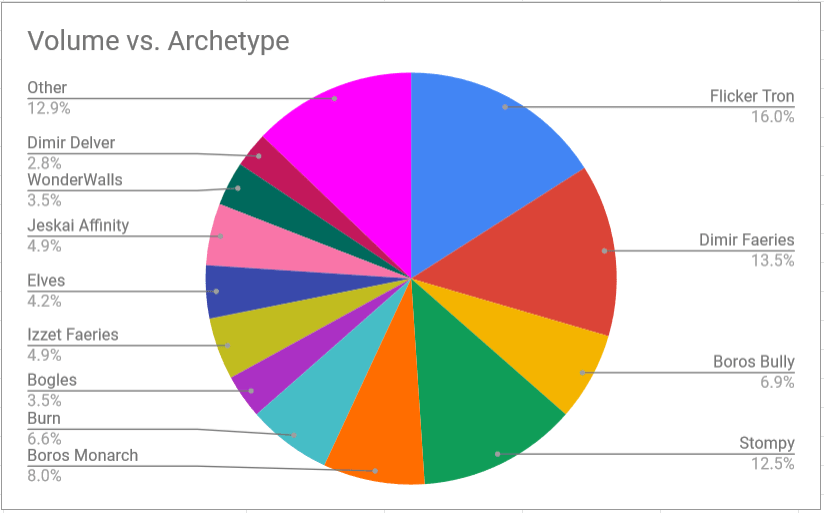
On raw volume the metagame looks fairly diverse. There are a dozen archetypes that make up at least 2% of the metagame. If you group the two Boros Palace Sentinel decks together, you have four archetypes at over 10% of the Top 32 metagame. If you’re wondering why these are not listen in descending order, just you wait. There is one thing that gives me pause. 17.8% of the Top 32 metagame is made up of hyper linear decks (Bogles, Burn, Elves, WonderWalls). These are all decks that try to attack on a non-traditional axis and, in all likelihood, are aimed at Tron. This is important when we take a look at the next breakdown.
This chart takes a look at the accumulated Win+ of each archetype and takes it as a percentage of the sum of all Win+ scores.
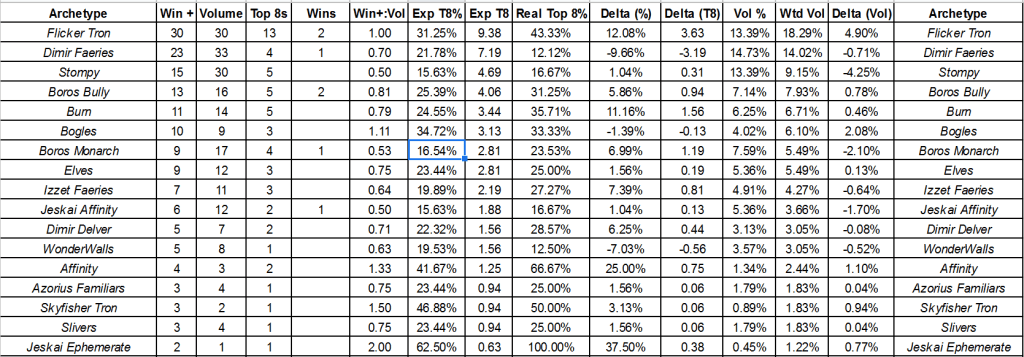
It’s neat that Dimir Faeries and Boros Bully improve on their performance when it comes to Weighted Volume. And the hyper linear decks perform almost exactly the same in this chart. But that’s burying the lede because Tron chewing the scenery. Almost a quarter of all Wins above X-3. That’s a fantastic rate. While this is absolutely bolstered by last weekend’s dominant performance, Tron’s Weighted Volume is an 8.44% increase over it’s actual volume. By comparison, the cumulative increase of the other four decks with a positive delta (Dimir Faeries, Boros Bully, Bogles, Elves) is 2.39%. Tron is over three times as successful as those four decks, combined.
In 9 events, Flicker Tron won three (and was in line for a fourth according to anecdotes, if not for clock issues). Flicker Tron has 23 Top 8s (nearly a third of all the Top 8 slots) and the next best decks (Dimir Faeries, Boros Bully, Boros Monarch) have 6 each. Add in Stompy (5 Top 8s) and those four decks have as many Top 8s as Flicker Tron in the same 9 week span.
Clearly something needs to be done. If Pauper was Standard, action would be a foregone conclusion. Last week I gave my suggestions for changes:
Ban Tron: At this point there is no reason these cards should continue to be legal as they’ve proven time and time again to be too good. Go ahead an unban Expedition Map while you’re at it.
Ban Monarch: A Monarch is a cool mechanic but in reality a free card every turn is too good in a two player format.
Ban Burning-Tree Emissary: If you remove late game incentives, you have to also remove draws that overrun control decks with ease and removing BTE takes some pressure off slower decks.
Ban Ephemerate: Ephemerate is basically the Monarch when paired with Mnemonic Wall or Archaeomancer except it’s also a tutor; removing Monarch but leaving this engine will create the same problems.
I do want to take a moment to discuss why I think adding more powerful card via downshifts is a bad idea. Over the past year we have seen what happens when you add more and more powerful cards to a format that is already unbalanced. Standard has been, for lack of a better term, a turbo-charged go-kart on a salt flat. Things are out of control and that has coincided with a conscious effort to raise the power level across the board. Doing this in Pauper is not likely to boost fringe archetypes but rather provide the best decks more tools since they are already set up to adopt new cards. You would have to pump prime Pauper with an entire small set of new options to better balance the scales.
I understand the desire to play with powerful cards and do cool things, but at some point something will need to be done to level the Pauper playing field. The card pool is growing and if the powers that be are not more aggressive with their use of the ban hammer, the format could very easily collapse under its own weight before much longer.
I didn’t write a weekend check in for this week. I wanted to, I even completed the spreadsheet entry for the Challenges that took place on October 3 and October 4. But I didn’t feel like writing a summary, mostly because I have been playing a lot of Pauper. And to be honest: I’m not enjoying it a ton right now.
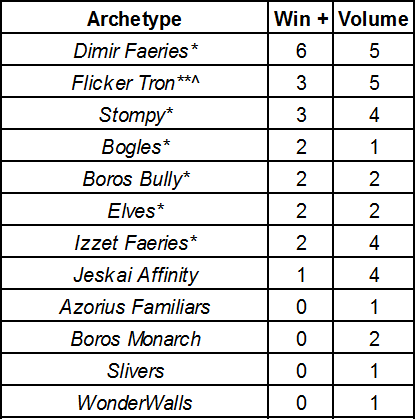
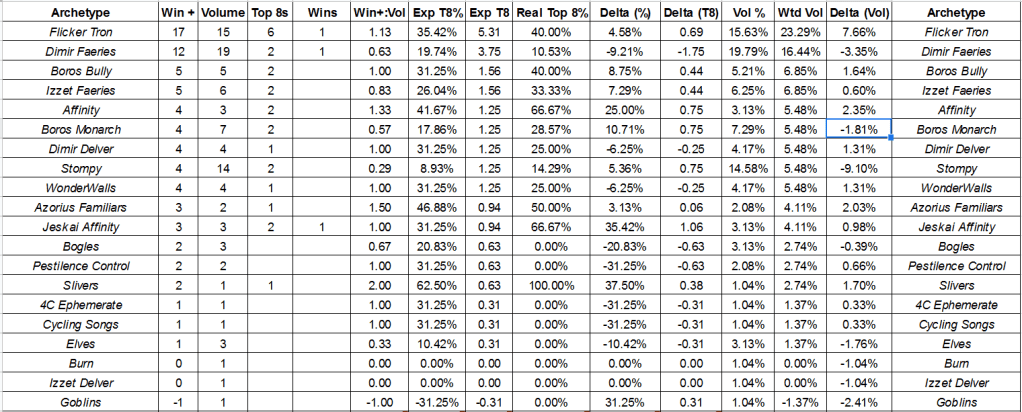
Zendikar Rising season through 7 events; only decks with a Top 8 finish featured
The incentives in Pauper are out of whack and right now the majority of games come down to a slog of card economy. The power of Monarch and Tron mean that prolonging the game and simply exhausting your opponent’s resources (and potentially their will to play). The other option is to be as aggressive as possible and try to end the game in the first five turns. There is a scrum in the middle, but those skirmishes tend to take place between decks that are trying to fight for long game advantages. None of this is new and Pauper has been trending this way since the release of Modern Masters 2017. (Note: I originally got the release wrong, these cards came in 2017, not 2015)
Modern Masters 2017 saw a number of key additions to Pauper. It gave the format Augur of Bolas, Burning-Tree Emissary, and Dinrova Horror. It’s release also coincided with the addition of Palace Sentinels and Thorn of the Black Rose to the Magic Online pool of available cards. You will be hard pressed to find a Pauper regular who can point to a more impactful release than that one. Shortly after the set hit, Stompy rose to prominence on the back of Burning-Tree Emissary turns only to be unseated by Boros Monarch leveraging free cards and Prismatic Strands. Not too long after, Dinrova Horror endgame Tron decks came into being. Along the way a bevy of blue cards got banned (Cloud of Faeries, Daze, Gitaxian Probe, Gush, and Mystic Sanctuary). These bans were needed to keep blue in check (and blue is doing just fine), but now Pauper is locked in a battle between an early knock out and a 12-round slog.
The incentives in Pauper are broken. The addition of Burning-Tree Emissary to the format made one-for-one removal a risky proposition. Your Lightning Bolt is very good at handling one threat but doesn’t do nearly as well when it trades with half of your opponent’s second turn. Stompy was dominant early in the Modern Masters 2017 on the back of incredibly strong BTE turns. That is until Boros players figured out how Palace Sentinels worked with Prismatic Strands. Now midrange decks had a way to stay alive when faced with pressure while also drawing into more removal. It is a lot easier to clear a board when you’re drawing two cards a turn.
This was a major inflection point. As running answers became less important and more decks were relying on damage prevention effects (and as these effects became better) it became easier to survive until simply drew enough answers or ended the game. (Note: the next section is edited to update for the correct timeline of events)Pulse of Murasa came in 2016 and made pushed for a major shift in Tron decks.. Until that point, Tron decks were largely focused on resolving large threats early and ending the game with Rolling Thunder or Ulamog’s Crusher. In order to survive, the deck ran Expedition Map, Chromatic Star, and Chromatic Sphere in concert with Fangren Marauder. Pulse of Murasa gave Tron a way to buyback dead Mulldrifters while also bolstering a life total. Mnemonic Wall getting back Pulse was backbreaking and bought tons of time. These Tron decks eventually gave way to builds that added Ghostly Flicker and the modern Flicker Tron decks were born. They only got better with the addition of Ephemerate and basically, every set since.
Pauper games currently trend in one of two directions: you’re dead before you can do anything or games drag on for several turns and the individual who drew more cards wins. While there are fun and interesting moments in these games, the games themselves (at least to me and surprisingly, several other regular players) are not fun. I suppose it’s a testament to how much we all love the format that we all continue to play it despite things being kinda meh.
If I had to look at a root cause, it would have to be things that are too good on rate. Current card design (January 2019-September 2020) seems to be pushing how much a single card can be worth. We are seeing this in other formats but the philosophy has trickled down to Pauper. Burning-Tree Emissary is “free”; Monarch provides free cards; Tron makes mana trivial. I am not sure the best way to make Pauper more enjoyable for more people, but here is where I would start:
Ban Tron: At this point there is no reason these cards should continue to be legal as they’ve proven time and time again to be too good. Go ahead an unban Expedition Map while you’re at it.
Ban Monarch: A Monarch is a cool mechanic but in reality a free card every turn is too good in a two player format.
Ban Burning-Tree Emissary: If you remove late game incentives, you have to also remove draws that overrun control decks with ease and removing BTE takes some pressure off slower decks.
Ban Ephemerate: Ephemerate is basically the Monarch when paired with Mnemonic Wall or Archaeomancer except it’s also a tutor; removing Monarch but leaving this engine will create the same problems.
These are drastic steps and will cause a massive change in the format. More than that, these will render several cards unplayable and for players who play tabletop, that is a real cost. That being said I think these changes can open up Pauper. I do not think these change the incentives but rather unlock additional things to play towards.
I don’t think unbanning cards (aside from Expedition Map) is the way to go. Adding powerful options back to the format don’t open up new pillars but rather rebuild old ones. The changes proposed above are just one set of options and I’d like to hear what other regulars have to say.
It feels weird to write about Magic today without talking about the Elemental in the room but I’m going to give it a shot. This past weekend there were two more Pauper Challenges (no PTQs this time) and, well, not a lot has changed. Zendikar Rising has yet to make a massive impact, instead offering only a boost to existing strategies. Instead, the status quo largely remains.
A six round tournament on Saturday saw Flicker Tron come out on top. Dimir Faeries was tied with Tron for the most popular deck in the Top 32 but ended up with more Win+ points – Tron had one player with a Win+ of -1 thanks to a 2-4 finish in the Top 32.
Sunday’s seven round Challenge had five players finish with a 3-4 record, which knocks Dimir Faeries down a peg. Even with these results we are getting a fairly clear view of the metgame. And, well, it looks familiar.
We are five events into this season and Flicker Tron has 27.5% of all Top 8s (or a clean 30% if you want to include Skyfisher Tron). The next two best decks (measured by Top 8 appearances) are Boros Bully and Dimir Faeries with 4 a piece. Simply put, Flicker Tron is a lap or two ahead of the field.
What is most alarming, this early in the season, is how much better Tron is in the Winner’s metagame than every other archetype. When taking the weighted volume of its Win+ score, Tron has 22% of wins over X-3 as opposed to only about 15% of total Winner’s volume. The delta of 7% is nearly five times greater than the next best delta (1.46%, Bogles). Now this is early in the season but it should give the format something to watch. Maybe this is just an early spike, fueled by a larger than normal number of negative finishes.
One can only hope.
The bigger thing to take away from this weekend is the rise of Boros Bully. While never actually dead, the deck has taken a backseat as of late to its more midrange cousin. Perhaps the ability to go wide and get around Dimir Faeries largely point removal has proven to be a turning point, giving Battle Screech a chance to shine once again.
Next week, I would be sure to come with extra copies of Suffocating Fumes and Shrivel at the ready, not to mention a way to take out a Lumithread Field.
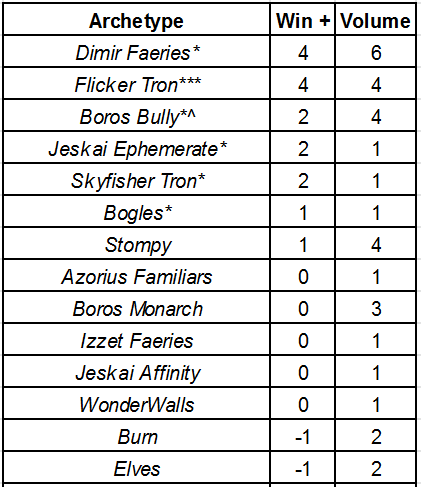
So yesterday when I released my breakdown of last weekend, I missed an event. I had completely forgotten there was a Pauper PTQ on Magic Online and as such I did not factor the results into my spreadsheet. Well, we’re going to remedy that today. To refresh our collective memory, let’s look at the results of just the two Challenges.
There really wasn’t much of a surprise with any of this. Rather, the decks that did well last season were well represented and – shock of shocks – Dimir Faeries and Flicker Tron were the best decks in the Challenges. But what happens when you add the PTQ into the mix?
Not much? Even thought Jeskai Affinity won, the rest of the metagame looked remarkably similar to the one from the Challenges. How does this affect my assessment from yesterday about what decks to expect?
Surprise, it doesn’t. If anything I would anticipate a rise in Izzet Faeries since it is solid against Dimir, but other than that I don’t expect a massive metagame shift.
Zendikar Rising is here and thus a new season of data tracking can begin. The latest set has some powerful options and three different cards (Cleansing Wildfire, Spare Supplies, Tuktuk Rubblefort) have already found their way into Top 8 lists. I do not expect these to be the last cards from Zendikar Rising to have an impact in Pauper.
All that being said, none of these new cards are format warping. Rather they present useful tools and solid upgrades for existing lists and archetypes. The end result is that the metagame should look largely the same as it did going into this season. In fact, let’s compare this past weekend’s results to my most recent Power Rankings. The data below pulls from the September 19 and September 20 Pauper Challenges.
I’m going to ignore Flicker Tron because, come on, that’s a gimme. It was the best deck before the latest set and that isn’t likely to change any time soon. If there is an opening it is that many pilots are switching away from Stonehorn Dignitary and instead leaning on Moment’s Peace as an answer to creatures turning sideways. This could create an opening for Flaring Pain or decks that can turbo out an Ulamog’s Crusher.
Number two on my list was Boros Monarch and, well, the deck did fairly well. Two Top 8s in 6 appearances is on pace with last season (although let’s not infer too much, given the small sample size and all). Dimir Faeries won a Challenge and was the second most popular archetype. The archetype is continuing its climb (and be on thelook out for an introduction to the deck from yours truly) proving again the combination of Ninja of the Deep Hours and Spellstutter Sprite is really good.
Next up on my Power Rankings: Stompy. Two Top 8s might look good but the Win+ of 2 looks positively abysmal. Part of this is due to the fact that these small challenges had several Stompy pilots finish in the Top 32 with a 2-4 record. If we remove them from the equation, the deck has a Win+ of 6 in 8 appearances. That represents a bit of resurgence for the Green Machine, one I would expect to continue as the rest of the metagame continues to evolve.
The last deck in my Top 5 was Izzet Faeries, which was the fifth most popular deck this past weekend (with a Top 8 to boot). So while my rankings were perfect, they were in the ball park.
And being in the ballpark is sometimes good enough. Without comprehensive metagame data it is a struggle to get a complete view of the metagame. However seeing what consistently rises to the top can help inform deckbuilding choices moving forward. So here’s how I see things moving into next week:
Be prepared for Flicker Tron but don’t expect the Rhino to show up game one.
Dimir Faeries struggles against two-for-one removal. Firebolt is great but don’t overlook Strangling Soot.
Cleansing Wildfire is probably at its best against Boros, so run enough basic lands to function.
Have a plan for Affinity – between the traditional and the Jeskai variant, the archetype put up 3 Top 8s in 4 Top 32 finishes.





 NerdtotheCore
You must be logged in to post a comment.