December 11-12 Pauper Weekend Recap

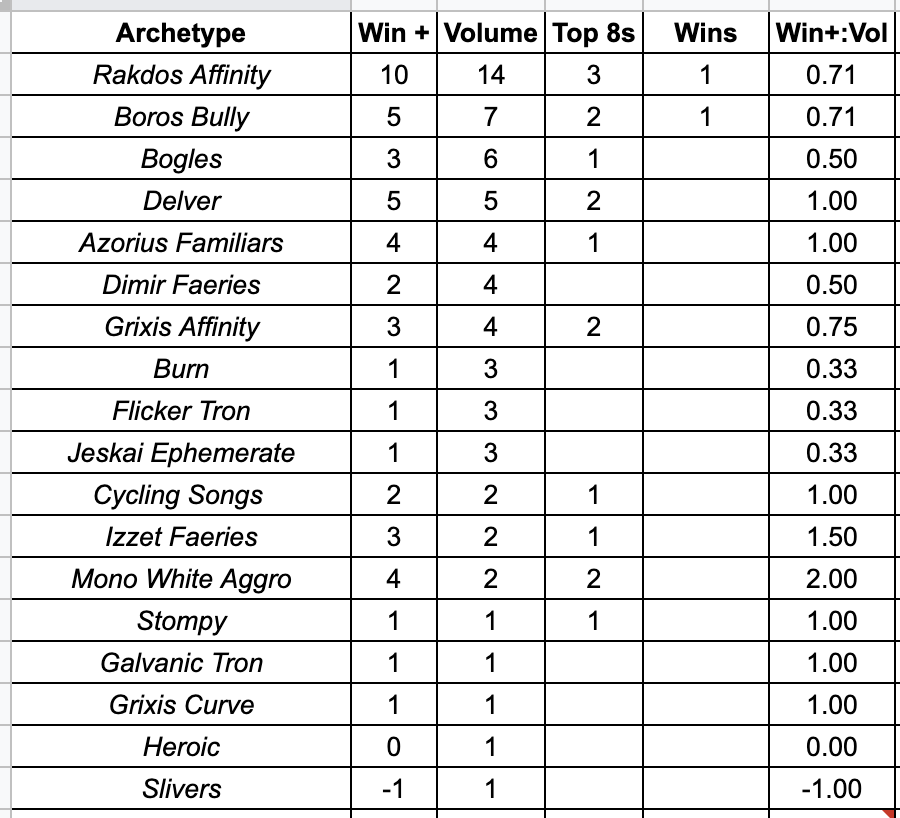
When we last left off, Affinity was at the top of the heap. Moving into the second four week chunk of Crimson Vow season with the December 11 and December 12 Challenges, there has been some movement but not enough to unseat the current top deck.

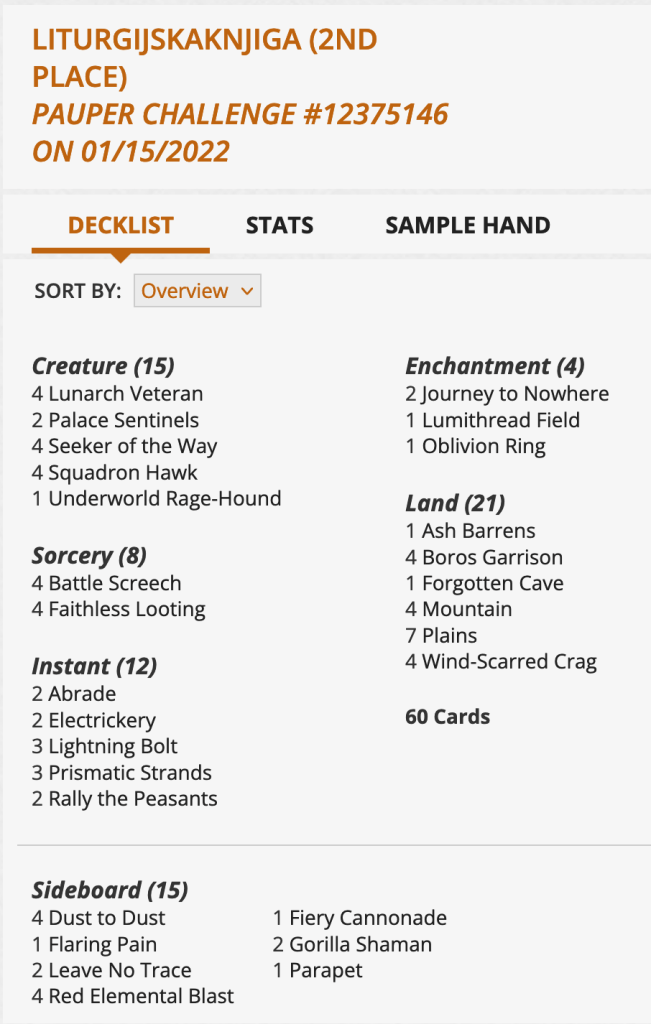
The biggest trends to be continued over this weekend revolved around Boros Bully and Delver. While Rakdos Affinity continues to assert itself as the go-to option for Atog these days, the other two archetypes mentioned had fairly good weekends of their own. Boros Bully continues to put up solid numbers – both the traditional and more token based build – including a Sunday win by former World Champion Javier Dominguez.

The rise of Delver is interesting as well. While the deck has never fully faded away, it has taken a backseat as of late to both Dimir and Izzet Faeries. Currently, Delver is performing slightly better than both of those options. This may be in part due to the mana base, as it is far more consistent than either of the two-color decks. It might also be related to the pressure of a first turn Delver of Secrets, as Affinity does struggle when put on the defense early. Regardless, Delver is back, which could open up a window for Kor Skyfisher based midrange.

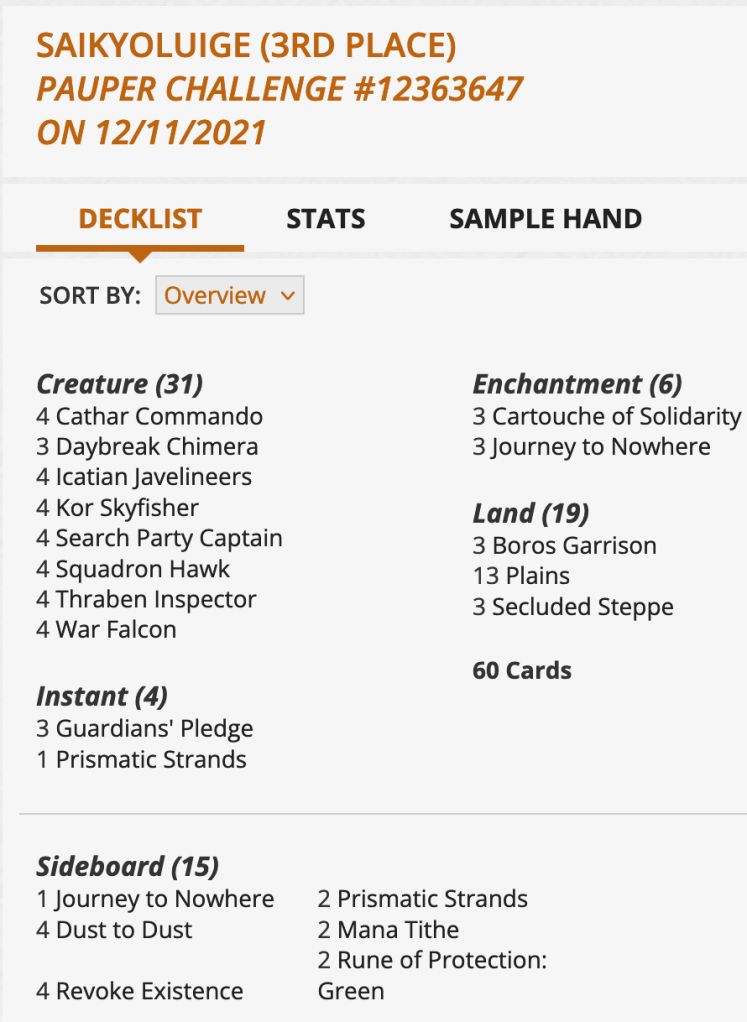
I do want to take a minute to talk about the mono white aggressive deck that has come into vogue recently. It is very likely that this deck will supplant Stompy as the traditional aggro deck in Pauper, at least given the current metagame. While it lacks the “go tall” plan of attack that Stompy can employ, it excels at going wide. It can also churn through cards faster than other aggro decks with Thraben Inspector and Search Party Captain.

Looking to next weekend, I would be looking to have a solid game plan to beat Affinity but would focus more energy on Delver and Bully. These two decks look to be making up more and more of the metagame and at this point if you’re playing, you should believe you have a solid matchup against Affinity, or be playing it yourself.

The First Four Weeks of Crimson Vow

Folks, I’m here to tell you that Affinity is good.

Shocker, I know.

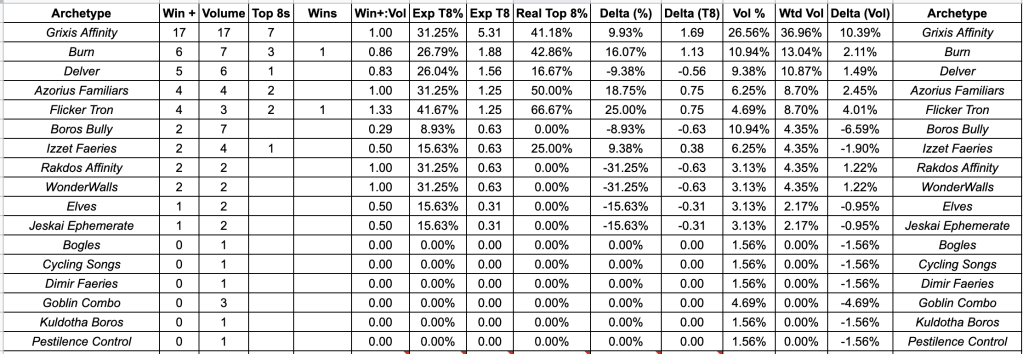
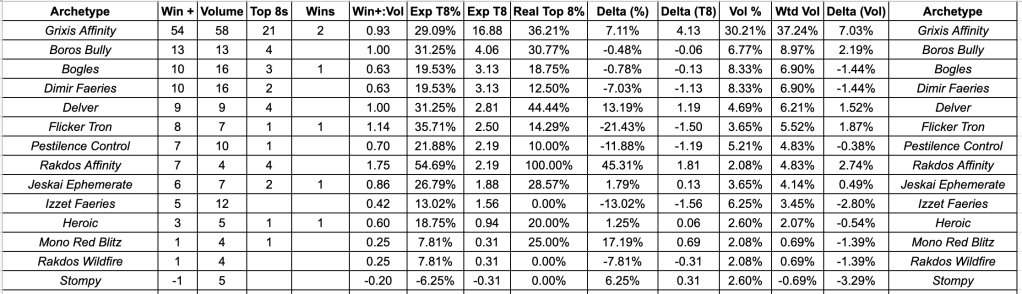
Here is a chart breaking down the macro-archetypes from the first four weeks of Pauper’s Crimson Vow season. While this does not tell the whole story it does give a pretty good image of what is going on:

Affinity is the clear best deck in the format. Recent builds have opted to forego Thoughtcast and Prophetic Prism in favor of Wedding Invitation to provide yet another way to make Atog lethal. Whether it’s Grixis or Rakdos, Affinity is a confirmed monster, with nearly twice the volume and win share of the next best macro archetype. It also has 32 out of 72 recorded Top 8 slots and 4 wins out of 9 tournaments.

Like I said, Affinity is good.

After a significant gap the next best decks are all clustered together. Faeries, Ephemerate/Flicker decks, and Boros all make a clear Tier 1.5 when compared to Affinity’s Tier 0. Boros might be the most impressive of these archetypes. Buoyed by Bully, which has an easier time running Dust to Dust main than most decks, the deck has picked up steam. There’s another version running around which leans harder on small life advantages from cards like Lunarch Veteran and Sacred Cat. This build still is Boros Bully, but takes a slightly different approach in its creature base.

The emergence of Rakdos Affinity and Lunarch Bully are two trends from the past month. The other major trend is the decline of Dimir Faeries and the rise of regular Delver. The latest Delver builds have a more aggressive slant, leaning on Mutagenic Growth and cards like Force Spike to press their advantage. That being said, Delver is still under 5% of the Top 32 metagame and has just over 7.25% of the winner’s share.

So where does the format go from here? There are no new cards hitting the scene for several months so unless a ban is coming down the pike we can expect the metagame to largely resemble this one heading into 2022. Affinity is not going to go quietly and, despite the sideboard and main deck slots we’ve seen dedicated to dismantling the machine, it still succeeds. My advice is to have a good plan of the metal menace or just accept it as a bad matchup and try to beat the other major players.

November 27-28 Pauper Weekend Recap

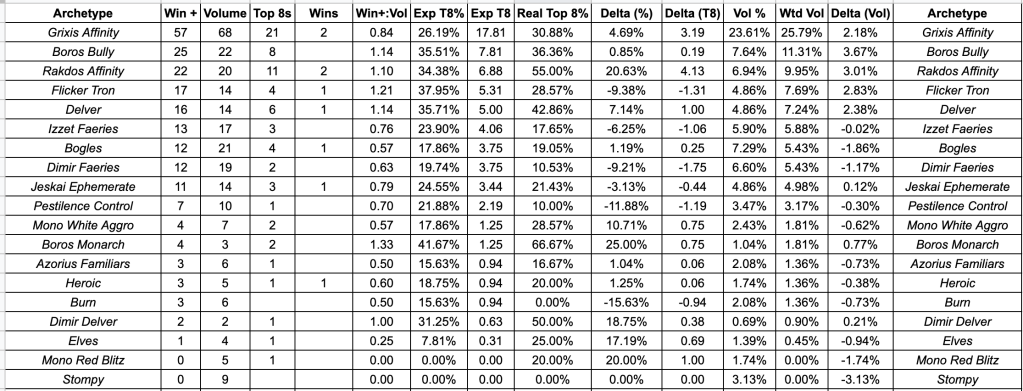
This past weekend there were three major Pauper events. In addition to the Saturday and Sunday Challenges, there was also a Championship Qualifier. While the Qualifier won’t be added to my season end spreadsheet (it only posted the Top 16 as opposed to the Top 32), the format trends continued – Affinity accounted for 10 of the 24 Top 8 slots handed out over the weekend. After six Challenges, here is where the Top 32 metagame shakes out (accounting for every archetype with at least 4 appearances):

If you look at Affinity as a whole (there’s one more Jeskai Affinity deck not listed here), the archetype makes up almost 33% of the Top 32 metagame and has taken down 52% of all Top 8s awarded in Crimson Vow season.

I am not going to spend more time talking about how the format needs a ban – I’ve done that enough and frankly I’m tired of repeating myself. Instead I’m going to repeat myself in another way: talking about why this always feels like this is happening in Pauper.

As formats add cards, combos are going to be uncovered. If not for serious limiting elements and lock pieces, formats like Vintage and Legacy would arguably be more dominated by combo decks than they are today. To a degree, non-aggro, non-prison decks in Vintage do have some combo element – we see you Vault-Key and Tinker. In these other non-rotating formats there are important limiting factors. Cards like Trinisphere, Thalia, Guardian of Thraben, Damping Sphere, Blood Moon, Wasteland, Force of Will – all of these and more help to keep the broken decks in check to some degree. These cards help to bear the weight of an ever additive cardpool that is constraining existing strategies and taxing “unfair” decks.

Pauper has the ever additive cardpool but completely lacks powerful limiting agents. The result is a format that hangs in a tenuous state where adding the wrong suite of cards has the potential to push an “almost good” combo deck into the stratosphere. At this point we all know that any Storm spout is liable to break the format in half. Currently we’re living under the auspices of Atog – a combo deck that existed for years but was held at bay by one of the true broken limiting agents in Gorilla Shaman.

There are two paths to forge with Pauper. The first is to take more action against these combo decks. Given the nature of the cardpool that means more aggressive bans when these combo decks do arise. Please stop asking for more powerful hate bears at common, that’s not going to happen folks. Force of Will isn’t walking through that door and neither is Dryad Millitant, so let’s stop wishful thinking. For what it is worth, I believe this is the correct path to take.

The other is to just have Pauper be a combo format – one where the game is decided on turn two or three. We have already seen what Pauper looks like with combo running roughshod, so maybe the “answer” is to just do that. For what it’s worth, again, I think this would make for a miserable format where the old Vintage axiom would hold sway: The early game is shuffling, the mid-game is the mulligan decision, the late game is turn one.

What should Pauper be? In my opinion it should be a place where people get to play with commons that may have been overlooked at one point and not have to thread the needle of hoping not to die to an over-the-top combo deck. Given that the best tools against combo decks are not viable at common, the answer becomes a more aggressive management of the ban list.

November 20-21 Pauper Weekend Wrap Up

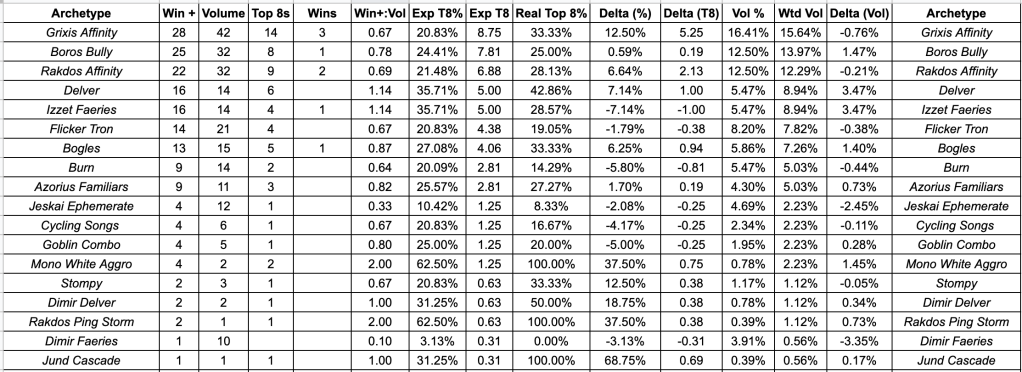
After four Crimson Vow challenges Pauper is in an unenviable spot. Grixis Affinity took home six Top 8 slots on Saturday and another six on Sunday. Over the course of the weekend 22 players took Grixis Affinity to a Top 32 finish – 11 on each day. The next most popular deck was Dimir Faeries with 4 appearances in the Top 32 on Saturday and none on Sunday.

Folks, this ain’t good.

This chart showcases every deck that has at least 3 appearances in the Top 32 this season or a Top 8 finish. Affinity is almost 29% of the metagame while no other deck has reached 8% Top 32 volume. Affinity is approaching if it has not already reached Splinter Twin status and things are not going to get much better.

Affinity has been around Pauper since the beginning and was the subject of the format’s initial banlist in Cranial Plating. Even after Atog was released as a common on Magic Online in 2011, the deck was merely another good choice for specific metagames. The Artifact Lands, which caused huge problems in other formats, were largely held in check by copious artifact removal headlined by Gorilla Shaman. Running Affinity always meant risking your board development in the face of a turn two or three Mox Monkey. As has been noted several times, the printing of the Modern Horizons 2 Bridge cycle made Affinity far more consistent in the face of hate. While Chatterstorm got a ton of press, Affinity was a strong contender during the reign of squirrels as well.

Now Affinity is not only remarkably consistent with regards to developing its board thanks to dual lands (that, by the way, effectively tap for more than two mana every turn), they also can present a fantastic natural clock in Myr Enforcer, a combo clock in Atog, and multiple combo-kill angles with Atog and Fling or Atog and Disciple of the Vault. It has one of the best removal spells in Galvanic Blast and access to some of the format’s best draw spells in Thoughtcast and Deadly Dispute – that latter of which is basically mana neutral in the deck. And let’s not get started on Blood Fountain which is basically a Sol Ring you can cash in for two creatures in the midgame.

Realistically, what deck can keep up with that?

Normally this is where we could talk about sideboard options. Cards like Dust to Dust and Deglamer have some utility but Fangren Marauder cannot stop Disciple from killing you – on the Fangren player’s turn your Disciple triggers will resolve before their Marauder triggers and well, we know how that ends. Without effective countermeasures, the deck will continue to add tools at a rate other decks cannot match. Affinity cannot continue to exist in its current form as there is no real way to fight the deck except to try and race.

I’m not going to get into the weeds about what should be banned as I’ve already made my opinion well known. We’re past the time for observing, for trying to figure out if something can reliably keep Affinity in check. After months, we know it’s the best deck by a fairly clear margin. There’s only one path forward and the people in Renton have to be the ones to walk it.

Yes, Gush Needed to be Banned

Whenever the subject of bans come up in the Pauper Discourse, Blue Monday enters the conversation. On May 20, 2019 Daze, Gitaxian Probe, and Gush were all banned in Pauper. At the time I had long advocated for a Gush ban as the card fostered a format imbalance that heavily favored blue decks. At the time I was fond of saying that if you wanted to compete you could play any Gush deck you wanted. Some players believe that these bans hit the wrong targets and that some or all of these cards should still be legal.

Clearly I disagree.

Before its ban Gush was powering up several decks – Izzet Blitz (a Kiln Fiend combo deck), Tribe Combo (Tireless Tribe and Inside Out combo), various Spellstutter Sprite decks (Delver, Izzet Delver/Faeries), and Dimir Delver (similar to Legacy Death’s Shadow); the combo decks and Dimir Delver also ran Daze and Gitaxian Probe, while Delver also ran Daze.

Gush is a powerful card draw spell and an engine all rolled into one. While nominally an instant, Gush was best leveraged on your own turn by floating two mana, returning the islands, and then potentially replaying a land to not only get a land drop but to also advance your board state. In Dimir Delver this made it rather easy to leverage an early Gurmag Angler but in Tribe Combo it meant a single Gush was lethal – especially when backed up with Circular Logic – and in Izzet Blitz a Gush could very easily translate to a victory. In the fair decks, Gush was just a fantastic way to accrue card advantage after Ninja of the Deep Hours went to work.

In all instances, Daze would protect investments at minimal cost while Gitaxian Probe allowed these decks to run fewer lands with reduced risk and increase their spell count for interactions where that mattered (Delver of Secrets, Augur of Bolas, Gurmag Angler).

While there were very real costs to running these spells they were far outweighed by the advantages garnered by including them in your deck. Blue is already at a significant advantage in non-rotating formats and these cards compounded that issue in that if you weren’t already playing blue you were already playing from behind. These cards were absolutely problems at the time even if people would like to point to different culprits.

A lot of folks want to place the blame on Augur of Bolas as a reason these cards got banned. Augur is a body that brick walls most aggressive creatures in Pauper while also digging for powerful spells. But Augur’s strength is bolstered by the spells it can dig up and these three, if found off of Augur, could almost always be cashed in immediately. An aside on Snuff Out: Snuff Out does not need to be banned. In an ideal world the cost of casting Snuff Out for four life would be real. As it stands today the life cost does not matter as the “clocks” of the format do not care about four life chunks. In a balanced format, the four life would represent a full turn of the game, not a fraction of one. Augur’s strength is a symptom of blue’s overall power but not the cause.

And then there’s Foil, the other free counterspell. Lots of people love to point to the fact that Gush only really took off once Foil was downshifted in Ultimate Masters. But Foil without Gush is a card that rarely sees play as the alternate cost is rather steep as it costs an Island and another card – some cards in Pauper are worth two cards for sure, but asking to trade three cards for a spell is a bridge too far. Gush was already a powerful card before Foil showed up and if Foil were banned, Gush would still be busted; without Gush providing you with extra cards at no cost, Foil sees almost no play.

There were casualties as a result of these bans. Tribe Combo has become a shell of its former self and only crops up occasionally from dedicated rogues. Izzet Blitz is a deck that has yet to reassert itself as a contender (although Festival Crasher is helping it back up the ranks). But these decks, as novel as they were, were not more important than Gush leaving the format. In both instances other cards could help them return to the metagame (again, as we are seeing with Izzet Blitz), but the number of worlds where the continued inclusion of Gush lead to a balanced and healthy format is infinitesimally smaller than ones without Gush.

So why am I bringing this up two and a half years after the fact? Because the way the Pauper community talks about Blue Monday has forever influenced the ways we approach ban discourse. There are people who want to keep powerful cards in a format because they are fun to cast and to pilot, even if they cause problems with meta health. And so individuals look at ways to navigate around the card causing issues in an effort to keep the potential offender legal. We saw an example of this not too long ago when Expedition Map was banned in an effort to curb Tron. Instead of hitting the actual problem, an ancillary card was axed and we all know how that turned out.

Oh? In case you did not know, Tron got better after Map was banned and pilots turned to Crop Rotation.

I am of the mindset that no one card is more important than the format as a whole. That helps guide my philosophy when it comes to bans. At the same point I understand that what draws some people to Pauper is the opportunity to play with some cards that are banned in other places. There is no easy answer to this conundrum, but I’d rather have a vibrant format with multiple viable options than one where my choice is which variant of the best deck I decide to pilot today.

I may be wrong. You may disagree with me and that’s okay. But Pauper is way past the point where we can ban around problem cards for the sake of preserving the opportunity to cast them.

November 13-14 Pauper Weekend in Review

A new season has hit Pauper. After eight weeks of Midnight Hunt, November 13 and November 14 heralded the start of Crimson Vow season. The early returns show a few cards making waves, headlined Blood Fountain and Reckless Impulse.

While we are still early in the season and can’t draw too many conclusions, we can extrapolate that things have not changed all that much with the injection of some new cards. Grixis Affinity still looks to be a popular and potent pick with Spellstutter Sprite decks not far behind. Boros Bully has been picking up steam recently and I expect that to continue as it remains one of the better Dust to Dust decks.

There was some discussion as to whether or not Blood Fountain would be an automatic inclusion in Affinity and this past weekend was a case in favor – all six Top 8 decks ran the new artifact. The allure of two artifacts early is tough to pass up, especially as it can either convert to three new cards late while also pinging with Disciple of the Vault. Blood Fountain is likely here to stay as it also made an appearance in Rakdos Wildfire.

Speaking of, the latest Cleansing Wildfire deck to make a splash also found a home for Reckless Impulse. This spell is powerful, giving you two cards for two mana, albeit with an expiration date. Having played with it myself I fully expect this card to reshape how red midrange decks are built moving forward, biasing them towards cheaper spells to help mitigate the “draw back”.

But what of the format? Things have not changed much. Affinity presents a problem where even if you aim targeted hate at it you might only delay the inevitable. Pro Tour Venice Champion Osyp Lebedowicz once described Arcbound Ravager as a fairy godmother – it did not matter what you did, when Ravager showed up it would save the day. Pauper Affinity feels similar in that it does not much matter what the opponent does – with Atog and Disciple of the Vault in the mix, there is nothing to do except try to win before they show up. That would be all well and good if these decks could keep Affinity in check, help bring some balance to the metagame. Yet the past 10 weeks have shown us that this is not the case, and as it is currently constructed, Affinity is a force that Pauper has to reckon with, even if it lacks the effective measures to do so.

Hermetic Study: Selesnya “Scales”

Ever since the Hardened Scales deck burst on to the scene in Modern I have been trying to see if it could be ported over to Pauper. The format has a ton of +1/+1 counter synergies and access to Vault Skirge. It does lack some key elements – namely the persistent advantage provided by a card like Hardened Scales or Winding Constrictor. Still, cards like Travel Preparations and Pollenbright Druid enticed the deck building half of my brain.

When Modern Horizons 2 rolled around I got the itch again thanks to Arcbound Mouser. Finally, Parish-Blade Trainee was the finally straw before I felt compelled to put something together. I knew I wanted to leverage Travel Preparations with Tethmos High-Priest and so I set about building a low to the ground White-Green Counter deck. After running a few iterations through the leagues, here is where I settled before putting the deck down in favor of something that was, for lack of a better term, better:

Big thanks to Matt Ferrando and Brian Coval for chatting with me about this idea

The deck performed rather admirably. It could put a lot of power on to the board quickly through the combination of Arcbound Mouser and Arcbound Worker leading into Travel Preparations and Pollenbright Druid. Ornithopter helped the deck hum in the early turns, giving you a clean target for counters if your opponent had early removal. Tethmos High-Priest gave you some action in the middle and latter stages of a game and could set up some turns where you could Duskshell Crawler in for massive damage. The combination of Thraben Inspector and Elvish Visionary provided the deck with some much needed velocity. The deck was exceptionally good at applying pressure to other fair decks in the early stages of the game and the two cheap lifelinkers could often put you in a position to where you could take a few punches.

There are two key things holding this deck back, and only one of them can be easily addressed. The first is the reliance on early artifact creatures. Affinity is a major player in the format and Dust to Dust is a common inclusion. Abrade also sees a ton of play and leaning on Vault Skirge to do the heavy lifting is a recipe for disaster. There is a solution to this – cards like Simic Initiate, Servant of the Scale, and Star Pupil all act as if they have Modular, but they can spread their gifts around to anything, not just artifacts. Sure you probably want to keep Vault Skirge in that situation, but Healer’s Hawk or other cheap lifelink creatures can do the same job.

The other problem was alluded to previously – there is no Hardened Scales. Rather, you have to do work for every little advantage and are playing a fundamentally fair game of Magic. Pauper, currently, is putting a ton of pressure on non-blue fair decks. While these decks can succeed, they often need a way to go over the top, whether it is Rally the Peasants or a Cascade threat. The Counters deck has none of that and instead tries to just play by the rules. Modern Hardened Scales needs Arcbound Ravager to do some tricks and the closest Pauper has to that creature is Atog. At that point, why are you not just playing Affinity?

I am not saying this was a failed endeavor – far from it. There are a lot of cool synergies in the deck and it is likely only one or two cards away from being a fringe contender. However, for the time being, I’m going to be investigating other options.