Wondering where my long-form breakdown went? You can find it here, on my Patreon!
Looking to buy any of the decks listed above? Click here for my TCGPlayer affiliate link. Any purchases through the link let the folks there know you like my content!
The other day I posed a question on Twitter to the wide Magic playing audience about what sort of Pauper content they would like to see and this reply from Sierkovitz got the old gears turning. In the wake of my new content plan, such series seemed very well suited for this very site. This is not to say that such a topic would seem out of place under the big banner or does not allow for the more nuanced and granular approach I want to take on my Patreon, but if I have to start somewhere. With that being said…
When people ask me the biggest difference between Pauper and other forms of Magic there are a few canned responses. The first is Planeswalkers and their absence, which has had a profound impact considering how much the past decade of design has taken these cards into account (and a corollary to this is the presence of Monarch and more recently, Initiative). The second is the absence of catch-up mechanics, typified by sweepers. While today’s Pauper features more sweepers than every before, and better ways to catch up thanks to an increased emphasis on material and reliance on Deadly Dispute, it can still be hard to overcome deficit. But if there is one area where the difference is still glaringly stark it is in mana bases.
Forget for a few minutes that the mana in Pauper is the best it has ever been. Forget that there are a bevy of lands that produce two colors of mana and have additional upside. Instead, take a moment and compare these two Dimir decks – one from Pauper and one from Legacy:
Despite all the new toys in Pauper’s mana pool, there are still some heavy limitations on what can be done with its mana base. First and foremost, it lacks dual lands that enter the battlefield untapped. This, in turn, has a massive impact on how decks are constructed.
The lack of two color untapped lands means that any deck that dips into multiple colors almost always trend towards midrange. It is not that you cannot build a more aggressive deck that touches a second color, but instead of leveraging multiple high power one and two-drops, (a la Zoo), the decks have to instead look to their second color for something specific and something that is not needed early in order to ensure it can matter. As a consequence, most aggressive strategies are either one color or, in the case of Bogles, uses Utopia Sprawl and Abundant Growth to help smooth things out.
There is a secondary cost as well, coming with double colored spells. Take the Pauper deck above – it is majority blue and as such it can run Counterspell with ease. It can also run Chainer’s Edict in the sideboard and reasonably expect to have the correct mana for it late. However the same deck would likely struggle to run a card like Choking Sands since it would require a secondary double color early to be most effective. Compare this to the Legacy deck which can run Delver of Secrets, Thoughtseize, Ponder, Hymn to Tourach, and Murktide Regent while still have space to run three Wasteland. In Pauper it can be much harder to cast your spells, even if you have plenty of lands.
An aside: This is one reason I am not a fan of Radiant Fountain in most two color decks. The card might enter the battlefield untapped but it comes with a very real cost in that it cannot cast key spells early.
The second big difference between Pauper and other non-rotating formats are the different “Fetch” Lands. Evolving Wilds and Terramorphic Expanse have to get basic lands – not lands with basic types. On top of that the retrieved cards enter the battlefield tapped, adding another tempo cost on top of the ones that already exist from running tapped dual lands. This gates the format from plays commonly seen in Modern and Legacy (most notably the Brainstorm shuffle trick). These additional costs are almost all tempo focused which also pushes multicolored decks to be a turn or two slower than their Eternal counterparts, which in turn pushes the format as a whole to be more of a grind.
To be clear this is not to say that Pauper is just a grind-fest these days. Rather there are several strategies that try to capitalize on decks that take a few turns to set up (like the Kuldotha Red list that follows), and the entire Initiative mechanic can punish opponents who take turns off in an attempt to get their mana under them.
There is a third element at play with mana in Pauper that does not appear to be nearly as universal as in other formats. More and more these days, the mana base is an active part of a deck’s engine. The most obvious execution of this principle is in Affinity where each land helps to turn on Metalcraft synergies while serving as additional fodder for Deadly Dispute and Makeshift Munitions. But the Bridges also serve a purpose in other decks that lean on them to accelerate with Cleansing Wildfire. More recently we have seen decks turn to Basilisk Gate as a way to push through damage, leaning on various other Gates to cast spells and speed up the clock. Even the current crop of green based ramp decks use an Arbor Elf engine – namely needing to pack their deck with Forests (including Highland Forest and Wooded Ridgeline) to help facilitate their jump from development to endgame.
None of this is new. For years many top Pauper decks leaned on their mana bases as a form of backup engine, from Islands and Spire Golem, to Swamps and Corrupt, Cloudpost and Tron, and the various engines built around the Ravnica Bouncelands and cards like Cloud of Faeries – mana bases have been integral parts of Pauper game plans. Given the (compared to Legacy and Modern) lower power level of the format, it makes sense to try and extract value from cards that are going to be in your deck anyway.
The mana in Pauper is the best it has ever been and is only going to get better. However if looking at Pauper mana bases compared to other formats there are a few things to keep in mind:
Pauper mana bases are slower and come with a tempo cost
This tempo cost pushes multicolored decks towards midrange
Mana bases can be leveraged as part of a deck’s core engine
Looking to buy any of the decks or cards talked about today? Click here for my TCGPlayer affiliate link. Any purchases through the link let the folks there know you like my content!
I want to take a moment to thank all my Patrons – both old and new. I am going to do my level best to keep providing you with the kind of content that brought you here in the first place. If you are interested in supporting my work, rewards for my Patreon start at just $1 and every little bit helps.
Today’s post is going to be a little different than usual. Instead of talking about Pauper I’m going to be discussing some changes to my content and how you – the reader – will be able to access it.
First things first – as of this writing I am still producing content for ChannelFireball, so that has not changed. My focus there will continue to be producing high quality Pauper focused content that is aimed at the widest possible audience.
Perhaps the biggest change will be coming to this very blog. I have been producing weekly metagame summaries in one form or another since Cloudpost was legal in Pauper. I have no plans on stopping, but there are going to be some changes. This blog will still feature the metagame charts and breakdowns for each weekend event and include some conclusions, but the deeper conversation will now take place on my Patreon under the Behind the Curtain tier. Tracking the data and writing the summaries takes time and with some of my other content plans for the future, I wanted to move that information to a space for folks who are more invested in Pauper.
So what new content can you expect on this blog? If ChannelFireball is for the wider Magic audience, I consider this blog to be for the Pauper-interested. If you want to figure out how Pauper relates to other formats or wade a little deeper, that is what this blog will strive to be. There might be some growing pains but my hope is that this site will serve as a good foundation for Pauper knowledge.
What happens on the Patreon? This will continue to be for the people who are most heavily invested in Pauper. I want that community to be a repository of data and knowledge, one where members can seek out the little edges to can mean the different between wins and losses. Deep dives, granular discussions – if that’s what you want from Pauper, then the Patron Only Content tier is the place for you.
All of this is subject to change in the future and I’m excited for the journey to come. Thank you all for everything.
I have a new quick deck guide live now on ChannelFireball! Check it out here!
Looking to buy the deck talked about today? Click here for my TCGPlayer affiliate link. Any purchases through the link let the folks there know you like my content!
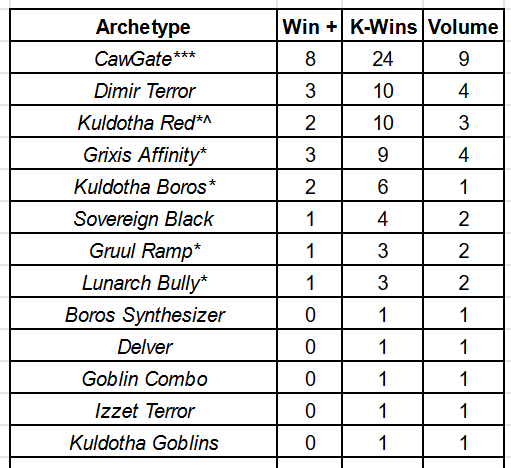
This past weekend, three Magic Online Pauper events took place. There were the normal Saturday and Sunday Challenges, but there was also a Pauper Super Qualifier on Saturday. This is our first real look at the metagame in the wake of the Initiative bans and this weekend was rather instructive in sorting out the wheat from the chaff in the competitive metagame.
October 1 Super Qualifier Top 32
The Super Qualifier had two decks that out performed the rest in CawGate and Grixis Affinity. Combined these decks took down five Top 8 slots (including a win) and had over half of the Top 32. Oddly enough, the most played deck in the 203 player event – Dimir Terror – did not have a Top 32 finish (but more on that later). Neither of these decks are all that quick but can pivot from developing to victory rather quickly – just ask anyone who has been on the receiving end of the triple Myr Enforcer turn – and both fall on “control” end of the spectrum. That might explain the relative success of Kuldotha Red as well – a low to the ground deck that uses Great Furnace and Experimental Synthesizer to pump out tokens with Kuldotha Rebirth – as a way to “go under” the top of the metagame.
All three of the best decks use their mana base as a supplemental engine. Affinity needs its artifact lands to power out its absurd turns, but also as a secondary source of fodder for Deadly Dispute and Reckoner’s Bargain. CawGate cannot pump through damage with out Basilisk Gate. Kuldotha Red doesn’t just need Great Furnace as more material, but actively wants Mountains for Fireblast. The nature of land based engines means that decks like Gruul Ramp – with its nine land destruction spells – has some merit in the current metagame.
But what about the rest of the weekend? Dimir Terror won on Saturday and had a fantastic weekend in the Challenges while Lunarch Bully – another Basilisk Gate deck – won on Sunday. There was also a relative dearth of Spellstutter Sprite decks – with 7 in the Challenges and none in the Super Qualifer, and only two of those seven touched a secondary color in Red. I am not sure if this is just a matter of meta positioning or if Tolarian Terror is powerful enough to push people away from Spellstutter Sprite in their blue control decks.
With all this in mind, here is where I have the metagame tiers right now. The Top Tier is Grixis Affinity, Dimir Terror, and CawGate, with Kuldotha Red not far behind in a Tier 1.5. Tier 2 is where we get our first hint of green in Gruul Ramp and Bogles, with Madness Burn residing here as well.
All of this is to say that right now removal is regent. Chainer’s Edict and Unmake look fantastic right now, but a lot of this space is taken up by Agony Warp in the Dimir decks. So if I were looking to gain an edge for October 8 and October 9 I would be trying to find the Dimir Terror deck that leans on removal while not giving up any ground to the existing Dimir Terror decks.
Looking to buy any of the decks talked about today? Click here for my TCGPlayer affiliate link. Any purchases through the link let the folks there know you like my content!
I want to take a moment to thank all my Patrons – both old and new. I am going to do my level best to keep providing you with the kind of content that brought you here in the first place. If you are interested in supporting my work, rewards for my Patreon start at just $1 and every little bit helps.
This past weekend was the first set of challenges since the Initiative was taken down a notch. The resulting metagame has some familiar features but is hardly the same old Pauper. As anticipated, Affinity came out in numbers but was it a force to be reckoned with?
Affinity was almost certainly the best deck on the weekend, taking down 4 Top 8 slots in 12 Top 32 appearances. It averaged close to a Top 16 finish in the Swiss rounds and taking those four Top 8s into account had 27 more wins than losses. If these numbers were consistent for several weeks there might be an underlying issue with the deck but as it stands this weekend is just the first set of data.
So what are the take-aways from this weekend beyond the presence of Affinity? In my mind there are four.
Tolarian Terror is Real
The absence of Faeries is not surprising as that archetype tends to do better in more settled metagames. However the number of Dimir decks featuring Tolarian Terror might be a small bad omen for Spellstutter Sprite and Friends. Terror has some serious closing power but demands a deck full of spells as opposed to creatures. If Terror is as good as believed it could split Faerie stalwarts and open up the metagame some, giving a sense of dynamism between weeks when Terror is better than Sprite and vice versa.
Gatecrash
Basilisk Gate is a fantastic damage engine in otherwise anemic offensive decks. CawGate might be a fine collection of cards but without access to the Gate it can take forever to close out games. There are multiple varieties of Gate decks but my favorite right now might be the one starts with the Cauldron Familiar engine, backs it up with Deadly Dispute, and ends on Basilisk Gate.
The New Old Red
Kuldotha Red looks to be the leading red deck in the new metagame. It is low enough to the ground and has enough burn to supplement Monastery Swiftspear. I thought that given the meta shift that Red Blitz would be a larger factor but it seems that people cannot get away from value and Kuldotha Red, thanks to Experimental Syntheszier, has that covered.
On Ramp to Initiative
The Initiative is still present in the metagame, finding a home in the Green-X Arbor Elf ramp decks. These decks can accelerate into land destruction and top their curve with cascade threats like Annoyed Altisaur. Avenging Hunter slots perfectly into these decks and provides more persistent advantage than Owlbear. At the same time these decks are somewhat vulnerable to awkward draws and low to the ground decks that can get their threats under Stone Rain, so it remains to be seen if they have staying power.
I want to take a moment to thank all my Patrons – both old and new. I am going to do my level best to keep providing you with the kind of content that brought you here in the first place. If you are interested in supporting my work, rewards for my Patreon start at just $1 and every little bit helps.
Okay to get things out of the way, the Dominaria United season as we knew it is over thanks to a few bans. If you want the full run down, please check out this highly detailed video from Gavin Verhey (and the other members of the Pauper Format Panel [of which I am a member]).
Okay, with that out of the way we are almost ready to look forward. Why almost? Because before we can discuss the texture of the format after the bans take place we need to better understand what was taking place leading up to today. For the record here is every deck with at least four appearances in the Challenges (or a Top 8 finish):
There’s a lot of information in here and it can be tough to parse the signal from the noise. The Kuldotha Red numbers, for example, are heavily inflated by 13 appearances in the September 18 Challenge which may have been a reaction to the success of Initiative running up to last weekend. Still, we can use the data to help make some “best guesses” as to what things will look like moving forward.
First and foremost, despite being not as relevant for the past few weeks, Affinity is absolutely going to be a major player in Pauper. The deck has lost nothing and is poised to find its footing without being pressured as early thanks to Initiative. Krark-Clan Shaman and Makeshift Munitions might falter in the face of Monastery Swiftspear but they do alright against Goblin tokens. And speaking of, a rise in Affinity makes all decks that run artifacts as an integral component somewhat riskier thanks to the up tick in Dust to Dust.
But you can’t keep Monastery Swiftspear down. The strategy was one of the best leading up to Dominaria United and adapted to the world of Initiative. Swiftspear decks are incredibly efficient and can win from nowhere thanks to the decks ability to churn through cards. I fully expect Swiftspear decks to return as the format’s clock.
Speaking of clocks, you can expect some form of Spellstutter Sprite deck to be strong. Get it? Because it’s like clockwork. Okay they’re not all winners but you get the point. Combining cheap blue filtering and countermagic with a removal suite has been good for quite some time and is going to remain a powerful option. The only way these decks could drop off a cliff is if Tolarian Terror decks are that much better.
Tolarian Terror came on strong this weekend and it is not hard to see why. It rewards you for playing spells by coming down quickly but unlike Gurmag Angler it does not eat the graveyard. This means each Ponder in the bin is a persistent point of generic mana. Terror decks can trade early and often on the stack and then mop up with their large, hard-to-solve haymaker. Now you can still Snuff Out a Terror but I imagine that we might see a small uptick in Diabolic Edict like effects in an effort to end the reign of this card.
Finally, Initiative is not dead. Arbor Elf powered ramp decks have been a staple of the format for the better part of the year and they just added another tool. Avenging Hunter had already shown up in spots and Goliath Paladin looks like it can hold the fort rather well. The fact that this deck can also ramp into Imperial Oath – and those tokens can wear Forge counters rather well – means Selesnya Ramp may just be the next big midrange thing.
What decks do you think are going to show up this week? What strategies are you excited to play?
I want to take a moment to thank all my Patrons – both old and new. I am going to do my level best to keep providing you with the kind of content that brought you here in the first place. If you are interested in supporting my work, rewards for my Patreon start at just $1 and every little bit helps.
But let’s be real – this is all about the Initiative.
Dominaria United and Initiative came to Magic Online at almost the exact same time and since then there have been four Challenges, with the Initiative taking down two of them. Given that these cards are still somewhat scarce on MTGO I do not want to read too much into the initial data. At the same time, I want to do a better job exploring what story the data I collect is telling. To that end, I am adding another metric.
In his recent run on the mothership Frank Karsten has shared how he derives a “match weighted” metagame – total match wins less total match losses. While Karsten is able to do this for every deck in an event I am limited to the Top 32 lists. For those wondering why I only use the officially reported results, it is because it is the only way I can get completely accurate decklist information. So this metric gets entered into the chart under the title of “K-Wins“. This number takes into account elimination round success in a way Win+ does not. It also allows me to compare actual volume to the volume as it relates to Win+ and as it relates to K-Wins, giving us an idea of where a deck’s so called “True Volume” should reside.
With that out of the way, let’s take a look at the first four weeks:
Right out of the gate it becomes clear that the new metagame is different from the one that existed prior to Initiative. While Grixis Affinity is still a top tier deck (6 Top 8s, 1 win, True Volume at 15.45%), everything surrounding it is different.
Initiative is clearly a big player, to the point where the deck is being run in line with Storm combo. Dimir Initiative takes the Faeries shell but eschews Ninja of the Deep Hours for a game based around the powerful four drop options. It also has added Dark Ritual to try and play to the board earlier. Dimir Initiative has 5 Top 8s and a win, and thanks to some very strong showings has a True Volume of 12.59%, out performing its actual metagame presence by 2.43%. Turbo Initiative takes this a step further and goes all in on resolving one of its namesake cards as early as possible. The deck burst on to the scene this past weekend so it only has a single Top 8 and win to its credit, but it is definitely a deck to watch.
CawGate has emerged as a real contender thus far this season. It has 4 Top 8s in 8 total Top 32 appearances, and a win. It runs the right mix of countermagic and hard to block creatures that it can take the Initiative, while also preventing it from going back with Prismatic Strands. It’s True Volume of 9.46% is over three percentage points higher than it’s actual volume, which indicates that it has been underplayed to this point.
This deck, which I’m calling Kuldotha Red, is a mashup of various red decks. It takes elements of Burn and Blitz, while layering on the Kuldotha Rebirth value engine. Going wide gives it another dimension of attack against the Initiative and thus far it shows: 6 Top 8s in 11 Top 32 finishes and a True Volume of 11.57%.
Okay, but what does this all mean? Grixis Affinity and Initiative are likely the best decks thus far, but there is a strong case to be made that both have vulnerabilities. CawGate seems very well suited, at least to fight the damage from Affinity and push through Initiative. Beyond that it does appear the other Guardian of the Guildpact strategies could find a niche in the meta, if they can survive long enough to resolve their key threat.
Alternatively you could go way under with cards like Gingerbrute, Tormented Soul, and Glaze Fiend all seeing play in part due to their ability to get through unhindered. Changeling Outcast and Slither Blade also place in this space and might just be good enough to fight for the one drop slot. But until then, watch out for Initiative because that mechanic is very real.
I want to take a moment to thank all my Patrons – both old and new. I am going to do my level best to keep providing you with the kind of content that brought you here in the first place. If you are interested in supporting my work, rewards for my Patreon start at just $1 and every little bit helps.




 NerdtotheCore
You must be logged in to post a comment.