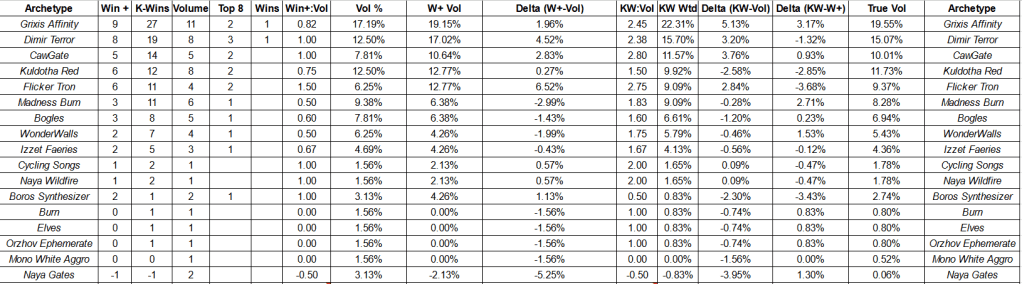
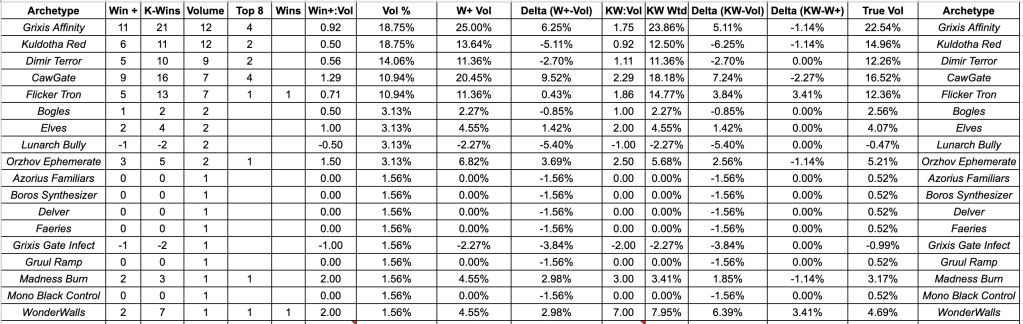
Earlier this week I wrote about the current status of Affinity and part of the issues surrounding the strategy as it relates to Pauper. There has quite a bit of discussion around the article and instead of rehashing the content of the piece I want to pose a rather broad question: When should bans be considered? Because it’s fresh in the format’s zeitgeist I am going to use Affinity as a primary example.
Before diving too deep I want to point out that given the breadth of cards available to the format the banned list is relatively small. Pauper has 31 cards called out on the Banned List while Legacy has 62 (and some additional cards where the reasoning is enumerated at the link). Modern, for example, has 48. In the case of Pauper it is possible some of these cards could eventually come off the list while others probably should be added. The list of banned cards in Pauper comes from multiple different eras and ban philosophies. All that being said, here are some of my personal criteria for looking at potential targets for removal from the format.
Digital and Tabletop
One thing that comes up often in these discussions is how tabletop players do not experience the same metagame issues as those who primarily play digitally. While both are part of a wider metagame, digital players often get in more games due to the nature of the play environment. None of this is to say that the tabletop experience is somehow less valid as the digital incentives can also skew the decks that see play in that environment. However with many of these elements I tilt in favor of the digital landscape experience due to the raw volume of games that are played there.
Ubiquity
Pauper should be a place where you can play a wide variety of decks. One of the best things about Magic is how it allows players to express themselves in a variety of ways. In non-rotating formats this is a tough thing to balance as there are times where certain styles of play may simply be a bad choice. What’s worse than this, in my opinion, is when the number of choices is significantly restricted. The most recent example of this I can think of revolves around Arcum’s Astrolabe. While it was legal, Astrolabe was a dominant force in the format and while it was believed that it could enable different strategies it ended up pushing the format towards base white value piles. The result was a metagame where the correct question to ask about the format was which Astrolabe deck was best. Astrolabe provided so much value and allowed decks to subvert the mana system in ways that made it miles ahead of everything else.
So how does this relate to Affinity? Currently things are not as clear cut as they were in the Astrolabe meta and there are viable archetypes that are not “Affinity”. That being said there are elements of Affinity showing up in various other decks, most notably the interaction of Deadly Dispute with the Artifact Lands. Dispute has come up often as a card worth looking at – and that very well might be the case – but then the question would linger of what Dispute looks like in a world without the Bridges. What is more likely to break again in the future – the Artifact Lands or Deadly Dispute?
At the same time ubiquity cannot be the end all-be all. Cards like Preordain and Lightning Bolt show up in in a large majority of decks that can support them without necessarily stifling deck diversity. The problem isn’t only presence but rather than that presence comes at the expense of other potential strategies.
Crowding
Separate from the omnipresence of cards is what certain decks can do to a metagame. Let’s look at Tron. The efficiency and strength of its mana engine means that other late game control decks have a significant barrier to overcome in order to be viable – why bother playing any other control deck when Tron is far and away the best one? This has come up at other times in the format’s history as well, notably with Monarch based strategies forcing out other midrange options.
Let’s go back to when Cloudpost was legal. Cloudpost not only was the best mana engine for a control deck but it also came with a built in defense from aggressive strategies thanks to Glimmerpost. The latter day Locus with the Mnemonic Wall and Ghostly Flicker engine put games out of reach of most beat down decks without needing to rely on Fog effects.
So where does this leave Affinity? Again, Affinity itself is not crowding out any decks per se, but rather inclusions like Krark-Clan Shaman and Makeshift Munitions are making life difficult for traditional aggressive strategies. One could make the argument that typical beatdown has no real home in large card pool formats and that is reasonable, but we are seeing a significant decline in the number of creatures turning sideways thanks to these cards and the copious amounts of fuel provided by the Artifact Lands. If the lands were removed these cards would still see play but the cost associated with them would increase, adding tangible cost to keeping the game locked down late.
Mana
If a card can subvert the mana system it tends to end up on my radar. Time after time, cards that cheat on the amount of mana produced have caused problems. Cloud of Faeries, Peregrine Drake, Treasure Cruise, Gush, Cloudpost, the Storm mechanic – the list goes on and on. It should come as no surprise that Affinity fits neatly into this category. Affinity is a cost reduction mechanic but the culprit, more often than not, are the Artifact Lands. Each of these produces at least one mana a turn but ask anyone who has faced down double Myr Enforcer on turn three – they produce closer to three mana on average.
I do not love drawing comparisons to Vintage, but Mishra’s Workshop produces three mana for artifacts on the regular in that format. Pauper Affinity is a deck loaded with contextually better versions of Mishra’s Workshop. Now Vintage has several other factors to consider, as well as the Restricted List at its disposal. Pauper, however, does not need to exist under these constraints.
Counter Play
A few weeks ago I wrote this in my article discussing Pauper’s identity:
When I look at a deck or interaction that is causing concern one question I ask myself is this: is there anything I could have reasonably done differently? The answer might lie in the in-game decisions or the composition of my deck, or even my deck choice. If there is no reasonable decision I could make differently then there may be a larger problem
Pauper’s Identity Crisis
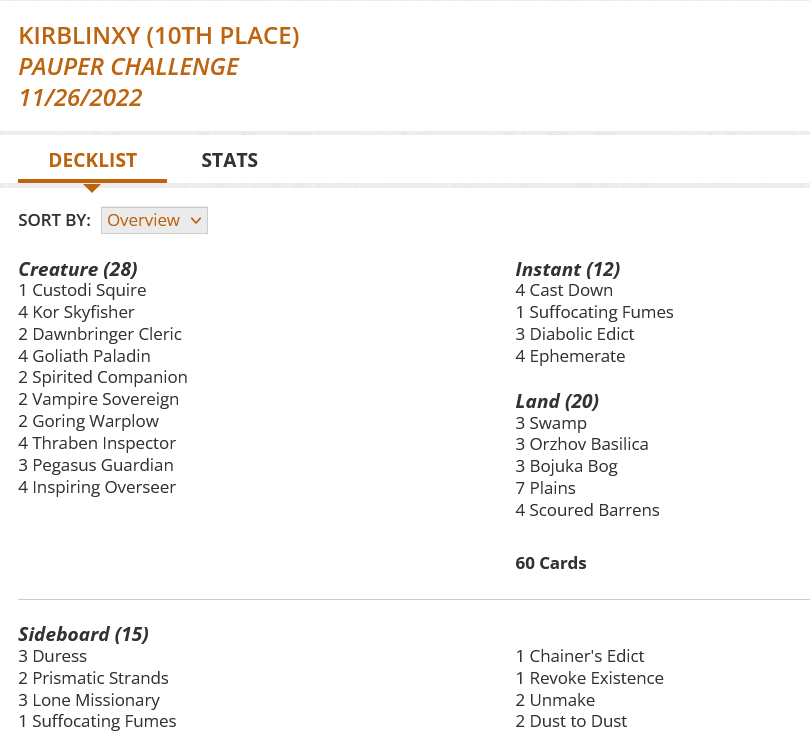
Now I am not going to sit here and say there is no way to interact with Affinity, because there are. Dust to Dust exists and cards like Smash to Dust and Ancient Grudge, while reduced in efficacy, can still have an impact. But there is a difference between interaction and meaningful interaction. If, on the play on my second turn on I cast Revoke Existence on my opponent’s first Artifact Land and follow it up with a three drop on the next turn, is that a meaningful interaction? In most cases the answer is no as I gave up a significant turn of development and valuable tempo to take my opponent off of a land that produces more than one mana, only to have them follow up with another land that does the same thing. It takes Affinity less than one turn to come back from each “land destruction” spell.
This was one reason why Gorilla Shaman was so important in the context of pre-Modern Horizons 2 Affinity. Shaman represented a massive threat that forced Affinity to try and develop other parts of its board in an effort to attempt to resolve spells that mattered. Meanwhile the presence of Mox Monkey made running Affinity a risk. Perhaps it pushed meaningful interaction too far but it did not render the deck a non-factor.
So where does this leave the current iteration of Affinity? To be clear the strategy of Affinity does not strike me as offensive. However the indestructible Bridges do check a lot of these boxes – they are becoming a ubiquitous inclusion to shore up decks with Deadly Dispute, they are helping to crowd out creature decks due to the way they fuel Makeshift Munitions and Krark-Clan Shaman, they cheat on mana and they are hard to interact with in a meaningful way.
Personally speaking, my goal would not be to remove Affinity entirely. Rather the hope would be to leave it as a viable metagame option that hovers between 7% and 12% of the over all competitive metagame. Frankly, that is my goal for the format as a whole – a bunch of decks that dwell in this area instead of some chewing up over 20% of the winner’s metagame. I hope this piece provides some additional information and insight into my thought process. If you’re interested in discussing this further be sure to join the MTGPauper Discord Server.
I want to take a moment to thank all my Patrons – both old and new. I am going to do my level best to keep providing you with the kind of content that brought you here in the first place. If you are interested in supporting my work, rewards for my Patreon start at just $1 and every little bit helps.
Looking for another way to support my work? Click here for my TCGPlayer affiliate link. Any purchases through the link let the folks there know you like my content!



 NerdtotheCore
You must be logged in to post a comment.