June 24-25 Pauper Weekend Recap

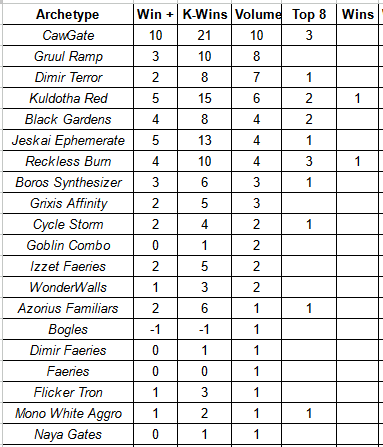
I use a few different metrics when looking at the Top 32 metagame. The first is just Raw Volume. The second is Win+, which takes the sum of all wins at X-2 or better in the Swiss and assigns a score; Win+ is helpful in measuring a deck’s Swiss round performance. K-Wins takes all of a deck’s wins and subtracts its losses, Top 8 inclusive; this helps to give a measure of overall performance. The final pair is call Meta Score and Meta Score Above Replacement, which takes the average of Win+ and K-Win to try and position an archetype against its field. This number helps to provide the most robust image of a deck’s performance.
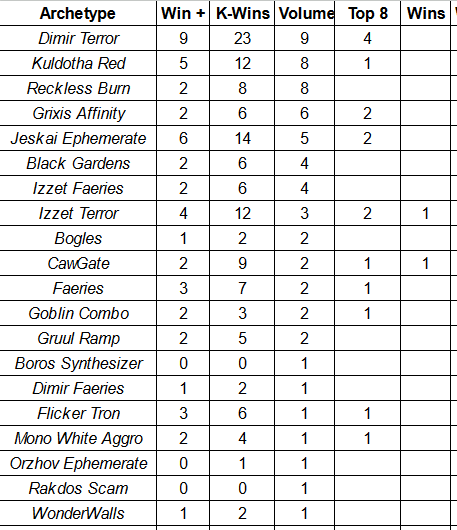
June 24 and June 25 Pauper Challenge Top 32 archetypes

Lord of the Rings: Tales of Middle-earth has hit Magic Online and a new season of Pauper Challeges has begun. The set has already made its presence felt with Cast into the Fire, Lembas, and Lorien Revealed (no I’m not going to try and get the exact characters) seeing heavy play. While it is hard to make any wide sweeping statements from the first week of a season there are definitely some elements of note.

First is the prevalence of Dimir Terror. A consistently good deck it is one of the better homes for Lorien Revealed as it can fix the deck’s mana early or be converted into raw cards once the game has reached a state of parity. Dimir Terror tends to have an abundance of resources in the middle and latter stages of the and the new addition provides a place to sink them. Dimir Terror averaged an adjusted MSAR of 0.55 last season and clocked in with a neat 1.47 over the weekend.

So what does this mean? The adjusted Meta Score Above Replacement – (a)MSAR – is a measure of how well an archetype did against the average Top 32 deck when taking a deck’s presence in the Top 32 into consideration. Decks with fewer entrants into the Top 32 tend to have higher unadjusted scores and this serves as a way to attempt and unskew the results. The average of all these scores over the weekend was 0.36 so Dimir Terror performed better than the average deck. Shocking, I know.

This statistic is not meant to be examined in isolation. The strategy averaged around a Top 16 finish over the weekend when looking exclusively at Swiss results, and when taking the Top 8s into account it performed at about a Top 4 clip (one win, one finals, one Top 4, two Top 8s). When taken together these metrics provide a snap shot of how Dimir Terror did in one isolated weekend.

But this is not about a singular weekend. Using these metrics we can measure a deck’s performance against itself week after week. As mentioned Dimir Terror averaged an (a)MSAR of 0.55 all of last season; in the final week it had a score of 0.02. In other words, Dimir Terror improved by nearly 1.5 Top 32 wins on average from last weekend to this weekend. When the spread from a Top 8 to a finish outside the Top 16 is often a win, that is a fairly significant jump. The top deck from the final week of March of the Machine was Grixis Affinity (1.21) which pulled in a respectable 0.58 this weekend.

Looking ahead I would not expect Dimir Terror to keep the top spot. Grixis Affinity has been a consistent force and Faeries has not gone anywhere. The various red decks have also added to their arsenal with Improvised Club. Notably absent from the Top 32 are Basilisk Gate decks, with only two all weekend. Given the number of token synergies present in the latest set I would not be shocked to see some number of Heap Gates showing up in the not too distant future.

I’m going to switch gears for a bit. Last week Daybreak, the company that manages Magic Online, announced a change to the price and prize structure of Pauper Leagues. While I am not the biggest fan of these changes (specifically at the 4 and 5 win levels) I am willing to see how things shake out. Daybreak has proved very responsive thus far and if things do not work out well I have faith the folks behind the scenes will adjust the leagues to ensure participation.

There was a common thread that showed up in many of the posts critiquing the decision that I wanted to discuss: that Pauper is somehow perceived as a lesser format. I want to pose the question as to why – why is there the perception of this perception? Why do some members of the community believe that the format is seen as lacking?

Personally I do not see this. Over the past few years Pauper has been embraced by the wider Magic community. It is on the regulars to be welcoming to those who want to test the waters and show why Pauper is enjoyable, beyond the expected value against time equation.

I want to take a moment to thank all my Patrons – both old and new. I am going to do my level best to keep providing you with the kind of content that brought you here in the first place. If you are interested in supporting my work, rewards for my Patreon start at just $1 and every little bit helps.

Can’t make a commitment to Patreon? I now have a Ko-Fi where you can make a one time contribution.

Looking for another way to support my work? Click here for my TCGPlayer affiliate link. Any purchases through the link let the folks there know you like my content!
Patreon Update

Hello everyone,

I launched my Patreon as a way to better connect with fans of Pauper, but also support the work I do in collecting metagame data. In the intervening years I have tried to figure out a better way to break down the Pauper tournament information that is publicly available to provide context and format analysis in a way that is driven by data. After a lot of trial and error (and help from friends), I think I’ve cracked the code.

One thing I love about baseball is how obsessed with numbers the game can be. A game with such a long history can be broken down into data to allow for reasonable comparison between different eras, and yet not lose anything if you just want to sit and watch teams battle for twenty seven outs. Baseball, like Magic in many ways, can be as shallow or as deep as you want. 

There’s a statistic in baseball called WAR – Wins Above Replacement. It measures how much better a player is than an “average” Major League Baseball player. It’s an incredibly useful stat that helps fans to see exactly how good their favorite player is at the moment, but also against the history of the game. WAR can be discrete – measured for a period of time – or cumulative – over an entire career.

Thanks to the help of some friends over the years, I now measure a stat from the Pauper Challenges called, uncreatively enough, Meta Score Above Replacement. The Meta Score Above Replacement of a deck roughly measures how well an archetype performed in a specific challenge but also the course of an entire season. This statistic can also be adjusted for decks that have fewer overall appearances to give a rather robust view of discrete eras of the Pauper metagame.

Today I want to launch a project to start analyzing seasons from Pauper’s past. Using the publicly available Magic Online Challenge tournament data I want to go back and explore formats and see what the best decks at the time were; I want to see if there were times where the metagame was in balance; I want to examine the times where there were broken decks and see how they stack up against each other.

And here is where you step in. This takes time and as much as I want to do it I cannot justify it from a temporal perspective at the current moment. I am launching two goals on my Patreon to make this endeavor more reasonable. If I can reach $250/month, I will start doing set retrospectives. These posts will take a look at different releases in Magic’s history and discuss their impact on Pauper to date – think of them as a set review, but with the benefit of seeing which cards actually performed. If I can reach $500/month I will start going back and looking at historical metagames, applying the same measures I use today to those eras to try and compare the format to itself at various points in time.

To support this I’m launching an additional $5 tier on the Patreon. This tier comes with all the prior benefits but you’ll not only get early access to my Patron only posts, but will also be able to view the spreadsheets and documents as they are being compiled.

Thank you for taking the time to read this. I am excited about these projects and I hope you are as well.

Best,

-Alex

March of the Machine Pauper Season Recap

Once again we come to the time between seasons. March of the Machine was the headlining set for eleven weeks with eighteen Challenges and two Showcase events. Going into this stretch there were fears around the strength of red and the potential for Azorius Familiars, now with Meeting of Minds, to assert itself as a true metagame force. So what happened? Let’s dig in.

Above Average

So much of the work I do in examining the publicly available Challenge data is done to try and get a better idea of what is happening in the Pauper metagame. Challenges provide a consistent source of information about what sort of strategies are rising to the top of the format. Top 8s and Wins are important but they fail to tell the entire story. Over the years I’ve worked on other measures to try and better understand what else is going on in the actual games and recently developed a statistic that measures an archetype against the average Top 32 deck. Borrowing from baseball I call this the Meta Score Above Replacement and I am able to track an archetype’s mean and cumulative performance. Here are the average and cumulative scores for every archetype with at least 5% of the total top 32 volume.

  1. Faeries: 1.26 average aMSAR; 6.29 cumulative aMSAR
  2. Grixis Affinity: 0.97 average aMSAR; 4.71 cumulative aMSAR
  3. Black Gardens: 0.94 average aMSAR; 4.46 cumulative aMSAR
  4. Bogles: 0.74 average aMSAR; 3.29 cumulative aMSAR
  5. Dimir Terror: 0.55 average aMSAR; 3.19 cumulative aMSAR
  6. Reckless Burn: 0.65 average aMSAR; 2.4 cumulative aMSAR
  7. Gruul Cascade: 0.56 average aMSAR; 1.3 cumulative aMSAR

This list provides a good snapshot of what has happened during the past nine weeks. Faeries was a consistently good performer, roughly six “wins” or so better than the average deck in the Top 32 over the course of the season. But it’s a testament to the deck to see exactly how much better, on average, it has been than the other contenders. The other thing that stands out in this list is where red has ended up, but more on that later.

This score is useful for comparing decks over the course of a season but it also can contrast decks from different seasons. How good was Faeries this season compared to the best decks from other seasons? I hope to find out and plan on launching Patreon goals to go back an explore Pauper’s past.

Seeing Red

Going into March of the Machine, there was some concern about the strength of red. Monastery Swiftspear was already tearing up Magic Online on the back of Reckless Impulse and Wrenn’s Resolve was another iteration of the effect. These decks were already incredibly consistent and the concern was that more draw would push them even further up the power rankings.

That isn’t exactly what happened. Make no mistake – red is still very good. But the addition of Wrenn’s Resolve has provided enough fuel for the strategy to bifurcate into the more token based Kuldotha Red and the Thermo-Alchemist/Kessig Flamebreather based Reckless Burn. Combined these strategies were just over 15% of the Top 32 metagame. Kuldotha Red fell one appearance short of making the 5% cutoff but ended the season with a cumulative aMSAR of 0.68, so even if these two archetypes were stacked on top of each other they still wouldn’t jump ahead of Dimir Terror.

Red has largely been contained. The metagame has adjusted to its persistent presence with strong defensive measures and a healthy dose of incidental lifegain. Blocking has gone up in value and decks that can absorb damage before feeding the speed bump to a Deadly Dispute or Reckoner’s Bargain have done rather well all things considered. Monastery Swiftspear can still apply a ton of pressure and lead to games that end before they really begin, but by and large red decks have not been the threat they were perceived to be back in April.

Something Familiar

The other big story going into the season was the potential for Azorius Familiars to have its moment. The deck has long been held back by the limitations of the Magic Online interface as it requires quite a few clicks to go through each iteration of an Archaeomancer loop. Meeting of Minds was supposed to make it easier for the deck to succeed as it reduced the manual dexterity needed to pilot Familiars to victory. Early on in March of the Machine season this seemed to be true. And then people started leaning on Thermokarst.

Arbor Elf and Utopia Sprawl into Mwonvuli Acid-Moss is a powerful start and can slam the door on several game plans. That these decks can also top out on the Initiative gives them a good place to put that mana in case there’s no reason to destroy lands. Gruul Cascade was a fairly popular deck in the back half of the season but suffers at the whims of variance. When its draws line up well it can feel like an unstoppable force but it can also fall flat, which helps to explain its middling Meta Score. Still, Gruul’s presence, on top of other decks that apply pressure early, has limited Familiar’s opportunities.

Meet You in the Middle

I think the biggest story of this season is the return of black midrange. Black Gardens – a midrange Golgari deck that pairs removal with Deadly Dispute for efficient card draw and the potential for Avenging Hunter at the top of the curve. But when you break it down and peel back the layers Black Gardens is just a descendant of Mono Black Control. The fact that creatures are good thanks to Monastery Swiftspear and Affinity means that a deck based around keeping them off the battlefield can go far. Initiative again is the glue holding it together as it provides a persistent advantage once the board is clear.

Black Garden is not the only midrange deck to find success in March of the Machine season but it is the best of the bunch, at least so far. Basilisk Gate strategies largely fell by the wayside in May as people iterated on Golgari Rot Farm. At the same time Jeskai Ephemerate has returned to the fold perhaps due in part to its reliance on Bridges giving inherent resilience to Gruul Cascade.

Odds and Ends

  • Affinity had a fantastic season with six wins in 20 Top 8 appearances. This may change once Cast into the Fire hits the digital client but I doubt Affinity is going anywhere.
  • Bogles remains a viable option even if it is consistently underappreciated. The high variance strategy can sometimes just steamroll people and if Black Gardens takes a step back the slippery ones could improve their standing in the metagame.
  • Boros Synthesizer had a pretty weak season overall with five total Top 32 appearances (and a single Top 8) but it had a breakout at Paupergeddon in Pisa. I would expect to see more of this deck in the first few weeks of the next season.

I want to take a moment to thank all my Patrons – both old and new. I am going to do my level best to keep providing you with the kind of content that brought you here in the first place. If you are interested in supporting my work, rewards for my Patreon start at just $1 and every little bit helps.

Can’t make a commitment to Patreon? I now have a Ko-Fi where you can make a one time contribution.

Looking for another way to support my work? Click here for my TCGPlayer affiliate link. Any purchases through the link let the folks there know you like my content!
June 10-11 Pauper Weekend Recap

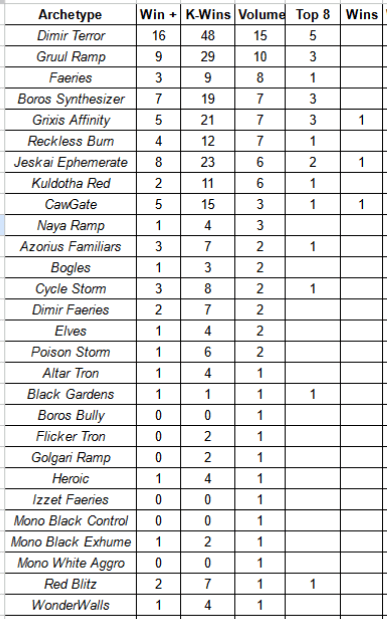
I use a few different metrics when looking at the Top 32 metagame. The first is just Raw Volume. The second is Win+, which takes the sum of all wins at X-2 or better in the Swiss and assigns a score; Win+ is helpful in measuring a deck’s Swiss round performance. K-Wins takes all of a deck’s wins and subtracts its losses, Top 8 inclusive; this helps to give a measure of overall performance. The final is one I call Meta Score, which takes the average of Win+ and K-Win to try and position an archetype against its field. This number helps to provide the most robust image of a deck’s performance.

June 10 Showcase, June 10 Challenge, and June 11 Challenge Top 32 archetypes

Magic Online is just over a week away from Tales of Middle-Earth hitting the digital shelves. March of the Machine season has one more weekend left in the hopper. Today, instead of recapping the previous weekend, I want to dive into a way I’ll be discussing the Pauper metagame moving forward.

If you follow me on various platforms you probably know I am a huge New York Mets fan. I love baseball and even though my team of choice might not be doing so great at the time of this writing, I can still turn to the sport for inspiration. Baseball is a game of numbers, and the amount of stats available help to compare different players against each other not only in the current season but across several eras. One of these metrics is Wins Above Replacement, or WAR. WAR takes a player’s overall contributions and compares it to an average Major League Baseball Player; the higher the WAR the better the player. WAR can also be used to measure historical greatness – Babe Ruth holds a lifetime WAR of 182.6 (according to Baseball Reference) while Shohei Ohtani has a current lifetime MLB WAR of 28.2.

I have been searching for wars to bring WAR to Pauper. Pauper is a format where there is a lot of data from the Magic Online events but it can be hard to fully make heads or tails of it. Over the years I’ve worked on tracking Swiss performance (Win+) and total performance (KWins) and just last week I started tracking an overall Meta Score. This last step was exactly what we needed to take a step towards WAR. If a strategy had a Meta Score in a given weekend then there had to be an average Meta Score. This average Meta Score could then be taken for a field and a deck’s individual Meta Score could be measured against it. The result would be a measure of a strategy’s performance against a closed field of an “average” finish.

Here’s how it works. Every archetype gets an average Win+ Score, which measures an average Swiss performance , and an average K Win score, which measures average overall performance. These two values are then averaged to provide a Meta Score. The total Meta Score for a given subset (a weekend, a season ,etc) is then divided by the number of total archetypes present in that field to provide the Average Meta Score. This becomes the baseline and is then subtracted from each archetype’s metascore to get a Meta Score Above Replacement.

Now there are some issues with this measure. first, I only gather data of the Top 32 publicly available decklists. The result is that this statistic, while useful, is not as robust as it could be if complete tournament data as easily on hand. Similarly, this does not take into account every Pauper event played, but simply the Magic Online Challenges. These formulas could be applied to tabletop events for a more comprehensive look at the metagame.

The other major issue is that as of this writing I have only run the calculations for March of the Machine season to this point. To that end I am going to ask that if this kind of analysis interests you and you want to see some comparisons between the different eras of Pauper to please consider signing up for my Patreon or contributing to my Ko-Fi. If there is enough interest I will carve out the time, but I want to make sure there’s an audience.

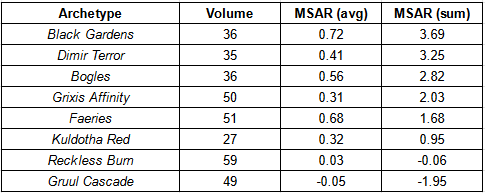
So with that out of the way, let’s look at the 16 Challenges and 2 Showcases in March of the Machine season (thus far). For this I will be examining the Top 8 decks by volume in the meta thus far – only one of these strategies falls beneath the 5% volume threshold (and it clocks in at 4.77%). For this exercise I am looking at average Meta Score Above Replacement (MAR) as well as Cumulative for the season.

Now this clearly does not tell the whole story but it does help provide context to what takes place in Pauper events. MSAR is a tool like so many others and it helps contribute to a deeper understanding of the Pauper metagame.

So what is it telling us today? Black Gardens has had an absurd season, as has Dimir Terror. Boggles numbers may be buoyed by a few particularly strong weekends and red, overall, is above average but potentially behind other major players. Gruul Cascade has some incredibly good weekends and some where it can barely put one foot in front of the other, indicating that build is more at the whim of variance.

Does this sort of analysis interest you? What would you like to see as we dive deeper into the realm of Pauper stats?

I want to take a moment to thank all my Patrons – both old and new. I am going to do my level best to keep providing you with the kind of content that brought you here in the first place. If you are interested in supporting my work, rewards for my Patreon start at just $1 and every little bit helps.

Can’t make a commitment to Patreon? I now have a Ko-Fi where you can make a one time contribution.

Looking for another way to support my work? Click here for my TCGPlayer affiliate link. Any purchases through the link let the folks there know you like my content!
June 3-4 Pauper Weekend Recap

I use a few different metrics when looking at the Top 32 metagame. The first is just Raw Volume. The second is Win+, which takes the sum of all wins at X-2 or better in the Swiss and assigns a score; Win+ is helpful in measuring a deck’s Swiss round performance. K-Wins takes all of a deck’s wins and subtracts its losses, Top 8 inclusive; this helps to give a measure of overall performance. The final is one I call True Volume, which takes the average of all three volumes (Actual, Win+, K-Win). This number helps to provide the most robust image of a deck’s performance in the metagame.

June 3 and June 4 Pauper Challenge Top 32 Archetypes

We are currently in the middle of a midrange resurgence in Pauper. Over the past three weeks three dedicated midrange decks have won a Challenge – Black Gardens twice and Gruul Cascade/Ponza – while two midrange killers (Boros Bully and Dimir Faeries) have also taken down the top spot. This runs contrary to the throughline of the past year or so with Monastery Swiftspear powered red decks dominating the format. So, how did we get here?

There is a difference between a deck defining a metagame and dominating a field. Monastery Swiftspear decks continue to help define Pauper, existing as a limiting factor on the format in the way Spellstutter Sprite decks and Monarch decks have done in the past. Red continues to occupy this space and the rest of the field has to adjust accordingly. Yet if March of the Machine season is any indication this adjustment seems to be working as midrange has been on the rise since the weekend of May 6 and 7. In the 11 Challenge level events that have taken place since May 6, five have been won by a traditional midrange deck and the macro has placed in the Top 8 27 times (just under 31% of all top 8s). These numbers are hardly gaudy but if decks of this stripe can find sustained success they can serve as an important counterpoint to some of the more polarized strategies.

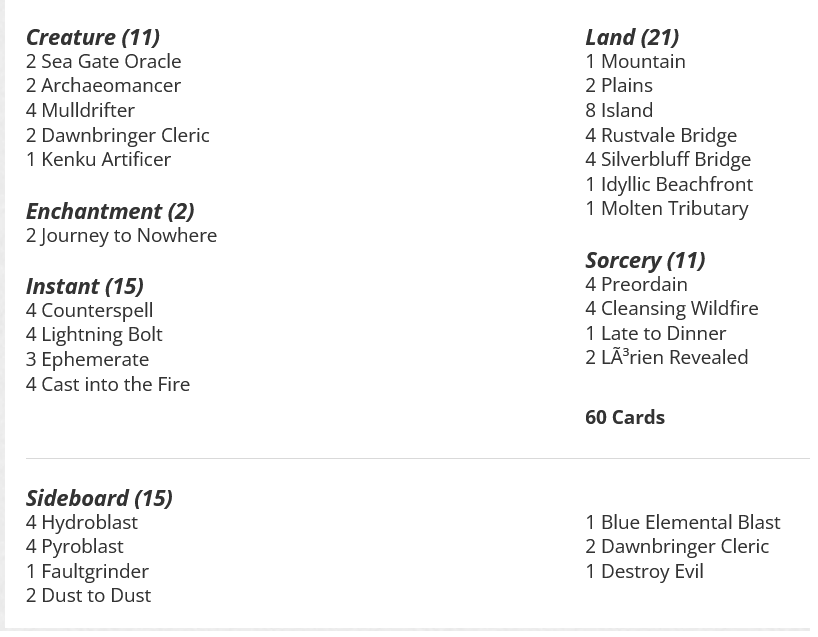
Alienware_’s June 3 Challenge Winning Black Gardens

Visualize the metagame as a spectrum, with Red representing the heavily played “fast” deck and Affinity taking the role of the heavily played “slow” deck. Despite the surrounding structure these archetypes are both heavily reliant on creatures. Midrange decks in Pauper tend to excel at removing creatures and gumming up the board to absorb combat damage. The ascent of Black Gardens over the past two weeks shows that the correct mix of removal combined with graveyard hate and the ability to slam the door can go a long way towards fighting the metagame as it exists. The big boon to these strategies over the past year has been the addition of supplemental card advantage engines, from Cleansing Wildfire in Jeskai Ephemerate to Deadly Dispute in Black Gardens. Orzhov Ephemerate can lean on the eponymous instant as a way to brige the gap to its trek to the Undercity.

_Against_’s June 4 Challenge Winning Boros Bully

Sunday’s winner is a repudiation of midrange. Boros Bully can apply pressure in a very different way than Monastery Swiftspear and Affinity and uses multiple small creatures to get the job done. Alexandre Weber also used Basilisk Gate – a common inclusion these days – as a way to go tall and provide another angle of attack. Bully runs enough counterplay to answer midrange’s removal while also having enough game to steal emblems if need be. White remains a hugely important color as it provides defense against both red and Affinity.

I do not think the age of red is over even if the top of the metagame seems to indicate that the strategy is starting to take a dip. Combining the two main varieties of Monastery Swiftspear decks – Reckless Burn and Kuldotha Red – the macro is averaging a Win+ score of 0.79, which is just outside a Top 16 on average. Combined the strategy is the second most popular “archetype” at 12.5% of the Top 32 metagame with an adjusted winner’s (true) volume of 12.65%. Gruul Cascade has been the most popular deck in this field over the past six weeks at 13.54% of the metgame with 13.31% of the adjusted winner’s volume. Faeries is outperforming its actual volume (8.85%) at 9.65% of the true volume. Yet Black Gardens is the big winner, with 8.33% of the Top 32 metagame but 11% of the True Volume, netting the largest gains from actual to adjusted over that span.

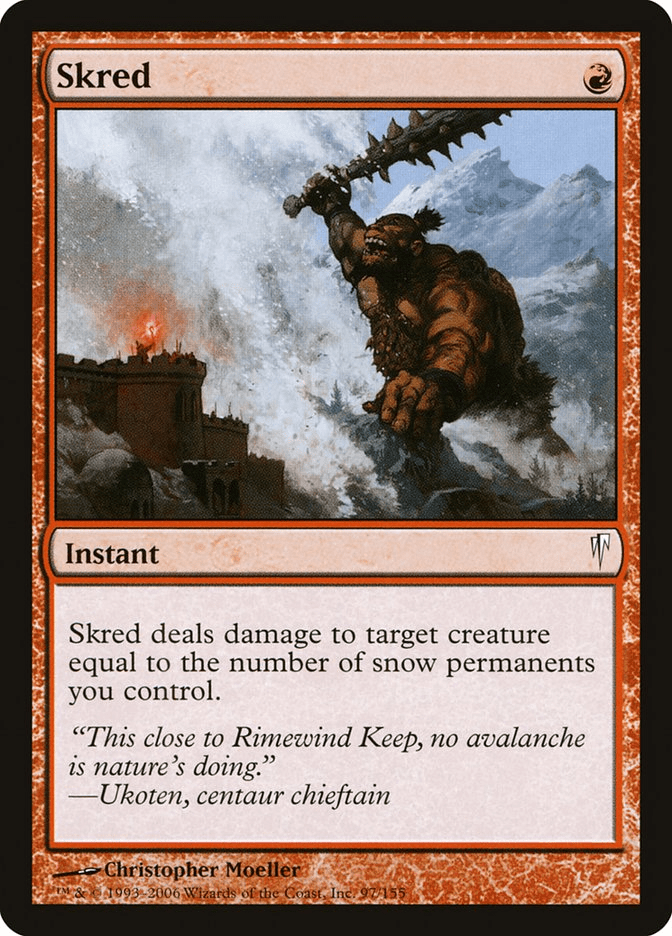
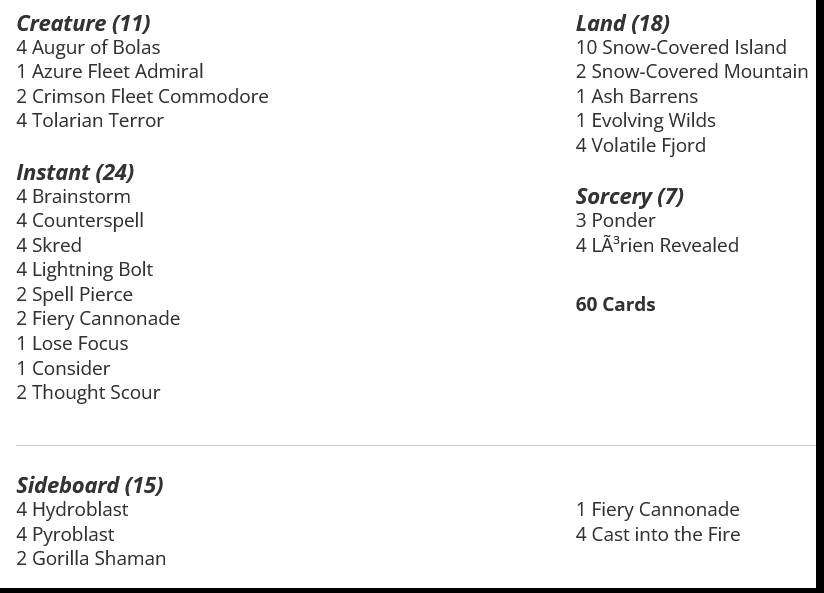
So how can you prepare? You have to be resilient to removal and have a good plan for surviving early. I’d also err on the side of having a good plan to mitigate the number of Mwonvuli Acid-Moss’ coming your way. To that end Affinity could be a smart choice of June 10 and 11, but I’d keep an eye on Izzet Faeries. Cheap counter magic is the way to go and one mana removal, whether it’s Skred or Lightning Bolt, is a great way to steal tempo back before applying pressure.

I want to take a moment to thank all my Patrons – both old and new. I am going to do my level best to keep providing you with the kind of content that brought you here in the first place. If you are interested in supporting my work, rewards for my Patreon start at just $1 and every little bit helps.

Can’t make a commitment to Patreon? I now have a Ko-Fi where you can make a one time contribution.

Looking for another way to support my work? Click here for my TCGPlayer affiliate link. Any purchases through the link let the folks there know you like my content!
May 27-28 Pauper Weekend Recap

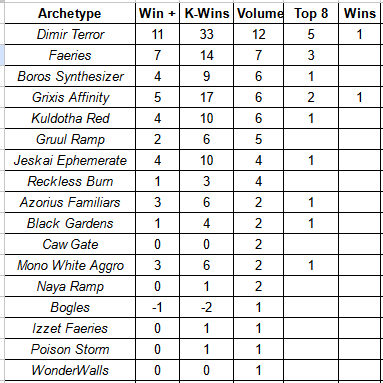
I use a few different metrics when looking at the Top 32 metagame. The first is just Raw Volume. The second is Win+, which takes the sum of all wins at X-2 or better in the Swiss and assigns a score; Win+ is helpful in measuring a deck’s Swiss round performance. K-Wins takes all of a deck’s wins and subtracts its losses, Top 8 inclusive; this helps to give a measure of overall performance. The final is one I call True Volume, which takes the average of all three volumes (Actual, Win+, K-Win). This number helps to provide the most robust image of a deck’s performance in the metagame.

May 27 and May 28 Pauper Challenge Top 32 Archetypes

Last week I made the note that current trends in the metagame were calling for a more versatile answer suite. I drew that conclusion in the wake of a rise in Faeries and shifts in the nature of red decks decks that could more easily adapt to the threats presented would perform well. This past weekend that seemed to be the case with three midrange decks – Black Gardens, Gruul Cascade, and Jeskai Ephemerate – all performing rather well. This continues the trend from last weekend where these decks started their ascent. But why now?

March of the Machine season began with a hesitancy around red and specifically the addition of Wrenn’s Resolve to the color’s repertoire and make no mistake, red continues to be good. However there are now multiple ways to play the deck – the more token focused Kuldotha Red and the more direct damage oriented Reckless Burn. While these both center on Lightning Bolt and Monastery Swiftspear they are fairly distinct strategies which in turn is leading to a more diverse looking metagame, at least at an archetype level. One can argue that these are just different takes on similar cores, but then again so are the various builds of Faeries (mono blue, Dimir, and Izzet).

So what does this have to do with midrange? It hinges, in a way, on Affinity. Affinity has long occupied the “control” role in the metagame even if it is not a true control deck. Thanks to Affinity’s robust card draw and long game engine it could easily outlast large swaths of the format. Recently the deck has adopted Somber Hoverguard for the first time in a long time, making it more susceptible to removal. As Affinity has become more vulnerable to the same spells that work against the rest of the metagame and the lower end of the meta – the aggressive strategies- diversify themselves, midrange decks have found an opportunity to occupy their traditional slot in an environment.

Midrange thrives when it can play the aggressive role against control and the control role against aggro. Since the metagame is making itself more susceptible to removal overall , midrange decks that pack answers have thrived. Black gardens and Jesaki Ephemerate make their bread by handling threats while a deck like Orzhov Ephemerate relies heavily on creatures. In this world, where midrange is taking the reigns, a deck like Gruul Cascade can emerge as a powerhouse since it attacks midrange at a weak point (their mana) while also having the opportunity to outclass opposing threats.

Next week I would be keen on trying to go under midrange. I am not all in on going back to the hyper aggression of red but a deck like Mono White Aggro, which is just large enough to roadblock red and Faeries while quick and resilient enough to beat up on black decks could find a lane. I would absolutely come with Ramosian Rally in this world because I’d want to be able to answer Breath Weapon out of Boros or Jeskai Ephemerate.

I want to take a moment to thank all my Patrons – both old and new. I am going to do my level best to keep providing you with the kind of content that brought you here in the first place. If you are interested in supporting my work, rewards for my Patreon start at just $1 and every little bit helps.

Can’t make a commitment to Patreon? I now have a Ko-Fi where you can make a one time contribution.

Looking for another way to support my work? Click here for my TCGPlayer affiliate link. Any purchases through the link let the folks there know you like my content!
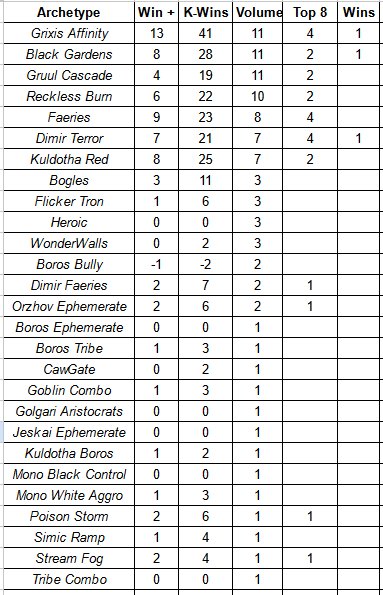
May 20-21 Pauper Weekend Recap

I use a few different metrics when looking at the Top 32 metagame. The first is just Raw Volume. The second is Win+, which takes the sum of all wins at X-2 or better in the Swiss and assigns a score; Win+ is helpful in measuring a deck’s Swiss round performance. K-Wins takes all of a deck’s wins and subtracts its losses, Top 8 inclusive; this helps to give a measure of overall performance. The final is one I call True Volume, which takes the average of all three volumes (Actual, Win+, K-Win). This number helps to provide the most robust image of a deck’s performance in the metagame.

May 20 and May 21 Pauper Challenge Top 32 archetypes

What does it mean to define a format? Any Magic format is by and large determined by the cards that are legal to play therein. A great number of cards automatically disqualify themselves due to rate or simply being outclassed. Merchant of Secrets comes to mind as a card that should not see competitive play since it is expensive for what it does and is obsoleted by a great many things. The point of all of this is to say that despite a massive cardpool any discrete Magic format is going to have some cards that simply should not see play.

Let’s go back to Invasion Block Constructed. With such a small card pool a powerhouse like Flametongue Kavu did a lot of work in setting the tone of gameplay, so much so that Hall of Famer Zvi Mowshowitz won the associated Pro Tour with maindeck copies of Galina’s Knight. Now this is not a treatise on the health of a format two decades gone but rather an example of what I am trying to get at. Creatures in that day needed to have an immediate impact lest they be rendered useless by FTK. You can run a similar exercise with any era and find the cards that help to shape the format, like Cut Down and Fable of the Mirror Breaker in current Standard. Cut Down places a restriction on what early drops are reasonable while Fable is one of the best things you can be doing in Standard.

What happens when the cards that define a format go too far? This is when things start to trend towards being warped. Let’s go back to Flametongue Kavu – if that persisted throughout its Standard reign to the point where the only other successful decks in the format were priced into running Galina’s Knight or creatures with five toughness that would have been a huge problem. Similarly one can look to CawBlade as a deck that contained several cards that not only defined their format, but completely warped Standard around them (and were subsequently banned).

So what does this have to do with Pauper? There has been a lot of talk over the better part of the past year as top whether or not red decks, supported heavily by Monastery Swiftspear, are warping the metagame. The recent results point to decks that have a strong red matchup as finding success. Even so I have long been of the mindset that red is not warping the Pauper meta but rather helping to define it. The line is close to be sure but rather than a format filled with decks that are running Galina’s Knight the format has adjusted to red’s place as the focal point of the metagame.

Bogles, Dimir Terror, Naya Gates, Faeries, and Black Gardens are all decks that are reasonable in their own right but also have a good matchup against red. Now it is possible that these decks, as currently constructed, would not have the same success if red were not as prevalent. That also presupposes that these decks would not adjust their builds to a different metagame – something that Bogles has been doing for years to be sure. The fact that the decks at the top of the format have good matchups against the most popular deck is not a symptom of something nefarious but part of the reality of a competitive metagame.

Now there is something else to consider. The examples I cited above came from time bound formats. Block Constructed would end with the release of a new block and Standard saw cards cycle out every year. Pauper is a non-rotating format so cards do not leave unless they are banned. This then gets to the question as to what is the threshold for banning a card (something I will not be getting into today) but something to consider is the pressure the red decks are putting on Pauper. While red is largely contained from a metagame perspective, there is no doubt that the ceiling of red’s draws exert a great influence on what sort of strategies are viable long term. That there are several decks finding success that lean heavily on taplands indicate that at the moment there are ways to come back from behind against red.

So where does that leave things with actually playing Pauper? Red continues to be popular but at the moment Faeries sees more play and is having more success, as has been the case for some time. Early removal remains at a premium but as Kuldotha Rebirth has given way to Kessig Flamebreather in red, sweepers have gone down in value. It looks like the format is primed for a reevaluation of removal. Suffocating Fumes seems like a larger risk in the wake of Ninja of the Deep Hours and so the rise of Jeskai Ephemerate, with its access to recurring removal and Fiery Cannonade/Breath Weapon seems to be the way to go fora versatile answer to the current threats being presented in the format.

I want to take a moment to thank all my Patrons – both old and new. I am going to do my level best to keep providing you with the kind of content that brought you here in the first place. If you are interested in supporting my work, rewards for my Patreon start at just $1 and every little bit helps.

Can’t make a commitment to Patreon? I now have a Ko-Fi where you can make a one time contribution.

Looking for another way to support my work? Click here for my TCGPlayer affiliate link. Any purchases through the link let the folks there know you like my content!