My latest article is now live on ChannelFireball. Check it out here.
I want to take a moment to thank all my Patrons – both old and new. I am going to do my level best to keep providing you with the kind of content that brought you here in the first place. If you are interested in supporting my work, rewards for my Patreon start at just $1 and every little bit helps.
Can’t make a commitment to Patreon? I now have a Ko-Fi where you can make a one time contribution.
Looking for another way to support my work? Click here for my TCGPlayer affiliate link. Any purchases through the link let the folks there know you like my content!
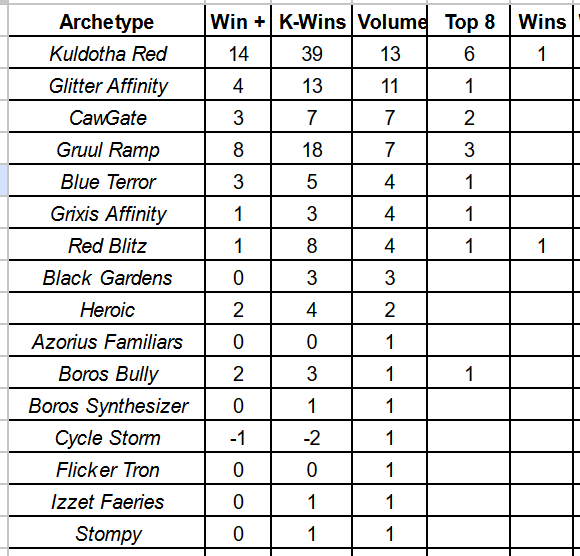
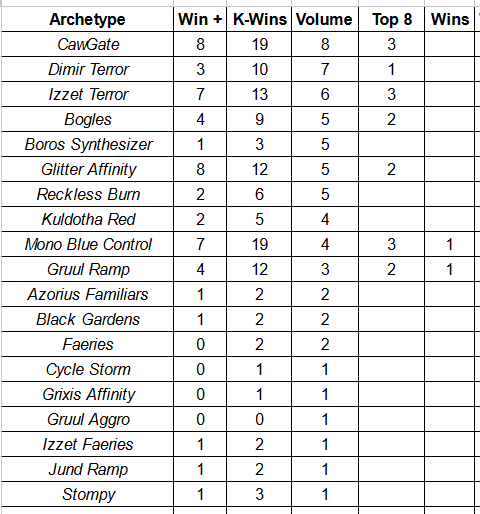
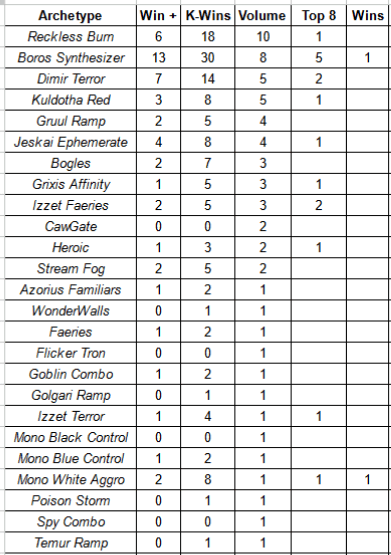
I use a few different metrics when looking at the Top 32 metagame. The first is just Raw Volume. The second is Win+, which takes the sum of all wins at X-2 or better in the Swiss and assigns a score; Win+ is helpful in measuring a deck’s Swiss round performance. K-Wins takes all of a deck’s wins and subtracts its losses, Top 8 inclusive; this helps to give a measure of overall performance. The final pair is call Meta Score and Meta Score Above Replacement, which takes the average of Win+ and K-Win to try and position an archetype against its field. This number helps to provide the most robust image of a deck’s performance.
The first four challenges of Wilds of Eldraine season Top 32 breakdown
I still like Pauper.
This probably looks like an odd thing to read in a blog that is largely dedicated to the format, in a weekly update on the competitive metagame for said format…but it still feels like it needs to be said. At times it feels like the majority of online discourse around Pauper circles around how bad things are; how far things have strayed from good and true Magic.
I want to talk about this. Maybe I’m feeling a certain way about fostering a community in the wake of the passing of Sheldon Menery (probably). Perhaps I’m coming off of an incredibly busy period in my personal life and just want to put digital ink to the digital page (definitely). I know for a fact that if you’re not having fun with a leisure activity then you shouldn’t continue to pursue it.
I started playing Pauper when I was in college. I was a Junior in the Spring 2005 semester and was trying to find an outlet for my competitive streak when I found the Pauper Deck Challenge community and I fell for it hard. I loved the unexplored nature (at the time) of the format and the people involved in putting on the events. I got a thrill out of how new everything felt. Then the format became officially recognized on Magic Online and my relationship with Pauper changed. I still loved trying new things and brewing decks, but I found another way to connect with the format. I started to chronicle it, tracking the metagame and reporting out on the happenings. I wanted to share something I enjoyed with the world and provide a way for other people to potentially find something fun to do with their spare time.
All the while I was writing, sharing, some would say evangelizing. I believed in Pauper. I built relationships with the folks who made the game and tried, even when I was critical, to be respectful. And for the past year and a half I have been part of the Pauper Format Panel. My relationship with Pauper has changed again and I am sure it will change in the future.
I’m going to let you in on a little secret: throughout my nearly 19 years of playing Pauper there have been times when I haven’t played. When I took a step back and decided that I’d rather do something else with my time. Maybe it was cook a good meal and get some extra sleep; train for a half marathon or read a book. But I always come back because I find it fun.
There’s a comfort I find in Pauper. That despite the new cards that things largely look similar. Maybe Mono Black Control is not as good as it was when I started but there are decks that play similarly. Blue decks will always be countering spells and red decks are always going to be burning my face. Things may have gotten more efficient over the years, more powerful, but by and large Pauper is still Pauper.
What has changed are the rules of engagement. Pauper, for a long time, was a format where simple accumulation of resources could translate to victory and this was largely concentrated in blue. The Monarch expanded it into other colors and the Initiative doubled down on this territory. Deadly Dispute and Experimental Synthesizer made this flow more efficient. That is important because once the cards were gathered the next step was deploying them. Tron was regent for so long due in part to how well it could fill its grip and then cast those very same spells; Monarch was jam packed with cheap removal for this very reason. Now this same efficacy is spread more evenly, albeit with power concentrated in certain cards and packages.
Before Pauper could be defined by powerful singular cards or tight combos. Now the format is based around different cores that can slot into different builds for desired outcomes. While this closes off some element of exploration in deck construction it can be liberating in helping to prop up decks that might not otherwise be able to cut the mustard.
Decisions matter now, more than ever. There is little room for error and tight play is rewarded. Maybe the choice has to be made in deck construction or in the posture you assume from turn one (Who’s the Beatdown? indeed). And I find this fun. In the micro maybe I’ll get rolled by bringing yesterday’s weapon to today’s battle, but other times I’ll be rewarded for those very same choices.
Playing Magic should be fun. Now I can’t define that for you, but if you aren’t having it then maybe it’s time to take a break and come back with fresh eyes. Life is too short to do stuff that you don’t like to do.
But if you’re having fun in Pauper and want to get a jump on next week you better have a plan for red. Whether that’s lifegain or blockers, red is out in force. I know it is a meme at this point, but there’s nothing wrong with running Thraben Inspector out there given the way things are going right now.
I want to take a moment to thank all my Patrons – both old and new. I am going to do my level best to keep providing you with the kind of content that brought you here in the first place. If you are interested in supporting my work, rewards for my Patreon start at just $1 and every little bit helps.
Can’t make a commitment to Patreon? I now have a Ko-Fi where you can make a one time contribution.
Looking for another way to support my work? Click here for my TCGPlayer affiliate link. Any purchases through the link let the folks there know you like my content!
Today on ChannelFireball I take a look at the first league results that feature Wilds of Eldraine. Check out the article here.
I want to take a moment to thank all my Patrons – both old and new. I am going to do my level best to keep providing you with the kind of content that brought you here in the first place. If you are interested in supporting my work, rewards for my Patreon start at just $1 and every little bit helps.
Can’t make a commitment to Patreon? I now have a Ko-Fi where you can make a one time contribution.
Looking for another way to support my work? Click here for my TCGPlayer affiliate link. Any purchases through the link let the folks there know you like my content!
I use a few different metrics when looking at the Top 32 metagame. The first is just Raw Volume. The second is Win+, which takes the sum of all wins at X-2 or better in the Swiss and assigns a score; Win+ is helpful in measuring a deck’s Swiss round performance. K-Wins takes all of a deck’s wins and subtracts its losses, Top 8 inclusive; this helps to give a measure of overall performance. The final pair is call Meta Score and Meta Score Above Replacement, which takes the average of Win+ and K-Win to try and position an archetype against its field. This number helps to provide the most robust image of a deck’s performance.
Traditionally the earliest part of a metagame cycle favors aggressive decks. When new cards are released into the wild it is far easier to present threats than to have the proper responses. Metagames take time to coalesce around the new environment at which point the more granular decisions can be made. You never want to bring Flame Slash to a Skred fight or be stuck with Dispel when you really wanted Spell Pierce. In that way it is no surprise that Kuldotha Red did well during the first weekend of Wilds of Eldraine season.
But how well did it actually do? We can see the Top 8 numbers – six of the sixteen Top 8 slots went to Kuldotha Red and it won the Sunday challenge. On this metric there is no doubt Kuldotha out performed the field. Digging deeper the numbers are both far less, and far more interesting.
For this we need to look at the Adjusted Meta Score Above Replacement. This score takes an archetype’s total Swiss record and it’s total Win-Loss record and compares it to those same averages for each other archetype, and then adjusts for metagame presence. Last weekend Kuldotha Red had an aMSAR of 1.79 – far and away the best performance on the weekend with Gruul Ramp holding the next highest score of 0.65.
Kuldotha absolutely had a great weekend but it is not giving me too much cause for concern. At the start of Commander Masters season Boros Synthesizer had an amazing first weekend, pulling down an aMSAR of 3.26 with the next best deck (Dimir Terror) clocking in at 0.93. Boros Synth ended the five week season with a respectable aMSAR of 0.67. Now I’m not saying that Kuldotha Red is going to take such a stark dive but it is important to look at these weekends as part of a larger picture.
What does that picture tell us? Taking Kuldotha’s success last season and the first weekend with new cards I would not put too much stock into the results as a long term predictor of anything. I would feel confident in saying Kuldotha Red is not going anywhere for the foreseeable future, but I also doubt it is going to run roughshod every week moving forward.
Here is where we come to the limitations of the Magic Online metagame. The pool of regular Challenge players is relatively static and as such singular results can cause ripples out of proportion with their actual impact. Because of this the metagame can be prone to overcorrection – a bevy a blue decks leads to some maindeck copies of Pyroblast which then leads to people trying to dodge en masse and ta-da.
So what does that mean moving forward? Another overcorrection is likely coming as people react to Kuldotha Red and load up on more anti-red measures. If I were trying to sidestep all of this I would avoid running Mountains and Islands next week and see if I could sneak in a Glistener Elf that has had it’s noble spirit Embiggened.
I want to take a moment to thank all my Patrons – both old and new. I am going to do my level best to keep providing you with the kind of content that brought you here in the first place. If you are interested in supporting my work, rewards for my Patreon start at just $1 and every little bit helps.
Can’t make a commitment to Patreon? I now have a Ko-Fi where you can make a one time contribution.
Looking for another way to support my work? Click here for my TCGPlayer affiliate link. Any purchases through the link let the folks there know you like my content!
I use a few different metrics when looking at the Top 32 metagame. The first is just Raw Volume. The second is Win+, which takes the sum of all wins at X-2 or better in the Swiss and assigns a score; Win+ is helpful in measuring a deck’s Swiss round performance. K-Wins takes all of a deck’s wins and subtracts its losses, Top 8 inclusive; this helps to give a measure of overall performance. The final pair is call Meta Score and Meta Score Above Replacement, which takes the average of Win+ and K-Win to try and position an archetype against its field. This number helps to provide the most robust image of a deck’s performance.
Hello again everyone! After a week where my real job took precedence I am back (without a vengeance, I might add)! Rather than go over the individual events I want to take a look at the bigger picture and examine the first four weeks of Commander Masters season. Wilds of Eldraine is right around the corner and that set, while interesting, lacks the punch of the last release. In other words, I would expect the impact of Commander Masters to reverberate for quite some time. This is not meant to be a knock on Wilds, as two of the set’s core mechanics – Bargain and Roles – play right into Pauper play patterns thanks to the way they interact with extra material.
Enough about the not-too-distant future, let’s talk about the now. This analysis is going to focus on the adjusted Meta Score Above Replacement. Roughly speaking this measures how much better an archetype is than an “average” Top 32 finishing deck. The higher the number, the greater the distance from the mean performance. Taken in conjunction with other measures, including Top 8 finishes, we can get an idea of the landscape at the top of the metagame.
There is one final thing of note before I begin: this is the first time during one of these check-ins that not a single archetype tops 10% of the Top 32 metagame in raw volume. The most popular deck (Kuldotha Red) pulls in at 9.38%. There are three other decks with between 8% and 9%, and another three with volume in the 7% range. While this only takes into account a four week span it is a huge step towards a “flattening” at the top of the metagame – something that Pauper has been striving towards for quite some time.
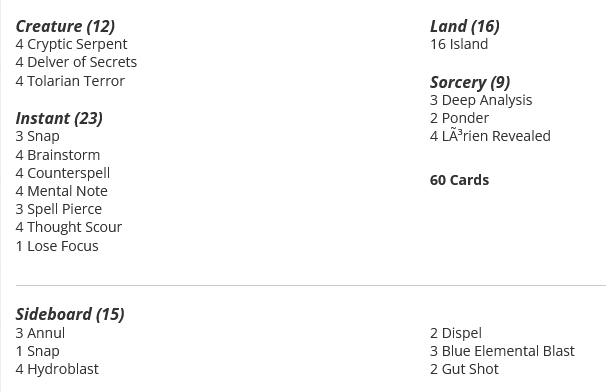
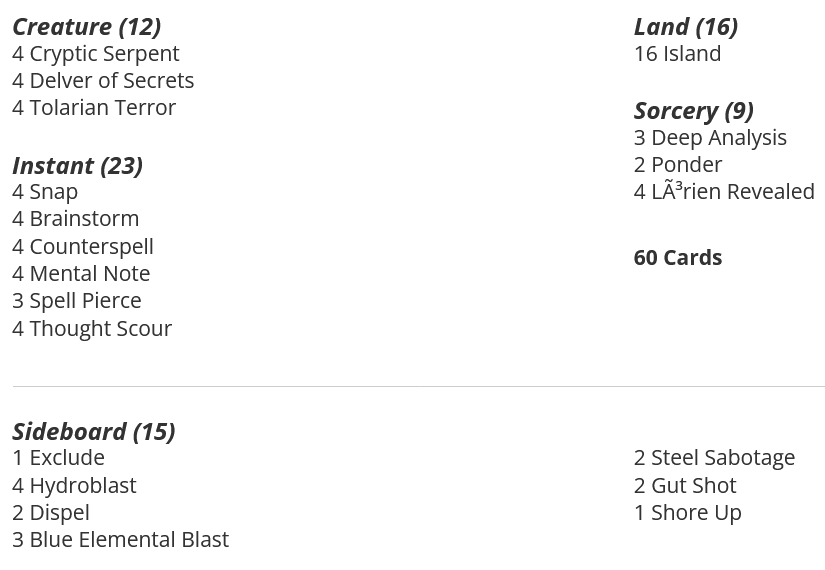
Blue Terror is just that – a terror. The fifth most popular deck (7.81%) it has eight Top 8 finishes, including two wins. It averages a Top 16 finish and when looking at winner’s meta volume sees a jump to 9.37%. Blue Terror is also leading the pack in aMSAR with 1.19. The deck takes the aggressive side of Delver decks of yore while adding large threats like Cryptic Serpent and Tolarian Terror. Churning through the library with cantrips, Terror also plays some of the best countermagic available in Pauper while shaving on lands thanks to Lórien Revealed. The cycle of basic landcyclers from Tales of Middle Earth have completely changed the way mana bases are constructed as they act as land drops early and high impact spells late. Blue Terror is so consistent in part due to its ability to make every land drop while using sculpting to further its game plan.
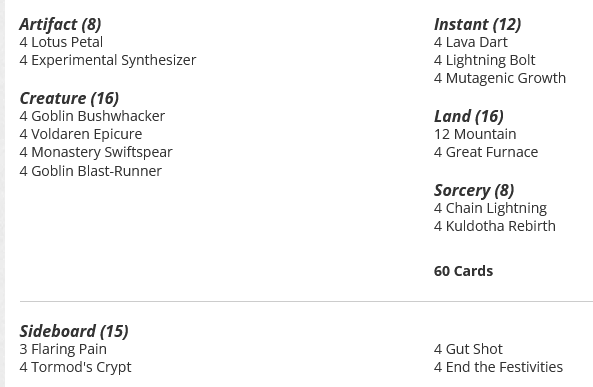
There is little to be written about Kuldotha Red that has not already been recorded in the annals of history. The best red deck Pauper has likely seen, Kuldotha Red is the most popular archetype thus far this season. It’s winner’s volume ticks up to 10.34% and it has seven total Top 8 finishes. It also lags behind Terror with an aMSAR of 1.16. Not much has changed with Kuldotha Red in practice even if certain builds have started to develop. Some players prefer Lotus Petal and Mutagenic Growth while others have leaned into Human typal with Burning-Tree Emissary and Rally at the Hornburg. Regardless, Kuldotha continues to be able to apply pressure early and often, putting a real clock on the Pauper meta.
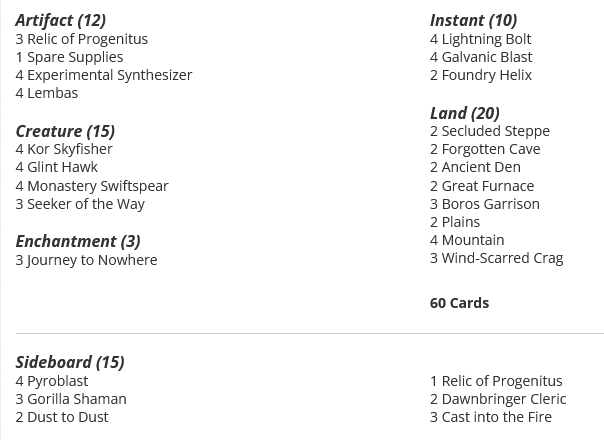
Add white to the mix and you end up with Boros Synthesizer. The deck came on strong with several Top 8 finishes early but has trailed off as of late. Boros Synth has taken down eight Top 8 slots (with a win) with 7.42% of the total Top 32 volume. It’s winner’s meta volume is a respectable 8.82% and it’s aMSAR weighs in at a respectable 0.97. Boros takes the burn of red and pairs it with the card flow of Glint Hawk/Kor Skyfisher with Experimental Synthesizer and other artifacts of that variety. Seeker of the Way and Foundry Helix have also shown up as ways to survive against other aggressive strategies. Boros Synth is less consistent in its overall performance than some other decks, often cycling between good weeks and bad depending on what else shows up in a given tournament.
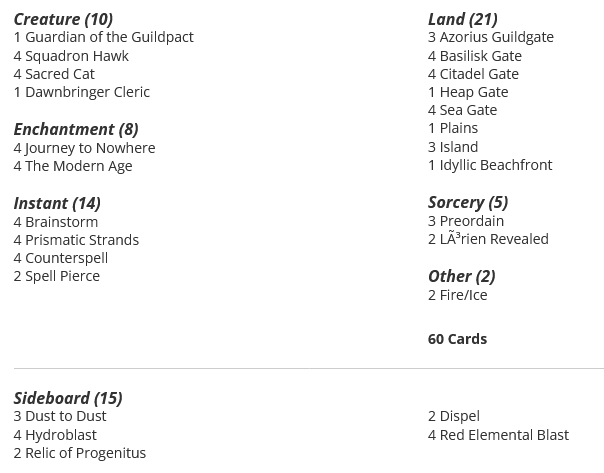
CawGate rounds out the Top 4 decks of the season thus far with six Top 8s and 8.2% of the total metagame volume. With a winner’s volume of 9.05% and an aMSAR of 0.94, it is not that far behind Boros Synthesizer and could easily overtake it before the season closes out. CawGate has a powerful core strategy and is able to supplement it with metagame specific bullets such as Fire//Ice or Cast into the Fire. The resilient nature of its win condition – namely any creature enhanced by Basilisk Gate – makes it dangerous in the late game provided it can survive that long. If the deck has any weakness it is that it has to spend time developing its mana while many of the other top strategies can sidestep this barrier.
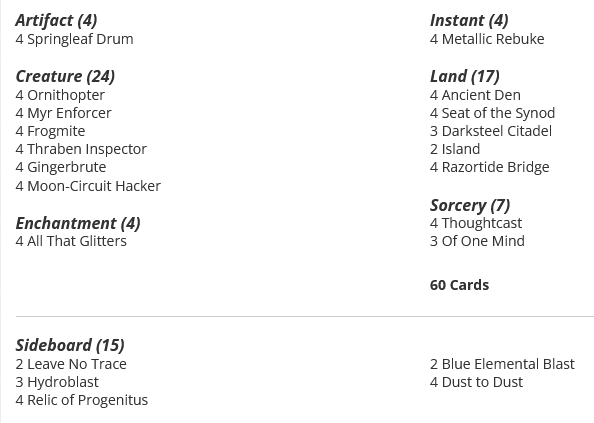
The last deck I want to focus on today is the fifth best strategy of the season: Glitter Affinity. In the same number of appearances as Boros Synthesizer it has four Top 8s but two wins. It’s adjusted volume comes in at 8.41% and it holds an aMSAR score of 0.88. Glitter Affinity is still an archetype in progress, with some opting to keep red while others focusing on black; some still run Deadly Dispute whereas certain builds lean into Reverse Engineer. The story here is less about Glitter Affinity and more how All That Glitters has pushed the archetype to be more assertive, with the more controlling Grixis Affinity taking a huge step back in popularity. Glitter Affinity is more vulnerable to removal but also is able to run narrow protective spells such as Blacksmith’s Skill. Out of all the archetypes today, this one has the most room to develop.
The decks listed above only scratch the surface with nine others topping the 2% volume threshold (Dimir Terror, Reckless Burn, Gruul Ramp, Bogles, Grixis Affinity, Izzet Terror, Black Gardens, Heroic, and Jeskai Ephemerate). The top of the meta, however, skews towards the Jeskai wedge of colors with base black showing up in Black Gardens and green centered decks popping up in the various Ramp strategies and Bogles. Black has traditionally struggled when its removal does not line up with the metagame and with a more open meta that is bound to happen. As for green, aside from accelerating out land destruction and large threats, it doesn’t really do much. Green has been eclipsed as an aggressive color and large midrange creatures don’t really cut it in competitive Pauper. Wilds of Eldraine might help the verdant cause with Troublemaker Ouphe taking on a disruptive role but even then the color has a long climb to the top.
Pauper remains in a great spot. The top of the metagame is fairly diverse with a wide variety of competitive archetypes available. Lingering just behind the top five there are several other strategies that might just need a few tweaks and tuneups before taking the next step. What’s going to happen when the format ventures into the Wilds? We won’t have to wait long to find out.
I want to take a moment to thank all my Patrons – both old and new. I am going to do my level best to keep providing you with the kind of content that brought you here in the first place. If you are interested in supporting my work, rewards for my Patreon start at just $1 and every little bit helps.
Can’t make a commitment to Patreon? I now have a Ko-Fi where you can make a one time contribution.
Looking for another way to support my work? Click here for my TCGPlayer affiliate link. Any purchases through the link let the folks there know you like my content!
I use a few different metrics when looking at the Top 32 metagame. The first is just Raw Volume. The second is Win+, which takes the sum of all wins at X-2 or better in the Swiss and assigns a score; Win+ is helpful in measuring a deck’s Swiss round performance. K-Wins takes all of a deck’s wins and subtracts its losses, Top 8 inclusive; this helps to give a measure of overall performance. The final pair is call Meta Score and Meta Score Above Replacement, which takes the average of Win+ and K-Win to try and position an archetype against its field. This number helps to provide the most robust image of a deck’s performance.
The second week of Commander Masters season is behind us and the metagame continues to evolve. After last week’s absurd performance by Boros Synthesizer, things have done anything but remain stagnant. Something old, something new, something borrowed, and something blue has definitely taken the spotlight.
First let’s explore Boros Synthesizer. It closed last week with an adjusted Meta Score Above Replacement of 3.26 – the best I’ve tracked thus far. This number is a rough representation of how much better a deck performance than an average Top 32 finish. Last week Boros just crushed the competition but this weekend it tanked with a score of -0.49. It is an accepted truism that early in seasons aggressive decks perform better because, to quote David Price, “there are no wrong threats; only wrong answers” and Boros presented a ton of threats. However after a week of people grinding out the format, the rogue’s gallery can be assembled so midrange and control decks can choose their weapon’s wisely when it comes to battling the beatdown.
This past weekend three different blue decks each place three pilots into the Top 8: Caw Gate, Izzet Terror, and Mono Blue Terror. CawGate continues to cement itself as a solid midrange option that never really goes out of style. Thanks to its mana base and flexible suite of answers it can be tuned and tweaked for most metagames. So that brings us to Izzet Terror and Mono Blue Control (or Mono Blue Terror, if you prefer). Izzet Terror had an adjusted Meta Score Above Replacement of 0.58; CawGate ended Sunday with a score of 1.09; Mono Blue lapped them with 2.21. Today I want to focus on the two Tolarian Terror and Cryptic Serpent strategies.
discoverN’s August 13 Challenge winning list
These two Terror decks have added Cryptic Serpent to their decks, upping their threat count. At the same time Dimir Terror decks have taken a step back in the metagame despite having a similar game plan. Dimir Terror leans on Snuff Out to survive the early game and needs its graveyard to fuel Gurmag Angler. Given this, and the noise around Spy Combo decks last week, it makes sense that people have adopted an increased amount of graveyard hate to try and constrain Dimir. So why have the other strategies been able to succeed? If I had to guess it is because while they may not have the slam dunk removal spell in Snuff Out they have enough creatures to brick wall most opposing attackers and can protect them with countermagic. Serpent and Terror can put opponents into The Abyss. Izzet can supplement this with sweepers and actual factual removal while mono blue can keep the opponent off balance with Counterspell and Snap until it can attack for the win. This is a very midrange approach to control in that it leans on having larger threats to stop attacks and therefore generate an incidental advantage.
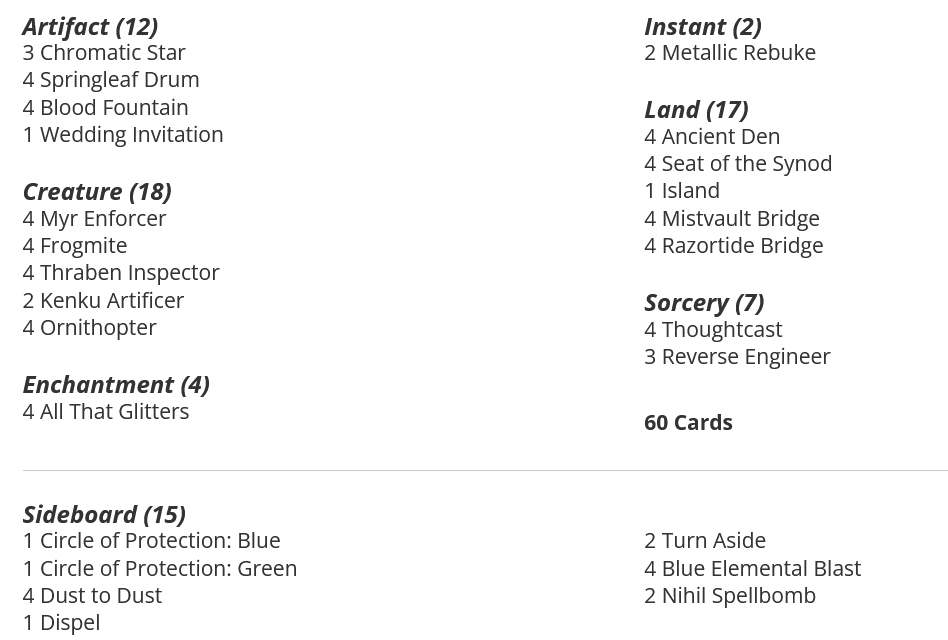
How can one fight back against this approach. The first would be to go over them with evasive creatures (and we’ve seen the value of Murmuring Mystic skyrocket this month). Another option is to simply go larger as we have seen with Bogles. The two most recent challenges also displayed exactly what a successful All That Glitters Affinity deck can look like. Eschewing red, these decks lack Galvanic Blast and Deadly Dispute and lean on applying pressure in other ways, like an enchanted Ornithopter.
Beicodegeia’s Glitter Affinity
Glitter Affinity looks far closer to an aggro-control deck than the midrange control of Grixis Affinity. Lacking some of the reach of red variants, these builds want to resolve an early threat and get it over the line for lethal damage. There are some builds that try to get even lower to the ground and I for one am eagerly awaiting these decks’ final form.
Going into next week I would not focus to heavily on trying to answer a singular threat. The allure of Chainer’s Edict and Curfew are strong but I anticipate people will be attempting to fight against these decks by taking to the skies with Murmuring Mystic or other cheap flyers. Instead I would look for a deck that can either sidestep the attack step – like Simic Fog builds – or can handle threats both large and small. If someone can make a Pestilence deck work next week they could be well positioned to spike an event.
I want to take a moment to thank all my Patrons – both old and new. I am going to do my level best to keep providing you with the kind of content that brought you here in the first place. If you are interested in supporting my work, rewards for my Patreon start at just $1 and every little bit helps.
Can’t make a commitment to Patreon? I now have a Ko-Fi where you can make a one time contribution.
Looking for another way to support my work? Click here for my TCGPlayer affiliate link. Any purchases through the link let the folks there know you like my content!
I use a few different metrics when looking at the Top 32 metagame. The first is just Raw Volume. The second is Win+, which takes the sum of all wins at X-2 or better in the Swiss and assigns a score; Win+ is helpful in measuring a deck’s Swiss round performance. K-Wins takes all of a deck’s wins and subtracts its losses, Top 8 inclusive; this helps to give a measure of overall performance. The final pair is call Meta Score and Meta Score Above Replacement, which takes the average of Win+ and K-Win to try and position an archetype against its field. This number helps to provide the most robust image of a deck’s performance.
Pauper isn’t sitting still. After a relatively brief six weeks in Lord of the Rings season the format gets to experience five weeks of Commander Masters before Wilds of Eldraine hits the shelves. The format is still adjusting to the presence of Lórien Revealed and the other Basic Landcylers, figuring out exactly how to craft correct mana bases with access to uncounterable, significantly more powerful copies of Lay of the Land. But time waits for no Magic player and the latest set – with its massive suite of downshifts – is upon us.
The first week of any format presents is noisy, except that noise may end up being significant when all is said and done. For example, Dimir Terror came out of the gates as the best deck during the previous season, performing well in the early weeks only to ride that crest and take home the best average Meta Score over the entire six week span. At the same time, I would not have pegged Jeskai Ephemerate as a top contender in the format on week two, even though it had the second best performance given the totality of the season.
I say all of this because at the end of the first weekend, Boros Synthesizer – some of which include the “all in” approach of All That Glitters and Wedding Invitation – had the best adjusted Meta Score this week at a whopping 3.26. Now this is a small sample size to be sure, but it is also the highest score of any archetype on any weekend going back to March of the Machine (where I first began tracking this metric). Boros Synthesizer loves to press damage and the addition of All That Glitters, while it might be “win more”, certainly applies pressure. That being said I would not be surprised if Boros’ early success trails off in the coming weeks as more people explore the options provided by Commander Masters.
One card I expect to see far more play is Murmuring Mystic. This card was all over the Top 32 this past weekend, albeit never as a four-of. Mystic, if it sticks, provides massive value to any spell based strategy. Battle Screech has long showcased the power of 1/1 flyers and Mystic is able to churn them out at a steady clip. We have already seen this card find a home in blue cantrip decks, Azorius Familiars, Jeskai Ephemerate, and as a sideboard juke out of the Simic Fog strategy. The biggest strike against the card is that it requires additional investment unlike Monarch or Initiative. Even so, the cost is one decks are happy to pay and with that in mind I would not be shocked to see more of this Wizard in the future.
What about next week? Boros Synthesizer looks to be a major player but both Bogles and Heroic are vying for the opportunity to be the best All That Glitters deck. With so many potential options for aggression, it would not surprise me if one of the various combo decks – either Poison Storm or the new variants of Balustrade Spy combo with Dread Return and Lotleth Giant – find a lane. In turn this could create an opportunity for decks like Black Gardens – with their disruption and removal – to sneak in and have an excellent showing. Regardless, it is an exciting time for Pauper and I cannot wait to see how things unfold.
I want to take a moment to thank all my Patrons – both old and new. I am going to do my level best to keep providing you with the kind of content that brought you here in the first place. If you are interested in supporting my work, rewards for my Patreon start at just $1 and every little bit helps.
Can’t make a commitment to Patreon? I now have a Ko-Fi where you can make a one time contribution.
Looking for another way to support my work? Click here for my TCGPlayer affiliate link. Any purchases through the link let the folks there know you like my content!


 NerdtotheCore
You must be logged in to post a comment.