
There’s a true joy in sharing your decklist with someone. A chance to show off something you crafted. There’s also a basal delight in being asked for advice – that a person trusts you enough with something they made to ask for input. When I am so entrusted I almost always start by looking at their Commander, then how they plan to win the game. And then my eyes drift towards the left hand side of their mana curve all the way to the two drop slot; a place normally reserved for Signets and Talismans. What am I looking for? Velocity.
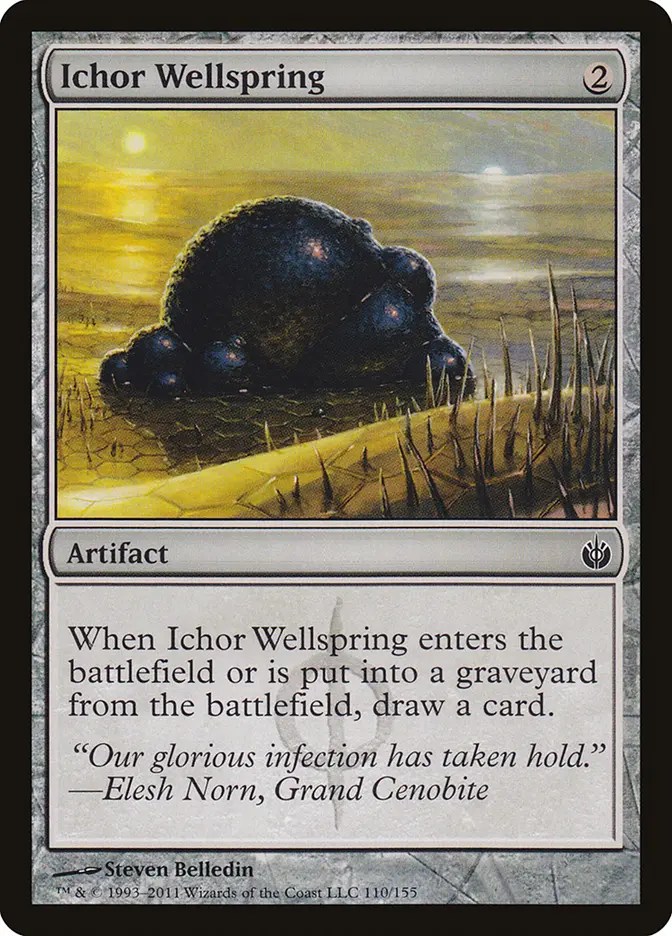
Velocity, roughly speaking, is the idea of seeing more cards. It is somewhat distinct from card advantage in that it does not necessarily mean going up on cards as much as getting a new option to replace the investment. These cards by and large are not impressive – they are not the cards that end games. Yet they can get you to that point and that is often overlooked. Too often I see decks that are all payoff and no fuel. The endgame exists in isolation from the way games actually play out. If you place an emphasis on actually being involved in the goings on at the table then you need things to do before everything ends.
Two drops are not high impact but they give you something to do at all points of the game. Early on they are important because they allow you to progress your game plan – and if you’re picking the right ones they replace themselves – but they are also cheap investments in the later turns. This is extremely important if you are building towards a specific them. Take Ichor Wellspring: in any old deck it is just a piece of material that sometimes replaces itself. Yet in a deck that cards about artifacts or one that wants you to sacrifice permanents then this becomes an important piece of the overall puzzle.
I bring this up in part because these cards are easy to ignore when mana is abundant. They are also rather weak in isolation and shine when they are part of an overall engine. Perhaps this is my age showing, but I prefer building decks where all the pieces fit together in a convoluted contraption; drawing the cards out of order isn’t a problem but rather just provides a new opportunity to find the same path towards victory.
Mire Triton is a fine card. It does enough on turn two to find a home in decks that care about the graveyard. Yet it is one of the better late game draws in my Moseo, Vein’s New Dean deck. In that deck it pads my life total while potentially providing new fodder for Moseo to bring back. The card is fine on turn two but better on turn four (or beyond) because its effect is compounded. When you are building a deck full of pieces that feed off of each other then you need to consider that you are not going to draw your cards in the perfect order for your mana curve. Sometimes you’ll need to cast a two drop and a four drop on turn six and it needs to matter.
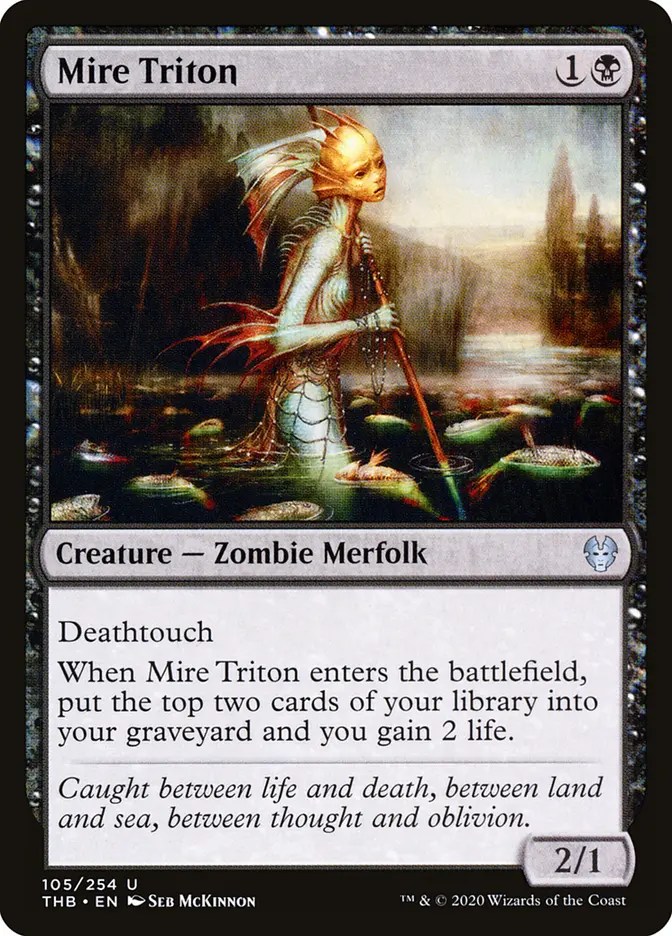
In the end, during any game of Commander doing stuff is more fun than not doing stuff. Having a suite of cards that harmonize with your main game plan, that aren’t game breakers but still matter, can help you continue to do things even if it might not being the Big Thing. And hey, if they draw you towards your haymaker, well that’s just velocity.
I want to take a moment to thank all my Patrons. I am going to do my level best to keep providing you with the kind of content that brought you here in the first place. If you are interested in supporting my work, you can sign up for my Patreon starting at just $1.
Can’t make a commitment to Patreon? I have a Ko-Fi where you can make a one time contribution.

