
Every so often I wonder what could have been. If I had decided that my first year Calculus class was not that bad, would I have pursued a degree in Physics instead of English? Would I have ended up getting as involved at college and found my career? If my Magic collection hadn’t fallen off the shipping truck to Graduate School, would I have become as engaged with Pauper?
If, if, if. One of life’s major existential thoughts appearing in a blog post (not even an official article) about building Commander decks. And yet it feels right, because deckbuilding is a situation where we have control over the result.
I can’t speak for everyone, but I still get a giddy little each every spoiler season. The lizard part of the my brain that was activated by Lego lights up, neural pathways that could have been spent trying to solve more important problems seeing how all the different pieces could potentially fit together. Invariably I get excited about a card or two and start plotting a new list. Avatar: The Last Airbender gave me one such card.
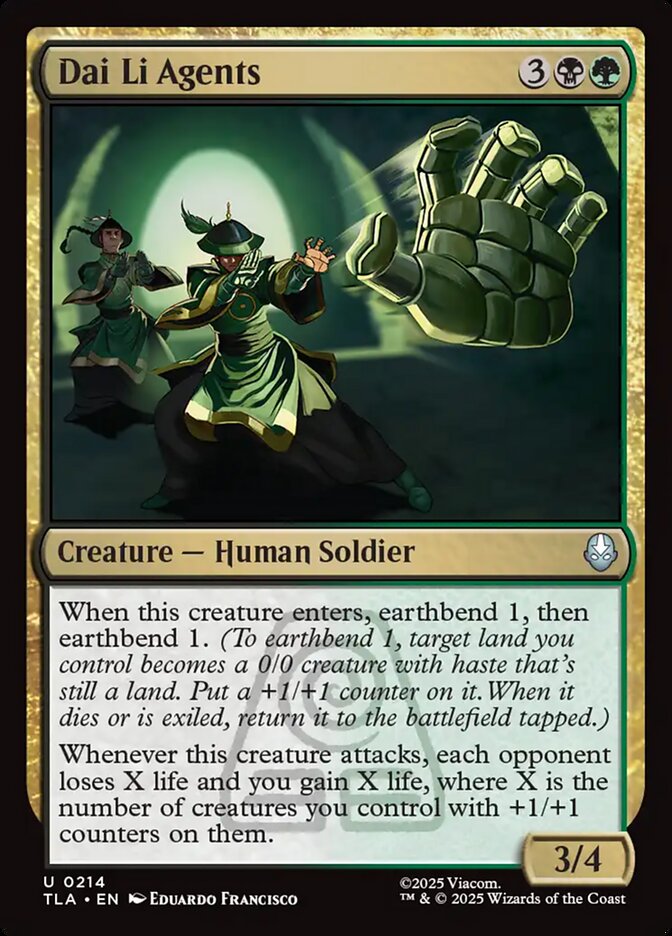
Dai Li Agents and similar cards deeply appeal to me in Commander. Like Gray Merchant of Asphodel and Skemfar Shadowsage they are creatures that have to work in the conceit of a given deck without being prescriptive. Each of these creatures help to win the game but none of them are necessarily locked into one specific build. Gray Merchant is just as home in mono black as Zombies; Shadowsage can fit into any number of creature-type-matters builds. Dai Li Agents asks for +1/+1 counters but I am sure it will show up in upcoming Earthbending strategies.
Maybe it was because I had Insidious Roots on the brain but the second I saw Dai Li Agents I felt like I was going to do something with the card. I was excited over the prospect of attacking for lethal damage despite not having to connect with the creature; part of Magic‘s uneven texture that makes me smile. The next few days were spent searching for Commanders that could helm such a deck before I found what I considered to be a perfect Partner pair.
Partner is a superposition of a terrible mechanic and something amazing. The original iterations left things far too open and broad, giving decks incredibly powerful cards in the Command Zone and access to too many options outside it, which could turn these builds less into focused entities and instead into a stew made from the best ingredients of varying cultures and cuisines. Perhaps it would be delicious, but blue cheese and kimchi are not the most compatible flavors (to my palette, at least).
And yet it is this open ended nature that gives Partner its beauty. It is possible to pore over these creatures and find the right mix of abilities to helm any mixture. My original idea for Dai Li Agents was an elf based deck using Naider, Agent of the Duskenel and Numa, Joraga Chieftan. I ended up drifting away from this pairing in part because of how expensive – mana wise – it could get. But I had hit upon something that worked – pairing the ability to put counters on creatures with generating tokens.
I was getting ready to build the Bane of Playmats; the Bookkeeping Nightmare.
The next pair I found was not going to ease that burden. Wanting to both go wide with tokens and conserve +1/+1 counters I settled on Alharu, Solemn Ritualist and Reyhan, Last of the Abzan. With these Legends at the helm I was going to have a fairly steady supply of tokens while also never really running out of counters to make sure my Dai Li Agents did its business.
Alharu was the card that encouraged me to go down this path. Reyhan has been a known quantity to me for years going back to days when I was a Skullbriar, the Walking Grave gamer. The white Legend’s ability to not only distributed counters but ensure that my creatures- which would for sure be dying regularly – left behind material went a long way towards patching what I considered to be a glaring hole in the idea – how to make the two seemingly disparate elements work together in the Command Zone. An Abzan Ascendancy that I could access whenever I wanted seemed to be exactly what the deck needed.
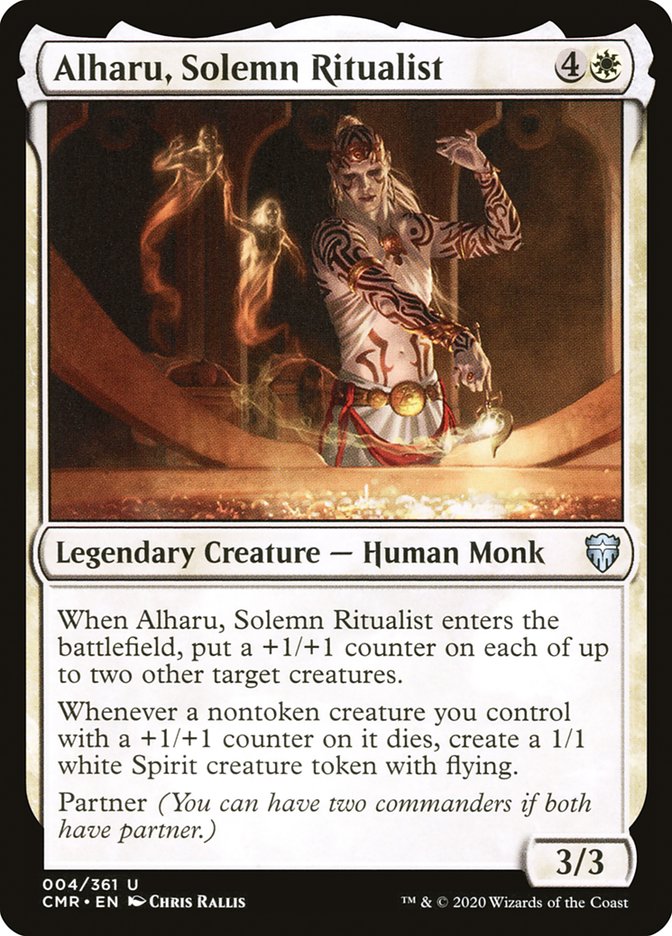
Once I had settled on the Commanders I started to generate the list of cards to round out the deck. Hardened Scales and The Ozolith (both versions) led the list, with Cathar’s Crusade and Inspiring Call quickly joining them. Winding Constrictor could find another home as would some of the very best removal spells available. Yet the more cards I added to my mental notes the more bored I became, Here was a new deck to uncover and put together and yet by the time I had figured out the majority of nonland options I had no lingering desire to actually pull the cards from my collection. The deck had built itself.
At its best Commander is a series of experiences. It is the joy of crafting and iterating a list and then piloting it. The games themselves should be a series of vibrant punctuations that spur a cycle of improvement. It is not always about finding the perfect build but rather the things that bring you those happy moments. For me part of this joy is derived from doing things differently. It’s not intentionally hampering my decks but rather doing something that provides a novel occurrence. The Alharu-Reyhan deck I had conceived would be strong for sure but nothing about it would be a surprise.
There was another nagging feeling. Poring over the latest card file I came to realize how much of a challenge it would be to keep the deck up to date. The further away from novelty a deck moves the more likely it is that new cards will be released that just fit. This would evolve to be an exercise in self restraint, telling myself I do not need the latest Ouroboroid for the deck to work. While absolutely true at what point would I tire of seeing cards perfect that I would pass up due to exhaustion?
Why do we avoid building decks? I cannot speak for everyone but for me it is about discovery. When I have an idea I want to feel like I found something, even if the pieces were laid out there in front of me. I want the games to unfold in a way so that even if I know what is coming there is an element of risk. We’re can’t go off script if there was only an outline at the onset. If I build a deck and it is just an expression of cardboard rather than something of mine I end up leaving the deck unplayed until the contents end up back in a pile somewhere.
One of my favorite creature types to build around is Zombie. Being a filthy Golgari player there is little I enjoy more than recycling material from my graveyard and over the years I have put together, and dismantled, multiple Zombie decks. This is due in no small part to the decks starting to Frankenstein themselves. On some level the deck was being constructed by a mad doctor outside my control. It was not until I honed in on Wayward Servant that I found a hook that made my lips curl; that kept me interested.
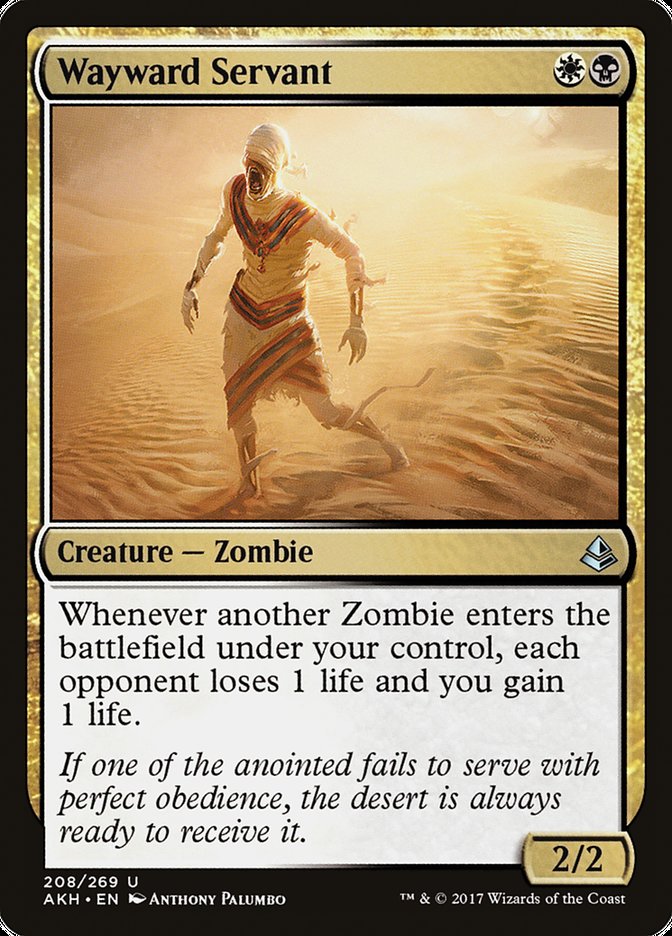
Wayward Servant was a card that grabbed my interest early on but I never got around to building around it. I love Aristocrats strategies and decks that win one point of damage at a time. Servant hit all those notes but the idea of Esper Zombies never sat right, in part because it was what the cards told me to do. Where’s the fun in self expression if you’re doing what you’re told? Listen, just because I’m a dad now doesn’t mean I’ve completed buried the punk ethos that got me all the way from high school to my late 20s. But Wayward Servant was giving me a signpost.
I started to think about what appealed to me about Zombies and so much of it was how the cards lent themselves to a relentless approach to the game. At one point I had a Gisa and Geralf deck it never stuck in part because it bored me. But Lurrus of the Dream Den never did. Instead of handing me directions it gave me a map and told me to find my own way. Lurrus is a legend that had captured my interest but I never found a build that stuck. It was a chocolate and peanut butter moment when I realized that Wayward Servant was a Zombies that only cost two mana. Suddenly I had something new and novel that would afford me the opportunity to have both a Lurrus deck and a Zombie deck.
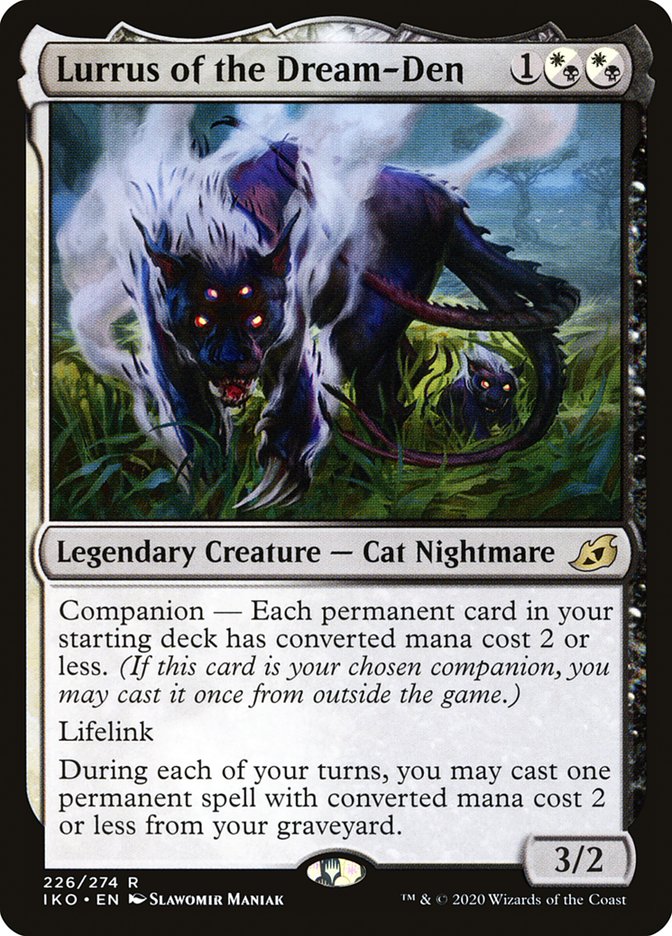
My current Lurrus deck may feature a number of cards considered staples in the Zombie archetype but it also gets to do things differently. Biasing towards working with Lurrus’ ability encourages me to think about the build from multiple angles. Yes, it may be a Zombie but can the Cat bring it back? If not, is it worth inclusion? It’s not enough to just be the correct creature type – it has to fit with the various engines. Whether it’s Lurrus herself or Binding Mummy or Siege Zombie, additions have earn their keep instead of just taking a spot that they earned by virtue of being printed.
Every time I build a deck there is a moment. An instant where I think about what comes next and either a smile spreads across my face or I realize that this collection of cards is not for me. The point on the timeline where I saw that Alharu-Reyhan would be rote was parallel to when I realized that Lurrus Zombies would continue to provide me opportunities to explore. If a deck is finished before I even shuffle it up for the first time then is it even worth putting it in sleeves?
If I had stuck with Gisa and Geralf for all those years, would I have found my current joy with Siege Zombie? If I had never taken apart my Skullbriar deck from the mid-2010s would I have the same qualms about a new +1/+1 counter strategy? I don’t have a good answer. What I do know is that no matter what you do, every step of the process, from conceiving a deck to saying “Good Game” as the last life point gets crossed out should bring a smile to your face. Otherwise, why did you even bother playing the game in the first place?
I want to take a moment to thank all my Patrons. I am going to do my level best to keep providing you with the kind of content that brought you here in the first place. If you are interested in supporting my work, you can sign up for my Patreon starting at just $1.
Can’t make a commitment to Patreon? I have a Ko-Fi where you can make a one time contribution.
 NerdtotheCore