
How do you build towards narrow cards? This is the question that has enamored me since I was introduced to Commander. There’s nothing wrong with picking a legendary that offers multiple paths – I’ve have more than one deck where such a card is at the helm – but I also derive joy from finding a general where I have to scour the entire history of Magic to find cards that fit and only if you squint just right. This is where love is found. There’s a fondness for the weird legends, the ones that when you take it out of the deckbox, members of the pod may be met with a card that they had no idea existed. These options do not have to be old but instead they may just not measure up to the current crop of commanders.
The (technically correct) way to build towards a narrow Commander is to find 99 other pieces of cardboard that you like and shuffle them up. Thank you for coming to my lecture, please leave a five star review. If you actually want a deck that does something you have to be more selective. You need to examine the card selected and think of everything it can do and build out from there. Given the entire legacy of Magic, the slowly shifting nature of the Color Pie, and the need to keep limited environments fresh, it feels possible to build nearly any archetype in any color identity. All it takes is the ability to see things in the context of that history instead of only the past few years.
This is easy for me to say. I am a full fledged adult who has been playing Magic since Revised (for the record my “break” came before Ice Age). I also went accomplished much of my schooling before the era of the omnipresent internet (and well before the era of the useless internet) and had to do research in libraries using microfilm and other antiquated concepts. There were times in college when I would find a book in the stacks and pore over the bibliography to check the source material on the off chance it would be applicable to my current endeavor. This is the approach one must take when looking at Commanders that play to themes not heavily supported in color identity.
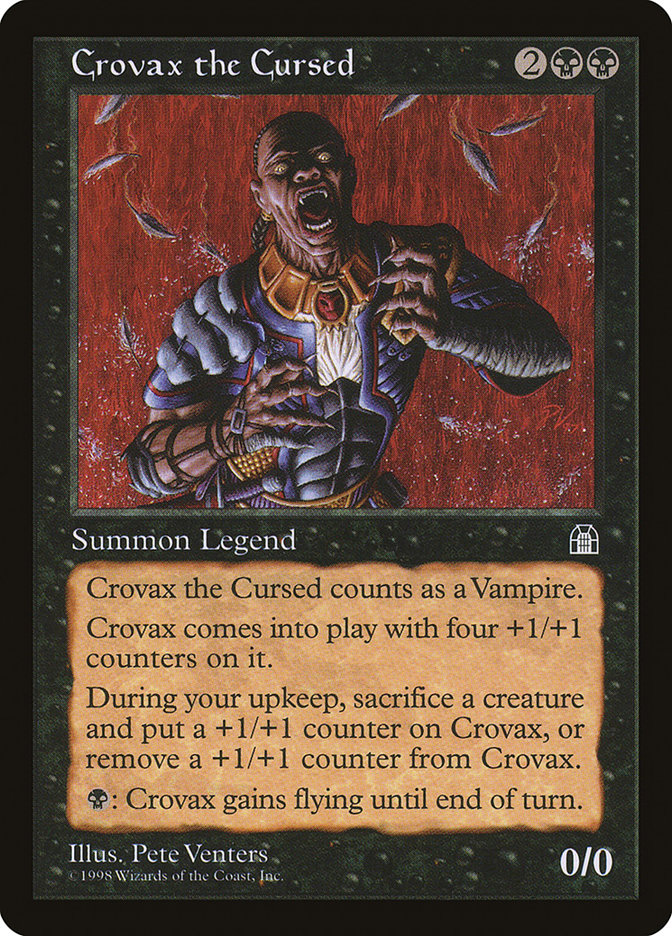
While there is no central library for Magic there are plenty of sources. Scryfall and EDHRec both facilitate research. If you are able to search terms and find key cards in the former you can then see how people are applying that knowledge in the latter. This is my preferred way to use EDHRec as it can give me clues to cards that may have escaped my notice (being old means I can’t keep up with the cadence of new cards) while letting me leverage the pieces of cardboard that get stuck in my mind (looking at you Strands of Night). I want to show putting this method into practice using Crovax the Cursed.
From the first time I saw Crovax I was enthralled. The Weatherlight Saga was in full force and the story was being revealed in the cards and the pages of The Duelist. This specific card depicted the moment that Crovax lost his humanity. The text says it all: he counts as a Vampire. He has to constantly feed to maintain his strength. Pete Venters’ art is striking in his signature manner. The line work is phenomenal, especially when shrunk down to card size. The lighting, the red, the feathers of the fallen angel; all of it communicates the moment. By modern standards the card is not very good but that does not matter because of the feelings it evokes.
When cards get stuck in my brain I am always looking for other options that may end up working with them. Years after I first saw and built my initial Crovax deck, Unforgiving One was spoiled. I knew I wanted to play this card in Commander. It did not matter to me that the card was not especially powerful or that its thematic hook – Modified – was not exactly supported in black. The idea of conditionally bringing creatures back from the graveyard makes me smile and attacking is still honest. A copy was added to my collection even as I took apart the first iteration of Crovax.
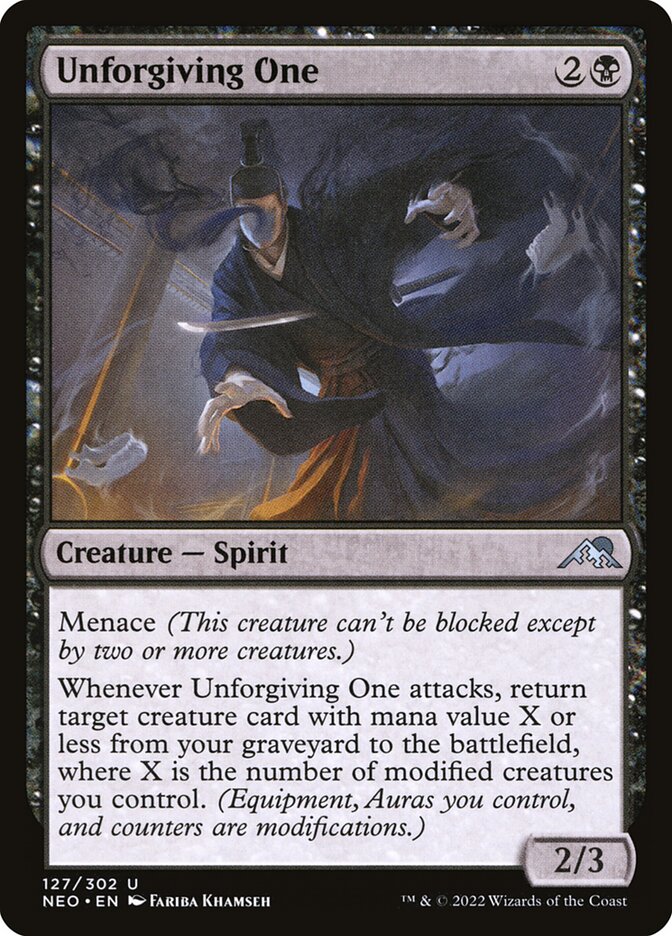
But the idea of Mono Black Modified continued to tickled the part of my mind dedicated to deckbuilding. The release of Tarkir Dragonstorm and its focus on different counters – not just +1/+1 counters – gave me the spark of inspiration I needed to pull the Vampire Noble back out. Flipping through my collection I saw cards that added all manner of counters to my army, from Charnel Serenade to Isareth the Awakener. The hook’s hooks were in me and I started to look for auras and equipment that would fit the bill. While I have not found auras that spoke to me, it does not mean I’ll leave Chorale of the Void on the outs forever. Thankfully, for my opponents at least, I decided to leave my copies of Grafted Exoskeleton and Phyresis on the bench. Nevertheless I had the hypothesis for my research.
Narrow decks are some of my favorite ones to build and maintain. Honing in on a select suite of cards while also being able to find new and novel ways to engage with the entire history of the game keeps things entertaining. It also makes these decks easier to update as new cards are released. Looking at a card file for black cards that care about counters provides a set of parameters where it is entirely possible no cards could be added to the deck for months at a time. What a relief!
Building Crovax with an emphasis on Modified meant he needed to be a threat. Crovax needs to get large to punch players in their mouth while surviving long enough to do it again (and again, hopefully). This is part of the allure. Being able to fling him at an opponent with Rite of Consumption is a reasonable endgame (I still can’t find my copy of Essence Harvest) and Surestrike Trident doesn’t force me to sacrifice my Commander while also leaning into the Modified theme. Looking at other ways to boost Crovax’s power, Blade of the Bloodchief fits perfectly turning each piece of fodder fed to Crovax into three points of power. Tarrian’s Soulcleaver might not care about Crovax’s vampirism but can grow him all the same. Ring of Xathrid is a fantastic option that not only can protect Crovax but also keeps him alive if I am unable to feed him enough.
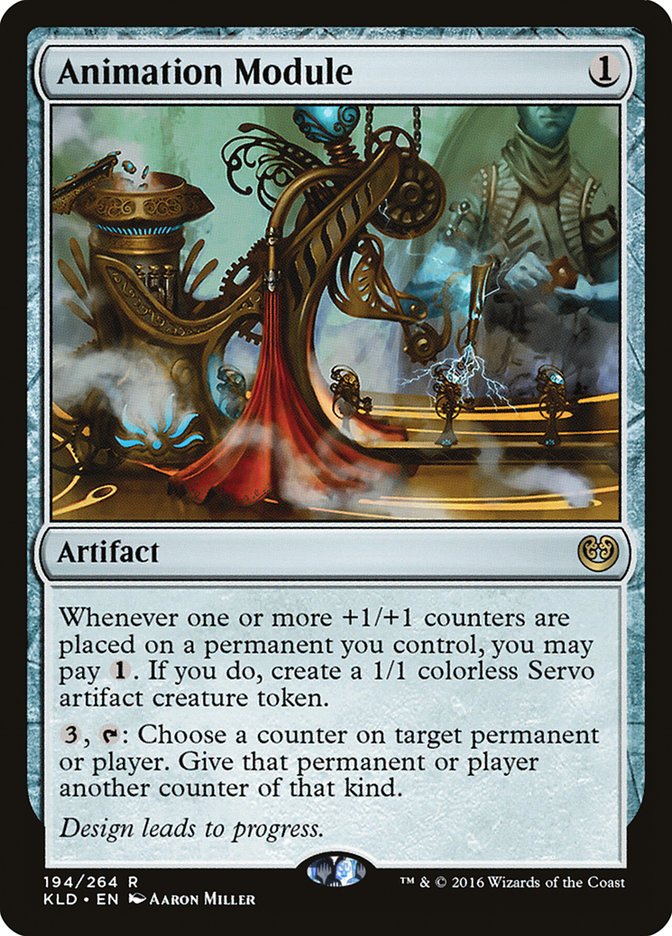
Caring about +1/+1 counters means I get to bust out one of my favorite trinkets: Animation Module. I am always trying to get this engine adjacent card to work and it shines here. When it is out on the board it turns Crovax’s upkeep cost into a scant one generic mana while also providing a pastiche of Proliferate. Animation Module cares about any +1/+1 counter being placed on a creature so actual Proliferate – Contagion Engine, Vat Emergence, and Vraska, Betrayal’s Sting – all find a home here as well. Now any of our creatures are able to grow tall.
What about going wide? As Unforgiving One cares about multiple creatures carrying enhancements, we need to look at options. Nikara, Lair Scavenger and Yathan Tombguard also want multiple creatures with counters and converts them into cards. Hagra Constrictor makes these creatures more difficult to block. Unspeakable Symbol is no Treasonous Ogre but it can convert life into damage. The three life is steep but does pay dividends in this build. Isareth and Charnel Serenade can bring these creatures back for one last rodeo as well, providing just enough of an oomph to make their finality clauses worth the cost of inclusion.
Noosegraf Mob is an odd duck. It comes in as a 5/5 but can provide a steady stream of bodies to block and feed to Crovax. There are plenty of ways to keep this zombie alive and spewing filth, from the equipment available to Mikaeus, the Unhallowed. It is also emblematic of cards in the deck that benefit directly from having +1/+1 counters placed directly on them – one only needs to look at Emperor of Bones or Fetid Gargantua to see what else can happen when you decide to feed your army of horrors.
The first time I played Crovax in its current rebuild it stumbled. Hard. Part of this was due to mana issues but a not so small part of the problem was the lack of relevant early drops. Bloodghast, Nether Traitor, and Reassembling Skeleton were slam dunks as they obliged the Noble. I had replaced more expensive card draw with Clattering Augur and Dusk Legion Zealot in an effort to speed up development. Still I needed more. The release of Edge of Eternities provided Timeline Culler as another persistent source of fuel. I leafed through my longboxes, found copies of Hangarback Walker and Marketback Walker as a smile spread across my face. Here were cards that could come down early. wanted to die, and worked with +1/+1 counters. It didn’t take much to convince myself of their worth
Now that I had all of these bonuses I needed to put them to good use. Retribution of the Ancients turns excess counters into creature removal and when combined with Mikaeus could help create a perpetually undying army. Retribution also enables the reactivation of an Adapt ability which can mean more cards from Fetid Gargantua or more hasted attackers from Emperor of Bones. Fain the Broker is a fiddly card that does a lot at a cost. However when there are counters to spare he can put it work.

The fact that Fain can remove Finality Counters does not hurt and provides some redundancy with Nesting Grounds to help keep the creatures coming back for more. Both the land and the Broker also allow creatures to continue to Adapt (are you sensing a theme yet?).

Then there’s Equipment. Loxodon Warhammer is a classic and helps to offset life loss. Ghost Lantern comes with Bind Spirit, leveraging both halves of the card. Lashwrithe not only makes a creature large but is also leaves behind a piece of fodder for Crovax. Banshee’s Blade is a neat card that leaves the counters on the artifact, meaning it can move its power around the board not unlike The Ozolith. There are other equipment that add counters to the creature itself – Armory of Iroas – but having one that is not contingent on its wielder surviving adds to the deck’s resilience.
This is my exploration of a narrow card that is anything but. I am not going to say that my Crovax deck is a world beater – if I wanted it to be stronger I would add another color. Skullbriar, the Walking Grave or Reyhan, Last of the Abzan or Grismold, the Dreadsower are all better decks for a +1/+1 counter theme that also come with green’s ability to multiply counters, and I have built each of these decks in the past. However each of them leaves something to be desired. These builds are, in many ways, prescribed. You can build any of these decks but how good are they without Hardened Scales and its ilk? There is nothing wrong with running these decks and leaning into the powerful options gifted by the additional color. But intentionally limiting yourself has more benefits than just bookkeeping – it can lower your threat profile.
Sitting down in any pod requires some level of assessment. Not only do you need to consider your position in turn order but you also must survey the other Commanders. If you are sitting in a regular group you understand more about your enemies but in open play you have to make snap judgements based upon known information. A card that screams +1/+1 counters at you is more likely to play with cards you have seen before and even if there are some minor differences the main thrust will remain the same. It is understood. If you take your Commander out and it is a narrow – or more likely worse – version of something of something established that can work in your favor. Your cards work in ways that may not be as easy to parse to the opponent’s providing an advantage. Playing cards that are present in fewer decks can also lead to being underestimated, which in turn can give you a chance to strike. At the end of the game this can lead to more enjoyment since everyone loves an underdog story.
If you are looking for something new for Commander night why not focus on something outside the box? Think to what card gripped you for the first time (of the fiftieth) and build with that in mind. You never know what relic you might uncover in your efforts.
I want to take a moment to thank all my Patrons. I am going to do my level best to keep providing you with the kind of content that brought you here in the first place. If you are interested in supporting my work, you can sign up for my Patreon starting at just $1.
Can’t make a commitment to Patreon? I have a Ko-Fi where you can make a one time contribution.
 NerdtotheCore