
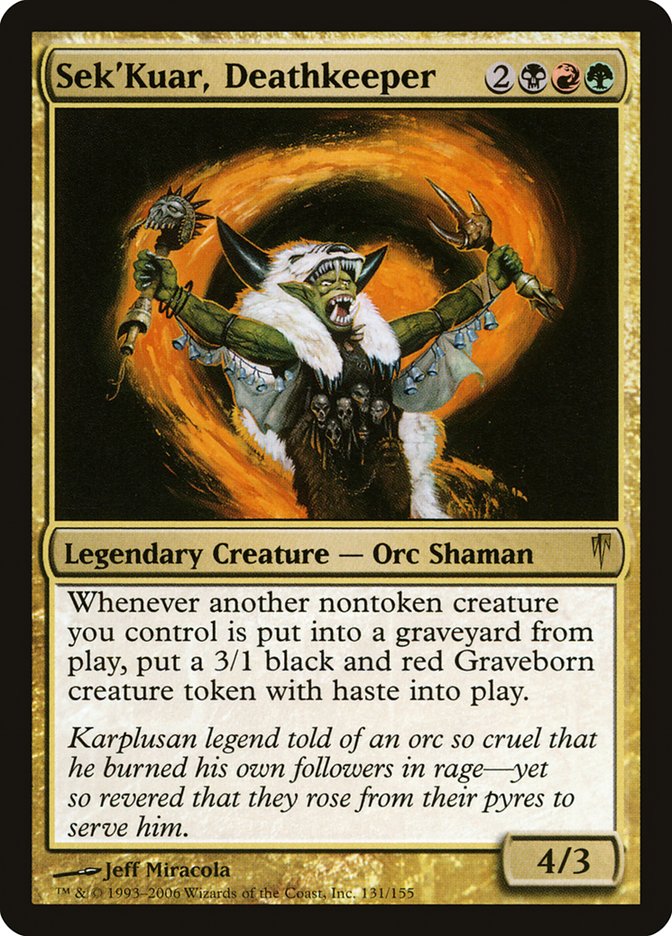
Recently, after Commander night I was standing outside my local game store with a friend and regular podmate. We had just finished our third game of the night where the two of us were the last players standing. Piloting my Sek’Kuar, Deathkeeper Aristocrats deck, I was able to whittle him down from 60 life to zero in a single turn. But that isn’t what he brought up. Instead he remarked that my deck was able to function, even without my Commander in play. He brought up the first game of the evening which I had also won, where my Pia, Consul of Revival deck secured the victory without the eponymous card on the battlefield. Clearly this conversation stuck with me as you are reading the words on this page. But why?
Let’s back track a bit. First off, I am a dinosaur in the world of Magic. I have been playing the game since Revised was fresh on the shelves and my introduction to Commander – then Elder Dragon Highlander – came before the Kaalia of the Vast was a physical Magic card. Back then even the most well oiled machine felt like they were held together with duct tape and a dream. In the intervening decade plus, Wizards has learned how to design for multiplayer even as they continuously push the envelope. Now decks that come out of the box can reasonably hold their own against tried, tested, and tuned homebrews. And that box matters because of who is plastered on the front.
Today Commander focuses far more on, well, the Commander. If Magic can be about personal expression then selecting a legend that leads a deck in some way is an extension of the pilot. The centering of the Commander also alters the way the deck functions in practice. When the Commander is an integral part of the strategy, the other 99 cards not only must support the Commander but also exist to turn that one card into a threat. In modern Commander every deck is a Voltron deck.
Voltron is a nickname for a type of deck where you enhance your Commander with the intent to attack. Whether it’s +1/+1 counters, auras, or equipment, the idea is to turn your Commander into an engine of destruction. These decks can falter when their centerpiece is dealt with, as the surrounding architecture only holds up when the general is on the battlefield. Now I am not saying every new deck that rolls off the printing press completely falls apart without one key card but when I look at Commanders printed since 2020 many are so powerful that their absence can cause the deck to stumble.
What does this have to do with the conversation I had? Back when I was learning the ins and outs of the format the cards were, by and large, worse. A deck had to have a strategy that, while not separate from the Commander, had to function in someway without it in play. This was not because the card in the Command Zone was any less a piece of self expression or important to the deck, it was just that they were cards not designed to be a Commander. When I rolled up to my meetups in the 2010s with Sek’Kuar, Deathkeeper, I had to have a deck built to support a five drop Commander that had no inherent protection and did not win the game on its own. These cards were just another cog in the machine; not Liquid Schwartz.
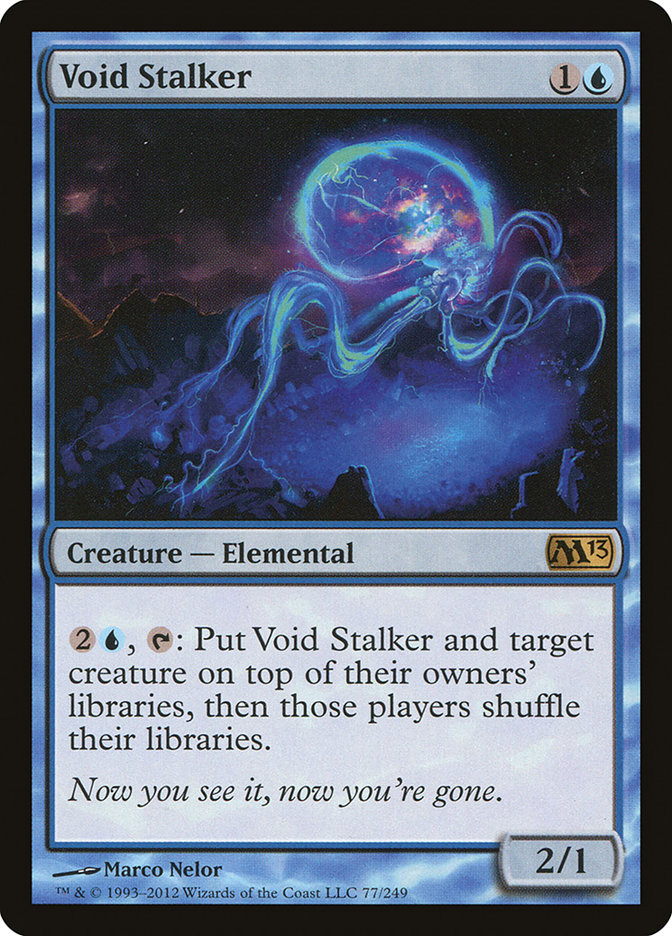
Part of this may have to do with how I was introduced to the format. Back when I started it was possible to shuffle a Commander into its owner’s library. The so-called “Tuck Rule” meant that a card like Chaos Warp could more or less ensure your opponent would never see their most important card again, I remember snatching up every copy of Void Stalker I saw, believing that they were going to be a terror at the tables. The existence of this rule practically necessitated building in such a way that your deck could function without its centerpiece; a lesson I carry to this day.
A deck’s reliance on a Commander is nothing new but the sheer number of strategies that begin to crumble without that 100th (or in many ways, 1st) card led me to think about resilience. When I get to play Commander I want to make sure I actually get to play; I want to engage in the game and not simply put cardboard rectangles on to my playmat as the other three competitors jockey for position. More than that I want to be engaged with as many points in the match as possible. I do not want to be undone by a single counter, removal spell, or board wipe. It is rather quixotic to believe this will never happen, but that does not mean I cannot build in such a way to reduce the amount of time I spend as a spectator.
But how do I accomplish this?
Not to beat a dead horse but make sure you’re running enough mana sources. While not the mainthrust of this piece the best way to make sure you are involved in a game is to be able to cast the spells you draw. Look at your Commander’s mana value and include enough resources to be able to cast it at least twice from the Command zone. If your deck falls apart without the Commander than you are going to want to up this number to three, or maybe even four times to ensure you have access to a key element of your strategy.
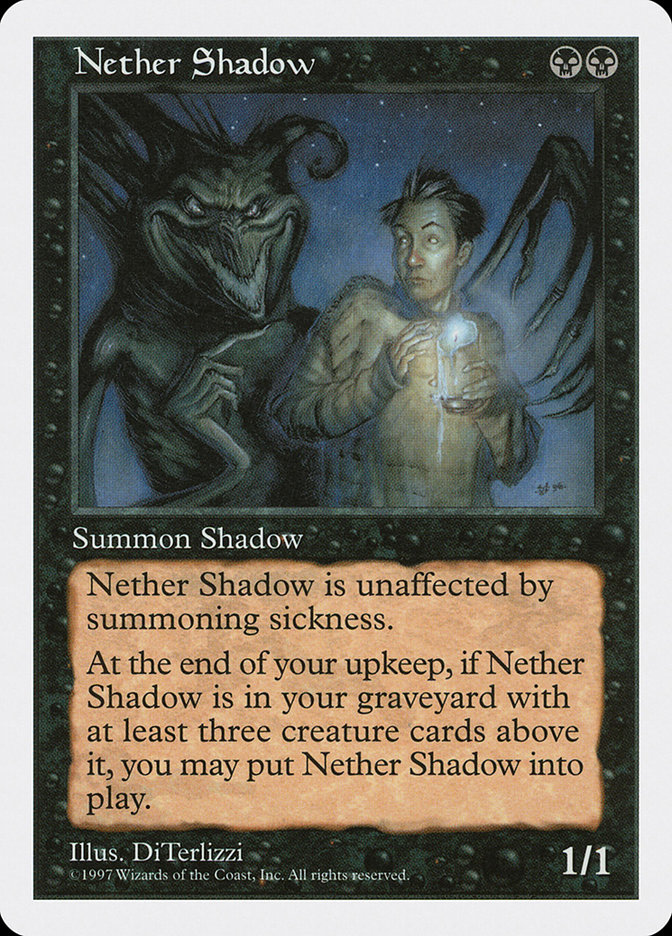
Being able to play your cards is one way to be active in a game, but what do those cards do? Several months ago I wrote about layered engines but today I want to take a little more time to explore what that means in context. It all starts with the conceit behind the deck: What are you trying to do? How are you trying to win? While the answer to this questions can often start with the Commander there are other options. Perhaps you are infatuated with a tournament deck from another era or you really enjoy specific aspects of the game. For example, I have long been a fan of Nether Shadows – creatures that can bring themselves back from the graveyard.
Bloodghast and Reassembling Skeleton make me happy to the point where I accidentally ordered 16 copies of Tenacious Dead. Regardless I had built more than one deck around these cards even before Tormod, the Desecrator was released. Given the expansive history of Magic it is possible, even if it is not easy, to build a deck around any mechanical concept.
The goal of this is to look sideways and do research. It feels almost odd in this current moment when the idea of digging into source material and looking for synonyms or corollaries are becoming as antiquated as a rotary phone. At the same point it can be rewarding to see how the pieces can come together to create something greater than the sum of its parts. Rebell (who for my money is doing some of the best work on social Commander theory today) put out a video recently about a similar concept and I encourage you all to check it out. Returning to the Nether Shadow example, once a seed is planted a deck can branch out in multiple directions. There is the previously mentioned Tormod angle, where you generate value from cards leaving the graveyard. Of course they also need to get into the bin in some way so that can lead you down the path of self-mill, Buried Alive, or sacrifice engines. If you are sacrificing the creatures then Blood Artist effects follow and yes I know we just built a Syr Konrad deck but bear with me. Each of these different synergies are not discrete and isolated entities. There are ways to bridge them together so that if you aren’t able to fully execute one plan it is possible for you at least progress on another. Syr Konrad is a perfect example in part because it does so much that it can easily bridge the gaps. Ayara, First of Lochthwain is another card that can stitch together these engines as it wants you to put black creatures into play while also providing a way to get them into the graveyard.
It is not about any one thing your Commander does but rather about everything it can do.
Let’s look at my Sek’Kuar deck. While the list above is not exactly what I played in the game in question, the conceit of the deck is the same. Sek’Kuar is an Aristocrats deck that wants to leverage the Orc’s ability to generate material. That the Graveborn tokens are reasonable threats in their own right matters as well. The overarching theme of the deck is to sacrifice for value and while the main spout is the Orc from Coldsnap there are many other cards that make use of things hitting the bin. While these can work together they do not have to in order to march towards victory. Creatures dying might give you an Experience Counter with Meren of Clan Nel-Toth or force opponent’s to make a choice with Savra, Golgari Queen. They can plink in for damage with Blood Artist (and friends) or draw cards thanks to Smothering Abomination. Mazirek, Karaul Death Priest means everything that is sacrificed can become more strength on the battlefield for your shambling horde. If the coast is clear you can also loop Living Death with Phyrexian Altar or Pitiless Plunderer and Eternal Witness. It is not that any given Sek’Kuar deck can’t do all of these things but rather there is a thread – Sacrifice – that ties these pockets together such that progressing on one axis can move you forward on others, all towards the same end.
I put a high priority on being an active participant in games of Commander. To me this means building redundancy into decks and finding ways to progress a game plan even in the absence of the Commander. There has been more than one occasion where a spoiler drops for a card that should be entirely in my wheelhouse but my reaction is “I don’t want to build that”. Why? Because the Commander itself is so powerful that its absence would completely wreck my opportunity to engage in the game.
Hashaton, Scarab’s Fist is a card I should enjoy. It deals with Zombies; it does sideways reanimation; it doesn’t even exile the cards from your graveyard. This card is practically calling to me from the grave. And yet it exhibits many of the qualities of Commanders I avoid. When Hashaton is not on the battlefield the strategy can shift towards standard reanimator. Now don’t get me wrong, I love this style of play, but there are other decks that do a better job of scratching that itch.
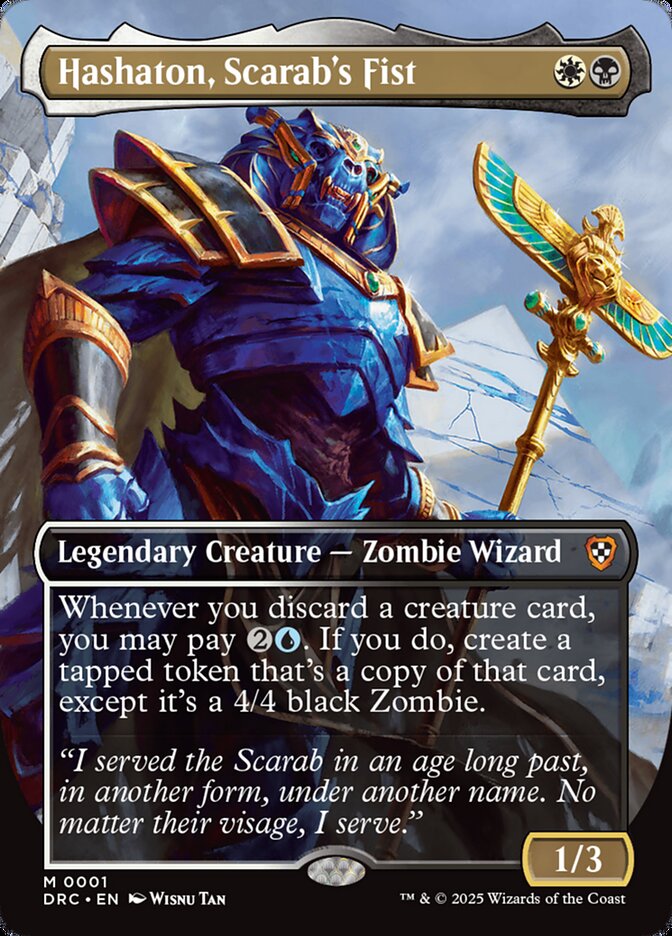
Hashaton demands discard outlets, which work well with this back up strategy but are required for your Commander to function. I think it’s actively a good thing Hashton does not have a built in way to pitch cards, but it then pushes the build to have enough of these cards to have one at all times. It is not that you cannot build a unique Hashaton deck that does things its own way, but rather every Hashaton deck is going to be doing the same thing, just slightly differently, and missing any one of the key pieces can turn the game into hoping you top deck the correct piece.
Another card that fits this mold for me is Meren of Clan Nel-Toth. If you’ve ever sat down against a Meren deck you know exactly what you’re in for. Sure the mixture of creatures might be different but at some point you are very likely to get locked under Spore Frog and hope against hope to draw the correct piece of interaction. Meren decks have a certain way they want to games to go and do everything in their power to try and stick to that path.
In these instances the decks don’t try to play the game but rather they are focused on enacting their game plan. While not Voltron in the strictest sense of the word they are honed in on doing the same thing and built towards that end. To be perfectly clear there is nothing wrong with decks of this stripe, but they do not appeal to me.
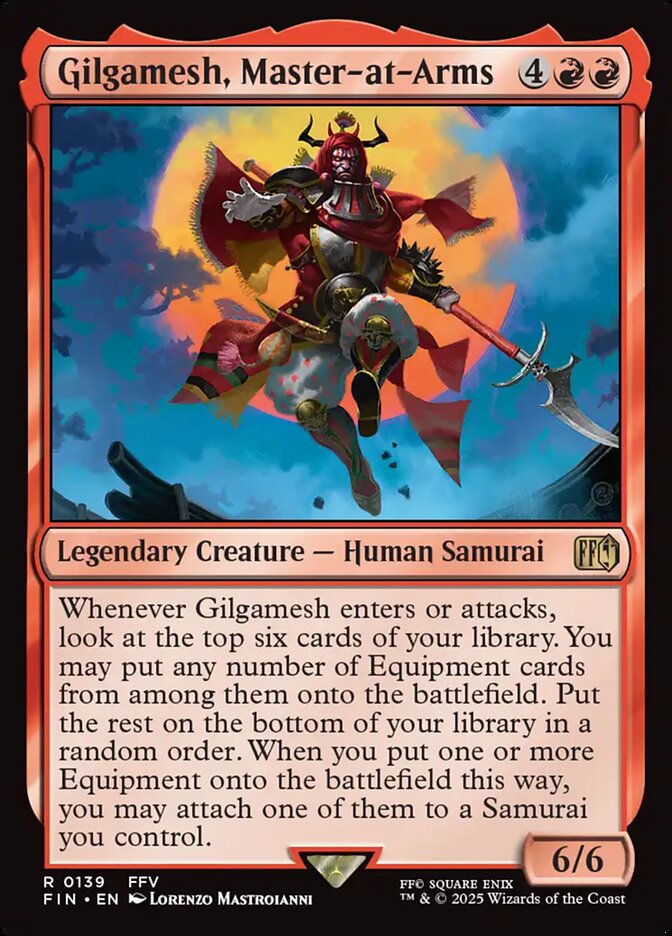
Let’s examine the relatively new Gilgamesh, Master of Arms. This Commander screams at you to follow a path – Equipment. There are ways to let your toe leave the path with Reconfigure or the Living Weapon lineage, but Gilgamesh is going to demand a hefty deckbuilding price and as a result things may play on rails. This is not to say you can do something different with Gilgamesh but the more you deviate from the primary objective the greater the chance of non-games.
Voltron decks make demands while other Commanders provide options.
In a hypothetical Gilgamesh deck, once the Commander is removed once or twice what can the deck do? It requires a density of Equipment to function but there are only so many pieces of Equipment that double as a creature. Adding cards like Godo, Bandit Warlord, Valduk, Keeper of the Flame, and Brass Squire might provide redundancy but do so at a real cost. Returning to Sek’Kuar, the deck absolutely wants to have its namesake on the battlefield but the deck does just fine without the Commander. It is part of the plan, not the only plan.
Here we run into a conundrum. If your approach to the format is playing games with your friends or finding the right build for a particular mechanical execution then pivoting away from a particular legendary is just part of the experience. But what happens when you want to play a deck because of a specific character and their card pushes towards Voltron? How can you ensure participation in the game when so much hinges on the main character.
I talked about supplementing the plan in the case of Gilgamesh, but that does come with a cost. In that instance it may require several games of playing to figure out the right balance of hits and misses to ensure the ability to play the game. Beyond that you can look for strategies that intersect with the main thrust of the deck in an attempt to provide other avenues of success. If I were to build around this Commander I would lean hard on cards like Commander’s Plate and Darksteel Plate which go a long way towards protecting my key component.
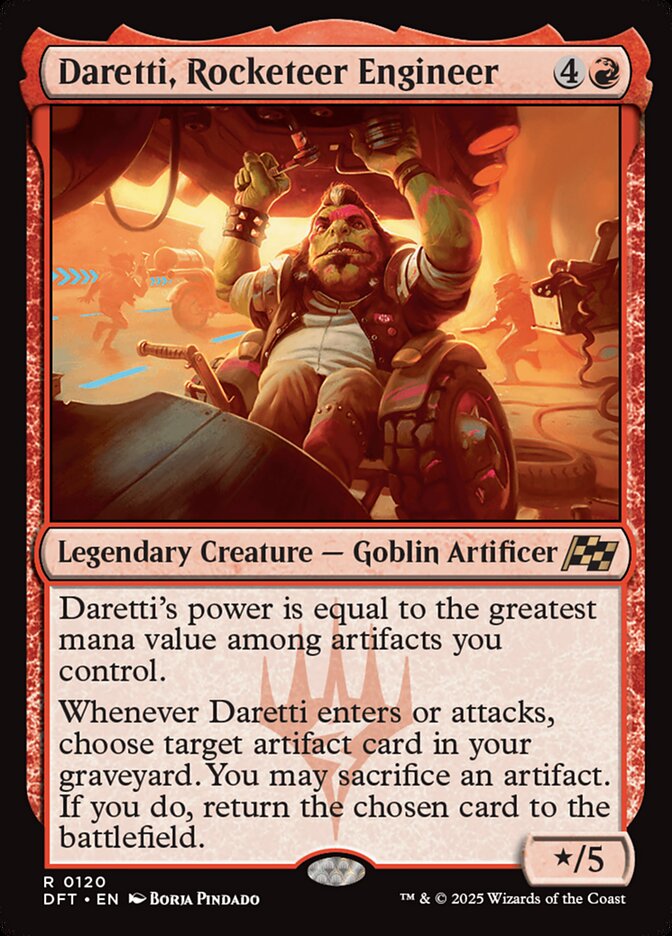
Expecting these cards to be targeted at some point means redundancy is in order and thankfully red has access to Goblin Welder and Daretti, Rocketeer Engineer. Daretti plays nice with Gilgamesh in that it also wants to attack, encouraging a similar line of play. From here I would look at ways to generate Artifact material like Powerstones, which would provide a steady supply of tokens to trade in for the armory. Powerstones can pull double duty as they would make it easier to reequip cards later in the game as well. While this deck might not be the best execution of a Gilgamesh strategy it does open up the possibility of participating in the game once the main strategy is cut off.
Legendary Creatures today are designed with Commander in mind. To that end they are crafted with the idea that someone will build a deck dedicated to make them work. The ceiling is high for sure, but in order to raise the floor more work has to be done to ensure that you get to engage in more of any given game. I’m not saying to take a completely different path, just to look for other routes to your destination.
I want to take a moment to thank all my Patrons. I am going to do my level best to keep providing you with the kind of content that brought you here in the first place. If you are interested in supporting my work, you can sign up for my Patreon starting at just $1.
Can’t make a commitment to Patreon? I have a Ko-Fi where you can make a one time contribution.
 NerdtotheCore