
Every so often I decide it’s time to attempt writing about Commander again.
When I started playing, Magic was not a social event. I made acquaintances through the game but I viewed Magic as a way to prove myself at an endeavor. As I got older, however, Magic morphed into a way to just hang out. Compared to other adult activities it’s (relatively) easy to get a few friends together or head down to the Local Game Store to get sling some cardboard. I get to relax, shoot the shit, and just enjoy playing Magic.
It’s nice.
So what has been the hold up with putting my thoughts on Commander down on digital paper? I’ve been writing about Magic in some capacity for the better part of two decades. My long standing view is that Commander is a deeply personal format and everyone has their own approach. The way I see things may not hit home for a wider audience. The internet might say there is a “right” way to engage with Commander but the reality of the situation is drastically different. There is no one true way to play the format other than the one you and your podmates agree upon for that specific game. So much of the run up to that is about how you, as an individual, feel. Who is at the helm of your deck? What cards do you include – or exclude – and why? Which Basic Lands are you running and what is that story? There is no matchup data to pore over nor metagame to attack. There are simply people playing cards and looking for stories. How, then, can you write about something that means drastically different things to the various pairs of eyeballs that may read your words?
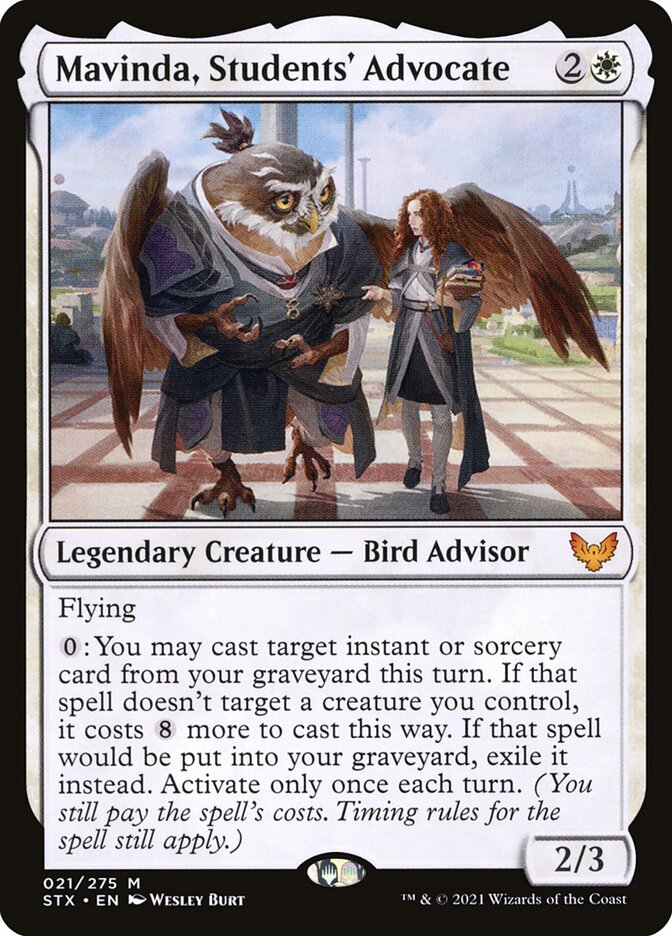
For the longest time I left it alone. I would try to write about Commander but it felt forced; the words rang hollow. A few weeks ago something changed. I was winding down from the day and excited about a deck I had just built: Mavinda, Student’s Advocate. For some reason I thought it was 2012 and decided to search the internet for anything written on the card. I found almost nothing. Sadly it made sense. These days there are so many Legendary Creatures printed that there’s no reason to write about all of them.
Given the current state of Magic content and the attention economy it tracks that only those cards that would reasonably get clicks should have dedicated articles. In that moment I realized that if no one was writing the kind of Commander content I wanted to read then I might as well do it myself. While I may not be able to write something that resonates with everyone the things that matter to me may well matter to other players. If that is the case then there is absolutely no reason to not share my thoughts.
The question then is what matters to me? It circles back to the social aspect of the format. My first experience with Commander was being invited out to Wizards of the Coast to play in the inaugural Magic Online Community Cup due to my work on the Pauper format. I had heard of EDH and decided to put a deck together on the off chance there would be an opportunity to play. I built a Darigaaz, the Igniter deck out of the cards I owned. I went to Wizards, helped win the Community Cup, and played my first game of EDH.
I was hooked. The format captured everything I loved about the my initial exposure to Magic. It combined the sense of discovery in finding weird cards with the puzzle of putting a deck together. I remember sitting at a table in Renton and relishing the feeling of just playing against people with nothing on the line besides a good time. I returned home and rifled through my collection to build another deck. At this time in my life I felt isolated. I was in my mid-20s living in the suburbs and working at a college while most of my friends were having their early adult years in New York City. It was not a far drive but my schedule did not afford me the opportunity to make many social calls. A 2011 change in job meant I could move back home to Brooklyn and EDH – now Commander – helped me to find new friends as I reconnected with my past. Time moved forward and then I was in my 30s, then my 40s. Playing the Magic became an important way to get me to engage with different people and often to get out of my own head.
These days Commander provides me a way to be social. The format also gives me an avenue where I can be creative in deck construction and play with cards that make me happy. It lets me tinker and refine, exploring new ways to make things work. Over the years I had to revise my expectations of games given my background in one-on-one play. Despite my affection for some cards it is often more enjoyable to leave them out if they can create a game that no one wants to play (looking at you, Grave Pact). Instead I found a philosophy that paired enjoyable game play with focused deck construction.

Every deck has an objective – they are all trying to Do the Thing. I realized that I derived enjoyment from decks that were trying to Play the Game. Winning the game was a secondary achievement. This conceit has become a major through-line in how I think about Commander, from the kernel of a new list to the compiling of cards itself to how I approach different pods. When I am concepting a new build I find it important to identify what the deck is trying to do and then build in such a way that allows me to engage with the game meaningfully towards that end. If I get to play the game an execute at least a portion of that gameplan, I can walk out of a match feeling as if I did something regardless of when I lost my final point of life.
Why do I feel the need to highlight this? In part I think it is because the recent deluge of options for the Command Zone have left multiple strategies with a “Best in Class” option that can do it all. The Commander is not only a way to win the game but also the main engine of progression – of moving the game plan forward. Lack of access to this card can often collapse a deck. The recent Omo, Queen of Vesuva comes to mind as one such example since that deck can cease to function without access to its Commander’s ability to make Everything Counters matter. I bring this up because building a deck that falters if a single card is absent can often lead to games where it feels like you do nothing. Constructing your deck so that it can work without the Commander and positively hum with it can make for an overall more enjoyable play experience.
Mavinda, Student’s Advocate is no one’s idea of what a Commander form the 2020s should be. She hearkens back to an era when Legendary Creatures were not designed with four player games in mind but rather a card where having multiple in play for a 60 card game might be an issue. Still I find something cool about her. If you are willing to work for it she can provide a steady stream of value “drawing” you an extra card each turn from a stocked graveyard. The buyout of eight generic mana to get around her targeting restriction means that in a pinch she can go after your opponents as well.
To best leverage her ability, Mavinda asks you to run cheap spells that target creatures you control. White heavily supports two paths that follow this route. The first is Heroic and Valiant: targeting your own creatures in an effort to make them large enough in combat to win. Here you want cards like Illuminator Virtuoso to ensure your improvement stick around as +1/+1 counters. Taking this route can mean looking for artifacts like Runechanger’s Pike to do some heavily lifting as white lacks both the force multipliers of red (Temur Battle Rage) and straight pump of green (Become Immense). Kaya’s Onslaught is fun but struggles to get the job done on its own. In the end I took a different path because boosting a creature’s stats ran counter to my vision of Mavinda.

Instead I focused on blink effects. While it is possible run both themes in the same 99 they can be at odds. Cloudshift can protect your creature but it would also erase the mountain of counters. Cards like Acrobatic Maneuver and Scrollshift also provide a save but they draw a card for good measure. The extra card helps move the game forward, digging deeper to find a way to win. The focus on flickering my own creatures encouraged me to run otherwise paltry bodies that replace themselves: Helpful Hunter, Spirited Companion, and Wall of Omens to name a few.
It also led me down a path of including some other engines that deal with cards entering (and leaving) the battlefield from old stalwarts Sun Titan, Reveillark, and Karmic Guide to the more recent Welcoming Vampire and Enduring Innocence. The resulting deck can do something at nearly every stage of the game and build towards a victory.
There is another reason I decided to focus the blink version of Mavinda and it did not become clear until after my second game with her. Sitting down to play the game is great but being able to fully participate is what leaves me feeling satisfied. I may not win but as long as I get to do something I feel like I got value out of my time. At the same point I build decks towards an overarching theme – they are not simply collections of cards but rather there is a plan. However many of these plans take time to set up and not every game provides the opportunity for their full realization. My solution is to build in layered engines that progress me towards my endgame. I did not realize it until recently but friends have longed described my decks as “Rube Goldberg machines”. The pieces all fit together so when they click I am able to do something that is far more than the sum of the parts. Mavinda is a fantastic example of this put into practice.
One of the through-lines of my build philosophy is maximizing the value of cards in play, whether that is through using them to regularly draw cards or by sending them to the meat grinder of a sacrifice outlet only to bring them back. I am naturally drawn to Aristocrats strategies – that is decks that want creatures to die for some effect – in part because they take an investment and convert it into something else. In the case of Artistocrats, a dying creature can become a point of damage with Zulaport Cutthroat or an extra card with Grim Haruspex. That’s awesome but it is something on top of what was already achieved – the creature itself. Mavinda does something similar with its spells – it already gets one use out of a Scrollshift but getting to use it a second time and draw even more cards means each actual card is worth several “cards” over the course of a game.
Taken together this means that every action is part of the overall plan. Each spell is a small step forward that provides the opportunity to engage with the other players and the battlefield while also advancing my game in a way that leads me in the direction of a win without catapulting me there. But in order to do this in Mavinda I need to build out a board. Mavinda is not a spellslinger deck that wants to amass spells and cast them in a flurry. Rather the deck needs permanents in play to generate maximum value from those same permanents being flickered to either draw cards or protect them from removal.
Once Mavinda has established a large enough board presence the deck can go about victory in any number of ways. It can plink in for damage turn after turn with whatever evasive threats it has at its disposal. It can go for value plays with cards like Sun Titan or Emeria Shepherd. Evangel of Heliod can generate an army of 1/1s that can swarm past defenses. Or it can find the cards I put in the deck to help win the game: Cathar’s Crusade or the combination of Reveillark, Karmic Guide, and Blasting Station.

We now open the door to another aspect my deck building philosophy. While some folks frown on any infinite combo I find including these engines as a way to close out the game has merit. While the play itself is meant to be enjoyed, part of any Commander game is determining the winner. Being able to jockey for position throughout the course of turns only to assemble a specific suite of cards can be exciting. What I personally do not enjoy is trying to race towards a those same game pieces as I find it anticlimactic. To this end I also make it a point of answering honestly when asked about the contents of my deck. My go-to line with Mavinda is: Yes, I do have unbound combos that can end the game, but they involved creatures and artifacts – and I will tell you when I play out the pieces when asked. Part of a good game of Commander, to me, is everyone being on the same page. Someone seeing Blasting Station, Karmic Guide, and Reveillark for the first time may not fully understand what is about to happen does not make for the best experience. Being honest and forthright with “this is when you have to kill my creature” makes it a lot easier to be invited back and to play the same deck another time.
Back to layered engines. What does this mean at the micro level? As mentioned I prefer this style of deck building because it allows me to always feel like I am “doing something” over the course of a game while also progressing my own plan. It breaks down to that the vast majority of cards in the deck need to work with other cards at various stages of the game. In Mavinda that means a heavy focus on cards that enter the battlefield but also figuring out other cards that care about said game actions.
Starting the build with Mavinda and the idea of “blink” effects at the top of mind led me down the path of cantrip creatures. White has plenty of those these days but lets go back to one of the first: Wall of Omens. On its own Wall of Omens simply replaces itself which does not seem like much. In Mavinda it makes for an excellent early target for Cloudshift. Wall of Omens also works with white’s persistent card draw like Welcoming Vampire and Enduring Innocence. I’ve opted against Mentor of the Meek in this build in part because I have found a need to leave my mana up once Mavinda is in play and overtaxing that resource can leave me low on reusing spells – it stops me from Doing the Thing. Wall of Omens also works perfectly with Reveillark, as does every other cantrip creature in the deck.
These creatures are all relatively small – three mana value or less – and that means the stalwart Sun Titan has a home here. Sun Titan is a fine blink target as well which pushes us further to the one circle Venn Diagram of “blink” and “recursion”. Karmic Guide and the aforementioned Reveillark also work here, as does Emeria Shepherd at the top of the curve. Shepherd also has the advantage of giving value to late game land drops. These creatures also help to reanimate some key creatures that also flicker such as Flickerwisp in the case of Sun Titan and Felidar Guardian, Restoration Angel, Glimmerpoint Stag, and Salvation Swan outside of Sun Titan’s wheelhouse. Salvation Swan a card where if other Birds emerge as good options for the deck I may bias towards them in the future, but I am just as likely to cut Swan in favor of a less restrictive creature.
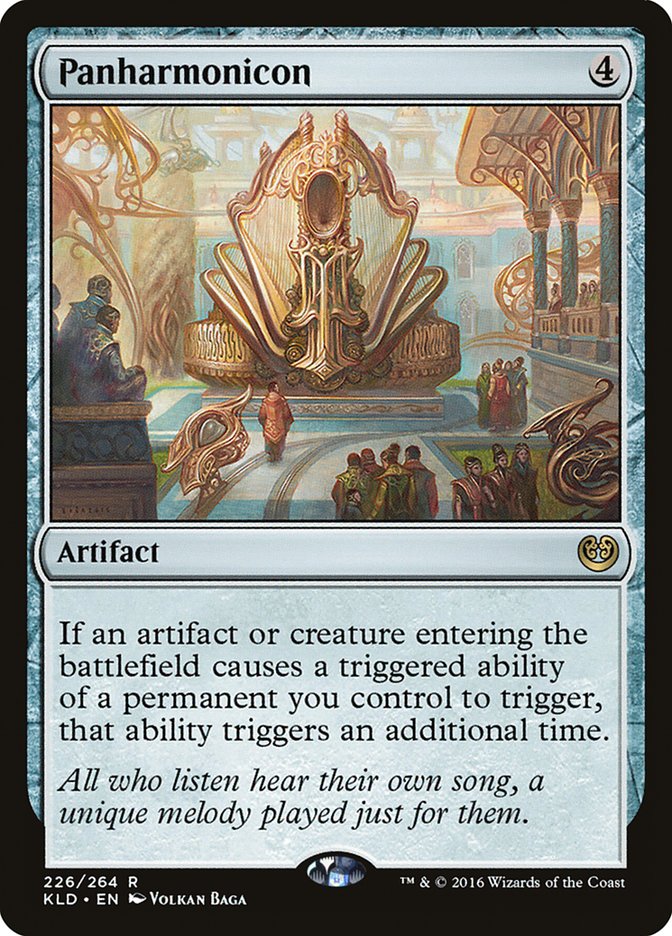
Considering how much this deck cares about creatures entering the battlefield, Panharmonicon made the cut. While the cards themselves can keep the game moving forward this artifact can help send the deck into overdrive while also helping the deck catch up if it lags too far behind. Extra card draw or blinks or recursion are always welcome and when you’re recycling Ephemerate Panharmonicon is just piling the value higher than a plate at an all you can eat buffet.
Considering how valuable a robust board state is to the strategy I needed to find ways to save my team from removal. Again I look towards to Commander to find options that meet the requirements. Divine Resilience, Eerie Interlude, and Clever Concealment all contain the magic word of target which means I get to go back for seconds without laying out eight additional mana. Bathe in Light stops damage based sweepers while also having the out to push damage past blockers in certain scenarios.
While this deck can function without its Commander in play everything works better when Bird Mom is around. As a result I tried to pick interaction that had some synergy. Wrath of God was going to make the cut regardless in part because I have a sick 8th Edition Foil. Dusk//Dawn fits because of the relatively small size of the creatures in the deck while Fell the Mighty has the all important word “target”, which means I can cast it without the tax from the graveyard with Mavinda. Sunblast Angel is a board wipe on a body that can conveniently be flickered. Outside of Wrath of God these cards all play nice with Mavinda while also allowing me to play the game and progress my gameplan mostly by delaying my opponent’s victory.
Mavinda has few defined victory condition by design. I built this deck to play the game with winning as consequence rather than a goal. Still there was intention behind selecting the ways to close things out. Karmic Guide, Reveillark, and Blasting Station get the job done quickly, but Blasting Station, Evangel of Heliod, and Emeria, the Sky Ruin does the same work, albeit at a much slower rate. Cathar’s Crusade can bolster the team while Monastery Mentor helps to go wide and push damage. The deck does not to race towards these cards but rather to finds them over the course of the game. A big part of playing this way is finding the various paths to eliminating your opponents.
How fast does Mavinda Do the Thing? That depends on your perspective. In some sense it can achieve it as early as the second turn by resolving a Spirited Companion, but if you want to get technical it will take until at least turn five to blink one of these value creatures with Mavinda in play, and then buy back the spell. Now if we’re talking about Doing the Thing – Victory Edition, well that is going to take quite a bit more time.
How is Mavinda perceived at the table? Thus far it seems to elicit positive reaction. It is an under the radar Commander that does not just steamroll the table. Instead it requires that you have put in some work to get the most out of her presence on battlefield. The combination of blink spells with Flickerwisp and friends means that you can play politics even if you are not going to pay the Iron Price for some spells. Cloudshift on Glimmerpoint Stag can remove a lethal attacker and curry favor.
I hope part of this resonated with you. I hope that, if you found this article and read it, that part of it tickled the lizard part of your brain and made you happy. Part of the joy of Commander is finding people who see things the way you do, and also who come at the game from obtuse angle.
I want to take a moment to thank all my Patrons. I am going to do my level best to keep providing you with the kind of content that brought you here in the first place. If you are interested in supporting my work, you can sign up for my Patreon starting at just $1.
Can’t make a commitment to Patreon? I have a Ko-Fi where you can make a one time contribution.
Looking for another way to support my work? Click here for my TCGPlayer affiliate link. Any purchases through the link let the folks there know you like my content!
 NerdtotheCore
One thought on “Untitled Commander Series 1: Mavinda, Student’s Advocate”