
Want to learn more about the metrics I use in tracking the metagame? You can find an explainer here.
Foundations season is well underway with eight weeks of Magic Online Challenges in the rear view mirror. At the same time, Pauper can feel as if it has been in the Modern Horizons 3 release cycle since that set debuted. Depending on how you look at things the metagame appears to be rather diverse but at the same time there are a relatively narrow band of things you can do. This coupled with the relatively slow metagame churn of the format has left some dissatisfied. Today I want to take stock of where things stand and try to identify where things might be headed.
First, my usual caveats. Yes, I am a member of the Pauper Format Panel. That being said the opinions I express here today are my own and are not representative of the Panel. While this information may (or may not) be similar to some of the points I make in our discussions, do not take them as gospel. Rather, these observations are just my take on things.
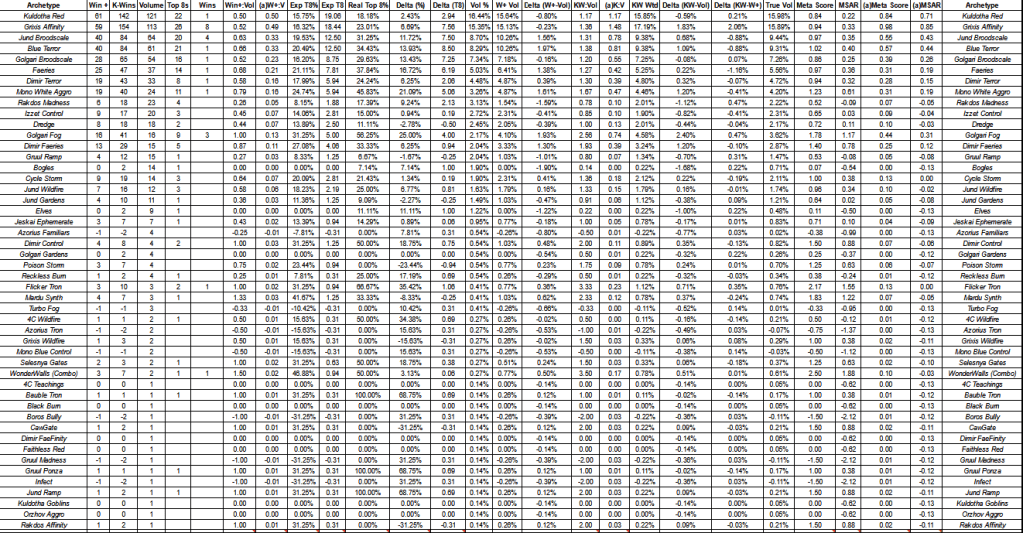
I know this chart is small, but I will do my best to highlight the relevant numbers as they relate to this discussion. Over the past two months and 23 Challenges, 49 different archetypes have made the Top 32 of the Challenges. Some of these are minor variations (a Goblins focused build of Kuldotha Red for example) or hybrids (a mashup of Affinity and Dimir Faeries). However only 14 archetypes clear 2% presence in the Top 32 (minimum 15 appearances) and only six clear 5% (37 appearances). The metagame, therefore, appears to be concentrated on a few top decks with “fringe” builds only occasionally making waves.
Today I want to focus on the “True Volume” column. This number attempts to measure how prevalent an archetype is as it relates to its strength. For example, Kuldotha Red took up 16.44% of the total Top 32 metagame but when looking at its relative performance it dipped slightly to 15.98% of the True Volume, or Winner’s Metagame. Looking at the raw numbers, only two decks stand out in this regard – the aforementioned Kuldotha Red and Grixis Affinity at 15.89% True Volume. These are the only two discrete archetypes that clear 10% for Foundations season.
Astute readers will no doubt discern that I am up to something. Despite Kuldotha Red and Grixis Affinity being the two archetypes with the best performance, the metagame includes several strategies that share core elements and gameplans. There are multiple Basking Broodscale combo decks spanning the Goglari and Jund color combinations, and no fewer than three different versions of Tolarian Terror decks (Mono Blue, Dimir, and Izzet). When we look at these larger strategically similar buckets we end up with a composite that is less a mosaic:
- Broodscale Combo (Golgari, Jund): 16.7%
- Red (Kuldotha, Goblins, Galvanic Blast Burn): 16.37%
- Tolarian Terror (Mono Blue, Dimir Terror, Izzet Control): 16.34%
- Affinity (Grixis, Rakdos, Faerie-Affinity): 16.15%
All told these four game plans occupy 65.56% of the Winner’s Metagame. Depending on your perspective this is either fantastic (a non-rotating format with four viable top tier strategies across seven sub-archetypes) or less than ideal (their dominance is squeezing out other potential builds). The more time passes the more I am in the latter camp in part because of how much ubiquity there is amongst multiple archetypes.
Let’s take Affinity, for example. This strategy often features the Artifact Lands, Deadly Dispute, and Galvanic Blast. If you look at the red strategies they also heavily lean on artifacts to enable Galvanic Blast. Broodscale decks run Deadly Dispute and some Jund varieties run the Bridges to accelerate with Cleansing Wildfire. Moving away from combo most midrange Golgari and Jund decks also run a Deadly Dispute package, with one build also running Bridges and Cleansing Wildfire. While there are four main buckets, there are, in some ways, three things to do – Red, Terror, or Dispute. This may be a reductive exploration but at the same time it is reflective of the top of the competitive metagame.
How many things should one be able to do in a non-rotating format? In my opinion three is too few and four is not quiet there either. If the top of the format only comprised say, half of the Winner’s Metagame it would allow for further development of Tier Two (and below) strategies that could potentially gain a foothold and find success. It is not necessarily that there are too few things to do but rather that these elements are clearly a lap or two ahead of everyone else. After the Big Four the next best macro-strategy in Pauper revolves around Spellstutter Sprite and it comes in at 8.43% of the Winner’s Metgame, and then it’s another massive drop off to Mono White Aggro at 4.2%.
Part of this is the nature of commons. Unlike Pioneer, Modern, and Legacy there fairly few singularly powerful cards around which you can build an archetype. The Initiative and Monarch both exist but have moved into a support role rather than a focus of the format. Instead of leaning on individual cards Pauper decks are built largely on layered synergies which means that the best packets will often rise to the top. The format has plenty of options but given the landscape means that the Big Four are the best things one can be doing at the moment.
Seeing as the upcoming releases are Innistrad Remastered and Aetherdrift, the chances for a Modern Horizons 3 level shake up are slim. Standard Legal sets rarely have a massive impact and neither Time Spiral Remastered nor Ravnica Remastered did much to nudge the metagame. It is possible that the only way to things to change would be for a forced rotation via cards being added or removed from the banned list. That being said it is also possible that the next two sets will buck the trend and make waves so nothing is set in stone.
There, of course, is another issue. While the format is currently rote in many ways it is balanced. Pulling or pushing on one of these core decks too strongly could upset that and cause another series of issues. Words similar to these have been written before and the solution is never obvious or prescribed. All this being said it is hard to ignore what recently happened with Modern and the massive shakeup – and excitement – that flowed from the changes to that format’s card pool.
What could be done? Lots, to be sure and I am not going to speculate on individual cards for the reason previously discussed. Still the question that lingers on my mind is how much would need to change for there to be emergent strategies? There are tons of established decks available that could assert themselves if an opening existed, but would they keep Pauper exciting or would the discourse return to this point in six months’ time?
What steps would you take with the format? Do you believe anything should be done? What cards are in your sights? Would you take a minimalist or maximalist approach to things?
I want to take a moment to thank all my Patrons. I am going to do my level best to keep providing you with the kind of content that brought you here in the first place. If you are interested in supporting my work, you can sign up for my Patreon starting at just $1.
Can’t make a commitment to Patreon? I have a Ko-Fi where you can make a one time contribution.
Looking for another way to support my work? Click here for my TCGPlayer affiliate link. Any purchases through the link let the folks there know you like my content!


Thank you for the write-up. For me, the core issue with the format as it stands is this:
While the top meta might feel balanced, fun, and fair (between the top decks), I’m not looking for “Pauper Battle Box: The Board Game,” where the choice is limited to one of four optimized decks. Instead, I want to explore the vast depth of Magic’s history, experimenting with new brews and a wider variety of viable strategies.
In an ideal format with a diverse pool of tier 2 decks, we’d see constant shifts in the meta. As “top decks” rise to dominance, tier 2 decks that counter them could gain strength and rise themselves, creating new opportunities for innovation and competition.
Currently, I believe the greatest limitation to this diversity is the artifact lands and affinity payoffs. These cards restrict deck-building by incentivizing “artifacts-matter” synergies so strongly that non-artifact strategies are often pushed out. The bridges are particularly problematic, as they’re incredibly resilient and difficult to interact with.
Additionally, Refurbished Familiar is too strong and further incentivizes playing Wellspring/Dispute shells in every black deck. Glee combo is similarly oppressive—it’s too fast and resilient, effectively overshadowing every other combo option.
To address these issues, I’d suggest the following changes:
• Ban the artifact lands (bridges): These lands dominate the format, making artifacts too efficient and crowding out non-artifact strategies.
• Ban Refurbished Familiar: This card warps black decks around the same artifact-based draw engines, limiting diversity.
• Ban Broodscale: This would preserve older cards in the format while addressing the Glee combo’s dominance.
• Ban Galvanic Blast: One red mana for 4 damage is too efficient in a format where artifacts are so easy to enable.
• Ban Serpent, not Terror: The redundancy between the two makes the Serpent/Terror combo too consistent. Keeping Terror but removing Serpent feels like a fairer approach.
I believe these changes would help unlock more of the format’s potential, encouraging diverse deck-building and fostering a healthier, more dynamic meta. Thank you again for your continued work on the format—it’s deeply appreciated!
LikeLike