
I use a few different metrics when looking at the Top 32 metagame. The first is just Raw Volume. The second is Win+, which takes the sum of all wins at X-2 or better in the Swiss and assigns a score; Win+ is helpful in measuring a deck’s Swiss round performance. K-Wins takes all of a deck’s wins and subtracts its losses, Top 8 inclusive; this helps to give a measure of overall performance. The final pair is call Meta Score and Meta Score Above Replacement, which takes the average of Win+ and K-Win to try and position an archetype against its field. This number helps to provide the most robust image of a deck’s performance.
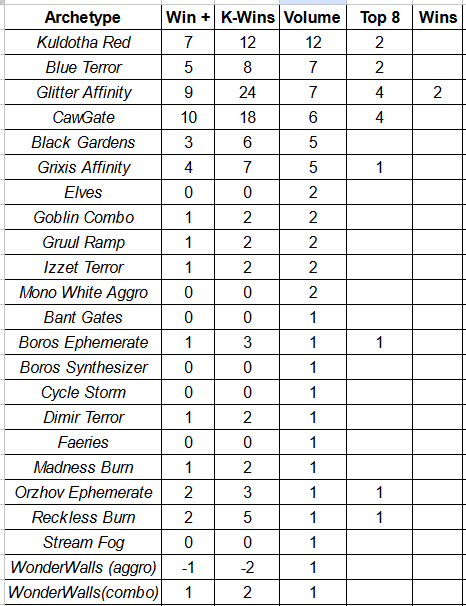
Coming out last weekend much of the discourse around Pauper was centered around the dominance of Blue Terror and Kuldotha Red. After the first four weeks of Wilds of Eldraine season these two archetypes were putting up impressive numbers, with 27 Top 8 finishes and 5 wins between them over the eight events. The conversation turned to whether or not these strategies were too dominant, whether they were healthy for the metagame, and if any sort of action needed to take place. These discussions are going to continue to occur as these archetypes are not likely to lose a step anytime soon.
Note: Yes I am a member of the Pauper Format Panel. No you shouldn’t read anything into the last sentence. I write these updates from the perspective of an observer. In fact these sentence itself would want to come at the end of the next paragraph but I wanted to put it here just to avoid any undue confusion.
Both blue and red are going to continue to get cheap and efficient spells that work with the game plans illuminated by these two decks. While the exact card lists might change the overall result is not likely to shift all that much.
This, of course, can result in a known metagame. Note I am using the term known as opposed to solved. While Pauper by and large might be a well charted continent, right now much of the game play is about mapping out every tree in the forest, not the borders of the woods itself. I think it is more than fair to say that both Blue Terror and Kuldotha Red operate at the center of the format, with Glitter Affinity not too far behind.
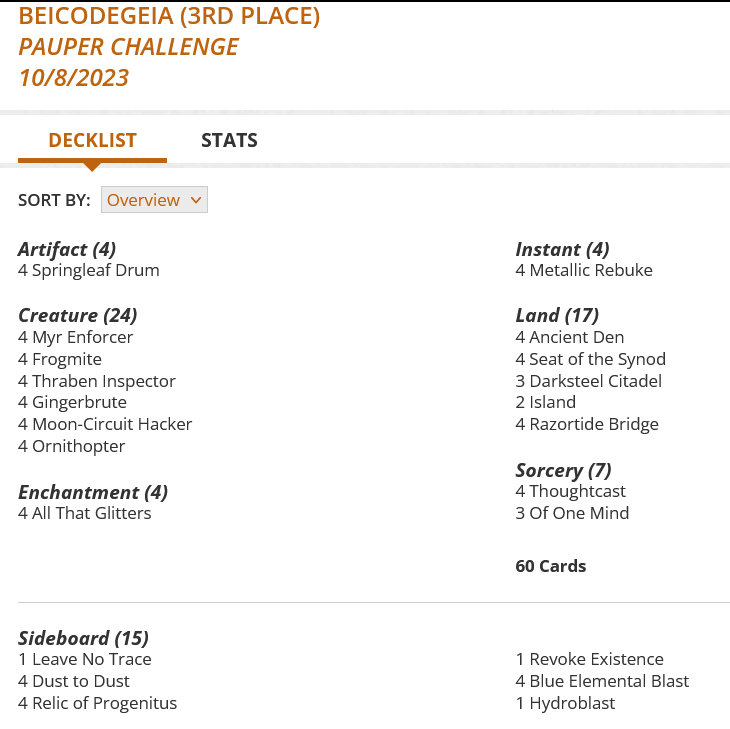
Glitter Affinity takes the Artifact Land engine and converts it into persistent damage through All That Glitters. Unlike Grixis Affinity this deck wants to hit the ground early and start applying pressure. As a result it pours all of that reach into the aura as opposed to a long game approach involving Blood Fountain or Makeshift Munitions. Glitter Affinity had a glowing weekend with four Top 8 finishes and two wins. It ended up with an adjusted Meta Score Above Replacement of 3.27 – the best single weekend score of any archetype thus far this season.
Which makes this next part almost funny. The next best deck on the weekend was CawGate, also with four Top 8 finishes. It’s aMSAR of 2.16 is the second best score of any archetype over the past ten events. So what does this actually tell us?
Both CawGate and Glitter Affinity can easily pack copies of the blue Blasts which in turn can hold red in check. Red was still the most popular archetype in the Top 32 with a dozen appearances but largely found itself outside the Top 16. These strategies also have ways to get around Blue Terror, with Affinity going under it and meeting key counters with Metallic Rebuke and CawGate going long before turning any old creature into a game ending threat. If there is a bright center to the Pauper universe these decks are both far closer to that than some far flung planet in the Outer Rim.
Going into next week I think it is reasonable to prepare for Glitter Affinity. This strategy has proved itself to be a real contender and as such I expect to see Disenchant effects out in force. I would err on the side of instant speed over a card like Dust to Dust for a few reasons. First, Glitter Affinity can one shot thanks to All That Glitters and being stuck with a sorcery in your hand is not helpful. Second, Glitter Affinity does no try to recur its threats so exiling them comes with minimal upside. Finally, being so low to the ground and with running Springleaf Drum the chances of cutting the mana out from under Glitter Affinity is low. Personally I would take a look at one of the two Ephemerate decks that made Top 8 and see if I could tweak them for the meta. Being able to absorb damage early and overpower an opponent with card flow late is a tried and true method worth exploring.
I want to take a moment to thank all my Patrons – both old and new. I am going to do my level best to keep providing you with the kind of content that brought you here in the first place. If you are interested in supporting my work, rewards for my Patreon start at just $1 and every little bit helps.
Can’t make a commitment to Patreon? I now have a Ko-Fi where you can make a one time contribution.
Looking for another way to support my work? Click here for my TCGPlayer affiliate link. Any purchases through the link let the folks there know you like my content!

