
I use a few different metrics when looking at the Top 32 metagame. The first is just Raw Volume. The second is Win+, which takes the sum of all wins at X-2 or better in the Swiss and assigns a score; Win+ is helpful in measuring a deck’s Swiss round performance. K-Wins takes all of a deck’s wins and subtracts its losses, Top 8 inclusive; this helps to give a measure of overall performance. The final pair is call Meta Score and Meta Score Above Replacement, which takes the average of Win+ and K-Win to try and position an archetype against its field. This number helps to provide the most robust image of a deck’s performance.
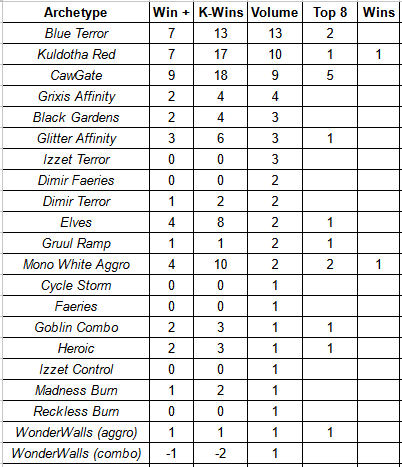
There are a few things you can take away from this past weekend’s Magic Online Pauper Challenges. The first might be Beicodegeia’s absurd four challenge win streak that wrapped up on Saturday. Another could be the continued strength of the blue and red strategies or the ascension of CawGate and Mono White Aggro on Sunday. However I feel what a lot of the discourse will center around will be this finalist list from Sunday:

The sideboard here is dedicated entirely to beating the red and blue decks that have been seeing play in the Challenges and judging from Gn42’s placement the gamble seemed to pay off, at least on Sunday. The question this brings to my mind is whether or not this is correct. So let’s dive in.
If you pay attention to the conversation around Pauper you no doubt see metagame numbers for every deck in the Challenges, not just the Top 32. These numbers can look alarming with Blue Terror and Kuldotha Red making up somewhere between 20% and 40% of a metagame on a given day. However this does not take into the account the overall size of these events which are relatively small when looking at a large tournament; when a single pilot can account for nearly 2% of the entire field these numbers can be misleading. Now to be clear, if people are running these strategies in large numbers it makes sense to come prepared with answers in their sidebaord and in the strategic choices made during deck construction. At the same time there is a bit of an Information Cascade taking place.
Shocker – Alex is referring to this article again.
Right now if you are paying attention to Pauper discussion a significant amount of it centers on dissatisfaction. The strength of red decks has been pushed in the past two years which in turn has shifted the focus of the format from control elements to assertive strategies. Applying pressure is now the Level Zero strategy as opposed to Pauper before Modern Horizons II where trying to find answers and drawing out the game was the baseline; take it from someone who tried to figure out how to attack through Stonehorn Dignitary lock for years. Red decks are not only fantastic at applying pressure but the old game plan of running them out of cards no longer applies thanks to the advent of Reckless Impulse and Wrenn’s Resolve. This leads some people to believe they need to max out of the blue suite of Blasts. In a similar vein, the current crop of blue decks gets on the board quickly and one of the best ways to answer their large threats is via the red pair of Blasts. These cards are not the only way but they are effective enough that if you get the right matchups a 15 card sideboard made of of these will do enough.
What does it mean to reframe the format through the lens of aggression? Let’s look at the decklist again. CawGates is a deck where a core conceit of the engine is to leverage lands that enter the battlefield tapped to turn Basilisk Gate into a card that can end the game in conjunction with any creature. The deck runs 11 lands that enter the battlefield tapped, another four that do not produce discrete colors of mana and one that filters mana. CawGate is very strong deck but by nature it has to play from behind and therefore has to make concessions to the beatdown decks (as in Who’s the Beatdown?) in Pauper. In this case it is about running several one mana answers to the most popular decks in the format in the sideboard to improve those matchups.
Pauper is a format where the mana is the best it has ever been but is still lacking in some ways. There are no lands consistently that produce multiple colors of mana that also enter play untapped. In order to fully leverage a multicolor deck it involves playing some number of tapped lands and making other considerations in deck construction. This, more than the presence of any one or two decks, is more important to the long term health of Pauper as a format. If a core element of midrange and control mana bases is rendered useless then perhaps there is a problem. At the same time several decks that make use of these slow two color lands continue to see success and not all of them need to take such drastic measures as the list presented above. While that alone is not enough to indicate a “healthy metagame” it is part of a larger picture.
How can midrange decks reposition themselves for an assertive metagame? I do not think they can entirely give up on dual lands as that will only lead to mana problems in the middle and later stages of the game. Reevaluating different one mana removal spells is a step as is taking a hard look at mana bases in order to facilitate casting spells on a defensive curve. The new basic landcyclers from Tales from Middle-earth can do a lot of work in this department. And I know it’s a meme at this point but it may also be about playing more cards in the vein of Thraben Inspector that can absorb damage and provide a benefit later. Thraben Inspector is not a strategy unto itself but it is emblematic of a style of card that has seen print several times recently – a one drop with upside. These cards will not win the game on their own and may only eat one attack or one removal spell, but they can provide the time necessary to bridge from the developing stages of the game to one where answers can come online.
The shift towards a format centered on assertiveness has a cost, especially as it relates to a change in what matters. The temporal cost of plays is now a very real consideration and taking time off develop can be costly. The increased strength gained from dipping into multiple colors has not vanished but it might mean waiting until the third or fourth turn to have that option as opposed to playing a Gate or Gain Land on the first or second turns of the game. Plays that come later in the game also have to do a better job of shutting the door so as to prevent decks with reload capabilities from, well, reloading.
Interaction also must adapt. While cheap spells remain best more and more games of Pauper play out on the board. Building a deck where the goal is to take the first few turns off to sculpt a hand and sit back on traditional control elements or hope for your turn four flourish to take over comes with inherent risk. The question that should be posed in deck construction is whether or not you’re willing to take that on, not bemoan those who take advantage of the cards available.
Pauper continues to evolve and adapt, albeit at a different pace than other non-rotating formats. If these trends worsen and the number of viable decks dwindles then perhaps more action needs to be taken at a structural level. For now, how are you adapting to the new realities of the Pauper metgame?
I want to take a moment to thank all my Patrons – both old and new. I am going to do my level best to keep providing you with the kind of content that brought you here in the first place. If you are interested in supporting my work, rewards for my Patreon start at just $1 and every little bit helps.
Can’t make a commitment to Patreon? I now have a Ko-Fi where you can make a one time contribution.
Looking for another way to support my work? Click here for my TCGPlayer affiliate link. Any purchases through the link let the folks there know you like my content!
 NerdtotheCore
One thought on “September 30 – October 1 Pauper Weekend Recap”