June 7-9 Pauper Weekend Recap

Want to learn more about the metrics I use in tracking the metagame? You can find an explainer here.

Outlaws of Thunder Junction season is drawing to a close. The final four weeks of the cycle took place without All That Glitters hanging over the format’s collective head. Last week we looked at three weeks worth of events but today we’re going to focus on the final weekend with it’s three Challenges and one Showcase Qualifier. A final review will be coming in the not too distant future but for now I want to explore this weekend in isolation.

Why explore four tournaments, separate from the rest of the season, especially with a high impact set coming down the pike? Pauper, traditionally, has evolved slowly. Even when strong cards are added the first implementations of the new options often come in existing shells. On top of that while Modern Horizons sets have caused shifts in the landscape they have done so in ways that were built upon Pauper’s history: Arcum’s Astrolabe fit neatly into existing Tron and Kor Skyfisher shells before taking on a life of its own; the Bridges slotted in alongside the Mirrodin Artifact Lands; Chatterstorm and Galvanic Relay looked to previous Storm shells. The cards in Modern Horizons 3 are powerful and could spawn entirely new archetypes. At the same time there’s a very good chance that in Week 1 we are going to see Refurbished Familiar brought back with Blood Fountain or blinked with Ephemerate in decks that are otherwise known.

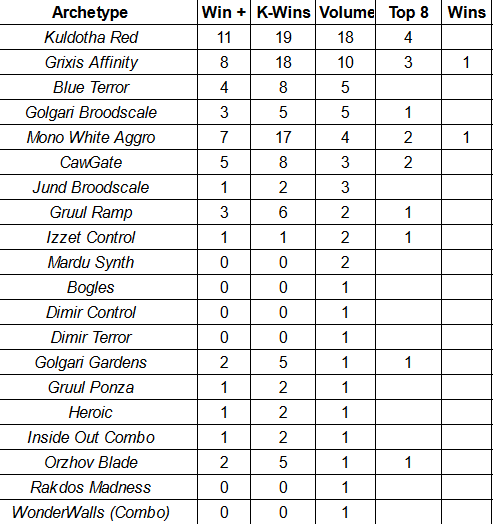
The weekend of June 7-9 saw three Challenges as well as a massive (for Pauper) 203 player Showcase Qualifier. All told there were 383 entrants that played at least one round in these tournaments. Kuldotha Red was the most popular deck on the weekend with 63 total appearances, accounting for 16.45% of the entire field. CawGate took silver in the popularity contest with 47 total appearances, good for 12.27% of the total metagame. Grixis Affinity also ended up on the podium with 29 total appearances (7.57%), barely beating out Gruul Cascade (28 appearances/7.31%) and Rakdos Madness (27/7.05%).

Moving into next week the top three decks should be on everyone’s radar. Kuldotha Red continues to set the pace for Pauper and while the latest release does not provide any clear additions, the fact remains that red isn’t getting worse. Getting on board early with a bevy of small creatures, only to turn them sideways later after kicking Goblin Bushwhacker, all while backed up with Galvanic Blast, remains a great way to win games. It’s possible Sarpadian Simulacrum supplants Voldaren Epicure as an artifact that turns on Kuldotha Rebirth while also being the correct creature type for Goblin Grenade, giving the deck a small boost in the synergy camp.

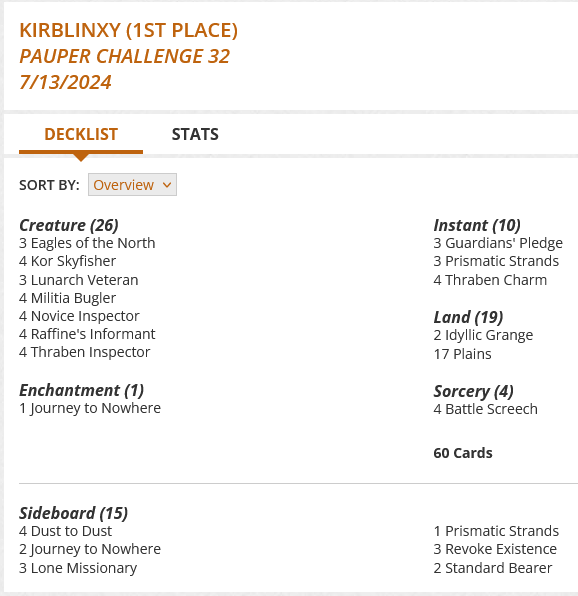
When it comes to the Top 32 metagame, Kuldotha Red moves into second place with 12.5% of the total Top 32 meta, 13.04% of the winner’s meta, and an Adjusted Meta Score Above Replacement of 1.16. Kuldotha Red performed admirably and took a reasonable dip in presence with the cut to the Top 32. The winner, however, was CawGate. In the same number of Top 32 appearances it ended up with 14.2% of the winner’s metagame and an aMSAR of 1.52.

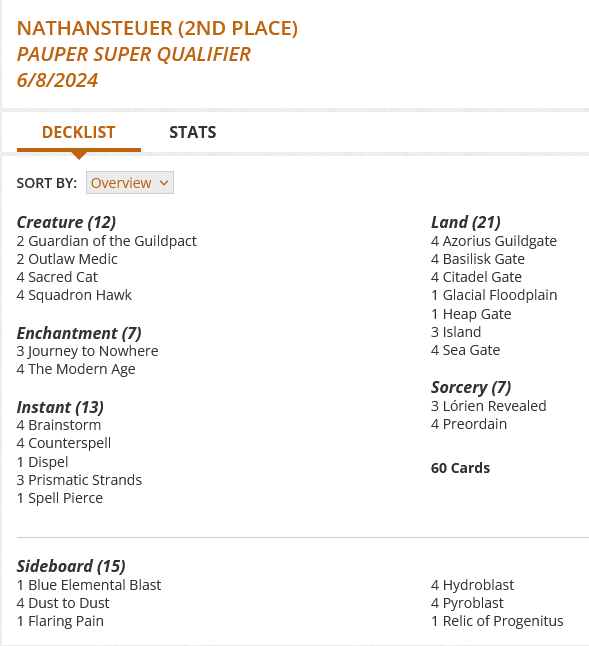
4 Azorius Guildgate
4 Basilisk Gate
4 Brainstorm
4 Citadel Gate
4 Counterspell
1 Dispel
1 Glacial Floodplain
2 Guardian of the Guildpact
1 Heap Gate
3 Island
3 Journey to Nowhere
3 Lórien Revealed
2 Outlaw Medic
4 Preordain
3 Prismatic Strands
4 Sacred Cat
4 Sea Gate
1 Spell Pierce
4 Squadron Hawk
4 The Modern Age

Sideboard
1 Blue Elemental Blast
4 Dust to Dust
1 Flaring Pain
4 Hydroblast
4 Pyroblast
1 Relic of Progenitus

CawGate is a midrange control deck that leverages the interaction between Brainstorm and Squadron Hawk (not to mention Lórien Revealed) to increase the overall quality of the cards in its hand. Its light permission suite is designed to ensure you can end the game with an evasive creature enhanced by Basilisk Gate. It is the quintessential blue midrange deck in Pauper, plodding along as a reasonable choice, often positioning itself thanks to a flexible mana base and sideboard. Basilisk Gate is a resilient threat that just requires a creature to get the ball rolling. CawGate does not have any clear gains from the latest set, but a card like Perilous Landscape could find a home if new builds desire a more reliable splash or want another shuffle effect while not missing out on mana development.

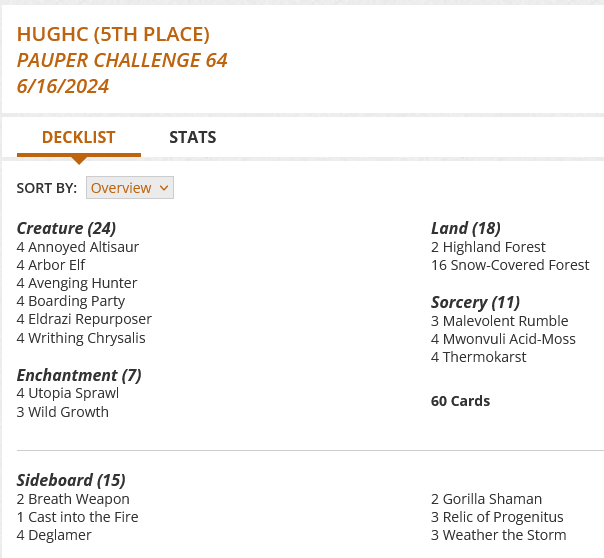
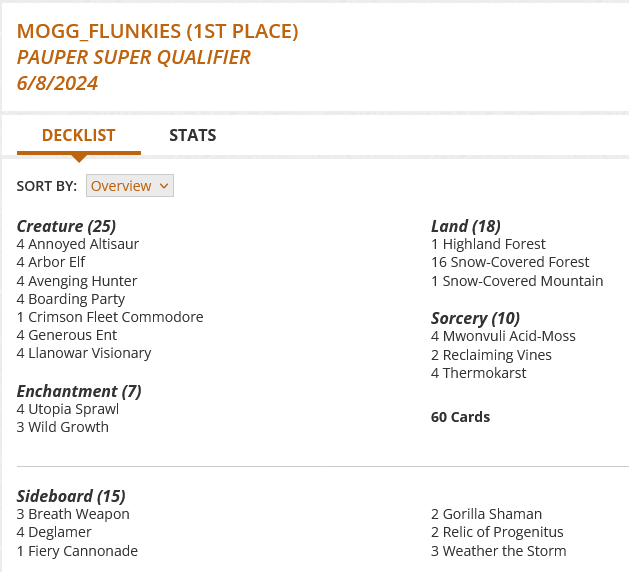
4 Annoyed Altisaur
4 Arbor Elf
4 Avenging Hunter
4 Boarding Party
1 Crimson Fleet Commodore
4 Generous Ent
1 Highland Forest
4 Llanowar Visionary
4 Mwonvuli Acid-Moss
2 Reclaiming Vines
16 Snow-Covered Forest
1 Snow-Covered Mountain
4 Thermokarst
4 Utopia Sprawl
3 Wild Growth

Sideboard
3 Breath Weapon
4 Deglamer
1 Fiery Cannonade
2 Gorilla Shaman
2 Relic of Progenitus
3 Weather the Storm

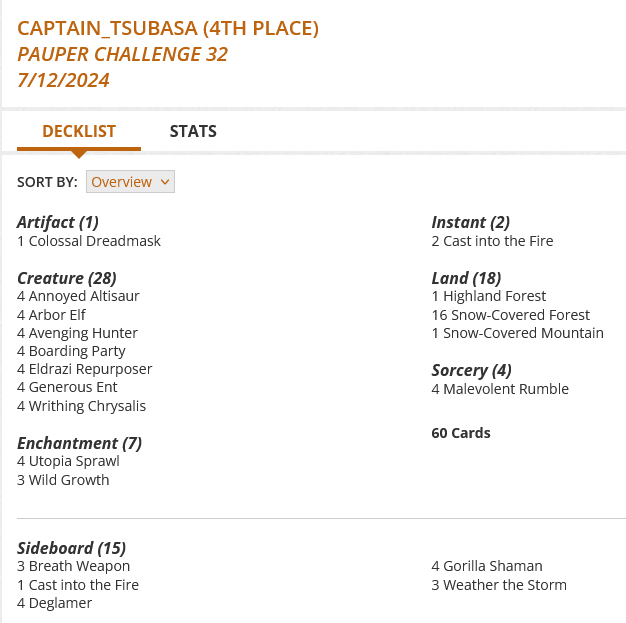
Although it did not have the best numbers on the weekend, Gruul Cascade (or something similar) is likely to flood the queues in the early going. 7.31% of the overall metagame is nothing to sneeze at, it dipped to 6.25% of the Top 32 metagame, dropping further to 4.1% of the Winner’s Metagame, ending up with a -0.17 aMSAR. So why am I bullish on this strategy? First, it won the Super Qualifier which always provides a small boost in popularity. Second, green ramp strategies are getting a gift in Colossal Dreadmask. A six drop that ca turn any old Arbor Elf into a real threat is attractive. Couple this with Horrific Assault, which might be a reason to return to Ulamog’s Crusher, and you get a strategy poised to run over the competition in the early going.

Going into next weekend, if I wasn’t keen on bringing something new, I’d be bringing Ethereal Armor to the party. Both Bogles and Heroic have been on the upswing recently (even if they are still mired in the scrum around the Top 32). These decks are getting a few new options thanks to new creatures with Bestow, as well as a focus on cards caring about Modified creatures and some neat combat tricks. On top of all this these decks are very good at applying pressure and you have a mix that is ripe for these strategies to have a strong showing.

I want to take a moment to thank all my Patrons I am going to do my level best to keep providing you with the kind of content that brought you here in the first place. If you are interested in supporting my work, rewards for my Patreon start at just $1.

Can’t make a commitment to Patreon? I have a Ko-Fi where you can make a one time contribution.

Looking for another way to support my work? Click here for my TCGPlayer affiliate link. Any purchases through the link let the folks there know you like my content!
Outlaws of Thunder Junction Check In

Pauper in a Post-All That Glitters World

Want to learn more about the metrics I use in tracking the metagame? You can find an explainer here.

It feels like I haven’t checked in on the format in a while. As it so happens the past few weeks have been incredibly busy for me, with a previously scheduled medical procedure (I’m fine!), childcare responsibilities (I’m exhausted!) and the reveal of Modern Horizons 3 (I need to finish my set review!). Because of this temporal reality we now have ten Challenge level events in the post-All That Glitters metagame, so what better time to do a check in? As per usual we are going to be looking at the total Challenge metagame, the Top 32 Metagame, and the Winner’s Metagame.

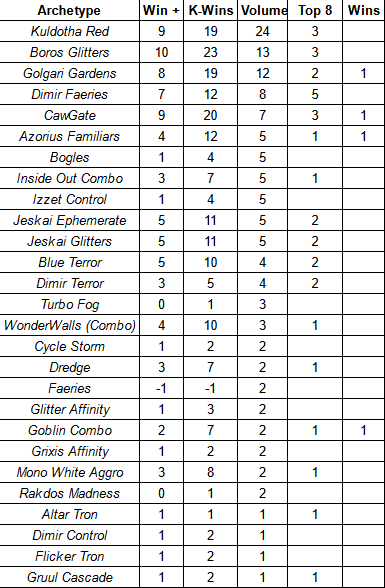
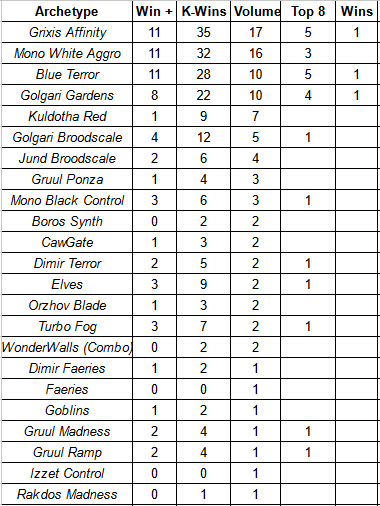
This chart takes into account all 656 decks that played at least one round in one of the events over the past three weeks. The cut off for making the chart is 2%, with 14 total appearances netting 2.13% of the total meta. There were 35 different archetypes that did not meet this threshold.

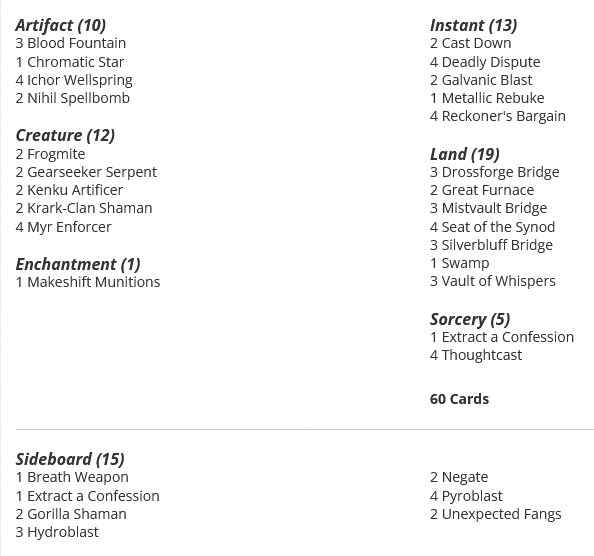
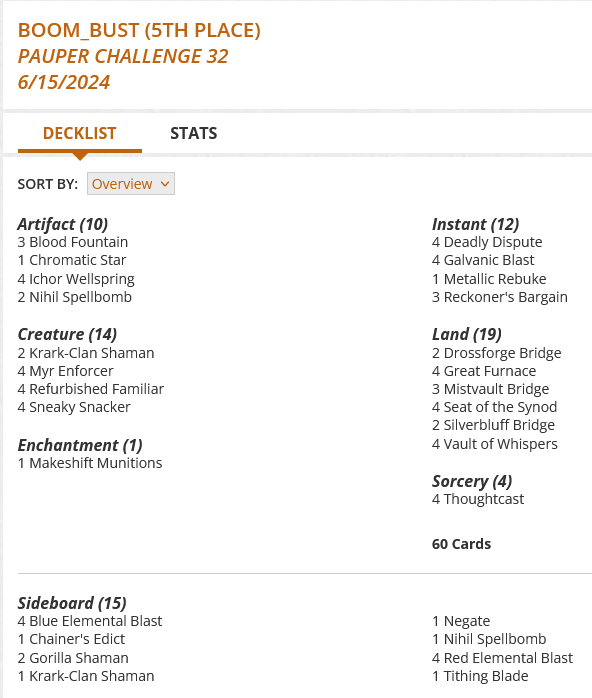
3 Blood Fountain
2 Cast Down
1 Chromatic Star
4 Deadly Dispute
3 Drossforge Bridge
1 Extract a Confession
2 Frogmite
2 Galvanic Blast
2 Gearseeker Serpent
2 Great Furnace
4 Ichor Wellspring
2 Kenku Artificer
2 Krark-Clan Shaman
1 Makeshift Munitions
1 Metallic Rebuke
3 Mistvault Bridge
4 Myr Enforcer
2 Nihil Spellbomb
4 Reckoner's Bargain
4 Seat of the Synod
3 Silverbluff Bridge
1 Swamp
4 Thoughtcast
3 Vault of Whispers

Sideboard
1 Breath Weapon
1 Extract a Confession
2 Gorilla Shaman
3 Hydroblast
2 Negate
4 Pyroblast
2 Unexpected Fangs

If you have been following Pauper over the past few months it should not be surprising that Grixis Affinity and Kuldotha Red are the two most popular decks in the format at the moment. Red was a powerful strategy before the recent ban and while it was possible that the lack of another aggressive strategy could mean an increase in hate for red, it hasn’t put a damper on how many people are eager to sleeve up Mountain and Great Furnace. This is not misplaced belief as Red largely holds up as you look at the meta from other angles, with 12.81% of the Top 32 Metagame and 11.77% of the Winner’s Metagame. Kuldotha Red is currently tied for 4th/5th in Adjusted Meta Score Above Replacement with a score of 0.57.

Grixis Affinity is a powerful control deck that leverages the Affinity and Metalcraft mechanics for undercosted threats, interaction, and card draw. Prior to the introduction of All That Glitters it was a top tier archetype that took a step back once people began to apply pressure early and often with copies of Gingerbrute wearing fancy pants. Without the threat of imminent doom it became reasonable for Affinity to grind out the game with Blood Fountain again, perhaps benefiting from the drop in artifact specific hate in the wake of the format update. While Grixis had a fantastic weekend May24-26 it came back to early last weekend, which could indicate that people are putting respect on the Grixis name. Like Red, Grixis largely held true to its 12.2% Challenge Metagame with 12.81% of the Top 32 Meta, ticking up to 13.36% of the Winner’s Metagame. Through these three weeks Grixis is leading the pack with an aMSAR of 1.06.

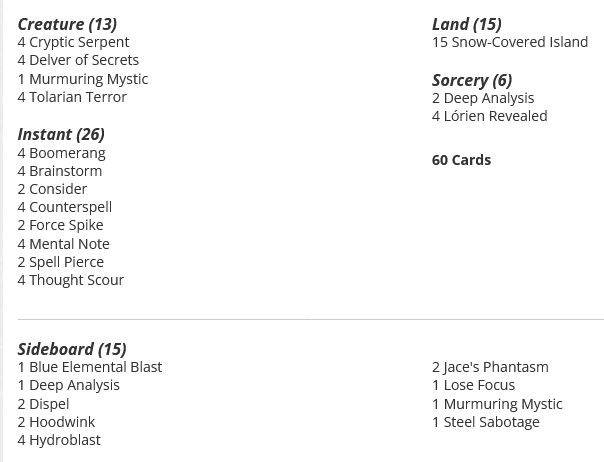
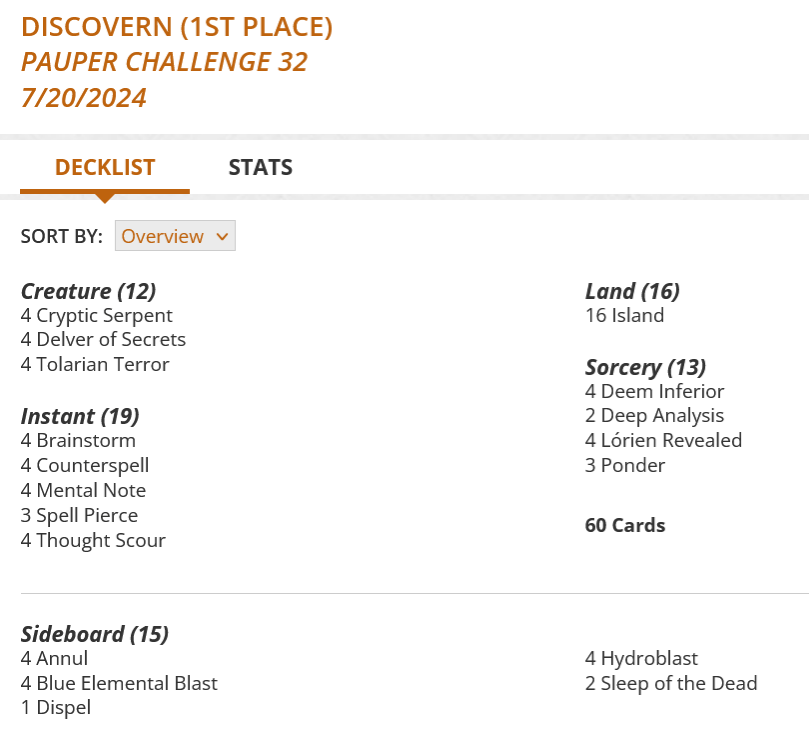
Not every strategy held true between the overall field and the cutoff to the Top 32. Golgari Gardens, for example, saw a decent increase from 5.79% of the larger sample to 8.56% of the Top 32 Metagame. These gains were not reflected in the Winner’s Metagame, dropping back to 5.25% of that sample with an aMSAR of 0.10 (ninth best through this point). Blue Terror, on the other hand, held steady from Total Metagame (4.57%) to Top 32 metgame (5%) but, thanks to a fantastic weekend May 31-June, jumped to 8.17% of the Winner’s Metgame. Also on the back of the last weekend of results (five Top 8 finishes with a win), it holds the second best aMSAR with 1.01.

4 Boomerang
4 Brainstorm
2 Consider
4 Counterspell
4 Cryptic Serpent
2 Deep Analysis
4 Delver of Secrets
2 Force Spike
4 Lórien Revealed
4 Mental Note
1 Murmuring Mystic
15 Snow-Covered Island
2 Spell Pierce
4 Thought Scour
4 Tolarian Terror

Sideboard
1 Blue Elemental Blast
1 Deep Analysis
2 Dispel
2 Hoodwink
4 Hydroblast
2 Jace's Phantasm
1 Lose Focus
1 Murmuring Mystic
1 Steel Sabotage

Blue Terror was not the only deck with five Top 9s and win last weekend. CawGate achieved the same results. A more popular deck with 9.76% of the Challenge Meta, the strategy jumps up to 11.56% of the Top 32 Metagame before coming back to the pack just a bit with 10.66% of the Winner’s Metgame. It falls just behind Kuldotha Red (and Jeskai Ephemerate) with an aMSAR of 0.56.

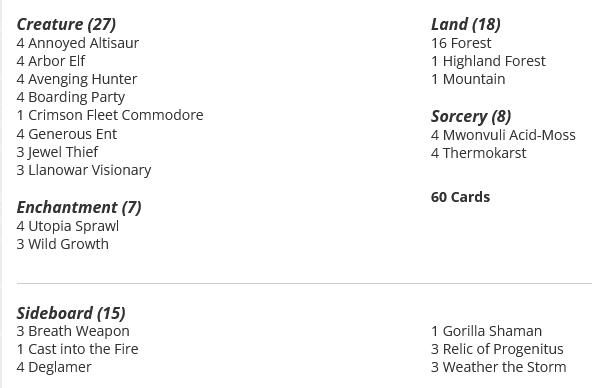
There’s one more deck I want to call out and that is Gruul Cascade. This deck, built around accelerating out copies of Mwonvuli Acid-Moss and Annoyed Altisaur, was hardly a blip during the All That Glitters era. The strategy went from 2.61% of the pre-ban Thunder Junction meta to 5.79% over the past three weeks. This jumps to 6.88% of the Top 32 Metagame (up from 1.17% before the ban) and another step up to 7.26% of the Winner’s Metagame (a massive leap from 0.84%). Arbor Elf might not be the best thing you can be doing in Pauper these days but it is a much more reasonable option these days.

4 Annoyed Altisaur
4 Arbor Elf
4 Avenging Hunter
4 Boarding Party
1 Crimson Fleet Commodore
16 Forest
4 Generous Ent
1 Highland Forest
3 Jewel Thief
3 Llanowar Visionary
1 Mountain
4 Mwonvuli Acid-Moss
4 Thermokarst
4 Utopia Sprawl
3 Wild Growth

Sideboard
3 Breath Weapon
1 Cast into the Fire
4 Deglamer
1 Gorilla Shaman
3 Relic of Progenitus
3 Weather the Storm

What does this mean moving forward and towards Modern Horizons 3? The metagame, overall, is far less stratified than it was previously. As a result being able to correctly predict the subtle shifts in top tiers will work to your advantage. For example, players adjusted for Affinity after the weekend of May 24-26 in deck choice and sideboard options and the deck took a massive step back. If this trend holds true then next week should see people attempt to beat back Blue Terror and CawGate, which means an emphasis on Tithing Blade and similar spells, which in turn can create a window for Dimir Faeries or Kuldotha Red to have a strong performance.

Power Rankings
  • 10: Dimir Faeries
  • 9: Izzet Control
  • 8: Golgari Gardens
  • 7: Gruul Cascade
  • 6: Jeskai Ephemerate
  • 5: CawGate
  • 4: Goblin Combo
  • 3: Blue Terror
  • 2: Kuldotha Red
  • 1: Grixis Affinity

I want to take a moment to thank all my Patrons I am going to do my level best to keep providing you with the kind of content that brought you here in the first place. If you are interested in supporting my work, rewards for my Patreon start at just $1.

Can’t make a commitment to Patreon? I have a Ko-Fi where you can make a one time contribution.

Looking for another way to support my work? Click here for my TCGPlayer affiliate link. Any purchases through the link let the folks there know you like my content!

May 17-19 Pauper Weekend Recap

Want to learn more about the metrics I use in tracking the metagame? You can find an explainer here.

We’re back!

Did anything happen?

Jokes aside, Pauper is entering an interstitial moment. All That Glitters is gone and Modern Horizons 3 is not yet here. The format exists in a metagame that is, for all intents and purposes, entirely temporary. While we can examine the data from this past weekend’s three Challenges to anticipate what Friday (and Saturday and Sunday) may bring. Attempting to prognosticate past June 14th is a waste of brain cells as the next direct to Modern release is all but guaranteed to shake things up (if history is any indication).

Here we have the overall Challenge metagame. Across the three events there were 163 entrants who played at least one round and aside from the absence of Glitter Affinity the metagame looks remarkably familiar. Kuldotha Red was the most popular archetype but hardly a dominant force by way of presence; Golgari Gardens managed to adjust quickly enough to maintain its position in the metagame.

There are a few things that stand out to me about this chart. First is the return of Gruul Cascade. This deck has been all but absent in the All That Glitters metagame which makes sense. A key play pattern of this deck is taking the opponent off of resources but when a top deck can operate on effectively no lands then this style of strategy can fall flat. The other element that really caught my eye was the relative meager showing of Grixis Affinity. The go-to Affinity deck before Commander Masters dropped off in a dramatic fashion once the aggressive builds came to bear, but it seems that for the time being people are shying away from such dedicated builds.

The Top 32 metagame has its own story to tell. Golgari Gardens had a strong performance once it reached the Top 8 but the strategy was more likely to end up outside the Top 16. Kuldotha Red fared better but not as well (albeit in limited sample size) as Dimir Faeries and Goblin Combo. And now we come to the rub about next week.

Given the relatively small sample size from last weekend, as well as the recent changes to the format, it is hard to pull too much information from the most recent trio of Challenges. The metagame in many ways looks entirely similar to the one we saw prior to the ban with the absence of Glitters pushing aggressive strategies down the ladder. Instead we are seeing a proliferation of combo and midrange decks. What can be extrapolated from this?

Next week I would want to be on a control deck. Counterspell and its ilk look incredibly well positioned at the moment, but housing it in a more reactive shell appears to be better. Outside of Kuldotha Red nothing is trying to kill you quickly. Trying to be a hair larger than midrange with an increased emphasis on interacting seems like a good place to be, especially if your opponents are trying to rely on that one key spell to ether things done.

I want to take a moment to thank all my Patrons I am going to do my level best to keep providing you with the kind of content that brought you here in the first place. If you are interested in supporting my work, rewards for my Patreon start at just $1.

Can’t make a commitment to Patreon? I have a Ko-Fi where you can make a one time contribution.

Looking for another way to support my work? Click here for my TCGPlayer affiliate link. Any purchases through the link let the folks there know you like my content!
May 3-5 Pauper Weekend Recap

Want to learn more about the metrics I use in tracking the metagame? You can find an explainer here.

Today’s post would not have been possible a few months ago. It is only recently that Daybreak games has decided to provide the decklists for every Challenge participant, which provides a more robust image of what actually is going on in Pauper. At the same time while more information is a good thing, the data still needs to be put into context. Let’s take this past weekend’s Challenge meta breakdown.

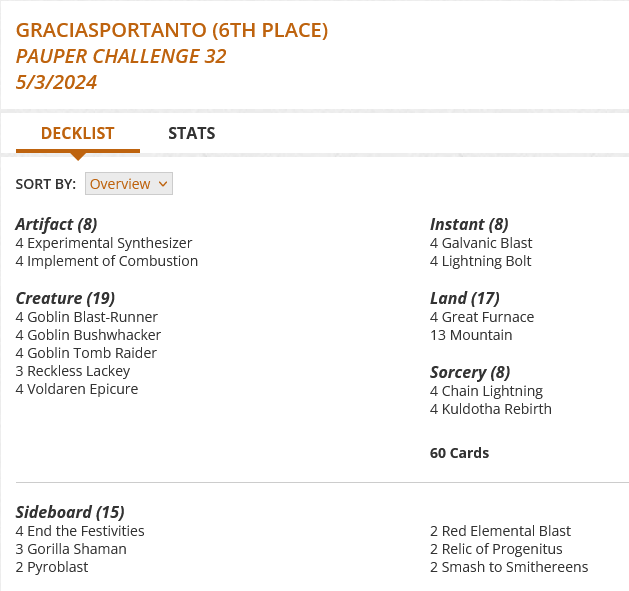
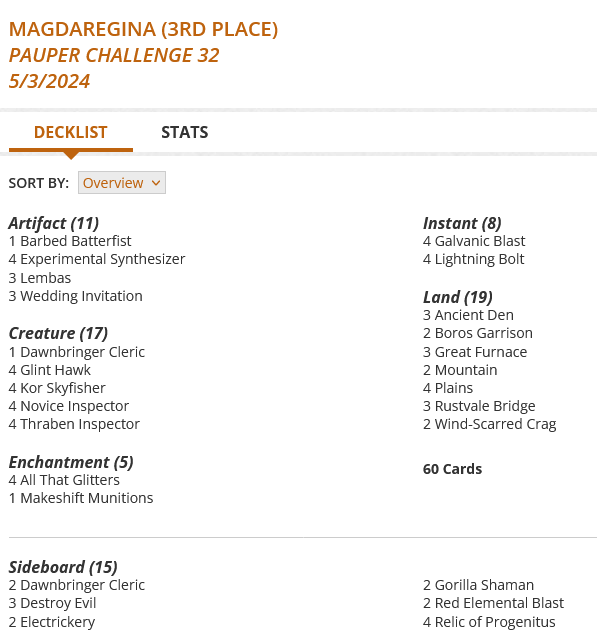
At first glance this does not look like a healthy metagame. Over 20% of the entire weekend Challenge metagame (49 decks out of 231 entrants) were Kuldotha Red. Coming off of a year dominated by Monastery Swiftspear and friends this is a disconcerting sight. Even if the Monk is banned the deck is still a force to be reckoned with as it can go under many other strategies while also putting a ton of damage on the board between Kuldotha Rebirth and Goblin Bushwhacker. Kuldotha Red also benefits from the positioning of Electrickery and Breath Weapon against All That Glitters. This is not trying to take anything away from the strength of Red but again, context matters.

4 Chain Lightning
4 Experimental Synthesizer
4 Galvanic Blast
4 Goblin Blast-Runner
4 Goblin Bushwhacker
4 Goblin Tomb Raider
4 Great Furnace
4 Implement of Combustion
4 Kuldotha Rebirth
4 Lightning Bolt
13 Mountain
3 Reckless Lackey
4 Voldaren Epicure

Sideboard
4 End the Festivities
3 Gorilla Shaman
2 Pyroblast
2 Red Elemental Blast
2 Relic of Progenitus
2 Smash to Smithereens

What happens when you look at the Top 32 metagame? Kuldotha Red takes a step backwards to 18.75% of that population. Going deeper and examining the Winner’s Metagame, Kuldotha Red tanks to 12.76%. While the deck is flooding the field it is not performing well relative to its performance. While it’s conversion rate from overall Challenge to Top 32 is reasonable, once it gets past that threshold the deck is largely pedestrian. Kuldotha Red’s weekend Adjusted Meta Score Above Replacement came in at 0.09, placing its performance as a hair above average.

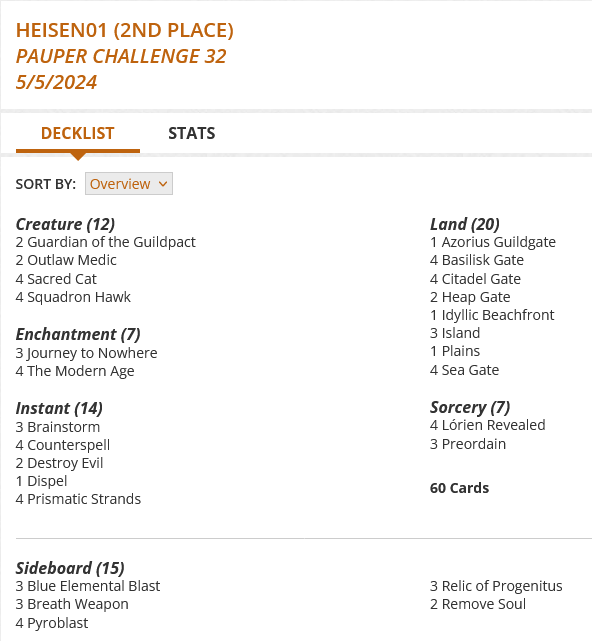
Using Adjusted Meta Score Above Replacement as our barometer, the best performing deck on the weekend was CawGate with a healthy 1.20 aMSAR score. CawGate only took down 4.76% of the overall metagame and improved upon this to 5.47% of the Top 32 metagame. Looking at the Winner’s Meta we see a decent jump to a share of 8.5%. The addition of Outlaw Medic provides a decent blocker and way to pad your life total. In a world so focused on aggression the ability to not only block but also to crunch in for massive lifelink swings thanks to Basilisk Gate counts for quite a bit.

1 Azorius Guildgate
4 Basilisk Gate
3 Brainstorm
4 Citadel Gate
4 Counterspell
2 Destroy Evil
1 Dispel
2 Guardian of the Guildpact
2 Heap Gate
1 Idyllic Beachfront
3 Island
3 Journey to Nowhere
4 Lórien Revealed
2 Outlaw Medic
1 Plains
3 Preordain
4 Prismatic Strands
4 Sacred Cat
4 Sea Gate
4 Squadron Hawk
4 The Modern Age

Sideboard
3 Blue Elemental Blast
3 Breath Weapon
4 Pyroblast
3 Relic of Progenitus
2 Remove Soul

So does that mean CawGate had the best overall weekend? That is not so clear. Boros Glitters can make a case. Looking at the three metagame shares it starts with 6.93% of the total meta before improving to 9.38% of the Top 32 meta and finishing off with 10.93% of the Winner’s Meta. A weekend silver medal with an aMSAR of 0.79 places this beatdown deck firmly in the “above average” camp, which should come as no surprise if you’ve played Pauper over the past few months. Boros Glitters is the premier All That Glitters deck at the moment and can effectively win from nowhere by maneuvering a game to a point where a top-decked Aura will end things on one swing.

4 All That Glitters
3 Ancient Den
1 Barbed Batterfist
2 Boros Garrison
1 Dawnbringer Cleric
4 Experimental Synthesizer
4 Galvanic Blast
4 Glint Hawk
3 Great Furnace
4 Kor Skyfisher
3 Lembas
4 Lightning Bolt
1 Makeshift Munitions
2 Mountain
4 Novice Inspector
4 Plains
3 Rustvale Bridge
4 Thraben Inspector
3 Wedding Invitation
2 Wind-Scarred Crag

Sideboard
2 Dawnbringer Cleric
3 Destroy Evil
2 Electrickery
2 Gorilla Shaman
2 Red Elemental Blast
4 Relic of Progenitus

There are plenty of other interesting tidbits from last weekend. Dimir Faeries led the way with five total Top 8 appearances but largely performed to expectations across the three metas (total, Top 32, Winner’s). Dimir Faeries’ 0.12 aMSAR places it as above a replacement level entry but lagging behind other strategies. Out of the four archetypes that won a Challenge only CawGate can lay claim to having the best weekend but Golgari Gardens is not far behind, improving over three percentage points from total meta with Winner’s Meta and ending up with an aMSAR of 0.46.

So where does that leave things going into next weekend? At a surface level you need to be prepared for aggression from both the “go-wide” of Kuldotha Red and the “go-tall” of All That Glitters, but you cannot rely entirely on Fog effects thanks to the copious amount of burn and the resilience of Basilisk Gate to push through damage. The best solution for this puzzle might be playing a more reactive deck that has ways to answer Guardian of the Guildpact. Being able to remove offending threats is important and sitting back with removal can work until you meet a creature that just refuses to die.

I want to take a moment to thank all my Patrons I am going to do my level best to keep providing you with the kind of content that brought you here in the first place. If you are interested in supporting my work, rewards for my Patreon start at just $1.

Can’t make a commitment to Patreon? I have a Ko-Fi where you can make a one time contribution.

Looking for another way to support my work? Click here for my TCGPlayer affiliate link. Any purchases through the link let the folks there know you like my content!
April 26-28 Pauper Weekend Recap

Want to learn more about the metrics I use in tracking the metagame? You can find an explainer here.

Today’s update is going to be a little different than usual as we’re going to start at the ending. Here’s what you need to know about Pauper: Kuldotha Red had a fantastic weekend on raw numbers, taking down over21% of the Challenge Metagame while also hauling in 24.12% of the Winner’s Metgame. It had the best Adjusted Meta Score Above Replacement at 0.97, just a shade above Azorius Familiars with a score of 0.96. Azorius Familiars improved on its 4.76% overall meta share to 10.67% of the Winner’s Metagame.

What does this mean for next week? I like the position of a Orzhov Blade deck that can leverage life gain and graveyard hate. That being said this strategy has struggled mightily over the past few weeks so I wouldn’t take this deck into battle unless I was sure I had a strong build that could meet the format where it is currently.

The other day I posed a question about a single card that defines Pauper. As expected All That Glitters was the most popular answer and it is almost certainly correct. However I believe you can make a case that Galvanic Blast might be the single most important card in the format currently. Despite the popularity of various Glitters decks over the past several months, Kuldotha Red has not gone anywhere. Similarly even before it adopted the Aura, Boros Synthesizer was a reasonable choice and Grixis Affinity has stuck around in part due to Blast’s strength.

What does Galvanic Blast do to the format? First and foremost it shrinks games. When the baseline burn spell available can take out 20% of a life total as opposed to 15% the result is that there may fewer turns if you are under pressure. Being able to attack early with small creatures and end the game in a flurry of fire is a tried and true method to winning games and as we have seen with Kuldotha Red it persists even in a high power format like Pauper. All That Glitters and Galvanic Blast can reduce an opponent to zero life in double time. The overall result is an increased pressure on the format.

But that’s not all since Galvanic Blast can also hit creatures. As a result if you are playing a deck that wants to keep threats on the board in the middle and later stages of the game they either need to have five toughness or be somewhat immune to Galvanic Blast. A look at decks like Black Gardens, CawGate, and Dimir Terror all showcase a creature suite that is in some way resilient to the removal spell. Alternatively you can try to go wide so that a single Blast is not as effective or play a deck that does not need creatures as all.

I want to be very clear with this: what follows is an observation and does not reflect the opinion of the Pauper Format Panel nor its members. Rather this reflects my own thoughts and feelings as they stand today, May 1, 2024.

Pauper currently is a format where there are a ton of very powerful enablers and a series of differently managed outputs. Some of these enablers, such as Tron, have settled into a good space. The artifact synergy package is one that is constantly at the line, if not over it. Over the years, as sets return to artifact based themes for draft archetypes, artifact synergies get better. On top of that the proliferation of artifact tokens as material has made it easier to just turn these mechanics “on”. While we do see this with other attributes of the game it is not at the frequency of artifacts. On top of that the new cards are far more balanced overall, which means previous outliers get to push the boundary and reap the rewards.

Will other suites get their day in the sun? Surely. Over those same years we have gotten tons of graveyard matters archetypes and “spells matter” over and over again. Every combat trick in white or green is an invitation to revisit Heroic or Stompy. Pauper is a non-rotating format and as such has to look forward as much as it looks back when new card enter the ecosystem.

I want to take a moment to thank all my Patrons I am going to do my level best to keep providing you with the kind of content that brought you here in the first place. If you are interested in supporting my work, rewards for my Patreon start at just $1.

Can’t make a commitment to Patreon? I have a Ko-Fi where you can make a one time contribution.

Looking for another way to support my work? Click here for my TCGPlayer affiliate link. Any purchases through the link let the folks there know you like my content!
April 19-21 Pauper Weekend Recap

Want to learn more about the metrics I use in tracking the metagame? You can find an explainer here.

It’s finally here! Outlaws of Thunder Junction has hit Magic Online and with it we had our first look at the latest iteration of Pauper. And what a look we had – not only were there the four regular Challenges on the weekend but Saturday also gave us an eight round Showcase Qualifier. In the span of 72 hours there were five major Pauper events and with it we got a solid look at the metagame. Did my most recent Power Rankings hold up? We’ll have to see.

First, a few pieces of bookkeeping. This season I’ve made some updates to the way I classify certain archetypes. Boros Synth has now been split into Boros Glitters and Boros Synth, which is dependent on the presence of All That Glitters. Black Gardens is now Golgari Gardens while Madness Burn gets the more appropriate Rakdos Madness moniker. Finally, Orzhov Blade gets its own delineation from other black-white builds.

Okay, let’s get to the data. First up we have the overall Challenge Metagame.

Once again we see Pauper swinging back towards being more aggressive in the early going. Between the Showcase and the Sunday “Bonus” Challenge, Kuldotha Red was all over the place and ended up being the most popular archetype on the weekend. Some pilots decided to incorporate Reckless Lackey into their builds while others ignored the new card. A few players opted to add Goblin Grenade for additional closing speed. Kuldotha Red also ended up as the most popular deck in the Top 32 metagame and had the largest share of the Winner’s Metagame and did all of this while having the second best overall performance over the span of the five tournaments.

Kuldotha Red never really went anywhere but it also is far more vulnerable that it was before Monastery Swiftspear got the axe. Losing that additional dimension means the strategy has to lean harder on early aggression and try to get under the opponent’s defenses. Once the game hits the middle and late stages, however, other decks’ answers start to come online. One thing that happens time and time again is that as a new set his the scene aggressive decks succeed early before the rest of the format adjusts to the new pace of threats.

We see this trend continue with the strength of Boros Glitters. The second most popular deck across all the tournaments (and, spoilers, holding that position in the Top 32 metagame and Winner’s Metagame). The current “scourge” of the format has the ability to grind with Clues and other artifacts while also going over the top with All That Glitters. While popular the format seems to have adjusted somewhat to its presence – Boros Glitters ended the weekend with an Adjusted Meta Score Above Replacement of 0.21 – the seventh best score on the weekend. From the performance of Kuldotha Red and Boros Glitters, as well as the provided lists, we can infer that decks were better situated to handle one large threat rather than several small creatures.

The chart above represents the Top 32 metagame and here we can see the strength of being on the beatdown plan in Pauper, at least early in Thunder Junction season. The two prominent Galvanic Blast decks were just under 26% of the total metagame but the same two decks were over 31% of the Top 32 metagame. The next five most popular decks (Golgari Gardens, Jeskai Ephemerate, CawGate, Dimir Faeries and Dimir Terror) were 28.7% of the entire metagame. In the Top 32 these five decks account for 23.7% of that field, but the Dimir duo lag behind Azorius Familiars, Bogles, Goblin Combo, and Turbo Fog in Top 32 presence.

Again we see the power of beatdown decks early in the metagame as other decks adjust to the new pacing of things. But if we look at the breakdown of the decks listed (those over 2% of the format over the weekend) we see a metagame that on the surface appears balanced between assertive decks and more controlling ones. The starkness of the numbers comes down to the fact that were are far fewer ways to succeed in attacking in Pauper than there are in slowing the game down. If you want to be anywhere on the spectrum from midrange to control you have several potential incentives. If you want to reduce your opponent’s life total as quickly as possible you have comparatively few choices which helps to exacerbate the presence of popular beatdown strategies.

This chart represents the Winner’s Metagame and here we see the first major shakeup – the rise of Goblin Combo. If you’ve been following my writing for the past few weeks you may have seen more digital ink spilled on this archetype than many others and that is because the strategy is coming back into its own. Goblin Combo had the best weekend as measured by Adjusted Meta Score Above Replacement, ending the five event marathon with a score of 1.26; the next best score was 0.89 out of Kuldotha Red, which shows just how far ahead of the field Goblin Combo was on the weekend. Being able to largely ignore the interaction of the day – the kind focused on attacking creatures and burn spells – is a reasonable path to victory.

1 Bojuka Bog
1 Candy Trail
2 Chromatic Star
1 Dark-Dweller Oracle
4 Deadly Dispute
1 Drossforge Bridge
1 Duress
3 Fanatical Offering
4 First Day of Class
4 Goblin Matron
2 Great Furnace
4 Ichor Wellspring
2 Impulsive Pilferer
1 Makeshift Munitions
2 Mesmeric Fiend
4 Mountain
4 Putrid Goblin
2 Rakdos Carnarium
4 Skirk Prospector
4 Swamp
3 Tramway Station
4 Unearth
2 Vault of Whispers

Sideboard
2 Abrade
1 Cast Down
2 Cast into the Fire
2 Duress
2 Introduction to Prophecy
1 Krark-Clan Shaman
1 Masked Vandal
4 Red Elemental Blast

Goblin Combo can generate an unbound amount of mana due to the interaction of Skirk Prospector with First Day of Class and Putrid Goblin. The -1/-1 counter from Persist is negated by the +1/+1 counter from First Day of Class which creates an unbound loop. Once a Dark-Dweller Oracle is found the deck can then dig to Makeshift Munitions and win the game. The deck can struggle in metagames where graveyard hate is abundant but I am not sure if that trend will be coming next week. In the interim planning to ignore your opponent remains a good choice.

4 Accumulated Knowledge
4 Arcane Denial
2 Behold the Multiverse
1 Bojuka Bog
1 Deep Analysis
2 Desert
3 Fog
2 Forest
1 Generous Ent
4 Growth Spiral
6 Island
4 Lórien Revealed
4 Moment's Peace
4 Preordain
1 Quandrix Campus
4 Simic Growth Chamber
2 Stream of Thought
2 Tangle
1 Tangled Islet
2 Thornwood Falls
4 Weather the Storm
2 Words of Wisdom

Sideboard
1 Azure Fleet Admiral
1 Bojuka Bog
1 Deep Analysis
1 Desert
4 Dispel
2 Faerie Macabre
1 Keep Watch
2 Murmuring Mystic
2 Wilt

Turbo Fog is another deck that can just render an opponent’s game plan moot. The deck had a very respectable 0.43 aMSAR which is good for fourth best on the weekend. I feel out of all established Pauper decks this one might get the most out of Outlaws of Thunder Junction with the advent of Dance of the Tumbleweeds. A card that can fetch actual factual Desert while putting a ton of power and toughness on to the battlefield could be worth an inclusion, especially if people are going to keep attacking with tiny creatures.

I want to take a moment to thank all my Patrons I am going to do my level best to keep providing you with the kind of content that brought you here in the first place. If you are interested in supporting my work, rewards for my Patreon start at just $1.

Can’t make a commitment to Patreon? I have a Ko-Fi where you can make a one time contribution.

Looking for another way to support my work? Click here for my TCGPlayer affiliate link. Any purchases through the link let the folks there know you like my content!
April 12-14 Pauper Weekend Recap

Want to learn more about the metrics I use in tracking the metagame? You can find an explainer here.

We made it! Ten weeks of Murders at Karlov Manor Challenges on Magic Online are in the books and we are ready to turn the page to Outlaws of Thunder Junction. While the latest cards are sure to have an impact the chances of them completely upsetting the apple cart are slim. With my season Power Rankings coming out later this week today, as always, is going to be a look at the immediate future based on the most recent past.

Once again this chart represents the entire Challenge Metagame for the four events over the last weekend. It should not come as a surprise that Boros Synth is remains the most popular deck – it is a strong option that has the ability to get games over in a hurry. What is interesting is that this is the second week in a row where Kuldotha Red took the silver medal in that category. Also of note is that Black Gardens overtook Dimir Faeries in overall popularity, at least for one weekend.

If there is an overarching story this season it is one of finding the correct suite of threats. Kuldotha Red started the cycle strong before giving away to the Azorius build of Glitter Affinity. After a short stretch of that deck at the top of the heap Boros Synth overtook it. At various points over the course of the ten weeks we also saw Black Gardens, CawGate, Dimir Control and Dimir Faeries lay claim to “best deck” for a weekend. What can we extrapolate from these points of information in order to better inform our plans for the first weeks of Thunder Junction?

I think the best place to start is to put your foot on the gas. Despite the prevalence of controlling strategies that include black removal, assertive strategies have had an overall better season than reactive ones. Specifically all three of the “aggro” decks that have found success are ones that have enough reach to conceivably “win from nowhere”. Whether it is a goblin that gives you a power boost or an aura that acts as a force multiplier, these decks can not only soften up an opposing life total but then take it out in one fell swoop once the time is right. If you are trying to beat down next weekend keep this in mind – do you have that extra gear? If not you may want to reconsider your deck choice.

If you want to meet the aggression head on then your best bet is to be running black removal. Red’s removal is fine but it lacks black’s ability to simply kill on sight. Whether it is a forced sacrifice or a targeted effect, black is just better at making sure the creature goes to the graveyard. Black also has the advantage of being able to scale its board wipes thanks to cards like Crypt Rats, which means it can save a higher leverage removal spell for more robust threats. The Rats also clears the board so Tithing Blade and the like can go to work helps to keep black in the driver’s seat when it comes to handling threats.

It is this interplay of black removal, headlined by Snuff Out, and All That Glitters that currently defines the format. Black uses its life total as a resource but that includes Snuff Out and Crypt Rats. If black can stabilize, either through card draw or simply removing all threats then it can reasonable survive until it can turn the corner. On the other hand if black missteps then All That Glitters can come down and end the game in short order.

So what does threading that needle look like? If I had the answer I’d be winning a lot more of my matches. Last week saw a small bump in Orzhov Midrange and Turbo Fog, which have slightly different approaches for dealing with the format. The successful builds of Orzhov leaned on removal for sure, but also provided enough bodies to throw in the way of attackers. Turbo Fog is not a deck for everyone but it does the job of simply attempting to ignore combat altogether.

Then there’s CawGate. The deck continues to chug along, posting solid results. It also has the right mix of threats to get get around black’s removal while also having access to cards that can stall Glitter strategies. Prismatic Strands is a heck of a card but Standard Bearer can also put in work. The issue with CawGate is speed as it is deck that needs to take the first few turns at half speed, using tap lands and cards such as The Modern Age to set up a midgame power house. This provides aggressive decks a chance to get under and provides the black decks the opportunities to find removal.

It is possible, therefore, to look at Arbor Elf and Utopia Sprawl decks as a way to jump the curve. Gruul Cascade also saw a small uptick in strength over the weekend and while fragile these builds can be explosive. I think if you can solve the consistency issue then these builds, with their ability to accelerate to an endgame, could be a reasonable week one choice in the world of Thunder Junction.

I want to take a moment to thank all my Patrons I am going to do my level best to keep providing you with the kind of content that brought you here in the first place. If you are interested in supporting my work, rewards for my Patreon start at just $1.

Can’t make a commitment to Patreon? I have a Ko-Fi where you can make a one time contribution.

Looking for another way to support my work? Click here for my TCGPlayer affiliate link. Any purchases through the link let the folks there know you like my content!
April 5-7 Pauper Weekend Recap

Want to learn more about the metrics I use in tracking the metagame? You can find an explainer here.

Is a dynamic metagame – one where the best choices change from week to week – inherently healthy? Can a format be at its peak if things are static? This is one of the many questions being posed by Pauper at the moment. The impetus for this discourse is All That Glitters.

Let’s take a step backwards in time to before Monastery Swiftspear was banned. For the majority of the Swiftspear era in Pauper – that is the format between the Initiative Ban in September 2022 and the Swiftspear ban in December 2023 – red decks were a dominant force. While they may not have been the top performer every weekend they were by and large the consensus best deck. They not only defined the metagame but warped it around their presence.

I think now would be a good time to try and draw a line between defining a format and warping a metagame. These are not two discrete concepts but rather, in my estimation, exist on a spectrum. Flametongue Kavu defined its era of Standard by limiting the kind of creatures that could reasonably see play. Outside of curve based aggressive strategies, creatures had to have an immediate impact or have more than four toughness. You can see this pattern repeated in formats where Lightning Bolt is legal. Removal is not a perfect example as in larger card pools there are going to be a wide enough variety of spells that every creature will carry some liability. Various components come together to help define a metagame and format which help to provide a landscape, but the key here is that all of them help to establish parameters – it is not any one card or strategy that acts as a black hole, pulling everything towards its center.

Compare this to warping a format. In these situations the sheer force exerted by a strategy or card force it to the locus. At these times the offender is so powerful that the options are to either play it or play a deck that allegedly can smush it into the dirt. The Swiftspear era of Pauper was one where the confluence of cards that went into red made it such that you either ran Mountains or a build that was heavily skewed towards beating it. There have been times in Pauper’s past where the deck that was doing the warping was so powerful that ignoring it was a viable option, but you were doing so at your own peril.

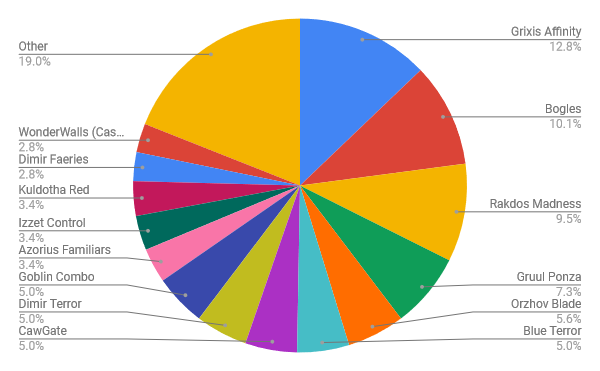
So what does this all have to do with today? At the height of its power Kuldotha Red was the best deck week in and week out and it clearly defined the format and was warping things around its presence. Today, Glitter decks are one of the best decks in Pauper but have not consistently been at the top of the Weekend Challenge meta. There has been significant movement from one week to the next as to the top performer even if these decisions are made with All That Glitters in mind.

Above is the overall Challenge metagame summary from last weekend, including the newly added Friday Challenge. Here we see a shift from last weekend with Boros Synth (which for this season consists of decks that both include and eschew All That Glitters) taking over the top spot in popularity. The archetype also leads the way in Winner’s Metagame share with 16.07% and tops Adjusted Meta Score Above Replacement for the week with a score of 1.55. This comes after a three week sequence where the top decks for each weekend were Black Gardens, Dimir Faeries, and Dimir Control, all after an impressive run by Azorius Glitter Affinity.

Here is an example of a dynamic metagame. There are core strategies that exist and different focal points (some with more gravity than others) that all work to construct the cycle of the format. Now, more than during the Swiftspear era, making the correct deck choice from week to week matters, and having the correct suite of threats and answers can have a positive impact. We can see this play out in the fringe decks that rise up, having correctly anticipated the shifts in the meta and threading the needle. In this way Pauper is healthy.

Yet at the same time one element of the metagame seems to hold more weight, at least in the discourse around the format. All That Glitters exerts a unique pressure on Pauper in that it is a threat that must be respected at all times. Once you believe the opponent is on the Aura every game action needs to be taken with this knowledge and thus the preservation of your life total. To me this is not a situation where All That Glitters it the black hole that sucks everything towards it but it certainly has more mass than other celestial bodies.

So is Pauper healthy? It depends on your definition. If you care about the variety of viable archetypes and a metagame that rewards correctly anticipating the shifting tides, then Pauper is in the best place it has been since before Modern Horizons 2 hit the scene. If your view of a healthy format includes metagame cores that are all relatively equal in strength then this iteration of Pauper leaves something to be desired. Having a threat define the format is not bad per se but when it becomes so important that other decks are pulled into its orbit, then maybe something is amiss.

Is that where Pauper is currently? Well, that depends on who you ask. But for now I wouldn’t leave home without cheap removal and interaction for a resolved copy of All That Glitters.

I want to take a moment to thank all my Patrons I am going to do my level best to keep providing you with the kind of content that brought you here in the first place. If you are interested in supporting my work, rewards for my Patreon start at just $1.

Can’t make a commitment to Patreon? I have a Ko-Fi where you can make a one time contribution.

Looking for another way to support my work? Click here for my TCGPlayer affiliate link. Any purchases through the link let the folks there know you like my content!
The Second Four Weeks of Karlov Manor Season

Want to learn more about the metrics I use in tracking the metagame? You can find an explainer here.

The first four weeks of Murders at Karlov Manor season showed Pauper the strength of All That Glitters. After months of living under Monastery Swiftspear, the running sneaker was lifted from the format’s throat and things largely settled. Things were dynamic, at least in the early goings, until the weekend of March 2-3 where Glitter Affinity broke on to the scene in a big way. The strategy took 10 of the 24 possible Top 8 slots in the three Challenges while also going on to win the Qualifier event. All told 11 of the 32 Top 8 slots available went to Glitter Affinity.

Understandably this caused a ruckus. The format had just started to recover from the dominant stretch of red and All That Glitters represented a threatening damage engine. While it was slower and more fragile than Monastery Swiftspear, it had a form of haste and could turn any creature into a game ending attacker. This coupled with the cheap interaction available to the deck painted a target on its back. It was not long after that first weekend of March that the calls for a ban began to ring throughout the Pauper-sphere.

That is where these next four weeks begin – with Glitter Affinity at the height of its power. The above chart displays the total Challenge metagame – that is every deck entered into a Magic Online Challenge – over the weekends starting March 9-10 and ending March 30-31. Glitter Affinity – that is the Azorius build – made up 13.2% of the overall metagame. Boros Synth includes builds that also run All That Glitters, but at most that’s a bit more than half of those builds over the span. Sprinkle in 0.75% of the field running Jeskai Glitters and you end up with a most popular macro-strategy that clocks in at right around 16% of the total field for a month long span.

Behind Glitter Affinity there are a variety of decks including black based midrange in Black Gardens, a flash-control deck in Dimir Faeries, low to the ground aggro in Kuldotha Red, and blue-white “tap-out” control in CawGate. The last month saw solid competitive variety in the Challenge metagame but the specter of Glitter Affinity loomed large. Being forced to play around the aura represented a new play pattern, one that was largely resilient to what Pauper had been presenting.

Think about Rancor. Rancor represented significant damage output over time thanks to its ability to come back from the graveyard. During its heyday there were absolutely better targets for Rancor, including Skarrgan Pit-Skulk and Silhana Ledgewalker, but slapping it on a Nettle Sentinel or a Nest Invader could get the job done. All That Glitters trades the long game for more immediate pressure and while Ornithopter and Gingerbrute might be the best ones to wear the shiny mantle, Thraben Inspector and Novice Inspector will do in a pinch. Unlike Stompy, Glitter decks can draw to their damage engine with ease and deploy several in a single turn. It is the combination of aura-as-threat and the low barrier to getting it into play that upset the established lanes of the format.

We start to see a different picture when we look exclusively at the make up of the Top 32 finishers. Glitter Affinity still is the most popular, but takes a small step back. Dimir Faeries leapfrogs Black Gardens while Kuldotha Red remains consistent. CawGate also ticks up a bit but stands pat in the fifth position.

There are a few ways to look at this. The first (and perhaps most obvious) is that Dimir Faeries has been an incredibly popular deck over the past two weeks. However part of the reason it may be popular is because it presents a counterweight to Glitter decks. Dimir has access to removal and countermagic in enough volume to answer the biggest threats out of Glitter Affinity. Dimir Faeries can sit back and play a Flash game with Spellstutter Sprite before going on the offense, all while hitting land drops and setting up haymakers in the form of Murmuring Mystic or Thorn of the Black Rose. Dimir Faeries is set up to prevent Glitter from the line described above of casting multiple auras in a single turn.

Is this enough? That’s hard to say. If a deck can help keep Glitter in check, then what about the other options? That Dimir Faeries is able to do this does not mean All That Glitters is healthy to have in the format (not does it prove the opposite, to be clear). Can other decks succeed against Glitters is the real key. Given what we laid out above it is plausible. At the same time, is it acceptable if part of the counterplay involves a mechanic largely limited to a single color in countermagic?

There are other options available. Cards like Dispeller’s Capsule, Cathar Commando, or Seal of Primordium can come down and prevent an All That Glitters from sticking. There are other Disenchant style effects as well that could stifle Glitter decks. This is to say nothing of simply cutting the creature out from underneath the aura. These angles are about keeping Glitters in mind during deck construction and the games themselves. And the format has started to see the results of people doing just that, if the Winner’s Metagame is any indication.

The Winner’s Metagame looks at the Top 32 for each Challenge. It takes into account the Swiss performance and the total of all wins less all losses for an archetype. These are weighted based upon share of the Top 32. All together this provides an impression of what to expect at the top of the metagame. Here we can see that over the past month Dimir Faeries has had the largest share of the Winner’s Meta. Glitter Affinity also loses a bit more than a percentage point from its overall presence, which could indicate that people are adjusting their game plans to better fight the machine menace.

Comparing to the first four weeks (which had some confounding data due to a corrupted set of week one Challenges) we can see a fairly stark difference. Glitter Affinity ended the first month of Karlov Manor season with 15.92% of the Winner’s Metagame while Dimir Faeries lagged behind at 5.53%. Faeries is nothing if not malleable and by making small adjustments (as well as other shifts in the metagame), the strategy has been able to climb back to the top of the heap.

Adjusted Meta Score Above Replacement gives us another look at how well different strategies are performing in relationship to one another. During the first month Glitter Affinity was lapping the field with an aMSAR of 2.22 while the next best deck – Kuldotha Red – came in with a score of 0.61. The leader over the second four weeks is Dimir Faeries with a more reasonable score of 1.37. While Faeries has a clear lead, the next cluster is not as far behind: Glitter Affinity with 0.78, Black Gardens and CawGate both with 0.68, Boros Synth with 0.5. All of this points to a metagame that is less polarized that it appeared after that one week in early March.

Pauper is, in many ways, stable. That is not to say things are stagnant or static but rather the meta is established. The top decks are largely known and from week to week adjustments in game plan and composition are rewarded. The aMSAR leader for each week of the last month cycled between four strategies – Glitter Affinity, Black Gardens, Dimir Faeries, and Dimir Control.

None of this, however, takes away from the pressure All That Glitters exerts on the format. It is the preeminent threat and, as discussed earlier, can create situations that force the opponent in a reactive state from the get go. This has continued the trend that began with Modern Horizons 2. From Chatterstorm and pre-ban Affinity to Relay Storm to Kuldotha Red, for nearly three years Pauper has been a format more defined by offense than defense. As things begin to settle we return to the old adage made famous (perhaps apocryphally) by David Price: there are no wrong threats, only wrong answers. Whereas in the past a deck could get by simply by having an overwhelming endgame and a decent mix of removal spells, Pauper now demands adjusting to whatever the big bad of the week might be. Whether it’s an Aura or Gurmag Angler or a horde hasty goblin tokens, it is incumbent to make the right choices for what you expect to meet across the table. In other words, a failure to prepare is preparing to fail.

I want to take a moment to thank all my Patrons I am going to do my level best to keep providing you with the kind of content that brought you here in the first place. If you are interested in supporting my work, rewards for my Patreon start at just $1.

Can’t make a commitment to Patreon? I now have a Ko-Fi where you can make a one time contribution.

Looking for another way to support my work? Click here for my TCGPlayer affiliate link. Any purchases through the link let the folks there know you like my content!
March 23-24 Pauper Weekend Recap

Want to learn more about the metrics I use in tracking the metagame? You can find an explainer here.

If Glitter Affinity lost a step last week, it decided to take a nap on the side of the road as the world passed it by this past weekend. The trend that began three weeks ago continued as the most recent format terror came crashing back down to earth. For context, the weekend of March 2-3 saw Glitter affinity with 34.67% of the Challenge Winner’s Metagame (this exclude’s that weekend’s Qualifier) with an adjusted Meta Score Above Replacement of 1.55. Fast forward to March 9-10 and Glitter Affinity had 27.03% of the winner’s metagame with an aMSAR of 1.06. March 16-17 saw that number tumble further to 13.87% of the winner’s meta and an aMSAR score of 0.55. Last weekend, the deck cratered to 4.55% of the winner’s meta with an aMSAR of -0.12. The strategy went from setting the pace of the field to performing worse than an average Top 32 deck.

Let’s start at the top with Kuldotha Red. This powerhouse had fallen on hard times as Glitter took the top spot in the metagame, but as Affinity has fallen, Red has risen. Part of this is due to a small shift in sideboarding that has brought both Gorilla Shaman and Smash to Smithereens back into focus. These cards fight Glitter Affinity on different axes and also represent two different philosophies when it comes to attacking the meta.

Smash to Smithereens is not the most efficient artifact destruction spell. It lacks the versatility of Cast into the Fire or the cost of Smelt. What it does do, however, is work perfectly with Kuldotha Red’s overall strategy. Even if it targets an indestructible land the damage still gets through so in a less than ideal scenario the card still does work. More than that it does exactly what the deck wants to be doing. Compare this to a card like Dust to Dust which rarely has synergy with a game plan. Instead of taking a turn off to potentially have an impact, Smash to Smithereens will always do something. While Kuldotha Red is not in the market for a below-rate Lava Spike having access to one that will occasionally knock an Ornithopter out of the sky does not hurt.

Gorilla Shaman is everything Dust to Dust aspires to be. While it fails at hitting creatures and the Bridges it can easily pick off the Mirrodin artifact lands while also hitting those all important Clue tokens and copies of Springleaf Drum. Glitter Affinity is a mana hungry deck and in the early turns it is often creating material that it cannot protect. The Mox Monkey can come down and start chewing through artifacts which in turn makes it harder for Glitter to stick to the plan. Gorilla Shaman also demands an answer or else it keeps doing work. Compare this to Dust to Dust which works for a single turn and has no persistent impact beyond the card text.

So what decks capitalized on Glitter’s fall? Kuldotha Red was the most popular strategy in the both the Challenges and the Top 32 metagame, but was second in Winner’s Meta share with 12.49% and fell outside the top four of aMSAR scores with 0.31. The best deck on the weekend goes to Dimir Faeries with an impressive 19.65% of the winner’s metagame and a stellar aMSAR score of 2.36 (for those of you keeping score, this is better than any one weekend of Glitter Affinity over the past month). One potential reason for this surge might have to do with Extract a Confession, which helps to shore up Dimir’s weakness against singular large threats in decks that can dodge a Chainer’s Edict.

Next week should be interesting for Pauper. I do not see a world where Glitter Affinity turns on a dime and comes back strong. Nor do I see a continued surge in Kuldotha Red. Rather I think Boros Synth decks that are packing All That Glitters put their stamp on the format in a big way. These builds can see a ton of cards and if they move in on Seeker of the Way have the ability to pile on the damage in ways that make Galvanic Blast blush.

I want to take a moment to thank all my Patrons I am going to do my level best to keep providing you with the kind of content that brought you here in the first place. If you are interested in supporting my work, rewards for my Patreon start at just $1.

Can’t make a commitment to Patreon? I now have a Ko-Fi where you can make a one time contribution.

Looking for another way to support my work? Click here for my TCGPlayer affiliate link. Any purchases through the link let the folks there know you like my content!