Innistrad Midnight Hunt Pauper Review – Black

Since we already examined the value of a token with Decayed yesterday. That’s good because we have a decent number of cards to discuss.

Blood Pact (MID)

Sometimes your Black deck wants more card draw beyond Sign in Blood but you also do not want to consistently tap out when you want to leave up mana for removal. While Succumb to Temptation does exist, Blood Pact has the added utility of being able to deal two points of damage to an opponent. The end result is a card that is more likely to be Sign in Blood number five in the decks that want such an effect. If a base-Black “Flash” style deck comes into vogue I could see this card getting the call.

Crawl from the Cellar (MID)

A lot of the strength of Black in Midnight Hunt is tied to how well it can support Zombie tribal. Crawl from the Cellar is not as strong as Ghoulcaller’s Chant or Cemetery Recruitment, but the ability to get back a creature and bolster an attacker is not nothing. Just like Blood Pact is the fifth Sign in Blood, this is fighting for the spot of the fifth Ghoulcaller’s Chant.

Eaten Alive (MID)

Spark Harvest is playable in a deck with enough cannon fodder and Eaten Alive is more or less a strict upgrade. Between Pulse of Murasa and Reaping the Graves, nothing stays dead in Pauper for long. The ability to exile an offender for a single mana should not be underestimated, even if it does come with an additional cost. This is going to look bad against Spellstutter Sprite, but outside of that it is going to do work, clearing out Stormbound Geist so Chainer’s Edict can get the job done.

A one drop that can turn into a 4/4 deserves a look. The fact that you can activate it at instant speed and turn on your Mortician Beetles does count for something, especially since Aristocrats decks need mana sinks in the mid game. Taken together, Ecstatic Awkener is a lot of work for a bad Myr Enforcer that still loses in combat to Gurmag Angler.

Rotten Reunion (MID)

Three mana to nab two cards out a graveyard and give a deck two pieces of sacrifice fodder is a decent rate. But as I’ve mentioned before I am not very high on the value of Decayed Tokens. Couple that with the fact that these cards always play worse than they look and you have a card that gets outclassed by other, older options.

Siege Zombie (MID)

Zombies and other Aristocrat style decks can often struggle to punch through the final points of damage. Once the board gets gummed up or Fogs and Stonehorn Dignitary come online, the ability to attack no longer matters. Then you have a deck built on putting creatures on the board with few ways to punch through. Siege Zombie might not be the most efficient way to end the game but, just like its namesake, it will eventually get the job done.

Innistrad Midnight Hunt Pauper Review – Blue

It is not easy for new Blue cards to make waves in Pauper. This has less to do with how strong the Blue cards from a given set are and more to do with the potency in older commons. Midnight Hunt concentrates some of the strength in Blue into the Zombie theme, which in turn leans on tokens with “decayed”.

Let’s talk about decayed for a moment. Normally in Pauper, a Zombie Token is a 2/2 with no other abilities attached and as such getting one tends to come with a decent cost attached. Decayed is a new ability that means the creature cannot block and once it attacks it must be sacrificed at the end of combat. So what does this mean in the context of Pauper?

Despite the baseline toughness for defensive creatures being 3 (Augur of Bolas, Kor Skyfisher, Thorn of the Black Rose), a 2/2 tokens is still a decent body on the board. Zombie Tokens have additional utility with cards like Shepherd of Rot and Gempalm Polluter and tend to make excellent sacrifice fodder for Carrion Feeder and Village Rites. However they also do something very important – they can block. In Zombie decks they can absorb blows from opposing aggressive strategies which is vitally important when some of your best cards – Shepherd and Sign in Blood – cost you valuable life points.

So if in an ideal scenario a 2/2 Zombie Token approaches a card worth of value, how much is a Decayed Token worth? To me it’s significantly less than a card. If you’re just making a token to sacrifice it to Carrion Feeder there are better options. In dedicated Zombie decks the type will matter and there it might be closer to a card’s worth of value but even then there are better options.

With that out of the way, let’s get to some Blue cards!

Consider (MID)

Already we have a card that falls victim to Blue’s historic strength. Consider is a fantastic card but how does it match up against Ponder, Preordain, and Thought Scour? Each of them have different utility and Consider is no exception. In decks that have a lot of graveyard redundancy or want a bit more control over the top of the library (think Dimir Delver), consider could get the nod over some other cantrips. The card also might find a home in Izzet Flash decks that lean on Devious Cover-Up and Goblin Wizardry to end the game. And if Izzet Blitz ever makes a comeback this card is quite good at putting Lava Dart into the graveyard.

Falcon Abomination (MID)

I want to like this card. I want it to be good enough. But the upside on this Wind Drake just is not enough to warrant its inclusion anywhere, and I say this as someone who keeps trying to make Sidisi’s Faithful work. Maybe a Dimir style Aristocrats deck pops up once the set hits the digital shelves, but I’m not holding my breath.

Preview(opens in a new tab)

Organ Hoarder (MID)

One mana more than Sea Gate Oracle for two more points of power and the ability to get a card deeper. More than that, you are more likely to want cards in your graveyard than on the bottom of your library. There’s a lot to like about Organ Hoarder but it comes with a hefty price tag – four mana. Chances are this one is just one the wrong side of playable but I would not be shocked if it did make an appearance or two.

Shipwreck Sifters (MID)

What gives? In an average use case this is just going to be a 1/2 that loots when you enter the battlefield. There’s are few things that can be done here to make the Sifters grow. The first is something from Strixhaven in Pilgrim of the Ages, but this is perilously slow. The Eidolon cycle from Dissension also wants to be discarded and can keep returning to your hand for free, given the right condition. Finally, there are plenty of original Kamigawa Block cards that can get Spirits back into your hand, from Soulshift to loops involving Hana Kami and Soulless Revival. That being said, this one is more speculative that the others. Will it get there? Probably not, but again that’s par for the course with Blue.

Innistrad: Midnight Hunt Pauper Review – White

Innistrad: Midnight Hunt continues the trend of printing commons with Pauper potential. While it feels like a lifetime ago, Strixhaven injected a ton of interesting options into the format and Midnight Hunt looks to do the same (now that we are out from under the thumb of all those squirrels). Now that I am writing these reviews here I figured I could do things a little differently. I am not going to be discussing every common, but I can give more time to those that are a bit more fringe. Let’s start with White!

Blessed Defiance (MID)

At first glance Blessed Defiance looks like a nifty trick with potential for Heroic. It targets a creature and can give you a huge life swing and, in a pinch, can leave you with a relevant creature if things go sideways. That being said it probably does not do enough. Heroic has better options for gaining life (Seeker of the Way and Lifelink) and other ways to generate tokens to eat Edicts (Cartouche of Solidarity). In builds that are focused on Double Cleave this could see play but even then that might be a big ask.

Cathar Commando (MID)

There’s a lot to like about this Viridian Zealot knock-off. First, it can get in there for three points of damage. Second, it has a relevant creature type for Pauper in Soldier (we see you Gemplam Avenger fans). Third, it has Flash, which means Mystical Teachings can fetch this up. Did you ever expect Tron to run a Blade of the Sixth Pride, because I sure didn’t. This card is fantastic and while it will not change the format, it is almost sure to see play. The low cost and the ability to get around Negate and Dispel will come into play. And let’s not forget that this fits very nicely into everyone’s favorite Little Engine that Could in Tortured Existence.

Celestus Sanctifier (MID)

Let’s set aside whether Day/Night will be a thing outside of this card. On its own, Celestus Sanctifier is a bit behind the curve at a three mana 3/2. The ability to curate the top of your library in White is something we have not seen that much of outside of Scry and Sanctifier’s ability is better than Scry as it can bin Battle Screech or Cenn’s Enlistment. The problem with this is Day/Night, which asks you to alternate casting two spells and then no spells on your turns to reliably trigger the change in the cycle. I am not sure there is enough incentive to have this card be “on” consistently, but that fact that it exists could prove an important piece in some undiscovered deck moving forward.

Homestead Courage (MID)

Now this is a card that Heroic can use. In an average case this is going to be four +1/+1 counters for two mana, no to mention two Prowess triggers. But that’s just the start of what this card can do. We have seen more Arcbound creatures in White as of late and pairing this with Arcbound Mouser and Arcbound Worker, and maybe some of the Proliferate cards that have been printed could be good enough to make a Porcelain Legionnaire deck a true threat in the format. Pairing these cards with Green gets you Travel Preparations and Duskshell Crawler but Red might be better thanks to Galvanic Blast and Foundry Helix.

Lunarch Veteran is not quite good enough to see play in Pauper as there are two cards – Soul’s Attendant and Soul Warden – that can gain you more life. However, given that you get an extra card out of Veteran in Luminous Phantom, and one that plays nicely with the more Aristocrat-bent Soul Sisters – and you have a potent one drop. Lunarch Veteran. has the upside of allowing you to spend mana in the late game as well, something these token strategies can often need when facing down more powerful endgame decks. If I had to pick a card that was for sure going to make a 5-0 League list as a 4-of, it would be this card.

Search Party Captain (MID)

Search Party Captain is great. It is often going to be a 2/2 for 1W that draws you a card on turn three, which puts it slightly ahead of Thraben Inspector. Of course there’s also the opportunity for this to end up as an Isamaru that draws you a card on turn four, leaving you open to cast more spells and add to your board presence. In white decks that want to build out their army the Captain is a fantastic way to keep the cards flowing. At four mana it is much harder to counter with Spellstutter Sprite, especially after being picked up by Kor Skyfisher. I cannot wait to see what this card does.

So that’s White in Midnight Hunt with regards to Pauper. What do you think? Which of these is your favorite and what decks are you eager to build? Do you think I missed on a card? Let me know!

The September 8th Pauper Bans

Where do we go from here?

In case you missed it, Chatterstorm and Sojourner’s Companion have been banned in Pauper. You can read my collected thoughts on the bans in this thread but that’s not why we are here today. Instead I want to look ahead and get a jump start on what the metagame might look like for the upcoming Challenges and Showcase Qualifiers.

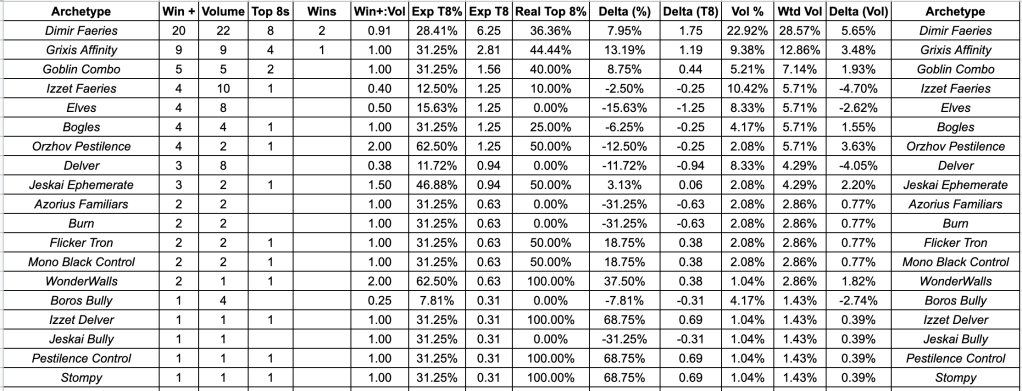
Let’s start by looking at the top performing decks from Strixhaven season. We have data for 14 challenges and this list contains every deck that made up at least 2% of the Top 32 metagame (around 9 appearances):

This is just a guide as there have been two releases (with another coming soon) since this season ended. That being said I think this is a good place to start.

Out of the gate I think Affinity is the best Day One deck. It loses Sojourner’s Companion but can easily go back to Carapace Forger or Gearseeker Serpent, or even look to Etherium Spinner as a way to generate additional artifacts for the Atog-Fling kill. If there will be one thing holding Affinity back it will be that sideboards won’t have to dedicate the same number of cards to Storm (at least not as we know it today) but even so Affinity is likely to be well positioned for the next few events.

Various Tron builds should benefit from these bans. Unless the newest iteration of Storm is as good as some folks fear, the game should slow down enough for Tron to establish its engine. Tron is a deck that can easily run Fangren Marauder if needed, which can throw a wrench into Affinity’s plans. Tron is also well positioned to run various narrow answers thanks to Mystical Teaching and as such could blunt Affinity’s assault. This is contingent on the format’s clock being slower.

Tron’s reemergence also depends on how popular Cleansing Wildfire decks will be moving forward. In the above chart there are three decks that can easily slot in the Cleansing Wildfire package, not to mention the various builds that emerged during Modern Horizons 2 and Forgotten Realms seasons. Cleansing Wildfire does not beat Tron on its own but it can prove troublesome. Depending on how popular Wildfire Midrange becomes, it could prove a stumbling block for Tron’s climb.

There are other decks, of course. WonderWalls, various Delver and Faerie builds, and different Monarch strategies could all come out of hibernation and hope to fill the vacuum left by Storm’s absence. That being said, here are some elements I believe will be important in the coming days:

  • Don’t skimp on creature removal. Affinity, Faeries, and WonderWalls all need creatures to function. While it hasn’t made a splash yet, a card like Unholy Heat could do work in Pauper. And if the Marauding Blight-Priest Storm deck is real, removal helps there as well.
  • Have a plan for Affinity – even in its weakened state it is going to be a presence and you cannot hope that other people running Dust to Dust is going to keep it down.
  • Fiery Cannonade is still a thing! While it saw play for the past several weeks its impact was lessened due to Storm’s reliable kill. Three toughness is going to be a break point moving forward.
  • Ephemerate is still a thing and is likely to be one of the better midrange options.
  • You’re going to face Monarch decks, for sure.
  • People are going to be playing Burn and Stompy, at least in the first week.

So what do you think? What decks gained the most from these bans? What do you expect to do well moving forward?

Not Very Effective: The Pidgeot-Steelix Core for Great League Remix

For the past 23 sets I have run one team in the Great League Remix. I ran my record with this team to 69-46 and only have three negative sets (0-5, 1-4, 2-3). I’m currently sitting at Ace with an ELO of 2136. The team is similar to the one I wrote about here but with one key difference – double legacy Dewgong has replaced Electrode as my safe switch. Today I want to talk about why I think the Pidgeot-Steelix is effective, what breaks it, and how to play it.

For reference, here is the team:

Lead: Pidgeot (Gust – Feather Dance/Brave Bird)

Switch: Dewgong (Ice Shard – Icy Wind/Water Pulse)

Closer: Steelix (Dragon Tail – Crunch/Earthquake)

So why this core? It starts with Pidgeot. The bird has solid coverage and despite the nerf to Feather Dance, it can still hold its own once it starts debuffing the opponent’s attack. It also has a good set of resistances in this iteration of Remix, taking reduced damage from Ghost and Ground types. Steelix gets the nod from me (over something admittedly great like Whiscash) because it can resist Poison and Fairy types – two stripes that were very common in the back for much of my climb. Steelix also takes neutral damage from Grass which has come up.

Besides their solid coverage, this team works well because of Feather Dance. Given Steelix’s bulk, launching a Feather Dance makes it easy for Steelix to go ham in the end game, taking charge moves while dealing out decent damage with Dragon Tail. It is often correct to preserve a Feather Dance on Pidgeot just to save for the end game, allowing Steelix to charge in against reduced

I have found that one key to running this core is to have another stat modifying move set on the safe switch. Icy Wind on Dewgong helps to blunt the assault while also allowing you to potentially preserve shields for your end game. Conversely, all the debuff moves provide a cushion of forgiveness if you had to burn shields early, which does come up in certain leads.

The next two skills needed for this core are tied together – energy management and undertapping. Because you use relatively slow fast moves, you need to be sure to not queue a fast move if you’re ready to throw a charge move. As a result, you have to carefully manage your energy in order to know when to throw and when to stop tapping. While it’s important with Dragon Tail it matters far more with Gust, as undertapping or overtapping is often the difference between winning and losing.

So what are the real problems for this core? There are two Pokemon that give me more fits than others: Dewgong and Unova Stunfisk. Both of these have solid play against your core duo thanks to their move set. When matched with Pidgeot, Dewgong is more offensive than Lapras thanks to a faster Ice type charge move and the debuff. Water Pulse also makes short work of Steelix unless severely debuffed.

Unova Stunfisk is an interesting opponent. In the lead it is only dangerous if they are running Thunder Shock as a fast move. While this might be the suggested move on PVPoke, I have run into far more Mud Shot Stunfisk’s. This makes sense given the abundance of Poison types running around. That being said, it does give you an opening as a debuffed Discharge will not take out a Pidgeot. Regardless, if they lead on U-Fisk, wait for a move before switching.

While not a core breaker, Obstagoon can be troublesome on the lead. It is not because it can straight up beat Pidgeot heads up but rather because of the pressure it puts on the bird. You have to commit both shields on the lead, regardless of boosts. If they get a Night Slash boost on the first try, it might be worth it to let the bird down after one Feather Dance and hope that you can deal the final few points with something else. Obstagoon is a common lead these days and while you do have game there, it is wise to be wary.

I’ve had a lot of fun with this core duo and am excited to use it for the final week of Remix. That being said if it starts to get hard countered along the way, I may have to adapt and adjust in order to make more progress on my goal of hitting Veteran and staying there.

Pauper’s Problem Periods

Today I woke up to messages about this – Pauper is in such a state that a tournament was set to fire and to fill the seats 11 people joined with decks containing only basic lands and due to a quirk of human behavior one of them won the event.

I’m not going to go over the various problems that exist in Pauper today (I’ve done that enough). Instead I want to respond to this question from SaffronOlive:

My gut reaction is that yes, this is the worst, but that is a recency bias. However I think this is one of the more egregious delays in my memory.

Cloudpost/Temporal Fissure

The utter dominance of these strategies is what led me to start tracking the Pauper metagame in the first place. Cloudpost was Tron before Tron and it was better. The mana engine took up fewer slots and thanks to Glimmerpost it could road block aggro decks simply by playing lands that helped up your mana production. Cloudpost was the best control deck of its day but it also enabled a powerful combo deck using the Cloud of Faeries/Ghostly Flicker engine. Looping Flicker through Cloud and Mnemonic Wall would generate a large Storm count and a similarly large amount of mana. You could then cast a one sided Upheaval with Temporal Fissure and then end the game with with Mulldrifter beats.

Peregrine Drake

I hated what Cloud of Faeries did to Pauper. Not only was it part of dominant combo engines – Fissure Post evolved into Familiar combo, using Cloud to generate mana – but it also created a lockdown play of Delver of Secrets into Cloud of Faeries, leave up Spellstutter Sprite. Cloud of Faeries lasted as a legal card for far too long, but when it was banned it signaled that Wizards was taking the format a bit more seriously.

And then they downshifted Peregrine Drake in Eternal Masters. To be clear, Drake was in the card file before Cloud was banned and a lot of people, myself included, felt that at five mana it would not be as oppressive. We were wrong. At the end of its five month life in the format Izzet Drake was around 75% of the competitive metagame.

Yikes.

This, to me, might be the most egregious, but we’ll get to that later.

Gush

Gush is a broken card, no ifs ands or buts. But despite how broken it was it actually fostered a diversity of Gush decks. And so while I felt that Gush was a significant problem for Pauper (and the metagame bore it out), it was not as reviled as some of these other options since it still allowed for some choice.

Choice is the animus here. Drake was egregious because it removed agency from your ability to select a deck – you had to play Drake, attempt anti-Drake (which did not work), or resolve yourself to losing your entry fee. Gush let you pick your variety of broken blue deck. Cloudpost and Temporal Fissure both came in an era where there were not as many people playing Pauper and there were tons of other choices that had some game (this might have been an illusion born of small sample size in Daily Events as opposed to Leagues, but that’s another post).

So that brings us to today. Squirrel Storm, Affinity, and Dimir Faeries are dominant to the point where they are removing the agency of choice beyond those three. However the nature of Squirrel Storm and Affinity is that the decisions you make may not matter and they simply run you over anyway.

These issues come on the heels of issues with Arcum’s Astrolabe, Fall from Favor, and persistent questions about whether or not Tron and the Monarch should be legal. Is this era any more problematic than the others? It’s definitely on par. But, just like the cycle of Standard with Throne of Eldraine, Pauper players are tired. Worse than that, they see other formats (Standard and Historic) getting attention and wonder how their (admittedly smaller) format continues to be ignored despite clear problems.

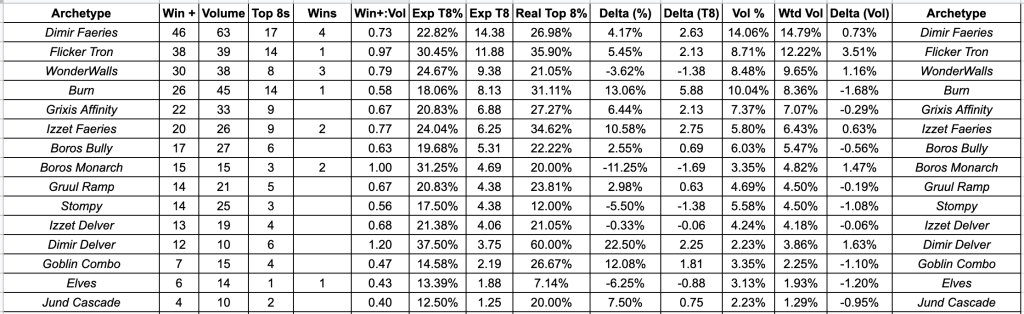
Everyone knew Chatterstorm was going to be a problem the day it was revealed. It has been legal for three months and in that time the big three have been ubiquitious:

Image

Pauper appeared to be in a good place before the release of Modern Horizons 2. After Fall from Favor was banned there was a proliferation of interesting decks that could keep pace with Monarch and Tron. We never got a chance to see that format develop.

So is this the worst stretch? No. But considering how many people are playing Pauper these days and the number of eyes on the format, it’s approaching an egregious amount of format neglect.

Not Very Effective: Remixing the Remix Cup

Season 9 is underway and with it I am renewing my goal of finishing in the Veteran Rank, above a 2500 ELO. While I started this season battling in the Great League it only took one day for me to switch to the Great League Remix.

The first team I ran through the wringer was a fairly standard line of Obstagoon – Double Poison (Nidoqueen on the switch and Shadow Golbat as the closer). As expected this team got me some wins on raw strength and a number of double Charm back lines. But starting day three I noticed a trend – there were a ton of Ice types.

For a cup that is largely defined by two Ground types – Diggersby and Nidoqueen – this makes sense. Ice attacks are effective against both of these options while maintaining utility against any Grasses that might show up and taking down Flying types as well. Considering that both Drifblim and Mandibuzz are viable, running a Dewgong or a Frosslass seems like a solid choice.

So what did I do? I thought about the backlines I had been seeing, most of which had Ice, Poison, and Fairy types. I figured that Steel types would make a good back line and looked at my options. I had a decently ranked Steelix that did not need a ton of dust to level up so I bought into that, hopeful that Crunch would do work against Ghost types. I then looked for a lead I could pair with Steelix and saw that Pidgeot provides great coverage for most of Steelix’s bad matchups (both lose to Registeel, but I haven’t seen any of those just yet). When looking at other back line options I thought about Excadril but hated how it lined up. I looked at Toxicroak and realized that I could craft a decent Flying – Double Ground line. I originally picked Toxicroak since it wasn’t weak to Counter users and figured Sludge Bomb might steal some wins.

After a few battles I came to two conclusions: I loved the Pidgeot-Steelix core and I did not like Toxicroak. And so I went back to the drawing board and reached back to the Kanto Cup. While it doesn’t look great on PVPoke, putting Electrode on the swap was exactly what the doctor ordered.

LeadPidgeot (Gust – Brave Bird/Feather Dance): Unless you hard lose you want to stay in with the bird (who definitely is the word). While Feather Dance has been nerfed it still does great work and can often let you farm up energy and chew up shields. I will often farm up past Dance and throw, hoping to nab a shield and then build up to Brave Bird, throw it, and duck out to Electrode. You swap out against every Ice type and anything where you think Electrode can do better work. The tough call is Unova Stunfisk – you have to wait a move to see if they’re running Mud Shot. If they are, it might be correct to stay in and go Dancing (considering our backline), but I haven’t tested that out yet.

Switch – Electrode (Volt Switch – Discharge/Foul Play): While you might suffer against Diggersby or Nidoqueen switches, the hope is that you can pressure enough with Foul Play to soften them up. When I switch in Electrode I do my best to time my moves to get off two charge moves while only using up one of my shields. Usually you can get both shields thanks to the damage output and then farm with either your lead or your closer. Electrode does great work against opposing Pidgeots, Drifblims, and every Ghost or Psychic you see.

Closer – Steelix (Dragon Tail – Crunch/Earthquake): What’s the play here? Just chew up damage. Steelix has solid resistances against non-Fighters and can apply decent pressure with Dragon Tail. I have found success in farming up to two Crunch and either throwing back to back or just going for Earthquake (against say, a Wigglytuff). Given the overall bulk of the team you can often save a shield or two for Steelix and if you can go into the endgame with a shield advantage it can often be game over.

I’m enjoying this team so far and will likely run it first thing tomorrow as well. That being said there’s something obvious about it that gives me pause: it has 3 and 4 turn fast moves. That downside is real as it can leave you caught throwing a charge move against a switch in or allow for opponent’s to sneak in moves. That being said the upside exists if you can play tightly. I see this team as a test of my skill and dedication – I can’t pilot this one if I’m not focused on the battle at hand.

What are you seeing in Great League Remix? What do you think of the Pidgeot-Steelix core? Sounds off and let me know!

August 28-29 Pauper Weekend in Review

Let’s cut right to the chase. The current format has been dominated by Affinity, Dimir, and Storm since Modern Horizons 2 came out. Since that set was released there have been 26 Challenges, which means 208 Top slots and 832 Top 32 finishes. Looking at just these big three – Affinity, Dimir Faeries, and Squirrel Storm, here is how things shake out:

Affinity: 10 wins (38%), 49 Top 8s (23.56%), 224 Top 32 appearances (26.9%)

Dimir Faeries: 5 wins (19%), 44 Top 8s (21.12%), 126 Top 32 appearances (15.1%)

Squirrel Storm: 7 wins (26.9%), 57 Top 8s (27.4%), 173 Top 32 appearances (20.8%)

All told these decks account for almost 85% of all Challenge wins, over 72% of all top 8s, and almost 63% of all Top 32 appearances.

This is 13 weeks of the same metagame. 13 weeks of three decks crowding everything else out of the meta. By comparison the three most popular decks from Strixhaven season (Dimir Faeries, Flicker Tron, Burn) accounted for just under 33% of all Top 32 appearances. These decks also had the most Top 8s and accounted for just over 40% of all Top 8s in that season.

Pauper deserves better than this stale format. It boggles my mind that right now Stompy, a perennial contender, has made exactly zero Top 32 appearances in Forgotten Realms season. Rancor has only two Top 32 finishes.

How is any of this okay?

Not Very Effective: Missing the Mark

I did not hit my stated goal in Season 8 of GO Battle League. I wanted to not only hit Veteran (which I did), but I wanted to end the season at above 2500 ELO. After finishing my battles today I’m ending at 2248. Not only did I fall short of my target, but I also will finish lower than I did last season (Veteran, 2257).

Where did things go wrong?

In breaking down my season, I can identify three times when I tanked myself. Let’s go over them.

Great League Remix

I never got a good read on the meta for this cup. Instead of running a team from a content creator or just a good overall squad, I jumped around almost every day. This kept me from finding a rhythm and establishing a practiced cadence. The result was a Cup where I could have made gains but instead I dug myself a hole.

Ultra League Premier Cup

During this Cup I actually hit Veteran and reached a new high ELO at 2614. If there was any one point that prevented me from hitting my goal it would be that: 2614. In my mind I had hit my mark – I knew that no matter what I would end at Veteran and if I had stuck to my guns with the team that got me there (Roserade – Alolan Muk – Lapras) I might have been able to climb higher. But that wasn’t my goal. And instead I tried learning other Pokemon in anticipation of Season 9. That dropped me down below 2400, again putting me at the bottom of the hill.

The Final Week

I put too much pressure on myself for the final week of Season 8. I knew that I could still hit my goal and tried to find a fun team for the climb. Some of the teams I put together worked for fits and spurts but were easily squashed by more meta picks. I should have done a better job selecting a team knowing that there would be tons of top meta options seeing play. And while I finally found a team that did well enough against the meta, I didn’t find it until the day before the season turned over.

So where does that leave me ahead of Season 9? The same place at the start of Season 8. My goal is to hit Veteran and finish the season above 2500. When I hit Veteran I am going to take a moment to see if hitting Expert is a possibility.

Without knowing that all the moves will look like for Season 9, I am planning on using the same team I used for my final day of Season 8. Skarmory lead, Jellicent on the switch, and Gliscor as a closer.

This A-B-A line came about because I kept running into Bastiodon – Medicham cores. I wanted to have Gliscor in the back as a Flying type attacker for the various Fighting types I saw, but also one that could put a hurt on Bastiodon and Galarian Stunfisk. Gliscor fit the bill, but I knew it would be weak to Ice types. That led me to Skarmory in the lead and Jellicent – which is all around fantastic – taking the safe swap role. The teams gets most of its work from Skarmory and Jellicent, both of which are top tier for a reason. I switch out of any bad matchup immediately to try and gain an energy advantage on Jellicent. Gliscor is best when you have a shield advantage (the other two work just fine down a shield) and can apply pressure with Night Slash and Earthquake.

The team does have some glaring weaknesses. Unova Stunfisk is a nightmare that can do work against the lead and switch. In a shields down scenario, Grass types are dangerous as they can take down both Jellicent and Gliscor.

I’m under no illusions that this is a fantastic team but it is one I am comfortable with after a day of battles. It has a good amount of bulk and as long as there are not a ton of Galvantual running around it can put in some work.

So here we go. One season down and another begins. I’m excited to try and reach my goals in Season 9. I look forward to keeping you all up to date on my journey.