Midnight Hunt Season Wrap

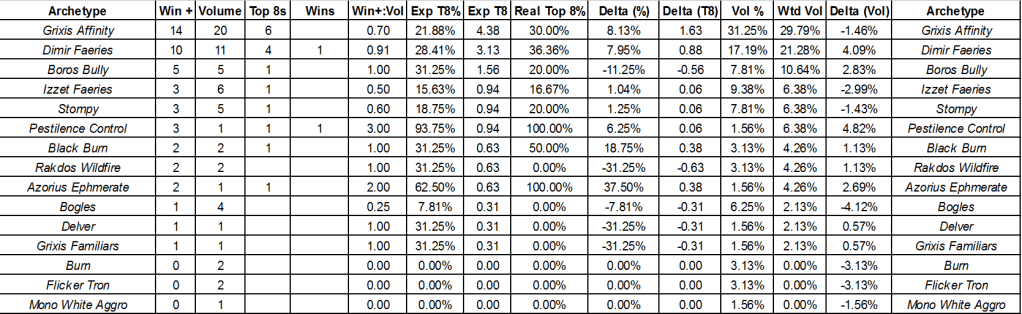
Well, Crimson Vow is right around the corner. After two months, 20 major events, and one nefarious bug, Midnight Hunt season is at an end. It was a season where the prevailing story was that of the dominance of Affinity and Dimir. Today I want to take a look at three different charts – one logging the first four weeks, one logging the second four weeks, and one looking at the entire season.

A few caveats:

  • These charts are inclusive of the Delver decks that won during the Faerie Miscreant bug; while this may skew the data some I do not believe they present a large enough sample size to upset the overall picture of the season.
  • I excluded the information from the October 9 Qualifier where only 16 decklists were published; Dimir, Affinity, and Ephemerate had a good day which tends to fall in line with the rest of the season.
  • Volume represents the number of Top 32 appearances; Weighted Volume looks at the macro archetype’s prevalence in the number of wins above 3 losses.

The First Four Weeks

The first month of the season Faeries -that is Spellstutter Sprite strategies were the dominant force. Affinity was a strong second with Ephemerate/Flicker decks and Creature based combo (Elves, First Day of Class, Wonderwalls) coming in a the top of the next tier. Here the format looked top heavy but given how new everything felt (Chatterstorm had just been banned), nothing looked woefully out of sorts. Both Affinity and Faeries were top strategies during the Chatterstorm era and this looked to be a continuation of that tale.

The Second Four Weeks
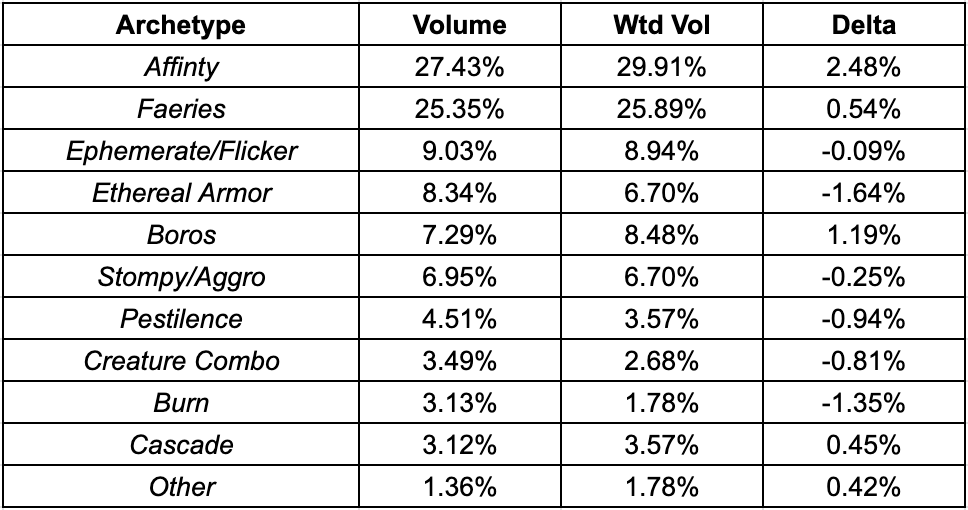
In the back half of the season Affinity asserted itself as a dominant force. While Faeries looked to lag some, it was simply folks playing other strategies besides Dimir (here we can see the influence of the Miscreant bug), but overall, Affinity and Faeries converged. Ephemerate decks improved their stock in part due to the iteration and refinement of value decks that also incorporated the Cleansing Wildfire package while Ethereal Armor decks – largely Bogles – put pressure on the format to have an answer.

In both instances, traditional aggro has been a low tier choice at best. Boros Bully came back in force in the back half thanks to some builds opting to run four copies of Dust to Dust main.

Both of these charts tell a similar story – Affinity and Faeries are significantly better than everything else going on in the format. Ephemerate engines are powerful but struggle to be as consistent as the other two metagame monsters. Creature decks have to either avoid interaction (Bogles) or focus on a combo (Elves) to win. Pure board control (Pestilence) is a metagame choice at best and can fall flat if it hits the wrong string of matchups.

Midnight Hunt Final

So here’s the metagame at the end of things. While Affinity might look scarier, with its propensity to take down half of a Top 8, Affinity only took down nearly 29% of all Top 8s included in these charts; Faeries took down just over 30% of the Top 8 slots. The fact is, these two decks are utterly dominant. They are not only highly consistent thanks to card filtering, redundancy, and card advantage, but they also do so at a rate significantly better than everything else in the metagame.

I am not going to rehash my thoughts on what needs to be done – I’ve made that abundantly clear several times. Instead, here are cards I would focus on playing in the early days of Crimson Vow season:

  • Dead Weight still kills Atog dead and is not the worst against Ninja of the Deep Hours. Gift of Fangs might be better if you’re running enough vampires.
  • Fangren Marauder is quite strong if you can get it out before Atog goes chomping.
  • Blood Fountain looks like it is going to be a house in Affinity since it provides two artifacts for a single black mana while also regrowing Atog late.
  • Speaking of, Wedding Invitation is going to cause lots of headaches as it gives Affinity another way to go over the top.
  • Dawn Charm might be good, but it looks pretty awkward if they have both Temur Battle Rage and Fling.

I wish there was more to say about the metagame right now. There’s a lot of interesting jockeying for position outside of the two best archetypes…but that only matters so much. If you want to succeed in Pauper currently, you shouldn’t concern yourself with anything outside of the top two, because they are so popular and so prevalent.
Pauper Under Pressure

Normally I would be using this space to write about what happened over the weekend in the Pauper Challenges. I won’t be doing that today since there was a pall cast over the format due to a bug that impacted Faerie Miscreant. Instead of requiring a copy already on the battlefield, Miscreant simply drew you a card regardless. As of today, Miscreant will be temporarily banned in Pauper until the Crimson Vow release on November 11. This will impact Delver but in my opinion the ban is necessary to maintain the integrity of Leagues and Challenges, including the Showcase Qualifier on November 6, until a fix can be implemented with Crimson Vow.

The Faerie Miscreant issue frustrated a large portion of Pauper players, with numerous format regulars upset about yet another problem with the format. And I understand this feeling. Over the past two years Pauper has felt neglected with regards to format health. Today I’m going to talk about some of the persistent issues with the metagame and what, if anything, can be done to alleviate the issues.

The current slate of problems began in earnest in May of 2019 with the so-called Blue Monday bans. Daze, Gitaxian Probe, and Gush were all banned. These bans neutered blue combo decks (Izzet Blitz, Tribe Combo) and hampered Delver strategies. I heavily advocated for a Gush ban but was not expecting the other two bans. I still believe banning Gush was correct, but I know there are folks who disagree. In the wake of these bans Arcum’s Astrolabe was released which turned the metagame into Astrolabe-Monarch vs Astrolabe-Tron. Astrolabe was banned in October 2019, right as Mystic Sanctuary was emerging as a threat. Sanctuary created a “lock” with Deprive – one where Delver decks could ignore the drawback thanks to a low curve. It wasn’t until the summer of 2020 that Sanctuary was banned and some action was taken to rein in Tron – Expedition Map was banned (we’ll come back to this later). The format was doing better until Commander Legends hit and Fall from Favor exposed the problems with Monarch once again. Even though Fall from Favor was expected to cause issues it remained legal until early 2021. Once it was banned, a vibrant and healthy format emerged until the release of Modern Horizons 2 released Chatterstorm and pumped up Affinity. Then a few weeks ago Chatterstorm and Sojourner’s Companion were banned, giving us the current state until the Miscreant Situation.

Some of the issues from the past – namely Tron and Monarch – have been wallpapered over by newer issues, but there exists a worry that if steps are taking to fix the format that the old problems will emerge anew.

So let’s break this down.

First up we have the sheer number of problem cards that have been banned in the past two years. Outside of Mystic Sanctuary, the bans after Blue Monday have all come from non-Standard sets. These sets have different needs that Standard releases for draft and both Fall from Favor and Chatterstorm (as well as the Bridges, which I will address later) served important roles for their Limited environment. However in both those cases it was suspected that these cards would cause issues in Pauper and, spoiler alert, they did.

Second, we have a fundamental misunderstanding of how the format works. I know the folks in Play Design have tins to worry about and truth be told, it does not make good business sense for them to spend a lot of time focused on Pauper. Still, the Expedition Map and the Sojourner’s Companion ban display a lack of knowledge about what makes those respective decks tick. Expedition Map may have helped Tron be more consistent, but the problem with that deck wasn’t achieving an early Tron but rather the mana advantage that rendered non-Monarch midrange and other control options irrelevant. Worse, the Map ban prompted people to move to Crop Rotation which made Tron more consistent in locked out aggro strategies. The Sojourner’s Companion ban displayed an error in understanding what allowed Affinity to be a reasonable part of the metagame – the risk of the mana base. Affinity has long had undercosted threats – Myr Enforcer, Carapace Forger, Gearseeker Serpent – and having another one wasn’t the problem. The problem was (and remains) that indestructible artifact lands remove the risk of playing Affinity, which was a core component in allowing it to be a reasonable part of the metagame. Affinity needs to be Pauper’s Dredge.

These two issues, when combined, leads to a feeling of neglect. The format is forced to live with problematic cards and interactions for extended lengths of times while experiments in power levels are printed (correctly) for Limited but end up ruining the play experience. The reality is this neglect makes sense in that Pauper is not a high priority despite its passionate player base.

All of this is well and good, but what can be done? Simply put, Wizards needs to listen to the people who play the format most often. However the people who play the format also need to be as respectful. I have seen far too many folks decide that because Wizards hasn’t done what they expect that the folks who make the game are “incompetent” or other worse insults.

To those people: what the hell are you doing? Do you really think calling the people you’re trying to influence stupid or bad at their job is going to endear them to your position?

In the past, a Pauper version of the Commander Rules Committee has been suggested. I think a better idea would be a Pauper version of the Commander Advisory Group. While I do not think that this group should have final say on bans, I think they should advise Play Design about the format and what the problematic cards/interactions are. I also think that Play Design should be more willing to ban suspected problem cards quickly instead of letting the format languish for months in the hope things might improve.

But these are just my thoughts – what do you think should happen to maintain a healthy and long-lived Pauper format?

October 23-24 Pauper Weekend in Review

I don’t want to go into depth about the October 23 and October 24 Pauper Challenges since they took place under the auspices of the Faerie Miscreant bug. That is, instead of needing a copy on the battlefield to draw a card, Miscreant was (and remains currently) bugged so that it draws a card all on its own. So while only three Top 32 decks from the entire weekend ran Miscreant, it feels awkward to dive too deep into the results.

Especially since once again, the best decks remain Grixis Affinity and Spellstutter Sprite builds (led by Dimir Faeries). Over the past two weekends these two macro-archetypes combine to account for nearly 70% of the Top 32 metagame and almost 72% of all Top 8 slots.

Today I want to use this space to talk about what I would like to see from the Pauper metagame in broad strokes. I often get accused of searching out an elusive “healthy” metagame without nailing down what I mean. So here it goes.

Over time, a healthy metagame would have a number of decks and strategies that can range from 8% to 20% of the winner’s metagame, while never sustaining numbers above 25% for appreciable lengths of time. There should be a decision from week to week about what the best options are for a given tournament; it should not be a forgone conclusion that one or two decks are always the optimal choice.

That is not to say there should not be a “Top Tier” but rather that the decks at the apex should have natural counterplay from other viable options.

Now this is incredibly hard to achieve in a non-rotating format. Due to the weight of history certain strategies are going to have more and better options. Historically speaking, non-rotating formats that reach back to the start of Magic favor blue because for several years blue was overpowered.

So that comes to the next aspect of what I believe is needed for a healthy metagame: intentional and regular bans. The fact is that Pauper has needed several bans for several years. As time rolls on the issues compound. Occasionally, such as after Fall from Favor was banned and before Modern Horizons 2 hit, there was a period of relative balance even if there was a power push. Now, we are still dealing with the fallout from Modern Horizons 2 completely upending a delicate balance.

The bans are never going to be cut and dry easy in a format like Pauper. A lot of the cards that cause problems are core to the format’s identity. That is part of what got us into the power creep problem. In an effort to combat historically great cards, new potent options were released into the environment. These had to go and as a result the decks that have subsisted on broken cards for much of the format’s history have continued to perform.

Healthy formats don’t just exist – they have to be curated. The fact is that Pauper can be great, but it needs some attention.

I wanted to take a few moments to give a shout-out to my Patreon Community. They are always ready to talk about Pauper and look for potential solutions to the metagame and the format’s woes. If you’re interested in becoming a Patron, you can sign up here. Rewards start at $1 a month.

October 16-17 Pauper Weekend in Review

We are now in the back half of Midnight Hunt season and the meta has, for better or worse, coalesced. Here is the breakdown of the Top 32 finishers in the October 16 and October 17 Challenges:

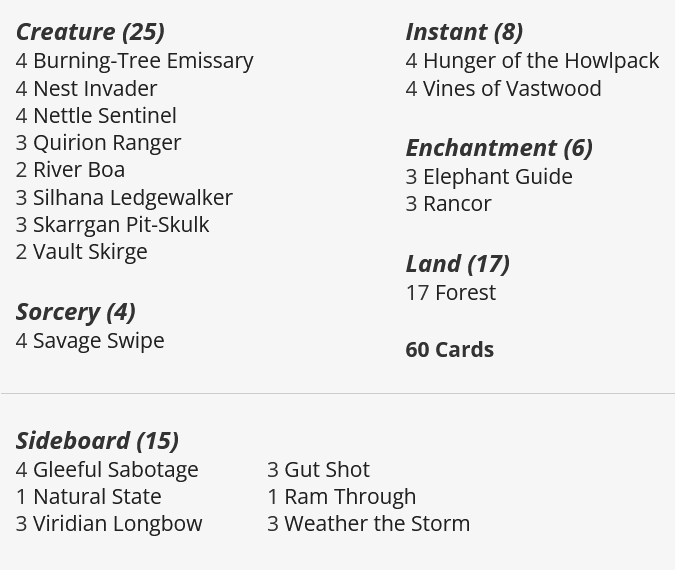
While Grixis Affinity remains the most popular deck, as mentioned last week the raw volume of Spellstutter Sprite/Ninja of the Deep Hours decks approaches a similar metagame share. But we are starting to see more obvious ill effects of the current state of things. Take, for example, this Top 8 Boros Bully list by The_nayr from Sunday:

Four copies of Dust to Dust main is a metagame call to be sure but it is far from a bad one. Bully already has the tools to throw away dead cards in Faithless Looting, and was the deck that ran maindeck copies of Red Elemental Blast during Fall from Favor’s hey-day. We had already seen decks shift to maindeck copies of Abrade to fight Bonder’s Ornament, this is just a logical extension of that point, albeit with a far more narrow card.

Is this indicative of a problem? Maybe, considering that running Dust to Dust main isn’t even a guaranteed win against Affinity. If decks feel priced into running the card, even if it doesn’t get the job done, then I would say there’s something to be concerned about.

But even then, that does not begin to address all the potential issues present in Pauper at the moment. The fact remains that Spellstutter Sprite decks remain a force in the metagame, one that is much harder to “hate out” with sideboard options. Instead these decks traditionally where help in check by the presence of Stompy.

Ixidor29, Top 4 October 17

Stompy has been popping up again after a decent vacation from the metagame. The deck is capable of presenting numerous threats in short order, and can run an offense that often side-steps Faeries (River Boa, for example). Stompy does have an uphill climb considering the popularity of both Pestilence as a strategy and Fiery Cannonade as a card, and that’s completely ignoring the fact that Affinity can often win before Stompy has a chance. All that being said, if Affinity was returned to a previous power level then perhaps Stompy could emerge as a more natural limit on Faeries power.

This returns to the argument I made before the most recent bans: the Modern Horizons 2 artifact lands are a problem. They remove one of Affinity’s key vulnerabilities and are having a warping effect. The strength of Affinity also means that decks that could normally help to constrain the other dominant strategy are relegated to a lower tier of competitive viability. In the long run, I believe these lands will have to go for the sake of Pauper.

The First Four Weeks of Midnight Hunt

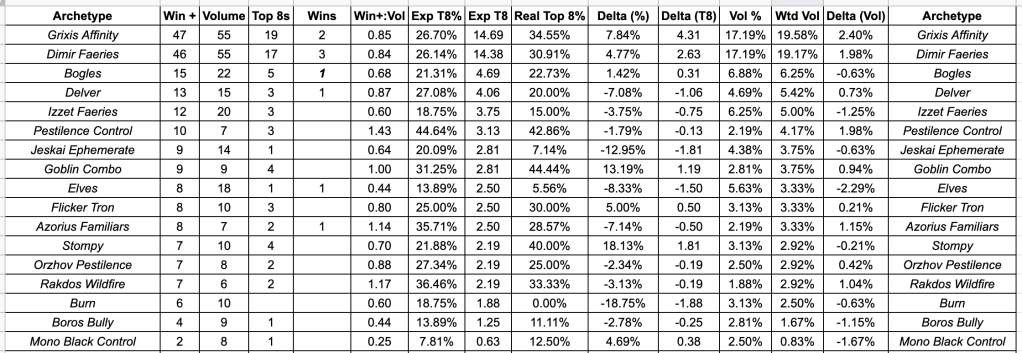
It’s been over a month since the most recent bans and Midnight Hunt has been out on Magic Online for four Challenge cycles. In that time there have been 8 Challenges as well as a Showcase Qualifier, a Super Qualifier, and a regular Qualifier. Given the amount of data at my fingertips, I decided to take a look at the metagame from a macro level. The following chart breaks down the current Pauper metagame into macro-archetypes based on key engines or themes present in a deck. This list excludes the October 9 Qualifier as only 16 decklists were published from that event. Of note – I did not include Cleansing Wildfire as a primary engine as it tends to supplement either an Ephemerate or a Cascade endgame.

Going into this experiment I was wondering exactly how prominent Affinity was in the metagame. While it was clearly a top contender it did not seem as egregious as some previous top decks. What I found out was that Affinity is a clear lap behind the most dominant engine in current Pauper: Spellstutter Sprite and Ninja of the Deep Hours.

Image

Affinity is largely Grixis Affinity – the combo-aggro deck that leverages Atog and Disciple of the Vault. Faeries encompasses three macro archetypes (Delver, Dimir Faeries, Izzet Faeries) and two sub-archetypes (Faeries, Izzet Delver). These decks take up nearly 30% of the Top 32 metagame and almost a third of the Winner’s Metagame. More than that, they are the best performing archetype by a decent margin, out-performing their volume by a respectable clip.

Affinity is a clear second here and then there’s a four deck scrum – Ephemerate/Flicker decks include Familiar combo, Tron, and Jeskai Ephemerate; Creature combo includes Elves, Goblin Combo, and WonderWalls; Pestilence is Orzhov and Mono-Black Control while Ethereal Armor encompasses Bogles and Heroic. Out of these only Pestilence is out performing its volume, largely due to a number of strong showings by Pestilence Control, the nearly creatureless “destroy all monsters” build.

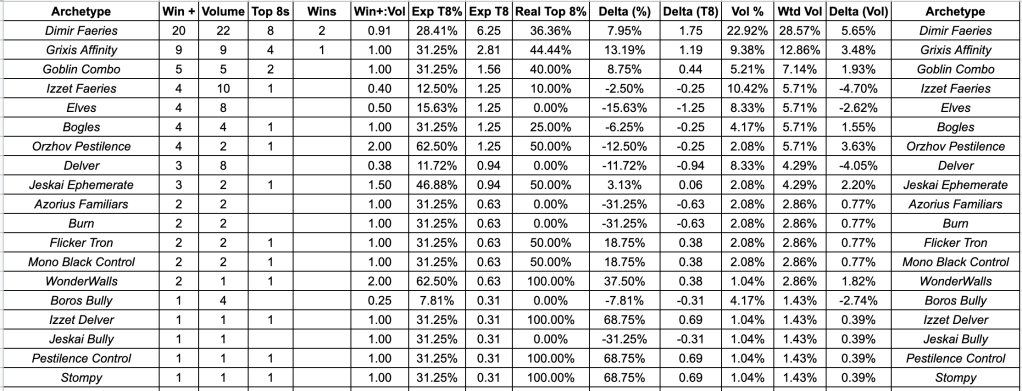
Let’s compare the above chart to the micro-archetypes, taking into account all decks that made at least 6 Top 32 appearances (again, excluding the October 9 Qualifier):

This metagame looks slightly more diverse, but still concentrated at the top in Grixis Affinity and Dimir Faeries. These decks are more or less the same with regards to how well they perform and how popular they are. Make no mistake – Pauper is currently in a much better position than it was pre-ban, but problems are lingering underneath the surface.

First, Faeries as a macro-strategy is clearly the best possible thing you can be doing at the moment. No individual card in the Faeries shell jumps out as obscenely powerful outside of the broken blue cantrips. Then again, Mono Blue Faeries has eschewing Ponder and Preordain for Of One Mind and Winged Words in an effort to draw more cards, not better ones.

Looking back at the first chart, we see a trend at the top: lots of blue draw spells. Faeries has access to the aforementioned cantrips but also the “draw two” of Ninja and Sprite, as well as Behold the Multiverse. Affinity lives on the back of Thoughtcast and more recently Deadly Dispute. Ephemerate and Flicker decks love a Mulldrifter more than is reasonable. It makes sense that the best decks in the format have the best two-for-ones.

The question then becomes how do you fight the card flow. Pestilence can do some work as it can undo some amount of accrued cards but only if they are committed to the board. Instead the best options might be things like Monarch and other card draw engines that can keep up.

Now I know what some folks are expecting: that I’m going to call for a ban. Well, not yet. We are weeks away from another set hitting the scene and considering what Midnight Hunt gave Pauper I’m interested to see what Crimson Vow has to offer. That being said, I hope the powers that be are closely monitoring the situation.

All that being said, I am not sure what can be banned that doesn’t fundamentally change the identity of Pauper. For example, banning Ponder, Preordain, Ninja of the Deep Hours or Spellstutter Sprite (TO BE CLEAR: I AM NOT SUGGESTING THESE CARDS SHOULD BE BANNED), that fundamentally changes a core part of the format’s identity, which could do more damage than no bans at all.

It’s certainly a pickle.

October 2-3 Pauper Weekend in Review

Another weekend and another three events in the books. October 2 saw a Challenge and a Super Qualifier while October 3 saw a Challenge. This brings the total number of major events in the Midnight Hunt season to 8, so we finally have a decent number of results from which we can infer trends. Here is the breakdown of the top decks, minimum 5 Top 32 finishes:

https://cdn.discordapp.com/attachments/534021867196121088/895382318255046686/Screen_Shot_2021-10-06_at_2.49.02_PM.png

It is safe to say at this point that Dimir Faeries and Affinity are not only the decks to beat, but they are significantly ahead of the rest of the field. That being said, things are not as dire as they were prior to the ban. Dimir is under 19% of the Top 32 metagame while Grixis Affinity is just over 16%. And neither of them is grossly outperforming their volume – they are merely great decks and not dominant.

For example, Delver decks have had a recent surge but last week the most successful builds eschewing Delver of Secrets entirely and leaned on Faeries. We have also seen a split in Jeskai Ephemerate lists – both with and without the Cleansing Wildfire package. As the metagame continues to evolve in the lead-up to Crimson Vow, I expect we will see a few staple archetypes cement themselves behind the early winners.

Yet no other deck has more than 7% of the Top 32 metagame share. Is this a reason to worry? I’m not so sure. I am absolutely concerned that these two decks are pulling away from the field but I think that a lot of the distance has to deal with the other decks figuring out the best builds for a relatively new metagame.

What would I be looking at for next weekend’s challenges? Between Delver and Dimir Faeries there are plenty of small flying creatures running around so finding the best way to stall their assault can come in handy. Penumbra Spider and Holy Light might have their day in the sun once again. In fact, a Green-White “Haterade” deck with Avacyn’s Pilgrim and access to Dust to Dust could perform well if it could just figure out other midrange matchups.

September 25-26 Pauper Weekend in Review

We are still in the early stages of Midnight Hunt season and Pauper is continuing to adjust to the post-Chatterstorm metagame. The September 25 and September 26 Challenges show that while some things have changed, many more have stayed the same. The following chart displays every deck with at least 3 Top 32 appearances across the five major events thus far:

After five events Dimir Faeries remains the most popular and, arguably, the best deck in the format. It retains somewhat gaudy numbers but is only eight Top 32s ahead of Grixis Affinity (there are two other Affinity decks that have one appearance each). Behind that is a decent gap before another scrum of decks in the 8-15 appearance range. Would things look better if other decks had a larger metagame share? Absolutely. But things are not as dire as they have been.

Take the top two decks. They are clocking in at a combined 36% of the metagame. That is probably too large a share but is lower than any pair of the pre-ban Top 3 by at least 4 percentage points. I anticipate the metagame share will go down over time but I doubt that these two decks will fall too much out of favor.

Dimir Faeries is successful in part because of its card advantage engines. The Ninja of the Deep Hours + Spellstutter Sprite combo is tried and true and since Faeries added the Monarch to the fold, it can keep the cards flowing with ease. Snuff Out provides the best protection possible as it is “free”. Snuff Out has become one of the defining spells of the metagame thanks to its ability to protect the crown at no cost and due to the dearth of aggro.

Why is aggro struggling? Even if it does not see a ton of play, Fiery Cannonade exerts a ton of pressure on the format as it can end a beatdown deck’s entire career (for one game at least). I also think that for so long non-Stompy aggro decks fell into the Bully camp – that is they leaned on Battle Screech and a force multiplier to end the game. In today’s Pauper that means dedicating your fourth turn to making 1/1 flyers. Maybe if the meta shifts back to midrange slogs that will be good enough but right now we seem to be more in the haymaker camp with Monarch and Cascade.

Time will tell, of course. The league results from this week showed that Midnight Hunt has quite a few cards to contribute to Pauper, and that’s before Festival Crasher has made its presence felt. If someone can crack the 8-Kiln Fiend deck, the meta could get rather interesting.

September 18-19 Pauper Weekend in Review

It’s good to be back.

After what feels like far too long, I’m excited to write about Pauper again. And what a great weekend to get started – with two different Challenges and a Showcase Qualifier we can get a good idea of the initial post-ban landscape. For better or worse, it bears more than a passing resemblance to the metagame before Modern Horizons 2 dropped. The following chart includes every archetype that had at least one X-2 finish or better over the course of the three events.

So the best deck on the weekend was the only one of the big three from last season not hit by a ban. That tracks. The Spellstutter Sprite-Ninja of the Deep Hours package is incredibly powerful and accounts for 41 of the 96 Top 32 decks from the weekend. More and more often these decks are backing this combo up with Monarch – even Azure Fleet Admiral showed up in Delver this weekend – and Dimir Faeries looks to set the pace of the format for the first few weekends.

So let’s talk about Snuff Out. Right now, Snuff Out is helping to define the format in that if you want to succeed to you need to play a deck that does not fold to the free removal spell. Taking a look at the other top decks, they all have some counter-play to Snuff Out whether its counter magic or the ability to just not care about a single removal spell. Expect this trend to continue and look for more decks running threats that dodge Snuff Out and answer suites focused on beating Spellstutter Sprite and its ilk.

Some players have already found an answer in Pestilence. Various Pestilence and Crypt Rats decks had respectable performances this weekend (7 wins above X-2 in 5 appearances) and I would expect this to continue for at least one more week. These decks were also well set up to beat Bogles, a deck that performed very well before Midnight Hunt and given their ability to fight both Gladecover Scout and Faerie Seer it makes sense for the deck to see a surge in popularity.

An archetype with not as much success was Gruul based Cascade. There were three such decks across all Top 32s, but they all finished at X-3. These decks are filled with 2-for-1s and tend to matchup well against countermagic. That being said these are midrange decks and if they are built for the wrong metagame can stumble. As such I can see them figuring out better options for next weekend and have a better weekend.

Grixis Affinity and Goblin Combo both had good results and we have yet to see a huge surge of cards from Midnight Hunt make their way into decks. Looking ahead I expect to see more Boros Ephemerate crop up and for someone to put up results with four copies of Festival Crasher in their deck.

What decks do you think are poised to break out next weekend? Can anything dethrone Dimir Faeries?

Innistrad Midnight Hunt Pauper Review – Green

So we have come to the final segment of my Midnight Hunt set review for Pauper. Green brings us…one card of note. That’s one more than Artifacts and Lands! Let’s get to…it?!

Shadowbeast Sighting (MID)

Shadowbeast Sighting bears a passing resemblance to Roar of the Wurm. The difference there is that the flashback on Roar was the enticing part, as pitching it to a Wold Mongrel could get you a 6/6 for 3G. Now getting 8 points of power split over two bodies for 11 mana may not be the best, but the real problem is that these are 4/4 bodies, which is an awkward set of stats in Pauper. Myr Enforcer is a 4/4 so you can trade for mana for…no mana. Or you can trade it for a Galvanic Blast or Flame Slash, or let it get eaten by a Gurmag Angler. I think this might see some play thanks to Archaeomancer loops, but at 4/4 it just misses the mark.

So this one was a little short, so let’s get to my Top 5 cards for Pauper from Midnight Hunt:

5. Eaten Alive

4. Search Party Captain

3. Festival Crasher

2. Consider

1. Ardent Elementalist

Innistrad Midnight Hunt Pauper Review – Red

Red has relatively few Pauper cards worthy of discussion but they are absolutely going to have an impact. Let’s get to it.

Ardent Elementalist (MID)

Archaeomancer is already one of the most important cards in Pauper thanks to its interaction with Ephemerate. Ardent Elementalist takes the Blue card’s ability and staples it to an easier to cast body. Now in Nightscape Familiar decks it can become trivially easy to generate mana with this, some Familiars, some Izzet Boilerworks, and a Snap. And this is to say nothing of how well that deck can make use of Ghostly Flicker.

But that’s not all. We have already started to see some Mardu value decks based around the almost prohibitively expensive Revolutionist. While the body here might be significantly more fragile it is easier to get this on to the board and start generating value. This opens up another angle of deckbuilding, giving spell based control options to base-Boros decks. It also provides Jeskai Ephemerate decks additional redundancy in their engine while being easier to cast. This is probably the most important card for the format in Midnight Hunt.

Electric Revelation (MID)

These cards are always much closer to playable than they look, and the fact that this one is an instant helps quite a bit. It is possible that some Izzet Devious Cover-Up decks will want this, but there are probably just better options in Blue.

Festival Crasher (MID)

So another Kiln Fiend enters the format, only this one has an additional point of toughness. Izzet Blitz and other Kiln Fiend decks are always a threat and providing redundancy makes them that much better. We are approaching a critical mass of cards to make a mono-Red version of the deck a true threat, especially given the amount of card filtering we have seen made available lately. Mark my words – someone is going to be complaining about getting killed by this thing about a week into the set’s release.

Raze the Effigy (MID)

In a format with Bonder’s Ornament and Myr Enforcer, this seems like it can see a ton of play. Remember those mono-Red decks I was talking about a minute ago? How many of them would love a bad Giant Growth/great Shatter split card? Quite a few, to be certain.