May 13-14 Pauper Weekend Recap

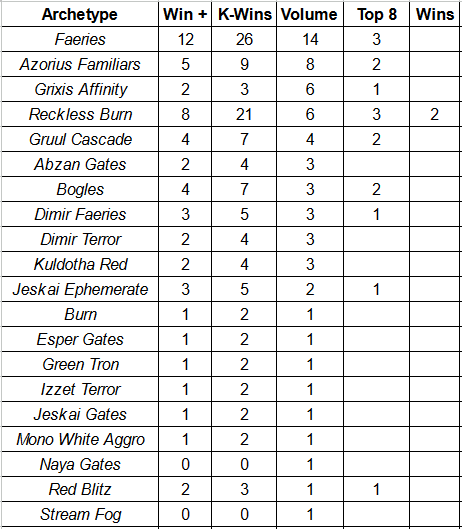
I use a few different metrics when looking at the Top 32 metagame. The first is just Raw Volume. The second is Win+, which takes the sum of all wins at X-2 or better in the Swiss and assigns a score; Win+ is helpful in measuring a deck’s Swiss round performance. K-Wins takes all of a deck’s wins and subtracts its losses, Top 8 inclusive; this helps to give a measure of overall performance. The final is one I call True Volume, which takes the average of all three volumes (Actual, Win+, K-Win). This number helps to provide the most robust image of a deck’s performance in the metagame.
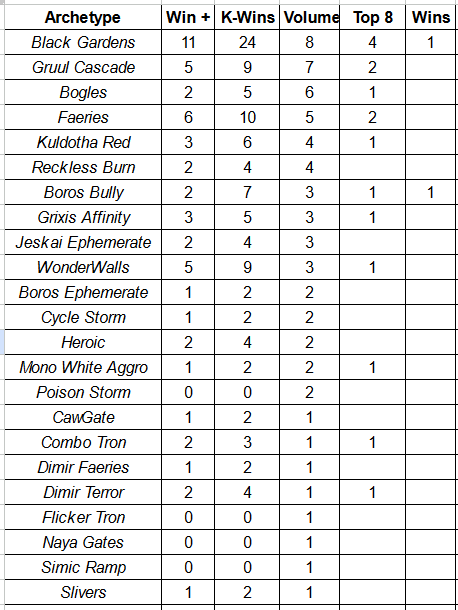
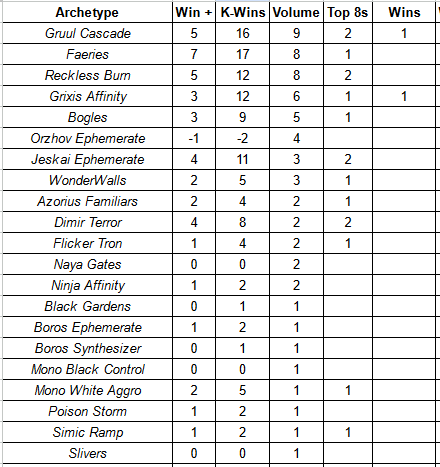
May 13 Showcase, May 13 and May 14 Challenge Top 32 archetypes

There were three challenge level Pauper events on Magic Online this past weekend. There are a lot of threads to tie together from the tournaments so I am going to do my best to break down the highlights.

The Red Decks

I think we have to start at the most glaring thing about the last weekend, and that is the relatively poor performance of the various red decks. These builds tend all feature Monastery Swiftspear, Experimental Synthesizer, Reckless Impulse, and Wrenn’s Resolve. These decks have largely defined the metagame since March of the Machine hit the scene. Combined these archetypes had a cumulative three wins above at X-2 or above across the three events with no Top 8s.

A few things seem to have happened. First, there is not a consensus on the best build of red for the current metagame. Some decks continue to run Kuldotha Rebirth while others have shifted off of metalcraft in favor of Kessig Flamebreather and Thermo-Alchemist. This weekend also saw the return of Dwarven Forge-Chanter to the fold in the archetype listed above as Red Prowess. Each of these builds is vulnerable to different interaction which means that reading the metagame to determine which red deck is ascendant will be a valuable skill moving forward. For the record, I think Kuldotha Red is best next week given how many copies of Chainer’s Edict were running around last weekend.

Both Bogles and Dimir Terror had great weekends and these are two decks that are traditionally good against red. The ability to present a large creature that can pick up lifelink can make life difficult for Lighting Bolt decks. These decks are powerful options that hold up well against red and have the ability to “just win” on the back of their difficult to answer threats.

The Heirs to Gary

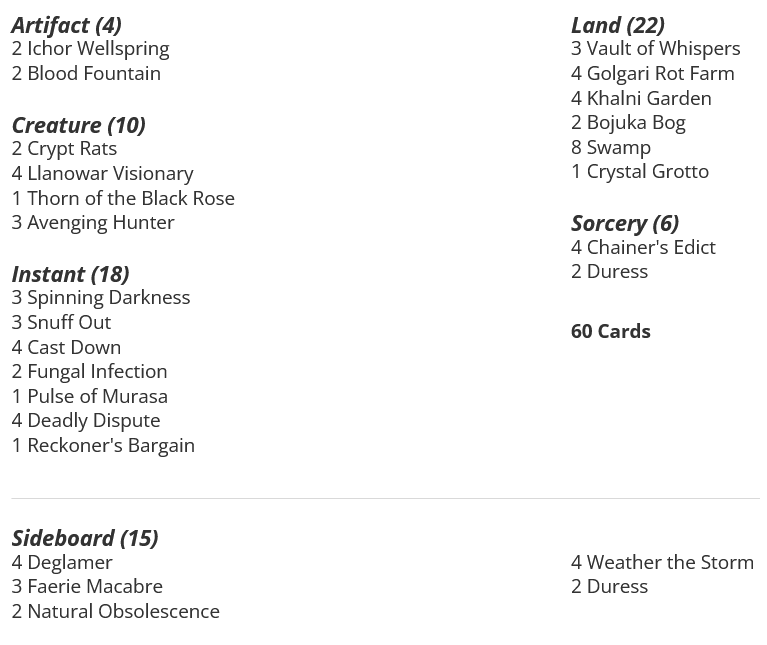
Another thread from the weekend was the relatively strong performance of black based midrange. Both Black Gardens and Orzhov Ephemerate had respectable performances. These decks thrive on matching up their removal to the perceived metagame and lean heavily on Chainer’s Edict – a card that can do quite well against Bogles and Dimir Terror. Edict is also much better against the non-Kuldotha rebirth versions of red which just so happened to be the more popular red archetype in the winner’s metagame from last weekend. Both Black Gardens and Orzhov Ephemerate have access to life gain which help their prospects against the more assertive decks in the metagame. Still both can struggle against a strong Faeries draw or decks with powerful recursive Ephemerate engines in the vein of Azorius Familiars or Flicker Tron.

The Sky is Blue

The two best decks on the weekend were Faeries and Dimir Terror. The ability to just say no with Counterspell remains powerful. Faeries put a cap on its fantastic first four weeks with another four trips to the Top 8 with a win for good measure. Dimir Terror had the same number of Top 8s but no win in the same number of Top 32 finishes, but it picked up two additional Swiss wins along the way. Both of these decks ended up with over 12% of the True Volume (only Bogles did better with almost 14% thanks to an 11-0 run in the Showcase).

These decks represent two different approaches to Counterspell strategies. Faeries wants to stick and early threat and protect their advantage while Dimir Terror wants to slow the game down until it can stick a 5/5 and ride that to victory. I believe that moving forward these are the best executions of Counterspell given the current metagame considerations with Faeries having an edge next week in the face of removal. That being said it is not difficult for Dimir Terror to add more fodder in the form of Augur of Bolas, Fallaji Archaeologist, or even Rotten Reunion.

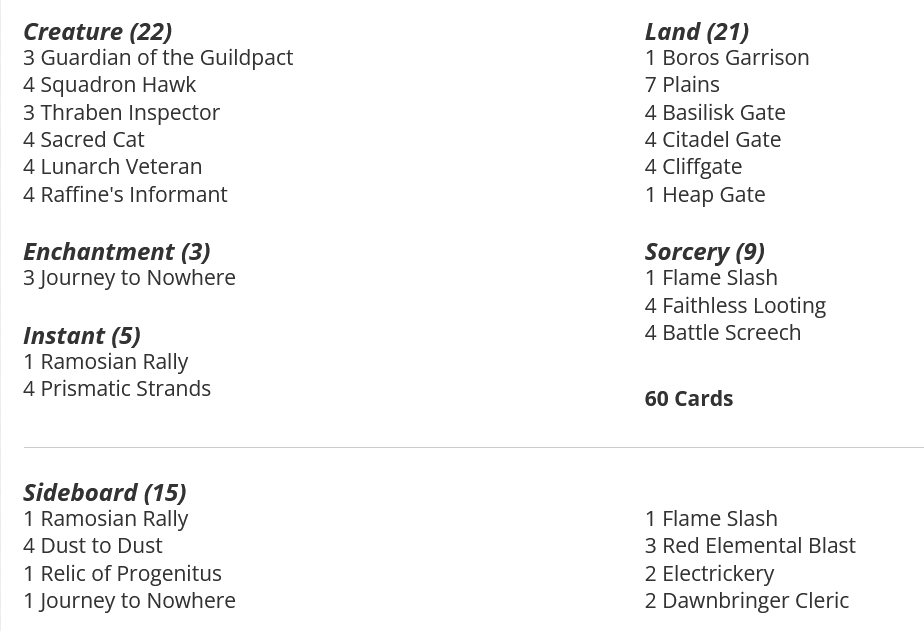
So what does this mean for next weekend? I think the Kudoltha Rebirth versions of red will be the best choice in that regard and give the various black midrange deck some fits unless they can adjust their composition without giving up too much against the rest of the metagame. Faeries will continue to be well positioned but could take a hit if people move back to Suffocating Fumes and Electrickery. Bogles probably won’t have as strong of a showing as people will absolutely try to catch Chainer’s Edict lightning in a bottle. With all of this in mind I would want to be packing Sacred Cat and Basilisk Gate. Whether that’s an established CawGate or Naya Gates build, or one of the up-and-coming variants remains, a resilient threat that has the ability to both gain a chunk of life and end the game is exactly what I want in my deck these days.

I want to take a moment to thank all my Patrons – both old and new. I am going to do my level best to keep providing you with the kind of content that brought you here in the first place. If you are interested in supporting my work, rewards for my Patreon start at just $1 and every little bit helps.

Can’t make a commitment to Patreon? I now have a Ko-Fi where you can make a one time contribution.

Looking for another way to support my work? Click here for my TCGPlayer affiliate link. Any purchases through the link let the folks there know you like my content!
May 6-7 Pauper Weekend Recap

I use a few different metrics when looking at the Top 32 metagame. The first is just Raw Volume. The second is Win+, which takes the sum of all wins at X-2 or better in the Swiss and assigns a score; Win+ is helpful in measuring a deck’s Swiss round performance. K-Wins takes all of a deck’s wins and subtracts its losses, Top 8 inclusive; this helps to give a measure of overall performance. The final is one I call True Volume, which takes the average of all three volumes (Actual, Win+, K-Win). This number helps to provide the most robust image of a deck’s performance in the metagame.

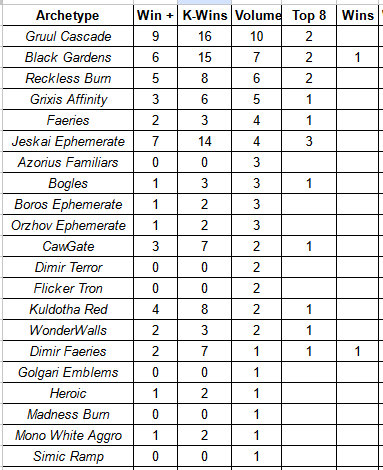
May 6 and May 7 Top 32 archetypes

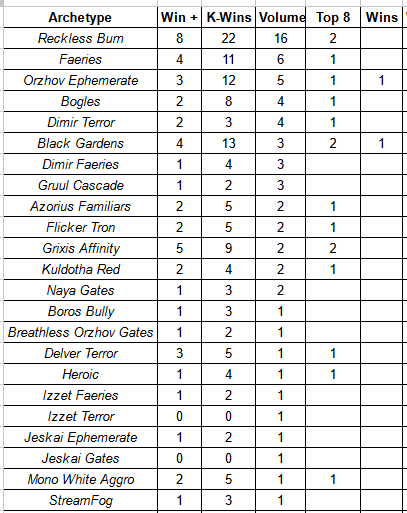
Let’s get one story out of the way: after the May 6 and May 7 Pauper Challenges it is fairly clear that Reckless Burn is the more popular stripe of aggressive red deck in the current metagame. It was incredibly popular in both tournaments and ended up with a full 25% of Top 32 slots. In turn this has made it looks worse in some regards as its popularity has ensured a decent number of these decks ended up with a X-3 record. So let’s take another step back and look at the first six events of March of the Machine weekend.

In that span Reckless Red is the second most popular archetype with 24 Top 32 appearances, 6 Top 8s, and 2 wins. It has a pretty solid Win+ ratio of 0.71, meaning it trends towards a Top 16 finish. It’s K-Score average of 1.96 tells a similar story – you can reasonably expect Reckless Red to make the Top 16 and as approximately three out of every 16 Top 8 decks get to the finish line with a X-2 record, you can expect a similar rate of Top 8s out of Reckless Red. The long and short of it is this: if you are aiming for the top tables of the Pauper Challenges you need to be prepared for Reckless Burn.

But it is only the second most popular archetype this season – Faeries comes in first with 25 total appearances thus far. It has a slightly better Win+ ratio (0.84) and K-Win average (2.04). It has six Top 8s as well, but no Challenge wins yet. I want to come back to this datum later, so let’s put a pin in it for now.

So what is going on with Reckless Burn? Like so much of Pauper’s history the current battle is being fought with yesterday’s technology. Take, for example, Suffocating Fumes. This card has absolutely earned its spot in the maindeck as a flexible way to answer hordes of small creatures like those deployed by Faeries or that sprout forward as a result of a Kuldotha Rebirth. But against a deck like Reckless Burn it fails to do anything of note. In certain metagames a card like Suffocating Fumes can absolutely be worth a slot (and to be frank, it probably still is worth a card today) but when key cards in the opposition have three toughness it starts to look silly.

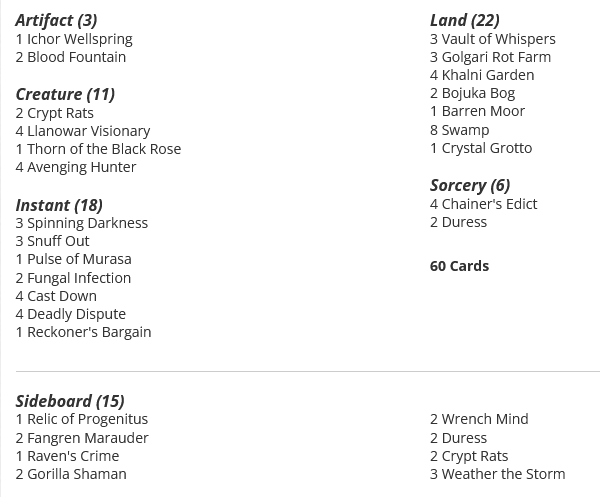
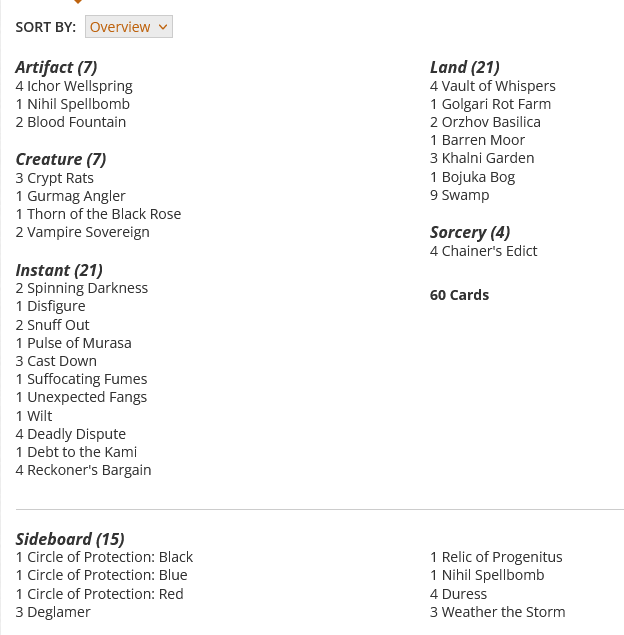
I think it’s important to look at the two Black Gardens lists that performed well this weekend. Both leaned into life gain with Spinning Darkness and Pulse of Murasa, while opting to use Crypt Rats as their sweeper of choice. Crypt Rats has the advantage of scaling and when backed up with enough lifegain it can clear out tokens and Thermo-Alchemists alike. I am not saying we are moving into a stage where Crypt Rats and Pestilence are the panacea for the format but they remain options that have largely been held to the fringes as of late.

Now to pick up the thread I left before about Reckless Red and Faeries, I think it’s interesting to note that only one of these decks gets a ton of ire in the discourse. It is quite possible that over the next few weeks Reckless Red will overtake Faeries and this little denouement will look foolish, but it is something that’s been tickling the back of my brain for a while. Blue being good in Pauper is not surprising since it is a high power non-rotating format. Blue is supposed to be good. Red, well, maybe not.

Being clear – red has gotten a ton of tools in the past few years and has seen its power level pushed quite a bit. And the fact that red’s reign is coming right on the heels of Affinity’s stay at the top can be seen as evidence there is something amiss with overall format health and some action needs to be taken. I for one am interested to see if this new brand of Red has the staying power of the previous iteration.

I want to take a moment to thank all my Patrons – both old and new. I am going to do my level best to keep providing you with the kind of content that brought you here in the first place. If you are interested in supporting my work, rewards for my Patreon start at just $1 and every little bit helps.

Can’t make a commitment to Patreon? I now have a Ko-Fi where you can make a one time contribution.

Looking for another way to support my work? Click here for my TCGPlayer affiliate link. Any purchases through the link let the folks there know you like my content!

April 29-30 Pauper Weekend Recap

April 29 and April 30 Challenge Top 32

We are now into the second week of March of the Machine season and the new metagame is started to round into shape. While things may look similar is some regards the top of the format is shifting in a way that could have a cascading impact.

Let’s start with Red. While Monastery Swiftspear is still leading the charge, Kuldotha Red – the deck that leans on artifact synergy and Kuldotha Rebirth – has taken a backseat. It is not that the deck is bad, per se, but Wrenn’s Resolve has given the color another opportunity to grind. The result is Reckless (or Impulsive) Burn, a build that leans more on Thermo-Alchemist and Kessig Flamebreather to plink away at a life total. It wants to build its own Grapeshot kill, but over several turns instead of several. Reckless Burn had a rather absurd weekend as it asserted itself, with three Top 8 finishes in six total Top 32 appearances, taking down both Challenges. It had an average finish firmly in the Top 16 (1.33 Win+ average) and with a K-Win average of 3.5, it split the difference between Top 8 and Top 16. Make no mistake – the face of red has changed.

Azorius Familiars was the second most popular deck but potentially suffered as a result. The strategy has always been strong but never popular, yet Meeting of the Minds has made the deck more accessible to a wider population of players. It had a very respectable two Top 8 finishes in eight total Top 32 placings and a Win+ average of 0.63, meaning it is trending towards the Top 16. It is just a far cry from it’s 0.97 Win+ average during Phyrexia season. So what gives? Chances are with more people playing the deck it has more opportunities to lose, but also given that it is now much more on the radar and showing up more in leagues, more players may be figuring out how to beat the strategy. Familiars is still a very good option and I don’t believe it will stay mired in relative mediocrity for long.

The rest of the top tier should look familiar. Faeries has been on an absolute tear since adopting a more assertive stance. Grixis Affinity is not going anywhere either as the strength of the machine is too much to deny. I would also keep an eye on Bogles. In a metagame where decks are trying to enact their gameplan as quickly as possible, Bogles can slip between the cracks and steal wins.

The big edge one can get in this metagame is properly picking your removal. Cards like Lightning Bolt may go up in value as they can pick off key pieces of both of the creature based combo decks (Reckless Burn, Familiars) at the top of the metagame while not being entirely dead against Faeries. This could leave an opening for decks like WonderWalls, Bogles, or even Elves to make a case for themselves provided the focus shifts to these pseudo-combo builds.

Another path is to lean on Battle Screech, or rather decks where Battle Screech is at its best. Soul Sisters – a mono white token deck using Soul Warden and Soul’s Attendant – can gain enough life to stabilize against both Red and Faeries. If the strategy can figure out a way to beat Familiars consistently it could make itself a true threat.

I want to take a moment to thank all my Patrons – both old and new. I am going to do my level best to keep providing you with the kind of content that brought you here in the first place. If you are interested in supporting my work, rewards for my Patreon start at just $1 and every little bit helps.

Can’t make a commitment to Patreon? I now have a Ko-Fi where you can make a one time contribution.

Looking for another way to support my work? Click here for my TCGPlayer affiliate link. Any purchases through the link let the folks there know you like my content!
April 22-23 Pauper Weekend Recap

April 22 and April 23 Pauper Challenge Top 32

March of the Machine season has arrived! After ten weeks of Phyrexia: All Will Be One a new set of cards has entered the fray. If you’re interested in my take on the new cards you can check them out here but today I want to talk a little bit about the April 22 and April 23 Challenges.

First off, it is hard to make any declarations about a format after a few days. The early chatter from March‘s release indicated that Wrenn’s Resolve would push red to another level and Meeting of the Minds was incredibly strong in Azorius Familiars. After two events these portents appear to be pointed in the right direction.

Let’s start with Wrenn’s Resolve. Kuldotha Red has adopted the card while a somewhat new archetype – Reckless Burn or Impulsive Burn – has hit the scene. The latter deck runs a lighter burn suite than traditional Burn but runs the full suite of Thermo-Alchemist and Kessig Flamebreather. In this way it plays a bit like a slow storm deck, chaining together its draw spells to provide a steady stream of damage. Compare this to Kuldotha Red which has cut some of non-core creatures – that is, creatures outside Voldaren Epicure and Monastery Swiftspear -to fit in the second playset of draw spells.

The divergence is sure to have ramifications in the metagame as these decks require rather different answers. Against Reckless Burn, for example, cards like Lightning Bolt go up in value as they pick off several of their key threats, while Smash to Dust and End the Festivities lose value since there are fewer targets. Reckless Burn also does not run Great Furnace (at least not yet), which turns off Galvanic Blast but in exchange it has Searing Blaze. Targeted removal is better against this newer deck but it is rather resilient, aiming to win in the mid and late game.

4 Snap
1 Prohibit
4 Sunscape Familiar
3 Sea Gate Oracle
1 Ghostly Flicker
3 Archaeomancer
1 Mortuary Mire
4 God-Pharaoh's Faithful
8 Snow-Covered Island
4 Mulldrifter
1 Lose Focus
2 Ephemerate
1 Dawnbringer Cleric
2 Plains
2 The Modern Age
2 Obscura Storefront
4 Preordain
4 Ash Barrens
4 Azorius Chancery
4 Meeting of Minds
1 Saiba Cryptomancer

Sideboard
1 Prismatic Strands
3 Dust to Dust
1 Holy Light
4 Hydroblast
2 Inside Out
2 Revoke Existence
2 Negate

Azorius Familiars has been one of the format’s secret best decks for years. The main thing holding the archetype back is the fact that it is difficult to pilot effectively on Magic Online without quite a bit of practice due to the user interface. Leaning on loops with Ephemerate/Ghostly Flicker and Archaeomancer, the deck can eat up a ton of clock. Despite this when the deck does show up it performs rather well. Over Phyrexia season it had 29 Top 32 finishes and made Top 8 in 14 of those while averaging close to a Top 16 Swiss finish; approaching an average event finish in the tenth-sixth place spot, and had two wins to boot. Meeting of the Minds provides more card advantage at a bargain basement price. Familiars is already adept at reducing the cost of spells and so, given the composition, it is not hard to imagine a scenario where Meeting can be looped for effectively free.

Where does that leave things going into next weekend? Red is going to be everywhere, but which version remains to be seen. It would not surprise me to see a small uptick in Familiars while Affinity remains constant. Bogles also had a strong weekend but I don’t see it having consistent staying power. If I were trying to tech for the meta I would want to try and figure out an Arbor Elf/Utopia Sprawl deck that could survive against red until it could stick a Flourishing Hunter.

I want to take a moment to thank all my Patrons – both old and new. I am going to do my level best to keep providing you with the kind of content that brought you here in the first place. If you are interested in supporting my work, rewards for my Patreon start at just $1 and every little bit helps.

Looking for another way to support my work? Click here for my TCGPlayer affiliate link. Any purchases through the link let the folks there know you like my content!
Phyrexia: All Will Be One Pauper Season Recap

The Phyrexia: All Will Be One Pauper season has ended. Ten weeks saw 20 Challenges and one Super Qualifier on Magic Online while it also contained the absolutely massive Paupergeddon Milan in Italy. That being said this article will focus on the data from the online metagame. The overarching story is one that will sound familiar to anyone who has played Pauper over the past several months, but there is a lot of nuance that will get lost if you only pay attention to the headlines.

A quick aside: While I am a member of the Pauper Format Panel, I see my role on this page as one where I talk about the format from the perspective of a player. The suggestions I make here are made with the intent to provide different ways to approach the format that may yield you success. Good? Good.

A second aside on terminology: I use a few different metrics when looking at the Top 32 metagame. The first is just Raw Volume. The second is Win+, which takes the sum of all wins at X-2 or better in the Swiss and assigns a score; Win+ is helpful in measuring a deck’s Swiss round performance. K-Wins takes all of a deck’s wins and subtracts its losses, Top 8 inclusive; this helps to give a measure of overall performance. The final is one I call True Volume, which takes the average of all three volumes (Actual, Win+, K-Win). This number helps to provide the most robust image of a deck’s performance in the metagame.

Defining the Metagame

Grixis Affinity and Kuldotha Red continue to define the Pauper metagame. Kuldotha Red was the most popular deck in the Top 32 metagame with 120 appearances alongside 20 Top 8 finishes and an impressive 6 wins (including the Super Qualifier). The deck also had an average Win+ of 0.58 and a K-Win average of 1.6. Grixis Affinity had 94 finishes in the Top 32, taking down a whopping 28 Top 8 slots and winning three events. Affinity’s Win+ average clocked in at 0.83 and it’s K-Win average settled at 1.84. When looking at True Volume, Kuldotha Red finished with 16.11% (down 1.64% from its actual volume) while Affinity closed the season with a True Volume of 14.92% (up 1.01% from it’s actual volume).

What does this all mean? Both of these are very good strategies that are solid choices for anyone looking to get into Pauper. Kuldotha Red is a bit more volatile and despite winning the most events in the season averaged a finish closer to 17th place than inside the Top 16. Affinity, on the other hand, had a better average finish in the Swiss. Player gathered data shows that both of these decks have acceptable non-mirror win rates, with Affinity hovering in the 50% range while Red often dips below that number. Yet these two decks are often to focal point of frustration in Pauper circles.

Perhaps this is because they get to simply be. The power of these decks means that overall there is relatively little fine tuning that needs to go into the builds. The strength of the core strategy is high enough that stock lists can perform admirably in a given event. Compare this the the other decks in the metagame which have to be constructed with these two in mind. Now it can be debated whether or not this is a “good thing” but from my vantage point there are always going to be decks that are the focal point of a metagame and it’s the job of the meta to adjust – especially when those threats are known.

Faeries, Again

And adjust the meta has. One of the biggest stories of this season has been the rise of Mono Blue Faeries. The deck has taken on a far more aggressive slant, eschewing Preordain for Faerie Miscreant and moving to maindeck copies of Mutagenic Growth as a standard inclusion. Faeries had a True volume of 9.35% over the first four weeks of the season and jumped to 13.10% over the second four weeks. The final five events saw Faeries end with 18.42% of the True volume. All told on the season the blue menace took home 13.10% of the True volume, 0.67% higher than it’s Top 32 presence. In 84 Top 32 finishes it had 20 Top 8s (the same as Red) and two victories.

Faeries is a low to the ground card advantage machine. Moon-Circuit Hacker, Ninja of the Deep Hours, and Of One Mind allow it to load up on cards while pressing its advantage in a damage race. If the deck can get to a point where it can resolve Snap into Spellstutter Sprite it can take over on tempo. Cheap countermagic such as Spell Pierce can help the deck maintain its advantage at a low cost. All told Faeries is looking to be a good choice moving into March of the Machine season.

Death and Taxes

Another story to come out of this season was the return of Mono White Aggro to the metagame. Practically a non-factor in the first four weeks of the season (two total Top 32 finishes), the deck came on strong in the second four weeks (10 Top 32 finishes, 5 Top 8s, 1 win) and had 3 more Top 8 finishes with 11 more Top 32s in the final five events. Like Faeries, Mono White Aggro is a low to the ground deck that wants to press its advantage via creatures. While it lacks the stack interaction of blue it makes up for this in burst damage with the likes of Steadfast Unicorn and Guardians’ Pledge.

The deck also has a decent number of options that are not always standard inclusions. Some builds are able to pivot into a Monarch or Initiative build while some lean on Militia Bugler. Recommission was commonly seen but is hardly a requirement these days. Instead it is all about picking creatures that are slightly better on rate than the other choices on curve. Then, thanks to Prismatic Strands, it can steal combat steps and win the old fashioned way: via combat.

Hardly Ephemeral

I don’t want to write this without acknowledging two of the better decks from the season: Azorius Familiars and Flicker Tron. Both of these strategies lean on a mana advantage (either from the Tron Lands or from Sunscape Familiar) to super charge the Ghostly Flicker/Ephemerate loop with Archaeomancer/Mnemonic Wall. From here these decks get to cherry pick the best option from their graveyard and eventually win the game thanks to their overwhelming advantage and ability to lock the opponent out of meaningful action.

Flicker Tron had seven Top 8 finishes in 26 appearances in the Top 32, concluding the season with 3.02% of the True volume (+0.07% over actual volume). Familiars ended with 5.32% of the True volume (+1.04% over actual volume), 14 Top 8s and 2 wins. It also had a positively gaudy 0.97 Win+ average, placing its average finish right around the Top 16; its K-Win average was 2.38 which correlates to a finish between 8th and 16th. These decks cannot be discounted moving forward and, despite their relatively small metagame presence, are major players.

Odds and Ends

Here are a final few thoughts that I’d be remiss to exclude from this wrap up:

  • Paupergeddon Milan showed the power of Altar Tron – a Myr Retriever/Ashnod’s Altar/Golem Foundry deck. This strategy has some limitations imposed by the Magic Online user interface which may be artificially depressing its numbers.
  • The surge of both Faeries and Mono White Aggro does give me some pause in that these two decks are incredibly consistent in part to their mana base. If the meta is pushing decks towards being a single color that may not be ideal for long term format health.
  • March of the Machine has a lot of interesting cards for Pauper and while some folks are concerned about Wrenn’s Resolve, I see this set as far more likely to bolster non-red archetypes than send Monastery Swiftspear to another level.

I want to take a moment to thank all my Patrons – both old and new. I am going to do my level best to keep providing you with the kind of content that brought you here in the first place. If you are interested in supporting my work, rewards for my Patreon start at just $1 and every little bit helps.

Looking for another way to support my work? Click here for my TCGPlayer affiliate link. Any purchases through the link let the folks there know you like my content!
April 8-9 Pauper Weekend Recap

Win +: Measures all wins better than X-3 in Swiss (X-2 is 1, X-1 is 2, etc). Measures a deck’s relative strength against the field in that event

K-Wins: Measures all wins less all losses, Top 8 inclusive. Measures a deck’s strength in a winner’s metagame

April 8 and April 9 Pauper Challenge Top 32

The April 8 and April 9 Pauper Challenges tell us a similar story to the weeks before: Grixis Affinity and Kuldotha Red are two of the better decks in the format, but Faeries is not far behind. In the ten challenges since March 11 Faeries has 12 Top 8s with a win – the same count as Grixis Affinity in three fewer appearances (Kuldotha Red, for the record, has 14 Top 8s and four wins in 64 Top 32 finishes). During the same same it has the best average Swiss finish and the best average finish, Swiss and Top 8, when looking at the Top 32 metagame. Whether or not it can stay in the top three remains to be seen. If history is any indicator, Faerie’s slot rotates between different flavors of blue, having cycled through CawGate and Dimir Terror, while the other major players jockey for position in and around the top of the metagame.

Here we can see some of the limitation of challenge data. These events, while regular, are relatively small compared to the volume of matches being played on Magic Online. The weekend challenges hover between the mid-40s and mid-70s for player count, meaning that any deck that has five or more pilots will make an outsized impression in the volume. This is one reason why I track results over a set’s release: it helps to provide insight as to what is happening given a set pool of cards. But even that does not always tell us how games play out.

Pauper, right now, is going through some serious game play growing pains. There are a few decks in the metagame that, given their power level or strategy, can leave people feel like they are playing “non-games”. Kuldotha Red has draws that just get there while Gruul Cascade is built on trying to prevent the opponent from actively doing anything. The result is that these strategies can leave the person on the other side of the table feeling as if they lack any sort of agency in actual game actions.

This is the reality of non-rotating formats once they reach a certain size. There are some matchups which are utterly lopsided or hinge on drawing a very specific card. Maybe I’ve been watching too many Legacy videos involving Chalice of the Void recently, but this is also nothing new to Pauper. Before there was Gruul Cascade there was Mono-Black Land Destruction which was never popular but could Choking Sands you out of the game. Before Kuldotha Red there was Burn which could still catch people unaware. The difference between past and present is that these decks are, for the time being, good.

That has nothing to do with what happened over the weekend, but it is a thought that’s been rattling around my skull for a while. As for looking forward, we are in the final week of Phyrexia season and one card I feel should be seeing more play is Anoint with Affliction. While it does miss many of the larger threats in the metagame it does something important in removing the animated lands from Kenku Artificer. While it is slow it also does trade with everything out of Kuldotha Red as well while also nabbing most of the standard inclusions in Faeries outside Ninja of the Deep Hours. I do not think you necessarily need to go all in on Corrupted, but I’m not sure it would hurt either. Whether this is a modified version of Black Garden or a Carrion Feeder based sacrifice deck with Crawling Chorus and Blightbelly Rat, I think you want to be using Swamps next weekend.

I want to take a moment to thank all my Patrons – both old and new. I am going to do my level best to keep providing you with the kind of content that brought you here in the first place. If you are interested in supporting my work, rewards for my Patreon start at just $1 and every little bit helps.

Looking for another way to support my work? Click here for my TCGPlayer affiliate link. Any purchases through the link let the folks there know you like my content!
April 1-2 Pauper Weekend Recap

Hello everyone. First, I want to apologize for the delay in getting this up. If you follow me on other channels you might have seen that I recently came down with Covid. The good news is that, being fully vaccinated and boosted, my case has been relatively mild. I am on the mend and finally have some time to sit down and write.

Second, you’re going to notice a change in this post…or rather a reversion. A few months ago I moved my in depth posts to my Patreon. After running the numbers I saw that relatively few people were getting the information that I was putting there so in the interest of growing Pauper and sharing the data, I’m moving my in depth posts back to this blog. I am going to be revising my Patron facing content in the future but in the interim I want to extend a heartfelt THANK YOU to everyone who has subscribed to this point. If you want to help keep the content flowing you can support me for as little as $1, which still grants to access to a Patrons only channel in the #MTGPauper Discord.

With that out of the way, let’s get to the results:

Win +: Measures all wins better than X-3 in Swiss (X-2 is 1, X-1 is 2, etc). Measures a deck’s relative strength against the field in that event

K-Wins: Measures all wins less all losses, Top 8 inclusive. Measures a deck’s strength in a winner’s metagame

April 1 and April 2 Challenge Top 32

Once again Kuldotha Red was the most popular deck on the weekend. However digging deeper it was not the best performing strategy on the weekend. A 0.33 Win+ average places it firmly outside the Top 16 on average and despite taking down 18.75% of the Top 32 volume it saw a pretty massive 4.32% drop in adjusted volume. All of this is to say that despite its popularity Kuldotha Red failed to perform to its presence. However it also has a healthy 1.5 K-Win average which tells us that when it does hit the elimination rounds it does well (as indicated by the Challenge win). It has largely held up this way for the entire season with five Challenge wins but a Win+ average of 0.59 and a K-Win average of 1.52 in 99 Top 32 appearances across 16 events.

So which deck would I say had the best weekend? To me it’s between Faeries and Familiars. Faeries had an additional Top 8 finish, a Win+ average of 1, which translates to averaging a Top 16 finish, and a healthy K-Win average of 2.29 in seven total Top 32 finishes. It made up 10.94% of the Top 32s but had an adjusted volume of 13.59%, a difference of 2.65%. Compare this to Familiars with four total Top 32 appearances, two Top 8s and a win and a better Win+ average (1.25) and K-Win average (3.5), and a better percent delta (+3.66%). Despite the fact that Faeries had three more appearances overall I think this week I have to hand it to Familiars.

So, then, what would I recommend for next week? Let’s be real: red is not going anywhere and with Faeries on the rise I think Kor Skyfisher strategies continue to be well positioned. Skyfisher decks tend to have enough life gain to keep up with red while also going wide enough to help to reduce the efficacy of Faeries’ attacks. Something to keep in mind is that whatever strategy you choose it will need to have a reliable way to target the graveyard. Familiars is not going anywhere and Affinity is lurking in the wings being able to disrupt the bin remains important. I know this is a place where folks are likely expecting me to recommend Orzhov Ephemerate but that deck has seriously been struggling as of late. I think what may be better is a deck that can run both Kor Skyfisher and Bojuka Bog, but also a Crop Rotation package to fetch Bog when needed. Whether this fits neatly into existing Skyfisher strategies or requires a rework of Gates, I am not sure.

But there’s more today. We are eight weeks into Phyrexia season so I wanted to take a look back at the season so far. First, let’s take a look at the past four weeks of the Challenge meta (this does not include Paupergeddon), with the cut off of 2% Top 32 volume.

Kuldotha Red continues to top the field in popularity but lags behind in other metrics. It is running at -1.45% between actual volume and adjusted volume, which is worse than its -0.97% in the first four weeks. Faeries, despite not having a win, is outperforming Affinity and Dimir Terror. It has a positive delta between actual volume and adjusted of 1.28% (up from 0.96% in the first four weeks) and continues to rise in the power rankings. Gates based decks have taken a dip while Orzhov Ephemerate is languishing. Mono White Aggro has seen an uptick in popularity in the past four weeks.

Consistency is key in the current metagame. Kuldotha Red is exerting pressure on the metagame and decks that are well set up to keep pace are doing just that. Faeries and Mono White do not have to take time off to set up their game plan and can instead get to the board quickly. That does not mean that slower decks are dead in the water but rather they need to rethink their approach. Gates decks suffer in this regard because they rely so heavily on lands that enter the battlefield tapped. It could be time for Abundant Growth to shine in decks outside of Bogles and Naya Gates as a way to churn through cards and fix mana.

Today I am going to leave you with the season chart, with the same 2% threshold (10 minimum Top 32 appearances). What story is this chart telling you about the Pauper metgame?

I want to take a moment to thank all my Patrons – both old and new. I am going to do my level best to keep providing you with the kind of content that brought you here in the first place. If you are interested in supporting my work, rewards for my Patreon start at just $1 and every little bit helps.

Looking for another way to support my work? Click here for my TCGPlayer affiliate link. Any purchases through the link let the folks there know you like my content!