I use a few different metrics when looking at the Top 32 metagame. The first is just Raw Volume. The second is Win+, which takes the sum of all wins at X-2 or better in the Swiss and assigns a score; Win+ is helpful in measuring a deck’s Swiss round performance. K-Wins takes all of a deck’s wins and subtracts its losses, Top 8 inclusive; this helps to give a measure of overall performance. The final pair is call Meta Score and Meta Score Above Replacement, which takes the average of Win+ and K-Win to try and position an archetype against its field. This number helps to provide the most robust image of a deck’s performance.
It’s over. After ten weeks the Wilds of Eldraine cycle has officially come to a close. What began with worries about red has ended with players seemingly happy about the state of the Pauper metagame. As we ready ourselves for the journey to the Lost Caverns of Ixalan it might benefit discussion to take a step back and look at why things seem “better” now.
I am putting that word in quotation marks because while both red and Affinity decks have taken a step back, what has filled the gap isn’t necessarily healthier but rather more familiar. The return of Dimir Faeries a few weeks ago has seen Pauper revert to a something resembling a prior state where decks leveraging powerful blue spells sat atop the metagame. In it of itself this shift is neither good nor bad, but rather represents a change. For a good stretch of time the format was largely defined by its most assertive decks and now something at the other end of the temporal spectrum is setting the tone.
The difference, to me, is that the decks at the top feel like they should be there because for many years in Pauper those are the decks that have been there. Part of the discomfort with red’s success was in part due to the fact that it was doing things with which the color previously struggled. When Affinity was at the top of the metagame it felt unbeatable due to the resilience of its core shell. Dimir Faeries is not as impervious as Affinity or aberrant as red and so its recent climb has felt familiar.
To be clear I think the metagame shifting is a good thing. Old decks coming back with new strategies and tools to fight the current battles demonstrates that the cards available in Pauper can handle a wide swath of what is out there. At the same time I have to take pause when I see folks effusively praising the way things are currently. It is not that the current state of the format is bad but rather one set of issues have been traded for another.
The issues before are well known – the assertive decks made it very difficult to for slower strategies to get their feet under them and mount a defense. Those decks are still out there but other builds have adapted and have started to skew their maindeck in addition to dedicating several sideboard slots to the beatdown. Because of this decks, like Dimir Faeries, which can take advantage of the skew have come to prominence. This is something that, in other formats, might take place over weeks. In Pauper this process has taken more than a quarter of a year.
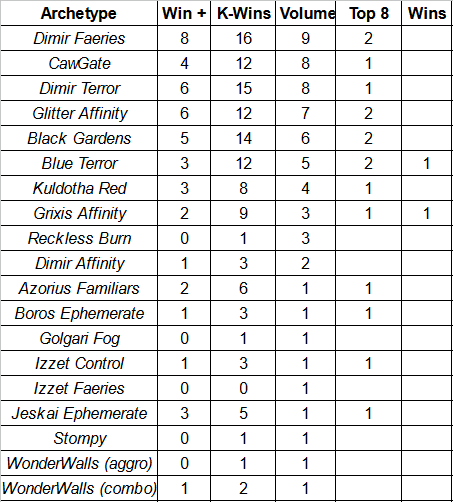
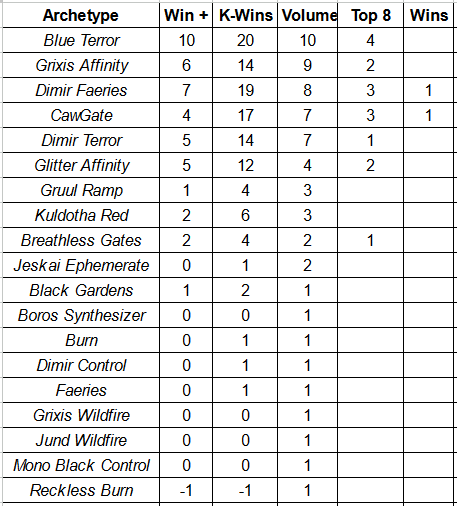
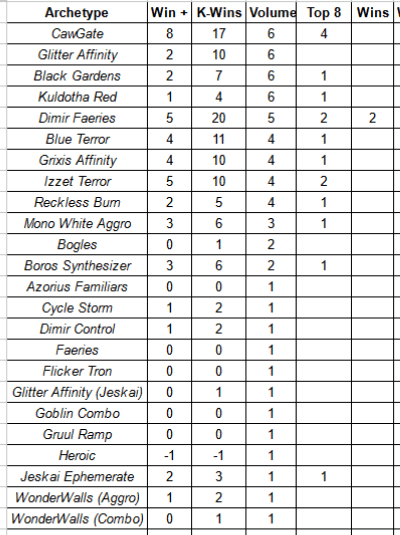
Where does this leave things going into Lost Caverns of Ixalan? The top decks at the end of Wilds of Eldraine season, taking into account all ten weeks, are (in order) Blue Terror, CawGate, Kuldotha Red, Glitter Affinity and then Dimir Faeries. If you isolate the last two weeks of the season the top tier is Dimir Faeries, Blue Terror, Dimir Terror, CawGate, and Grixis Affinity. Counterspell looks to be a major factor in the early part of the next cycle and with Map tokens running around being able to take down a 6/6 creature is going to be vital to success. As a result you do not want to fold to a single removal spell and you want to have a low enough curve to be able to deploy multiple threats in the face of countermagic.
What are you looking to run in Lost Caverns of Ixalan season? What cards have caught your eye and which ones are you eager to test out once the format hits the digital shelves?
I want to take a moment to thank all my Patrons – both old and new. I am going to do my level best to keep providing you with the kind of content that brought you here in the first place. If you are interested in supporting my work, rewards for my Patreon start at just $1 and every little bit helps.
Can’t make a commitment to Patreon? I now have a Ko-Fi where you can make a one time contribution.
Looking for another way to support my work? Click here for my TCGPlayer affiliate link. Any purchases through the link let the folks there know you like my content!
The Lost Caverns of Ixalan release is still a few days away on Magic Online so in the interim lets dive into the latest Pauper League results.
Okay so there’s a lot going on here, but at its core this is a Kor Skyfisher value deck based around enchantments. While this build lacks the artifact synergies of more established builds it does get to leverage Spirited Companion and force multipliers like Ethereal Armor and All That Glitters. The deck also has a sideways win condition in Grim Guardian. I am not sure how real this deck is but it certainly provides something new to explore.
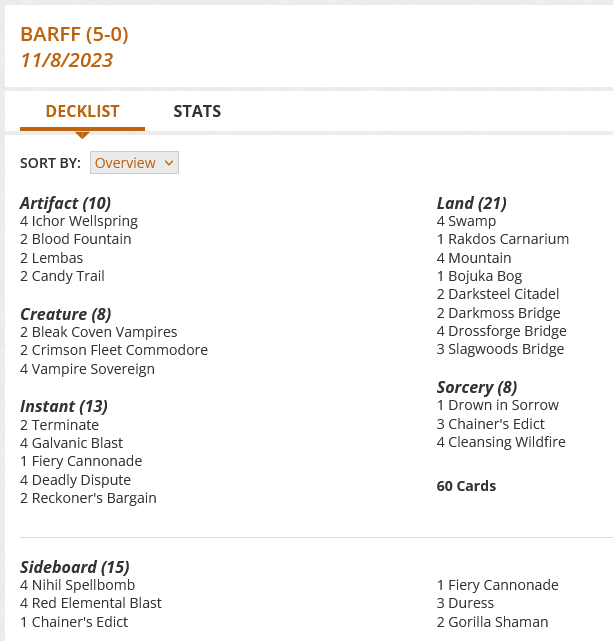
Rakdos Wildfire is not a new strategy but it is one that has not been seen in quite some time. This build is leaning hard into the life gain elements by running the full suite of Vampire Sovereign and a pair of Bleak Coven Vampires. This build also is running a pair of sweepers main and plenty of removal, but I would love to see a more robust win condition outside of trying to Siege Rhino the opponent.
Scam in every format? While Pauper lacks the pitch elementals you can still cast Dark Ritual, cycle a giant monster, and then Exhume it back on turn one. This build also has outs to a first turn Monarch Emblem and turn two Initiative. I am a big fan of Exhume strategies and am hopeful there’s a way that this one can find some firm footing in the metagame.
I want to take a moment to thank all my Patrons – both old and new. I am going to do my level best to keep providing you with the kind of content that brought you here in the first place. If you are interested in supporting my work, rewards for my Patreon start at just $1 and every little bit helps.
Can’t make a commitment to Patreon? I now have a Ko-Fi where you can make a one time contribution.
Looking for another way to support my work? Click here for my TCGPlayer affiliate link. Any purchases through the link let the folks there know you like my content!
I use a few different metrics when looking at the Top 32 metagame. The first is just Raw Volume. The second is Win+, which takes the sum of all wins at X-2 or better in the Swiss and assigns a score; Win+ is helpful in measuring a deck’s Swiss round performance. K-Wins takes all of a deck’s wins and subtracts its losses, Top 8 inclusive; this helps to give a measure of overall performance. The final pair is call Meta Score and Meta Score Above Replacement, which takes the average of Win+ and K-Win to try and position an archetype against its field. This number helps to provide the most robust image of a deck’s performance.
Sometimes it can be hard to write about Pauper at this point in its life cycle. With a new set on the horizon it is exciting to look forward and consider what might be, as opposed to looking back and potentially bemoan what is. But that would be a disservice to what is happening in the final weeks of Wilds of Eldraine season.
Blue is ascending. Over the past month decks such as CawGate, Blue Terror, and Dimir Faeries have battled for the top spot in the metagame. Considering that for many months the top decks were either Kuldotha Red or some Affinity variant, this shift seems almost sudden and yet comfortable. Faeries, specifically, has been one of the top decks in Pauper for quite some time. Whether they are mono blue, Izzet, or Dimir, Spellstutter Sprite decks have been a staple of Pauper and their absence over the past several months has been felt.
So how did they return?
Over the course of the past several weeks CawGate began to position itself as an answer the the metagame. It had the tools to keep red decks in check and the ability to get around the large threats of Terror. At its core, however, the deck remains a blue-white midrange strategy. It relies on a light suite of interaction to stop key spells from the opponent and leverages its creature base to provide a form of virtual card advantage. You can’t counter the Embalm of Sacred Cat easily and eventually Basilisk Gate will force the opponent to either throw blockers in the way or lose all their life points. CawGate was able to position itself to go over the aggro decks and around the control decks.
Dimir Faeries eats this sort of midrange deck for lunch. The deck has access to better removal and more stack interaction. It can also play a “flash” game with Spellstutter Sprite coming down to leverage card flow on the next turn from one of its two Ninja so it can leave more mana open on its turns while CawGate runs a bevy of lands that enter the battlefield tapped and has to operate largely at sorcery speed. If CawGate goes over aggressive strategies and sidesteps control, Dimir Faeries sidesteps CawGate.
Traditionally, Boros strategies have been able to sidestep Dimir Faeries. Going wide with flyers such as Kor Skyfisher or Battle Screech tokens has been a solid counter to Faeries. I am not sure if that is the case any longer thanks to the addition of Murmuring Mystic, which can gum up the air just as easily as it clogs the ground. Instead decks may have to look for persistent forms of damage in the vein of Makeshift Munitions to try and keep the fair folk grounded. We have already seen black based midrange decks move back to Cuombajj Witches as an “answer” to tiny flying creatures.
Beating Dimir Faeries is not as simple as just answering their threats. Given the options at the deck’s disposal many strategies are unable to beat them card for card. Between Ninjas, the Monarch, hand scultping, and now Lorien Revealed it is incredibly difficult to out card Faeries using individual pieces of cardboard. Munitions and Witches are cards that stick around and provide virtual card advantage – that is they can render multiple opposing cards less useful by their mere presence. The goal here, then, is to find cards such as these and maneuver the game to a position where they can take over.
The other option is to go wide in a way that Faeries might struggle to stop. Traditionally Elves was well suited to this endeavor. While the deck has not picked up that many new toys it can still vomit out a veritable army thanks to Quirion Ranger and Priest of Titania. While a single Suffocating Fumes is unlikely to quash an elvish uprising, Arms of Hadar makes things more challenging.
As for next week? I would look for an Izzet deck that can not only leverage Murmuring Mystic and Makeshift Munitions, but also find a way to make another new sweeper – Sulfurous Blast – work. It should not be too hard considering the number of five toughness monsters available to blue these days.
I want to take a moment to thank all my Patrons – both old and new. I am going to do my level best to keep providing you with the kind of content that brought you here in the first place. If you are interested in supporting my work, rewards for my Patreon start at just $1 and every little bit helps.
Can’t make a commitment to Patreon? I now have a Ko-Fi where you can make a one time contribution.
Looking for another way to support my work? Click here for my TCGPlayer affiliate link. Any purchases through the link let the folks there know you like my content!
I use a few different metrics when looking at the Top 32 metagame. The first is just Raw Volume. The second is Win+, which takes the sum of all wins at X-2 or better in the Swiss and assigns a score; Win+ is helpful in measuring a deck’s Swiss round performance. K-Wins takes all of a deck’s wins and subtracts its losses, Top 8 inclusive; this helps to give a measure of overall performance. The final pair is call Meta Score and Meta Score Above Replacement, which takes the average of Win+ and K-Win to try and position an archetype against its field. This number helps to provide the most robust image of a deck’s performance.
Okay folks, before I dive in to today’s post I highly (highly) encourage you to read this post from two weeks ago that goes into a bit more detail about the different metrics I use in examining the Pauper metagame.
Last weekend saw three events on the Magic Online Pauper calendar. Not only were there the regularly scheduled Saturday and Sunday Challenges, but there was also a Pauper Qualifier on Saturday. While I pay attention to every Challenge, Showcases and Qualifiers tend to provide some more robust data. This is because these tournaments tend to have more rounds than a typical challenge which helps to reduce the impact of variance on results. These events also attract a larger audience than the typical Pauper Challenge which can mitigate some of the accepted conventional wisdom in the format. So when an event of this nature has eight different blue decks in the Top 8, and another four in the Top 16, I sit up and take notice.
I don’t want to get too much deeper into this post without getting to the main point, so here it is: blue is back in a big way. While a massive amount of the discourse over the past few months has been about the various red decks packing Monastery Swiftspear, the story of Wilds of Eldraine season to this point has been the steady climb of CawGate and now, the return of Dimir Faeries.
But that’s the end result. Let’s take a look at what has gone on as of late. I think it’s important to start with Kuldoltha Red. This deck has 80 total appearances thus far this season with an impressive 18 Top 8s and two wins. It held a health 1.19 adjusted Meta Score Above replacement for the first four weeks before plummeting to a 0.01 in the second four weeks. It’s aMSAR on the season sits at 0.82.
When I talk about Kuldotha Red I am specifically referring to decks that run Kuldotha Rebirth. Some of these decks are lower to the ground, sticking with one drops while others have incorporated Name Sticker Goblin to their gameplan.
These, a decks like them, have provided a consistent clock to Pauper for months. They hit the board early and can apply pressure while reloading in the middle stages of the game thanks to red’s new suite of card “draw”. Despite their popularity and the amount of digital ink spent on dissecting these builds they have somewhat under performed, especially in Challenges.
So what gives?
The vast majority of online Pauper play takes place in Leagues – five round non-sequential event that have scaling rewards for three, four, and five wins. Leagues are a great way to get in reps with a deck but also a great way to grind for more prizes. If the goal is to play as many leagues as possible to garner the more reward, then red decks make sense since they can breeze through a league and have draws that Just Win. This in turn can impact the way people feel about the format at large, especially if they are running into red deck after red deck in a league. Given that Leagues are one of the best ways to practice a deck for the Challenges it also means that many players come to these tournaments expected red, which in turn has placed increased importance on Blue Elemental Blast and Hydroblast.
This is a very important piece I do not want to get lost: the rise of blue makes sense given the incentive structure of leagues and the nature of red decks. As blue has the best answers to red, the question becomes what is the best blue deck to run.
The answer, it seems, is CawGate. This flexible midrange strategy has been the best performing archetype over the past two months. It has 31 Top 8 finishes in 60 total appearances, with a trio of wins as well. It is the best performing deck in the Swiss rounds, and the best performing deck taking Swiss rounds and the Top 8 into consideration. It has an aMSAR of 1.54 for the entire season (0.44 for the first four weeks; 1.73 for the second four weeks) which is the best mark amongst all decks.
There’s a lot to like about these decks. Sacred Cat and Basilisk Gate can undo several turns of attacking after Prismatic Strands helps you stabilize. The game will eventually end with a flyer or Guardian of the Guildpact that has passed through the Gate. The mana base makes it easy to splash important off color cards (one of the Top 8 decks from the qualifier leaned into green for Centaur Healer, for example) and the result is a deck that can be tuned for a wide variety of metagames.
Is CawGate as good as the numbers indicate? Thus far this season the answer is yes. The deck has enough tools to get it over the finish line and the right mix of interaction to keep pace against the wide gamut of archetypes that can get thrown at it. The mana base also allows it to pack anti-blue cards that other blue decks cannot support.
The numbers on Dimir Faeries are not nearly as impressive as those in the other two decks discussed today. It only has 21 appearances with eight Top 8 finishes and two wins. It had a -0.20 aMSAR for the first four weeks, countervailed with a 0.62 score for the second four weeks for a 0.30 overall score. But if CawGate is the best deck for the season, Dimir Faeries may be the best deck for this moment. Traditionally Dimir Faeries is the midrange control deck that preys on other blue decks. As people go lean on their counterspells with cards like Dispel and Spell Pierce, Spellstutter Sprite shines bright as a way to win stack battles. Dimir Faeries also has several ways to keep cards flowing between Ninjas and the Monarch and enough removal to keep opposing threats off the board. The strategy has only been back in force for two weeks but given how well it has performed in that time (weekly aMSARs of 2.26 and 0.88) I fully expect it to keep putting up numbers.
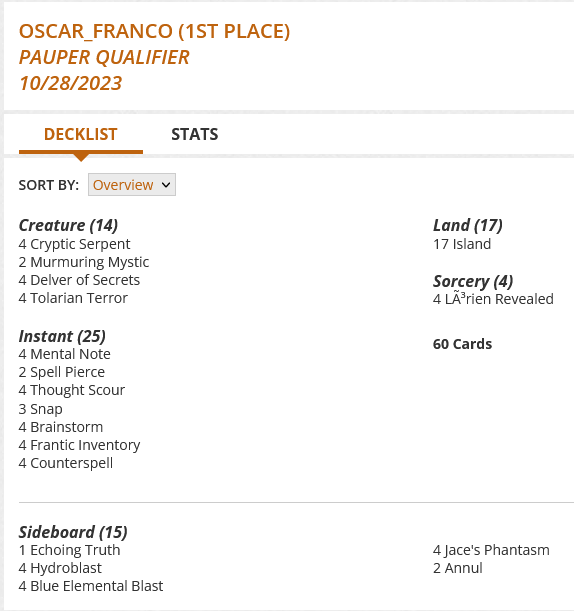
Blue Terror is right behind CawGate in terms of seasonal aMSAR (1.5). With 19 total Top 8 finishes and four wins in 69 total appearances the deck has been a consistent force at the top of the metagame since Cryptic Serpent made its way to common. The deck is lean and has minimal flex slots. Even then, the build above has found the way to be relevant in the ascending control meta with Murmuring Mystic. Mystic has the ability to completely take over control mirrors thanks to its ability to churn out threats. As the number of control decks in the meta rise I anticipate Mystic will be one of the defining cards of the final two weeks of Wilds of Eldraine season.
What do I mean about an ascending control meta? As mentioned previously the prevailing conversation in Pauper as of late has centered on the strength of red decks and how they have forced blue decks to play a bevy of Blasts. Other decks have risen up around these two focal points, including a surge in Golgari Moment’s Peace decks that seek to drawn the game out as long as possible.
These strategies have been marginally successful to this point in part for their ability to take down red decks but also provide enough interaction to stymie the Terror builds and other aggressive strategies like Glitter Affinity, Bogles, or Heroic. But these decks are not able to play control the same way against Faeries since they can simply pick their spots with countermagic for maximium impact. Dimir Faeries, for example, lines up rather well against the above list.
The control decks have reached a point where they can not only reasonably handle the red decks, but they can also deal with the decks that have come to beat up on aggro. In many ways this is a typical Pauper development, with Faeries rising to the top. It is entirely possible that in a few weeks time we will see the return of Boros to the metagame, or perhaps Orzhov Ephemerate will rise up again.
Now when we talk about the format we cannot start with the primacy of Swiftspear. It is easy to point at the results from this weekend and say that blue rose to the top due to its ability to handle red. At the same time, they also had to handle the non-red decks and other blue decks, all while hampered by the dead weight of between four and eight sideboard cards.
How can you approach this metagame? Faeries decks are traditionally week against “go wide” white strategies but these decks have been a step behind in recent weeks. It is not that they have gotten worse but the other decks have gotten lower to the ground and tapping out for Battle Screech isn’t nearly as daunting if the blue deck has its own flying army at its disposal. It could be Electrickery‘s time to shine once again which could translate to a boon for traditional Boros Bully.
I want to take a moment to thank all my Patrons – both old and new. I am going to do my level best to keep providing you with the kind of content that brought you here in the first place. If you are interested in supporting my work, rewards for my Patreon start at just $1 and every little bit helps.
Can’t make a commitment to Patreon? I now have a Ko-Fi where you can make a one time contribution.
Looking for another way to support my work? Click here for my TCGPlayer affiliate link. Any purchases through the link let the folks there know you like my content!
I love what this deck is trying to do. Ichor Drinker might not be Sacred Cat but it passes through Basilisk Gate nearly as well (while also being immune to Snuff Out on the front half). Stitch it together with a light Food engine (would Candy Trail be better than Golden Egg here?) and you have a recipe for a deck I am sure to test out and somehow make worse.
I am very high on damage prevention effects at the moment and this Golgari Fog deck is pretty neat. The deck is light on win condition, leaning on Crypt Rats in a big way, as well as a single Mirkwood Bats to turn all those Heap Gate Treasures into damage. As much as I love the idea behind this deck I doubt that I have the patience to play this one but if you do, more power to you for sure.
This list, from my Pauper Format Panel colleague, is another take on the Golgari stall strategy. We see copies of Moment’s Peace again and tons of ways to gain life, including Fangren Marauder. This, however, feels like a deck that could benefit from Heap Gate and the excess Treasures it creates because the one of the few things better than making a Treasure is gaining five life off of sacrificing it.
I want to take a moment to thank all my Patrons – both old and new. I am going to do my level best to keep providing you with the kind of content that brought you here in the first place. If you are interested in supporting my work, rewards for my Patreon start at just $1 and every little bit helps.
Can’t make a commitment to Patreon? I now have a Ko-Fi where you can make a one time contribution.
Looking for another way to support my work? Click here for my TCGPlayer affiliate link. Any purchases through the link let the folks there know you like my content!
I use a few different metrics when looking at the Top 32 metagame. The first is just Raw Volume. The second is Win+, which takes the sum of all wins at X-2 or better in the Swiss and assigns a score; Win+ is helpful in measuring a deck’s Swiss round performance. K-Wins takes all of a deck’s wins and subtracts its losses, Top 8 inclusive; this helps to give a measure of overall performance. The final pair is call Meta Score and Meta Score Above Replacement, which takes the average of Win+ and K-Win to try and position an archetype against its field. This number helps to provide the most robust image of a deck’s performance.
Any conversation about the last weekend in Pauper needs to start with Beicodegeia’s absurd run as of late. They have taken first (either through an outright victory or an agreed upon split) in seven of the last ten Challenges with four different strategies. During that stretch folks have calculated Beicodegeia’s win rate at around 70%, which borders on obscene. Not only are they a fantastic player, but they also have a stellar read on the metagame.
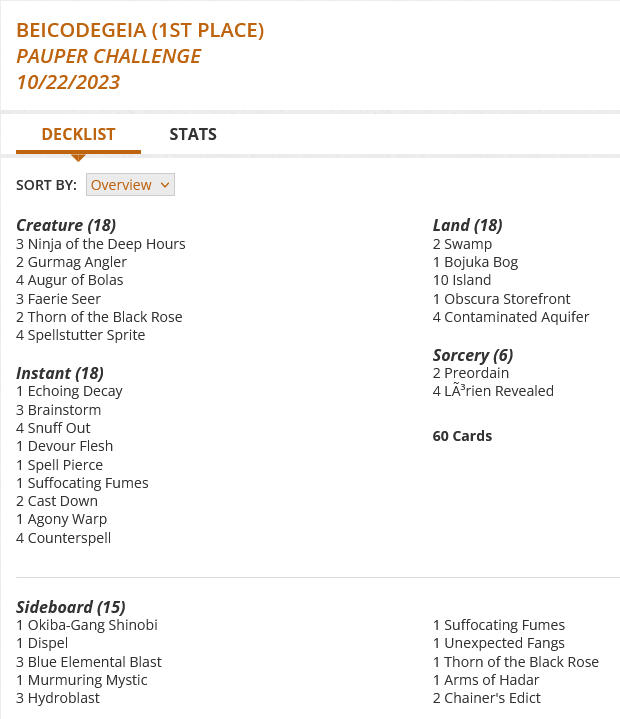
This weekend Beicodegeia took down both Challenges with 74 of the same cards in their deck. The biggest difference was on Saturday they used two copies of Arms of Hadar in their sideboard and on Sunday they cut a copy for Okiba-Gang Shinobi. And this shift is emblematic of the bigger change in the Pauper metagame over the past few weeks.
The driving forces in the metgame for the first portion of Wilds of Eldraine season have been aggressive strategies. Glitter Affinity and Kuldotha Red clearly fall on the aggressive side of the spectrum. Blue Terror is not an aggro deck per se but it is hardly a control deck. Instead it wants to churn to large threats and protect them once they hit the board instead of dragging the game out forever. Three weeks ago CawGate began to emerge as the best deck of the moment and as a result aggressive strategies began to struggle. And now what comes back to roost?
Faeries.
Dimir Faeries is one of the premier “fair” decks in the format and it is well positioned to prey on other control strategies that are trying to beat the beatdown decks. After Counterspell other control decks have started to lean on Dispel and Spell Pierce to round out their interactive suite. And you know what dodges them both? Spellstutter Sprite. Combine that with the ability to see a ton of cards and you have deck primed to prey on the other prevalent “control” decks of the day while packing enough removal to hold its own against aggro. And if the switch from Arms to Shinobi is any indication, control is on the rise while aggro has taken a step back.
The next question that presents itself goes something like this: can this last? Has Pauper again reached a state where aggressive strategies are not at the tip-top of the metagame and are instead merely another good option? Have solutions been found to slow things down enough for other decks and ideas to take hold?
Does it matter?
What I mean is, if the meta is changing at the top but it is familiar faces taking over, is that a good change? This goes to the core of non-rotating formats. In some sense, having Faeries be a viable strategy again is aGood Thing in that having stable staples can provide a sense of security. In another very real way, it can be disheartening to see new gods toppled only for old titans to take their place.
In the micro, next week I would focus on building something resilient that does not fold to Snuff Out (nor need it as a key piece of the deck’s structure). Orzhov Ephemerate could be well positioned as it can match Dimir’s value while playing to the board, but Mono White Aggro could sneak in and find the middle road between lingering aggressive tendencies and the rising tide of control.
I want to take a moment to thank all my Patrons – both old and new. I am going to do my level best to keep providing you with the kind of content that brought you here in the first place. If you are interested in supporting my work, rewards for my Patreon start at just $1 and every little bit helps.
Can’t make a commitment to Patreon? I now have a Ko-Fi where you can make a one time contribution.
Looking for another way to support my work? Click here for my TCGPlayer affiliate link. Any purchases through the link let the folks there know you like my content!
Let’s start off with this take on Jeskai Gates. This deck is wild and I worry it’s trying to do too much. While it has a ton of way to generate artifacts I worry it is not enough to support Galvanic Blast. I wonder if moving to an Ash Barrens mana base and moving some cards around could support Unholy Heat as a secondary removal spell. I also am not the biggest fan of Navigator’s Compass in general but I can see the utility in a heavy red metagame.
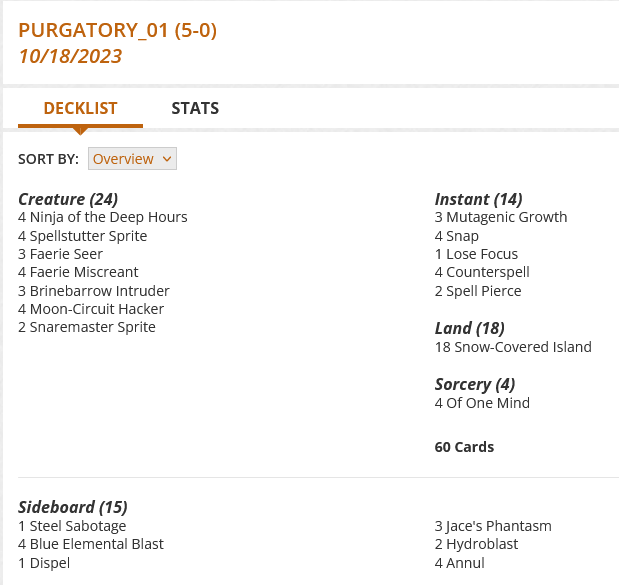
There’s nothing special about this Faeries list but I want to talk about the sideboard. Jace’s Phantasm is an inspired choice as a way to fight against all the Tolarian Terror/Cryptic Serpent decks running around. An early Phantasm can get out of hand quickly. While this strategy might not work as well against Dimir and Izzet stripes, the Phantasm can apply real pressure to the mono-blue versions of the deck.
I love what Beicodegeia is doing here. Slowing down the Dimir Terror shell to be a more true control deck, this list leans more into the removal available in black and the late game power of Murmuring Mystic and Thorn of the Black Rose to slam the door after biding time early. I do wonder if this deck has enough to stymie the red decks but the pilot here is one of the best Pauper players right now so I’m inclined to believe it’s a solid choice.
I want to take a moment to thank all my Patrons – both old and new. I am going to do my level best to keep providing you with the kind of content that brought you here in the first place. If you are interested in supporting my work, rewards for my Patreon start at just $1 and every little bit helps.
Can’t make a commitment to Patreon? I now have a Ko-Fi where you can make a one time contribution.
Looking for another way to support my work? Click here for my TCGPlayer affiliate link. Any purchases through the link let the folks there know you like my content!
I use a few different metrics when looking at the Top 32 metagame. The first is just Raw Volume. The second is Win+, which takes the sum of all wins at X-2 or better in the Swiss and assigns a score; Win+ is helpful in measuring a deck’s Swiss round performance. K-Wins takes all of a deck’s wins and subtracts its losses, Top 8 inclusive; this helps to give a measure of overall performance. The final pair is call Meta Score and Meta Score Above Replacement, which takes the average of Win+ and K-Win to try and position an archetype against its field. This number helps to provide the most robust image of a deck’s performance.
Today I want to make the case that at the current moment CawGate is the best deck in Pauper. To do this I am going to lean on the metrics I use in metagame discussion, specifically adjusted Meta Score Above Replacement. But given that I want to take a few moments to explain exactly what this score represents.
The statistic I have been tracking for the longest (beyond raw volume) is something called Win+. Win+ measures a deck’s Swiss record with a point for each win at X-2 or better. In a six round tournament a 4-2 record is worth 1 Win+ point; in a seven round tournament a 5-2 record is worth 1 Win+ point. The goal of this score is to see how a deck performs in relation to the lowest placing Top 32 deck (with a positive record). This metric only covers Swiss record; K-Wins however is inclusive of Top 8 wins and losses. K-Wins measures a deck’s total wins and subtracts the total losses. Together Win+ and K-Wins gives a broad picture of how well an archetype performs in the abstract.
The next measure is Meta Score, which is contingent on Win+ and K-Win. In fact, it is an average of the two scores; the Meta Score Above Replacement takes the average of all Meta Scores to set a baseline for a weekend and then measures the Meta Score against that average. For example, CawGate had a Meta Score of 1.50 for the most recent weekend while the average of all Meta Scores was 1.53, meaning CawGate’s MSAR was -0.03.
Okay, we’re in the home stretch where we talk about Adjusted Meta Score. Adjusted Meta Score takes the most popular deck by volume and sets it as the baseline. It then takes the a weighted measure of both Win+ and K-Wins (based upon volume) to assign an adjusted Meta Score, and then from there we find the adjusted Meta Score Above Replacement. This provides the best image of how well a deck performed in a given data set against its field
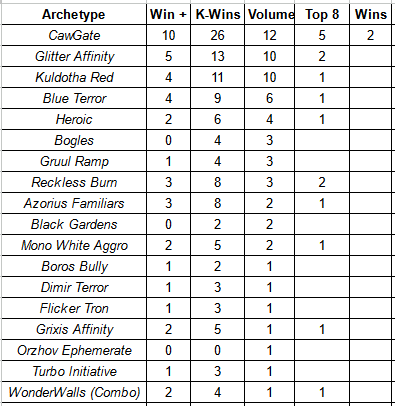
Again, let’s use CawGate from this past weekend as a test case. CawGate had a total Win+ score of 10 with 26 K-Wins. It’s adjusted Win+ for Volume was 0.83; its adjusted K-Win was 2.17. As mentioned it had a Meta Score of 1.50 which is the same as its adjusted Meta Score (CawGate was the most popular deck on the weekend). The average of all adjusted Meta Scores was 0.37 which means CawGate’s adjusted Meta Score Above replacement on the weekend of October 14 and October 15 was 1.13, which was the best score on the weekend.
That’s a lot of words as background as to why today CawGate is my pick as the best deck in the format. Why? It’s aMSAR has been steadily climbing week over week. Here is the progression of CawGate’s aMSAR over the first six weeks of Wilds of Eldraine Season: -0.04, 0.12, 0.22, 1.26, 2.13, 1.13. While the most recent weekend looks like a step backwards it was the best score of an archetype on the weekend.
So what is going on? The earlier weeks of the season were defined by assertive decks like Blue Terror, Kuldotha Red, and Glitter Affinity. CawGate is not the beatdown in any capacity and instead assumes a midrange control role in the metagame. The steady climb seems to indicate that it found the correct configuration to once again assert its position in the Pauper Challenge metagame.
And on some level it makes sense. The strategy is built, in many ways, around leveraging Prismatic Strands to its full potential (if only someone wrote an article on this subject) and leaning on the correct suite of counter magic. Without knowledge of the expected field you cannot select the proper suite of reactive spells. With a more known metagame this task becomes easier.
How should you approach next weekend? I think Gingerbrute is a good place to start as it can completely get around Prismatic Strands’ damage prevention. If you’re looking to go in a more rogue direction there’s Shepherd of Rot. Zombies is a fringe strategy to be sure but as more red decks adopt Lava Dart I want to be on the deck that can run Festering Mummy to shrink opposing 1/1s.
I want to take a moment to thank all my Patrons – both old and new. I am going to do my level best to keep providing you with the kind of content that brought you here in the first place. If you are interested in supporting my work, rewards for my Patreon start at just $1 and every little bit helps.
Can’t make a commitment to Patreon? I now have a Ko-Fi where you can make a one time contribution.
Looking for another way to support my work? Click here for my TCGPlayer affiliate link. Any purchases through the link let the folks there know you like my content!









 NerdtotheCore
You must be logged in to post a comment.