
Want to learn more about the metrics I use in tracking the metagame? You can find an explainer here.
As has become tradition here, we are four weeks into a play season which means it is time to dig a bit deeper into the metagame. Today, instead of relying on the explainer linked above, I want to talk a bit more about what the statistics I track and how you can use them to inform your approach to playing in Pauper events. For this exercise we are going to be using a 2% cut off of Top 32 volume, which translates to roughly ten appearances over the course of the 16 tournaments.
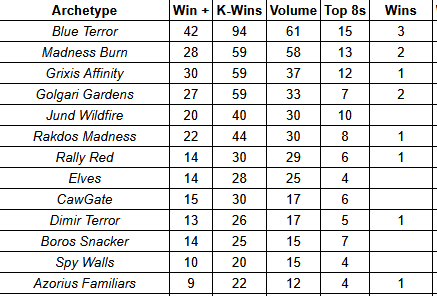
Thirteen decks had at least ten appearances in the Top 32 over the past month. Blue Terror and Madness Burn were the two most popular and also are leading the field in Top 8 appearances. Win+ measures a deck’s performance against an X-3 record in the Swiss rounds. K-Wins takes all wins less all loses, Top 8 performance included. These are mere counting stats and without proper context do little to tell us about how well these decks are performing in comparison to each other.
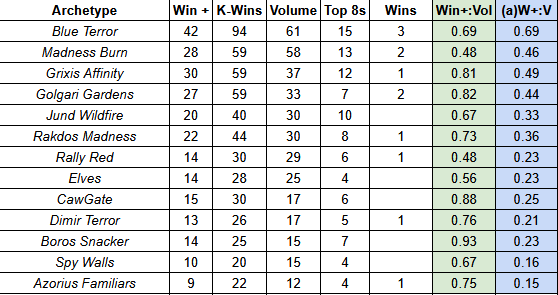
Win+ is useful for understanding how well a deck does during the tournament itself. As a Win+ score approaches 1, a deck is more likely to be finishing in the Top 16. From the green column we see that Boros Snacker comes the closest to finishing in the Top 16, followed by CawGate and Golgari Gardens. However these decks combined only have four more Top 32 finishes than Blue Terror. This is where the blue column – Adjusted Win+:Volume comes into play. This metric corrects for how popular a deck is (or is now) in comparison. These numbers are deflated compared the unadjusted metric but still provide insight.
When looking at Swiss performance it is important to take both numbers into account. A smaller sample size should not render a finish moot, but the popularity has to be considered. Based upon these numbers, I would rank Blue Terror as the best deck for Swiss rounds, followed by Grixis Affinity, Golgari Gardens, Cawgate, and then Madness Burn.
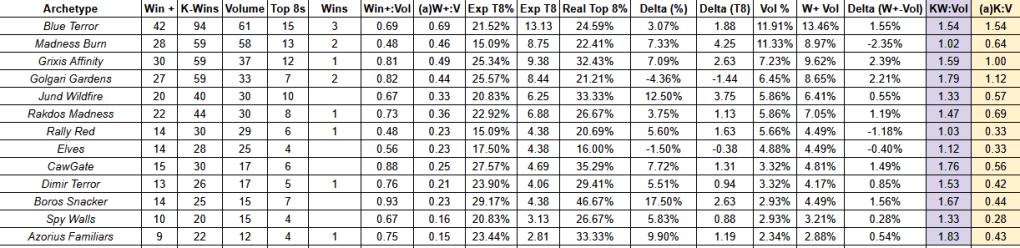
Apologies for the small image – if you want access to the full spreadsheet you can sign up for my Patreon – but we are going to be focusing on K-Wins in this segment. Again, this measure takes into account Top 8 performance and measures all wins less all losses. Here as the number approaches 2 we are averaging a finish closer to the Top 8 than the Top 16. Once again, sample size can confound the data which is why the raw ratio (purple) has some outliers. Azorius Familiars, for example, might have a better average finish than Blue Terror but does that make it a stronger deck?
The yellow column corrects for presence. Again it should come as no surprise that Blue Terror is leading the pack but under the hood we are seeing some movement. Golgari Gardens jumps past Grixis Affinity when looking at the format from this metric. After those two I would probably places Rakdos Madness ahead of CawGate.
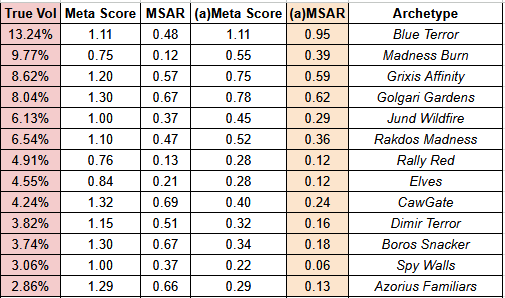
Here we travel to the other end of the chart where we get to some of the more “all encompassing” numbers. First in red is True Volume. This is what I commonly refer to as “Winner’s Metagame Percentage” and takes an average of the actual Top 32 presence, the percentage of overall Win+ points, and the percentage of overall K-Win points. This provides an general idea of how strong a given strategy is in the Challenge Metagame. In this measure we see that Blue Terror has started to pull away from the rest of the field while Madness Burn, Grixis Affinity, and Golgari Gardens form a solid second tier.
And finally there’s Adjusted Meta Score Above Replacement. Borrowing from baseball’s concept of Wins Above Replacement (or WAR), this is designed to see how good a deck is against an average (or replacement level) Top 32 deck. The Meta Score is based upon the Win+ and K-Win to volume ratio while the adjusted score is based upon the adjusted versions of those measures. Once more, Blue Terror leads the pack while Golgari Gardens and Grixis Affinity end up in the second tier.
So this is what I take into consideration when I explore the top of the Pauper metagame. The stronger a deck does in these areas, the more likely I am to give it more weight and push it up the Power Rankings, while also giving it more credence in what people should be considering when they hit the digital tables. So with all of that being said, here is were I see Pauper after four weeks of Avatar: The Last Airbender:
Power Rankings
Dropped from rankings: Boros Snacker, Dimir Terror
10. Elves
9. Rally Red (Not Ranked)
8. Azorius Familiars (-4)
7. Jund Wildfire (+1)
6. Rakdos Madness (-1)
5. CawGate (Not Ranked)
4. Madness Burn (+2)
3. Grixis Affinity
2. Golgari Gardens
1. Blue Terror
I want to take a moment to thank all my Patrons. I am going to do my level best to keep providing you with the kind of content that brought you here in the first place. If you are interested in supporting my work, you can sign up for my Patreon starting at just $1.
Can’t make a commitment to Patreon? I have a Ko-Fi where you can make a one time contribution.
 NerdtotheCore
One thought on “The First Four Weeks of Avatar Season”