
Want to learn more about the metrics I use in tracking the metagame? You can find an explainer here.
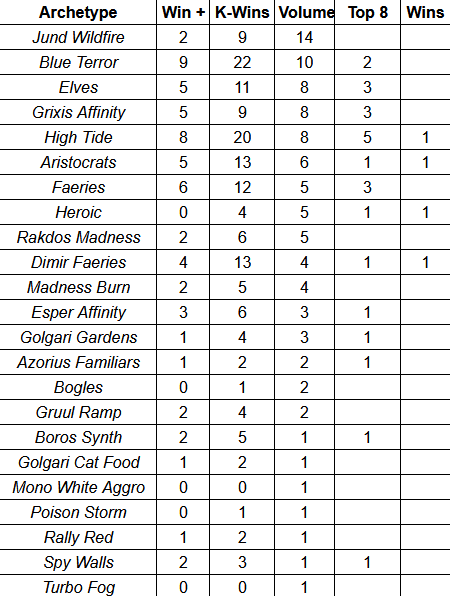
It is impossible to tell the story of last weekend’s Magic Online Pauper Challenges without addressing High Tide. The deck made eight total appearances in the Top 32 and five of those ended in the Top 8 (including a win). Gavin Verhey of Wizards of the Coast and the Pauper Format Panel announced that the update on the format had been moved to November to align with the other Banner and Restricted List updates. This announcement is supposed to decide the fate of High Tide – whether it is banned once again or allowed to persist. The anticipation is palpable and if you are following the discourse then you probably know how people feel about the deck. Almost no one feels it is oppressively strong in the metagame and yet many people want the deck neutered in some way because of how it impacts tournaments.
High Tide is non-deterministic. When the deck goes for it there is a high chance of success but it is not guaranteed, which means the correct play in a tournament setting is to hope the Tide pilot fizzles; that they run into a sequence of cards that opens the window for you to take one more turn and hope they don’t go for it again. The High Tide combo turn can be a plodding ponderous thing that requires constant attention and tracking. The Professor recently featured such a turn as a part of the closing credits of his Shuffle Up & Play series and if you have a quarter hour to spare you can check the turn here. Yes, this is played for laughs and yes, there are pilots who can move through the operations more quickly. That does not take away from the reality that these kinds of moments exist and can wreck havoc on a tournament’s timeline and participants enjoyment (beyond the agony of defeat).
What about the deck’s performance? It is merely above the curve. Over Tarkir Dragonstorm season High Tide had an Adjusted Meta Score Above Replacement of 0.48 – about half a win better than an average Top 32 deck in that span. It’s mean finish was just outside the Top 16 and it had two wins in nine Top 8 appearances. But there’s another stat I measure that I don’t break out often – Expected Top 8% against Actual Top 8%. Given a deck’s average Swiss performance we can estimate how often the deck should make the Top 8. In Tarkir Dragonstorm season High Tide should have made the Top 8 in 23.85% of its Top 32 appearances, or 9.06 times. While the strategy didn’t meet the fractional mark, it played true to form.
In Magic X FINAL FANTASY the deck made the Top 8 ten times with two victories. It had an AMSAR of 0.45 (in line with Dragonstorm) but this time averaged a finish in the Top 16. It had an expected Top 8% of 31.25%, or ten appearances. Once again, High Tide merely performed to its mean. It isn’t until Edge of Eternities that we see the deck bump itself to another level. In the most recently completed season the strategy ended up with an AMASR of 0.43 and again, had an average finish just outside the Top 16. However it had 19 Top 8 finishes and two wins. Given its overall performance High Tide should have ended with a Top 8 conversion rate of 24.48% – around 15 trips to the elimination rounds. It over-performed in this metric to the tune of 7.19%, earning around four additional chances to play more Magic.
Now those numbers might seem gaudy, and they are in isolation. However if we look at two of the more popular and successful decks in the format, we see another story. Blue Terror had around a dozen Top 8s above expectation during Edge of Eternities season; Jund Wildfire had around eight more opportunities to win the trophy. Yes, High Tide has been good, but when taken in the context of the metagame that has been where the deck tops out. Even in the current season (three weeks in) it has the third best AMSAR of 0.62 (behind Blue Terror and Aristocrats) and us currently performing about two Top 8s above expectation.
On the numbers, the deck does not appear to be an issue. That being said there are things these statistics do not tell us. They do not tell us how many people opt out of the deck due to clock considerations nor how successful the deck is in tabletop play. They do not tell us how many rounds go to time or past (active player finish your turn and then there are five additional turns does not come with a hard cap on minutes). We do not know how many people have zoned out, miserable that they couldn’t grab a bite to eat because there was an iota of a chance they could pull out a win if and only if the opponent couldn’t find the key card.
I don’t have an answer for you today, but I want to know what you think: what do you think should happen to High Tide?
Power Rankings
10. Rakdos Madness (Not Ranked)
9. Rally Red (-3)
8. Faeries (+1)
7. Madness Burn (-2)
6. Dimir Faeries (NR)
5. Grixis Affinity (-1)
4. Jund Wildfire (-3)
3. High Tide (+5)
2. Aristocrats (+1)
1. Blue Terror
I want to take a moment to thank all my Patrons. I am going to do my level best to keep providing you with the kind of content that brought you here in the first place. If you are interested in supporting my work, you can sign up for my Patreon starting at just $1.
Can’t make a commitment to Patreon? I have a Ko-Fi where you can make a one time contribution.
 NerdtotheCore
One thought on “October 10-12 Pauper Weekend Recap”