
Want to learn more about the metrics I use in tracking the metagame? You can find an explainer here.
Change is a constant. While it sometimes moves slow – as it did for much of Pauper’s history – it still takes marches on. Entropy is a natural state and to defy it is to swim upstream against the way of things. In Pauper the combination of a series of bans and a powerful release in FINAL FANTASY has resulted in a format that while familiar, has some striking differences. With four weeks of Magic Online Challenge data available, as well as the results of the latest edition of Paupergeddon, we can take stock of the format as it exists in the middle of 2025.
It is important to first understand the difference between the digital and tabletop metagames. Magic Online has two main avenues of competition: Leagues and Challenges. Leagues reward quick play-throughs and as such can lead players to choosing decks that have a high ceiling but a low floor. For some participants it is less about selecting the best option but rather the one that will give you the highest yield on your time. It’s not about taking the best shot but rather the most shots. Challenges (and other larger tournaments) instead reward picking consistently good decks. At the same time these events are not so long that the aggressive bias disappears but rather it is reduced. Magic Online also makes it rather easy to switch decks, which leads to players often cycling through archetypes in an effort to maximize enjoyment and success.
Compare this to tabletop, where players may be more locked in to their decks. Physical play can be a more social experience and smaller tournaments can be defined by what decks people have on hand. The larger tournaments – like Paupergeddon – do not take place in a vacuum and players have to draw their information from somewhere. That Paupergeddon cuts to Day 2, like the Grand Prix of yore, means that decks that are consistent (high floor, decent ceiling) have a real shot at making waves.
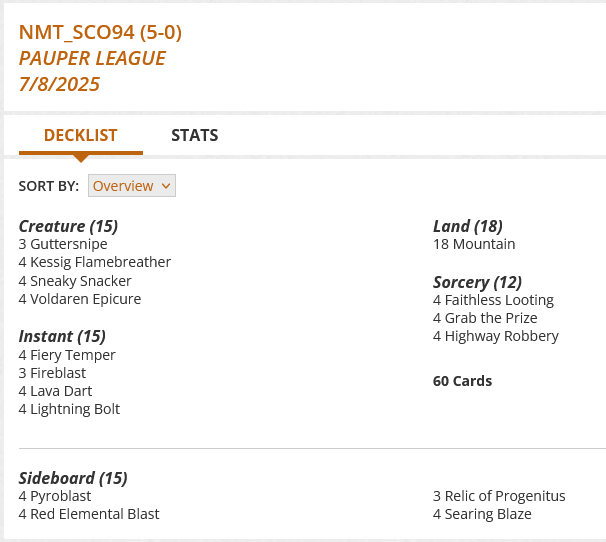
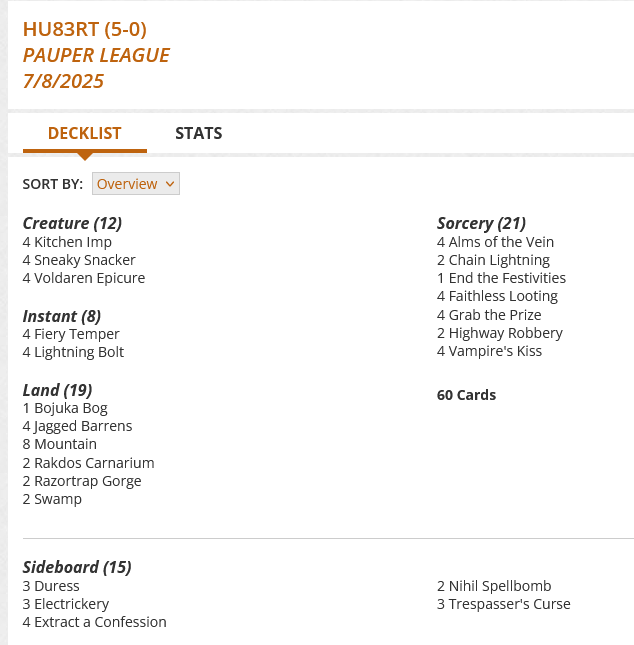
The discourse in Pauper has largely been centered on High Tide but that is not where I am going to start. Rather I am going to talk about the Tier 1.5 competitive decks on Magic Online: Madness Burn and Rakdos Madness. Sneaky Snacker might be the most important red card in Pauper at the moment, powering up these strategies and providing a consistent source of damage. Combined these decks make up just under 17% of the Top 32 metagame and around 17.6% of the Winner’s Metagame. These builds want to turn the “downside” of Grab the Prize and Faithless Looting into an advantage but in doing so they increase their reliance on the graveyard and other synergies. The mono red builds lean on Guttersnipe which exposes them more to a well timed removal spell unlike Red Deck Wins – the descendant of Kuldotha Red. The more traditional red builds are 4.4% of the Top 32 metagame and 4% of the Winner’s Meta.
These decks are one of the defining attributes of digital play due to how fast they can churn through leagues. Even if they are not as powerful in a longer event they are still something to consider and are far from weak. Combined these decks have 21 Top 8 finishes and a pair of wins. The red decks are taking metashare away from each other and an increased reliance on permanents and creatures means decks packing removal are no longer carrying dead weight in the main deck.
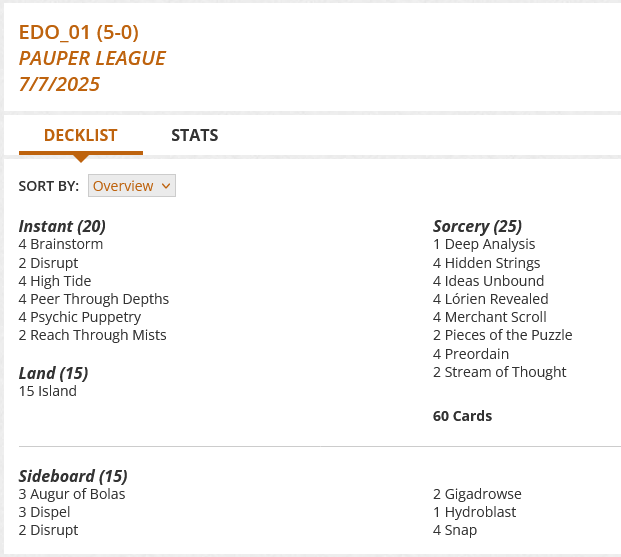
With that out of the way we can talk about High Tide. The deck is polarizing. While the win rate is nothing special the combo turn can often eat up the clock, leaving the person on the other side of the table doing nothing with the hope that the combo player does not find the win. On Magic Online this is less of an issue since each player has an allotment of time. Tabletop, however, has a shared clock where a protracted combo can leave precious little time to complete a match. All that being said High Tide has four Top 8 finishes in FINAL FANTASY season, with 4.95% of the Top 32 metagame and 5.7% of the Winner’s Metagame, good enough to be at the bottom of Tier 2.
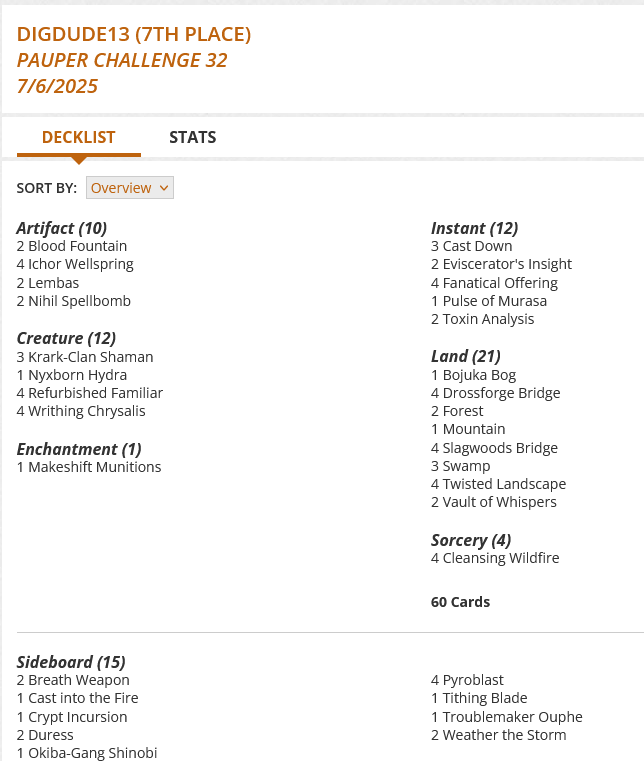
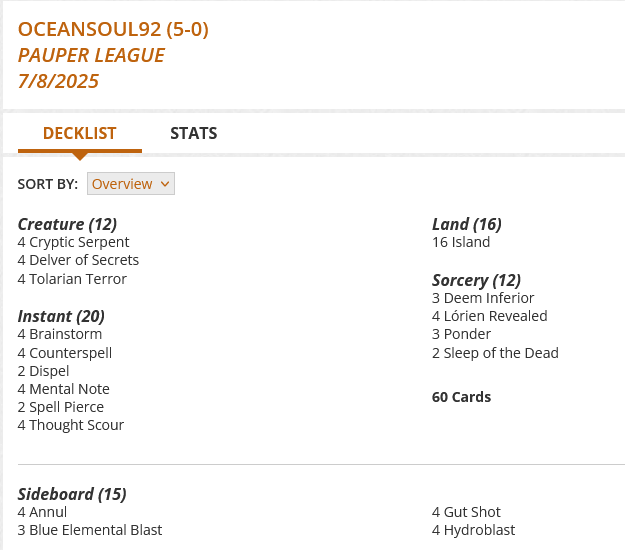
The best decks in Pauper at the moment are Blue Terror and Jund Wildfire. Both of these decks have amassed fourteen Top 8 finishes; Blue Terror has four wins and Jund Wildfire has one. They are the most popular decks (11.46% of the Top 32 metagame for Blue Terror; 10.68% for Jund) and top the Winner’s Metagame as well (13.17% for Blue, 12.69% for Jund). Both of these strategies can present large threats and have the ability to disrupt the opponent either on the stack or in play. They also are able to pack reasonable hate for assertive red decks (Hydroblast, Weather the Storm) and High Tide (counterspells, Pyroblast). Blue Terror and Jund Wildfire also excel at utilizing their mana, either through chaining cantrips to resolve a threat or by accelerating with Cleansing Wildfire and sticking a massive Nyxborn Hydra.
Jund Wildfire has largely supplanted Affinity’s role as the metalcraft enabled midrange deck. The Cleansing Wildfire engine allows Jund to accelerate out threats and Writhing Chrysalis not only outsizes Myr Enforcer, but also fuels the second copy in a way that can make both creatures a more imposing threat. It is clear that Affinity can find success (six Top 8s, 6.82% of the Winner’s Metagame) but it is not the format defining threat it has been in recent history.
There are two other points I want to address from the Magic Online metagame. The first is the continued presence of Black Mage’s Rod. This little artifact is giving tons of decks reach that lacked similar access previously. While black based midrange is hardly a force in the digital realm we are seeing plenty of decks lean on the extra damage from the Black Mages as a way to apply pressure. Grixis Affinity has adopted the equipment as an additional source of damage and Gardens decks – that is black midrange splashing green – have also started to run the artifact.
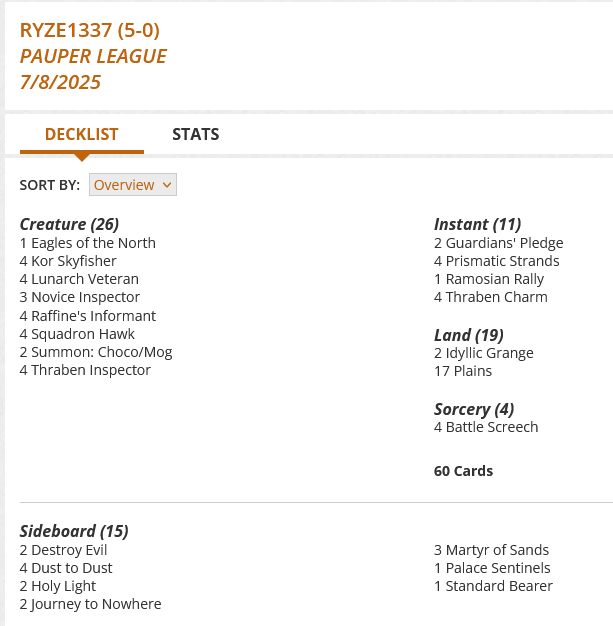
The second point is the steady pace of Mono White Aggro. The strategy has put up six Top 8 finishes with a pair of wins with 5.21% of the Top 32 metgame and 6.17% of the Winner’s Metagame. Mono White has adopted Summon: Choco/Mog as a way to add damage to the board turn after turn and like Loyal Cathar of old it provides virtual card advantage with Kor Skyfisher. It is remarkable that a deck that is largely just power and toughness continues to perform in such a high power format but at the same time it is absolutely awesome that power and toughness still gets the job done.
But what about Paupergeddon? CawGate took down the massive event and out the top decks only Blue Terror made Top 8 at two copies. While the Azorius deck has not entirely vanished from the online metagame it has only three Top 32 finishes in the past four weeks. While some commenters have noted the favorable pairings the winner got along the way, no one ends up winning a massive event on luck alone.
So what does this all mean? Pauper is largely balanced. There is no competitive deck that is miles ahead of the others and the top of the metagame is within grasp of lower tiers. Overall things are in a good spot and players can be rewarded for paying close attention to the trends in the metagame, adjusting accordingly. As I head off for family vacation I am excited to see where things end up as we enter the final weeks of FINAL FANTASY and approach the Edge of Eternities.
Power Rankings
10. Red Deck Wins
9. High Tide
8. Faeries
7. Elves
6. Grixis Affinity
5. Mono White Aggro
4. Madness Burn
3. Rakdos Madness
2. Jund Wildfire
1. Blue Terror
I want to take a moment to thank all my Patrons. I am going to do my level best to keep providing you with the kind of content that brought you here in the first place. If you are interested in supporting my work, you can sign up for my Patreon starting at just $1.
Can’t make a commitment to Patreon? I have a Ko-Fi where you can make a one time contribution.
 NerdtotheCore
One thought on “The First Four Weeks of Final Fantasy”