
Want to learn more about the metrics I use in tracking the metagame? You can find an explainer here.
Hello again.
It’s been a hot minute.
For those of you who don’t know, earlier this month I had some surgery. I thought that, in the run up to the procedure, I would be able to use writing as a distraction – a way to occupy my mind and keep focus away from my impending trip under the knife. I was wrong. I had no energy to look past anything but the operation. Once it was done and I was out of the hospital it took me time to get back into the swing of things. Turns out that have your insides rearranged is an exhausting experience and as much as I enjoy poring over Pauper decklists, the combination of my body and brain were focused on healing.
But, just like my incisions, the urge to write has started to itch again. And so after a few days of playing catchup and getting back into the rhythm of my life (being a dad, going back to work, being aware of but not dwelling on the horrors). Looking at the past several weeks of major Magic Online Pauper tournaments has definitely provided insight into the format. Now since I usually write once a week, but have been gone for the better part of the month, I have decided to talk about the most recent events (the past three weeks) and how those trends vary from the first month of Tarkir Dragonstorm Season.
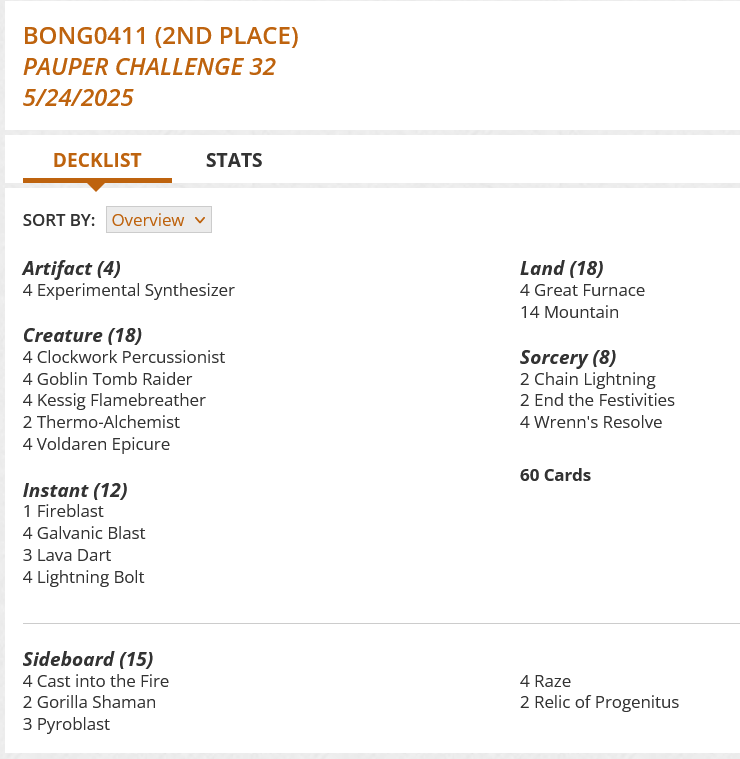
First and foremost, Pauper looks balanced at least in the Challenge metagame. Over the past three weeks – which includes nine Challenges and a Qualifier – the top three decks in the format are all within spitting distance of each other in Winner’s Metagame Share: Red Deck Wins (the heir apparent to Kuldotha Red) at 12.86%, Blue Terror at 11.05%, and Elves (yes Elves) at 9.75%. These are also the three leaders in Adjusted Meta Score Above Replacement (0.84, 0.77, 0.74 respectively).
Compare this to the first four weeks of Dragonstorm season. The top three decks by Winner’s Meta Share were Blue Terror (10.53%), Grixis Affinity (9.51%), and RDW (9.33%). When looking at the aMSAR of these decks, Grixis led the way with 1.21 with Blue Terror behind at 0.92. RDW (0.53) was behind both Flicker Tron (0.58) and Faeries (0.57).
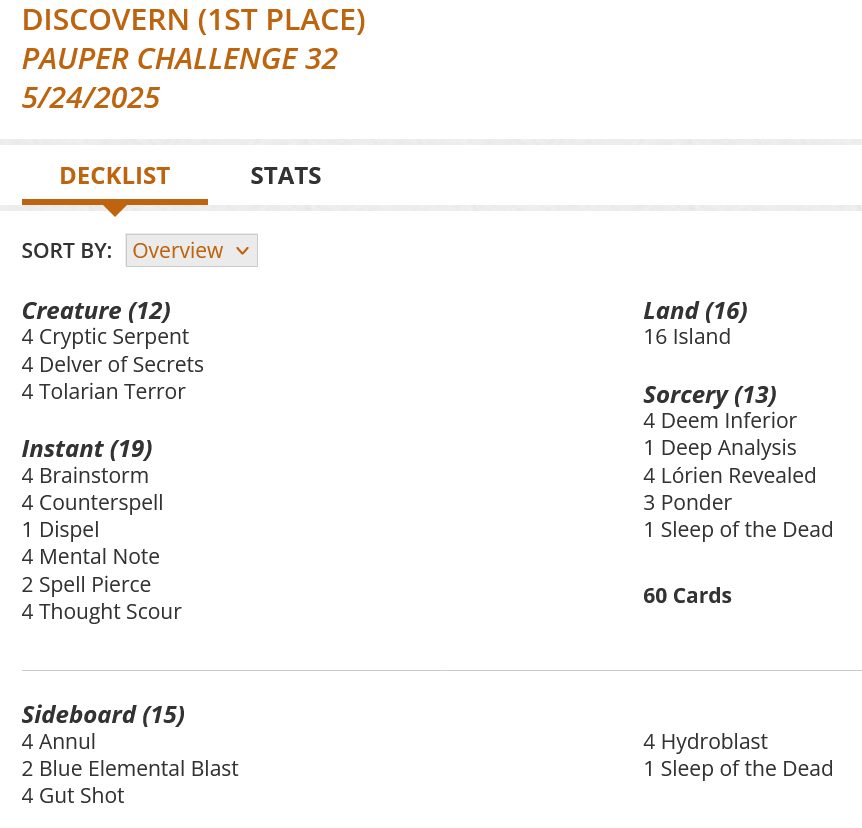
These numbers tell us a few things. First, the metagame is evolving and dynamic. There has been movement amongst the top decks and while many of them are no stranger to the top tier, no deck has a stranglehold on first place. The clustering of the top decks, with none of them topping 15% of the Winner’s Metagame also point to a format where no deck is dominant to a point of concern. RDW has been the most popular deck on raw volume but even those numbers come in under that 15% threshold. The competitive landscape is far from flat but not nearly as stratified as some previous iterations of Pauper.
I would be lying to say I was not concerned about the repercussions after the actions taken by the Pauper Format Panel in March. While I am a member of the Panel and had a say in these decisions I still was wary of what the return of High Tide and Prophetic Prism would mean for overall format health. Much to my delight, both Flicker Tron and High Tide have integrated into the metagame and at this point do not present a problem based on numbers alone. I understand the experience of playing against these decks can leave something to be desired (one can look at my writings on the format during the height of Tron’s power for an example) but based on their results in the weekend tournaments things seem to be just fine.
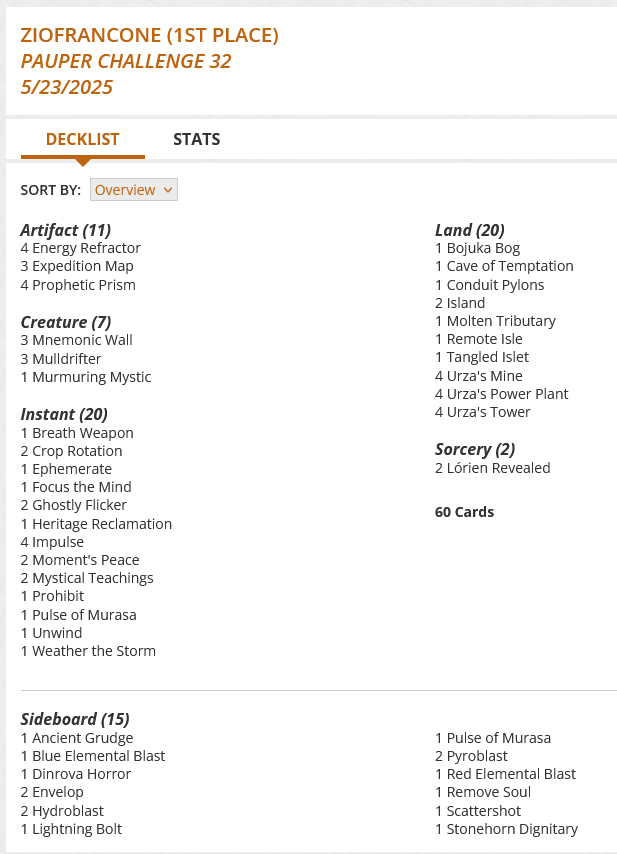
Flicker Tron made up 4.26% of all Top 32 decks during the first four weeks of Dragonstorm Season, improving to 5.3% of the Winner’s Metagame with an aMSAR of 0.58. For the last three weeks the former elephant-in-the-room made up only 1.88% of the Top 32 metagame and 2.87% of the Winner’s Meta, seeing its aMSAR score drop to 0.16. Taken together we see a deck that is certainly capable of strong finishes but is lacking in some ways. Whether the format has gotten too fast for Tron or too few players are iterating on it to find an optimal build or the metagame is dynamic enough that one needs to constantly tinker to present the correct 75 the outcome is that Flicker Tron has simply become another solid option instead of the clear best choice.
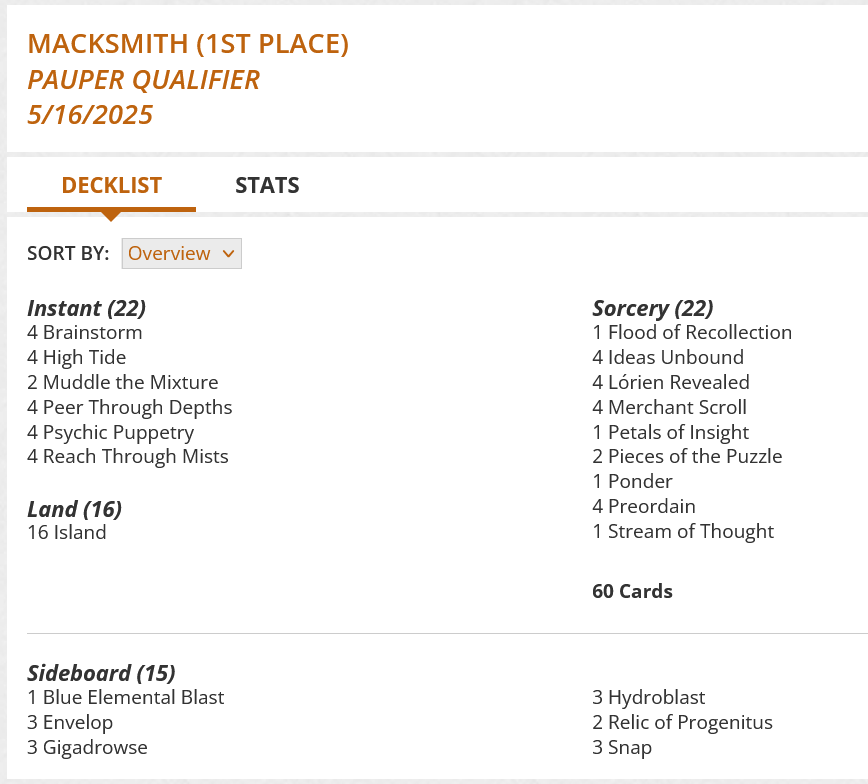
High Tide, as a deck, has caused more hand wringing. Combo, when it has been good in Pauper, has typically found itself over the line. Storm and Broodscale decks are two examples of combo builds that pushed other strategies out of the competitive sphere. High Tide, being a spell based combo, shares some issues with both. It can be difficult to interact with on the combo turn and given the make up of the deck it can “win from hand”. Unlike many other Pauper combo decks, High Tide does not rely on the graveyard or creatures, further insulating it from counter-play. However the deck has merely been fine. In the first four weeks, High Tide was 3.98% of the total Top 32 metagame and dropped to 3.35% of the Winner’s Meta with an aMSAR score of 0.00 (this is roughly equivalent to averaging a Top 16 finish). The past four weeks have been kinder to the Islands, with 3.75% of the Top 32 metagame, 5.57% of the Winner’s Meta and an aMSAR of 0.57. It should be noted that this boost may be related to the 8-0, 3-0 run by MackSmith with the deck in the May 16 Pauper Qualifier. Taken together High Tide is in a similar spot to Tron – a strong option but currently not a dominant force.
In my opinion, High Tide has actually been good for Pauper overall. As a spell based combo deck that avoids leaning on the graveyard, High Tide has opened up paths for other combo decks to succeed. While not nearly at the same level, Spy Combo, Dredge, and WonderWalls have seen some recent success and that doesn’t include the resurfacing of old friends Goblin Combo and Inside Out Combo. High Tide has attracted the attention of players which in turn has impacted the amount of hate for these other decks. While not a direct cause, the strength of High Tide may be related to the open lanes for other combo decks to reach the winner’s circle.
So where does that leave Pauper going into this weekend? Overall it is in a good spot. Ideally you want a deck that has access to some number of sweepers to handle both Elves and RDW and at the same time you need access to disruptive elements. Grixis Affinity is also a factor even if it is currently trending down. If I had to pick one card to highlight it would be Pilfer. A solid backup to Duress, Pilfer is a relatively recent addition from Foundations that can nip problematic cards in the bud. The issue, of course, is figuring out the best shell and while Mono Black Control has put up a few results I think finding a second (or third) color could prove beneficial to the strategy.
Power Rankings
10. Bogles
9. WonderWalls
8. Flicker Tron
7. Rakos Madness
6. Jund Wildfire
5. High Tide
4. Grixis Affinity
3. Elves
2. RDW
1. Blue Terror
I want to take a moment to thank all my Patrons. I am going to do my level best to keep providing you with the kind of content that brought you here in the first place. If you are interested in supporting my work, you can sign up for my Patreon starting at just $1.
Can’t make a commitment to Patreon? I have a Ko-Fi where you can make a one time contribution.
 NerdtotheCore
One thought on “Catching Up on Dragonstorm”