
Want to learn more about the metrics I use in tracking the metagame? You can find an explainer here.
A new season is upon us with the release of Tarkir Dragonstorm. Due to the recent additions to (and subtractions from) the Banned List the format was primed to undergo a pretty significant shift. Despite this today’s Pauper bears more than a passing resemblance to the format from a month ago aside from the absence of Broodscale Combo and the presence of both High Tide and Control Tron. There’s more, of course, but so much of it is confounded by the available data.
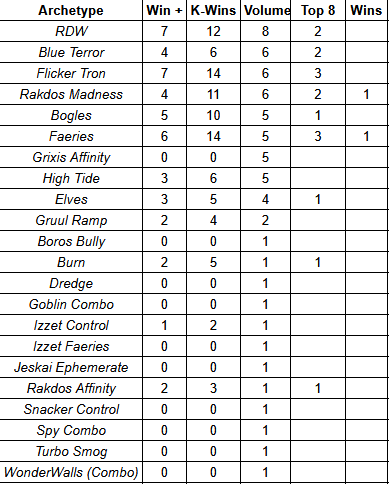
The first weekend of Dragonstorm season saw a disruption on Magic Online which canceled the Sunday Challenge. These things happen. That the issue took place on the first weekend is both a blessing and a curse when it comes to data collection. Relying on too small a sample size to draw conclusions can prove to be a mistake but losing early season data is not a hindrance in understanding a season long story. Why? Put simply in the first weeks of a format people are still figuring things out.
The most popular deck on the weekend was just an update of Kuldotha Red while two of the decks tied for the second most appearances were known quantities from last season and are proactive. The final deck in a three-way tie for the silver was Flicker Tron – a deck with a known pedigree that had one of its biggest enablers reintroduced to the format. Given what I know about Pauper the decks we saw last weekend are likely to persist but their raw volume is likely to shift.
Pauper moves slowly – it always has. However one thing that always tends to happen is that in the earliest stages of a new format – whether due to the removal or addition of high impact cards – is that decks with a clear gameplan rise to the top in the early goings. Red decks, Bogles, decks that present a clear and concise threat perform well as decks have to adjust their answer suite to the new normal.
Let’s take a case study with Kuldotha Rebirth. This card, in concert with other factors, made one-for-one removal risky despite that style of card’s relative strength against Broodscale combo (to say nothing of the rest of the format). Now that Kuldotha Rebirth has been banned many red decks are pivoting back towards builds where singular creatures (such as Kessig Flamebreather) are more important. It should follow that cards like Doom Blade and Skred would go up in value.
Except for the ascendancy of both Tron and High Tide. These decks are largely inoculated against creature removal because they were constructed in such a way to lack that vulnerability. This tension will likely remain for the foreseeable future which puts into context the deck that led the way in Adjusted Meta Score Above Replacement.
Faeries had arguably the best weekend. A 60% conversion rate from Top 32 to Top 8 and a win all lead to a weekend leading AMSAR of 1.51. Faeries might not provide the quickest clock but it can put the opponent on the back foot. What it lacks in offense it makes up for in broad answers. Counters might not be the best in every application but they do have play against nearly everything. It follows then that Faeries could both stymie certain aggro strategies while having game against decks that eschew creatures. Again, none of this is new but it can be important to spell it out so we understand the field of battle.
What does all of this mean for next week? I would expect a lot of the same decks to show up but given the recent league results I would hedge more against Tron and red decks. These builds have been fairly present and operate at two extremes of the format. Faeries absolutely remains a strong choice but it is unclear if something could slide in and come at the metagame from another angle.
Can’t make a commitment to Patreon? I have a Ko-Fi where you can make a one time contribution.
Looking for another way to support my work? Click here for my TCGPlayer affiliate link. Any purchases through the link let the folks there know you like my content!
 NerdtotheCore