
Want to learn more about the metrics I use in tracking the metagame? You can find an explainer here.
Oh, hello. I didn’t see you there.
Yeah…so it’s been a while since I’ve posted. March was a lot busier than I anticipated. Between my child’s birthday, a professional conference, and my tenth wedding anniversary I was busy. That was all before I found out I was going to need surgery. And then there was the small fact of the bans which had the potential to completely reshape the format. To put it bluntly, my mind was elsewhere. Given the nature of the surgery there’s a chance I may be slow to post in May but my sincere hope is that I am well enough to type out a few words now and then.
So where were we? Oh yeah…the first week of post ban Pauper…which is also the last week of Aetherdrift season. A historical footnote in that this format will only exist for a brief period of time before Tarkir Dragonstorm hits the scene. While there is no guarantee things will change with the next release I still isolated the results from the first weekend of April.
Why separate results by release cycle? Technically speaking each set of cards entering Pauper generates a new format. It is not that the rules change but rather the available interactions between the game pieces can be altered. While these shifts are often minor in nature they still exist and over time small shifts can push towards upheaval. In order to examine the format through this lens I have found that partitioning by set release (read: card legality shifts) to be helpful in understanding trends.
But what to do about this vestigial week? Only two cards have been added to the format while three removed, all before a new set which has some interesting tools at the ready. Completely ignoring the results serve no one as they could provide the baseline for what is to come. At the same point putting too much stock in these numbers may lead you down the wrong path for multiple reasons. Not only will next week’s format feature new cards but also this is week one after a massive shift. The banning of Basking Broodscale, Deadly Dispute, and Kuldotha Rebirth and the return of High Tide and Prophetic Prism altered the rules of engagement. The builds we are seeing may not be optimized and as the format continues to evolve we are likely to see some pretty significant changes in the way decks are constructed.
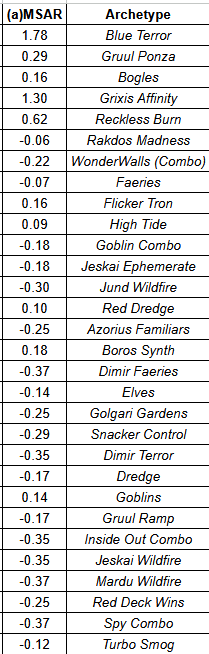
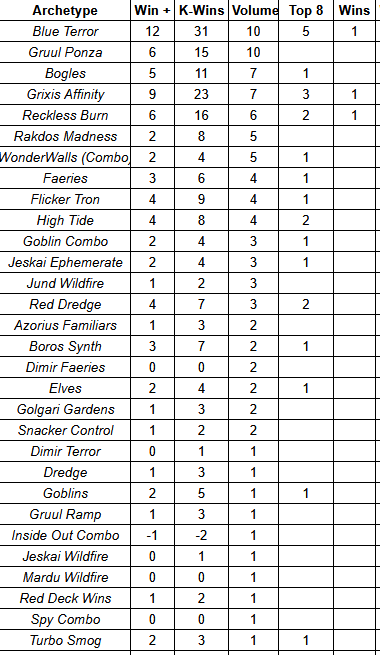
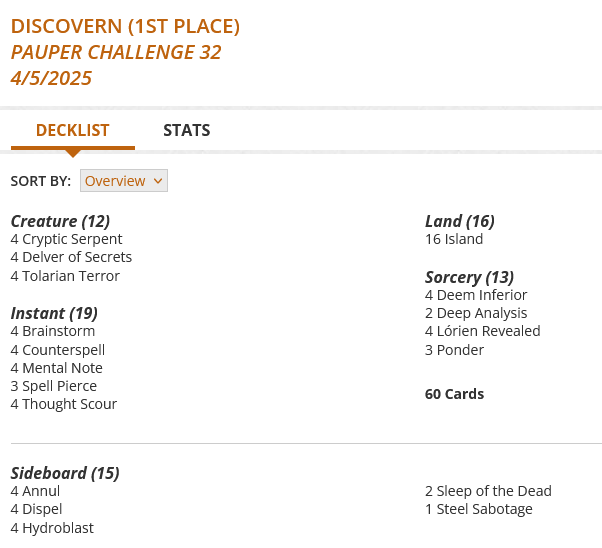
What, then, do the results say? The top two decks last weekend were Blue Terror and Grixis Affinity and this tells us two not entirely dissimilar stories. The performance of Blue Terror can be in part due to the unsettled nature of the new format. The dominant aggressive strategy has been taken down a notch which can give slightly slower decks a boost. In an open field the ability to present a threat and back it up with Counterspell would always be strong. When the deck also has the potential to stymie a new combo and win before the control deck can establish a foothold that’s a recipe for success. Blue Terror is not likely to be as strong moving forward but it put up solid results in this intercalary week.
Grixis Affinity, on the other hand, is just a good deck. Yes, it lost a step with the banning of Deadly Dispute but the core engine still exists. In an open field playing a known deck full of good cards is hardly a bad idea, especially as people figure things out. I am not sure how strong Affinity will be moving into Tarkir Dragonstorm season as builds evolve and configurations are cemented but I do not believe the Machine is going to fade into obscurity.
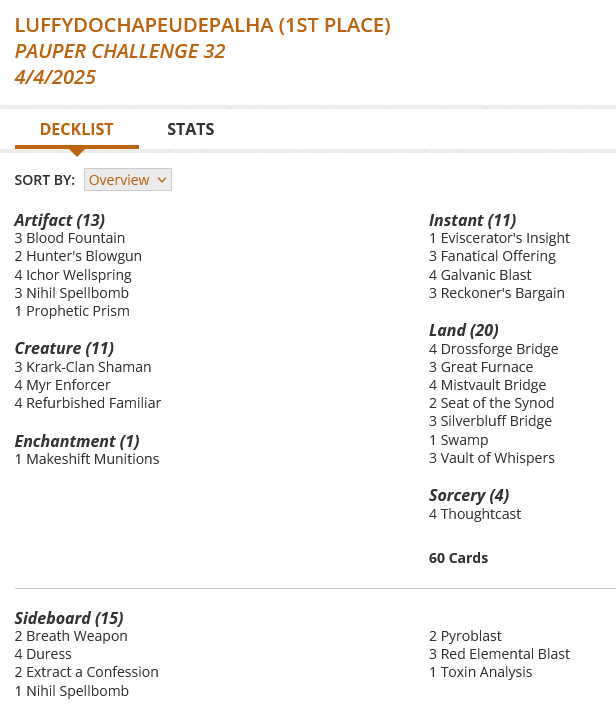
Blue Terror and Grixis Affinity were smart choices for an open field when two of the expected emergent decks were spell based combo and long game control. Both have access to disruption and the ability to apply pressure. Terror has better stack interaction while Affinity can do more to grind out games against Tron thanks to Makeshift Munitions. One reason I am unsure about these strategies’ positions moving forward is due in part to the uncertainty around High Tide and Tron.
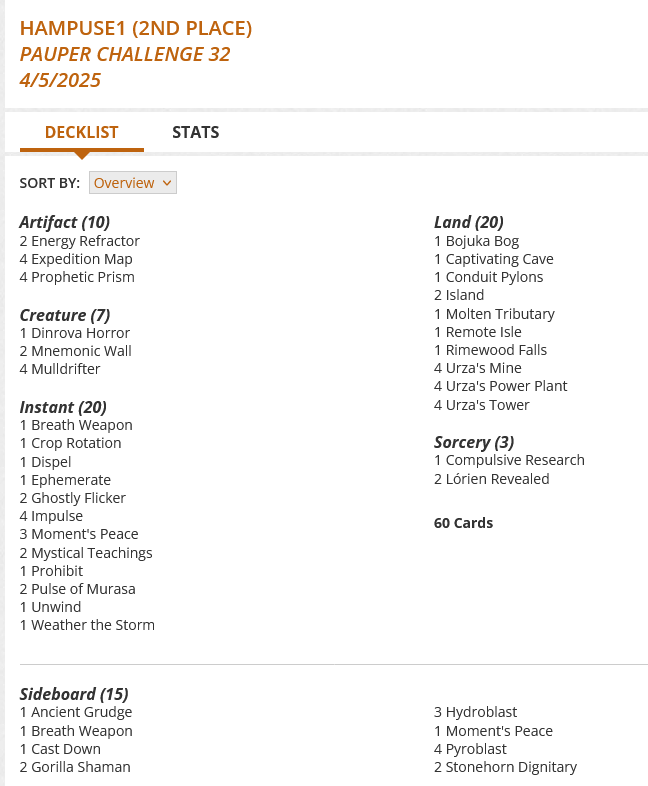
If your knowledge of the Pauper metagame came exclusively from discourse circles you would assume that these two decks dominated the weekend. High Tide Combo can win on turn four and can lead to games where one player is taking all the meaningful game actions early. Tron is a beloved archetype that has returned and can lead to games where one player is taking all the meaningful game actions late. Yet despite digital ink spilled in various channels neither of these decks were dominant forces on week one. Rather their specters loom large because of the fear of what they might become. Given historical precedent this feeling is not entirely unfounded. The past can be a decent lodestone for getting your bearings provided the wider environment has not changed. Still, metagames take time to coalesce and trying to prognosticate the future based on a small sample size could be a fool’s errand.
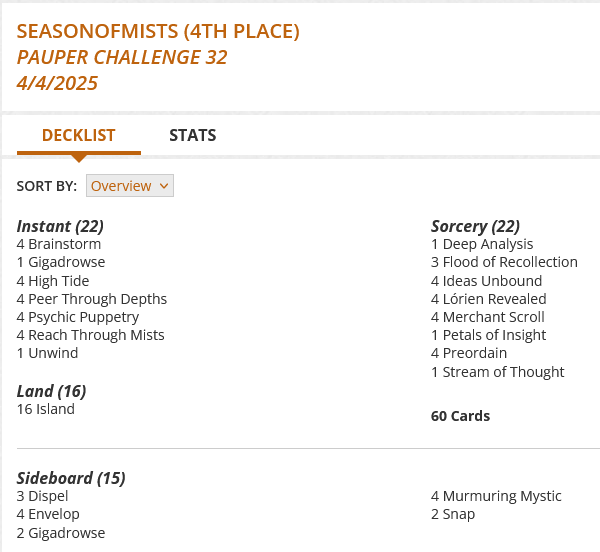
Where does that leave things going into next week? You’re guess is as good as mine but I would not be surprised to see a small surge in Bogles or various combo decks as we move into Tarkir Dragonstorm season.
I want to take a moment to thank all my Patrons. I am going to do my level best to keep providing you with the kind of content that brought you here in the first place. If you are interested in supporting my work, you can sign up for my Patreon starting at just $1.
Can’t make a commitment to Patreon? I have a Ko-Fi where you can make a one time contribution.
Looking for another way to support my work? Click here for my TCGPlayer affiliate link. Any purchases through the link let the folks there know you like my content!
 NerdtotheCore