
Want to learn more about the metrics I use in tracking the metagame? You can find an explainer here.
Aetherdrift has arrived. The first weekend of Magic Online Challenges are in the books. Three tournaments are in the rear view mirror and while nothing is drastically different from Foundations season, we still have a slew of new cards making their presence known.
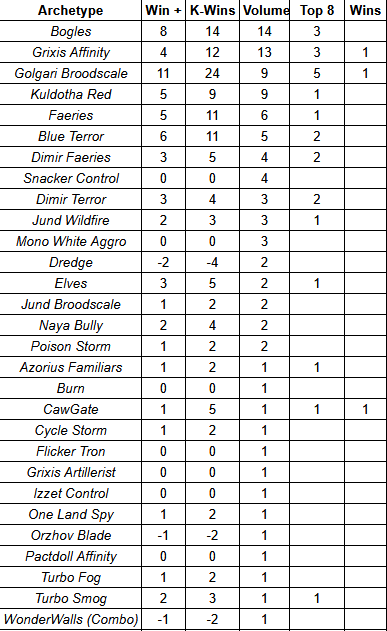
As someone who deals in the data I would not put too much stock in these numbers. Two of the Challenges had multiple 2-4 finishers make it to the Top 32 and the early going numbers have Bogles as the most popular deck. While the slippery bois are hardly a bad choice I do not think they’ll be able to sustain these numbers as the season progresses. Rather we can approach this season much as we did the last one – focusing on the known best decks in the format. If you’re looking to get started in Pauper with the latest release here are some important pieces of knowledge.
The Bridges Connect
The Modern Horizons 2 Bridges are everywhere in the format. These cards help to power up multiple decks and strategies beyond their “natural” home in Affinity. This is due in no small part to the recent trend of printing cards that ask players to sacrifice a creature or an artifact. The result is that several decks in Pauper are built to fully leverage these lands. The most obvious of these decks is Affinity which uses the Bridges to vomit out threats while keeping the cards flowing with Deadly Dispute and Thoughtcast. Affinity never seems to run out of cards due to how many different ways it has to convert otherwise dead material into fresh cards. Many builds these days also have additional reach in the form of Makeshift Munitions which is happy to gobble up all those extra lands – both Bridges and the Mirrodin originals – to deal the final few (or final dozen) points of damage.
Many of these elements are repeated in various black midrange builds. Deadly Dispute has asserted itself as Pauper’s premier card advantage engine thanks to all the material available to grist the mill. While not every Dispute deck runs Bridges plenty do, including the ascendant Jund Wildfire. Cleansing Wildfire on a Bridge provides card neutral acceleration, making it easy for Jund to double spell or hold the fort off the back of Writhing Chrysalis. Both Affinity and Jund Wildfire have powerful end games so when you see a Bridge hit the battlefield you should be of the mindset of trying to end the game before they can set up their defenses.
Gotta Go Fast
Kuldotha Red remains the clock of the format. It is low to the ground and has nearly unmatched damage output. The recent advent of red card advantage has given Kuldotha the ability to keep pace in the mid game as well. Just as decks must be prepared for what the Bridges have in store for the long game they must be able to contend with lightning quick starts backed up by copies of Galvanic Blast and Lightning Bolt. Some of the pure defensive decks – the Moment’s Peace variants – have taken to running Campfire to give themselves a chance against the rest of the format once they manage to weather red’s starts.
Scaling the Walls
So what does that mean for the middle stages of the game? It should be anyone’s game but the reality is that portion is dominated by Broodscale Combo. Slapping a Sadistic Glee on a Basking Broodscale gives you unbound colorless mana. Once achieved it is possible to dig for a win with Eviscerator’s Insight until Nadier’s Nightblade is found and then it’s all over but the crying. The latest Pauper version of a Splinter Twin situation, Broodscale Combo cemented itself as a real threat in the last season. It can win as early as turn four but has no problem waiting to assemble a protected victory. Racing is possible but risky and while you can technically use removal to break up the combo Broodscale has countermeasures. The deck is not invulnerable but understanding how you are going to approach the matchup is going to matter quite a bit in the coming weeks.
Just Say No
And then there’s Counterspell and Spellstutter Sprite. These cards have not gone anywhere and are to be played around, Sequencing your spells in blue matchups is important and trying to get a read on what their interaction may be – whether it’s Spell Pierce, Dispel, or something else – can go long way in sneaking through threats. Of course that only matters if you’re up against a mono blue version, as multicolor builds can simply pick off creatures that manage to resolve.
Where does that leave Pauper? Honestly, in much the same place it has been for much of its recent history. The only new wrinkle is Broodscale combo and even it falters to removal – a common refrain in Pauper. For the foreseeable future these are the fights at your doorstep and the only question that remains is are you ready to battle?
I want to take a moment to thank all my Patrons. I am going to do my level best to keep providing you with the kind of content that brought you here in the first place. If you are interested in supporting my work, you can sign up for my Patreon starting at just $1.
Can’t make a commitment to Patreon? I have a Ko-Fi where you can make a one time contribution.
Looking for another way to support my work? Click here for my TCGPlayer affiliate link. Any purchases through the link let the folks there know you like my content!
 NerdtotheCore