
Want to learn more about the metrics I use in tracking the metagame? You can find an explainer here.
How important is stability in a non-rotating format? This is a question I ask myself often these days as I examine the Pauper metagame on a week-to-week basis. I know I am not the only one who pores over the latest published decklists, looking for something new or exciting, only to be met with the same groupings of cards time and time again. But my personal disappointment is not a determining factor in the overall health of the Pauper format.
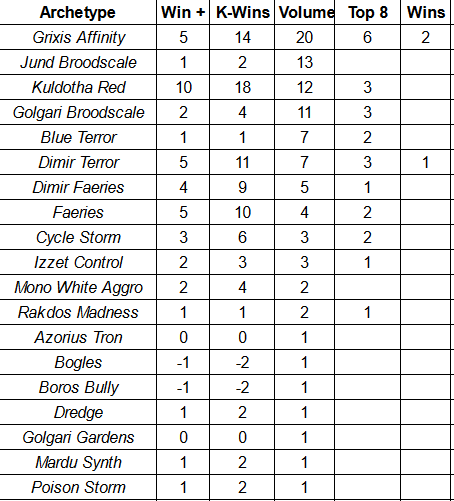
The three Challenges that took place from November 29 to December 1 were small, even by recent standards. In two of the events, players with 1-5 records made the Top 32. This is not giving me pause as late November into December usually heralds a dip in participation thanks to the American Thanksgiving holiday leading right into the Winter Holiday season. The smaller field helped to highlight the concentration at the top of the metagame, with four macro-archetypes (Grixis Affinity, Kuldotha Red, and Golgari/Jund Broodscale) combined to hold more than 58% of the Top 32 metagame and 50% of all Top 8 slots awarded (although Jund Broodscale did not contribute to this latter achievement). Kuldotha Red ended up having the best weekend, ending Sunday with a 19.16% of the Winner’s Metagame (compared to 12.5% of the overall Top 32) and an Adjusted Meta Score Above Replacement of 0.89. While Affinity had the second most impressive Winner’s Meta Share (16.4%), this represented about a 4% decline from it’s Top 32 share.
By my measure, the second best performing deck on the weekend was Faeries. Straight up Mono Blue Faeries. With an AMSAR score of 0.7, it improved upon its 4.17% Top 32 meta share by over 5% to close Sunday with 9.28% of the Winner’s Metagame. Faeries is the deck that just will not go away, and with good reason. Faeries might never reclaim the status of “Best Deck in Pauper” but it is always going to have game by virtue of being an aggressive Counterspell shell. Faeries can apply damage, draw cards, and keep the opponent off balance. Unlike Blue Terror the deck also does not have to spin its wheels just to resolve a threat. Yes, Tolarian Terror might end games quickly once it arrives but by that point Faeries may have already dealt five damage and seen three extra cards.
Faeries is a stable choice in Pauper. It is a deck that has a great chance of being competitive in a given environment, provided a skilled pilot and proper deck construction. We have seen this phenomena repeat with decks such as Elves (which has undergone a significant makeover in the past six months) and Bogles (which has had less work done -but still some – over the same span of time). Stability in a format means solid choices only lose some of their expected value over time and can reward experts that understand the nuances of different matchups. While it may be boring for people preoccupied with content and dynamism (and I count myself in this camp), having a known suite of threats and predators in a given pool means that plans can be made specifically to combat said threats and predators.
Stability in non-rotating formats is good because it helps to set the rules of engagement for tournament play.
At the same time stability can go too far. When things are too stagnant than the cycle becomes routine. For competitive endeavors this is not the worst thing but when that same exercise is supposed to provide enjoyment then perhaps a problem can arise. One could make the cast that Pauper has crossed this line with Grixis Affinity and Kuldotha Red remaining the two best decks for the better part of two years. Granted these decks are not at the apex of the power experienced at their heights, but they still are at the top of the metagame.
That being the case there is a significant amount of churn at bronze and beyond. The various Basking Broodscale combo decks have emerged as real contenders while Tolarian Terror decks remain strong choices. As mentioned, Faeries decks (both mono blue and Dimir) have been putting up strong results recently and Elves has emerged as a relevant archetype once again. Gruul Ramp was ascendant for some time before regressing to the mean. Rakdos Madness was a surprise contender, almost disappeared, and then reemerged. And this list does not include various Basilisk Gate decks as well as Mono White Aggro. There exists a large variety of viable things to do.
All of this is to say that despite the fact the top of the metagame looks largely unchanged from a macroarchetype perspective, the format is far from static. While it may be disheartening to see different iterations of Deadly Dispute package showing up time and time again, that the cards can express themselves in different strategies is far from a Bad Thing. Rather it provides the foundation for potential future decks to pull from previous successes as a way to break through and spike a result.
What does this mean for next week? The same as the weeks before – have a plan for Affinity and Red. Protect your life total while also being able to disrupt a long game in some capacity. Interaction for Broodscale is key but comes in multiple stripes so figure out what works best for your strategy. And don’t forget to figure out how you’re going to handle an army of 5/5 monsters breathing down your neck.
I want to take a moment to thank all my Patrons. I am going to do my level best to keep providing you with the kind of content that brought you here in the first place. If you are interested in supporting my work, you can sign up for my Patreon starting at just $1.
Can’t make a commitment to Patreon? I have a Ko-Fi where you can make a one time contribution.
Looking for another way to support my work? Click here for my TCGPlayer affiliate link. Any purchases through the link let the folks there know you like my content!
 NerdtotheCore