
Want to learn more about the metrics I use in tracking the metagame? You can find an explainer here.
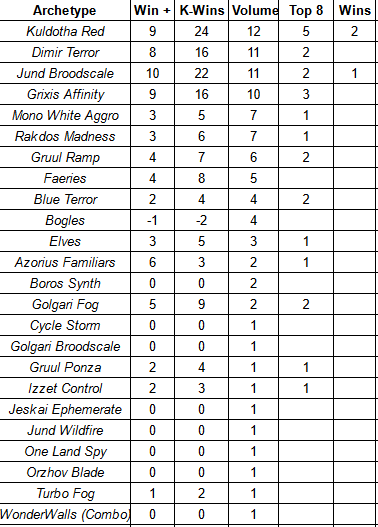
I am not going to bury to lede this week: Kuldotha Red had the best weekend. The assertive strategy had a dozen Top 32 appearances and converted that to five Top 8s and a pair of wins. It had an average finish firmly in the Top 16 and held 14.51% of the winner’s meta share (an increase of 2% over general Top 32 volume). Its Adjusted Meta Score Above Replacement of 1.02 put it about a win clear of the mean Top 32 finish for the weekend.
Why put this above the fold? Because, as discussed elsewhere, Kuldotha Red occupies an outsized portion of the discourse around Pauper. There are datasets where the deck looks fantastic on the surface but under performs (like the weekend of September 27) and then there are tournament sets like last weekend where the deck is just as good as it looks by the numbers. Red is a good deck to be sure but it is hardly a dominant force.
What, then, is the difference between something being dominant and a deck being a part of a healthy metagame? What role does Kuldotha Red serve? Formats need a Clock – that is a deck that puts a limitation on the amount of nonsense in which one can engage. This is neither good nor bad but rather a feature of competitive metagames. Without decks that can establish parameters it can become difficult to craft a strategy that can navigate a tournament. Here we find the crux of the difference between competitive formats and social ones. It is entirely possible to play social Pauper where you concoct a contraption out of commons, yet if that deck cannot operate within the very real parameters of the competitive metagame it exists on a parallel track.
A dominant deck, on the other hand, is one that takes up an outsized portion not only of the metagame as it exists in results but the metagame as it exists as a thought experiment around the format. If the first, last, and only consideration one would have when building a deck and sideboard is a specific meta deck then there may be a problem. Similarly if an interaction or suite of cards starts to create a similar monopoly of thought then perhaps additional investigation might be warranted. Currently I do not believe that Kuldotha Red rises to this level.
Now you might be asking yourself about the Bridges. These cards have earned a level of notoriety. These lands have changed the way other decks have had to approach Affinity while also serving as the backbone for one of the best card draw engines in the format. The Bridges have become part of the landscape of Pauper in a way that they support multiple strategies, often enabling decks that might otherwise struggle. At the same time it is hard to ignore the impact they have had. The question that exists today is whether or not the rest of the format has risen to the power band or remains too far behind to reasonably keep up.
Today I want to look at one list I believe supports the former statement. Golgari Fog is an emergent strategy that blends elements of Golgari Gardens with Turbo Fog to present a deck that can wring out a victory in the long game.

Golgari Fog is a midrange control deck that leans on the Deadly Dispute package to keep cards flowing. It leans into Gates as well to provide a win condition in Basilisk Gate and a steady stream of material through Heap Gate. Campfire (and in this build Stream of Thought) provide additional insurance on the library count and this version continues the innovation of including the Broodscale Combo in the sideboard for a juke. In my opinion the relatively strong positioning of this deck indicates a healthy metagame.
Golgari Fog is constructed with two different poles in mind. It wants to survive the early game onslaught of small creatures and does so with various Fog effects. It also is prepared for decks that want to drag the game out with copies of Campfire to recycle its resources – and exhaust those of the opponent – in something that feels extremely Golgari. The deck is evocative of the control decks of yore with scant few actual win conditions – we’re talking a single Basilisk Gate here – and simply wants to grind your opponent’s will to keep playing into dust.
Looking ahead to next week I would come prepared to Kuldotha Red first but Jund Broodscale is not that far behind. Dimir Terror also had a solid showing so having a reliable way to wipe the board early feels paramount, but you need to survive against those 5/5s in the midgame. If I were looking to go off script I’d be trying to find a way to make Swirling Sandstorm work but I would also keep my eye on Battlefield Scrounger, especially if I was set on playing something Golgari.
I want to take a moment to thank all my Patrons. I am going to do my level best to keep providing you with the kind of content that brought you here in the first place. If you are interested in supporting my work, you can sign up for my Patreon starting at just $1.
Can’t make a commitment to Patreon? I have a Ko-Fi where you can make a one time contribution.
Looking for another way to support my work? Click here for my TCGPlayer affiliate link. Any purchases through the link let the folks there know you like my content!
 NerdtotheCore