
Want to learn more about the metrics I use in tracking the metagame? You can find an explainer here.
Just in time for October (also known as Spooky Season for some reason), Pauper has entered its Duskmourn era. The first weekend of Magic Online Challenges proved to be scary for a number of reasons, not the least of which were the paltry number of participants in the Friday and Saturday tournaments. Barely breaking the threshold to launch, the first two Challenges in the latest cycle have confounded the data set just a bit. All told, 22 of the 96 Top 32 competitors (let me tell you how painful it is to write a sentence with so many sequential numbers) had losing records.
What does this mean? Largely that we cannot infer too much from the first dataset presented. Including the losing records does provide some insight, especially for popular decks that falter in that we can have a better idea of what happens outside a traditional winner’s metagame. If, for example, Grixis Affinity has a ton of decks in the Top 8 but also plenty of people piloting the strategy to 2-4 records we can’t draw any conclusions but it could mean that perhaps the deck is not the behemoth those Top 8s make it out to be.
We’re not going to be talking about Grixis today, however. Instead we are going to be talking about Kuldotha Red. The latest iteration of the red deck took down twenty Top 32 slots last weekend, good enough for 20.83% of the field. Eight Top 8 finishes and a win made it so Kuldotha finished with the second best overall performance at the end of Sunday. It did this with an average finish well outside the Top 16 and with an Adjusted Meta Score Above Replacement of 0.35.
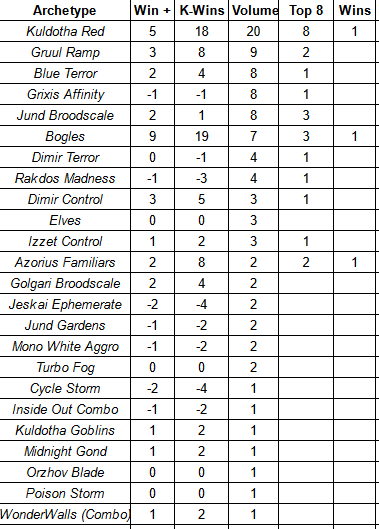
We also aren’t going to be talking about the best deck on the weekend. Bogles had three Top 8 appearances, and a win, in seven total trips to the Top 32. It had an average finish in the Top 8 and vastly improved on its raw Top 32 volume (7.29%) in winner’s meta share (26.78%) with a healthy adjusted meta score above replacement of 1.43.
So why are we talking about Kuldotha Red? Because this deck often becomes the center of attention early in a set’s cycle when it puts up some unhealthy looking rates of play. In a way we will be talking about Red, but also Bogles and Grixis. What we are we talking about, however, is interpreting small sets of information.
Bear in mind I am not a statistician. My background in analyzing data comes from the world of social sciences. In my day job I help to run the assessment initiatives for my department where we try to identify different areas of growth, learning, and participation in a college aged population. A tad different than Magic all told.
Kuldotha Red is an assertive strategy. It wants to play to the board early and press its advantage with small creatures. It can end the game with a massive attack or a furry of burn spells. Relatively recently (historically speaking), the deck has also gained access to solid card flow options, giving it the opportunity to keep pace in the middle stages of a game. The strategy has been hit by one ban – Monastery Swiftspear – and while not as potent as prior iterations, Kuldotha Red remains a top choice in Pauper.
It is also, in a way, metagame agnostic. While the specific inclusions at the fringes may change, the core of the deck is largely static. More than that, it does not have to adapt as much to the an otherwise changing field. Put another way, you do not always need to tech out Kuldotha Red in order for it to succeed as it is inherently powerful, albeit susceptible to the whims of the metagame. The ability to simply overrun your opponent before they can establish themselves is powerful and Kuldotha Red is quite good at that.
Whenever a new set enters Pauper (or any format really) had to adjust. Often times this means testing out new pieces for more intricate builds and trying to gauge what is going to happen in the wider metagame. Put another way people are trying out the latest cards. While things are still being defined, Kuldotha Red is a great choice in that it can, as mentioned, just win. For players who are grinding Leagues day after day Kuldotha Red also affords them the opportunity to learn the most in the shortest amount of time. The number of games you can play with Red likely outpaces nearly every other deck, all while giving a good rate of return on the investment of Play Points and time.
Early on, therefore, it follows that Red is going to be overrepresented. It is largely insulated from micro shifts in the metagame, wins quickly, and has an established pedigree. As time marches on the deck may get less popular (it is difficult to ascertain this with any confidence as we do not have the lists for every deck in the League) or the metagame adapts. It can still put up numbers but other decks are able to keep pace or surpass it in the results column.
How, then, can it be determined if Kuldotha Red is problematic? This decision cannot be made in the short term, regardless of how much the deck surges in the early part of a season. The early leagues for Bloomburrow had a strong showing of Kuldotha Red, with the deck hovering around 20% of the early League 5-0 lists. The same strategy had two weekends where it was the most popular Top 32 deck in the Challenges and another pair of weekends where it was second most popular (this includes a weekend where it was tied for second most popular). Over the eight weeks of Bloomburrow the deck did not hold true to that early surge and settled into a healthy spot – outside the very best decks in the metagame but still a solid contender. For those wondering, it held a seasonal adjusted meta score above replacement of 0.51 (about half a win better than the mean Top 32 deck) and had the eighth best average Swiss performance of all decks with at least 2% of the Top 32 metagame (16 appearances).
A decision cannot be made based entirely on early results nor can it wait for absolute certainty. Red has a short leash due to its pedigree but for now it simply seems to be a smart choice in a developing metagame. Sideboard accordingly.
I want to take a moment to thank all my Patrons. I am going to do my level best to keep providing you with the kind of content that brought you here in the first place. If you are interested in supporting my work, you can sign up for my Patreon starting at just $1.
Can’t make a commitment to Patreon? I have a Ko-Fi where you can make a one time contribution.
Looking for another way to support my work? Click here for my TCGPlayer affiliate link. Any purchases through the link let the folks there know you like my content!
 NerdtotheCore
One thought on “September 27-29 Pauper Weekend Recap”