
Want to learn more about the metrics I use in tracking the metagame? You can find an explainer here.
As Bloomburrow season starts to wind down the threads that have woven their way through Pauper since Modern Horizons 3 are starting a new pattern. The ascendancy of Gruul Ramp and Basking Broodscale strategies were a jolt to the Pauper metagame and for a while seemed poised to turn the format on its ear. The past few weeks saw a rise in decks that looked far more familiar in Faeries and other blue based control and tempo strategies. Given this I anticipated a rise in Kor Skyfisher decks that have traditionally done well in the face of Spellstutter Sprite and Counterspell. And, reader, I was very wrong.
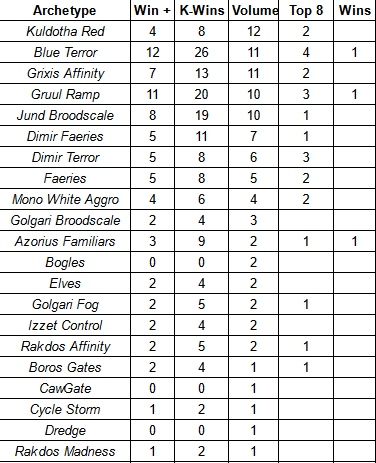
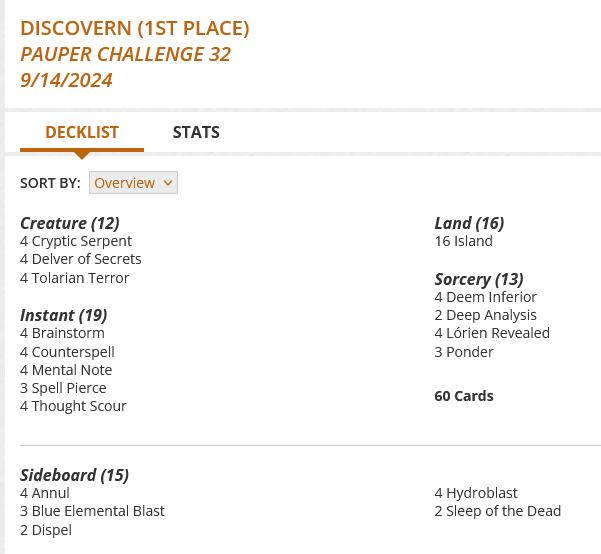
Blue Terror didn’t just continue to have a strong showing – it dominated the weekend. On raw stats the deck outperformed its rate. At 11.46% of the Top 32 metagame, Blue Terror took down 14.43% of the Winner’s Metagame and had the best Adjusted Meta Score Above Replacement of 3.24. The strategy did not only lead the way in Top 8 appearances but when taken on balance it performed significantly better than the average Top 32 deck. This pushes Blue Terror to the top of the format over the past three weeks with an aMSAR over that span of 1.12, beating Grixis Affinity’s score of 0.77.
Rather than dive deeper into this little wrinkle, especially with a suite of new options entering in the coming weeks with Duskmourn, I instead wanted to dive into another metric I utilize when looking at the competitive metagame: Expected Top 8. Hold on because this is a stat I don’t bring up often but can provide another bit of insight into Pauper.
Top 8 finishes are one way to understand how well a given archetype is performing. While a single Top 8 finish does not mean much in the grand scheme of things, a deck consistently making it to the Top 8 can represent something that can sustain success. Over a long enough time period, however, decks are going to miss out on Top 8 due to things like tiebreakers. This is one reason why many larger tournaments have breakdowns that get into the weeds of the Top 16.
Expected Top 8 is a metric that has been part of my analysis for quite some time, even if I do not lean on it much anymore. The underlying theory of it is that it there is an average distribution of records for the Top 8 that clusters around X-1 with an occasional X-2 and undefeated record. Using this average we could therefore estimate how often a deck should make Top 8 based on its Swiss performance. Extrapolating from this we can also see where decks are outperforming expectations, albeit in only a small aspect of the metagame.
For the next portion I am going to use the Challenge data set starting August 2 and concluding August 25. This includes 12 Challenges and therefore 96 Top 8 finishes. The relevant portion of this chart is coded in green.

Let’s start with Grixis Affinity. The second post popular archetype over the timespan the deck put up an impressive 18 Top 8 finishes (including two wins). Given it’s Swiss Performance as indicated by Win+ (and the Win+: Volume ratio) it had a mean finish within the Top 16. Given this performance it could be expected that Grixis Affinity would Top 8 roughly one out of every top 32 appearances, good for 15 total Top 8s. In other words Grixis Affinity outperformed its expectations to the tune of three finishes in the Top 8.
Compare this to Gruul Ramp – the most popular archetype over the same span (by a single Top 32 finish). Ten Top 8 finishes (with a win) put it behind Grixis in the end of event accolades. It also had a worse Win+:Volume ratio which puts its mean finish outside the Top 16. Even so given its results it was reasonable to expect the deck to have a dozen Top 8 placements. It missed this mark by two whole finishes.
Now not that this is predictive, but Grixis Affinity has continued to sustain success in the back half of Bloomburrow season while Gruul Ramp has fallen off some. And if we want to talk about trends, Blue Terror outperformed its actual Top 8 finishes by almost a full showing in the elimination rounds and is currently putting up results at a similar clip.
Leaning on this metric to make predictions for next week the decks I would expect to see tick up in success include Dimir Terror and Mono White Aggro. Of course using only one measure to try and understand the metagame only gives you part of the story. The addition of net wins less net losses (K-Score in my charts) provides yet another way to explore the format. For example, these two archetypes both had a negative aMSAR, meaning they performed worse than an average Top 32 deck. Put another way, I’m putting down my prognosticator hat for a week.
Did you like this look behind the curtain? Let me know if you want me to do more look ins on various statistical measures over the course of a season.
I want to take a moment to thank all my Patrons. I am going to do my level best to keep providing you with the kind of content that brought you here in the first place. If you are interested in supporting my work, rewards for my Patreon start at just $1.
Can’t make a commitment to Patreon? I have a Ko-Fi where you can make a one time contribution.
Looking for another way to support my work? Click here for my TCGPlayer affiliate link. Any purchases through the link let the folks there know you like my content!
 NerdtotheCore